





Event Description
Event Type: Recurrent Flash Floods and Tropical Cyclone Monsoon Exacerbation
Event Dates: October 19-20, 2017; October 18-21, 2022; July 8, 2023
Location: Sitiarjo Village, Sumbermanjing Wetan, Malang Regency, East Java, Indonesia
Geographic Coordinates: 8°26′23″S, 112°39′40″E
Response Type: Emergency Medical Team (EMT) Type-1 Deployment
Introduction
Indonesia is one of the most disaster-prone countries in the world, due to its geographical location along the Pacific Ring of Fire and its tropical climate. The nation frequently experiences a wide range of natural disasters, including earthquakes, volcanic eruptions, tsunamis, floods, and landslides. 1 These disasters not only cause significant loss of life and property, but they also place an immense burden on the national health system and Emergency Medical Services. Reference Chimed-Ochir, Yumiya and Taji2 Effective disaster management and coordination of medical response are critical to minimizing the impact of such events. Reference Shackelford, Remley and Keenan3
Flooding is a recurring disaster in Indonesia, particularly in coastal and lowland regions. Sitiarjo Village, Sumbermanjing Wetan, Malang Regency, Indonesia, located in the southern coastal area of East Java, is an example of a community that faces annual flooding, often caused by heavy rainfall and overflowing rivers during the monsoon season. Reference Hariyono and Kurniawan4 These floods disrupt livelihoods, damage infrastructure, displace residents, and create significant public health challenges, including outbreaks of waterborne diseases and limited access to medical care. Reference Nengrum5,Reference Fatmah, Purwana and Bisri6 Despite these recurring events, disaster medical response systems in rural settings are often under-resourced and poorly coordinated. Reference Shah, Miller and Mothabbir7
Although the World Health Organization (WHO; Geneva, Switzerland) recommends the use of Emergency Medical Team (EMT) Minimum Data Set (MDS) daily reporting to standardize data collection and improve response coordination during disasters, Indonesia has not systematically implemented this tool in its national or regional disaster response mechanisms. Reference Kubo, Chimed-Ochir and Cossa8 The EMT MDS is a set of standardized data elements collected and reported by EMTs during disaster response. The absence of a standardized medical data reporting system leads to gaps in monitoring, evaluating, and improving EMT performance during disasters. Reference Nakamura, Fukunaga and Nagata9 This disaster report aims to analyze the clinical epidemiology, operational workload timelines, and syndromic evolution captured by the WHO EMT MDS framework during cyclical flood responses in rural Indonesia, focusing on the case of Sitiarjo Village, Sumbermanjing Wetan, Malang Regency, Indonesia. The findings are expected to support evidence-based improvements in disaster medical response policies and practices in the country.
Source
Primary health consultation logs were derived from the archived disaster response registries of the Universitas Brawijaya Emergency Medical Team (UB-EMT; Malang, Indonesia). The duration of health services is determined by flood severity and local government readiness. Health events of 2017 were collected manually based on Japan-Surveillance in Post Extreme Emergencies and Disasters (J-SPEED) EMT daily report and converted to WHO EMT MDS daily reporting system 2019 version. Health events of 2022 and 2023 were collected based on the WHO EMT MDS daily reporting system, 2019 version. The UB-EMT collected demographic and health event-related data on the disaster. A total of 363 consultations were reported during the three EMT deployments (2017, 2022, and 2023) without a single death report. Annual data of the ten most common illnesses in the disaster-free period of 2022 were collected from the Public Health Agency Report of Malang Regency 2023. 10
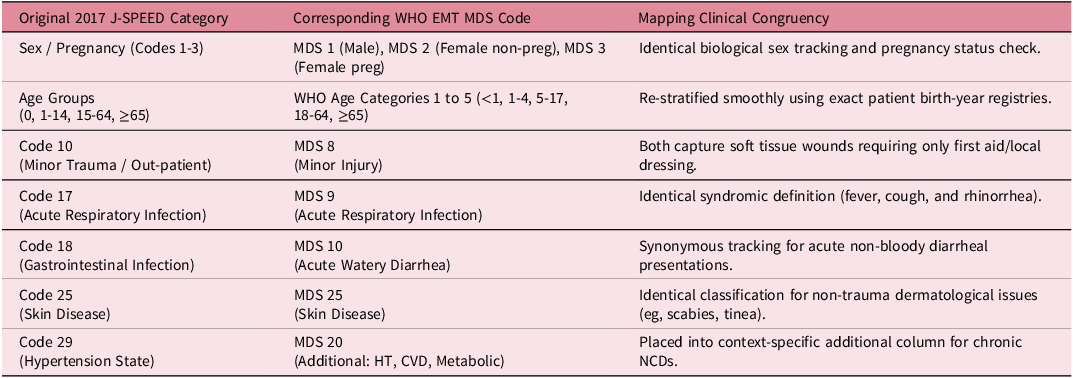
To construct a standardized dataset, a retrospective J-SPEED to WHO EMT MDS Mapping Protocol was executed for the 2017 cohort. This harmonization was methodologically robust because the WHO EMT MDS framework was globally established by the WHO in February 2017 based directly on the syndromic surveillance taxonomy of the J-SPEED system. Reference Kubo11,Reference Kubo12 Variable cross-referencing demonstrated a seamless clinical alignment. Syndromic records from the 2017 logs, specifically acute respiratory complaints, diarrheal episodes, and infective dermatological conditions, were mapped with diagnostic congruency to MDS-9 (Acute Respiratory Infection), MDS-10 (Acute Watery Diarrhea), and MDS-25 (Skin Disease), respectively. The detailed variable-by-variable translation matrix and synchronization are presented in Table 1.
Methodological Mapping Matrix: Conversion of 2017 J-SPEED Variables to WHO EMT MDS Standard

Table 1. Long description
A table with 7 rows and 3 columns. The columns are labeled ‘Original 2017 J-SPEED Category’, ‘Corresponding WHO EMT MDS Code’, and ‘Mapping Clinical Congruency’. The rows are as follows: Row 1: Sex / Pregnancy (Codes 1-3), MDS 1 (Male), MDS 2 (Female non-preg), MDS 3 (Female preg), Identical biological sex tracking and pregnancy status check. Row 2: Age Groups (0, 1-14, 15-64, ≥65), WHO Age Categories 1 to 5 (<1, 1-4, 5-17, 18-64, ≥65), Re-stratified smoothly using exact patient birth-year registries. Row 3: Code 10 (Minor Trauma / Out-patient), MDS 8 (Minor Injury), Both capture soft tissue wounds requiring only first aid/local dressing. Row 4: Code 17 (Acute Respiratory Infection), MDS 9 (Acute Respiratory Infection), Identical syndromic definition (fever, cough, and rhinorrhea). Row 5: Code 18 (Gastrointestinal Infection), MDS 10 (Acute Watery Diarrhea), Synonymous tracking for acute non-bloody diarrheal presentations. Row 6: Code 25 (Skin Disease), MDS 25 (Skin Disease), Identical classification for non-trauma dermatological issues (eg, scabies, tinea). Row 7: Code 29 (Hypertension State), MDS 20 (Additional: HT, CVD, Metabolic), Placed into context-specific additional column for chronic NCDs.
Abbreviations: J-SPEED, Japan-Surveillance in Post Extreme Emergencies and Disasters; WHO, World Health Organization; EMT, Emergency Medical Team; MDS, Minimum Data Set; HT, hypertension; CVD, cardiovascular disease; NCD, non-communicable disease.
To ensure data reliability and eliminate bias for the 2017 cohort, a Structured Clinical Consensus Review via Focus Group Discussion was conducted to audit 38 handwritten medical records. The expert panel consisted of the UB-EMT MDS Manager, who received specialized operational training under the ASEAN ARCH Project directly from the pioneer of the J-SPEED and WHO MDS frameworks, and a senior epidemiologist. Reference Silapunt, Fernando and Catampongan13,Reference Kubo14 This consensus mechanism achieved 100% data fidelity with zero information loss during retrospective mapping. The data were analyzed using Python version 3.12.13 (Python Software Foundation; Wilmington, Delaware USA). Ethical approval was obtained from the Research and Innovation Ethics Commission of Universitas Brawijaya (Malang City, Indonesia; approval number: 501/EC/KEPK/12/2025).
Observations
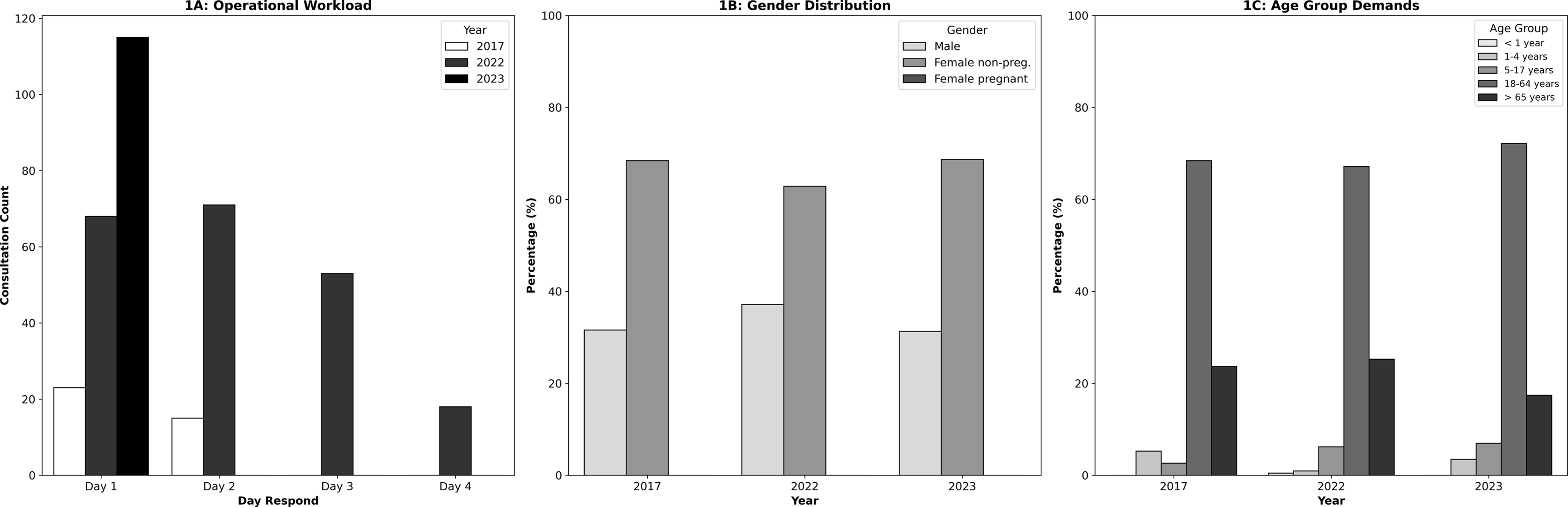
A total of 363 unique patient consultations were officially registered by the UB-EMT across the three flood relief deployments. The UB-EMT operational timeline was strictly governed by the regional Incident Command System (ICS), where activation and demobilization mandates were dictated by the Incident Commander of the Regional Disaster Management Agency to the local field Medical Commander (Head of Sitiarjo Primary Health Center [Sitiarjo, Sumbermanjing Wetan, Malang, Indonesia]). The operational workload demonstrated a heavily front-loaded demand for health care. Patient volumes consistently peaked within the first 24 hours of EMT deployment (Day 1), capturing 56.75% (n = 206) of the cumulative sample, followed by a progressive decline in subsequent operational days as immediate primary care needs stabilized. The exact temporal breakdown of daily patient attendance per deployment year is provided in Table 2.
Temporal Breakdown of UB-EMT Consultations by Deployment Period and Operational Days (N = 363)

Table 2. Long description
A table titled ‘Temporal Breakdown of UB-EMT Consultations by Deployment Period and Operational Days’ with 363 total consultations. The table has four rows and five columns. The columns are labeled ‘Day Response’, ‘2017’, ‘2022’, ‘2023’, and ‘Overall’. The row labels are ‘Day 1’, ‘Day 2’, ‘Day 3’, ‘Day 4’, and ‘Total Consultations’. Row 1: Day 1, 23 (60.5 percent), 68 (32.4 percent), 115 (100.0 percent), 206 (56.7 percent). Row 2: Day 2, 15 (39.5 percent), 71 (33.8 percent), 0 (0.0 percent), 86 (23.7 percent). Row 3: Day 3, 0 (0.0 percent), 53 (25.2 percent), 0 (0.0 percent), 53 (14.6 percent). Row 4: Day 4, 0 (0.0 percent), 18 (8.6 percent), 0 (0.0 percent), 18 (5.0 percent). Row 5: Total Consultations, 38 (10.5 percent), 210 (57.9 percent), 115 (31.7 percent), 363 (100.0 percent).
Abbreviation: UB-EMT, University Brawijaya Emergency Medical Team.
To report the EMT response framework, operational workload timelines and demographic characteristics were aggregated. Daily patient volume trends across each deployment year demonstrated a presentation surge visit on Day 1, with the 2022 tropical cyclone response requiring the most prolonged field presence owing to systemic community isolation (Figure 1A). Female patients accounted for 65.29% (n = 237) of the overall consultations, compared to 34.71% (n = 126) for male patients (Figure 1B). The adult population aged 18-64 years constituted the largest clinical cluster across all years, representing 68.87% (n = 250) of the total sample, followed by geriatric patients aged ≥65 years (22.59%; n = 82; Figure 1C). Pediatric presentations were rare; infants under one year of age (n = 1) and preschoolers aged one-to-four years (n = 8) combined represented less than three percent of the total consultations. Out-patient trauma codes (MDS-4 through MDS-8) were exceptionally low across all operational days, with most patients seeking treatment for nontraumatic medical presentations and infective conditions.
Demographics of Consultations Provided by UB-EMT in Flood-Affected Areas in Sitiarjo Village, Sumbermanjing Wetan, Indonesia, 2017-2023. (1A): Operational Workload Trends Highlighting the Front-Loaded Day 1 Surge; (1B): Gender Distribution Across Deployment Years; and (1C): Age Group Mapped to MDS WHO Categories.

This study categorized health events according to diagnostic groups to facilitate standardized reporting. Figure 2 shows the health events reported by the UB-EMT. A total of 529 health events were recorded from the 363 examined individuals, demonstrating a high prevalence of multi-diagnostic encounters per patient. Longitudinal tracking restricted to the multi-day deployment cohorts (2017 and 2022) revealed a highly specific temporal evolution of disaster-related morbidity (Figure 2A). There was a sharp surge in dermatological diseases (MDS-25; total n = 125 during multi-day responses), which peaked on Day 2 with 59 consultations (47.2%) before decreasing as the floodwaters receded. Conversely, musculoskeletal disorders and localized soft-tissue pain (MDS-19; total n = 82) maintained a high, sustained volume throughout the activation window, peaking late on Day 3 (n = 26; 31.7%).
Clinical Syndromic Matrix and Operational Utility Analysis Tracking: (2A) Evolution of Top Five Clinical Conditions across UB-EMT Responses (restricted to 2017 and 2022 cohorts); (2B) Age-Specific Distribution Profile of Aggregate Health Events; and (2C) Comparative Proportion of Context based on WHO MDS Disaster-Relation Classifications (MDS 44–46).

Figure 2. Long description
Panel A: A line graph shows the temporal syndromic evolution of five clinical conditions over four days. The x-axis represents days, and the y-axis represents consultation counts. The conditions include skin disease, HT/CVD/Metabolic, Myalgia/Pain, Dyspepsia/GERD, and ARI. The graph shows peaks and troughs in consultation counts for each condition over the days. Panel B: A horizontal bar graph displays the demographic distribution of these clinical conditions by age group. The x-axis represents the percentage, and the age groups are Adult (18-64), Geriatric (>65), and Pediatric (0-17). Each condition has a different distribution across these age groups. Panel C: A vertical bar graph compares the proportion of disaster-related health events based on WHO disaster-relation classifications for the years 2017 and 2023. The x-axis represents the disaster year, and the y-axis represents the percentage. The bars are divided into Directly Related, Indirectly Related, and Not Related categories, showing changes in proportions over the years.
Among the active adult demographic, skin infections and pain-related conditions accounted for the most presentations (Figure 2B). Geriatric cohorts exhibit a concentrated demand for chronic non-communicable disease (NCD) management, specifically for severe hypertensive states and metabolic syndromes (MDS-20).
When contextually evaluated under the WHO disaster-related codes (MDS-44 through MDS-46), direct acute trauma was remarkably rare (n = 1; 0.27%), whereas conditions indirectly related to the disaster or entirely unrelated to the event constituted more than 99% of the clinical registries across all response cycles (Figure 2C). Because of the short period of EMTs service, most patients were discharged without medical follow-up (n = 357; 98.35%). Only four patients could be followed up (1.1%), and the other two patients were referred to the hospital. Adults (18-64 years old) dominated the patient population with the ten most common diseases. Preschool and school-age children suffered from infectious diseases such as skin diseases, acute respiratory disease, acute watery diarrhea, and fever.
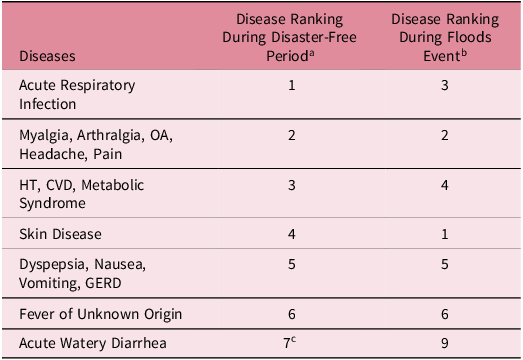
Because there are no official periodic records of illness during flood events, the relevant authorities use the annual data of the ten most common illnesses in the disaster-free period to prepare health aid for refugees. This study demonstrated distinct disease patterns between non-disaster periods and flood events (Table 3). During the disaster-free period, acute respiratory infections were the most prevalent diseases. However, during the flood event, skin disease was the most prevalent disease.
Comparative Matrix of Disease Rankings Between Disaster-Free Baseline and Active Flood Responses

Table 3. Long description
A table comparing disease rankings during disaster-free periods and flood events. The table has three columns: Diseases, Disease Ranking During Disaster-Free Period, and Disease Ranking During Floods Event. It contains seven rows with the following data: Row 1: Acute Respiratory Infection, 1, 3. Row 2: Myalgia, Arthralgia, OA, Headache, Pain, 2, 2. Row 3: HT, CVD, Metabolic Syndrome, 3, 4. Row 4: Skin Disease, 4, 1. Row 5: Dyspepsia, Nausea, Vomiting, GERD, 5, 5. Row 6: Fever of Unknown Origin, 6, 6. Row 7: Acute Watery Diarrhea, 7, 9.
Abbreviations: WHO, World Health Organization; UB-EMT, University Brawijaya Emergency Medical Team; MDS, Minimum Data Set; OA, osteoarthritis; HT, hypertension; CVD, cardiovascular disease; GERD, gastroesophageal reflux disease.
a Data extracted from the annual baseline morbidity database of the Public Health Agency Report of Malang Regency (2023) representing non-disaster periods. 10
b Rankings calculated based on the absolute frequency of clinical diagnoses (N = 529 health events) captured prospectively by the UB-EMT using the WHO MDS framework.
c Rank 7 denotes its position among the seven matched core syndromes; on the comprehensive field manifest, minor injuries and unclassified diagnoses occupied intermediary frequencies.
Analysis
This is the first study to use the WHO EMT MDS daily report in Indonesia. The findings of this study highlight the critical role of EMTs during flood disasters in rural Indonesia, particularly in Sitiarjo Village, Sumbermanjing Wetan, Malang. Due to its location in a lowland, this village suffered floods every year, with a major flood cycle every five years. 15 At least since 1939, this village has been subject to annual flooding. Reference Ridhoi16 However, the community is reluctant to move because they want to stay in their hometowns. In addition, villagers felt that community resilience to natural disasters was better than being in an urban area. This study underscores the critical role of EMTs in supporting vulnerable communities by providing timely and structured medical response during recurrent flood events within the first 72 hours. Reference Delaney, Moussally and Wachira17,Reference Oksuz and Satoglu18 Community resilience must be increased before and after a disaster. Reference Li, Wang, Zhang and Du19
The surge in consultations on Day 1 of the operation indicates an immediate and substantial demand for health services, consistent with patterns seen in other disaster responses where affected populations seek urgent medical care as soon as access is available. In contrast, a study on heavy rain in western Japan showed that in the large-scale disaster, the largest number of visits occurred after Day 4. Reference Chimed-Ochir, Yumiya and Taji2,Reference Nakamura, Fukunaga and Nagata9 The current study showed that the sharp decline in consultations after the first day may suggest that initial health concerns are addressed rapidly or that community access becomes limited due to medical logistic challenges as the disaster progresses. Similar challenges in disaster logistics include shortages of pharmaceuticals and medical equipment, and the physical inaccessibility of health care centers caused by damaged infrastructure. Reference Wang, He and Guo20
This study also reveals important demographic patterns in health service utilization. Women represented the majority of consultations throughout the response period, which is consistent with previous studies that show women often seek medical care not only for themselves, but also as caregivers for family members during disasters. Reference Kubo, Chimed-Ochir and Cossa8 A scoping review focusing on response strategies to promote gender equality during disasters demonstrated that women and girls frequently face disproportionate negative impacts such as sexual and reproductive health and exposure to violence. Reference Steinert, Alacevich, Steele, Hennegan and Yakubovich21 Integrating gender-specific demographic patterns into EMT intervention and resource allocation is crucial for disaster medical response. Reference Shiroma, Chimed-Ochir and Yumiya22
The predominance of adults (18-64 years old) among the patients may reflect their role in evacuation, cleanup, and other physically demanding activities, which may explain the high prevalence of musculoskeletal complaints such as myalgia and joint pain. Reference Chimed-Ochir, Yumiya and Taji2,Reference Niederstrasser and Attridge23 The notable proportion of school-aged and preschool children requiring care, particularly for infectious diseases and fever, may highlight the vulnerability of younger populations to environmental exposure and poor sanitation during floods. Reference Chimed-Ochir, Yumiya and Taji2,Reference Kubo, Chimed-Ochir and Cossa8 A cross-sectional study in southern Ethiopia revealed that acute diarrhea was highly prevalent among children under five years of age after a flooding disaster. Reference Yirdaw, Mekonen, Assaye, Amare and Yenew24
Most conditions treated were indirectly related to the disaster, such as skin diseases, acute respiratory infections, and musculoskeletal pain, which are typical of flood environments where exposure to contaminated water and physical exertion are common. Reference Yirdaw, Mekonen, Assaye, Amare and Yenew24–Reference Chou, Winker, Rebuli, Moran and Rager26 Chronic conditions unrelated to or indirectly exacerbated by the disaster represented a significant portion of consultations as well, emphasizing that disasters disrupt continuity of care for people with pre-existing diseases. Reference Acosta-España, Romero-Alvarez, Luna and Rodriguez-Morales27 The high prevalence of health events indirectly related (MDS-45) or unrelated to the disaster (MDS-46) underscores a crucial operational paradigm shift in rural flood responses. Reference Chimed-Ochir, Yumiya and Taji2,Reference Kubo, Chimed-Ochir and Cossa8,Reference Tsuboi, Sasaki and Park28 In settings like Sitiarjo, where the permanent primary health center does not suffer catastrophic structural damage, the medical command should not default to rapid demobilization based on low acute trauma rates. Reference Del Prete, Valente, Mitiku Saji, Khorram-Manesh and Ragazzoni29 Instead, as demonstrated by the UB-EMT data, the tactical decision to extend deployment must be driven by the volume of indirectly related health events. Reference Kubo, Chimed-Ochir and Cossa8,Reference Iserson30 Unfortunately, the lack of follow-up care and limited referrals in this EMT operation point to a gap in on-going medical management and surveillance. This study underscores the utility of adapting the WHO EMT MDS as a standard practice in disaster medical responses in Indonesia to improve real-time monitoring, resource planning, and post-disaster evaluation. Reference Yeung, Bausch, Cerga Pashoja and Schellenberg31,Reference Oyugi, Tadelle and Gebreyesus32
Author Contributions
Aurick Yudha Nagara: Substantial contributions to the conception and design of the study, data acquisition, data analysis, data interpretation, drafted the manuscript, and gave final approval of the version to be published.
Holipah Holipah: Substantial contributions to the conception and design of the study, data analysis, data curation, critically revised the manuscript for important intellectual content, and gave final approval of the version to be published.
Sri Andarini: Substantial contributions to the conception and design of the study, data analysis, data curation, critically revised the manuscript for important intellectual content, and gave final approval of the version to be published.
Hikmawan Wahyu Sulistomo: Substantial contributions to the conception and design of the study, acquisition of funding, data analysis, data curation, manuscript drafting, and gave final approval of the version to be published. All authors agree to be accountable for all aspects of the work
Competing Interests/Funding
Aurick Yudha Nagara declares that he has no conflicts of interest. Holipah Holipah declares that she has no conflicts of interest. Sri Andarini declares that she has no conflicts of interest. Hikmawan Wahyu Sulistomo declares that he has no conflicts of interest. This study was funded by the Faculty of Medicine, Universitas Brawijaya (grant no. 13942.2/ UN10.F0701/ T/ PJ/ 2025).
Use of AI Technology
Artificial intelligence tools, including ChatGPT (OpenAI; San Francisco, California USA), QuillBot (Learneo, Inc.; Redwood City, California USA), and Grammarly (Superhuman Platform Inc.; San Francisco, California USA), were used solely to assist with English language translation, grammar correction, and stylistic refinement of the manuscript. These tools were not used to generate scientific content, analyze data, interpret results, or make research decisions.



 Open access

