Introduction
Residential care is required by older adults who are unable to remain living in the community independently. The benefits of living in residential care include a community atmosphere with access to staff support and other residents. However, higher levels of social isolation has been suggested among people living in residential care, compared to the community (Grenade and Boldy, Reference Grenade and Boldy2008). Physical conditions which impact mobility, sensory impairment, and lack of confiding relationships may contribute (Morrison and Barnett, Reference Morrison and Barnett2012).
The widely available and relatively low cost internet may have the ability to support social networks (Morrison and Barnett, Reference Morrison and Barnett2012). Facilitating communication and social connectedness have been cited to also improve well-being (Vetere, Reference Vetere2012). Sensory impairment is one barrier to the uptake of internet use by older adults (Rogers and Fisk, Reference Rogers and Fisk2010), but if they can perceive the benefits and there is appropriate training, they can adopt new technology (Rogers et al., 2010). While computers are traditionally used to access the internet, touchscreen technology (TT) such as iPads may be easier to use as it has a relatively large screen which has the ability to increase the font size and icons for improved visibility, and by using an onscreen keyboard is less reliant on dexterity (Upton et al., Reference Upton, Upton, Jones, Jutla and Brooker2011; Vetere, Reference Vetere2012).
The University of Worcester evaluated use of TT in people with dementia. They enjoyed using the TT individually and as a group, and it supported reminiscence and interpersonal interactions (Upton et al., Reference Upton, Upton, Jones, Jutla and Brooker2011).
This study investigated a structured training program on using the internet via TT to residents with psychiatric conditions living in residential care facility. The major hypotheses were that the program would decrease social isolation and improve self-esteem.
Methods
This non-randomized convenience cross-sectional study occurred in an aged care facility located in metropolitan Melbourne, Australia, between February to July 2015. This specialized facility accommodates older adults with a variety of psychiatric conditions such as bipolar disorder and schizophrenia who require low-level support.
Inclusion criteria included:
-
1. A sufficently stable physical state (that is, the absence of a rapidly deteriorating illness or delirium);
-
2. The ability to attend to a task for at least 15 minutes, with assistance;
-
3. Sufficient command of the English language;
-
4. The ability to provide informed consent.
Outcome measures included:
-
1. Rosenberg self-esteem scale (Rosenberg, Reference Rosenberg1965), a ten-item questionnaire with a four-point Likert scale with statements such as “On the whole I am satisfied with myself” and “I certainly feel useless at times.” The scores are summed and higher scores indicate higher self-esteem. Cronbach's α was calculated as 0.606.
-
2. Hawthorne Friendship scale (Hawthorne, Reference Hawthorne2006), a five-item quesitonnaire which asks about friendship and social isolation with a five-point Likert scale for responses. The scores are summed with higher scores indicating greater social isolation. Cronbach's α was low (0.398), but increased to 0.606 when item 5 was deleted.
-
3. Internet/TT questionnaire was specifically designed for the study and asks about familiarity of use, and attitudes toward the internet. A five-point Likert scale is used for responses. Statements include “The internet will be useful for me to communicate,” “my age is a barrier to internet use,” and “being in residential care makes it difficult to use the internet.” Higher scores indicate better attitudes toward internet usage. Cronbach's α was calculated as 0.624.
Ethical approval was given by the local hospital ethics committee. Residents were informed about the study. Those interested in participating notifed their clinician who reviewed their eligibility. They were administered the internet/TT, self-esteem, and friendship questionnaires before and after the 12 sessions.
The sessions
These were facilitated by the occupational therapist (OT) who worked in the unit and another staff member, usually a nurse. We developed a structured six week, twice weekly program of 45 minutes duration based on a local program used for older adults (Internet for Seniors). The duration of 45 minutes was chosen to allow for the possibility of shortened concentration and attention, but flexibility of timing was allowed considering participants’ diagnoses of psychiatric conditions, leading to difficulties with concentration, attention, and mood. Apple iPads were used as the TT.
The sessions were structured and the facilitators adhered to this:
-
1. Week 1 involved navigation around the iPad (on/off, volume, “home button” and use of the “swiping” motion), how to “surf the web” using search engines, and use of basic applications (Google Maps, Skype, camera).
-
2. Week 2 involved practicing the concepts learnt in Week 1.
-
3. Week 3 involved reviewing the previous skills, and emailing was introduced (how to get an email address, how to compose an email, how to send and receive emails).
-
4. Week 4 involved consolidation of previous skills.
-
5. Week 5 participants used the search engines to look up topics which interested them which generated discussion between the residents and the facilitators.
-
6. Week 6 involved the participants presenting on a topic of their choice to the group.
Statistical analysis
The Statistical Package for the Social Sciences (SPSS version 21, IBM Corporation) was used to analyze the data. To compare pre- and post-scores for the measures, repeated measure T tests were used. The significance level was set at p < 0.05.
Results
Five residents, three males and two females were involved. Their mean age was 69.9 years old. Three of them were diagnosed with bipolar affective disorder, one had depression and anxiety, and one had schizophrenia. All five participants attended the 12 sessions which were delivered as planned according to the program timetable.
Examples of the topics of final presentations included a discussion of ancestory, Poland and World War II, and boat voyages.
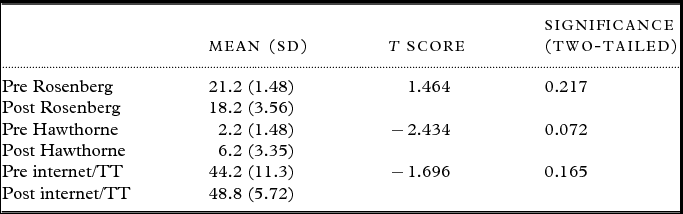
Table 1 shows the statistical analyes for the pre- and post-scores of the questionnaires, and showed no statistical differences in self-esteem, friendship, or in the internet questionnaires. There were no differences in scores between males and females (not shown).
Pre-intervention and post-intervention measures

Rosenberg – Rosenberg Self-esteem scale.
Hawthorne – Hawthorne Friendship scale.
Internet/TT – Internet/TT questionnaire.
Significance level set at p < 0.05.
Participants provided qualitative feedback using open-ended questions on the post-internet questionnaire. They all stated that they had improved confidence using the internet and iPads. Two participants commented that they enjoyed being able to communicate with family members. One stated that the sessions “brought five residents together and enabled us to learn a bit more about one another.”
Discussion
This training program for older adults with psychiatric disorders did not decrease social isolation and improve self-esteem as hypothesized. First, the program was only of six weeks’ duration, only allowing participants to learn how to use TT and the internet, rather than necessarily building social connections, so this may be insufficient time to improve these outcomes, both of which may have been long-standing. A 12-month study by Mellor et al. (Reference Mellor, Firth and Moore2008) also showed no improvement in the older adults’ well-being and suggested that different measures may be more useful for evaluating improvement. The low internal consistency in the Friendship scale may be indicative of this. There may have been other events occurring in the participants’ lives which could have affected their mental state, including their self-esteem which could not be assessed. Conversely, by introducing the “world wide web” to these participants could have caused more social isolation by exposing them to much larger “world” which they previously had not participated in personally. Alternative outcome measures in future studies might include whether participants felt more confident or more proficient in their use of the internet. In addition, evaluation by the facilitators to gather feedback about their experiences may also provide information for future programs.
However, feedback from open-ended questions suggested that the participants engaged with the program and enjoyed discussing and sharing what they discovered with the other residents and facilitators. Previous research suggests that older adults use the internet for communication via email (Russell et al., Reference Russell, Campbell and Hughes2008) and researching and gathering information (Sum et al., Reference Sum, Mathews and Hughes2009). These were useful parts of the program. The facilitators knew the participants so had previous good relationships with them. Other important aspects for the facilitators were being sufficiently flexible with the program, and that revision and practice of previously learnt concepts was crucial. Ongoing monitoring of the participants’ mental state was also essential to ensure that they did not become distressed or anxious due to the program.
There were barriers. One participant preferred to use a keyboard. Similar problems pertaining to the TT itself has been found previously (Vetere, Reference Vetere2012). Other barriers included participants had fluctuating concentration and attention which led to frustration in learning and practicing new concepts. This has also been reported in community-dwelling older adults (Gatto and Tak, Reference Gatto and Tak2008). Regardless, as far as the authors are aware, there are no previous reports on internet training programs for older adults with psychiatric conditions.
Six months later, despite cessation of the structured program, two of the participants continue to access the internet using TT.
The study suggests this group are able to engage with, and enjoy using the internet if facilitators know them and can implement a flexible training. Further research using alternative outcome measures and a larger sample size and a longer duration may yield more information on the positives and negatives on training programs for this population.
Conflict of interest
None.
Description of authors’ roles
S.Loi conceived and designed the project, wrote the paper, and did the statistical analysis. S.Hodson, A.Mazur, and J.Swan implemented the project to the participants in the residential care facility. N. Lautenschlager, D.Huppert, and J.Swan reviewed the paper and suggested changes. N. Lautenschlager supervised S.Loi.
Acknowledgments
The authors would like to acknowledge the staff and residents of the residential aged care facility where the study occurred. This study was funded by the Royal Melbourne Hospital Home Lottery Grant, and NorthWestern Mental Health seed funding.