When President Johnson first declared a war on poverty in January 1964, he had neither a concrete battle-plan nor a firm commitment from anyone to run the future program. Just over seven months later he signed the Economic Opportunity Act (EOA), making the fight against poverty a national commitment enshrined in statute. The act created the Office of Economic Opportunity (OEO), a new operational agency based in the Executive Office of the President; a set of legislative titles and programs to fight poverty; and invested in the director of the OEO (Kennedy in-law and head of the Peace Corps, Sargent Shriver) the authority to coordinate and direct federal resources in the national antipoverty effort.
The president had high hopes for the program, describing it as “a new day of opportunity” and “a new era of progress . . . opening for us all.”Footnote 1 Together with combating disease and ignorance, the War on Poverty was central to Johnson’s own vision of “fighting man’s ancient enemies” and creating the Great Society.Footnote 2
But poverty was never defeated. Instead of leading the fight on poverty, the OEO, its staff and its programs had to fight annually for their very survival against a highly skeptical Congress, an angry press, and an increasingly wary and preoccupied White House. Only three years after its launch, OEO’s successful congressional two-year reauthorization of 1967 was viewed by many as a political miracle. A member of the House was quoted as saying, “A few months ago . . . nobody would have bet a nickel we would approve a poverty program in this Congress.”Footnote 3 By this time the antipoverty programs had become synonymous with petty corruption, mismanagement, embezzlement, political extremism, and even black power militancy.
Amid the tumult of the late 1960s, the OEO and its local staff were accused of playing an active part in the Newark riots of 1967, funding criminal gangs in Chicago, supporting the staging of racist theater performances in New York City, and embezzling federal money in Mississippi. Such key War on Poverty components as the Community Action Program (CAP), the Job Corps, Legal Services, Upward Bound, and even the popular Head Start were often mentioned in sensationalist news stories of violence, corruption, and financial mismanagement. In 1966, Richard Nixon spoke for many when he described the War on Poverty as having been “first in promises, first in politics, first in press releases—and last in performance.”Footnote 4
Almost as quickly as it had risen to the top of the national policy agenda, the War on Poverty and its programs became one of the topics the president and White House least wanted to discuss. If Vietnam became LBJ’s foreign policy albatross, the War on Poverty was viewed by many as his domestic one. Indeed, Time magazine in 1966 wrote that “next to the shooting war in Viet Nam, the spending war against home-front poverty is perhaps the most applauded, criticized, and calumniated issue in the U.S.”Footnote 5
At the center of this maelstrom about the antipoverty programs was Community Action. To some, the idea was simply a management vehicle, a way of coordinating the many disparate and overlapping antipoverty programs existing within the federal, state, and local bureaucracies. Communities consisting of the poor, local government, business, and labor interests would come together and form not-for-profit Community Action Agencies (CAAs) to coordinate, engage, and devise plans for tackling the problems of local poverty. Community Action was in this light viewed as a deliverer and coordinator of services to combat poverty. Certainly, consultation with the poor and participation of the poor were elemental parts of this approach, but this version of Community Action was not about political or social empowerment. It was simply a new way of more efficiently coordinating programs and engaging the poor in an effort to help them help themselves.Footnote 6 By bypassing state government and distributing federal funds directly to the CAAs, this was administratively a relatively new approach,Footnote 7 but based on what the White House and administration viewed as the “traditional and time-tested American methods of organized community effort to help individuals, families and whole communities to help themselves.”Footnote 8 This was also the view held by many in Congress. For example, GOP congressman Albert Quie was a staunch supporter of the Community Action concept, if a harsh critic of the OEO, arguing that the Community Action concept devolved power locally.Footnote 9 Similarly, Carl Perkins, a member of the House Education and Labor Committee, to which the poverty bill was referred in March 1964, supported the idea of local community involvement and participation of the poor.Footnote 10
But to others, Community Action translated into direct political empowerment—a way of forcefully confronting political and economic power structures. It was a way of taking, and giving, power to the poor by means of confrontation. This type of Community Action was closely associated with the thinking of Saul Alinsky, a former Chicago academic and community organizer who ran several independent community organizations around the country and later became associated with some of the more radical OEO-funded CAPs in Syracuse and Chicago. Crucially, this brand of Community Action became the popularized perception of the program and was extensively covered by major news outlets and in Congress throughout the 1960s.Footnote 11
While the media portrayal of Community Action remained rather one-sided throughout the 1960s, the conflict over the meaning and purpose of Community Action ran deep within the OEO and was at the heart of the agency’s troubles. Between 1965 and 1969, numerous management surveys of the OEO were carried out by the federal government, private management consultants, grass-roots groups, and the U.S. Comptroller General. With remarkable consistency, they all pointed to a similar set of problems the agency faced and failed to address: (1) the inability to agree and define what the War on Poverty and Community Action actually desired to achieve, and (2) an incapacity to draw clear lines of responsibility and communication between the different levels of the agency.Footnote 12 Reflecting the generational and cultural divisions of the late 1960s, the divisions over Community Action became a microcosm for the wider historical processes shaping the United States.Footnote 13 Civil rights, antiwar and student protest, the emergence of a counter-culture, and growth of a politics of protest—all fused together and became part of the debate over the meaning of Community Action and American liberalism.Footnote 14
Contributing to the image of Community Action as a disruptive force was the widespread publicity of organizations like the Citizens’ Crusade against Poverty (led by former senior OEO managers Jack Conway and Richard Boone) and Dr. George Wiley’s National Welfare Rights Organization of the early 1970s. While these groups were often very critical of the antipoverty agency, their fiery rhetoric and often chaotic demonstrations gave the poor and the poverty debate a rough and militant edge. Their widespread publicity tended to crowd out other grass-roots groups such as the National Association for Community Development (NACD), a national umbrella organization for Community Action Agencies and antipoverty workers. Unlike these other groups, the NACD was strongly opposed to using Community Action as a tool of political empowerment. Instead, it argued that the proper role of CAAs was to emphasize the local population’s participation “in new opportunities in education, employment, and other activities that can lead to self-sufficiency.”Footnote 15 Organized political action was best left to the poor themselves and should “not [be] at the direction or by the stimulation of a staff member of the community action agency.”Footnote 16
Forged by the antipoverty program’s negative reputation and the wider social and political conflicts of the 1960s, the War on Poverty has within American politics become a symbol of the excesses of liberalism and the wider failure of the Great Society programs.Footnote *
Conservative politicians, pundits, and even some former prominent liberals have all referred to the failure of the War on Poverty as an example of how government during the 1960s expanded too far and tried to do too much.Footnote 17 President Reagan’s famous sound bite—“We had a war on poverty: poverty won”18—succinctly captures this judgment.
While less categorical in its judgment, much of the traditional historiography of the War on Poverty and Johnson administration has broadly agreed with this description, viewing the antipoverty programs as both political failures and failures of public policy.Footnote 19 Yet this judgment is often based on the popular conclusions made about the politics of the antipoverty programs during the mid- to late 1960s. Made in the heat of the moment, many of these assumptions and conclusions were profoundly influenced by the waves of social, political, and cultural change that swept through the later parts of the decade.
Indeed, the evidence on which this historiographical judgment is based rests largely on the CAP’s negative political image and academic studies of a relatively small sample of the nine hundred to one thousand CAAs that came into being in 1964–66. For example, the two most influential case studies of local Community Action only look at a small number of CAPs in large metropolitan areas.Footnote 20 The influence of this literature has been profound, and it is indeed striking how many of the negative perceptions of the poverty program found in the traditional scholarship can be directly traced back to it.Footnote 21
Only in the last few years has there been a sustained questioning of many of these negative policy conclusions.Footnote 22 These newer studies are all of real importance precisely because they challenge established judgments about Community Action. As case studies they provide an often detailed and rich account of a particular action agency or local antipoverty effort and real insight into the local politics of a program. While many of these studies still focus on urban areas, there has also emerged a new subfield in the study of Community Action that examines its rural component.Footnote 23 Just as their urban counterparts, these studies are adding nuance and much-needed detail to the War on Poverty scholarship. They are showing how rural CAPs functioned and were part of wider historical processes that were changing the complexion of American society, in particular the advance of civil rights in the South and Southwest.
This article seeks to add to and complement this new generation of War on Poverty scholarship. It does so in three ways. First, it provides a big-picture overview of just how integral rural and small-town America was to the War on Poverty’s biggest program, Community Action. Although the OEO and its staff often showed an urban bias, funding and demographic data reveal that rural and small-town areas received the lion’s share of the Community Action budget. Moreover, rural Community Action was by far the largest single rural antipoverty program, easily dwarfing the Rural Loans program—the only specifically rural title of the Economic Opportunity Act. This is an often overlooked fact and an essential starting point for the history of the War on Poverty.
Second, this article examines the role the United States Department of Agriculture (USDA) played in the rural War on Poverty. The USDA during the 1960s was heavily criticized for not doing enough on rural poverty and its record on racial discrimination was widely viewed with disdain in Washington, D.C.Footnote 24 Most notably the Department (and the OEO) was pilloried during the Mississippi hunger scandal in 1967.Footnote 25 Yet paradoxically the USDA, in particular Secretary Orville Freeman and officials around him in Washington, took an active interest in the War on Poverty and Community Action. Archival evidence shows how senior USDA officials played an important part in the planning of the War on Poverty and throughout the 1960s embraced the Community Action platform as an idea for assisting the rural poor. While the department’s interest appears to have been driven as much by bureaucratic self-interest as a genuine desire to help the poor (and more field work is needed to investigate how much of this effort translated into actual action and involvement of regional and local USDA entities), nevertheless this evidence supports an often overlooked facet of the Economic Opportunity Act: the effect it had on pressuring federal bureaucracies into becoming more responsive to the needs of the poor.
Third, this article complements the growing case study literature on rural CAPs (which focuses mainly on the South, Appalachia, and the Southwest) by providing an example of how Community Action worked in the Great Lakes Region, specifically rural Michigan.
By adding to this new generation of scholarship on Community Action and the War on Poverty, I hope this article makes an important contribution to the study of the Johnson administration and its domestic policies.
Community Action: A Rural Program?
In the beginning it seemed that rural poverty was the primary target of LBJ’s antipoverty crusade. One of the most well-ensconced images of the War on Poverty is President and Lady Bird Johnson’s 1964 “poverty tours” through the Midwest and the hardest poverty-stricken areas of rural Appalachia. Conceived of as a way of dramatizing and building support for the proposed Economic Opportunity Act and Appalachia Regional Act, the tours saw Lady Bird attending poor rural schools and the president pressing the flesh and listening to the problems of Appalachia’s mountain men. The highlight of theses two tours was a one-day whirlwind visit on April 24 to five key poverty states. That day the Johnsons traveled from Indiana through Ohio, Pennsylvania, West Virginia, Kentucky, and Virginia. Everywhere they went, there were vast crowds to greet the President and First Lady. LBJ was described by Marjorie Hunter of the New York Times as “bareheaded and smiling,” plunging himself into “the screaming crowds and shaking every hand in sight.”Footnote 26 Shouting “We must get rid of poverty” and “I need your help,” the president’s encounter with the poor was as intense as it was personal.Footnote 27 This trip, remembered by posterity in the image of President Johnson huddling down in eastern Kentucky on a pile of lumber with former sawmill worker and father of eight Tom Fletcher, provides a snapshot of how many people—both inside and outside government—viewed America’s poor.
As noted, traditionally studies of Community Action and the OEO have focused on urban areas: New York City, Los Angeles, Philadelphia, Newark, and Chicago. Part of this is explained by much of the contemporary media’s and political debate’s focus during the mid- to late 1960s on the links between the antipoverty programs and urban rioting. Beginning with Watts in August 1965, the perception and politics of the poverty program changed profoundly with urban rioting and disorder directly feeding into the poor political image and reputation of Community Action and the OEO. For example, when the devastating Newark and Detroit riots broke out in the summer of 1967—in the middle of that year’s EOA reauthorization process—they reinforced the widespread belief in Congress and across the country that, in the words of historian Randall Woods, “Head Start and the antipoverty programs were indirectly subsidizing anarchism and riots.”Footnote 28 While OEO Director Shriver in congressional testimony after testimony made it clear that very few OEO staff had been arrested or involved in any of the riots during 1967, inevitably those that had made the headlines.Footnote 29
Although urban rioting had occurred prior to 1965 and had indeed been part of the internal White House deliberations of why an antipoverty program was needed (as is illustrated by President Johnson’s telephone conversations on the matter), the American public and those that wrote the initial history of the antipoverty effort—Moynihan, Donovan, Clark, and others—came to strongly associate Community Action with big cities.Footnote 30 The riots and the risk of provoking urban rioting played an important role in decisions made about OEO programs both within the agency and at the White House. Indeed, it was one of the key reasons the president did not opt for a disbandment and root-and-branch reform of the OEO in 1966.Footnote 31 However, examination of some of the most important statistics and data for Community Action and the OEO reveals a number of surprising and counterintuitive facts.
First, a majority of poor Americans actually lived in rural or small-town areas in 1964, not in large cities. In 1965, the OEO published Dimensions of Poverty in 1964, a survey outlining the basic demographics of American poverty.Footnote 32 The survey found that out of a total of 34.3 million people categorized as living in poverty (a computation based on a family of four having an annual income of less than $3,000),Footnote 33 43.4 percent lived in rural areas. Of the remaining 56.6 percent nonrural poor, less than two-fifths lived in metropolitan areas.Footnote 34 In other words, in 1964 a substantial majority, over 60 percent, of America’s poor lived in rural areas or small cities.
Second, the majority of Community Action Agencies were actually rural: out of the total number of 1,000 to 1,100 action agencies in operation by 1967, 643 were in rural areas. These agencies covered most of America’s rural counties. Bureau of the Budget (BOB) figures show that by 1967 these agencies covered 1,451 out of a total of 2,465 rural counties. Furthermore, close to 75 percent of the poorest rural counties, that is, those with the lowest income levels in the country, were covered by the CAP.Footnote 35
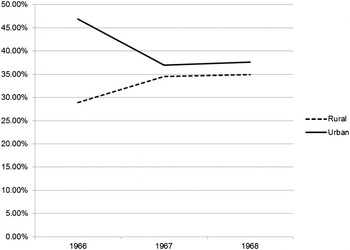
Third, and perhaps most important, OEO funding figures reveal the extent to which rural areas were from the outset a significant part of the national Community Action Program and how the funding gap between urban and rural areas narrowed over the course of the decade. In 1966, rural areas received 28.9 percent of the total CAP budget. In 1967, this had increased to 34.5 percent, and by 1968 the CAP allocation was projected to be 34.9 percent.Footnote 36 During the same period, CAP funds for cities with a population of over 150,000 decreased from 46.9 percent of the total Community Action budget in 1966 (the only year when metropolitan areas clearly received the largest share of funds) to a projected 37.6 percent in 1968—a drop of nearly 10 percent in two years.Footnote 37Figure 1 illustrates this trend for rural and urban funding.
Percentage of total Community Action funding, 1966–68, rural versus urban areas

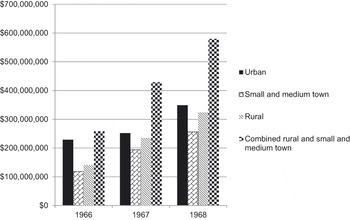
Drilling a bit deeper into this funding data reveals some important information about urban Community Action funds. The OEO categorized its budget according to population size: urban areas with a population over 150,000, areas with a population between 15,000 to 150,000, and rural areas.Footnote 38 Further analysis of this budget data reveals that between 1966 and 1968 rural areas and areas with a population between 15,000 and 150,000 actually received the majority of Community Action funds. In 1968, out of a total Community Action budget of $929 million, urban areas with a population over 150,000 were to receive $349 million, areas with a population of 15,000 to 150,000 would receive $256 million, and rural areas would get $324 million.Footnote 39 The latter two combined totaled $580 million—over two-thirds more than the total budget for urban areas. Figure 2 provides an overview of this funding.
Total Community Action funding, 1966–68, rural, small, and medium towns, and urban areas

Judging from these figures, it is far from evident that the big cities that the early studies of Community Action focused on were getting a majority of Community Action funds at all. Indeed, in 1968 the share going to rural areas was almost the same as for urban areas and the combined funding for rural and small and medium towns vastly exceeded funding for urban areas. In other words, these funding data reveal that rural and small-town areas by the end of the Johnson administration received over 62 percent of the Community Action budget. Significantly, these funding levels closely match the geographic concentration of America’s poor described in the OEO’s 1964 survey cited above in which over 60 percent of the poor lived in rural or small-town areas.
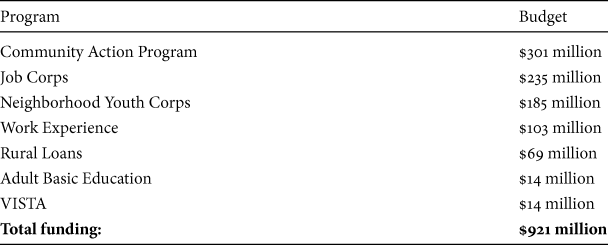
Finally, not only did Community Action funding for rural programs actually increase during this period, but rural Community Action was by far the biggest of all OEO rural programs. Indeed, total funding figures from the BOB reveal that from October 1964 through December 1967 just under one-third of all OEO funding for rural areas went toward rural Community Action Programs. During this period, Community Action was the largest rural recipient, with the Job Corps running a relatively distant second. Worth noting is that the Rural Loans program—the only specifically rural title of the 1964 Economic Opportunity Act—ran a very distant fifth. The programmatic breakdown for these figures is summarized in Table 1.
Total funding for the Community Action Program in rural areas, 1964–6740
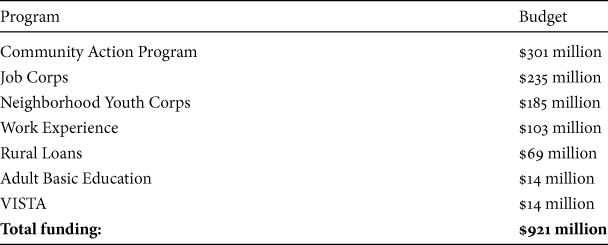
Together this demographic and funding data provide a different starting point for analysis of both the War on Poverty and Community Action. The figures shows quite clearly that OEO CAP funding during the Johnson presidency targeted rural and small and medium cities and that the CAP was in fact the number-one rural War on Poverty program as defined by the EOA.
The OEO did not make these funding decisions in a vacuum. Pressure to increase rural antipoverty funding and focus came from Congress through the 1966 Sub-professional Career Amendment, the White House (both informally and more directly through the appointment of a presidential commission, the President’s National Advisory Commission on Rural Poverty; both discussed below), as well as from other federal agencies, most notably the Department of Agriculture.
This involvement of other federal agencies in Community Action is an important part of the history of the War on Poverty. While the relationship between the antipoverty agency and the federal bureaucracy was not always smooth—in fact it deteriorated quite rapidly once the OEO got into political hot waterFootnote 41—an often overlooked facet of the War on Poverty is the extent to which other federal departments and agencies more directly addressed the issue of poverty and, more strikingly in light of its poor political reputation, embraced Community Action as a tool for fighting poverty. This is particularly the case with rural poverty and the USDA.
The following section will outline how throughout the Johnson administration the USDA remained supportive of the antipoverty effort and Community Action, if not the OEO. As the political difficulties of the antipoverty agency mounted, the USDA increasingly came to argue that the OEO’s efforts favored urban over rural antipoverty programs and that the USDA was more effective using CAPs to fight poverty than the OEO. As I will explain, there was a large degree of self-interest on the part of the USDA in pushing this argument. There is also a lack of evidence as to how this support for Community Action at the Washington, D.C., level trickled down to USDA operatives on the ground. Still, these findings show how antipoverty programs and Community Action in particular were actively embraced by officials at the USDA and how the Economic Opportunity Act prompted senior USDA officials to increase their involvement in the poverty issue.
The Department of Agriculture and the Rural War on Poverty
The USDA was from the outset heavily involved in Community Action and the War on Poverty. Several senior staff, such as Assistant Secretary John Baker and Undersecretary James Sundquist, took an active part in both the Shriver task force and the early “brown bag” poverty meetings during the Kennedy administration. Indeed, Sundquist was described by Ron Goldfarb, a Department of Justice lawyer who worked on the Shriver task force on a daily basis, as both “the Agriculture Department’s guy” and “an integral part of the task force.”Footnote 42 Both men were struck by Community Action, but neither was particularly enamored with many of the other task-force members and later antipoverty warriors. In a 1980 oral history interview, Baker categorized the members of the task force and OEO as “the Ford Foundation crowd and all these human resources deep breathers.”Footnote 43 Similarly, Sundquist, in later interviews, expressed concern over Shriver’s interest and oversight with regards to Community Action. He argued that the antipoverty director’s personal interest and capabilities would move him more toward the operational aspects of the proposed antipoverty programs as opposed to the original coordinating functions of Community Action: “One thing that was clear was that Shriver at that time was running for vice president, and he wanted to do something that would get him into the limelight. That certainly entered into his judgments on how you moved and when you moved on particular programs.”Footnote 44
On Community Action, both men were broadly supportive. In a USDA briefing memo from April 1964 reporting on the War on Poverty task force, Sundquist argued that Community Action was the central part of the proposed antipoverty bill, the other programs being secondary.Footnote 45 Baker was also taken in by the idea but was concerned with some of the task-force members’ interpretation of Community Action being far too radical and ultimately ineffective. In his oral history interview for the Johnson Library, he said:
I was kind of two minds. The dirt level, pragmatic country politician told me that if you let people like Yarmolinsky and [the Ford Foundation’s Paul] Ylvisaker run them [the poverty programs], you might just as well kiss the rural areas good-bye for LBJ because they’d turn everything up on its edge and even LBJ’s magic couldn’t put it together. On the other hand, in my own work in the department I had already organized what we call Rural Areas Development Committees. The need for a focus at the community level, county level, and the state level, and mine [Rural Area Development Committees] had created a lot of controversy. Not all controversy is bad, but people started visualizing power redistributions. While mine had a mild advocacy slant, these things that these wild boys [Yarmolinsky et al.] were talking about . . . they were just wild. They were going to revolutionize America through these community action agencies and substitute community action agencies for city and county government and so forth. That part I just knew wouldn’t work. . . . But I shared their idea that it needed something. There had to be something there.Footnote 46
Both men’s positive view of Community Action was shared by others within the department. USDA Director of Information Harold Lewis claimed in an internal memo that “the Economic Opportunity Act of 1964 places a major leadership role on USDA for combating poverty in the United States.”Footnote 47 Lloyd Davies, administrator of the Federal Extension Service (FES), wrote to Richard Boone of the War on Poverty task force asking for advice, saying that “there is beginning to build up a tremendous amount of enthusiasm among the States for opportunities under the Community Action Program.”Footnote 48 And USDA Secretary Freeman wrote a public letter to the presidents of all U.S. land-grant colleges endorsing Community Action and encouraging them to apply for funding.Footnote 49 In the letter, Freeman claimed that the USDA extension services would play a big part in Community Action.
Yet this initial positive view of Community Action was tempered by a deep unease at what the USDA thought was OEO’s bias toward urban poverty. As early as December 1964—less than six months after passage of the EOA—Freeman, in a letter to Shriver, showed his disappointment in the administrative and organizational efforts of the OEO on behalf of the rural poor:
Despite all of the emphasis that you and we have been giving the rural side of the problem, the inherent difficulties and disparities have resulted in a far more successful application of the benefits of the Economic Opportunity Act in the cities. For example, the initial allocation under Title II show 27 times as much money allocated to cities as to rural areas. . . . I am afraid that these disparities will not be much narrowed unless we devise some additional organizational means for extending the reach of the antipoverty programs into rural America.Footnote 50
This criticism would only intensify as the OEO’s Community Action and Job Corps programs became more and more embroiled in controversy in the spring and summer of 1965.Footnote 51 For example, in April 1965 the Wall Street Journal ran a story on how urban areas were viewed by many rural supporters as having been prioritized in the War on Poverty by the OEO.Footnote 52 Many rural boosters were cited as claiming that this was because “most OEO officials hail from urban or suburban areas (that’s true of both Mr. Shriver and his deputy Jack Conway) and simply don’t understand the problems and attitudes of their country cousins,” and that “Shriver’s office has concentrated on funding urban projects so far because they promised ‘more bang for a buck’ and quicker results to show Congress.”Footnote 53
Significantly, Freeman sent this article to Vice President Hubert Humphrey together with a letter claiming that it was a “fair story.”Footnote 54 Humphrey responded to the letter by outlining his commitment to the War on Poverty in rural areas: “I have for many years been deeply concerned about the ‘opportunity gap’ which seems to exist between rural and urban America. The problem of working out a coordinated and well-balanced anti-poverty program is certainly of high priority.”Footnote 55
This direct contact with the White House strongly suggests that the USDA was deeply dissatisfied with the early direction of the OEO and the War on Poverty’s rural effort and wished to make its displeasure known. While it is certainly the case that the OEO was at this time investing more heavily in urban Community Action—as the funding data outlined above shows—the OEO was also still dealing with the logistical difficulties of starting and running rural CAPs, especially multicounty CAAs that were slow to get off the ground. There is also the ever-present element of federal bureaucracies fighting one another in an effort to expand their own influence and power. In this case, the political difficulties the OEO was experiencing in the spring of 1965 made it an easy target for Freeman and the USDA.
As the OEO’s difficulties mounted, internal USDA sentiment solidified that the department, through the Rural Community Development Service (RCDS) and the FES, was having a greater level of success in organizing communities into CAAs than the OEO. In a revealing undated and anonymous memo from Freeman’s files from late 1965, the memo’s author insisted that the record bore out that the USDA’s approach to Community Action was working.Footnote 56 (In fact, on the back of the memo Freeman scribbled: “We [the USDA] can do better on CAP production then they [the OEO] are doing now”).Footnote 57 The memo claimed that in a number of states Community Action would be nonexistent had it not been for the efforts of the RCDS. Comparing the RCDS’ CAP efforts with OEO-sponsored efforts, the memo argued that the former was much more effective. For instance, the memorandum contrasted the RCDS’ work in Indiana (where significant progress is said to have been made thanks to the help of its local field-man) with that of Illinois, claiming that “Illinois has not received the services of an RCDS field-man and . . . no significant rural county, or multi-county CAP project has been funded.”Footnote 58 The same argument was made for Montana and Wyoming, with Montana being described as “an example of what can be accomplished by RCDS if we have the funds to do the job.”Footnote 59 No OEO programs are said to have existed before the RCDS arrived, yet within a short space of time six CAPs were funded and two more were in the pipeline.
This argument did not change much over the next few years. In fact, throughout the Johnson administration, senior USDA staff continued to argue that the USDA was emulating and working with Community Action and even developing its own version of the concept, the Technical Action Panels (TAPs). For instance, in a July 1967 letter to Ira Kaye (OEO’s director of Rural Services Division), Secretary Freeman’s description of what the USDA was doing in terms of local community organizing and activities is similar to Community Action. Freeman claimed that “where there is no real community development organization or any unified approach,” the USDA’s local TAPs should “try and provide a coordinating and unifying influence” and involve other federal agencies, local and state agencies, and private individuals in their organizing effort.Footnote 60 He also stated that once this had developed into a working group under local leadership, the TAPs should “continue to participate, but phase out their positive identification.”Footnote 61 Where CAPs or similar groups already did exist, Freeman claimed the TAPs should cooperate with them fully and even “submerge themselves in the organization led by local people.”Footnote 62
Freeman also gave public testimony about the importance of the TAPs and how their work was both similar to and closely linked to that of local CAAs. In July 1967, before the House Committee on Education and Labor, he stated:
The TAPs have the machinery to answer any inquiry in the field of rural areas development. This means that any rural individual, family, or community seeking access to anti-poverty or development services can get one-stop service at the county level. In many counties TAPs and CAPs work in double harness. They meet together, plan together, and pool resources. In this way they can reach the poor and the poorest of the poor. . . . Planning and action programs are going forward not only in individual counties but on a multi-county or regional basis as well.Footnote 63
Together these USDA memoranda, letters, and public statements paint a picture of a USDA actively seeking to take part and influence the War on Poverty. Clearly senior officials, including Freeman, Sundquist, Baker, and others, saw Community Action as a tool worth embracing both in public and in private. What motivated this interest, and what were the results on the ground?
To begin with the self-evident: first, the USDA’s interest in Community Action and the War on Poverty was not entirely benign. The department had an obvious interest in promoting its own agenda. At the time of its launch, the OEO was the defining domestic effort of the Johnson administration and the president himself had invested a great deal of political capital in the antipoverty campaign. It is natural that the USDA and its officials wished to acquire as much influence as possible from an early stage. Equally, once the OEO’s popularity and political standing began to wane—especially as claims mounted of a lack of OEO effort in rural areas—it is not surprising that the USDA’s criticism of the agency would intensify together with loud claims of being able to better fight poverty.
Second, it is not at all clear what Secretary Freeman and senior officials meant by Community Action. Baker’s oral history interview suggests a more service-oriented type of program involving the poor and a “mild advocacy slant,” but overall there is a lack of evidence as to how the department’s local operatives actually viewed Community Action and how USDA entities, such as TAPs, the RCDS, and the FES, interacted and worked together with CAAs.Footnote 64 Historian Pete Daniel has detailed how large parts of the USDA bureaucracy in the South—particularly the FES—were plagued by what amounts to institutional racism and discriminatory practices. Yet in other areas of the country, the USDA seems to have played a more constructive role. For instance, in Michigan’s Upper Peninsula, the State Extension Service and Michigan State University (a federal land-grant college) helped found the Upper Peninsula Committee for Area Progress (UPCAP). As I will detail in the following section, the UPCAP subsequently founded and developed some of the first CAAs in the country. Indeed, even in the South, the USDA’s top officials were aware of the crisis brewing in Mississippi prior to the 1967 Senate investigation. Reacting to local protests by civil rights activists and the poor—which included a sit-in at the Greenville Air Force Base—in a memo from February 1966 Freeman urged the department to “get a program into effect in these areas to meet this great human need. . . . We can’t just sit here and let this go on. We need to know where it’s worst, what’s now being done, what we can do with what we have, and what we need to go after to be able to meet the greatest need as we can effectively identify it and before it explodes.”Footnote 65 Yet as the subsequent national scandal and Senate investigation illustrate, clearly the results on the ground were, at best, mixed and seem to have been particularly poor in the South.
Nevertheless, the USDA’s role in the rural War on Poverty and the manner in which senior officials supported a service-oriented form of Community Action is significant. At the very least it suggests that even within the most conservative parts of the federal government the War on Poverty spurred an increased emphasis on helping and involving the poor.
The USDA’s embrace of Community Action also indicates that Community Action was more multifaceted and varied in its effects on the ground than many studies have hitherto found. As explained at the beginning of this article, a growing number of recent case studies have outlined how Community Action operated in rural America. However, the majority of these studies focus on the South, with a few looking at the Southwest and Appalachia. Given the specific problems relating to the implementation of the Civil Rights Act, the clear link between racial discrimination and poverty in the South and the challenges this posed to the poverty program, it is important to complement this scholarship by examining CAPs in other parts of the country. The next section provides an example of how Community Action worked in the Great Lakes Region, specifically the Upper Peninsula of Michigan.
Rural Community Action Outside the South—UPCAP Michigan
Founded in 1961 as a multicounty Regional Planning Commission, UPCAP covered fourteen out of fifteen counties of the Upper Peninsula of Michigan and a population of more than three hundred thousand. By the late 1960s, UPCAP had founded and developed six CAPs in the Upper Peninsula and one of the first Head Start programs in the United States.Footnote 66 One of the country’s first antipoverty programs off the ground, the UPCAP’s CAAs grew quickly. By 1967, UPCAP and its CAP subsidiaries had started or were running Head Start programs, thirty-one area centers, Medicare alert, dental programs for poor children, a homemaker services program, a year round preschool program on one Indian reservation, a project to provide electricity to another Indian reservation, and centers for senior citizens.Footnote 67 Underlining the broader fact that Community Action and War on Poverty programs continue to carry the fight on poverty into the twentieth-first century, UPCAP and its CAPs exist to this day and, according to its website, are still “providing guidance and support to Upper Peninsula residents.”Footnote 68
The CAAs founded and supported by UPCAP were, and remain, multicounty. Because rural communities often lacked basic economic and social infrastructure and, above all, population density, they initially found it difficult to achieve both the adequate population size and the 10 percent minimum level of local funding Title II of the EOA legislation required. Indeed, internal OEO memoranda from 1965 and early 1966 show how antipoverty services and information were difficult to spread, organizing CAP information as well as board meetings was challenging, and securing regular attendance to these meetings even more so.Footnote 69 To address this, one solution that was implemented on a large scale was the idea of multicounty action agencies. Multicounty CAAs covered a larger geographical area and population, thereby providing a larger base for starting and running CAPs. These agencies existed solely in rural areas and were often based on older community structures and preexisting community organizations. Multicounty CAAs grew quickly. By December 1966, out of a total of 613 rural OEO-sponsored CAAs, 300 were multicounty.Footnote 70
What perhaps is most striking about the UPCAP is that the organization and its CAAs do not seem to have encountered the type of conflicts that many CAAs in urban areas and the rural South suffered from. For example, local and state newspapers contain no articles or news items relating to Community Action protest or conflict within the UPCAP CAAs or between these organizations and local or state government during the Johnson administration. A key word search in the NewspaperARCHIVE.com database (which contains 120 million newspaper pages and an extensive listing of state and local newspapers in Michigan) of “UPCAP + Community + Action” between 1964 and 1969 retrieves 144 results. Out of these 144 results, the majority of articles report on relatively mundane matters of granting of poverty funds or ongoing UPCAP antipoverty program activities.Footnote 71 The sole instance of conflict is from late November and early December 1965 when both the UPCAP executive director and secretary resigned in protest over organizational changes to the UPCAP.Footnote 72 The changes involved the expansion of the UPCAP Delegate Body from its original fourteen members to thirty. This expansion is said to have been imposed on UPCAP primarily by the federal government through the OEO and Economic Development Administration with both agencies requiring delegate representation.
Interviews with UPCAP staff also confirm that the CAAs seem to have functioned relatively well. For example, current UPCAP President and CEO (and son of one of the original founders of the UPCAP, Frank Mead,) Jonathan Mead stated in an interview with the author that during the 1960s there had not been the conflict between local government and action agencies in the Upper Peninsula as had occurred in other parts of the country.Footnote 73 Mead said that UPCAP’s CAAs were from the outset organized to provide basic antipoverty services: “as entities [they were founded] to provide critical services to the poor. They were not designed to be strong community activists. . . . The fundamental core was providing those critical services.”Footnote 74 While advocacy on behalf of and with the poor (who remained members and made up at least one-third of CAA boards)Footnote 75 was part of this process, according to Mead, there was relatively little in the way of conflict between local government and action agencies as took place in many urban areas: “not to the point where it led to a lot of tension between local government and local agencies.”Footnote 76 Similarly, the UPCAP CAPs appear to have received the support of the State of Michigan, including then Republican Governor George Romney. For example, in 1967, the governor approved over $100,000 in OEO grants for the UPCAP to provide technical assistance to its local CAPs.Footnote 77 This constituted over half of the total OEO grants of $200,000 for the state.
What explains this? First, it seems likely that being located in a non-Southern state meant that the UPCAP CAAs were not faced with the twin challenges of battling decades of racial discrimination as well as poverty. In absolute terms, there were relatively few minorities and black Americans in the Upper Peninsula during the 1960s.Footnote 78 Even today, demographic figures reveal that black Americans make up a relatively low percentage of the overall Upper Peninsula population.Footnote 79 Traditionally the largest minority group have been Native Americans, who were included within the UPCAP project as one of the six original CAAs was founded and run for Native Americans.Footnote 80
Second, it seems that since UPCAP’s administrative and local roots preceded passage of the EOA, it was more closely connected and intertwined with both the local community and local government. The UPCAP structure consequently avoided some of the pitfalls other CAPs had stumbled into. The organization was originally set up as a Regional Planning Commission under authority of Act 200, Michigan Public Acts in 1961. In addition to county commissioners, founders and supporters included a wide swath of the community: Michigan State University (a land-grant college that was and is part of the USDA Federal Extension Service); the Michigan State Extension Office; as well as local citizens.Footnote 81 As a Michigan planning commission, UPCAP was allowed to apply for and receive planning grants to study and develop programs for economic assistance and development. Some of the initial grants supported on-the-job training programs, small businesses centers, and youth training programs, as well as urban planning and local industrial development.Footnote 82 Perhaps most important, the impetus for the founding of UPCAP emanated from both local government and the local community. Mead argued that there was “[a] sense of the need for a collective voice in the Upper Peninsula. . . . Having individual counties advocate by themselves wasn’t politically effective enough. . . . To meet the needs of our citizens we needed to do it as a region. . . . We were viewed as the perfect organization to carry it out.”Footnote 83
Finally, the UPCAP and its CAPs seem to have maintained a relatively close working relationship with the OEO and other federal and state agencies. In the interview, Mead stated that he had never seen or heard of a conflict between the regional or Washington office of the OEO and the UPCAP CAAs.Footnote 84 Instead, as mentioned, local and state USDA entities such as the Michigan State Extension Service and Michigan State University played a key part in the founding of the UPCAP.
Conclusion
This article has sought to add to the scholarship on the Johnson administration’s Community Action Program by emphasizing its rural components in three ways. First, it has shown that Community Action was to a large extent a rural program with both the majority of action agencies being in and funding going to rural and small and medium-sized towns. Second, this article has described how the USDA played a significant role in the rural War on Poverty. Senior Washington officials, including the secretary, took an active part in the War on Poverty task force and throughout the War on Poverty supported a service-oriented form of Community Action. Finally, as illustrated by the UPCAP in rural Michigan, this article shows that there is evidence that CAAs outside the rural South and Appalachia (1) did not experience many of the conflicts over political power that their urban and southern counterparts did, and (2) were more focused on the provision of services.
Together these findings complement the growing scholarship on the War on Poverty and add to our understanding of the Johnson administration’s domestic policies. Specifically, the data showing that rural and small-town areas received the majority of OEO CAP funds and how the vast majority of Community Action Agencies were in rural America effectively refutes the traditional interpretation that Community Action was an urban program targeting America’s largest metropolitan cities. The archival and oral-history evidence relating to USDA involvement and support for Community Action, at the very least, suggests that within even the most conservative parts of the federal government the War on Poverty spurred an increased emphasis on helping and involving the poor. Finally, the example of the UPCAP in Michigan adds to the recent literature on rural community action, which has up to now focused mainly on the South, Appalachia, and the Southwest. It suggests that rural Community Action outside these areas could be supported and waged by local government, state, and federal bodies and be carried out with a relatively low degree of conflict and confrontation.