Developmental or adaptive programming, including in the fetal period, has emerged as a major model for understanding the developmental origins of health outcomes. The model proposes that in utero exposures instigate an adaptive response in the organism that is carried forward in development with persisting effects on behavior and biology. Much of this work focuses on poor nutrition or an index of poor growth (e.g., low birth weight) as the causal factor, although other and additional sources of stress with causal effects may be operating (Barker, Reference Barker1999; Gluckman & Hanson, Reference Gluckman and Hanson2004; Painter, Roseboom, & Bleker, Reference Painter, Roseboom and Bleker2005; Wadhwa, Buss, Entringer, & Swanson, Reference Wadhwa, Buss, Entringer and Swanson2009). Evidence for the model as applied to cardiovascular and metabolic outcomes is substantial, derives from numerous large-scale investigations in diverse settings, and has spawned an influential line of study because of its potential to influence health and development of populations in developed and developing countries (Gillman et al., Reference Gillman, Barker, Bier, Cagampang, Challis and Fall2007).
Building on the fetal programming model for somatic health, several research groups are seeking to translate the model for psychological and neuroscience outcomes. These studies focus on maternal prenatal anxiety or stress as a putative causal agent initiating a developmental programming response. The focus on prenatal anxiety or stress follows from decades of experimental animal studies linking prenatal stress to sizable and lasting effects on offspring fear, neurogenesis, immunity, and stress physiology, among other outcomes (Coe et al., Reference Coe, Kramer, Czeh, Gould, Reeves and Kirschbaum2003; Maccari et al., Reference Maccari, Darnaudery, Morley-Fletcher, Zuena, Cinque and Van Reeth2003). A number of observational studies in humans show that prenatal anxiety or stress in the mother is associated with behavioral outcomes in children (Bergman, Sarkar, O'Connor, Modi, & Glover, Reference Bergman, Sarkar, O'Connor, Modi and Glover2007; Buitelaar, Huizink, Mulder, de Medina, & Visser, Reference Buitelaar, Huizink, Mulder, de Medina and Visser2003; Davis, Glynn, Waffarn, & Sandman, Reference Davis, Glynn, Waffarn and Sandman2011; O'Connor, Heron, Golding, & Glover, Reference O'Connor, Heron, Golding and Glover2003; Robinson et al., Reference Robinson, Mattes, Oddy, Pennell, van Eekelen and McLean2011; van den Bergh et al., Reference van den Bergh, Mennes, Stevens, van der Meere, Borger and Stiers2006). These results raise important conceptual challenges for studies of developmental models of psychopathology that, with a few exceptions (Fisher et al., Reference Fisher, Lester, DeGarmo, Lagasse, Lin and Shankaran2011; Liu, Portnoy, & Raine, Reference Liu, Portnoy and Raine2012), tend to consider neither prenatal exposures nor programming effects. Furthermore, the hypothesis that there are prenatal programming effects for psychopathology has sizable implications for intervention, and particularly the timing of early interventions. Interventions starting in early infancy to promote the mother–infant relationship and the quality of parenting (Allen, Reference Allen2011; Melhuish, Belsky, Leyland, & Barnes, Reference Melhuish, Belsky, Leyland and Barnes2008) are grounded in research linking the quality of the early postnatal rearing environment and the behavioral, emotional, and cognitive development of the child (Murray et al., Reference Murray, Arteche, Fearon, Halligan, Goodyer and Cooper2011; Nelson et al., Reference Nelson, Zeanah, Fox, Marshall, Smyke and Guthrie2007; Ramchandani & Psychogiou, Reference Ramchandani and Psychogiou2009). If prenatal exposures are also shown to have a particular causal role, then systematic interventions may be required from pregnancy, a practice that is not now common.
Recent findings suggest that the mother's emotional well-being during pregnancy may have a significant impact on the neurodevelopment, endocrine, immune, and behavioral and emotional problems in the child (Huizink, Mulder, & Buitelaar, Reference Huizink, Mulder and Buitelaar2004; King et al., Reference King, Mancini-Marie, Brunet, Walker, Meaney and Laplante2009; O'Connor, Bergman, Sarkar, & Glover, Reference O'Connor, Bergman, Sarkar and Glover2013; O'Connor et al., Reference O'Connor, Heron, Golding and Glover2003; O'Connor, Winter, et al., Reference O'Connor, Winter, Hunn, Carnahan, Pressman and Glover2013; Robinson et al., Reference Robinson, Mattes, Oddy, Pennell, van Eekelen and McLean2011), with some studies suggesting that maternal prenatal anxiety, depression, or stress may extend to more severe mental illness and neurodevelopmental outcomes (Khashan et al., Reference Khashan, Abel, McNamee, Pedersen, Webb and Baker2008; King et al., Reference King, Mancini-Marie, Brunet, Walker, Meaney and Laplante2009; Kinney, Miller, Crowley, Huang, & Gerber, Reference Kinney, Miller, Crowley, Huang and Gerber2008). As with the animal data, likely putative mechanisms involve alteration of the hypothalamic–pituitary–adrenal axis, although supporting evidence is only suggestive (Oberlander et al., Reference Oberlander, Weinberg, Papsdorf, Grunau, Misri and Devlin2008; O'Donnell et al., Reference O'Donnell, Bugge Jensen, Freeman, Khalife, O'Connor and Glover2012).
Despite the number and diversity of studies, questions persist about the causal effects of prenatal anxiety or depression on child behavioral health. To some extent, that derives from the inevitable lack of experimental leverage possible in human compared to animal work. A variety of approaches have been employed to examine if there is a particular and causal effect of maternal prenatal mood on child development. One in vitro fertilization study of mothers and their genetically related or unrelated children found a prenatal stress effect for conduct problems (but not attention-deficit/hyperactivity disorder [ADHD] or emotional problems), but this study used a single item from a retrospective report to index prenatal maternal stress (Rice, Jones, & Thapar, Reference Rice, Jones and Thapar2007). Other studies have employed analytic approaches that adjust for multiple confounds, including postnatal maternal mood (O'Connor et al., Reference O'Connor, Heron, Golding and Glover2003). These approaches have been helpful in ruling out some confounds, but questions remain about the causal nature of this link. In the current study, we leverage the power of a 14-plus year prospective longitudinal study with five occasions of measurement spanning age 4 to 13 years to expand research on the developmental programming hypothesis for prenatal anxiety and child behavioral development.
One key limitation of existing human research is that it incorporates a limited developmental model. These studies are, by design, longitudinal because they link prenatal exposure to later behavioral outcomes; however, most studies rely on a single outcome measure in the child. That is significant because it is not clear that a single assessment is adequate for operationalizing a “programming” effect, which is a key concept undergirding this research. The concept of programming has not received much empirical construction, despite the growing influence of the model in health research. In the current study, which includes assessments from ages 4 to 13 years, we operationalize a programming effect using growth curve modeling. If there is a programming effect, than we might expect to see a persisting impact of prenatal anxiety that does not diminish over time. That possibility has not yet been formally tested (in human or animal studies). In contrast, if the prenatal anxiety risk exposure conforms to the more typical, nonprogramming pattern of risk, we would expect to see that the magnitude of effect diminishes over time; that is, the longer the time interval between prenatal exposure, the weaker its prediction because of the intervening postnatal risk and protective factors that might ameliorate its impact. We contrast these two developmental hypotheses in the current study.
A related developmental question for prenatal mood disturbance is whether or not the effects persist beyond childhood. Experimental animal data reviewed above indicate that the effects of prenatal stress are evident into the offspring's adulthood. In contrast, many but not all (O'Connor et al., Reference O'Connor, Ben-Shlomo, Heron, Golding, Adams and Glover2005; Robinson et al., Reference Robinson, Mattes, Oddy, Pennell, van Eekelen and McLean2011; Stein, Pierik, Verrips, Susser, & Lumey, Reference Stein, Pierik, Verrips, Susser and Lumey2009; van den Bergh, Van Calster, Smits, Van Huffel, & Lagae, Reference van den Bergh, Van Calster, Smits, Van Huffel and Lagae2008) of the studies of prenatal anxiety and child development are limited to phenotypes in infancy and early childhood. That is significant because developmental epidemiology data indicate that there are sizable changes in the expression and prevalence of childhood psychopathologies from early childhood to adolescence (Costello, Copeland, & Angold, Reference Costello, Copeland and Angold2011). The assessment period into early adolescence and puberty is particularly important for documenting the clinical and public health significance of a programming effect because early adolescence is a time of substantial biological and social changes (Dahl & Gunnar, Reference Dahl and Gunnar2009; Spear, Reference Spear2000); these substantial biological changes might be expected to disrupt or diminish a prediction from the prenatal period. Moreover, because symptoms in adolescence reliably predict adult impairment (Kim-Cohen et al., Reference Kim-Cohen, Caspi, Moffitt, Harrington, Milne and Poulton2003), detecting an effect of prenatal mood into adolescence implies, as in the animal data, that the effects may be potentially long term. Therefore, it may be premature to conclude a programming effect from studies that do not extend into adolescence. We address this concern in the current study.
In addition to extending developmental analyses of a prenatal effect on childhood psychopathology, we also include several additional methodological features that provide a stronger test of the prenatal causal pathway. Specifically, we include paternal prenatal mood. If the effects of maternal prenatal mood on child outcome are mediated by direct physiological changes to the intrauterine environment, as proposed by the programming hypothesis, then we would expect a stronger prediction from maternal than paternal prenatal anxiety. Alternatively, an equivalent prediction of child outcome from maternal and paternal prenatal mood would support a genetic transmission of risk, or a genetic confound. In addition, with a few exceptions, (e.g., Bergman, Sarkar, Glover, & O'Connor, Reference Bergman, Sarkar, Glover and O'Connor2010) prior studies have ignored psychosocial risk and particularly caregiving quality as potential mediators or moderators of the prenatal effect; we include in this analysis information on psychosocial risk, as well as obstetric and sociodemographic risk, and multiple postnatal measures of maternal mood to examine if there is a particular effect of prenatal maternal mood on child psychiatric symptoms. Finally, to advance our understanding of the clinical impact of prenatal anxiety on childhood psychopathology, we include in this study analyses of clinical algorithms to derive estimates of probable disorder.
Methods
Sample
Data for this study were obtained as part of the Avon Longitudinal Study of Parents and Children, an ongoing population-based study designed to investigate the effects of a wide range of influences on the health and development of children (Golding, Pembrey, & Jones, Reference Golding, Pembrey and Jones2001). Pregnant women residing in the Avon area of southwest England who had an estimated date of delivery between April 1, 1991, and December 31, 1992, were invited to participate in the study. It was estimated that 85%–90% of the eligible population participated. All data used for this study were collected via postal questionnaires. The study cohort consisted of 14,541 pregnancies and 13,971 children who were still alive at 12 months of age. The current analyses focus on mothers (n = 7,944) who provided data on their child's emotional and behavioral development across childhood and into early adolescence. Ethical approval for all measures was obtained from the Avon Longitudinal Study of Parents and Children Ethics and Law Committee and from local research ethics committees.
Measures
Child emotional and behavioral problems were assessed using the Strengths and Difficulties Questionnaire (SDQ) a well-validated assessment of child emotional and behavioral problems (Goodman, Meltzer, & Bailey, Reference Goodman, Meltzer and Bailey1998). The SDQ assesses child symptoms related to ADHD, conduct, and emotional problems. In addition, the total SDQ score shows good predictive validity of clinician-rated mental health disorders (Goodman & Goodman, Reference Goodman and Goodman2011); an algorithm for calculating the age-adjusted population prevalence of a probable mental health disorder on the basis of the total SDQ score is available (Goodman & Goodman, Reference Goodman and Goodman2011). Mothers completed the SDQ when their study child was aged 4, 7, 9, 11.5, and 13 years of age. Participants providing SDQ data from at least two time points were included in the current analysis. We focused our analyses on the three problem subscales listed above, the total SDQ score, and the predicted prevalence of a mental disorder.
Symptoms of maternal anxiety were measured using the Crown–Crisp Experiential Index, a well-validated self-rating inventory (Alderman, Mackay, Lucas, Spry, & Bell, Reference Alderman, Mackay, Lucas, Spry and Bell1983; Birtchnell, Evans, & Kennard, Reference Birtchnell, Evans and Kennard1988). Assessments of maternal anxiety were made twice during pregnancy (18 and 32 weeks) and again when the study child was aged 33 months. Both continuous scores and a quasiclinical cutoff (in the absence of established cutoff, we identified the top 15% of the sample) are used in analyses. Symptoms of maternal depression were assessed at these times and also in the postnatal period at 8 weeks using the Edinburgh Postnatal Depression Scale (EPDS; Cox, Holden, & Sagovsky, Reference Cox, Holden and Sagovsky1987), a 10-item questionnaire shown to be valid both within and outside of the postnatal period. We use both continuous scores and the established clinical cutoff of 13 or above in analyses below.
Paternal anxiety and depression were assessed using the Crown–Crisp Experiential Index and the EPDS. One assessment of paternal mood in pregnancy was available corresponding to the 18th week of gestation. Paternal EPDS scores were available from the 8-weeks postnatal assessment and anxiety scores were available when the study child was aged 33 months. Paternal measures of anxiety and depression were included as a further test of the in utero effect and as an indirect index of a genetic confound.
Maternal education and household crowding in pregnancy were used as measures of maternal socioeconomic status. Women endorsed their highest educational achievement giving rise to four categories ranging from low to high: Certificate of Secondary Education/vocational training, O-levels (equivalent to modern-day General Certificate of Secondary Education), A-levels, and higher degree. Household crowding was calculated by dividing the number of people in the household by the number of rooms, giving rise to four categories ranging from low to high: 0–0.50, 0.50–0.75, 0.75–1.00, and >1.00.
At 24 months mothers completed a series of questions related to parenting behavior. The frequency of positive (e.g., playing, cuddling, and eating with or praising child) and negative (e.g., slapping and shouting) behaviors were summed to calculate a parenting score that ranged from 18 (low) to 40 (high; see Gale, O'Callaghan, Bredow, & Martyn, Reference Gale, O'Callaghan, Bredow and Martyn2006).
Data on antenatal risk factors such as maternal age, smoking, and alcohol/substance use were collected during pregnancy. Obstetric outcomes such birth weight and gestational age were recorded from medical notes. Extremely low birth weight (<1500 g) and those born before 32 weeks of gestation were excluded from these analyses.
Data analyses
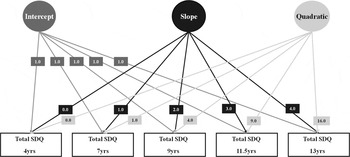
We present descriptive data on the sample and bivariate associations between the target risk, prenatal anxiety at 32 weeks gestation, and several confounds and covariates. After reporting bivariate analyses, we present the tests of the main study hypothesis of a link between prenatal anxiety and child behavioral and emotional problems from age 4 to 13 years. These analyses are based on a longitudinal growth model, which capitalizes on the increased power from multiple outcomes (i.e., SDQ ratings from 4 to 13 years) and distinguishes between different longitudinal effects: intercept, linear growth, and nonlinear growth/quadratic (Figure 1). The intercept parameter is constructed as a mean level of behavioral problems derived from the measurement occasions 4, 7, 9, 11.5, and 13 years. The linear change parameter indexes the degree to which there is linear change or growth in the behavior problems over time; the nonlinear or quadratic parameter indexes quadratic change in behavioral problems over time. These three parameters are simultaneously predicted from prenatal anxiety (and other predictors and covariates in the model). For the main prediction model presented here, we include prenatal anxiety (at 32 weeks gestation), postnatal depression, and maternal anxiety at 33 months as continuous variables. These measures were chosen because of our a priori interest in whether or not prenatal anxiety predicted childhood symptoms independently from maternal anxiety closer in time to the measures of child symptoms (i.e., from 4 years). We included postnatal depression as a maternal mood covariate because we also wished to examine a prenatal anxiety effect that was not confounded with postpartum depression (O'Connor, Heron, & Glover, Reference O'Connor, Heron and Glover2002) and because of prior work showing that prenatal anxiety increases the risk for postpartum depression (Heron, O'Connor, Evans, Golding, & Glover, Reference Heron, O'Connor, Evans, Golding and Glover2004). Additional prediction models are provided as appendices. Analyses of child outcomes were conducted separately for the main symptom subscales of the SDQ, despite their overlap, because of our interest in each dimension and because prior animal and human work suggested that the prenatal effect may be stronger on some symptoms sets than on others. We also report effects on total SDQ scores because that provides a reference point for deriving likely clinical disturbance. In addition, we report findings from analyses using continuous and categorical (Figures 2–4) prenatal variables to examine the robustness of effect and clinical significance. Supplementary analyses are presented that examine the relative effects of prenatal maternal anxiety on child behavioral and emotional problems compared with maternal anxiety in early childhood.
The three-factor growth model used to describe child strengths and difficulties across childhood. SDQ, Strengths and Difficulties Questionnaire.

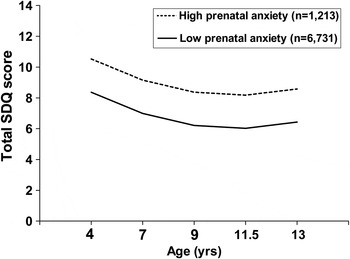
The total Strengths and Difficulties Questionnaire (SDQ) scores across childhood in children grouped by maternal anxiety at 32 weeks of pregnancy. The dashed line represents the top 15% of maternal anxiety ratings controlling for birth weight, gestational age, child sex, substance use in pregnancy, maternal age, education, crowding as index of socioeconomic status, parenting style, maternal depression at 8 weeks postnatal, maternal postnatal anxiety at 33 months, paternal prenatal anxiety, paternal postnatal depression at 8 weeks, and paternal postnatal anxiety at 33 months.

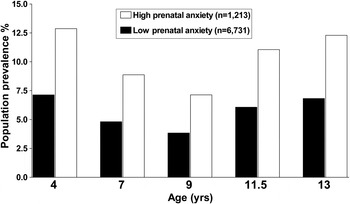
The predicted population prevalence of a probable mental health disorder in children born to high (open bars represent the top 15%) and low (filled bars) anxiety mothers. Estimates are based on total Strengths and Difficulties Questionnaire scores generated using growth curve analysis controlling for birth weight, gestational age, substance use in pregnancy, maternal age, education, crowding as index of socioeconomic status, parenting style (see Methods), maternal depression at 8 weeks postnatal, maternal postnatal anxiety at 33 months, paternal prenatal anxiety, paternal postnatal depression at 8 weeks, and paternal postnatal anxiety at 33 months.

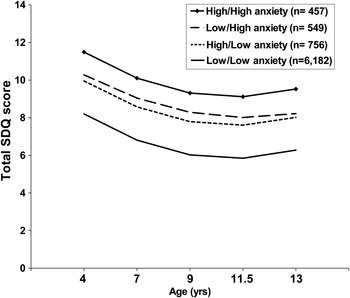
The maternal anxiety and child total Strengths and Difficulties Questionnaire (SDQ) scores across childhood. The growth curve analysis describes the total SDQ scores in four groups of children formed on the presence or absence of high maternal anxiety in the prenatal period (32 weeks gestation and at 33 months postpartum: the solid line denotes low maternal anxiety at both time points, the dotted line denotes high prenatal anxiety only, the dashed line denotes high maternal anxiety at 33 months postpartum, and the diamond symbol line refers to children exposed to high levels of maternal anxiety at both assessments.

Growth curve analyses were run in MPlus version 5.21 (Muthen & Muthen, Reference Muthen and Muthen1998–2009). The following criteria were applied to determine goodness of fit for each model: a comparative fit index (CFI) > 0.95, a Tucker–Lewis index (TLI) > 0.95, and a root mean square estimate of approximation (RMSEA) < 0.06 (Hu & Bentler, Reference Hu and Bentler1999). Group differences (e.g., high versus low maternal prenatal anxiety) were tested using Satorra–Bentler scaled chi-square difference (Δχ2) tests (Satorra, Reference Satorra, Heijmans, Pollock and Satorra2000). To account for nonnormal data distribution and missing data a full information maximum likelihood estimator with robust standard errors was used. We include as covariates those factors that have been linked to prenatal anxiety and additional potential risks for behavioral and emotional problems in the child.
Results
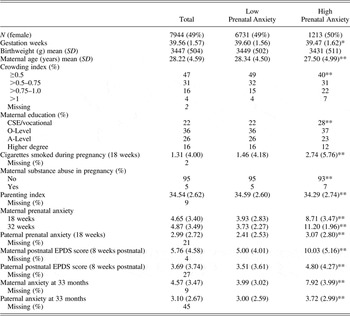
Table 1 shows demographic information for the women and their children used for these analyses. Participants were predominantly Caucasian (95%), which is consistent with the geographical area from which the families were drawn. Table 1 also shows that maternal prenatal anxiety at 32 weeks gestation (approximately the top 15%) was associated with generally elevated risks for behavioral emotional problems in the child and that prenatal anxiety was associated with elevated postnatal anxiety. Partners of anxious women also reported higher prenatal anxiety, postnatal depression, and increased anxiety when the study child was aged 33 months. A comparison of maternal and paternal ratings of mood indicated that maternal anxiety and depression scores were significantly higher at each occasion of measurement (all ps < .001). Intercorrelations among predictor variables are presented in online-only Supplementary Table S.1 (http://journals.cambridge.org/dpp).
Cohort demographics

Note: CSE, Certificate of secondary education; EPDS, Edinburgh Postnatal Depression Survey.
*p < .05. **p < .01. Significant differences between high and low prenatal (32 weeks) anxiety groups are denoted.
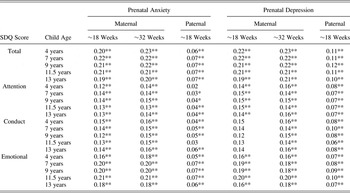
Table 2 shows the Pearson (r) correlation coefficients between maternal and paternal prenatal anxiety and depression continuous ratings, and child SDQ scores. Maternal prenatal anxiety was more strongly correlated with child SDQ scores than was paternal prenatal anxiety at each assessment (based on Fischer r to Z transformation, all ps < .001; data available upon request); comparable results were obtained for maternal and paternal prenatal depression. In addition, correlation coefficients were largely similar with maternal anxiety at 18 and 32 weeks, suggesting no/minimal timing effects. Correlation coefficients between maternal prenatal anxiety and maternal prenatal depression, and child SDQ score were similar (Fischer Z ≤ 1.90, all ps > .05). Virtually all of the correlations in Table 2 were statistically significant at p < .05 because of the large sample size; accordingly, it is the relative effect size of correlation coefficients that warrants interpretation.
Correlations between parental prenatal anxiety and depression and child Strengths and Difficulties Questionnaire (SDQ) scores across childhood

*p < .05. **p < .01.
Developmental analyses using growth curve modeling
Child SDQ scores changed over time in a U-shaped manner, with lower scores at age 9 than at 4 or 13 years. The trajectory of total emotional and behavioral difficulties across childhood was best described by a three-factor model: intercept, slope, and quadratic (CFI = 0.97, TLI = 0.99, RMSEA < 0.03; Figure 2). This was true for the three SDQ subscales: ADHD (CFI = 0.99, TLI = 0.99, RMSEA = 0.04), emotional difficulties (CFI = 0.99, TLI = 0.99, RMSEA = 0.02), and conduct problems (CFI = 0.99, TLI = 0.99, RMSEA = 0.03).
There were significant sex differences for the trajectories of total SDQ scores; males had a higher intercept score at 4 years of about one point higher (p < .001). This was mostly because of higher male scores in ADHD and conduct problems, early and across childhood (see online-only Supplementary Figure S.1 (http://journals.cambridge.org/dpp). The females showed increasing total scores at early adolescence, represented by a significantly higher quadratic term (p = .02). Females also tended to show elevated emotional problem scores at age 4 (p = .06) followed by a significant increase in difficulties across childhood (slope effect: p = .02). However, there was no significant interaction between child sex, prenatal maternal anxiety, and child outcome (details from first author), so the two sexes were combined for further analyses; child sex is included as a covariate in prediction models.
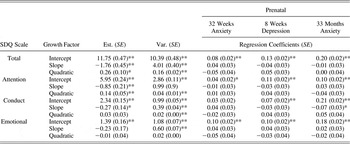
The results of the analysis of prenatal anxiety using the continuous scale are shown in Table 3. Maternal prenatal anxiety at 32 weeks predicted greater child emotional and behavioral problems independent of a range of confounders (maternal age and education, crowding as index of socioeconomic status, birth weight and gestational age of the child, child sex, maternal prenatal smoking and substance use, maternal postnatal depression and anxiety, paternal pre- and postnatal anxiety, and a parenting index). Specifically, maternal prenatal anxiety predicted higher means across occasions (intercept). This is true for the ADHD (p = .02) and emotional subscales (p < .001) but not for conduct problems (p = .17); maternal effects were unchanged when the analysis was restricted to participants with complete maternal and paternal prenatal anxiety data. Online-only Supplementary Table S.2 (http://journals.cambridge.org/dpp) provides the full regression models describing the effects of all the parameters for total and subscale SDQ scores. Additional analyses indicated comparable effects when we included postnatal anxiety (at 8 weeks postpartum) rather than postnatal depression (details available from the first author).
Prediction of child symptoms from prenatal, postnatal, and early childhood maternal mood ratings

Note: Covariates include maternal age, education, crowding as index of socioeconomic status, birth weight, and gestational age of the child, child sex, maternal prenatal smoking and substance use, maternal postnatal depression and anxiety, paternal pre- and postnatal anxiety, and a parenting index. Est., estimate; Var., variance.
*p < .05. **p < .01.
Figure 2 shows the trajectory of total SDQ scores for the children of the high and low 32-week prenatal anxiety groups from age 4 through 13 years. Total SDQ scores remained high in the high prenatal anxiety group into early adolescence. The analysis allowed for the wide range of possible confounders described above. Results were similar using maternal depression at 32 weeks or maternal anxiety at 18 weeks (details available from the first author). Children born to the more anxious women had a significantly elevated intercept (Δχ2 = 6.21, Δdf = 1, p = .01), with no significant between-group differences in the slope (linear rate of change in SDQ score over time) or quadratic terms (nonlinear rate of change). Figure 3 shows the predicted population prevalence of a mental health disorder based on total SDQ scores using the formula of Goodman and Goodman (Reference Goodman and Goodman2011), after allowing for all the same covariates. At 13 years, the children of mothers in the top 15% for anxiety at 32 weeks gestation had a risk of 12.31%, just under twice that of the rest of the children, who had a risk of 6.83%.
Analyses were carried out to examine if the effect obtained for prenatal maternal anxiety extended to prenatal maternal depression. The effects were comparable. Specifically, maternal prenatal anxiety and depression (at 32 weeks) both predicted child SDQ scores; the effects were confined to the intercept and were of a similar magnitude (prenatal anxiety: estimate = 0.08, SE = 0.02, p < 0.01; depression: estimate = 0.08, SE = 0.02, p < .01). Online-only Supplementary Table S.3 (http://journals.cambridge.org/dpp) includes detailed model results for analyses including maternal depression rather than maternal anxiety as a predictor.
Given the high correlation between these predictors (r = .76), we next tested their independence in a model containing both maternal prenatal anxiety and depression. The effects of maternal prenatal anxiety on the intercept were reduced (prenatal anxiety: estimate = 0.04, SE = 0.02, p = .06; depression: estimate = 0.05, SE = 0.02, p = .02) but not fully mediated by the inclusion of prenatal depression (and vice versa).
To model the combined effects of maternal prenatal (32 weeks gestational age) and postnatal anxiety (33 months), four groups were formed: low maternal anxiety (bottom 85%) in both the prenatal and postnatal periods (low/low); high (top 15%) maternal anxiety in the prenatal but not the postnatal period (high/low); high postnatal (top 15%) but not prenatal anxiety (low/high); and high maternal anxiety in the prenatal and postnatal periods (both top 15%; high/high), allowing for all the previous confounders. Figure 4 shows that exposure to maternal anxiety in the prenatal and postnatal periods resulted in a significantly higher intercept relative to the low anxiety group (p < .05). The trajectories of the two middle groups were similar, indicating a similar magnitude of association with prenatal and postnatal anxiety. No between-group differences in the two middle groups were found. Similar patterns were found using anxiety at 18 weeks and depression at either prenatal time point (details available from first author).
Discussion
Findings from this long-term prospective longitudinal study of a large community cohort show that maternal anxiety and depression in pregnancy predicted lasting effects on behavioral and emotional problems in the child, after adjusting for multiple confounders, and that this effect is clinically as well as statistically significant. These results considerably extend previous research and are consistent with the emerging programming model for psychopathology derived from experimental animal work and increasingly translated to human development. We discuss the broader context for the findings and potential mechanisms of action before addressing the limitations and clinical applications.
Several features of the results for prenatal anxiety and depression deserve special attention. The first is that the effects were specific to the intercept and not on change in disturbance across the 4–13 years of age. Although there were sizable changes in the levels of these symptom clusters over time, which varied somewhat by child sex (which is consistent with developmental epidemiological work), the prenatal effect was to increase symptom levels to a constant degree. The absence of a linear or quadratic effect means that the effect of prenatal mood on behavioral and emotional problems did not decrease over time. In other words, the impact of prenatal anxiety or depression on behavioral problems at age 13 years was not significantly weaker than at age 4 years, despite the pronounced psychological and biological changes that occur in this decade of life. This degree of persistence is notable and rare in developmental studies of psychopathology in which there is often a weakening of effect between predictor and outcome as the length of time between them increases. Nonetheless, it parallels the experimental animal work demonstrating that the prenatal stress effects persist into the offspring's adult life.
The second key feature of the results is that the effects were observed despite controlling for multiple confounders, including obstetric and psychosocial risk, maternal postnatal depression and anxiety, maternal parenting, and paternal prenatal and postnatal mood and postnatal depression. The inclusion of postnatal maternal mood helps to control for rater bias and confirms that there is something particular to maternal anxiety or depression in pregnancy that is not accounted for by (or mediated by) postnatal mood. The results with paternal anxiety are also notable. The correlations between maternal prenatal anxiety and child outcome were much stronger than with paternal anxiety (Table 2), and including paternal prenatal anxiety into the final model did not have a significant effect on the growth curves. This suggests that maternal prenatal anxiety has a much larger effect than does paternal prenatal anxiety (which is not significant) and provides additional support for the in utero programming hypothesis. Our approach of including multiple postnatal maternal measures and other covariates provides considerable protection from confounding factors; the inclusion of maternal postnatal and paternal mood as covariates also provides some protection against method variance and genetic confounds. That, together with the finding of effects persisting into adolescence, provides the strongest evidence to date of fetal programming of emotional/behavioral outcomes in humans. Nonetheless, we are not yet able to confirm causal effects from this observational study design. Studies in this area lack the experimental leverage to show causal associations between prenatal mood and child outcomes. It would be unethical to induce anxiety in pregnancy, and treatment trials for reducing prenatal anxiety are so far quite limited (O'Connor, Monk, & Fitelson, Reference O'Connor, Monk and Fitelson2014).
A third key feature concerns subscales. The effects were most marked for internalizing symptoms in the child. This differs somewhat from analyses at earlier ages, which showed robustness across subscales (O'Connor et al., Reference O'Connor, Heron, Golding and Glover2003), but it is congruent with other longer term follow-up studies that examine internalizing symptoms (e.g., van den Bergh et al., Reference van den Bergh, Van Calster, Smits, Van Huffel and Lagae2008). Additional work is needed to examine programming effects in light of developmental changes in the epidemiology of psychological symptoms and psychiatric disorder from early childhood through adulthood. Fourth, despite our emphasis in prior studies on prenatal anxiety late in pregnancy, results from these analyses suggest that, at least for behavioral and emotional problems, the risk phenotype in pregnancy is rather broad and there are not obvious developmental timing effects. In other words, the effects of prenatal anxiety at 32 weeks were not substantively different from prenatal anxiety at 18 weeks or prenatal depression at either time point. Anxiety and depression often occur together, and more research will be needed to disentangle whether the biological changes associated with anxiety and depression are different and have different programming mechanisms, or whether they share the same mechanisms. More research is also needed with respect to gestational timing. This is likely to differ for different outcomes according to when different regions of the brain associated with anxiety or memory (e.g., the amygdala and the hippocampus) may be at their most vulnerable. It is notable that some outcomes linked with prenatal anxiety, stress, or depression, such as atypical laterality and morphological changes (cleft lip and palate) do seem more sensitive to anxiety earlier in pregnancy (Glover, O'Connor, Heron, & Golding, Reference Glover, O'Connor, Heron and Golding2004; Hansen, Lou, & Olsen, Reference Hansen, Lou and Olsen2000).
Which mechanisms account for the obtained prenatal effect are not clear from the current analyses. Several candidate explanations exist, including altered function of the placenta (O'Donnell et al., Reference O'Donnell, Bugge Jensen, Freeman, Khalife, O'Connor and Glover2012); alteration of the child's hypothalamic–pituitary–adrenal axis that may increase risk for subsequent psychopathology (O'Donnell et al., Reference O'Donnell, Glover, Jenkins, Browne, Ben-Shlomo and Golding2013); and alteration of brain morphology that may underlie stable individual differences in psychopathology (Buss, Davis, Muftuler, Head, & Sandman, Reference Buss, Davis, Muftuler, Head and Sandman2010), although other mechanisms are likely. Follow-up and additional studies that explain persistence of effect are needed, and will be required to understand under which clinical and treatment applications these results hold. In this regard, it is notable that, although the pattern of development of the SDQ subscale scores differed over time with boys and girls, the magnitude of effect of prenatal anxiety or depression was comparable in boys and girls.
Limitations
The first limitation of the current study is that maternal mood was derived from self-report in pregnancy. We did not have direct measures of biological mechanisms that might mediate the prenatal anxiety effect. Second, the SDQ data are based on maternal report; comparable paternal report SDQ data were not available. Nonetheless, the results imply that simple explanations such as reporter bias are insufficient for accounting for the prenatal effect because it remained after accounting for multiple maternal postnatal measures (although we cannot rule that out entirely). Third, we are unable to account for a possible genetic mediation of these effects; the need for further research on genetic influences that may moderate the effects of early stress, as well as epigenetic changes that might be linked with stress exposure, including prenatal stress, has been discussed (Bick et al., Reference Bick, Naumova, Hunter, Barbot, Lee and Luthar2012; Braithwaite et al., Reference Braithwaite, Ramchandani, O'Connor, van Ijzendoorn, Bakermans-Kranenburg and Glover2013; Monk, Spicer, & Champagne, Reference Monk, Spicer and Champagne2012). Balancing these limitations were several strengths, including a long-term prospective longitudinal design based on a large community sample; detailed assessment of risks, outcomes, and confounders; inclusion of multiple covariates that would account for alternative explanations; and a sophisticated data analytic approach that allowed us to differentiate between stable effects and changes over time.
Clinical implications
Approximately one million children in the United Kingdom suffer from some form of neurodevelopmental problem (Ford, Goodman, & Meltzer, Reference Ford, Goodman and Meltzer2003), and comparable population rates are found in other countries around the world (Costello, Mustillo, Erkanli, Keeler, & Angold, Reference Costello, Mustillo, Erkanli, Keeler and Angold2003). Advances in immunizations, reductions in toxic exposures, and healthcare improvements have had a sizable impact on preventable physical health maladies. Interventions for reducing clinical disturbances in child behavioral disorders are also widely available (Scott & O'Connor, Reference Scott and O'Connor2012; Scott et al., Reference Scott, Sylva, Doolan, Price, Jacobs and Crook2010). Our findings complement and perhaps challenge this work by suggesting that prenatal maternal mood has lasting effects on child and adolescent psychopathology, and accounts for a notable increase in the rate of behavioral disturbance. The clinical and policy implication is that early interventions to prevent behavioral disorders, which has a major public health cost, could begin in pregnancy by targeting maternal mood.
Supplementary Materials
The supplementary materials referred to in this article can be found online at http://journals.cambridge.org/dpp