Introduction
Emerging organic pollutants such as pharmaceutical and medical substances, persistent organic pollutants (POPs) and endocrine disruptors have been dispersed worldwide and as a result are emerging in surface, groundwater and even in drinking water, in the latter case due to inefficient removal treatments (Ikehata et al., Reference Ikehata, Gamal, El-Din and Snyder2008; Benner et al., Reference Benner, Helbling, Kohler, Wittebol, Kaiser, Prasse, Ternes, Albers, Aamand, Horemans, Springael, Walravens and Boon2013). The concentrations of these substances are low but increasingly numerous (year by year) and variable over time (Khetan & Collins, Reference Khetan and Collins2007; Rodil et al., Reference Rodil, Quintana, Concha-Graña, López-Mahía, Muniategui-Lorenzo and Prada-Rodríguez2012). These substances can exert toxicological but also epigenetic effects on many functions, operating on somatic cells and in the germ line, in this case promoting transgenerational effects (Rusiecki et al., Reference Rusiecki, Baccarelli, Bollati, Tarantini, Moore and Bonefeld-Jorgensen2008; Skinner, Reference Skinner2011).
Contrasting with toxicological studies where the substances concentration effects to be evaluated have been previously established (Galus et al., Reference Galus, Kirischian, Higgins, Purdy, Chow, Rangaranjan, Li, Metcalfe and Wilson2013; Dai et al., Reference Dai, Jia, Chen, Bian, Li, Ma, Chen and Pei2014), in the current paper there is no intention to detect specific pollutants, but the effect of the mixture of pollutants possibly present in drinking water on phenotypic characters of the zebrafish (Martínez-Sales et al., Reference Martínez-Sales, García- Ximénez and Espinós2015b). In fact, the option to develop an analysis waters study comes as a very difficult alternative, since emerging organic pollutants are new products without regulatory status and, therefore, without a specific control (Deblonde et al., Reference Deblonde, Cossu-Leguille and Hartemann2011). Moreover, the vast quantity of these new substances in the environment makes very difficult to limit them. (von der Ohe et al., Reference von der Ohe, Dulio, Slobodnik, De Deckere, Kühne, Ebert, Ginebreda, De Cooman, Schüürmann and Brack2011; Nikolaou, Reference Nikolaou2013). Hence, due to the complexity of their detection and removal, bioindicators can be used as an alternative to monitor their presence.
In our previous work (Martínez-Sales et al., Reference Martínez-Sales, García- Ximénez and Espinós2015b), we defined and narrowed the most sensitive developmental and reproductive parameters in zebrafish, with the long-term aim of establishing the zebrafish as a bioindicator of the possible presence of environmental pollutants. Specifically, the assessment was carried out in three drinking waters from different tap water sources. The most sensitive parameters detected were: hatching rate, fertility rate and underdeveloped specimens. So, in the present work we focused on these parameters in order to study the possible cumulative effect and/or possible reversibility of the effects, between generations, of these environmental pollutants in the same three drinking waters (A, B and C), despite the fact that there are other sensitive parameters, for example sex ratio.
Materials and methods
Zebrafish maintenance
Both F0 obtained from the original wild zebrafish colony and F1 generations were reared in the laboratory following the protocol described in Westerfield (Reference Westerfield1995). Briefly, adult zebrafish were kept in 20 l glass tanks at 28.5°C, in a 3:2 ratio (females:males) (Westerfield, Reference Westerfield2007) and fed on granular food supplemented with recently defrosted hen egg yolk and shrimp meat (Simão et al., Reference Simão, Cardona-Costa, Pérez Camps and García-Ximénez2010 a) twice a day. The light cycle was regulated on a 14 h light/ 10 h dark cycle (Brand et al., Reference Brand, Granato, Nüslein-Volhard, Nüslein-Volhard and Dahm2002; Matthews et al., Reference Matthews, Trevarrow and Matthews2002). The aquaria had water recirculation systems but without active carbon filters to avoid removal of chemical pollutants possibly present in water. According to the Westerfield (Reference Westerfield2007) recommendations, a quarter of the total aquarium water was removed weekly and replaced by clean water to avoid ammonia, nitrite and nitrate toxic concentrations.
It must be stated that all environmental conditions were identical to all aquaria and the spatial distribution of the aquaria was randomized in the housing room.
The experimental procedures and animal care in this work fully comply with the standards for use of animals established by the Ethical Committee of the Polytechnic University of Valencia, which specifically approved this study.
Water sources
The four different drinking waters used in the present study (the same as in our previous work) were classified depending on their source in the region of Valencia (Spain), into three waters from different tap water distribution networks (A, B and C) and one bottled spring water (stored in plastic) which was established as a control. Type A was tap water from a city located in a region with intensive farming activity, from the hydrological basin of the Túria river. Type B was from the tap water distribution network of a medium-sized city, supplied from the Túria and Xúquer rivers. Finally, type C was tap water from a city also located in a region with intensive agricultural activity, but from the hydrological basin of the river Xúquer. Types A and C came from groundwater prospecting.
Before filling the aquaria with water, recipients (where the water was stored) were kept open for at least a week, with a large exchange surface to favour chlorine elimination (Westerfield Reference Westerfield1995).
It should be mentioned that all the waters were potable and also that the chemical parameters defined for tap water for human consumption in Royal Decree 140/2003 of 7 February, which establishes the health criteria for the quality of water intended for human consumption, are suitable for zebrafish breeding and maintenance (Westerfield, Reference Westerfield2007). Furthermore, the drinking waters used met the physical and chemical requirements set by this Royal Decree.
Specimen management
Fertilized embryos were obtained by siphoning. Batches of 20 fertilized and normal developing embryos at the Mid Blastula Transition (MBT) stage with the chorion intact (Martínez-Sales et al., Reference Martínez-Sales, García- Ximénez and Espinós2015a,b) were selected under a stereo microscope. These embryos were left in Petri dishes and cultured until 5 days post fertilization (dpf) at 28.5ºC in dishes with the same water type where their progenitors were reared (same water origin and water destination: A–A; B–B; C–C; Control–Control) and, conversely, in dishes with control water (different water origin and water destination: A–control; B–control; C–control).
Next, from 5 dpf to complete adulthood (5 months post fertilization) larvae were left in aquaria (20 l) in the same type of water as that in which their progenitors were reared and in aquaria with control water, to assess either the possible cumulative effect of specimen culture in the same water or the possible reversibility effect when culture was in control water. From these combinations, four replicates were established with 28 aquaria and with a maximum of 20 specimens per aquarium.
After 3 months, marbles were placed in each aquarium with the aim of siphoning all aquaria two or three times a week throughout the fourth and the fifth month, to evaluate the onset of spawning and the fertility rate. Sex ratio of the surviving adults, underdeveloped specimens and survival and abnormality rates at 5 months post fertilization (mpf) were also evaluated. Moreover, in the F1 offspring (F2 larvae) we evaluated the survival and abnormality rates at 5 dpf and the hatching rate at 72 hours post fertilization (hpf).
Experimental design
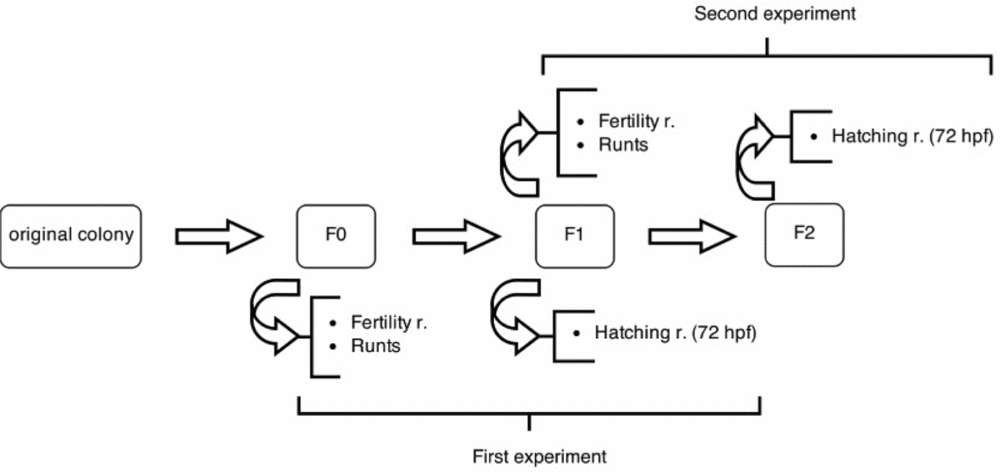
Two different analyses were carried out on the most sensitive parameters obtained in our previous work: hatching rate, fertility rate and underdeveloped specimens. The first analysis studied the possible cumulative effect between generations. To this end, fertility rate and underdeveloped specimens (runts) were compared in the F0 and F1 generations. In turn, the hatching rate at 72 hpf was compared in the F1 and F2 generations (see Fig. 1). The second analysis studied the possible reversibility of the effects in fertility rate and in underdeveloped specimens in the F1 generation, and hatching rate in the F2 generation.
Two different analyses were carried out on the most sensitive parameters. In the first experiment were compared the parameters from F0 (Generation 0) and F1 (Generation 1). The same comparison was carried out in the parameters from the F1 and the F2 generations (Generation 2).

Statistical analysis
The possible cumulative and reversible effects in all parameters were analysed using the chi-squared test (Statgraphics Plus 5.1). The Yates correction for continuity was used when a single degree of freedom was involved. Values were considered statistically different at P < 0.05.
Results
As stated in Materials and methods, four replicates were performed in all water groups with 28 aquaria at the outset. However, eight aquaria were discarded due to total mortality of the larvae cultured in Petri dishes until 5dpf for reasons unknown and uncontrolled. This mortality cannot be associated to a water type, as the mortality was random between groups. So, the minimum number of replicates per group was two, with 20 aquaria. In the first group (control–control) the final number of replicates was three, in the second group (A–A) the final number of replicates was two, in the third group (A–control) the final number of replicates was also two, in the fourth group (C–C) the final number was three, in the fifth group (C–control) the final number it was four, in the sixth group (B–B) the final number was two and in the seventh group (B–control) the final number was four.
Hatching rate
Hatching rate was evaluated at 72 hpf (Martínez-Sales et al., Reference Martínez-Sales, García- Ximénez and Espinós2015b) in the F1 and F2 generations during the fourth and fifth mpf.
Cumulative effect
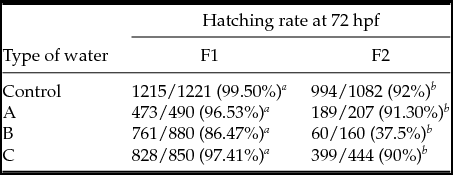
The analysis showed statistically significant differences (P < 0.05) between the F1 and the F2 generations in all waters studied (see Table 1). In all cases, the worst results were obtained in the second generation. These results reveal a cumulative effect in all waters, even in the control water. The negative cumulative effect in the case of water B should be highlighted.
Hatching rate of zebrafish (Danio rerio) embryos cultured in control water, water A, B and C at 72 hpf in F1 and F2 generations

a,b Columns with different superscripts are statistically different (P < 0.05).
Reversible effect
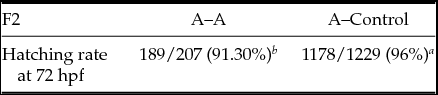
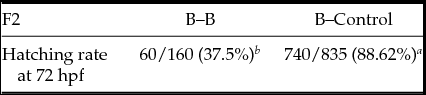
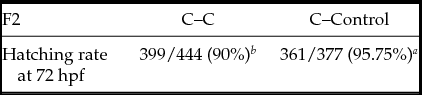
The analysis showed statistically significant differences (P < 0.05) between data from the specimens reared in waters with the same origin and destination and data from the specimens reared in control water in all waters studied (see Tables 2, 3 and 4). The worst result was obtained in all waters with the same origin and destination. These results reveal that there was a reversible effect in all waters when specimens were cultured in control water.
Hatching rate of zebrafish (Danio rerio) embryos cultured in water A–A and in water A–Control at 72 hpf in the F2 generation

a,b Columns with different superscripts are statistically different (P < 0.05).
Hatching rate of zebrafish (Danio rerio) embryos cultured in water B–B and in water B–Control at 72 hpf in the F2 generation

a,b Columns with different superscripts are statistically different (P < 0.05).
Hatching rate of zebrafish (Danio rerio) embryos cultured in water C–C and in water C–Control at 72 hpf in the F2 generation

a,b Columns with different superscripts are statistically different (P < 0.05).
Fertility rate
Fertility rate was evaluated through the fourth and fifth mpf in the F0 and F1 generations.
Cumulative effect
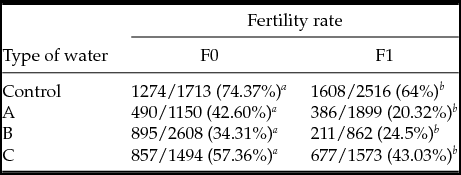
The analysis showed statistically significant differences (P < 0.05) between the F0 and the F1 generations in all waters studied (see Table 5). The worst results were obtained in the second generation (F1). These results reveal a cumulative effect in all waters, including the control water.
Fertility rate of adult zebrafish (Danio rerio) cultured in control water, water A, B and C in F0 and F1 generations

a,b Columns with different superscripts are statistically different (P < 0.05).
Reversible effect
The analysis showed statistically significant differences (P < 0.05) between data from specimens reared in waters with the same origin and destination and data from specimens reared in control water in all waters studied (see Tables 6, 7 and 8). In the case of waters A and B, the worst result was obtained in waters with the same origin and destination (A–A and B–B), whereas in water C the result did not improve when specimens were cultured in control water. These results revealed that there was a reversible effect in waters A and B when specimens were cultured in control water, but a non-reversible effect in water C.
Fertility rate of adult zebrafish (Danio rerio) cultured in water A–A and in water A–Control in the F1 generation

a,b Columns with different superscripts are statistically different (P < 0.05).
Fertility rate of adult zebrafish (Danio rerio) cultured in water B–B and in water B–Control in the F1 generation

a,b Columns with different superscripts are statistically different (P < 0.05).
Fertility rate of adult zebrafish (Danio rerio) cultured in water C–C and in water C–Control in the F1 generation

a,b Columns with different superscripts are statistically different (P < 0.05).
Underdeveloped specimens (runts)
In this work, specimens evaluated at 5 mpf in the F1 generation were all sexes that were clearly identifiable, and morphologically were also similar. Hence, there were no underdeveloped specimens.
Sex ratio
Even though in the previous work sex ratio was not a sensitive parameter, in the present work, water C displayed a feminization process. Therefore, sex ratio in water C was analysed at 5 mpf in the F0 and in the F1 generations.
Cumulative effect
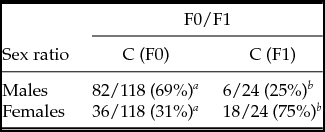
The analysis showed statistically significant differences (P < 0.05) between water C from F0 and water C from F1. The worst result was obtained in water C from F1, where the sex ratio was skewed towards females (males 25%: females 75%) (see Table 9). No significant difference (P > 0.05) was obtained in the other waters (A and B) whose sex ratio percentages were within the normal range in zebrafish in both generations (60 males: 40 females) (Fenske et al. Reference Fenske, Maack, Ensenbach and Segner1999).
Sex ratio of zebrafish (Danio rerio) adults cultured in water C at 5 mpf in F0 and F1 generations

a,b Columns with different superscripts are statistically different (P < 0.05).
Reversible effect
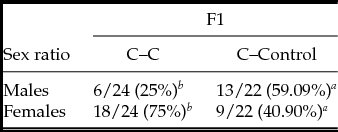
The feminization detected in specimens cultured in water C, disappeared when were reared in control water (see Table 10).
Sex ratio of zebrafish (Danio rerio) adults cultured in water C–C and in water C–Control at 5 mpf in F1 generation

a,b Columns with different superscripts are statistically different (P < 0.05).
Discussion
The reasons that prevent to develop an analytical water study of emerging organic pollutants are mostly the lack of information regarding their occurrence and toxicity, the lack of appropriate analytical methods for their determination, or both (Nikolaou, Reference Nikolaou2013).
Based upon results from our previous work (Martínez-Sales et al., Reference Martínez-Sales, García- Ximénez and Espinós2015b), hatching rate, fertility rate and underdeveloped specimens were the most sensitive parameters to detect the possible presence of environmental pollutants in drinking waters from different tap water distribution networks (A, B and C). These parameters were selected considering the full life-cycle (from development to reproduction) of zebrafish specimens.
The same waters were used in the present work, but it should be taken into account that although these waters have the same original source, the physical and chemical conditions of the water may have changed due to seasonal variations in quality at the water source (Ouyang et al., Reference Ouyang, Nkedi-Kizza, Wu, Shinde and Huang2006), although in order to be drinkable it should meet legal strict limits. Nonetheless, differences between waters also appeared in the same parameters in this experiment, except in the rate of underdeveloped specimens.
The period around hatching is a critical stage during embryogenesis (Henn, Reference Henn2011), which is why the hatching rate has been extensively used as a parameter in many toxicological studies (Han et al., Reference Han, Jiao, Shan and Zhang2011; Galus et al., Reference Galus, Kirischian, Higgins, Purdy, Chow, Rangaranjan, Li, Metcalfe and Wilson2013) as well as a parameter for reproductive toxicity assessment (Simon et al., Reference Simon, Mottin, Geffroy and Hinton2011). Our results for hatching rate revealed that although the results were high in all waters in both generations, except in water B (86.47% in F1 and 37.5% in F2), there was a negative cumulative effect in the second generation in all waters tested, even in the control water. Surprisingly, water B reached the worst results in both generations compared to the control water, decreasing to 48.97% (86.47–37.5%) in the second generation compared with the first. These outcomes may suggest either the possible increasing presence of pollutants such as pharmaceutical substances (David & Pancharatna, Reference David and Pancharatna2009), endocrine disruptors (Han et al., Reference Han, Jiao, Shan and Zhang2011) and insecticides (Mandrell et al., Reference Mandrell, Truong, Jephson, Sarker, Moore, Lang, Simonich and Tanguay2012), among others (Duan et al., Reference Duan, Zhu, Zhu, Yao and Zhu2008) in waters in both experiments (generations) which affect the hatching process and/or the possible transmission of these negative effects to the next generation via epigenetic mechanisms (Skinner et al., Reference Skinner, Manikkam and Guerrero-Bosagna2010; Skinner, Reference Skinner2011). However, it should be stated that when specimens were cultured in control water, this cumulative effect disappeared, which rules out a possible transgenerational transmission via epigenetic mechanisms.
Fertility rate has also been used in many toxicological studies as a good parameter (Ankley & Johnson, Reference Ankley and Johnson2004; Liu et al., Reference Liu, Jin, Huang and Zhu2014). Results from fertility show that there was a negative cumulative effect in the second generation compared to the first in all waters, even in the control water. The most pronounced reduction between generations was obtained in water A, 22.28% (42.60–20.32%), as this water reached the lowest rate (20.32%), followed by water B (24.5%) in the second generation. These outcomes may suggest either the possible increasing presence of the same pollutants in waters in both experiments (generations), which affected the fertility rate and/or the possible transgenerational transmission of these negative effects to the next generation via epigenetic mechanisms (Skinner et al., Reference Skinner, Manikkam and Guerrero-Bosagna2010; Skinner, Reference Skinner2011). It should be noted that when specimens were cultured in control water, there was a reversible effect in waters A and B, which ruled out a possible transgenerational transmission via epigenetic mechanism in these waters, although the cumulative effect remained in water C, the fertility rate decreasing to 12.03% (43.03–31%) when specimens were cultured in control water.
So, on the basis of these findings we posit the possible presence of environmental pollutants in waters A and B that affect fertility rate in both generations without transgenerational transmission, due to the reversibility process in these waters. Nevertheless, in water C the non-reversible effect also leads us to consider the possible presence of environmental pollutants in water C that affect fertility rate in both generations, but in this case with a possible transgenerational transmission due to the maintenance of the cumulative effects when specimens were cultured later in control water. This could be explained because early exposure during critical periods of development to environmental pollutants, such as endocrine disruptors (Braw-Tal, Reference Braw-Tal2010), can promote an adult-onset alteration (in this case a reduction in fertility rate) long after the compound is removed, even in subsequent generations if the germ line is affected through epigenetic mechanisms (Skinner et al., Reference Skinner, Manikkam and Guerrero-Bosagna2010; Skinner, Reference Skinner2011).
Regarding the non-reversible effect of the fertility rate in water C, although we are unable to describe the mechanism of action behind this effect, a plausible explanation could be an early exposure to some pollutant in water C during a critical period of embryo development (Braw-Tal, Reference Braw-Tal2010), such as the MBT stage in our case, without a germ-line alteration via epigenetic mechanism. The crucial period for epigenetic regulation and modification of the germ-line is during the period of primordial germ cell migration and gonadal sex determination (Skinner et al., Reference Skinner, Manikkam and Guerrero-Bosagna2010), events that take place after the MBT stage (3 hpf) (Dahm, Reference Dahm, Nüslein-Volhard and Dahm2002), at the early gastrulation stage (from 6 hpf) (Yoshizaki et al., Reference Yoshizaki, Takeuchi, Kobayashi, Ihara and Takeuchi2002). So, taking this argument into account, the most likely explanation could be an alteration in the germ-line transgenerational transmitted from the previous generation (parents) via epigenetic mechanisms to this generation.
Sex ratio is a relevant parameter used in many toxicological studies (Hill & Janz, Reference Hill and Janz2003; Baumann et al., Reference Baumann, Holbech, Keiter, Kinnberg, Knörr, Nagel and Braunbeck2013; Liu et al., Reference Liu, Jin, Huang and Zhu2014). However, in our previous work, it was not classified as a sensitive parameter because in all drinking waters tested sex ratios were within the normal ranges. Thus, all percentages of females were around 40%, which agreed with our current results and with other studies on zebrafish (60 males:40 females) (Fenske et al. Reference Fenske, Maack, Ensenbach and Segner1999), (68:32) (Örn et al., Reference Örn, Holbech, Madsen, Norrgren and Petersen2003), (56:44) (Vaughan et al., Reference Vaughan, Van Egmond and Tyler2001; Hsioa & Tsai, Reference Hsioa and Tsai2003). However, in this second experiment in water C there was an alteration of sex ratio towards females (75%), although this feminization changed towards normal values in zebrafish when specimens were cultured in control water.
These results suggest the possible presence of some environmental pollutants, only in water C, such as endocrine-disrupting chemicals (17-ethinylestradiol, even at ng/l) that can disrupt sexual differentiation in fish (Larsen et al., Reference Larsen, Bilberg and Baatrup2009) and cause feminization and retardation of sexual maturation in zebrafish. These substances may trigger disruption of sex hormones during sexual development and alter female sex, male sex or even both sexes. In fish, the hormonal balance between estrogens and androgens appears to be an important factor in the course of sexual differentiation (Liu et al., Reference Liu, Jin, Huang and Zhu2014).
It must be highlighted that all environmental factors were rigorously controlled to avoid any external alteration of our sex differentiation in zebrafish, as this is known to be a difficult process in fish (Liew & Orbán, Reference Liew and Orbán2014) that can be affected by several environmental factors in a very complex way (Baroiller et al. Reference Baroiller, Guiguen and Fostier1999).
Evidence from our results gathered to date corroborates that zebrafish is a suitable model for use as a bioindicator to detect environmental pollutants in drinking water. The complexity of detecting these substances in conventional potabilization treatments, due to their interactions and their variable and random presence even at low levels in drinking water, makes their routine chemical detection and control difficult or even impossible (Khetan & Collins, Reference Khetan and Collins2007; Benner et al., Reference Benner, Helbling, Kohler, Wittebol, Kaiser, Prasse, Ternes, Albers, Aamand, Horemans, Springael, Walravens and Boon2013). For this reason, bioindicators could be used as backup control measures to conventional potabilization treatments.
Finally, the detection in our previous (Martínez-Sales et al., Reference Martínez-Sales, García- Ximénez and Espinós2015b) and current works of the negative effects on reproductive parameters in zebrafish reared in drinkable water is cause for alarm, as the presence of emerging organic pollutants in drinking water may be one of the reasons behind the decline in human reproduction in metropolitan areas (Toft et al., Reference Toft, Rignell-Hydbom, Tyrkiel, Shvets, Giwercman, Lindh, Pedersen, Ludwicki, Lesovoy, Hagmar, Spanó, Manicardi, Bonefeld-Jorgensen, Thulstrup and Bonde2006; Jurewicz et al., Reference Jurewicz, Hanke, Radwan and Bonde2009; Braw-Tal, Reference Braw-Tal2010; Mileva et al., Reference Mileva, Baker, Konkle and Bielajew2014; Vested et al., Reference Vested, Giwercman, Bonde and Toft2014).
Declaration of interest
The authors declare that there is no conflict of interest that could be perceived as prejudicing the impartiality of the research reported.
Funding
This research did not receive any specific grant from any funding agency in the public, commercial or not-for-profit sector.
Acknowledgements
The authors would like to thank Javier Rubio Rubio for his valuable technical support and Neil Macowan for improving the English of this manuscript.