Introduction
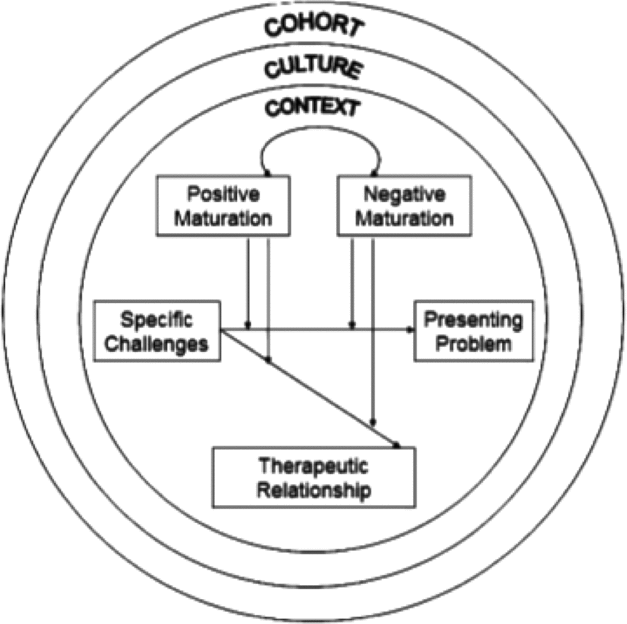
The CALTAP (see Figure 1) was developed to guide psychotherapists using a variety of systems of therapy in thinking about what aspects of therapeutic work might change when working with older adults rather than the younger adults that most therapies were originally designed for (Knight and Pachana, Reference Knight and Pachana2015). The model encourages attention to both positive and negative aspects of developmental aging, but places more emphasis on the social context of the older adult (as examples: age integrated vs. age segregated services and living arrangements; independent living vs. some level of aged care), and the broader social-historical contexts of cohort membership (e.g. World War 2 generation; Baby Boomers), and cultural background. The model is transtheoretical with regard to psychotherapy theories and can be used to guide adaptations of cognitive behavioral therapy (CBT), psychodynamic therapy, family therapy, and other evidence-based approaches to working with older adults.
Components of the contextual adult life span theory of adapting psychotherapy (CALTAP).

The model also calls attention to common specific challenges of later life including chronic illness and disability, bereavement, and family caregiving. Taken together, these influences suggest that working with older adults can be quite different in some instances from working with younger adults, but that the differences are often due more to these contextual factors and specific challenges rather than to normal developmental aging per se.
The model can be very useful in psychotherapeutic work with chronic illness and disability in older patients, including PD and its functional disability effects. A key issue for many patients, and their therapists, is separating the effects of their illness from the effects of developmental aging. Additionally, understanding what aspects of the patient's life are due to the other influences in the model (social context, cohort membership, cultural background, and values) can also be helpful for both patient and therapist in guiding the patient's adjustment to PD and the related changes in lifestyle. In this paper, we explain in more concrete detail how this works using case history examples of patients with PD in psychotherapy. First, we review background evidence for the need for psychological intervention with Parkinson's patients and the evidence for its effectiveness with them.
Psychotherapy and Parkinson's disease
PD is a chronic, and disabling neurological disorder predominantly observed in older persons. The prevalence of PD increases with age, and the prevalence estimates suggest 3% are over 65 years of age, while 10% are over 80 years of age (de Rijk et al., Reference de Rijk1997). Persons with PD often experience depression and/or anxiety (Weintraub and Burn, Reference Weintraub and Burn2011). Indeed, prevalence estimates in this patient group for major depression range between 11% and 17%, minor depression between 6% and 22%, and dysthymia between 6% and 13% (Reijnders et al., Reference Reijnders, Ehrt, Weber, Aarsland and Leentjens2008; Dissanayaka et al., Reference Dissanayaka2010). An average of 45% of patients with PD report clinically significant current depressive symptoms, and reports of lifetime depression in this group are reported to be as high as 66% (Dissanayaka et al., Reference Dissanayaka, Sellbach, Silburn, O'Sullivan, Marsh and Mellick2011). Anxiety is even more common, with prevalence estimates of up to 50%, with 75% of cases of anxiety occurring without concomitent depression (Dissanayaka et al., Reference Dissanayaka2010; Reference Dissanayaka2015; Reference Dissanayaka2016). With such high prevalence of these non-motor symptoms which greatly erode quality of life, and given the number of medications to control the symptoms of PD in these patients, the use of psychotherapy to address these psychiatric presentations is advantageous (Pachana et al., Reference Pachana2013).
While CBT is the most common psychotherapy method trialed in PD (Armento et al., Reference Armento, Stanley, Marsh, Kunik and York2012), other forms of therapy such as Interpersonal Therapy (IPT) may be entering this space (Rubino et al., Reference Rubino, Young and Dobkin2013). The clinical features of depression and anxiety appear to be somewhat different in patients with PD compared to the general population. Depressed PD patients are likely to experience greater dysphoria, irritability, anxiety, anhedonia, cognitive deficits, pessimism, and suicidal ideation without suicidal behavior, and less guilt and self-blame, early morning awakening, low mood with diurnal variation, withdrawal, and dysphoric mood fluctuations in response to the on–off states of dopaminergic therapy (Weintraub and Burn, Reference Weintraub and Burn2011; Wishart and Macphee, Reference Wishart and Macphee2011). PD specific manifestations of anxiety include fear, worry, insecurity, social embarrassment, and social withdrawal due to motor symptoms (e.g.: tremor, rigidity, slowness in movement, and postural instability), and to complications of PD therapy (e.g.: on–off motor fluctuations, dyskinesias, and impulse control behaviors) (Dissanayaka et al., Reference Dissanayaka, White, O'Sullivan, Marsh, Pachana and Byrne2014; Reference Dissanayaka2016). Persons with PD also experience psychological distress resulting from difficulties in acceptance and adjustment to the disease, and anxiety relating to seeking aid due to disability (Macht et al., Reference Macht, Schwarz and Ellgring2005).
Depression and anxiety are major contributors of lowering quality of life in PD patients (Schrag, Reference Schrag2006; Dissanayaka et al., Reference Dissanayaka2010). Motor and non-motor disability in PD often results in a high dependence on care from others, and caregivers play an important role in PD patients’ well-being. In most cases, care is provided by family members. Estimates suggest that on average caregivers spend 22 hours per week looking after the PD patient (Whetten-Goldstein et al., Reference Whetten-Goldstein, Sloan, Kulas, Cutson and Schenkman1997). Both physical disability and psychological manifestations of PD negatively impact the psychological well-being of caregivers (McLaughlin et al., Reference McLaughlin2011). Progressive declines in the physical health of PD patients increase caregiver burden, and subsequently reduce the psychological well-being of caregivers (Martínez-Martín et al., Reference Martínez-Martín2007; Peters et al., Reference Peters, Fitzpatrick, Doll, Playford and Jenkinson2011). Anxiety in PD patients is also highly associated with an increased caregiver burden (Viwattanakulvanid et al., Reference Viwattanakulvanid2014). Caregiver burden in PD elevates suicidal ideation in carers (Nielsen et al., Reference Nielsen2014), and reduces the quality of care available for the PD patient (McLaughlin et al., Reference McLaughlin2011). Therefore, psychotherapy such as CBT is useful to effectively improve carer depression and anxiety (Secker and Brown, Reference Secker and Brown2005). Nevertheless, the involvement of carers in CBT interventions for PD enhances the effectiveness of the treatment (Dobkin et al., Reference Dobkin2012).
While there is substantial evidence for the effectiveness of CBT with PD patients, incorporating cognitive restructuring based on CALTAP principles can enhance the impact of psychotherapy by supporting accurate attributions of the various changes in the patient's life to PD, to developmental aging, to social context, and to cohort and culture contexts. Without this focus, there is a tendency for patients to overgeneralize causal attributions to developmental aging and so support cognitions that encourage depressive and anxious automatic thoughts regarding the disease, their life, and their future.
Method
This paper uses case examples to demonstrate the usefulness of the CALTAP model in helping patients and clinicians separate disease symptoms from the process of aging. The examples also illustrate how doing this can be beneficial in reducing emotional distress in persons with PD.
Results
Specific challenges versus developmental aging as explanation
With regard to working with adults with PD, the CALTAP model first focuses attention on the implications for both therapist and client of being clear about which life changes are due to PD and which are related to aging. While the diagnosis of PD may well have some negative emotional impact, that impact is likely to be broader and more negative if the disease is taken as sign of the general breakdown of the body with aging. To the extent that PD is identified with aging, that identification also tends to lead to greater hopelessness. Aging itself cannot be avoided or reversed and clients who see their disease as part of the aging process are likely to be pessimistic about adapting to it and quite likely non-compliant with aspects of treatment and rehabilitation therapies.
Jim, a male client in his 70s, was referred for help with depression related to PD and some family issues (about which more will be said later in this article). He was doing rather well on medications and not experiencing a lot of tremors or muscle stiffness. He had also had some good results with an exercise program emphasizing large scale movements as a way to maintain functioning, but had stopped going to those sessions for unclear reasons. Initially, much of his depression focused on the contrast between his life in retirement with PD and his very active life when he had been working as a professional. He saw all of these changes as a single process of growing older. His middle-aged wife and his son were both working and pursuing educational goals. He was also socially isolated by living at the top of a rather steep hill, away from the nearest shops and access to public transportation. Early sessions of therapy focused on his feelings about the disease and working on possible alternative ways of being in touch with friends and pursuing activities he was actually personally interested in pursuing. At one point he reached out to some long time friends by phone, and they arranged a get together. A major psychological impact of the get together was that he compared himself both in terms of age and level of functioning to his friends and saw himself as less disabled than they were and separated his sense of retirement and aging from his sense of where he was in the disease.
Trudy, a female client about 80 years old, had been diagnosed for more than 10 years but had only recently developed noticeable tremors and difficulties in movement that made dressing herself difficult. She was very anxious and depressed, and spent the majority of most days in bed because she was able to pretend that she was not ill while she was in bed. Several sessions into her therapy, she opened up to talking about her reluctance to acknowledge the disease and reported that until around the time of the diagnosis she had always been the healthy one in a family that had quite a lot of chronic disease. She had a core belief in herself as a healthy person and as likely living to be more than 100. With that belief destroyed by her diagnosis and the progression of the disease, she felt that life was essentially over. In many ways, she was much more bothered by the loss of this identity of being healthy than she was by the symptoms of PD themselves. Some grieving about this change in identity and further discussion about what the future held for her as a PD patient, including thinking about how long she was likely to live with the disease, led to an improved attitude toward the disease and a more positive attitude toward getting out of bed, exercising more, and taking other steps to prolong active living as long as possible.
Clearly, these case examples would have gone very differently with a therapist who herself was inclined to see aging and disease as unified and did not make the key distinction between PD as a specific challenge that called for particular responses in terms of treatment, rehabilitation therapies, and adaptation to it rather than an expected part of growing old. Likewise, a therapist with unconscious ageist stereotypes might well have unintentionally reinforced the pessimistic beliefs of the clients rather than being able to guide the clients to a more realistic view of later life while also working on adjustment to PD as a specific disease.
Having a clear sense of normal developmental aging can also throw the issues involved in coping with late life disease and disability into a sharper focus. While there are some downsides to developmental aging including cognitive slowing, problems in name finding and word finding and so forth, there are also pluses including the accumulation of knowledge and expertise, generally better coping skills, generally better ability to regulate emotion and maintain a positive mood, and a lifetime of experience to draw upon (see Knight and Pachana, Reference Knight and Pachana2015 for more detail). Understanding these more positive aspects of aging can guide the therapist in identifying the specific individual strengths of the client with PD and helping them apply those strengths to coping with the illness.
In our case examples, Jim had a wealth of knowledge and social contacts developed over his professional career and a lot of intellectual and social justice interests that were fairly easily translatable into things that could be done from home as well as contacts with people and groups who could visit him or take him to meetings. His intelligence and investigative skills were also an asset in learning more about PD and thinking about how to adapt to it.
Trudy had a long history of helping others and taking care of others as well as interests in music and other arts. Although part of her adjustment to PD was cutting back some on her expectations of what she could do for others and learning to focus on helping herself, continuing to be involved in helping family members with serious illnesses was still very important to her and a mood enhancing set of activities. With encouragement in therapy, she also reengaged with her interests in music and used music to improve her day to day mood as well as making a point to go to concerts and performances to the extent that she could.
Social context
The social context of the client also has a strong influence on their psychological state and adjustment to PD. As noted earlier, many of Jim's frustrations and his social isolation were related to the physical context of his home being up a hill that he had trouble walking up if he went to places on his own. The need to walk and to use public transportation was also influenced by the social context of his family. His younger spouse and his young adult son were both very busy and used the cars that the family had to get to work and school. Since having the PD, he was also unsure of his own ability to drive in a large urban area.
In contrast, Trudy had more flexibility in going places because her husband was retired and had the time and willingness to drive her places. They also lived in a smaller city where driving was less challenging. This difference in family context meant that Trudy, with greater physical limitations, had more mobility within the community and more access to support and to social opportunities than Jim did.
Again, for the therapist a key aspect of the CALTAP approach is conceptualizing the client's problems and resources in terms of the social context rather than in terms of aging per se. Like the specific challenges of disease, thinking in terms of social context leads therapist and client to think in problem solving terms. In Jim's instance, considering the limitations of his social context suggested thinking through ways to get up and down the hill that would be easier for him, ways to increase social contact and activity that did not involve leaving the house (telephone, email, Skype), and also raised the question of whether his needs could be prioritized more within the family. Ideally, this last conceptualization could have led to family sessions and some changes in the family's willingness to help him get out more often.
Cohort effects
While they were not many years different in age, Jim and Trudy came from different identifiable cohorts. Jim was an early Baby Boomer and was particularly influenced by the civil rights struggles of the early 1960s in the US. Those early experiences had shaped much of his life values and influenced his professional work experience. He was sceptical of authority, including physicians. One of his complaints was that a neurologist he had really liked and had confidence in had gone on an extended leave and he was not accepting of the replacement neurologist. This complaint was less intense than his other issues, but still important to acknowledge in building rapport and reducing his anxiety. He also had some of the Baby Boomer's blithe disregard of aging, the Peter Pan syndrome of that generation that believes in never becoming older. Some of his psychological adjustment in later life came from never having given much thought to growing older. Helping him to see his reluctance to think about aging, to have planned for it, and to be positive about future aging as cohort characteristics rather than personal failures was a helpful step in reducing his self-blame about his lack of planning for post-retirement life and his negative attitude toward his own aging and also made it easier to change those attitudes. It is fairly common that people find that understanding aspects of their lives as older adults in cohort-based terms rather than as aspects of aging or their own personality opens up greater optimism about the possibility of change at their point in life.
Trudy was shaped more by growing up during World War 2 and the silent generation that followed soon after. She grew up with an expectation of difficult economic times, needing to work hard and to be careful with money and the style of greeting life problems with a “stiff upper lip” and wading through them. She was much more accepting of the status quo in society and generally more trusting of authority, including physicians. While she had not anticipated getting seriously ill, she had fully expected to get old, and in fact had expected a very long life. Helping her to frame her stoicism and reluctance to express feelings, especially negative ones as having been conditioned by her generational background helped her to open up about her feelings and talk with others in the family about her doubts and fears. One aspect of seeing these issues in cohort-based terms was that she became more open to taking advice on handling emotion from her daughter once the differences in their views were generational and not age related. This openness in turn improved her mood and her motivation for doing more.
Culture
While both were non-Hispanic White Americans, they were culturally different in the sense that Jim was and always had been a part of urban professional culture. His social world had been, and still was to a large extent, national and international in scope. This made the contrast with his current isolation sharper, but it also meant that he did have the possibility of connections to friends and colleagues that were reachable via phone, Skype, and email from his home.
Trudy had grown up in a small farming community in the middle of the US that was heavily influenced by the Scandinavian values of many of the settlers there. That background shaped a strong sense of self-reliance, and in fact a view of herself as someone who stayed strong and helped others, rather than one who needed or accepted help.
Discussion and conclusion
Psychotherapy with people with PD is an important adjunct to their medical treatment and has been shown to be effective in reducing depression and anxiety and thus eliminating excess disability due to these emotional disorders that are reactions to PD. On theoretical grounds and based on clinical experience, we would expect that adding the understandings of PD and of the aging process suggested by the CALTAP model and illustrated in the case examples given here would further enhance the effectiveness of psychotherapy. This enhancement would come from the patient's understanding of disease effects as distinct from general aging effects and from the increased optimism about change that often accompanies understanding effects of late life diseases as being in part influenced by social context, cohort, and culture.
This more nuanced understanding of aging and the contextual reasons for differences between older patients and the younger people around them can also be quite helpful emotionally. Generally negative attitudes towards aging are prevalent in most nations and older adults often have incorporated these attitudes into their self-perception as they have aged, knowingly or not. The more complex and realistic view of developmental aging and of age differences of CALTAP, derived in turn from life span developmental psychology and from scientific gerontology, is generally more realistic and less negative than these stereotypes that support automatic negative thinking about aging.
There are limitations of the approach taken in this paper. While the examples offered in the case histories are useful in explaining CALTAP concepts and illustrating their use in CBT, further research is needed to test the value added effects of combining CALTAP with CBT. CALTAP itself is potentially limited by its inherently rather abstract nature. Designed to be transtheoretical, it takes effort to translate the broad implications of CALTAP to in session therapy techniques. More of that translation is needed in the future as well in order to make it more broadly available to clinicians.
Nonetheless, this paper provides a start to understanding how CALTAP can be useful in guiding psychological interventions with PD. Therapists can use these conceptual principles to guide their work. The more nuanced understanding of the array of influences on the emotional state of the person with PD can be helpful in guiding the clinician's work in helping to alleviate depression and anxiety and their excess disability effects.
Conflict of interest
None.
Funding
There was no funding received for this manuscript.
Description of author's roles
All authors were involved with the conception, drafting, and revising the manuscript.
Acknowledgment
Dr Nadeeka Dissanayaka's fellowship is supported by the Lions Medical Research Foundation.