Introduction
Schizophrenia is a disorder that causes a great burden (Rössler et al. Reference Rössler, Salize, Van Os and Riecher-Rössler2005; Gustavsson et al. Reference Gustavsson, Svensson, Jacobi, Allgulander, Alonso, Beghi, Dodel, Ekman, Faravelli, Fratiglioni, Gannon, Jones, Jennum, Jordanova, Jönsson, Karampampa, Knapp, Kobelt, Kurth, Lieb, Linde, Ljungcrantz, Maercker, Melin, Moscarelli, Musayev, Norwood, Preisig, Pugliatti, Rehm, Salvador-Carulla, Schlehofer, Simon, Steinhausen, Stovner, Vallat, Van den Bergh, van Os, Vos, Xu, Wittchen, Jönsson and Olesen2011). For years antipsychotic medication has been the only option in the treatment of schizophrenia. However, over the last decades great interest has emerged in the effectiveness of psychological interventions (Wykes et al. Reference Wykes, Steel, Everitt and Tarrier2008; Morrison et al. Reference Morrison, Turkington, Pyle, Spencer, Brabban, Dunn, Christodoulides, Dudley, Chapman, Callcott, Grace, Lumley, Drage, Tully, Irving, Cummings, Byrne, Davies and Hutton2014).
Psychological interventions based on cognitive therapy are mainly addressed at modifying cognitive biases. Several cognitive biases are more prevalent in people with schizophrenia, and some of them are present from the early onset of the disease. Jumping to conclusions (JTC), making a decision without sufficient evidence, has been shown to be more prevalent in people with delusions and with first-episode psychosis than in healthy controls or people with other mental disorders, with differences of up to 73% v. 10% (Garety et al. Reference Garety, Hemsley and Wessely1991, Reference Garety, Freeman, Jolley, Dunn, Bebbington, Fowler, Kuipers and Dudley2005; Bentham et al. Reference Bentham, McKay, Quemada, Clare, Eastwood and McKenna1996; Conway et al. Reference Conway, Bollini, Graham, Keefe, Schiffman and McEvoy2002; Falcone et al. Reference Falcone, Murray, O'Connor, Hockey, Gardner-Sood, Di Forti, Freeman and Jolley2015a , Reference Falcone, Murray, Wiffen, O'Connor, Russo, Kolliakou, Stilo, Taylor, Gardner-Sood, Paparelli, Jichi, Di Forti, David, Freeman and Jolley b ; Dudley et al. Reference Dudley, Taylor, Wickham and Hutton2016). Regarding attributional style, a personalized bias has been described in people with psychosis, both in chronic and first-episode psychosis, in which patients blame others rather than themselves for negative situations (Bentall et al. Reference Bentall, Kaney and Dewey1991; Martin & Penn, Reference Martin and Penn2002; Fornells-Ambrojo & Garety, Reference Fornells-Ambrojo and Garety2009). Other cognitive biases such as overconfidence in errors and bias against disconfirmatory evidence have been described as being more prevalent in people with persecutory delusion (Kaney & Bentall, Reference Kaney and Bentall1992; Moritz et al. Reference Moritz, Woodward, Whitman and Cuttler2005; Moritz & Woodward, Reference Moritz and Woodward2006), who show higher levels of self-certainty in their decisions. Moreover, irrational beliefs that include demands, catastrophic thinking, low frustration tolerance, and conditional self-acceptance, are more frequent in people with schizophrenia (Newmark & Whitt, Reference Newmark and Whitt1983). In addition, social cognition is highly affected in people with schizophrenia and first-episode psychosis (Green et al. Reference Green, Bearden, Cannon, Fiske, Hellemann, Horan, Kee, Kern, Lee, Sergi, Subotnik, Sugar, Ventura, Yee and Nuechterlein2012; Bora & Pantelis, Reference Bora and Pantelis2013; Pinkham et al. Reference Pinkham, Penn, Perkins and Lieberman2003, Pousa et al. Reference Pousa, Duñó, Brébion, David, Ruiz and Obiols2008). These cognitive biases, as social cognition impairment, are important features as well as in the creation and maintenance of delusions and contribute negatively to the functioning of the patient.
Metacognitive training (MCT) is a group therapeutic approach to the treatment of psychotic symptoms based on a cognitive-behavioural model of schizophrenia with a psychoeducational approach addressed to reducing all the aforementioned cognitive biases (Moritz et al. Reference Moritz, Veckenstedt, Bohn, Köther, Woodward, Roberts and Penn2013a ). MCT has demonstrated its efficacy in the reduction of positive symptoms in people with schizophrenia (Moritz et al. Reference Moritz, Veckenstedt, Randjbar, Vitzthum and Woodward2011, Reference Moritz, Veckenstedt, Bohn, Hottenrott, Scheu, Randjbar, Aghotor, Köther, Woodward, Treszl, Andreou, Pfueller and Roesch-Ely2013b , 2014a, b; Balzan et al. Reference Balzan, Delfabbro, Galletly and Woodward2014; Erawati et al. Reference Erawati, Keliat, Helena and Hamid2014). A recent meta-analysis shows that MCT is useful for the reduction of positive symptoms and delusions, and acceptance of the intervention is greater than it is for other models (Eichner & Berna Reference Eichner and Berna2016). Moreover, other variables such as JTC, quality of life, cognitive insight, and memory also show improvement with MCT (Aghotor et al. Reference Aghotor, Pfueller, Moritz, Weisbrod and Roesch-Ely2010; Gawęda et al. Reference Gawęda, Krężołek, Olbryś, Turska and Kokoszka2015).
However, to our knowledge no study has tested the efficacy of MCT in people with a recent-onset of psychosis. Effective psychological intervention in recent-onset of psychosis is needed due to the importance of early intervention in reducing chronicity and improving the prognosis of the illness. Moreover, aspects related to metacognitive variables have to date scarcely been assessed, if at all.
Therefore, the aim of the present study was to assess the efficacy of group MCT in people with recent-onset of psychosis in terms of symptoms as a primary objective and metacognitive variables as a secondary objective.
Method
Design
A parallel multicenter randomized clinical trial was performed, in which one group received MCT while the other, a psycho-educational group, received sessions of equal frequency and duration. Patients were randomized for inclusion in the study in blocks of four from a list of random numbers in each center provided by the coordinator of the study. The person responsible of the study in each center was the person who assigned participants to each group.
Sample
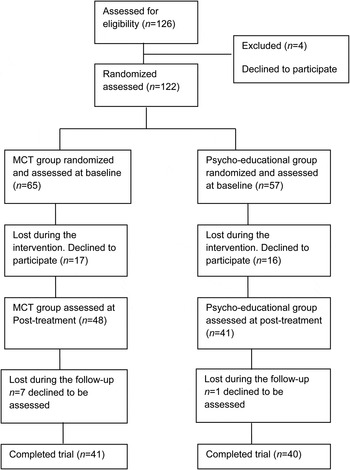
The sample size needed, based on the results reported by Moritz et al. (Reference Moritz, Veckenstedt, Randjbar, Vitzthum and Woodward2011), was 92, considering a 20% drop-out rate in the follow-up. In the end, our recruitment effort achieved a total sample of 126 patients. Four of them left the study after enrollment (see Fig. 1). The sample was composed of patients with recent-onset of psychosis (Breitborde et al. Reference Breitborde, Srihari and Woods2009) treated at one of the nine participating mental health centers: Servicio Andaluz de Salud of Jaén, Málaga and Motril (Granada), Salut Mental Parc Taulí (Sabadell), Hospital de Santa Creu i Sant Pau (Barcelona), Centro de Higiene Mental Les Corts (Barcelona), Institut d'Assistència Sanitària Girona, Hospital Clínico Universitario de Valencia, and Parc Sanitari Sant Joan de Déu (Coordinating center). Patients were enrolled by their clinical therapist. Inclusion criteria were (1) a diagnosis of schizophrenia, psychotic disorder not otherwise specified, delusional disorder, schizoaffective disorder, brief psychotic disorder, or schizophreniform disorder (according to DSM-IV-TR); (2) <5 years from the onset of symptoms; (3) a score during the previous year of ⩾3 in item delusions, grandiosity, or suspicions of PANSS (according to Moritz et al. Reference Moritz, Veckenstedt, Randjbar, Vitzthum and Woodward2011); and (4) age between 17 and 45 years. Exclusion criteria were (1) traumatic brain injury, dementia, or intellectual disability (premorbid IQ ⩽ 70); (2) substance dependence; and (3) PANSS ⩾5 in hostile and uncooperative and ⩾6 in suspiciousness, to avoid altering the dynamics of the group.
Trial profile.

Interventions
The interventions consisted of eight weekly group sessions of MCT (experimental group) in its third edition or psycho-educational (control group). The therapists were trained during a 2-day workshop by Steffen Moritz, author of MCT, and Lisa Schilling.
The MCT program included eight modules: Attributional style (1), Jumping to conclusions (2, 7), Changing beliefs (3), Empathy (4, 6), Memory (5), and Depression and self-esteem (8), worked through with PowerPoint presentations with different examples and material on all these topics.
In the psycho-educational group the modules were: Healthy habits (1); Risk Behaviors (2), Prevention of relapse (3), Video forum (4, 5), Resources of work (6), Leisure activities (7), and Resources available in the community (8). Material for each weekly module was previously agreed upon by all participating centers to unify interventions. Both interventions were performed in the patients’ habitual center of care.
Outcomes
Patients were assessed at baseline, post-treatment, and 6 months follow-up. The evaluator was blinded to the condition of the patients. The evaluators were trained in the scales of the study, scoring >0.70 in inter-rater reliability.
Symptoms were the primary outcome and were assessed with the Positive and Negative Syndrome Scale (PANSS; Kay et al. Reference Kay, Fizbein and Opler1987; Peralta & Cuesta, Reference Peralta and Cuesta1994).
The Global Asessment of Functioning (GAF; Endincott, Reference Endincott1976) was used to assess symptoms and social adaptation.
A battery of questionnaires regarding cognitive biases and social cognition was included in order to assess the secondary outcomes:
-
• Beck Cognitive Insight Scale (BCIS; Beck et al. Reference Beck, Baruch, Balter, Steer and Warman2004; Gutiérrez-Zotes et al. Reference Gutiérrez-Zotes, Valero, Cortés, Labad, Ochoa, Ahuir, Carlson, Bernardo, Cañizares, Escartin, Cañete, Gallo and Salamero2012) consists of a self-administered scale assessing cognitive insight, containing self-reflectiveness and self-certainty subscales, and a composite index. Cronbach's alpha in the Spanish validation for self-reflectiveness was 0.59 and 0.62 for self-certainty.
-
• Jumping to Conclusions (JTC) was assessed with the beads task in which the subject must take a decision regarding the probability of the extracted bead belonging to one of two jars. In task 1 the probability is 85:15 and in task 2 it is 60:40. JTC was considered as taking a decision after extracting one or two beads (Brett-Jones et al. Reference Brett-Jones, Garety and Hemsley1987).
-
• Irrational beliefs were assessed with the Irrational Belief Test (TCI; Calvete & Cardeñoso, Reference Calvete and Cardeñoso2001). The scale is composed of ten subscales: needing acceptance from others, high expectations, guilt, intolerance to frustration, worry and anxiety, emotional irresponsibility, avoidance of problems, dependence, helplessness, and perfectionism. Cronbach's alpha in the Spanish validation for the subscales oscilated between 0.63 and 0.79.
-
• Attributional style was assessed with the Internal, Personal and Situational Attributions Questionnaire (IPSAQ; Kinderman & Bentall, Reference Kinderman and Bentall1996), including two subscales: Externalizing and Personalizing Bias.
-
• The Hinting Task was used to assess Theory of Mind (ToM; Corcoran et al. Reference Corcoran, Mercer and Frith1995; Gil et al. Reference Gil, Fernández-Modamio, Bengochea and Arrieta2012). In order to avoid learning, three different stories were used in each assessment taking into account their validity and the level of difficulty according to the scores obtained in the Spanish validation of the questionnaire. Cronbach's alpha of the Spanish version of the instrument was 0.64.
-
• Emotional perception was assessed with the Emotional Recognition Test Faces (Baron-Cohen et al. Reference Baron-Cohen, Wheelwright and Jolliffe1997), composed of 20 photographs that express ten basic and ten complex emotions.
Ethical aspects
The project was evaluated by the research and ethics committees of the coordinating center and each center included in the study. The participants signed informed consent for participation in the study. The study was recorded in Clinical Trials (Identifier: NCT02340559).
Statistical analysis
The differences between each assessment were compared by group with Student's t test and ANCOVA. McNemar association was used to compare JTC between each assessment. A general linear model for repeated measures was performed in order to compare the longitudinal effect of the intervention. A complementary analysis was performed in order to assess the intra-group differences using a comparison means for repeated measures. The analyses were performed imputing data from the last evaluation in follow-up and without imputation. The results shown corresponded to those with no imputed data. All the analyses were controlled for number of sessions, not a significant variable. Effect sizes of the comparison were analyzed with the Cohen's d.
Results
Fig. 1 is the flowchart of participants in each of the three assessments. The analyses were performed with the total number of patients that completed the baseline and post-treatment assessment (n = 89) and follow-up (n = 81). Percentage of drop-outs in the post-treatment assessment was 27% in the MCT group and 28.1% in the psycho-educational group. Mean number of sessions attended was 4.95 (s.d. = 2.98) for the psycho-educational group and 5.53 (s.d. = 2.46) for the MCT group. No statistical differences were found. The best attended sessions of the MCT group were: attributional style (1), jumping to conclusions (2), memory (5) and depression and self-esteem (8); while changing beliefs session had lower adherence (3).
The study started in June 2011 and inclusion of patients was closed by December 2013. The study with the follow-up was closed in August 2014.
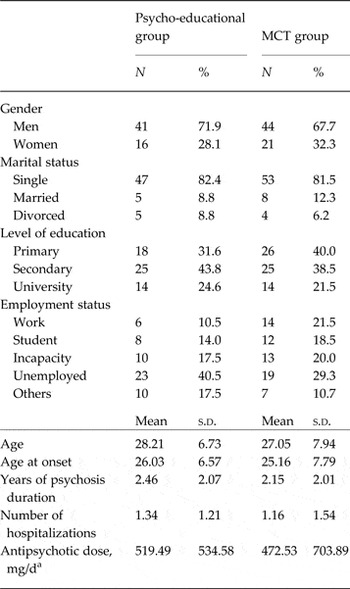
Table 1 indicates the sociodemographic characteristics of the two groups, MCT and psycho-educational. No statistical differences were found regarding any sociodemographic or clinical characteristics between the two groups at baseline.
Sociodemographic characteristics of the sample

MCT, Metacognitive Training.
a Antipsychotic drug doses are expressed as chlorpromazine equivalence.
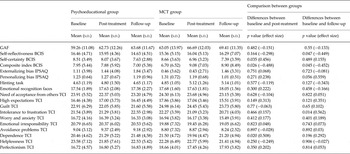
Table 2 shows that there was no difference in PANSS assessment at baseline and post-treatment, and baseline and follow-up, between the two groups.
Differences in clinical outcomes between MCT and psycho-educational groups

MCT, Metacognitive Training; PANSS, Positive and Negative Syndrome Scale.
Table 3 shows that BCIS self-certainty, BCIS composite index, and dependence of the TCI improved in the MCT group v. the psycho-educational group between baseline and post-treatment. Between baseline and follow-up there are differences in the groups in BCIS self-reflectiveness, BCIS composite index, and intolerance to frustration of the TCI.
Differences in functioning and metacognitive variables between MCT and psycho-educational groups at baseline compared to post-treatment, and baseline compared to follow-up

MCT, Metacognitive Training; GAF, Global assessment of functioning; BCIS, Beck Cognitive Insight Scale; IPSAQ, Internal, Personal and Situational Attributions Questionnaire; TCI; Irrational Belief Test.
Regarding the effect of the intervention taking into account three assessments (baseline, post-treatment, and follow-up) together, a general linear model for repeated measures was performed. The PANSS positive was significant for time effect (p = 0.001) but not for the time × group interaction (p = 0.316). The PANSS negative had a significant effect of time (p = 0.005), but no effect for time × group interaction was found (p = 0.651). Regarding the PANSS general, a clear effect of time was found (p < 0.001), but no effect for time × group interaction was detected (p = 0.107). Finally, the PANSS total was significant for time (p < 0.001) but not for the time × group interaction (p = 0.193). Regarding general functioning, GAF score indicated that there was an effect of time (p = 0.004) but not of group (p = .54). On the self-reflectiveness subscale of the BCIS, there was an effect of time (p = 0.027) and a trend in the time × group interaction (p = 0.067). The self-certainty subscale of the BCIS showed no effect of time (p = 0.182) but a trend in time × group interaction was detected (p = 0.081). Finally, the Composite Index of the BCIS showed that the MCT group improved more than the psycho-educational group over time, with p = 0.042 for the time × group interaction, and p = 0.038 the effect of time. The IPSAQ personalized bias showed no effect of time (p = 0.395) but a trend for time × group interaction was seen (p = 0.087). As to irrational beliefs, intolerance to frustration showed an improvement in the MCT group compared to the psycho-educational group over time (p = 0.016).
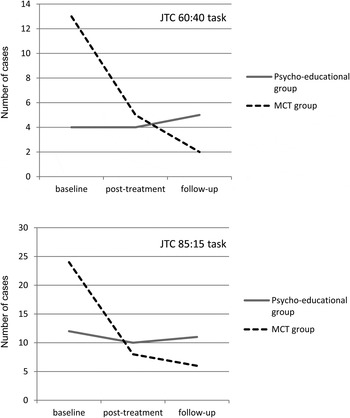
The number of patients who jumped to conclusions in each assessment by group is shown in Fig. 2. Regarding the MCT group, significant differences were found between baseline and post-treatment regarding the 85:15 task of JTC (p = 0.021) and a trend toward significance at follow-up (p = 0.057).
Number of patients jumping to conclusions in each task (85:15 and 60:40) between the two groups in the three assessments.

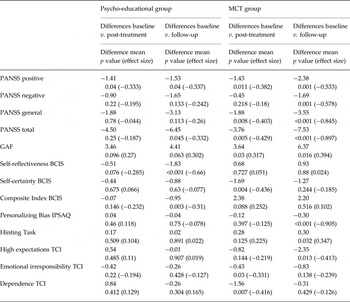
A supplementary analysis was performed comparing differences between baseline and post-treatment and baseline and follow-up in each group, independently. The results are presented in Table 4, indicating more significant values and greater effect in the comparison of PANSS subscales in the MCT group than in the psycho-educational group. Moreover, significant values were found in the MCT group for GAF, Personalizing bias, Hinting task, and some subscales of the TCI that were not found in the psycho-educational group.
Differences in each group between baseline and post-treatment and baseline and follow-up

PANSS, Positive and Negative Syndrome Scale; GAF, Global assessment of functioning; BCIS, Beck Cognitive Insight Scale; IPSAQ, Internal, Personal and Situational Attributions Questionnaire; TCI; Irrational Belief Test.
Discussion
The results are unique in that this is the first study to observe the effectiveness of MCT in people with recent onset of psychosis, which is of clinical relevance, given early intervention is important in reducing chronicity and improving prognosis. Both the MCT and the psycho-educational groups showed reduced clinical symptoms. Moreover, MCT presented greater improvements than the psycho-educational group in cognitive insight, irrational beliefs, and JTC.
Symptoms improved considerably in both treatment groups. However, the complementary analyses show that the MCT group presented greater improvements with greater effect size, especially in the follow-up (some of them superior to 0.8). Although other studies performed in people with schizophrenia have found a clear improvement in symptoms in MCT groups, compared with control and cognitive remediation, our results indicated a slight improvement when compared to a psycho-educational group (Favrod et al. Reference Favrod, Rexhaj, Bardy, Ferrari, Hayoz, Moritz, Conus and Bonsack2014; Windell et al. Reference Windell, Norman, Lal and Malla2015). However, it is important to note the greater improvements of MCT in the follow-up, coinciding with the results of Moritz et al. (Reference Moritz, Andreou, Schneider, Wittekind, Menon, Balzan and Woodward2014a , Reference Moritz, Veckenstedt, Andreou, Bohn, Hottenrott, Leighton, Köther, Woodward, Treszl, Menon, Schneider, Pfueller and Roesch-Ely b ) after 3 years of follow-up, suggesting a ‘sleeper’ effect of MCT, implying that work in the sessions could have an important effect in the future. Moreover, MCT had a clear effect in follow-up not only on positive symptoms but also negative and general symptoms as well, suggesting more improvement in functionality (Windell et al. Reference Windell, Norman, Lal and Malla2015). It is likely that the strategies worked on in the group were indirectly related to symptoms and could be useful in preventing future relapses. In our study, people with psychosis of recent onset showed improvement in positive symptoms with both interventions. It should be taken into account that levels of symptoms at baseline were very low, indicating a possible floor effect that made it difficult to detect the superiority of one intervention over the other due to the restriction in range. In contrast, people with schizophrenia in other studies scored higher in symptoms (Moritz et al. Reference Moritz, Veckenstedt, Randjbar, Vitzthum and Woodward2011) suggested that in order to avoid the floor effect future studies should recruit subjects with at least mild delusional symptoms.
The MCT group had a clear effect in cognitive insight, in the post-treatment and follow-up, according to (Lam et al. Reference Lam, Ho, Wa, Chan, Yam, Yeung, Wong and Balzan2015) and contrary to van Oosterhout et al. (Reference van Oosterhout, Krabbendam, de Boer, Ferwerda, van der Helm, Stant and van der Gaag2014). The psycho-educational group scored worse on the self-reflectiveness subscale at all time points while the MCT group showed a reduction in their scores on the self-certainty subscale, indicating better scores for the composite index for people who attended the MCT intervention. The reduction of levels of self-certainty is relevant because in reducing this bias, patients achieve a lower confidence in the interpretation of their own ideas (Beck et al. Reference Beck, Baruch, Balter, Steer and Warman2004) and possibly prevent these ideas from becoming delusions. Moreover, MCT acts as a preventive intervention regarding self-reflectiveness, because patients from the psycho-educational group scored worse throughout the clinical trial, obtaining similar scores to chronic patients with schizophrenia (Beck et al. Reference Beck, Baruch, Balter, Steer and Warman2004). Improvement in insight, which is one of the core results found, has been associated with treatment adherence, higher metacognition, and fewer symptoms in people with first episode of psychosis and schizophrenia (Myers et al. Reference Myers, Bhatty, Broussard and Compton2014; Lysaker et al. Reference Lysaker, Kukla, Dubreucq, Gumley, McLeod, Vohs, Buck, Minor, Luther, Leonhardt, Belanger, Popolo and Dimaggio2015; Vohs et al. Reference Vohs, Lysaker, Liffick, Francis, Leonhardt, James, Buck, Hamm, Minor, Mehdiyoun and Breier2015).
People from the MCT group decreased in intolerance to frustration and in dependence compared with people from the psycho-educational group. Intolerance to frustration may cause the patient to be over-concerned and manifest early appearance of negative emotional responses such as irritability, guilt, anger, and lower cognitive flexibility (Stanković & Vukosavljević-Gvozden, Reference Stanković and Vukosavljević-Gvozden2011). Both variables could be related to depression and self-esteem (Xu et al. Reference Xu, Zu, Xiang, Wang, Guo, Kilbourne, Brabban, Kingdon and Li2013). In this line, MCT may act as a protective intervention for depressive symptoms and as an elicitor of improved self-esteem.
JTC improved in the MCT group but not in the psycho-educational group; however, the changes were produced only in the 85:15 task, and were clearly significant only in post-treatment. Curiously, despite randomization, the psycho-educational group presented less JTC at baseline than the MCT group. These results suggest that JTC could be reduced by MCT training (Menon et al. Reference Menon, Mizrahi and Kapur2008), although the possible floor effect in the psycho-educational group should be considered. Our results are in accordance with previous studies that found that MCT is useful in reducing JTC in people with schizophrenia (Aghotor et al. Reference Aghotor, Pfueller, Moritz, Weisbrod and Roesch-Ely2010), and taking into account the theoretical model of Salvatore et al. (Reference Salvatore, Lysaker, Gumley, Popolo, Mari and Dimaggio2012), it could therefore help prevent the emergence of delusions.
Although no differences were found in the comparison between groups, in the intergroup comparison personalizing bias presented an improvement in the MCT group but not in psycho-educational group in the follow-up, with a high effect size (up to 0.9). This is an interesting result because higher scores on this subscale are associated with higher levels of paranoid ideation and persecutory delusions (Kinderman & Bentall, Reference Kinderman and Bentall1996; Mehl et al. Reference Mehl, Landsberg, Schmidt, Cabanis, Bechdolf, Herrlich, Loos-Jankowiak, Kircher, Kiszkenow, Klingberg, Kommescher, Moritz, Müller, Sartory, Wiedemann, Wittorf, Wölwer and Wagner2014). In the same line, ToM improved in the MCT group but not in the psycho-educational group in the follow-up, and with a mild effect size. It did not improve in the analysis between groups. However, scores on the ToM task were high even at baseline, suggesting that the patients included were not sufficiently impaired in this area, contrary to a previous meta-analysis (Bora & Pantelis, Reference Bora and Pantelis2013). Another possibility might be that the test used did not detect deficits in ToM, as suggested by Langdon et al. (Reference Langdon, Still, Connors, Ward and Catts2014). Regarding emotional recognition there was no improvement in either of the two groups, contrary to previous research (Ussorio et al. Reference Ussorio, Giusti, Wittekind, Bianchini, Malavolta, Pollice, Casacchia and Roncone2016). Both groups had good scores in emotional recognition at baseline assessment, so perhaps at this stage of the illness there is not a clear deficit, in contrast to chronic samples (Besche-Richard et al. Reference Besche-Richard, Bourrin-Tisseron, Olivier, Cuervo-Lombard and Limosin2012). Moreover, the MCT does not target better emotion recognition but rather modulates confidence for social judgments.
However, some considerations should be taken into account. Regarding the characteristics of the ‘control’ group for comparison, an active intervention was used in order to control the effect of the group. However, this group was not really ‘control’ because in two sessions patients were receiving and sharing information regarding risk behaviors and prevention of relapses. The other clinical trials performed with the MCT have used other characteristics in the comparison groups such as waiting lists and cognitive rehabilitation (Moritz et al. Reference Moritz, Veckenstedt, Andreou, Bohn, Hottenrott, Leighton, Köther, Woodward, Treszl, Menon, Schneider, Pfueller and Roesch-Ely2014b ), and this could account for the discrepancies in findings. Another point to take into account is that both groups received an extra intervention (MCT or psycho-education) not considered treatment as usual, which probably helped both groups improve in several areas. Perhaps the MCT group might have improved more if the comparison group had been with treatment as usual. Second, the frequency of sessions in our study was once a week while in other studies it was twice a week. This divergence in the methodology could have influenced the results in some way, producing slower changes in the MCT intervention. Another consideration arises from the setting of the patients; in our study we included only outpatients while in other studies inpatients were also included (Moritz et al. Reference Moritz, Veckenstedt, Bohn, Köther, Woodward, Roberts and Penn2013a , Reference Moritz, Veckenstedt, Bohn, Hottenrott, Scheu, Randjbar, Aghotor, Köther, Woodward, Treszl, Andreou, Pfueller and Roesch-Ely b ). Another limitation is that the patients were not asked to complete homework in the MCT group and this could be a cause of the lower integration of the areas worked up in the sessions. MCT has been demonstrated to be effective in people with schizophrenia with eight sessions included in the program (Eichner & Berna, Reference Eichner and Berna2016). However, in order to further improve the results other interventions could be provided to these patients, such as joint implementation of MCT in group and individualized (Moritz et al. Reference Moritz, Veckenstedt, Randjbar, Vitzthum and Woodward2011), as well as other kinds of interventions addressed to covering similar aspects (Penn et al. Reference Penn, Roberts, Munt, Silverstein, Jones and Sheitman2005). Finally, the training has been recently complemented with two modules on self-esteem and dealing with stigma as these domains may also contribute to the formation and maintenance of positive symptoms. Whether these modules augment effects awaits to be established, however.
The strengths of the study include an adequate sample size, the novelty of the characteristics of the sample in terms of early stages and community settings, and its multi-site implementation.
In conclusion, MCT is an effective psychological intervention for people with a recent onset of psychosis, in order to improve psychotic symptoms and cognitive insight, and to reduce irrational beliefs. MCT could be a good treatment choice in clinical practice taking into account the positive results in insight improvement that may act to prevent further psychotic episodes. More studies should be done with this population in order to assess the cost-effectiveness of MCT and the combination of this treatment with others.
Appendix. Spanish Metacognition Study Group
Acevedo A, Anglès J, Argany MA, Barajas A, Barrigón ML, Beltrán M, Birulés I, Bogas JL, Camprubí N, Carbonero M, Carmona Farrés C, Carrasco E, Casañas R, Cid J, Conesa E, Corripio I, Cortes P, Crosas JM, de Apraiz A, Delgado M, Domínguez L, Escartí MJ, Escudero A, Esteban Pinos I, Figueras M, Franco C, García C, Gil V, Giménez-Díaz D, Gonzalez-Casares R, González Higueras F, González-Montoro MªL, González E, Grasa Bello E, Guasp A, Huerta-Ramos Mª E, Huertas P, Jiménez-Díaz A, Lalucat LL, LLacer B, López-Alcayada R, López-Carrilero R, Lorente E, Luengo A, Mantecón N, Mas-Expósito L, Montes M, Moritz S, Murgui E, Nuñez M, Ochoa S, Palomer E, Paniego E, Peláez T, Pérez V, Planell K, Planellas C, Pleguezuelo-Garrote P, Pousa E, Rabella M, Renovell M, Rubio R, Ruiz-Delgado I, San Emeterio M, Sánchez E, Sanjuán J, Sans B, Schilling L, Sió H, Teixidó M, Torres P, Vila MA, Vila-Badia R, Villegas F, Villellas R.
Acknowledgements
This work was supported by the Instituto de Salud Carlos III (Spanish Government), research grant numbers PI11/01347 and PI14/00044, by the Fondo Europeo de Desarrollo Regional (FEDER), Progress and Health Foundation of the Andalusian Regional Ministry of Health, grant PI-0634/2011 and PI-0193/2014, Obra Social La Caixa (RecerCaixa call 2013), and Obra Social Sant Joan de Déu (BML).
We thank Daniel Cuadras for his statistical help.
Declaration of Interest
None.