Emily Dickinson's intense love of music and nature is regularly encountered in many of her most beloved poems.Footnote 1 Her verse and her correspondence consistently display a musical familiarity and authority that has been well documented by Dickinson scholars; a favorite of composers, thousands of musical settings have been realized from her poems.Footnote 2 Yet the significance and context of Dickinson's daily musical activities—her home performances at the piano, her sheet music collecting, and her concert attendance—have not been fully examined or properly positioned as an important backdrop to her life and to her development as a poet. Through her engagement with music, Dickinson (1830–86) was able to fashion an identity served by musical longings, and to cultivate opportunities for musical borrowings and boundary crossings, allowing her to create an enduring musical persona that would ultimately serve a vital role in the formation of her unique poetic voice.
As early as age two and a half, Dickinson displayed musical ability. In 1833 Dickinson's aunt, Lavinia Norcross, wrote to her brother-in-law Edward Dickinson: “I have but a few moments of leisure but I will just let you know that Emily is perfectly well & contented—She is a very good child & but little trouble—She has learned to play on the piano—she calls it the moosic.”Footnote 3 As she grew older, Dickinson's musical engagement extended to the singing schools and services at the First Congregational Church in Amherst. The singing school was an important social and pedagogical community activity, the function of which was to teach the rudiments of amateur music-making. In 1844, thirteen-year-old Dickinson eagerly wrote about her singing master to her brother Austin: “I attend singing school. Mr. Woodman has a very fine one Sunday evenings and has quite a large school. I presume you will want to go when you return home.”Footnote 4 Dickinson's letters consistently indicate that she was musically engaged, and that she absorbed every opportunity to excel. To her childhood friend Abiah Root she reported: “I go to singing-school Sabbath evenings to improve my voice as a matter of [], & have the pleasure of a glimpse at nearly all the [] and [] in the town. Don't you envy me?”Footnote 5 Like many young people of Amherst, she was immersed in the singing school and church repertoire. The hymns and psalm settings of Isaac Watts were chief among this repertoire; they had taken hold in the Jonathan Edwards Church in Northampton.Footnote 6 These hymns migrated throughout New England and Dickinson's Pioneer Valley and into hymnbooks such as Nettleton's Village Hymns,Footnote 7 and later Lowell Mason's Church Psalmody, both of which the Dickinsons owned.Footnote 8
In 1845, at the age of fourteen, Dickinson was devoted to her musical studies of voice and especially piano, for which she displayed accomplishment and ambition: “I also was much pleased with the news [your letter] contained especially that you are taking lessons on the ‘piny’, as you always call it,” she wrote to Root, “but remember not to get on ahead of me. Father intends to have a Piano very soon. How happy I shall be when I have one of my own.”Footnote 9 In August of that year Edward Dickinson purchased a piano through his brother William in Worcester.Footnote 10 In a letter to Root in August 1845 Emily reported happily that she now had her own piano and was moving forward with her studies:
I am taking lessons this term, of Aunt Selby who is spending the summer with us. I never enjoyed myself more than I have this summer. For we have had such a delightful school and such pleasant tea[c]hers, and besides I have had a piano of my own. Our Examination is to come off next week on Monday. I wish you could be here at that time. Why cant [sic] you come. If you will—You can come and practice on my piano much as you wish to. . . . Are you practising [sic] now you are at home—I hope you are, for if you are not you would be likely to forget what you have learnt. I want very much to hear you play. . . . I have the same Instruction book that you have, Bertini, and I am getting along in it very well. Aunt Selby says she shant let me have many tunes now for she wants I should get over in the book a good ways first. . . . I have been learning several beautiful pieces lately. “The Grave of Bonaparte” is one. “Lancers Quick Step”—“Wood up,” and “Maiden Weep no More,” which is a sweet little song. I wish much to see you and hear you play.Footnote 11
Dickinson's fondness for the “tunes,” as she refers to them, confirms her interest in collecting sheet music, an activity in which both she and her sister Lavinia (1833–99) regularly engaged. Many of the sheet music titles Emily and her sister acquired are identified in the family correspondence, and are included in Emily Dickinson's binders’ volume of sheet music which is in the Dickinson Collection at Harvard University (see Figure 1).Footnote 12
Emily Dickinson's music book (EDR 469), index. Used by permission of the Houghton Library, Harvard University.

The Music Book
Aided by American industrial and economic expansion, along with a growing middle class whose interest in music intersected with the antebellum value of gentility, binders’ volumes came into existence as an important and popular cultural artifact around 1830 and flourished through the 1860s. Individually published sheet music titles, collected and bound into a book, were assembled primarily by women during their formative years of musical training, the conclusion of which often coincided with adulthood or marriage. These musical keepsakes contained popular music of the day often commemorating attendance at live musical performances or other events. The sheet music in Emily Dickinson's binders' volume was collected over a period of about eight or nine years (ca. 1843–51, age 12–20) and was likely bound in 1852, when she was twenty-one years old.Footnote 13
Thirty-five percent of the pieces in the Dickinson book contain a date of copyright. An additional thirty percent can be dated by the plate numbers used by publishers to collate their yearly inventory.Footnote 14 Containing just over 100 pieces, Emily Dickinson's binder's volume was uncommonly large.Footnote 15 Nearly one third of the music book's content spans the years 1843–45, an active period of musical study for young Emily (age 12–14). In May 1844, she spent a month with her Norcross family cousins in Boston, during which time she was able to purchase a great deal of sheet music from the local music stores. Out of the twenty-three most popular pieces of 1843 and ’44 listed in Julius Mattfeld's book Variety Music Cavalcade, more than half are represented in Dickinson's binders’ volume.Footnote 16
The presence of thirty-two waltzes (including nine misattributed to Beethoven) is a clear indication of the waltz craze of the day.Footnote 17 These include “Glenmary Waltzes” by Richard Storrs Willis (1819–1900), best known today as the composer of the 1850 carol “It Came Upon a Midnight Clear.”Footnote 18 “The Swiss Waltz” with variations by P[eter] K. Moran (d. 1831) is also notable in that Moran, although little known today, was a prolific composer and active performer and music teacher; he was the organist at Grace Episcopal Church and for the New York Choral Society's first concert in 1824.Footnote 19
Ethnicity, as represented in the Dickinson binder by the “Swiss Waltz” and other compositions, reflected both an aspect of the American imagination promoted by the music publishers and Dickinson's own fascination with exotic lands.Footnote 20 Comer and Steele's “Favorite Melodies from the Grand Chinese Spectacle of Aladdin, or, The Wonderful Lamp, As Produced at the Boston Museum” was based on an exhibit that Dickinson attended while visiting her cousins in 1846. Closer to home, “The Juniata Quick Step,” based on Marion Dix Sullivan's popular 1844 ballad “The Blue Juniata,” evokes Native American culture. The song captured the public imagination, echoing the image of the noble savage as portrayed by Henry Wadsworth Longfellow (1807–82) and James Fenimore Cooper (1789–1851).Footnote 21 (Considering the song's immense popularity, it says something about Dickinson's devotion to her piano studies that she would prefer and enjoy a more difficult quickstep arrangement rather than the standard vocal ballad.) Finally, race and ethnicity are also represented in the Irish and minstrel content in the Dickinson binder, which will be discussed later.
Also present in the Dickinson book are thirteen sets of variations on popular tunes and operatic arias. Often found in binders’ volumes, these were essential ingredients in the amateur piano repertoire, equally important for their pedagogical and entertaining qualities. The four polkas, twelve quicksteps, and nine marches include “Sounds From Home” by Josef Gung'l (1810–89), whose works were widely performed in the United States. Most notably, Dickinson's volume contains a march and quick step arrangement of “The Battle of Prague.” Composed by Franz Kotzwara (1730–91), it was by far one of the best-known and most widely circulated pieces in the early decades of the nineteenth century; Richard Wolfe cited forty extant editions.Footnote 22 Also present in the Dickinson binder is the “Bay State Quick Step,” “as performed by the Boston Brass Band,” an ensemble that the Dickinsons may have seen. Concertgoers often purchased the sheet music performed by these groups, inspired to recreate the experience of these concerts in the parlor. The size and content of Dickinson's binders’ volume affirms that Emily Dickinson participated fully in the social and cultural fabric of her time, where serious musical engagement and accomplishment was supported, enjoyed, and encouraged.Footnote 23
Throughout her teenage years and into early adulthood, Dickinson freely exchanged information about her musical activities with others. As was typical, familiarity with the current repertoire easily found its way into general conversation and enriched correspondence with musical references. A good example comes from Dickinson's second cousins Olivia and Eliza Coleman, who continued to keep her up to date on their activities and music purchases after their move to Philadelphia. In 1846, Olivia Coleman wrote to Emily Dickinson (age fifteen): “We discovered a new Music Store, and I purchased the song ‘I'm alone—all alone,’ for I am truly alone without you.”Footnote 24 The varied repertoire in Dickinson's volume not only reflected her broad musical taste, but also revealed her longing for the refinements and human connections she sought in her performing and listening experiences.
“An air of exile”
Dickinson collected the sheet music associated with some of the most important musical virtuosos of her time and offered insightful commentary on some of their performances.Footnote 25 The most significant and best-documented professional performance that Dickinson witnessed was by the Swedish soprano Jenny Lind (1820–87). On 3 July 1851, Emily (age twenty) along with her father and sister attended Lind's concert in Northampton. In a letter to her brother Austin, she suggested that perhaps Lind herself was more attractive than her singing: “Herself, and not her music, was what we seemed to love—she has an air of exile in her mild blue eyes, and a something sweet and touching in her native accent which charms her many friends—.”Footnote 26
For Dickinson it was the setting and the Lind persona—rather than the music—that caught her attention. Judith Pascoe notes that “the singularity of a woman taking the place of a male minister [at the front of the church] was surely not lost on Dickinson, whose propensity for imaginative flights from the confines of the church pews is a matter of record.”Footnote 27 Lind's manager, P. T. Barnum, had chosen the venue wisely. For most of the nineteenth century, women of the stage had to contend with a popular perception of immorality, and Dickinson was certainly aware of this prevailing attitude.Footnote 28 Barnum counteracted this perception by successfully projecting an image of Lind as pure as birdsong. What Dickinson perceived as Lind's “air of exile” seems to have succeeded, and would resonate for Dickinson, not just in her letter to Austin, but long after Lind's Northampton performance.Footnote 29
The Dickinsons saw other celebrated performers as well, including the German singer Henrietta Sontag (1806–54) and the Irish soprano Catherine Hayes (1818–61). Hayes toured the United States just after Jenny Lind. Austin Dickinson saw her perform in Boston on Sunday 5 October, and wrote to Martha Gilbert about it the following Friday 10 October: “I like the woman, but dont [sic] think her songs compare with Jenny Lind's. I will tell you about it Wednesday.”Footnote 30 His observation of Hayes's performance is significant; most American concertgoers of this period compared other singers to Lind. Both Hayes and Sontag have largely been eclipsed by Lind; however, Dickinson's binders’ volume does remind us of the once enormous popularity of Sontag and Hayes, when audiences enjoyed hearing and performing the repertoire from their concerts, whether Irish and Scottish ballads, or opera arias such as “I Dreamt I Dwelt in Marble Halls” and “Then You'll Remember Me” from Michael William Balfe's The Bohemian Girl (1843), two pieces typically found in binders’ volumes, including Dickinson's.Footnote 31
It should not be a surprise if ongoing research reveals that the Dickinsons, who were typical concertgoers and above-average consumers of sheet music, either witnessed or were familiar with many more star performers than has previously been known and discussed. New England towns of even moderate size—readily connected by good turnpikes and served by stages—were visited by touring performers to an extent that is generally unknown today.Footnote 32 The overall population of New England and the relatively limited geographical area appealed to visiting performers, many of whom launched tours around New England during the 1830s, ’40s, and later. The performance culture in small-town Amherst and its vicinity was rather impressive.
In addition to hearing Lind, Sontag, and Hayes, the Dickinsons attended performances by the most popular bands of the day, including Edward (Ned) Kendall's Boston Brass Band.Footnote 33 Kendall helped to popularize the already-mentioned “Wood Up Quick Step,” with its famous keyed bugle solo, which the virtuoso Kendall performed brilliantly.Footnote 34 A regular feature on many band concerts, the “Wood Up Quick Step” was introduced in 1834 and remained popular long after Dickinson was introduced to it in 1845 by her Aunt Ann Elizabeth Vaille Selby, her piano teacher.Footnote 35 Lavinia Dickinson, in fact, noted the family's attendance at Kendall's concert in her diary, which is significant. This was the heyday of the antebellum American band movement, during which time touring ensembles under the leadership of such household names as Kendall, the Dodworths, and Patrick Gilmore inspired the formation of bands in nearly every American city and town.Footnote 36 It would have been unthinkable for the Dickinsons not to have seen them, especially because their performances were advertised in the local Franklin and Hampshire Express. Footnote 37 Another appeal of the Gilmore and Dodworth bands was their repertoire of popular music, including arrangements of arias from operas by Bellini, Rossini, and of course Balfe's The Bohemian Girl. This was precisely the kind of music that appealed to the Dickinson family, and plausibly would have lured them to such concerts.
The most sensational of the touring ensembles witnessed by Emily Dickinson was the Germania Serenade Band, which had arrived for an extended stay in the United States in 1848. The Germanians’ exquisite performances focused on the masterworks of Beethoven, Haydn, and Mozart, but they offered up more popular fare as well. “Sounds from Home” by Gung'l—one of the marches in Dickinson's binder—was part of their standard repertoire.Footnote 38 On 19 April 1853, Dickinson (age twenty-two) attended a performance by the ensemble that concluded the Spring Exhibition at Amherst College, and her account of that concert confirms her predilection for colorful musical performances:
The Germanians gave a concert here the evening of Exhibition day. Vinnie [Lavinia] and I went with [cousin] John [Graves]. I never heard [such] sounds before. They seemed like brazen Robins, all wearing broadcloth wings, and I think they were, for they all flew away as soon as the concert was over.Footnote 39
By the 1850s, the importation of European performers—among them the Germanians, violinist Ole Bull, and singers like Hayes, Sontag, and Lind—was a thriving industry. In small towns such as Amherst, access to these star performers allowed audiences to experience a remarkable show of musical refinement and virtuosity. Concert audiences used these experiences as a means of artistic identification, comparison, self-reflection, and inspiration to improve their own home music-making.Footnote 40
After their Jenny Lind experience, the Dickinson family correspondence indicates an increased interest in collecting sheet music and attending live performances. Brother Austin (1829–95), who was teaching in Boston and later attended Harvard Law School, was the sisters’ chief source for purchasing sheet music at the local Boston music stores.Footnote 41 The two sisters’ tastes in music were apparently quite different. Emily's requests were almost always for instrumental selections. Lavinia's were consistently aimed at sentimental vocal pieces, and she was constantly hounding Austin to send her new pieces by the latest vocal stars. For example, in a letter to her brother dated 26 January 1852, she wrote,
The song, “[Oh the] Merry Days When We Were Young” is not the one, I sent for, & I want to have you exchange it, if you will, the one I want you to get is sung by Mrs. Wood & not by “Mr. Leffler.”Footnote 42 I do not want this one any how. I think you can find the right one, at some of the music stores. I'm anxious to have it. Olivia Coleman used to sing it & tis a beautiful thing. Remember that tis sung by Mrs. Wood & no other, the tune begins with these words, “Oh! the merry days, the merry days when we were young.”Footnote 43
Lavinia's request for Mrs. Wood's version of “Oh the Merry Days When We Were Young” indicates that she was aware of the star power of the Scottish soprano Mary Anne (Paton) Wood (1802–64), and favored the sheet music edition promoted by the publisher as “Sung with unbounded Applause by Mrs. Wood” (see Figure 2).Footnote 44
“Oh the Merry Days When We Were Young.” New York: Atwill, 1840. Music Division, The New York Public Library for the Performing Arts; Astor, Lenox and Tilden Foundations.
Music publishers played an essential role in marketing directly to women a type of vocal parlor music that was meant to encourage refinement through displays of musical talent and taste. On 8 June 1851, Emily sent a report to Austin that suggests her humor, the family dynamic, and Lavinia's musical progress.
We are enjoying this evening what is called a “northeast storm”—a little north of east, in case you are pretty definite. Father thinks “it's amazin raw,” and I'm half disposed to think that he's in the right about it, tho’ I keep pretty dark, and don't say much about it! Vinnie is at the instrument, humming a pensive air concerning a young lady who thought she was “almost there.” Vinnie seems much grieved, and I really suppose I ought to betake myself to weeping; I'm pretty sure that I shall if she dont [sic] abate her singing.Footnote 45
Although not included in the Dickinson binders’ volume, Lavinia's “pensive air,” “Are We Almost There?” (by Florence Vale), is an example of the type of sentimentalized vocal music marketed directly to women.Footnote 46 Another example is Henry Russell's “The Old Arm Chair,” which is found in many binders’ volumes, including Dickinson's. Russell's song, set to a poem by Eliza Cook, addresses motherhood and the role of mother as the most revered person in the home. The intense expression of sentiment common to these period vocal pieces is emphatically represented in the poem's second verse:
There are other popular sentimental vocal compositions in the Dickinson volume, but Emily tended to collect and perform many more instrumental showpieces than sentimental vocal ballads. These instrumental works include “The Much Admired Sliding Waltz” and a four-hand arrangement by Charles Czerny of “The Celebrated Overture to Lodoiska” by Rodolphe Kreutzer. The variation sets on arias from Rossini's Tancredi and Bellini's Norma, and arrangements from Balfe's Bohemian Girl are modifications of well-known opera arias, made accessible to antebellum period American concert audiences, and were meant to be recreated and enjoyed as vocal arrangements or challenging variation sets in the parlor setting.Footnote 48
The presence of this difficult music supports the antebellum culture of refinement where, typically, intensive musical training for both men and women was encouraged; however, this virtuosity had no outlet for women outside the social parlor setting. It would have been inappropriate for Dickinson to position herself beyond that prescribed feminine domestic sphere.Footnote 49 From an early age, she seems to have understood and accepted these limitations:
We enjoyed the evening much & returned not until the clock pealed out “Remember 10 o'clock, my dear, remember 10 o'clock.” After our return, Father wishing to hear the Piano, I like an obedient daughter, played & sang a few tunes, much to his apparent gratification. We then retired & the next day & the next were as happily spent as the eventful Thanksgiving day itself.Footnote 50
Dickinson's desire for musical accomplishment is revealed in the avid acquisition of the sheet music that filled her oversized binders’ volume and more explicitly in her correspondence. Dickinson expected her sister to improve as well. On Monday morning 12 January 1852, she wrote to her brother: “Thank you for the music Austin, and thank you for the books. I have enjoyed them very much. I shall learn my part of the Duett [sic] and try to have Vinnie [learn] her's [sic]. She is very much pleased with Charity. She would write you now but is busy getting her lesson.”Footnote 51 Vinnie was “very much pleased” with Stephen Glover's popular religious song “Charity,” which she had recently received from Austin. Perhaps the song was part of the lesson that Emily had overheard. Lavinia must have been having trouble learning her part of the instrumental duet they received from Austin. Two weeks later on 28 January, Emily followed up with this missive: “You sent us the Duett, Austin. Vinnie cannot learn it, and I see from the outside page, that there is a piece for two hands. Are you willing to change it. Don't be in haste to send it; any time will do! Shall write when I hear from you, more fully.”Footnote 52
Music publishers appealed to different segments of the population, marketing various vocal versions, keys, instrumental arrangements, and variation sets. Many pieces in the Dickinson volume are typical of this segmented marketing. For example, although the volume includes some of the most popular vocal music titles of the day—among them Thomas Moore's “Araby's Daughter” and his ubiquitous “Believe Me if All Those Endearing Young Charms,” or William Dempster's “The Lament of the Irish Emigrant”—other popular vocal pieces like “Blockley's Beautiful Melody of ‘Love Not,’” Moore's “The Last Rose of Summer,” and “Auld Lang Syne” appear in the Dickinson binder as quick steps or variation sets, emphasizing Dickinson's interest in challenging instrumental repertoire.
“There's a Good Time Coming”
There are three vocal pieces by the famous Hutchinson Family in Dickinson binders’ volume: “There's a Good Time Coming,” “The Old Granite State,” and “The Little Maid.” The Hutchinsons brought their family parlor-style repertoire of temperance, suffrage, and abolitionist songs to audiences around the country. Dickinson may have heard the Hutchinsons at the Mount Holyoke Female Seminary as a seventeen-year-old student there in 1848.Footnote 53 The Hutchinsons performed in Northampton and had an association with the nearby utopian community of Florence.Footnote 54
It is clear from Emily Dickinson's correspondence that the musician in her did not let anything pass by that might serve as a musical metaphor, either storing it for later use in one of her poems, or simply to convey and enliven the dynamics of the family's everyday home life, which was generally close, congenial, and often funny. Other musical references similarly refer to the contents of the binders’ volume and suggest extramusical meaning. Popular songs such as “Home Sweet Home,” “Home as a Waltz,” “Sounds from Home,” and “The Home That I Love,” for example, are all found in the Dickinson binder and substantiate the idea of home as an important ingredient in the Dickinson family's sense of unity and well-being.Footnote 55 In a letter of 14 November 1853, Dickinson (age twenty-two) refers to a Hutchinson Family song while writing to Austin, who was due home for a visit:
Mother got a great dinner yesterday, thinking in her kind heart that you would be so hungry after your long ride, and the table was set for you, and nobody moved your chair, but there it stood at the table, until dinner was all done, a melancholy emblem for the blasted hopes of the world. And we had new custard pie, too, which is a rarity in the days when the hens dont lay, but mother knew you loved it, and when noon really got here, and you really did not come, then a big piece was saved in case you should come at night. Father seemed perfectly sober, when the afternoon train came in, and there was no intelligence of you in any way, but “there's a good time coming”! (see Figure 3).Footnote 56
Part of the unity and well being of the Dickinson home was orchestrated by Edward Dickinson himself. He seems to have preferred having his two daughters at home where, as treasurer of Amherst College, he entertained regularly, and counted General George B. McClellan and Frederick Law Olmsted among his guests.Footnote 57 The family's home life served multiple functions as both a social and domestic hub and a haven for Dickinson's emerging poetic activities. Lavinia often stated that the family “lived like friendly and absolute monarchs, each in his own domain.”Footnote 58
“There's a Good Time Coming.” Boston: Oliver Ditson, 1846. Music Division, The New York Public Library for the Performing Arts; Astor, Lenox and Tilden Foundations.
“And we broke up with a dance:” Borrowing from the Dickinson servants
Whereas Dickinson's binders’ volume offers palpable evidence of the musical activities at the Homestead, it also provides insight about the impact that the domestic servants had on Dickinson's musical borrowings and boundary crossings. From the time that Dickinson was fourteen years old, Edward Dickinson's desire that his daughter take on the majority of the bread-baking duties in the home meant that she was in daily contact with the household domestic staff of maids, stablemen, and groundskeepers.Footnote 59 During Dickinson's lifetime, over eighty servants worked for the family, many of them from the local Irish and African American communities around Amherst.Footnote 60 She had a keen interest in the staff and was particularly observant when a new hired hand was first noticed on the grounds, as evidenced in her 1859 poem, “New feet within my garden go”:
The activities of the domestic servants and Dickinson's interactions with them are well documented in her correspondence. Dickinson scholar Aíf Murray describes how over time, Emily grew closer to the Irish servants as she went about her daily work in the kitchen. By the 1860s, a steadier presence of domestic help relieved her of some of that work and gave her more time to write poetry.Footnote 62
Of these servants, none was more loved than Margaret Maher. A fixture at the Homestead beginning in 1869, she stayed on after Dickinson's death in 1886, remaining until Lavinia passed away in 1899. Described by Emily as “warm and wild and mighty,” Maggie lived a short distance from the Dickinson Homestead next to the Amherst train depot, in a building owned by her brother-in-law Thomas Kelley, who also worked for the Dickinsons.Footnote 63 Over time, Kelley purchased additional buildings from Edward Dickinson, which allowed him to create a comfortable residential compound. Upon occasion, Emily (as indicated in this letter from 1854) would visit “Kelley Square,” and the homes of the other servants: “Then I worked until dusk, then went to Mr. Sweetser's to call on Abiah Root, then walked around to Jerry's [African American stablemen Jeremiah Holden] and made a call on him—then hurried home to supper.”Footnote 64 In these settlements around the train depots and the outposts along the Connecticut River, black and Irish laborers experienced a proximity conducive to cultural interchange; vernacular artworks and other sources from this period attest to the fact that these groups freely exchanged and integrated African and Irish traditional dance and fiddle repertoire.Footnote 65 The seasonal migrations of these laboring groups brought their music into the towns and villages, often providing the middle class with accompaniments to their social dancing.
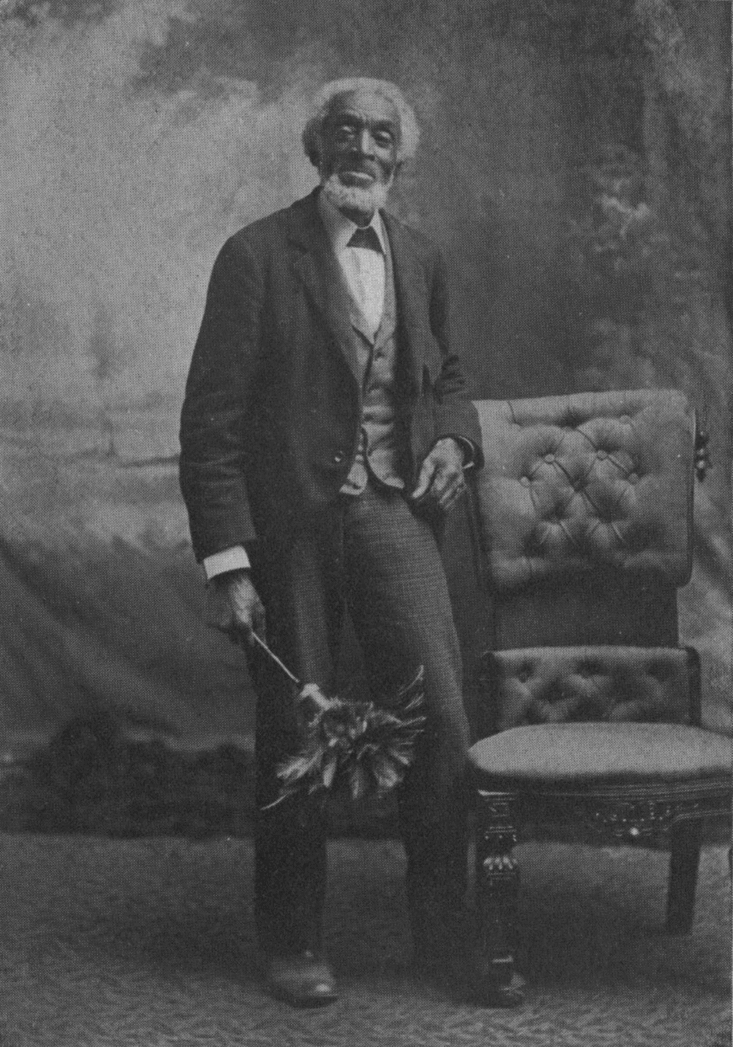
On 22 June 1851 Dickinson (age twenty) wrote to her brother: “Our Reading Club still is, and becomes now very pleasant—the last time Charles came in when we had finished reading, and we broke up with a dance—”Footnote 66 “Charles” was Charles Thompson, an African American man who for decades was a janitor for Amherst College and a laborer for the Dickinsons (see Figure 4). Thompson played the fiddle and taught some of the local children his tunes. He was remembered fondly in a pamphlet written in 1902 by Abigail Eloise Stearns Lee, daughter of former Amherst College president Rev. William A. Stearns:
But it was Charley's musical ability that made us love him, as a companion in the evening, for Charley owned a fiddle, and when he played “Money Musk” or some lively jig, the children could not help dancing. “Just keep your fingers going and bumby [by and by] you'll get it,” was his advice to my brother when he tried to play.Footnote 67
Dickinson may have been remembering Charles Thompson and his music in her 1859 poem “New feet within my garden go”—as her “Troubadour opon the Elm,” or when describing that “No Black bird bates His Banjo—.” These references identify Dickinson's engagement with both the local music-making she heard and with home performances of the minstrel and traditional tunes in her music book (see Figure 5).Footnote 68 The popularity of minstrel music as theater entertainment was widespread and easily crossed from the theatrical threshold into the parlor with performances around the piano. The minstrel tunes were bound into the very back of Dickinson's book, out of sight, but perhaps inadvertently awarded a secret pride of place. Their inclusion in binders’ volumes is uncommon, but their presence here and Dickinson's accounts of visiting the servants, or of Charles Thompson leading her reading club in a dance, demonstrates that this type of music was in the air, and readily borrowed, adapted, and performed from the oral tradition as well as from published piano editions for parlor entertainment or fiddler's tunebooks for social dancing (see Figures 6a–b).Footnote 69
Lee, Abigail Eloisa (Stearns). Professor Charley: A Sketch of Charles Thompson by A. E. L. Boston: D.C. Heath & Co., 1902. Written by the daughter of Rev. William A. Stearns, president, Amherst College (1854–76). From the Jones Library, Amherst, MA. Used with permission.
Whitlock, William. Whitlock's Collection of Ethiopian Melodies. “Who's That Knocking at the Door.” New York: C. C. Christman, 1846. From Emily Dickinson's music book (EDR 469). Used by permission of the Houghton Library, Harvard University.
“The Original Old Dan Tucker.” Boston: C. H. Keith, 1843. Music Division, The New York Public Library for the Performing Arts; Astor, Lenox, and Tilden Foundation.
Ethiopian Flute Instructor. Boston: Elias Howe, 1848. Music Division, The New York Public Library for the Performing Arts; Astor, Lenox, and Tilden Foundation.
“Old Dan Tucker.” From Ethiopian Flute Instructor. Boston: Elias Howe, 1848. Music Division, The New York Public Library for the Performing Arts; Astor, Lenox, and Tilden Foundation.
Dickinson's awareness and engagement with the music of the servants is also verified by eighteen Irish and Scottish dance tunes and ballads that she collected over the years, and that occupy a distinct presence in her binders’ volume. Among these are traditional fiddle tunes, jigs, reels, and hornpipes. The tunes have been fitted out with accessible piano accompaniments underneath the melodies, facilitating lively performances and dancing in the family parlor both around the piano and to the accompaniment of instruments normally associated with this music (fiddle, banjo, and flute) (see Figure 7). Among these tunes in the binders’ volume, “Drops of Brandy,” Fisher's Hornpipe,” “College Hornpipe,” “Bonaparte's March Crossing the Rhine,” “Durang's Hornpipe,” and “Ye Banks and Braes of Bonnie Doon,” would have all been familiar to the servants and to members of the Dickinson family.
“Bonaparte's March Crossing the Rhine.” Boston: Oliver Ditson, n.d. (EDR 469). Music Division, The New York Public Library for the Performing Arts; Astor, Lenox, and Tilden Foundation.
“I can improvise better at night:” Dickinson's Musical Borrowings from an Oral Tradition
The traditional tunes in Dickinson's binders’ volume likely inspired her musical creativity. By her twenties, she was already known by family and neighbors to be an expert improviser. Her late-night excursions at the piano were described by her cousin John Graves as “heavenly music.” John Graves's daughter recounts that in March 1854, when he visited his cousins and stayed overnight, “father would be awakened from his sleep by this heavenly music. Emily would explain in the morning, ‘I can improvise better at night.’”Footnote 70 Dickinson's cousin Clara Newman Turner also recalled that “before seating herself at the piano Emily covered the upper and lower octaves so that the length of the keyboard might correspond to that of the old fashioned instrument on which she had learned to play.”Footnote 71 MacGregor Jenkins, a Dickinson neighbor during her lifetime, noted in his memoir that:
[Emily] went often across the lawn to her brother's house. It was through him, and his handsome wife the “Sue” of her letters and messages, that she kept in touch with the life of her circle, and to a considerable extent with the village and the world. It was here that she would fly to the piano, if the mood required, and thunder out a composition of her own which she laughingly but appropriately called “The Devil,” and when her father came, lantern in hand, to see that she reached home in safety, she would elude him and dart through the darkness to reach home before him. This was pure mischief and there was much of it in her.Footnote 72
These anecdotes and observations suggest that the vernacular tunes in her music book, and others she heard firsthand, may have served as a broad canvas for her musical improvisations, from which she would elicit “weird and beautiful melodies all from her own inspiration.”Footnote 73
“The noise in the pool at noon excels my Piano.”
After Dickinson's volume was bound (see Figure 8) and as the 1860s approached, she avidly began hearing and collecting music of a different type. Dickinson had attained substantial musical experience and expertise, and was entering a watershed period of self-assessment. Between 1861 and 1864 Dickinson produced a staggering number of poems—708. In many of those poems she began to employ her music in the form of metaphors, borrowings, and boundary crossings that would assist her in making the transition from pianist to poet.
Emily Dickinson's music book (EDR 469), cover. Used by permission of the Houghton Library, Harvard University.
In an April 1862 letter to Thomas Wentworth Higginson (1823–1911), an abolitionist and writer who had become a mentor to Dickinson, she had alluded to her musical and poetic transformation. “You ask of my Companions Hills—Sir—and in the Sundown—and in a Dog—large as myself, that my Father bought me—They are better than Beings—because they know—but do not tell—and the noise in the Pool, at Noon—excels my Piano.”Footnote 74 To Dickinson, the concept of “noon” was an established biblical-based reference to the prevailing force of nature, the daily apex of which occurred when the sun was at its highest. It was at that hour that the cacophony of nature was most active and alive to her.Footnote 75 She often used musical metaphors to describe these noises; and as her poetic voice emerged, she increasingly began to recognize that the musical backdrop that was beginning to inform her verse was far superior to the sounds and textures of her own “Piano.” Consider her 1861 masterpiece “Musicians wrestle everywhere”:
“Musicians wrestle everywhere” reaches back to her past musical experiences, conjuring the Germanians “in brass and scarlet” and the tambourines of minstrel music, both of which resonate from the music in Dickinson's binders’ book.Footnote 77 Hymns such as “Morning Star” led by the choir's treble voices remind us of the Village Hymns of her youth, which also would prove vital to the development of her emerging poetic persona.Footnote 78 The musical memories Dickinson would incorporate into this and other poems date to a time when her verse was still embryonic, not yet a discernible vehicle for her powerful musical metaphors, with their foreshadowing of New England Ivesian borrowings and rhythmic discords. Those memories with their attendant musical longings and borrowings, which begin appearing in 1859, would be released full force in the early 1860s, vibrantly capturing the gamut of dialects available to her.
With the cascade of poetry that ensued during this period, Dickinson may have been channeling her love of music into her poetry with some urgency. She understood but kept silent about the fact that there would be no professional outlet for her as a musician. This may shed light on the feelings behind a passage in her April 1862 letter to Higginson: “I had a terror—since September—I could tell to none—and so I sing, as the Boy does by the Burying Ground—because I am afraid—.”Footnote 79 There may have indeed been an important decision for Dickinson to make at that time, one to which she would finally achieve closure a few years later.
Biographer Richard Sewall observed: “That, at a certain point, she made a professional decision about music is suggested in Clara Bellinger Green's memory of [a] conversation [she had] with Dickinson: “She [mentioned] her early love for the piano and confided that, after hearing Rubinstein [?]—I believe it was Rubinstein—play in Boston, she had become convinced that she could never master the art and had forthwith abandoned it once and for all, giving herself up then wholly to literature.”Footnote 80
Anton Rubinstein made an acclaimed American tour which featured concerts in nearby Springfield on 21 October 1872 and an added “farewell concert” on 8 May 1873.Footnote 82 Dickinson's poem “The Show is not the Show” was written at the end of 1872, providing us with some evidence that she may have been part of the menagerie of concertgoers who saw Rubinstein perform. Unlike her experience with Jenny Lind, this poem admittedly seems to have engaged her in the local excitement generated by Rubinstein's scheduled concerts and perhaps aided in her own assessment of the changes she had experienced during the previous several years.
At the time of Rubinstein's October 1872 Springfield concert, Dickinson wrote to Thomas Wentworth Higginson using powerful musical imagery to describe the change of season then taking hold in Amherst. She may have used this imagery to describe her own transformational assessment as her musical longings were being re-articulated and applied to her poetic voice:
The fact that the music “hurt” provides affirmation that her “Piano” had been supplanted by the shifting metaphoric musical elements informing her poetry. In late May 1873, Dickinson's correspondence with her cousins Frances and Louise Norcross of Boston offers striking imagery indicating that she may have been a witness to the great pianist the previous October: “Glad you heard Rubinstein. Grieved Loo could not hear him. He makes me think of polar nights Captain Hall could tell! Going from ice to ice! What an exchange of awe!”Footnote 84 Here, Dickinson may be articulating the tension of “going from ice to ice,” and the feeling of release in those shifting “behaviors.” For an accomplished musician such as herself, this concept of tension and release would have been an essential ingredient to good music-making.
One of the ways in which Dickinson may have achieved the same tension and release of “shifting behaviors” in her poetry was by borrowing from her New England hymn tradition. The hymn and scriptural references in her correspondence attest to the fact that although she gradually withdrew from attending church services, Dickinson's firm foundation in the Christian hymn tradition sustained her. It has been thoroughly argued that hymn meter and popular ballad meter may have served as an underpinning for a good deal of Dickinson's poetry.Footnote 85 As first elucidated by biographer Thomas Johnson, Dickinson “did not have to step outside her father's library [which included hymn books] to receive a beginners lesson in metrics.”Footnote 86 Johnson notes that when these meters are employed, Dickinson's poetry most often affirms the use of common meter (CM), which could be aligned with any number of hymn texts or set to any number of corresponding tunes with which Dickinson would have been intimately familiar. Dickinson may have been thinking of the Watts hymn, “Oh God Our Help in Ages Past” when she wrote her poem, “This is my letter to the world,” in 1863 at the age of thirty-two. Both texts employ common meter, and like Watts, Dickinson accesses the divine, not through an orthodox rhetoric but through her own daily experience.Footnote 87 With its familiar meter, we are invited to participate in the poem's sense of conformity that satisfies the “hymnness” to which Dickinson aspired. However, within that context Dickinson's text freely presents an opportunity for rebellion against that conformity. In this case Dickinson asserts that the natural world around her is not only central to her reality, it is also feminine and divine. At the conclusion of the poem, Dickinson asks for tender judgment, a request that resonates far beyond the poem itself. On the surface, the poem's dissonant rhythms may (in recalling Dickinson's words) “hurt almost like Music—shifting when it ease us most;” but underneath, there is indeed a hymn tune embedded in this verse.Footnote 88 Like the Watts hymn text, Dickinson's poem aligns itself with the tune “St. Anne.” When Dickinson's text is made performative, the parallel to New England composer Charles Ives (1874–1954) is striking. As musicologist J. Peter Burkholder points out, “using another work as a model was common for all types of music in the nineteenth century.” Like Ives, Dickinson crossed boundaries in the melding of the sacred with the secular, or in harvesting a dissonant tonality and applying it to her poetic voice. Her re-casting more than emulates the Watts hymn. Dickinson may have surpassed Watts, as the hymn tune's presence underneath a new “shifting” secular lyric text above invites a “faith,” not in religion, but in the action of capturing what Dickinson referred to as the “fuller tune,”Footnote 89 a divinity of performance to which Dickinson (and Ives) aspired.Footnote 90
As her poetic aspirations fully emerged, Dickinson's intimacy with the New England hymn tradition may have assisted her in navigating some difficult waters. Should she have identified herself to her family and to the world as a secular poet, she would have been branded an outlier, positioning herself well beyond the orbit of her country town of Amherst. In affirming that “My business is to sing,” she could align herself within the occupational boundaries of the Christian feminine hymnists of her day, and thereby justify her poetic calling.Footnote 92 Both the Christian tradition and the natural world held her, together comprising a duality that would allow her verse to conform to and rebel against tradition, sometimes simultaneously. Dickinson once wrote to her cousins, “Let Emily sing for you because she cannot pray.”Footnote 93 This statement is emblematic of her ability to set a strong conviction against, as she put it, a scalding fear and resolve it through musical metaphors and borrowings.Footnote 94 Although Dickinson loved to “buffet the sea,” she also understood well “the cordiality of the Sacrament.”Footnote 95 She drew on the Christian tradition to articulate her belief in the divinity of the natural world, while her keen aural intelligence for music, ballad, hymn, and song guided her to a safer shore where her poetry could reside.Footnote 96 Dickinson scholar Cristanne Miller writes: “While there is ample evidence that Dickinson wrote with the rhythms of hymns in her ears, several aspects of her verse suggest that a more accurate formulation would be that she wrote in relation to song. Song in this context includes the hymns and ballads she sang, the poetry she read, and the popular music she played on the piano.”Footnote 97
“She has an air of exile”
Dickinson's musical engagements reveal that she was equally at home in the sacred and the secular, the weird and the beautiful, and the parlor and the kitchen, where her eyes and ears were exposed to a variety of Hibernian accents and black dialects, both spoken and sung. Just as she may have sung from her father's hymn books or improvised on the traditional tunes in her binders’ volume, Dickinson extended her daily conversations with the Irish servants into some of her verse. Traces of ephemeral Hibernian dialect, functioning as dialogic commentary, are melded almost unnoticed into the meter of this 1865 poem (italics mine):
Indeed, Dickinson's commitment to music and performance is clearly articulated throughout her life and work. By the close of the 1860s and for the rest of her life, this commitment may have manifested itself in a different but more sustainable form. It was around this time that Dickinson adopted a simple white housedress as her daily costume; perhaps it assisted her in achieving the same “air of exile” she had observed years before in Jenny Lind.Footnote 99 Whereas Dickinson's musical borrowings were an agent in the development of her poetic persona, the white dress visually branded that persona, eventually becoming recognizable as part of her unique and enduring identity. The housedress was moreover a symbol of her social and artistic boundary crossings as she worked and wrote alongside the servants of the Homestead, whose music she performed from her music book.Footnote 100
Elizabeth Phillips states that Dickinson “enjoyed being enigmatic and dodging the inquisitive.”Footnote 101 Contemporary usage of the word “dodge” can be traced to the musician Ossian E. Dodge who deceptively tried to associate himself with Jenny Lind by securing a winning auction bid of $625 for the first choice seat at Lind's first Boston concert in September 1850.Footnote 102 Accounts of this and other shrewd promotional tactics instigated by Lind's manager P. T. Barnum were widely circulated in the press. Eventually Lind put an end to Barnum's auction stunt just before her Northampton performance.Footnote 103 As an avid reader of The Springfield Daily Republican, Dickinson was certainly aware of Barnum's shrewd business activities. The sheet music cover of “Ossian's Serenade” issued by Dodge depicts his introduction to Lind by Barnum in an after-concert parlor setting, an event which never took place.Footnote 104 The fact that Dickinson may have owned a copy of the sheet music to “Ossian's Serenade” indicates that she may have identified herself with the image of Lind and her white dress as depicted on the cover of the sheet music, and adopted that as her own (see Figure 9).Footnote 105 With the memory of Ossian Dodge's stunt still in the air, Dickinson's “dodging the inquisitive,” and her performance persona signified by the white dress, may have inadvertently assisted in promoting herself during her lifetime as the Amherst “Myth.” As Mabel Louis Todd reported to her parents in 1881, “I must tell you about the character of Amherst. It is a lady whom the people call the Myth. She is a sister of Mr. Dickinson, & seems to be the climax of all the family oddity. She has not been outside of her own house in fifteen years. . . . No one knows the cause of her isolation, but of course there are dozens of reasons assigned.”Footnote 106
Dodge, Ossian E. “Ossian's Serenade.” Boston: Oliver Ditson, 1850. Music Division, The New York Public Library for the Performing Arts; Astor, Lenox, and Tilden Foundation.
By her late thirties, Dickinson was already developing an intimate relationship with her own poetry and persona. It is likely she did not want or need contact with others that might offer her publicity or notoriety. Instead, she seems to have demanded intimate contact only with those who intersected with her daily activities: her family, her correspondents, and the Irish and African American servants.
“I play the old, old, tunes”
Emily Dickinson's fondness for the domestic servants and groundskeepers was sustained through the end of her life. Her final request was that her body be borne from the house to the cemetery by the Irish servants to whom Emily had entrusted her daily activities. These servants had given her a space for work, musical and linguistic dialects for borrowing, and thresholds for crossing. She identified with them as belonging to an outlier class, eager for assimilation yet wanting to retain their Irish identity. Emily did not reject the cultural structures of her own class or faith; rather, in stating “Mine by the right of the white election,” she freely borrowed from them, claiming a personal ownership and a faith in the tunes and dialects that were part of the fertile surroundings of her beloved Pioneer Valley.”Footnote 107
Emily once wrote to her cousin John Graves “I play the old, old tunes yet, which used to flit about your head after honest hours—and wake dear Sue, and madden me, with their grief and fun—How far from us, that spring seems—and those triumphant days.”Footnote 108 The “old, old tunes” in Emily Dickinson's music book offer new perspective on understanding how Dickinson's daily musical encounters informed her unique poetic voice. Dickinson participated fully in the musical and cultural activities of her time and place, where she was encouraged to develop her craft, sharpen her ear, and hone her musical sensitivity. That the level and intensity of these musical activities were typical for her time allowed her unfettered and joyful engagement in the fluid expression and thorough integration of music into her correspondence, her improvisations, and eventually into her poetry, in which she found a voice for music that she could articulate outside the restrictive parlor setting. Captured in her binders' volume were her longings for musical engagement and her ambition to excel in that sphere. In turn the volume represented the musical borrowings and boundary crossings that served the realization, application, and expression of her poetic voice. “The thing itself”Footnote 109—in this case the binders' volume—serves us not only as a precious keepsake of past musical activity at the Homestead but as a tool for unlocking, understanding, and contextualizing the musical and cultural practices and activities of an era, and their relationship and engagement in the vibrant musical life of a great American poet whose “business was to Sing!”