Introduction
As attention to emergency preparedness becomes a critical element of health care facility operations planning, efforts to recognize and integrate the needs of vulnerable populations in a comprehensive manner have lagged.Reference Kreisberg, Thomas, Valley, Newell, Janes and Little 1 , Reference Cutter, Boruff and Shirley 2 Not only does this result in decreased levels of equitable service, but it also affects the functioning of the health care system in a disaster scenario. The resulting gap critically impacts the sensitivity with which the system can absorb and address unique needs during actual event response. This report: (1) describes a conceptual framework that provides a model for the inclusion of vulnerable populations into integrated health care and public health preparedness; and (2) applies this model to a pilot study.
Framework Development
The conceptual framework was derived from literature addressing social factors underlying the performance of service systems along with hospital regulatory policy and standards.
Health Care Needs of Vulnerable Populations
Many factors contribute to individual and community vulnerability. When examined in the broadest context, identifying vulnerability includes assessing social and demographic factors, hazard risks, infrastructure, and resource availability.Reference Diamond, Wilson-Stronks and Jacobs 3 Vulnerable populations include social groups with an increased relative risk or predisposition toward adverse health outcomes.Reference Brooks, Adger and Kelly 4 , Reference Adler, Boyce, Chesney and Cohen 5 In the United States (US), vulnerable populations are defined with respect to disaster management as those groups “whose needs are not fully addressed by traditional service providers or who feel they cannot comfortably or safely access and use the standard disaster preparedness, relief, and recovery resources offered.”Reference Flaskerud and Winslow 6 The most at-risk groups within a community can be identified based on age, economic disadvantage, cultural and language differences, medical or mental health issues, disability, or isolation, or a combination or interaction between these factors.Reference Flaskerud and Winslow 6
Often, health care disparities for vulnerable populations are magnified in the wake of disasters as health care systems become strained exponentially. 7 , Reference Morrow 8 Socially vulnerable populations bear the burden of disasters more heavily, may require higher levels of medical care, often have functional limitations due to decreased mobility or hearing impairment, and are less likely to have health insurance. 7 , Reference Morrow 8 The majority of planning efforts aimed at improving disaster preparedness and response fall short of including social vulnerability and cultural competency concerns. 7 The vulnerability and capacity of a community before a crisis occurs has a direct relationship to the magnitude of the impact during and after the event, as well as the ability to recover.Reference Kreisberg, Thomas, Valley, Newell, Janes and Little 1
A number of challenges make it difficult to care for vulnerable populations during a disaster. For example, during times of disaster and mass-casualty events, a large number of individuals spontaneously present at medical facilities.Reference Chandra, Acosta and Meredith 9 , Reference Barbisch and Koenig 10 Despite the resulting medical surge, hospitals and other medical providers need to be prepared to respond appropriately to all, including vulnerable populations. This demand may conflict with the need for altered standards of care that may become necessary during a surge. These crisis standards of care require that adjustments be made to health care standards so that the number of lives saved is maximized.Reference Runkle, Brock-Martin, Karmaus and Svendsen 11 With the inequity of provision of care in current daily conditions, crisis standards of care that disregard the special needs of vulnerable populations may magnify disparate outcomes for these populations. These challenges make it vital to include vulnerable populations explicitly in disaster planning.
Inclusion of Vulnerable Populations
A broad range of health care providers play a critical role in supporting community needs during a disaster, including providing physical, psychological, and emotional care. These include hospitals, medical centers, clinics, physician networks, nursing homes, hospice care providers, Emergency Medical Services, mental and behavioral health services, and rehabilitation services. These also are becoming increasingly involved in public health preparedness and emergency management efforts, at least in the US.
In the US, the term “integrated health care” refers to the coordination of diagnosis, treatment, care, and rehabilitation, providing a more seamless experience for patients. Several national-level efforts in the US have addressed inequities in health care provision. Standards issued by the US Department of Health and Human Services’ (Washington, DC USA) Office of Minority Health (Rockville, Maryland USA) require that all people seeking health care receive culturally and linguistically appropriate services (CLAS). 12 The US Joint Commission on Accreditation of Healthcare Organizations (TJC; Oakbrook Terrace, Illinois USA) also directly addresses the disparate care that often is experienced by vulnerable populations. 13 The guidance extends to hospital emergency preparedness. In other parts of the world, integrated health care may be referred to as integrated health, coordinated care, comprehensive care, seamless care, or transmural care. 14 The goal is to provide a more deliberate and formal mechanism for identifying and understanding the diverse needs of hospital and health system service populations in the pre-event planning phase to ensure culturally competent care in a surge situation. As recent disaster events have demonstrated,Reference Gröne and Garcia-Barbero 15 - Reference Gostin, Hodge and Burris 18 and planning policy and guidelines require, 12 , 13 ensuring that all vulnerable populations are incorporated explicitly and fully into these integrated processes is vital to ensuring safety and well-being for all.
Social Factors and Service Systems
Organizations need to understand community demographics and characteristics, as well as how various groups access and view health care. As an extension of these types of data, the communities’ level of awareness for, and acceptance of, crisis standards of care during a large-scale disaster response should be assessed in order to appreciate community expectations before, during, and after a disaster.Reference Runkle, Brock-Martin, Karmaus and Svendsen 11 The composite information from such an assessment can illuminate needs for adequate staffing to support response efforts (physicians, nurses, technicians, support staff, supplies, and equipment) for serving diverse populations.
The ways in which vulnerability minimizes the ability to respond to, or recover from, an event are numerous. Individuals, including those with dementia, Alzheimer's and psychiatric conditions (schizophrenia, intense anxiety, and panic disorder), or unaccompanied children, may lose the support of caregivers, family, or friends who may be unable to fill their support roles during a disaster. Such individuals may need support with: unstable, terminal, or contagious conditions that require observation and ongoing treatment; managing intravenous therapy, tube feeding, and vital signs; dialysis, oxygen, and suction administration; managing wounds; and operating power-dependent equipment to sustain life.Reference Messias and Lacy 19 Vulnerability increases dramatically for individuals who are isolated culturally or have limited English proficiency. The challenge is that communication is not just about language translation.Reference Ghosh and Ghosh 20 If phone service is unavailable and language lines cannot be accessed, how will these fundamental modes of communication be delivered? Transportation needs also are relevant when people need to access medical services, or for evacuation, and they cannot drive due to the presence of a disability or because they do not have access to a vehicle or public transportation. If a disability is involved, particular types of vehicles may be necessary (eg, lift and/or ramp equipped or a vehicle suitable for transporting individuals who use oxygen).
Clearly, medical and public health preparedness organizations, particularly hospitals, need to know who accesses health care, how, and why in order to plan for improved operations during and after an event. Identifying the most vulnerable populations, their locations, and the number of people included is a first step in the assessment process, but it extends beyond this to engaging with service populations in order to understand critical health delivery barriers and opportunities for disaster planning.
Appropriate health care delivery during disasters requires a coordinated effort of services which are contingent upon the alignment and integration of both public health services and private health care systems. Identifying and educating appropriate staff about the alternate standards of care policy or service standards for minority populations and ensuring that hospitals’ organizations are working in collaboration with the at-risk communities for issues of effective communication before, during, and after a disaster surge situation is fundamental. Engaged leadership for both hospitals and the community, before, during, and after an emergency or a disaster, should work with planners to ensure there are appropriate channels of communication within the community.Reference Solet, Norvell, Rutan and Frankel 21
Regulatory Frameworks and Standards
Recently, US federal regulations have been published placing increased emphasis on the ability of community service systems to recognize the unique needs and capacities of isolated, at-risk, and other vulnerable populations. The US National Response Framework formalizes the national approach and serves as the coordinating structure for preparedness and response efforts, assigning roles to national agencies in the form of Emergency Support Functions (ESFs). While emergency management agencies are the lead for overall disaster planning and response efforts, the health care sector is responsible for planning and coordinating efforts to preserve the population’s health. These guidelines are conceptualized in ESF-8: Public Health and Medical Services. 22 The following pieces of legislation and guidelines resulted from this US federal mandate and inform the present conceptual framework. While these are specific to the US and to complex medical systems found there, the general principles are sound and can be applied in many places in the world.
National Health Security Strategy
As a requirement of the 2006 Pandemic and All-Hazards Preparedness Act, the National Health Security Strategy 23 (NHSS) from 2009 provides the national vision for the US health care system’s role in protecting the public’s health from disasters while ensuring this vision is aligned with the Department of Homeland Security’s (Washington, DC USA) goals for emergency management. The goal of the NHSS is to reduce the health impacts of disasters by developing resilient communities and strengthening the health care response capabilities using a “systems approach to health.” 23 The first mandated step in this process is an assessment of the community’s overall baseline health. This includes an analysis of chronic disease and disability prevalence and distribution, and also considers community members’ access to health services, as well as the social and economic conditions of the community.Reference Morrow 8
Public Health and Health Care Preparedness Capabilities
To achieve the goals of the NHSS, the Centers for Disease Control and Prevention (CDC; Atlanta, Georgia USA) and Department of Health and Human Services developed the Public Health Preparedness CapabilitiesReference Flaskerud and Winslow 6 and the Healthcare Preparedness Capabilities 24 to provide state and local preparedness planners within the health sector a set of functional competencies that public health organizations, hospitals, and private medical systems should achieve. Each set of capabilities recognize that “planning must be community-based, representing the whole population and its needs”Reference Flaskerud and Winslow 6 in order to establish planning priorities, as well as emphasizing the importance of community assessments which consider both the health and socio-economic conditions of the community.
Culturally and Linguistically Appropriate Services
In addition to guidelines and requirements stemming from the emergency preparedness field, health care organizations in the US are also guided by the 14 standards for CLAS recommended by the Office of Minority Health to provide services that are culturally and linguistically appropriate. 12 While these requirements are not specific to disaster preparedness, they are an essential component in increasing community resilience to disasters and aptly are becoming a part of health preparedness and response planning guidance.Reference Cutter, Boruff and Shirley 2
Roadmap for Hospitals
In 2010, TJC published a Roadmap for Hospitals that establishes additional standards for cultural competence within the health care service in the US. The roadmap outlines strategies for “effective communication” and puts an emphasis on patient and family-centered care. 13
Gaps between Standards and Practice
Both the CLAS standards and those of TJC recognize that these appropriate services are essential to safe, high-quality care. Enforcement of such standards, mandatory or otherwise, has been challenging.Reference Cutter, Boruff and Shirley 2 However, these standards have been successful at setting expectations for what quality health care for diverse populations should look like and how agencies and health care providers can play a role in improving care for minority populations. 25 Despite an unclear system for evaluation, having these new regulations and guidelines that span health care and emergency management and emphasize addressing social determinants of health as part of the planning process provides a more coordinated and community-sensitive approach for health preparedness planners. They also inform the development of the framework presented here.
Integrated Health Care and Public Health Preparedness Framework
The Framework
The framework (Figure 1) incorporates the need for the integration across the health care sector necessary for reducing individual and cultural vulnerabilities, representing both a bottom-up and top-down approach. It is based on the assumption that the links between individuals, communities, health care providers, and public health/health care preparedness with emergency management are vital for ensuring vulnerable populations are included fully in emergency planning. This model offers the possibility of creating an integral, multi-level communications process from which specific sectors interface within a relational context. In turn, the integrated approach encourages standards and guidelines for service delivery that can be used to communicate and define critical relationships during and after a disaster response between hospitals and diverse communities.
Framework for Multi-level Integration of Health Care Services.

In order for a multi-level process to be effective, it must enable both horizontal and vertical collaboration.Reference Lurie, Jung and Lavisso-Mourey 26 Horizontal collaboration allows for the transmission of policy guidelines among organizations, between and within jurisdictional boundaries, and ultimately guides overarching goals across an integrated emergency response system. Furthermore, flexibility and communication are required during an emergency response in order to avoid a dogmatic, plan-bound approach that may not be sufficient as a disaster unfolds. Vertical collaboration ensures that interaction is possible among agencies at local, intermediate (state or provincial), and federal levels.Reference Beaton, Bridges and Salazar 27 , 28
The top level of Figure 1 represents national and state or provincial public health entities that provide policy and guidance to local and community-based service providers from the macro systems level. In the US, as the primary recipients of federal preparedness funds, state health departments are charged with ensuring hospital surge capacity and response planning. Importantly, this framework demonstrates not only the downward policy implications, but also the upward service implications, as community-based service providers articulate the resources required to address the unique need sets of diverse populations. In essence, CLAS standards are rearticulatedReference Murphy 29 in the context of access and the provision of care. As the responsibility for actualizing equitable service access and care delivery for vulnerable population is played out in the context of local planning and response, a lack of vertical collaboration results in a disconnect with overarching policy goals, as well as a lack of consistency in developing innovative preparedness models (medical and behavioral health) for health and hospital system that engage the needs of diverse communities.
The second level in the model illustrates a need for vertical collaboration incorporating an understanding of how social factors regarding specific needs of these vulnerable populations are impacted in local communities. Thus, vertical alignment directly affects the way providers relate to issues of access and service provision. In turn, this can improve the coordination and response for groups that are at the highest risk for poor outcomes in disasters. As a vital link to marginalized and vulnerable populations, community-based organizations serving these groups have extensive experience, expertise, and knowledge regarding serving the needs of these communities.
Identifying and understanding critical organizational service provision linkages and vital connections for vulnerable populations can increase the overall system’s resilience to disasters significantly. This is true in all settings globally. For instance, preventing and drastically reducing impacts on elderly populations along a continuum of functional needs can be achieved by aligning public health emergency preparedness efforts with existing, established, and trusted structures that currently serve the elderly. In the US, Meals on Wheels (Arlington, Virginia USA), local home health care agencies, the Council on Aging (Arlington, Virginia USA), and American Association of Retired Persons (AARP; Washington, DC USA) all have in-depth knowledge regarding residential location of those served along with specific needs (for example, food, medical devices, and oxygen). As another illustration, many populations with limited English capacity consider local community health centers as trustworthy sources of information;Reference Jacobs, Graves, Kenyon and Pacheco 30 , Reference Eisenman, Glik and Gonzalez 31 thus, communicating disaster preparedness or personal readiness information through these already established and trusted entities would increase efficiency and the likelihood of adoption within the appropriate cultural context. Vulnerable populations differ by community and as such, the poor, elderly, children, mentally and physically disabled, and minority populations can be incorporated directly into emergency planning processes through the organizations that most directly serve them at the local level.
The upward feedback loop directly articulates the impacts of the implementation of policy directives and, in turn, would influence policy and planning adjustments. Service providers and community-based organizations are connected more closely to the populations they serve and so have a sense of the unique needs and capacities of these groups.
Pilot Implementation Project
Guided by the conceptual framework, a pilot project was carried out in the state of Colorado in the US. The application of the framework guides the inclusion of vulnerable populations into integrated public health, hospital, and emergency management disaster planning processes. Figure 2 presents the four equally important and interdependent components to the application of the framework, including: (1) a systematic review of existing efforts; (2) a statewide systematic vulnerability assessment; (3) surveys of hospital planners; and (4) focus groups in communities across the state. The project was approved by the Colorado Multi-Institutional Review Board (Denver, Colorado USA).
Pilot Project: Four Interdependent Steps used to Develop Integrated Disaster Preparedness that Includes Vulnerable Populations. Abbreviation: GIS, geographic information systems.

Systematic Review of Existing Efforts
A systematic review of existing preparedness frameworks and standards was conducted. Current practices situated around five themes were reviewed: hospital disaster preparedness; existing regulatory frameworks and standards; community vulnerability and capacity; vulnerability and capacity assessments; and community resilience in relation to health‐related disasters. The review revealed that the complexity of regulations is compounded by their origins in multiple sectors and agencies. Areas of difficulty in attempting to comply with (and enforce) the overlapping cultural vulnerability standards and frameworks as laid out in Homeland Security Directive 5Reference Eisenman, Glik, Maranon, Gonzales and Asch 32 were also revealed.
The review furthermore identified several best practices and guidelines that can facilitate the process of integrating preparedness activities and ensure that planners use tested vulnerability assessment methods and avoid duplicating efforts. Specifically, local counties and states need to develop plans for shelters, registries, and transportation to assist special needs and vulnerable populations during an emergency or disaster. This includes information about the registry, transportation, and shelter plans for each county, including contact information from each county for emergency preparedness and county health.Reference Solet, Norvell, Rutan and Frankel 21 This begins with having a complete picture of the facility’s service population,Reference Solet, Norvell, Rutan and Frankel 21 going beyond number of individuals to demographic details;Reference Paton and Johnston 33 completing vulnerability and capacity assessments;Reference Allen and Katz 34 and determining the baseline, pre-disaster health of community.Reference Morrow 8 It is crucial that underrepresented groups are included in community participation processes.Reference Thomas, Stephens and Goldsmith 35 A communication plan is needed that communicates response efforts to staff, patients, and external organizations, and non-English speaking and hearing impaired individuals. The plan should be capable of communicating care with patients and their families, and should account for an increase in care for individuals with ongoing chronic conditions. 13
Statewide Vulnerability Assessment
Identification and mapping of vulnerable populations and capacity across the state was carried out. The purpose was to provide baseline information and identify concentrations of vulnerable segments of the population potentially most impacted in the face of a disaster or mass-casualty event. The ability to summarize the data by geographic trauma center service areas revealed how functional needs aligned with service areas and which populations could utilize the trauma center during a disaster event.
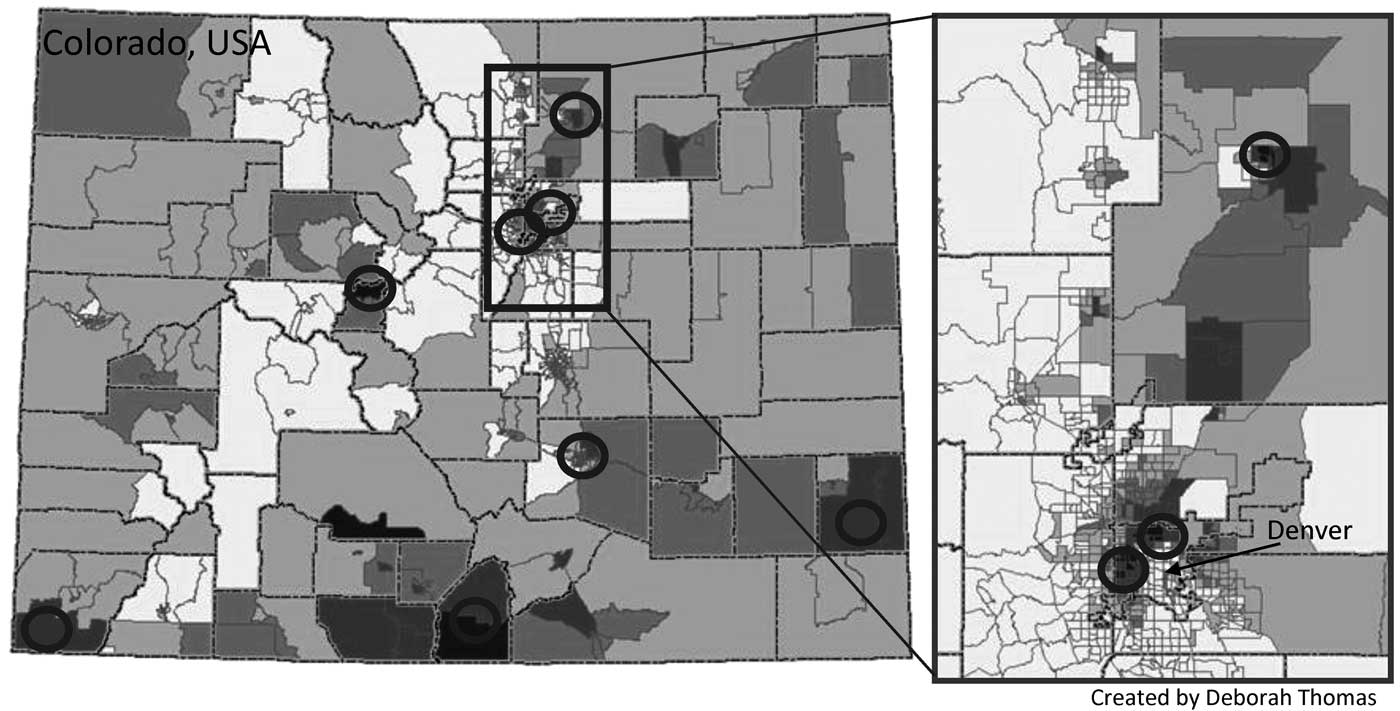
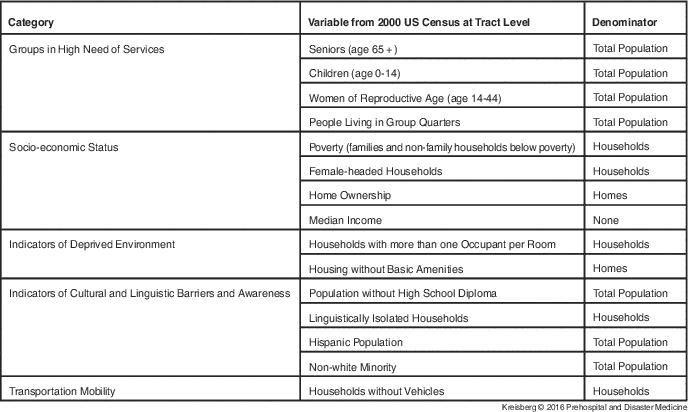
The project employed descriptive mapping, trauma center service area calculations, and statistical analysis. For the vulnerability assessment, 15 variables were selected, based broadly on previous social vulnerability analysis researchReference Kreisberg, Thomas, Valley, Newell, Janes and Little 1 and US Census data,Reference Albanese, Birnbaum and Cannon 36 and analyzed in five main content areas, as shown in Table 1. Several Colorado communities emerged from the factor analysis that highlights higher potential composite vulnerability. Each of these factors alone creates vulnerability that is emphasized during a disaster, but populations with concentrations of compounded indicators of vulnerability face greater risk for exacerbated poor outcomes during disasters. These communities were targeted later for participation in focus groups (Figure 3).
Eight Focus Group Locations (gray circles) Selected Based on High Composite Community Vulnerability Score (darkest shaded areas have highest vulnerability scores).

Compiled Variables from the US 2000 Census

While such a vulnerability assessment does not provide a comprehensive understanding of the needs and capacities of marginalized populations in the context of disaster planning, it does offer systematic baseline information that gives planners a general sense of their service populations. A hospital planner could use the vulnerability assessment data to target additional information gathering efforts and prioritize and integrate cultural competencies, language needs, and even special services explicitly into the disaster plan. Further, the hospital could also utilize this information to seek organizations that provide services to these populations for fostering partnerships. Importantly, this assessment guided the selection of communities in which to conduct focus groups.
Hospital Planner Surveys and Interviews
Learning about the perspectives of health care providers and their experiences of disaster planning and vulnerable populations is fundamentally important to a robust appreciation of the complexities of inclusionary plans and meeting the operational needs of the health care delivery system. Thus, any comprehensive hospital cultural vulnerability assessment necessitates adding this perspective directly to the equation by interviewing and surveying health care professionals such as hospital emergency planners. Data from hospital emergency planner surveys and interviews not only give a more in-depth understanding about providers’ experiences, but they also identify existing resources and provide knowledge of service resource availability and allocation.
An email survey was conducted of all hospital emergency planners in Colorado to establish and assess baseline levels of awareness and importance given to the needs of culturally vulnerable populations during emergency and disaster planning. Survey questions were derived from an existing survey. 37 Responses were captured through the use of Yes/No questions, Likert scales, and open-ended questions. Descriptive statistics were used to determine the characteristics of participating hospitals, as well as awareness of the needs of culturally and linguistically vulnerable populations in disaster planning efforts. SPSS 18 (IBM Corp.; Armonk, New York USA) was used to conduct bivariate Chi-square and Pearson’s correlation tests to determine associations between: (1) hospital characteristics; and (2) perceptions of respondents regarding disaster planning efforts.
Of the 153 Colorado hospital emergency planners surveyed, 91 responded (59.5%). The level of respondent perception of diversity in their hospital service area correlated with their level of concern about linguistic and cultural competency (Pearson’s r=.39; P<.001). Respondents reported that hospitals lack adequate data about the populations living in their service areas and that there is room for improvement in increasing their efforts to partner with culturally and linguistically vulnerable populations during the emergency planning process. Only 39.2 % of participants indicated that their organizations had an organized way of collecting data on the cultural and linguistic characteristic of the patients. Ultimately, such an assessment can enable hospital emergency planners to pinpoint and address gaps in their services and preparedness plans and activities. Not only will this contribute to a decrease in local vulnerability and health disparities, but it will also contribute to the ability of hospitals to operate efficiently as critical infrastructure.
Community-based Focus Groups
Hearing the voices from vulnerable populations themselves is fundamental for their inclusion. The pilot study conducted eight focus groups across Colorado in communities identified by the statewide assessment process as having high composite vulnerability, including large numbers of Hispanic and limited English proficiency populations (Figure 3). The goal of this phase of the project was to gather more in-depth data from multiple communities related to the complex social and cultural interactions with hospitals, specifically during disasters or emergency events.
The focus groups were conducted in seven Colorado communities identified by the statewide vulnerability assessment. Since vulnerable populations may not have high levels of trust for institutions viewed as authority structures, recruitment and implementation of focus groups took place with the cooperation of local community-based organizations that already interacted daily with the target population. Inclusion criteria were: (1) Spanish speaking; (2) with limited English proficiency; (3) living in one of the seven communities; and (4) at least 18 years of age. Each focus group, lasting about two hours, was comprised of 10-15 adults who were each paid $50 for their participation. A discussion guide was used to ask participants to share their experiences and plans regarding crisis events.
Audio recordings of each focus group session were transcribed and then translated into English by an experienced transcriptionist and translator. Participant identifiers were removed. A codebook was created using an inductive approach with themes and categories that emerged from the data. Codes were assigned to the transcripts by the project team as a group, reaching agreements through discussion. NVivo 8 software (QSR International; Doncaster, Victoria, Australia) was used to organize the codes and text.
A number of themes emerged from the focus groups: (1) Participants across focus groups indicated that baseline community vulnerabilities were magnified during disaster events, often due to limited resources; (2) Personal agency and structural considerations also emerged as a theme. Wait times in emergency departments and the cultural insensitivity of health care organizations were described as key factors in the negative experiences of vulnerable populations in their attempts to access care. Participants expressed frustration at the way they were treated as non-English speaking, undocumented individuals. These issues in part lead to (3) Issues of trust. Levels of trust appeared to be important in influencing decisions made about accessing care during disaster situations. Participants did not always trust that hospitals and clinics would care about them, and expressed their tendency to seek medical care from more trusted and affordable revenues, such as native healers or the Red Cross (Washington, DC USA); (4) A community’s spirit of collectivism can affect decision making during disaster events. Focus group participants suggested that they would try to avoid putting others at risk during an epidemic, but that during a disaster, they would stick together as families. Finally, (5) Analysis of the focus group findings revealed that community members acknowledge that not all disasters are alike. However, their disaster response and preparedness literacy was limited for those events that did not offer any warnings.
The focus groups revealed community views of health services in a disaster context and provided insights into a vulnerable population’s decision making in “non-disaster” times. Understanding community perception of care access during a disaster is a critical component in directly enabling hospitals to more effectively reduce risk by: (1) identifying readiness levels as they relate to serving vulnerable populations; (2) choosing and prioritizing cost effective, community-based, and sustainable interventions; and (3) increasing community and health care systems resilience through broadening risk awareness and culturally appropriate planning. Focus groups are only one mechanism for gathering more detailed community information related to community experiences, behavior, response, and access to health care during disasters and emergencies, but proved to be extraordinarily rich and had several positive side effects, including increasing awareness and knowledge, laying the foundation for improved communication, and relationship building.
Overall Project Findings
Taken together, the results of the pilot study indicate that disaster planning and culturally competent care for at-risk populations are not integrated functionally in Colorado, and vulnerable populations are not yet included in the processes fully. Hospital emergency planners should strive to understand the diverse makeup of their service areas, including meaningful interactions with local communities prior to disasters, to provide services more effectively that are appropriate and equitable during and after an event. These interactions will contribute to decreases in local vulnerability and health disparities, better hospitals’ ability to operate efficiently as critical infrastructure during disasters, and increase efficiencies in daily operations.
Conclusion
This report describes a conceptual framework that formalizes a collaborative strategy to include vulnerable populations in hospital and public health emergency preparedness planning. The framework effectively guided a pilot project conducted in the state of Colorado in the US, illustrating how the model can inform integrated hospital and public health emergency preparedness that incorporates vulnerable populations explicitly. The framework and illustrated application lay the foundation for further work on comprehensive inclusion of vulnerable populations into hospital and public health emergency preparedness.
Acknowledgements
The authors acknowledge the assistance of Gwenda Schmidt-Snoek in the preparation of the manuscript.