Introduction
It is widely accepted that narratives have a role in medicine. There are core texts on narrative-based medicine (Greenhalgh and Hurwitz, Reference Greenhalgh and Hurwitz1998; Launer Reference Launer2002), and a trainee in psychiatry advocates the use of narratives within the specialty (Wallang, Reference Wallang2006). Taking a psychiatric history in a sensitive manner may help someone arrange a coherent narrative of their life. Listening to or reading a narrative can similarly have a profound impact.
The Faculty of Old Age Psychiatry is the specialist branch of the Royal College of Psychiatrists dealing with aspects of older people's mental health. The Faculty established a joint forum where users and carers who were identified through the Alzheimer's Society and Age Concern England met with Faculty officers (all practicing old age psychiatrists) and staff members of the two voluntary organizations to discuss matters of mutual interest: this group chose to be called the Consumer Group (referred to hereafter as the Group). The initiative to set up the Group came from the Faculty and was linked with the Royal College of Psychiatry's “Partners in Care” campaign. The Faculty's aim was to get feedback from users and carers on the work being undertaken by the Faculty itself: for example, papers being produced by the Faculty were sent to the Consumer Group for comment and suggestions prior to being finalized, and members of the Group were invited to join other working groups. During their terms of office, the authors recognized that the Group had a strong influence on the work of the Faculty and have reported their reflections on the Consumer Group and its influence elsewhere (Ong et al., Reference Ong, Benbow, Black and Garner2007). Although the Faculty officers brought to the Group ideas about how it might work, users and carers joined the Group with their own ideas about how it should function and what the Faculty should do, and developed a profound influence on the Faculty's work which had not been anticipated by the Faculty officers. Some members travelled long distances to attend the Group from various parts of England. The Group itself has initiated work through the Faculty. It includes users and carers who are coping with dementia and other mental health problems in later life, and continues to meet quarterly. Despite active participation in the Group (for example, being able to raise issues for discussion and adding items to the agenda), members caring for relatives with dementia expressed a wish to share their personal experiences. They recognized that the Consumer Group is a working group and not a support group, and that the timing, agenda and formality of meetings did not allow for detailed sharing of personal experience. It was suggested that they could prepare and share narratives as a way of informing the Group and initiating discussion about carers' issues.
Our paper describes the narratives arising from the Group, and considers their meanings, impact and potential use.
Method
Those members of the Group who wished to do so were asked to send a full written account of their experiences as carers of people with dementia to one of the authors. They were encouraged to prepare the narrative in any way they chose, whether chronological or not, which they felt might inform the Group. The intention was to ensure that carers' issues were properly acknowledged and addressed by the Group within a safe and secure setting, and then fed into the work of the Faculty. Carers were given several months to prepare narratives and a meeting of the Group dedicated to the narratives was organized at which the analyzing author presented his qualitative analysis (without identifying individuals) to the whole Group for further discussion and debate. The analyzing author read and re-read the narratives several times and carried out a qualitative thematic analysis, using methodology based on Balint's work (Balint et al., Reference Balint, Courtenay, Elder, Hull and Julian1993), with the aim of identifying major common themes.
Eight written narratives – four by daughters and four by spouses – were prepared and submitted for analysis by self-selected members of the Consumer Group: all were caring for people with dementia. Seven narratives were written specifically for this project. The eighth carer submitted a published paper from a qualitative research project of which he is a co-author (Galvin et al., Reference Galvin, Todres and Richardson2005).
Results
Five main themes were identified:
1. Difficulties carers have in obtaining a diagnosis from primary care services
2. Acting as advocate-cum-bridge between the private world of a person with dementia and the public world of health and social care
3. Stressors associated with caring for a person with a dementia
4. Difficulties with services offered by social services
5. Emotions experienced during the various stages of being a carer.
1. Difficulties in obtaining a diagnosis
The first theme identified was the difficulty carers have in obtaining a diagnosis from primary care services (Narrative 1):
“During the summer of 1998 I made a number of visits to our GP service encouraged by my brother-in-law who has a medical background and suspected my husband was showing signs of an early dementia.
Our GP [general practitioner] was sympathetic and understanding. His approach was to test for physical causes which made sense to me. He arranged for my husband to have a blood test. I heard nothing further.
I had to ask for an appointment. He informed me the results were not significant.
I asked him to see my husband alone to form an opinion. When my husband returned home he had with him a prescription for vitamins but could not tell me anything about the discussion with our GP. Shortly after, we received an appointment to see the practice counselor.
The meeting with the counselor was pointless. He was trying to deal with a couple with marital problems. My husband's reaction was a ‘b. . . . waste of time.’
I then saw the senior partner whose reaction was why put my husband through a mental health assessment when I already knew there was a problem.
In April 1999 my husband was admitted to hospital as his diabetes was out of control. One of the nurses asked me if I had noticed my husband appeared to be rather confused. I took a deep breath and explained how for the last seven months or so I had been trying without success to involve our GP. The diabetic consultant in charge took control and arranged a CT brain scan and an assessment by the clinical psychologist.
Thus it was some ten months after my initial approach to our GP we finally received a diagnosis of dementia.”
2. Bridging private and public worlds
The second theme was that of the carer being an advocate-cum-bridge between the private world of the person with dementia and the public world of health and social care. The private world of the patient consists of their current neuro-psychiatric situation, increasing dependency, previous personality, relationships and experience. A carer often has access to this based on their close relationship, history and empathy with the person for whom they care. They may be placed by health and social care staff in a position where they are required to interpret or advocate on behalf of their relative with dementia. Excerpts from several narratives illustrate this theme:
“Only after six months did I have a conversation with a social service supervisor. Their philosophy is not to move a person from familiar home surroundings until absolutely necessary as any move would lead to extra confusion. This is an admirable policy although both my sister and I would have liked mother to move closer to us. My mother has always been a happy and positive person. However she has recently become depressed. She feels she is not managing. We try to reassure her, reminding her she has lots of people coming in to help and she only needs to ask. She says she cannot remember this available help and what to ask for, It breaks my heart to see her so unhappy.”
“He is a “carrier” of complexity. Becoming increasingly public with his advocacy requires paradoxically that he engages in and draws on an intimate knowledge of how his wife is as her ability to communicate recedes” (Galvin et al., Reference Galvin, Todres and Richardson2005).
3. Stressors of caring
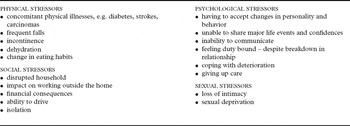
All narratives mentioned similar stressors contributing to the burden of care; these can be subdivided into physical, psychological, social and sexual. The most frequently mentioned are listed in Table 1.
A classification of stressors contributing to the burden of care

4. Practical problems with social care
Another major recurrent theme was the ongoing difficulties carers had with the services provided by social services. There were a few examples of positive experiences, but the majority of experiences were difficult, as illustrated by Narrative 2:
“Things came to a head one weekend when I felt I could continue no longer. Another social worker had in the meantime been given responsibility for our case. I had some difficulty contacting him. When I eventually spoke to him I said I couldn't cope any more. Things had got so bad that I was at the end of my tether and had felt desperate enough on occasion to consider walking out of the house. His response was “there is no point in you making threats”. I was taken aback that a cry for help should be perceived as a threat.
When he visited four days later I gave him an account of my husband's rapid deterioration in the last few weeks including three falls, two of which had involved an ambulance call-out and one a 10 day stay in hospital. Having listened to this, his first question was whether with the existing level of home, day and respite care would I be able to carry on for another year? My response was an emphatic “no” as I reminded him that I was not coping now. He then agreed to recommend my husband for long term care but warned me that it would take some time to sort out funding. There was some suggestion that I was being manipulative.
This response was for me the last straw. I packed a suitcase for myself and another for my husband together with all his medication and instructions. I waited for the evening home carer to arrive and briefed her on what I intended to do. I then gave her the following letter to pass on:
to whom it may concern
Please be aware that I am this evening leaving my house to go and stay with relatives and that I am leaving behind my husband who suffers with Alzheimer's disease and insulin-dependent diabetes. The wear and tear on myself, both physically and psychologically of caring for him at home, is no longer acceptable or sustainable. In order that there is no ambiguity about the situation I am putting in writing that with immediate effect I am no longer prepared to be his carer. I can be contacted only via my daughter.
I have tried in vain to convey to social services that I can no longer manage this situation. I don't feel I have been heard or understood. I have always assumed social services would collaborate with carers and support them in the very difficult task they undertake: unfortunately my experience to date has been the complete reverse of this.
Following this action, emergency admission was made into a local care home and within two weeks I was contacted to say there was a permanent place for him. I feel angry I had to take such an extreme step in order to force the issue.”
5. Emotions experienced by carers
The carer has the dual burden of the conscious often practical problems of coping with a close relative with dementia plus the unconscious conflicts evoked by being in this role (Garner, Reference Garner, Evans and Garner2004):
“Carers either know or fairly quickly learn practical tasks they have to undertake. Sometimes with professional help from one or more agencies. What we need is to understand what is happening to us on an emotional level.”
This is complicated by the quality, nature and history of premorbid relationships. The most frequent emotions described by carers are illustrated by the following quotations from the narratives:
1. Guilt: “I should have been more patient, spent more time with her, done more, etc.”
2. Confusion: “I had no idea how my father was thinking. I fumbled around trying out different theories and occasionally got it right but often made my father unnecessarily unhappy.”
3. Resentment: “I was aware I had to ration my own energies but had no idea of the time involved or the demands I would need to meet. My health has suffered over the last years.”
4. Helplessness: “The opposition of social services to my father's wish to remain in his own home and the antipathy of some of my father's neighbors were difficulties I had not anticipated.”
5. Grief/ sense of loss: “My major point is that the acute emotional strain and sense of loss takes a greater toll than the required physical effort experienced when providing 24-hour care for a loved one suffering from dementia.”
6. Sadness: “I am sorry to say that I found the recollections were often quite distressing and I shed a few tears during the typing of my narrative. I guess the other people who have sent you narratives will be similarly distressed by the task.”
Discussion
Despite being drawn from memories, narratives are structured accounts of events across time and are inherently social (Mumby, Reference Mumby1993); they are created and shared through language. As Anderson (Reference Anderson, Anderson and Gehart2007) states:
“stories are told and retold . . . new versions or new meanings of old ones emerge from these tellings and retellings.”
Thus narratives have a rhetorical power. They evolve and can be contested, negotiated, changed and act as an agent of change. Rather than listening passively, these accounts create a reaction (Gardner, Reference Gardner2002).
During repeated readings of the narratives in order to identify recurrent themes, the authors became aware that the narratives and themes within them reflected contributory ideas and opinions expressed by carers in the Consumer Group. The narratives thus serve as recorded self-contained accounts of the carers' contributions. They have impact for the carer in developing the narrative and for the reader/listener in terms of the potential influence of hearing that narrative. The process of feedback and discussion employed within the Group offered further opportunity for narrators and listeners to develop the themes and ideas further. Accounts such as Narrative 2 bring to life the realities of living with a person with dementia and make professionals face the discomfort of discovering how families can be let down by the services that should be supporting them.
Illness narratives have been divided into three categories by Frank (Reference Frank1998): the restitution story, the chaos story and the quest story. All our carers' narratives could be categorized as quest narratives, fulfilling the definition as unflinching views of the reality of dementia and of being a carer. In the face of this reality, our carers looked not to restitution, but rather to what can be reclaimed of life. What can be learned and how can this lesson be passed on to those who have not made their journey?
When the analysis of the narratives was presented to the Consumer Group, they discussed how the themes might be addressed in their ongoing work. One initiative which arose from these discussions was a one-day conference for primary care representatives, Faculty members, user and carer representatives. It aimed to give carers the chance to discuss perceived difficulties with primary care representatives and to address the first theme (difficulties of obtaining a diagnosis) by allowing general practitioners to hear directly from carers in a setting outside the consultation room. The second and third themes (carers being the bridge between the person with dementia and the health system, and the stresses resulting from this) were partly addressed by carers' involvement in the Consumer Group, giving them a direct link to professionals, an influence within old age psychiatry at the Royal College of Psychiatrists and an arena where change could potentially be achieved. Their enthusiasm is reflected by their regular attendance at meetings with few absences or apologies and by the distances some people were prepared to travel in order to take part in the Group.
The fourth theme of practical difficulties with social services was not directly acted on, as social services professionals were not involved in the Group, although the need to have a holistic approach was acknowledged and, by acknowledging the theme, the professionals involved were made aware of its importance to families.
Dealing with the fifth theme (the emotional experiences of carers) proved to be more difficult as there was a working agenda of issues within the psychiatry of old age to occupy Group meetings, and the Group's agreed remit did not include support to users and/or carers. Recognition of the need for support had been part of the rationale behind the suggestion of writing narratives and the professional members of the Group hoped that writing narratives would itself be of some support to the carers involved. Furthermore they hoped that by identifying themes which could influence the Group's work and the work of the Faculty, carers would be able to help others learn from their experiences and that this in itself would be a positive experience for them. Narratives are known to offer a method for addressing existential qualities such as inner hurt, despair, hope, grief and moral pain which frequently accompany and may even constitute people's illnesses (Greenhalgh and Hurwitz, Reference Greenhalgh and Hurwitz1999). Our fifth theme well illustrated this aspect of narratives and alerted us to our carers' health and a need in some instances to try to bring peaceful resolution to the grieving process. Grief is a time to ask questions, and if answers are not found grief may be prolonged.
A main aim of good dementia care is to help people with a dementia and their families to enjoy life as much as possible while living through their illness. Losses may be mourned, but the ability to enjoy day-to-day activities, contact with friends and relatives, and to retain hope is part of life itself, and may be retained throughout the illness. This is clearly shown by the major debate in 1995 about the quality of De Kooning's paintings. The conclusion was that De Kooning might not recover from his forgetting but he could live serenely within it (Shenk, Reference Shenk2001). Even if at times he confused his wife with his sister, De Kooning went on to create. His resurgence is a testimony to the potential of the human mind, and evidence for hope (Espinel, Reference Espinel1996). Espinel (Reference Espinel2007) goes on to identify, in his later work, a syndrome called “creating in the midst of dementia” which may give further hope for dementia sufferers and their carers. We were disappointed that hope was not an emotion that was mentioned in these narratives. We anticipate that by using this, and similar information in teaching students about dementia care, we may improve the quality of dementia care, and increase users' and carers' hope.
Different meanings are associated with a dementing illness in a spouse or in a parent. Anthony-Bergstone et al. (Reference Anthony-Bergstone, Zarit and Gatz1988) found an increase in hostility and anxiety in female carers, but an increase in depression only in wives. Balint's method of analysis would allow us further detailed analysis and information also of social perspectives on the differences between spouse carers and daughters along the lines of published work (Kirsi et al., Reference Kirsi, Hervonen and Jylha2004; Ward-Griffin and Bol, Reference Ward-Griffin, Bol and Paoletti2007). It would also allow an exploration of concepts of the different kinds of grief (Garner, Reference Garner1997). We were privileged to have this information but decided to focus on the main themes of the role of narratives in a Consumer Group.
This was not a Balint group but it had some resonances with his ideas. He wished to promote the psychological dimension of medical education. He wrote of the physician's role in organizing the illness through doctors' interventions (Balint, Reference Balint1955). In this case the carers' experience was organized into themes and priority given to experience over theoretical abstractions. Balint wrote that his groups for doctors allowed a better understanding of the doctor–patient relationship. In this case, the Faculty officers were able to reflect on their role in similar situations to those described in the narratives.
The value of narratives for carers lies in helping them make sense of the experiences they have been through and in sharing those experiences in such a way that they might be able to influence others, whether users and carers, by sharing their wisdom/ difficulties/ solutions, etc, or professionals, by confronting them with the realities of care. The value of narratives for professionals lies in helping them to learn more about the impact of caring on families and the sobering reality of using health and social care services. Haeney et al. (Reference Haeney, Moholkar, Taylor and Harrison2007) recently described how service users can be involved in psychiatric training. Tew et al. (Reference Tew, Gell and Foster2004) have looked at the involvement of users and carers in education and stress that they offer distinct but complementary perspectives. Narratives are one way of involving carers (and users) in teaching, training and continuing professional education. Benbow and colleagues (Reference Benbow, Taylor and Morgan2008) have described the powerful impact on students of involving a user in multi-professional postgraduate education and the user herself describes how she approached the teaching by talking openly about her own experiences. The work has been taken further with the development of a module at Staffordshire University dedicated to the experiences of users and carers in older people's mental health settings (Benbow and Boyce, Reference Benbow and Boyce2008).
One of the greatest values of narratives for professionals may lie in identifying gaps and difficulties in service provision. It is important that users and carers have opportunities for their experiences to influence services and service providers. The use of “patient journey” or “carer journey” methodology is one way of doing this and has been helpful to members of the West Midlands Older People's Mental Health Collaborative in identifying areas for service improvement work (Doherty et al., Reference Doherty, Benbow, Craig and Smith2008).
In conclusion, the impact of narratives in this setting is similar to that of narratives used in other settings as a therapeutic tool. By writing these narratives, our carers confirmed their strong relationship with the Consumer Group, which they hope provides an opportunity to influence changes in dementia care.
Conflict of interest
None.
Description of authors' roles
All authors were involved in study design, discussion and contributed to writing up. Dr. Ong took a lead in analyzing the narratives.
Acknowledgments
The authors wish to thank all the members of the Consumer Group for their contributions to the discussions on the themes described here and, in particular, the carers who generously shared their experiences by writing their narratives. The authors confirm that all carers who submitted narratives have seen a draft version of this paper and gave their written consent to publication.