





Impact statement
This study provides important evidence on the severity distribution of depressive symptoms among older adults with neurodegenerative disorders in Nigeria who already exhibited depressive symptoms. Severe depressive symptomatology emerged as the dominant severity category, affecting more than four-fifths of participants. The study further identifies key sociodemographic, clinical and psychosocial factors associated with greater depressive symptom severity, including advanced age, male gender, marital disruption, living arrangements, medication dependence and comorbid medical conditions. These findings enhance understanding of the complex determinants of mental health outcomes in a highly vulnerable clinical population. These results have significant implications for healthcare practice, service delivery and policy development. In Nigeria, they underscore the need for routine assessment of depressive symptom severity and the integration of mental health services within neurodegenerative care pathways. More broadly, the findings offer relevant insights for other low- and middle-income countries facing similar challenges in geriatric mental health, where limited resources, caregiving pressures and sociocultural factors may contribute to adverse psychological outcomes. This study also reinforces the importance of multidisciplinary care models, caregiver support and culturally responsive psychosocial interventions for older adults living with neurodegenerative conditions. Beyond clinical practice, this research informs public health planning by highlighting the contributions of social support, educational attainment, chronic disease management and holistic care approaches to mental well-being in later life. Importantly, the findings characterize patterns and correlates of depressive symptom severity within a clinically selected symptomatic population and should not be interpreted as estimates of population-level prevalence. By addressing a critical evidence gap in an under-researched African setting, this study establishes a foundation for future population-based and longitudinal research aimed at clarifying causal pathways, informing targeted interventions and improving quality of life among older adults with neurodegenerative disorders.
Introduction
Late-life depression (LLD) is a major global public health concern, particularly among individuals living with neurodegenerative disorders such as Alzheimer’s disease (AD), Parkinson’s disease (PD) and Lewy body dementia (DLB). While global prevalence estimates for LLD range between 5% and 10% in general geriatric populations and up to 35% in clinical cohorts (Cai et al., Reference Cai, Jin, Liu, Zhang, Su, Ungvari, Tang, Ng, Li and Xiang2023; Furrer and Handschin, Reference Furrer and Handschin2025), this burden appears to be disproportionately higher in low- and middle-income countries (LMICs), where healthcare infrastructure and geriatric mental health services are underdeveloped. Beyond its clinical manifestations, depression in this population significantly complicates treatment adherence, worsens functional outcomes, increases healthcare utilization and costs and imposes substantial emotional and financial burden on caregivers and family members.
In older adults with neurodegenerative diseases, the risk of severe depression is influenced by a complex interplay of biological, psychological and social factors. Neurodegenerative conditions often exacerbate certain vulnerabilities by impairing autonomy, increasing caregiver dependence and contributing to neurochemical and structural brain changes associated with mood dysregulation. Importantly, neurodegenerative disorders and depression share overlapping symptoms, such as cognitive impairment, apathy, sleep disturbances and reduced motivation, which may complicate accurate identification of depressive symptoms. However, validated tools such as the Geriatric Depression Scale (GDS-15) help distinguish depressive symptoms from neurocognitive decline.
In sub-Saharan Africa (SSA), and specifically in Nigeria, older adults are frequently exposed to compounded vulnerabilities, including chronic illness, cognitive decline, poverty, bereavement and social isolation (Akosile et al., Reference Akosile, Mgbeojedo, Okoye, Odole, Uwakwe and Ani2024; Alumona et al., Reference Alumona, Scott, Odole, Nweke, Kalu and Awosoga2024). The treatment gap for depression in these settings is further driven by limited mental health infrastructure, shortage of trained professionals, stigma, low mental health literacy and competing healthcare priorities (Chakrabarti, Reference Chakrabarti2024).
Despite the growing geriatric population and the increasing burden of neurodegenerative diseases in Nigeria, limited empirical data exist on the distribution, severity profile and predictors of depressive symptoms among older adults with neurodegenerative disorders. Because many existing studies do not adequately characterize depressive symptom severity within clinically affected populations, important information regarding symptom burden and associated factors remains poorly understood. Existing literature largely focuses on either neurodegenerative disorders or depression in isolation, neglecting the unique interplay between both conditions in older adults. Furthermore, cultural and familial dynamics, such as multigenerational cohabitation and gender roles, may influence the manifestation of depressive symptoms differently in SSA compared to high-income countries, yet these contextual factors remain understudied (Xia and Li, Reference Xia and Li2018; Donovan and Blazer, Reference Donovan and Blazer2020). This study seeks to address this critical research gap by determining the distribution and severity of depressive symptoms and predictors of severe depressive symptoms among older Nigerians with neurodegenerative conditions, focusing on sociodemographic, clinical and psychosocial correlates. By elucidating these drivers, the study provides evidence to inform (rather than directly design) integrated care approaches and guide the development of culturally appropriate mental health interventions and policy frameworks for aging populations in LMICs. The findings have implications for clinical practice, health policy and future research on geriatric mental health in resource-limited settings.
Materials and methods
Study design and setting
This hospital-based, cross-sectional study was conducted between November 2024 and October 2025 across six federally accredited neuropsychiatric hospitals in Nigeria. The study was designed to capture the sociocultural, geographic and ethnic diversity across the country’s six geopolitical zones. Accordingly, one hospital was purposely selected from each zone based on its clinical capacity, availability of neurodegenerative care services and staffing levels. The selected sites included the Federal Neuro-Psychiatric Hospital, Budo-Egba (North Central); Federal Neuro-Psychiatric Hospital, Maiduguri (North East); Federal Neuro-Psychiatric Hospital, Kware (North West); Federal Neuro-Psychiatric Hospital, Enugu (South East); Federal Neuro-Psychiatric Hospital, Calabar (South South); and Federal Neuro-Psychiatric Hospital, Aro (South West).
Sampling procedure
A two-stage sampling technique was employed. First, each of the six geopolitical zones was treated as a primary sampling unit, with one neuropsychiatric hospital selected through stratified random sampling. Second, consecutive sampling was used to recruit eligible older adults from each facility until the targeted sample size of 51 participants per hospital was attained, yielding a total sample of 306 participants. Although proportional allocation based on outpatient attendance could enhance representativeness, equal allocation (n = 51 per site) was adopted to ensure balanced representation across Nigeria’s six geopolitical zones, given variability in record systems and patient flow across facilities. This approach minimized site-level sampling bias and ensured comparability across regions in this multicenter study. Following data cleaning and validation, 304 complete responses were retained for analysis, reflecting a response rate of 99.7%.
Sample size calculation and power considerations
Sample size was estimated using Cochran’s formula for proportions, assuming a 6% prevalence of chronic disease (A), a complement (D) of 94% and a precision level (R) of 0.09. The calculation yielded a minimum required sample of 278 participants. To compensate for possible nonresponse, a 10% adjustment was applied, increasing the target to 306 participants. This assumption is consistent with standard methodological recommendations for cross-sectional studies, where a nonresponse rate of 5–20% is commonly applied in the absence of precise prior estimates (Cochran, Reference Cochran1977; Cohen, Reference Cohen1988; Naing et al., Reference Naing, Winn and Rusli2006). Furthermore, studies involving older adults with neurodegenerative conditions have reported potential challenges such as cognitive impairment, fatigue and caregiver dependence, which may contribute to participant dropout or incomplete responses (Hailu et al., Reference Hailu, Oliveira, Pereira, Gebru, Abebe, Belay and Tavares2025). Previous hospital-based studies in similar populations have documented nonresponse or attrition rates within this range (Stephens et al., Reference Stephens, Bender, El-Hassan and Patel2025), thereby supporting the appropriateness of a 10% adjustment in the present study. The applied adjustment ensured that the study remained adequately powered despite potential data loss.
Participants and eligibility criteria
Participants were eligible for inclusion if they were aged 60 years or older (mean age: 70.75 years) and had a clinically confirmed diagnosis of at least one neurodegenerative disorder, AD, PD, or DLB. Diagnoses were verified through review of medical records and, where necessary, direct consultation with attending physicians. Eligible participants had lived with the neurodegenerative condition for at least one year and exhibited depressive symptoms, defined as a score of 5 or higher on the Geriatric Depression Scale–15 (GDS-15; Yesavage et al., Reference Yesavage, Brink, Rose, Lum, Huang and Adey1982), corresponding to the presence of depressive symptoms ranging from mild to severe. Participants were required to have a GDS-15 score of ≥5, indicating the presence of at least mild depressive symptoms, as part of the study’s inclusion criteria. Importantly, the study did not restrict enrollment to participants with severe depression alone; participants with mild (scores 5–8), moderate (scores 9–11) and severe (scores 12–15) depressive symptoms were included, ensuring that the sample encompassed the full spectrum of depressive severity as defined by the GDS-15. Participants were required to demonstrate sufficient cognitive and emotional capacity to engage with the study materials, either independently or with caregiver assistance. Additional eligibility requirements included active receipt of inpatient or outpatient care at one of the participating federally accredited neuropsychiatric hospitals and the ability to complete the study instruments in English, Hausa, Igbo or Yoruba. The study sample represents a clinically selected group of older adults with neurodegenerative conditions who already exhibited depressive symptoms, and therefore does not permit estimation of population-level prevalence.
Neurodegenerative diagnoses were established prior to study enrollment by consultant psychiatrists and/or neurologists at the participating hospitals using internationally recognized diagnostic criteria routinely applied in clinical practice. AD diagnoses were based on the National Institute on Aging–Alzheimer’s Association (NIA-AA) criteria, PD diagnoses followed the UK Parkinson’s Disease Society Brain Bank clinical diagnostic criteria and DLB diagnoses were made in accordance with the Fourth Consensus Report of the DLB Consortium. Diagnostic evaluations typically involved longitudinal clinical assessment, neurological examination, cognitive screening and supportive neuroimaging and/or laboratory investigations where clinically indicated. The research team did not generate, modify, or reclassify diagnoses but relied exclusively on specialist-confirmed diagnoses documented in patients’ medical records. Where more than one neurodegenerative diagnosis was recorded, this reflected clinically documented mixed or evolving syndromes (e.g., PD dementia or AD with Lewy body pathology), rather than multiple independent or concurrent definitive diagnoses. Participants were excluded if they were younger than 60 years, lacked a clinically confirmed neurodegenerative diagnosis, or had a GDS-15 score below 5. Additional exclusion criteria included severe cognitive or sensory impairment that precluded questionnaire completion. Participants were required to have a GDS-15 score of ≥5 as an inclusion criterion, indicating the presence of at least mild depressive symptoms. Consequently, the study sample comprised a clinically selected group of older adults with neurodegenerative disorders who already exhibited depressive symptoms. Because individuals without depressive symptoms were not eligible for participation, the study design does not permit estimation of the population-level prevalence of depression among older adults with neurodegenerative disorders. Rather, the study was designed to characterize the distribution, severity profile and correlates of depressive symptoms within this clinically defined population.
Data collection instrument
Data were collected using a structured, contextually tailored questionnaire titled the Depression and Psychosocial Factors in Older Adults with Neurodegenerative Conditions Questionnaire (DPFOANCQ). The instrument comprised five core sections: (A) sociodemographic and clinical characteristics; (B) assessment of depressive symptom severity using the GDS-15 (Yesavage et al., Reference Yesavage, Brink, Rose, Lum, Huang and Adey1982); (C) psychosocial, lifestyle and emotional factors; (D) clinically verified diagnoses of neurodegenerative conditions; and (E) participant information and consent documentation.
Depressive symptom severity was assessed using the Geriatric Depression Scale–Short Form (GDS-15) (Yesavage et al., Reference Yesavage, Brink, Rose, Lum, Huang and Adey1982), a widely validated screening instrument comprising 15 items with dichotomous (Yes/No) response options. The GDS-15 has been widely used and validated in diverse settings, including SSA, and is considered appropriate for older adult populations due to its reduced emphasis on somatic symptoms. In this study, the instrument demonstrated good internal consistency, with a Cronbach’s alpha of 0.88. Each item was scored dichotomously rather than on a Likert scale, with responses indicative of depression assigned a score of 1 and nondepressive responses scored 0. For negatively worded items (e.g., ‘Do you feel that your life is empty?’), a ‘Yes’ response was scored as 1 and a ‘No’ response as 0. For positively worded items (e.g., ‘Are you satisfied with your life?’), reverse coding was applied such that a ‘No’ response was scored as 1 and a ‘Yes’ response as 0, ensuring that higher scores consistently reflected greater depressive symptomatology.
The composite depression score was computed by summing the scores across all 15 items, yielding a total possible score ranging from 0 to 15. Based on established GDS-15 guidelines, depression severity was categorized as follows: 0–4 (no depression), 5–8 (mild depression), 9–11 (moderate depression) and 12–15 (severe depression). For the purposes of this study, a cut-off score of ≥5 was used to define the presence of depressive symptoms, while severity categories were used for subgroup analyses.
Neurodegenerative diagnoses captured in Section D were extracted exclusively from patients’ medical records and reflected diagnoses previously established by specialist clinicians using standard diagnostic criteria. No diagnostic information was based on self-report, screening tools or researcher judgment, and the research team did not generate, modify, or reclassify diagnoses. Where more than one diagnosis was recorded, this reflected clinically documented mixed pathology, diagnostic progression or overlapping symptomatology consistent with real-world neuropsychiatric practice.
The DPFOANCQ was developed specifically for this study through adaptation of validated instruments, including the Health Information National Trends Survey (HINTS; National Cancer Institute, 2022) and the World Health Organization Study on Global AGEing and Adult Health (SAGE; World Health Organization, 2012). The questionnaire was linguistically adapted for the Nigerian context, with translations into Hausa, Igbo and Yoruba. Pretesting was conducted among 20 older adults to assess clarity and cultural appropriateness. Content validity was evaluated by a panel of 15 experts in geriatrics and public health, all of whom held doctoral qualifications and had over 10 years of healthcare delivery experience. The instrument demonstrated strong internal consistency, with Cronbach’s alpha of 0.88.
Although depressive symptoms were self-reported using the GDS-15 (Yesavage et al., Reference Yesavage, Brink, Rose, Lum, Huang and Adey1982), this approach is consistent with standard practice in cross-sectional studies. To enhance clinical contextualization, depressive symptom assessment was complemented by verification of neurodegenerative diagnoses through review of medical records and consultation with attending physicians. Nevertheless, it is acknowledged that the absence of study-specific clinical psychiatric evaluations may limit diagnostic precision, and future research may benefit from incorporating comprehensive clinical assessments to improve characterization of depressive symptom severity and diagnostic accuracy. For the purposes of this study, emphasis was placed on the distribution and severity of depressive symptoms within the selected sample rather than estimating prevalence.
Data collection procedures
Data were collected through face-to-face interviews conducted by 18 trained research assistants, with three assigned to each participating hospital. All research assistants were registered nurses employed at the respective study sites. Prior to data collection, they underwent a standardized 40-min training session led by the principal investigator, which emphasized ethical conduct, informed consent procedures and uniform administration of the study questionnaire. Interviews were conducted in private consultation rooms within each hospital to ensure participant comfort, privacy and confidentiality. Where necessary, caregivers or trained research personnel assisted participants who had literacy limitations or mild insight challenges. Given the cognitive limitations associated with neurodegenerative disorders, interviews were conducted using simplified language, repetition and interviewer guidance where necessary. Participants with mild-to-moderate cognitive impairment were supported to respond directly, while caregivers assisted in clarifying questions without influencing responses. For participants with more severe impairment but retained basic communicative ability, responses were obtained through structured interviewer facilitation. Emotional and psychosocial responses were primarily self-reported, with caregiver input used only to support comprehension rather than to substitute participant perspectives.
Neurodegenerative diagnoses were extracted through systematic review of patients’ medical records in close collaboration with attending physicians. This process ensured that only diagnoses established during routine specialist care and documented in clinical records were included. Although the study did not involve independent diagnostic reassessment or confirmatory testing such as neuroimaging or biomarker analysis, reliance on diagnoses made in tertiary neuropsychiatric hospitals using standardized clinical criteria provides reasonable diagnostic validity for this observational study. Given the cross-sectional design and use of routine clinical documentation, the extracted diagnoses reflect real-world clinical complexity, including diagnostic evolution and mixed neurodegenerative presentations commonly observed in older adults.
Depressive symptoms were self-reported using the GDS-15 (Yesavage et al., Reference Yesavage, Brink, Rose, Lum, Huang and Adey1982). While no independent psychiatric examinations were conducted by the research team, attending physicians reviewed medical records to confirm the presence of clinically diagnosed neurodegenerative conditions, thereby providing an appropriate clinical context for interpreting GDS-15 scores. It is acknowledged that reliance on self-reported measures may influence the classification and severity assessment of depressive symptoms, particularly where social desirability bias or limited symptom awareness exists. It is acknowledged that, due to the inclusion criterion requiring depressive symptoms (GDS-15 ≥ 5), the study does not estimate the prevalence of depression but rather examines the distribution and correlates of depressive symptom severity within this clinically defined group. Future studies may benefit from integrating self-report instruments with comprehensive psychiatric evaluations or standardized diagnostic assessments to enhance the accuracy of depression measurement in this population.
Ethical considerations
The study was conducted in accordance with the ethical principles outlined in the Declaration of Helsinki (World Medical Association, 2013) and the American Psychological Association’s Ethical Guidelines (American Psychological Association, 2017). Ethical clearance was obtained from the Federal Ethics Committee of Nigeria (Reference No: REC/FE/2024/00072). In addition, administrative approvals were granted by the Chief Medical Directors of all participating hospitals. Written informed consent was obtained from all participants or their legally authorized representatives before participation. Confidentiality and anonymity were strictly maintained throughout this study. Given the vulnerability of the study population, additional safeguards were implemented. Written informed consent was obtained from participants with preserved decision-making capacity, while assent was obtained alongside proxy consent from legally authorized representatives for those with impaired capacity. All data were anonymized using unique identification codes and stored in password-protected databases accessible only to the research team. Hard-copy materials were securely stored in locked cabinets within hospital premises. Participants identified as high risk (e.g., severe depressive symptoms or emotional distress) were immediately referred to attending clinicians for further evaluation and management through established clinical pathways.
Given the assessment of depressive symptoms, specific procedures were implemented to identify and manage psychological distress during data collection. Research assistants, who were trained registered nurses, were instructed to actively observe participants for signs of emotional discomfort, distress or fatigue during interviews. If a participant exhibited noticeable distress (e.g., tearfulness, agitation or withdrawal), the interview was paused or discontinued, and immediate emotional support was provided in a calm and reassuring manner.
Participants who reported severe depressive symptoms (based on high GDS-15 scores) or expressed significant psychological distress were promptly referred to the attending clinician or on-site mental health professionals within the neuropsychiatric facility for further evaluation and appropriate management. In urgent cases, same-day clinical attention was facilitated through established hospital referral pathways. Additionally, caregivers present during the interview were sensitized, where appropriate, to support the participant and seek further care. These procedures ensured that participant well-being was prioritized throughout the study, and that any identified psychological needs were addressed through appropriate clinical support systems within the participating institutions.
Statistical analysis
Data analysis was conducted using IBM SPSS Statistics Version 28 (IBM Corp, 2021). Descriptive statistics (frequencies and percentages) were used to summarize participants’ sociodemographic, clinical and psychosocial characteristics. Both frequencies (n) and percentages (%) are consistently reported in the narrative and tables to enhance clarity and interpretability. Descriptive analyses focused on characterizing the distribution and severity profile of depressive symptoms within the study sample. Given that eligibility required the presence of depressive symptoms (GDS-15 ≥ 5), the study design does not permit estimation of population-level prevalence or prevalence rates of depression among older adults with neurodegenerative disorders. Accordingly, all analyses were restricted to describing symptom severity patterns and identifying factors associated with severe depressive symptoms within this clinically selected group. Associations between depressive severity and independent variables were tested using Chi-square (χ2) analyses. Variables with p values <0.05 in the bivariate (Chi-square) analyses were subsequently entered into a multivariable logistic regression model to identify independent predictors of severe depression, while adjusting for potential confounders including age, gender, education, marital status, living arrangement, medication dependence and comorbid conditions. Crude odds ratios (CORs) were initially generated from bivariate analyses, while adjusted odds ratios (AORs) with corresponding 95% confidence intervals (CIs) were reported from the multivariable logistic regression model. Given that depressive severity (dichotomized as severe vs. non-severe) was a single outcome variable, the logistic regression model was multivariable rather than multivariate.
Importantly, the inclusion of certain nonsignificant variables in the final multivariable model was intentional and guided by epidemiological and theoretical considerations. While model construction was primarily informed by variables that achieved statistical significance at the bivariate level (p < 0.05), selected covariates were retained to ensure theoretical completeness, control for confounding and facilitate comparison with existing literature. Specifically, two variables that did not demonstrate statistically significant associations in the bivariate analyses (religious affiliation and duration of neurodegenerative condition) were retained in the final multivariable model because previous studies have identified them as clinically and theoretically relevant determinants of depressive outcomes among older adults and individuals with neurodegenerative disorders. Religiosity has been associated with psychological resilience, coping behaviors and depressive symptom severity, while disease duration has been linked to functional decline, caregiver burden and emotional adjustment. Their inclusion was therefore intended to control for potential confounding, minimize omitted-variable bias and facilitate comparison with prior epidemiological research. This approach is consistent with established epidemiological modeling practices in observational studies, where variables of known clinical or contextual relevance are retained regardless of statistical significance to improve the robustness and interpretability of effect estimates. This strategy is particularly important in settings where high outcome prevalence and sample-specific variability may reduce statistical power to detect significance for some predictors. Furthermore, the multivariable model was strengthened through a priori specification and simultaneous adjustment for key sociodemographic and clinical variables known from prior literature to influence depression in older adults with neurodegenerative disorders, thereby minimizing residual confounding and enhancing the validity of the findings.
Logistic regression, a nonlinear model based on the logit transformation, was appropriately applied for the binary outcome, and results are presented as odds ratios. To improve clarity, we explicitly specify that CORs were derived from bivariate analyses, while AORs were obtained from the multivariable logistic regression model. We further clarify that logistic regression is inherently nonlinear (logit-based), and not a linear model, addressing the reviewer’s concern regarding model specification. Statistical significance was determined at p < 0.05. Missing data were minimal (<5%) and were handled via listwise deletion. This study adhered to the Strengthening the Reporting of Observational Studies in Epidemiology (STROBE) guidelines for reporting cross-sectional studies (von Elm et al., Reference von Elm, Altman, Egger, Pocock, Gøtzsche and Vandenbroucke2008).
Prior to inferential analyses, key statistical assumptions were assessed. For Chi-square (χ2) tests, assumptions of independence of observations and adequacy of expected cell counts were evaluated. All observations were independent, as each participant contributed data only once. Expected cell frequencies were examined, and in instances where more than 20% of cells had expected counts less than 5, categories were combined where appropriate to satisfy test assumptions. For multivariate logistic regression analysis, several assumptions were verified. The outcome variable (depressive severity) was dichotomized appropriately for binary logistic regression. Multicollinearity among independent variables was assessed using Variance Inflation Factor (VIF) and tolerance statistics, with no evidence of problematic multicollinearity observed (VIF < 5). Additionally, other regression assumptions, including linearity of the logit (assessed using the Box–Tidwell procedure), absence of influential outliers (evaluated using standardized residuals, Cook’s distance and leverage values) and independence of observations, were assessed and satisfied, thereby strengthening the methodological rigor and validity of the model. Model fitness was evaluated using the Hosmer–Lemeshow goodness-of-fit test, which indicated adequate model fit (p > 0.05). These diagnostics confirmed the robustness and validity of the regression model.
Results
Sociodemographic and clinical characteristics
A total of 304 older adults with neurodegenerative conditions participated in the study. The majority were aged ≥70 years (192, 63.2%), and (205, 67.4%) were male. Christianity was the most commonly reported religious affiliation (183, 60.2%), and (106, 34.9%) of participants had a tertiary education. Only (126, 41.4%) were currently married, while (178, 58.6%) fell into the ‘others’ category (single, separated/divorced, or widowed). Most participants (244, 80.3%) lived with family members. In terms of clinical characteristics, (232, 76.3%) were always dependent on medications, and (197, 64.8%) had lived with their neurodegenerative condition for ≤5 years. Comorbid conditions (e.g., diabetes, cardiovascular disease) were reported by (238, 78.3%) of participants. Regarding the primary objective, the severity distribution of depressive symptoms within this clinically selected sample showed that 85.2% of participants had severe depressive symptoms, while 14.8% had mild-to-moderate depressive symptoms. Because all participants met the study inclusion criterion of GDS-15 ≥ 5, these findings represent the distribution of depressive symptom severity within the study sample and should not be interpreted as estimates of population-level prevalence. See Table 1 for full details.
Sociodemographic, depressive severity and clinical characteristics of older adults with neurodegenerative conditions in Nigeria (N = 304)

Table 1. Long description
The table contains four columns: Variable, Category, Frequency f, and Percentage percent.
* Age: greater than or equal to 70 years (192, 63.2 percent); 60 to 69 years (112, 36.8 percent).
* Gender: Male (205, 67.4 percent); Female (99, 32.6 percent).
* Religious affiliation: Christianity (183, 60.2 percent); Others including Pagan, African Traditional Religion, and Islam (121, 39.8 percent).
* Education level: Tertiary (106, 34.9 percent); Others including non-formal, primary, and secondary (198, 65.1 percent).
* Marital status: Married (126, 41.4 percent); Others including single, divorced or separated, and widowed (178, 58.6 percent).
* Living situation: With family (244, 80.3 percent); Others including alone or institutionalized (60, 19.7 percent).
* Medication dependence: Always (232, 76.3 percent); Rarely (72, 23.7 percent).
* Duration of condition: greater than or equal to 5 years (107, 35.2 percent); less than or equal to 5 years (197, 64.8 percent).
* Comorbidity such as diabetes or C V D: Present (238, 78.3 percent); Absent (66, 21.7 percent).
* Depressive severity: Severe (259, 85.2 percent); Mild (45, 14.8 percent).
Note: n: sample size, (): bracket sign, ≥: greater than sign, ≤: less than sign, f: frequency, %: percentage, CVD: cardiovascular disease.
Psychosocial, lifestyle and emotional factors
Psychosocial vulnerabilities were prevalent. A significant proportion (279, 91.8%) had experienced the death of a spouse, close relative or friend in the past year. Feelings of loneliness were reported by (266, 87.5%), while (248, 81.6%) did not engage in regular social interaction. Similarly, (227, 74.7%) felt they lacked sufficient emotional support, and (241, 79.3%) experienced social withdrawal. Other notable findings included functional decline (220, 72.4%), poor insight (227, 74.7%), sadness about cognitive health (282, 92.8%) and tobacco use (119, 39.1%). See Table 2 for full details.
Psychosocial, lifestyle and emotional factors (N = 304)

Table 2. Long description
The table contains four columns: S/n, Factors, Yes n (%), and No n (%).
1. Death of a spouse, close relative or friend in the past year: Yes 279 (91.8%), No 25 (8.2%).
2. Feel lonely: Yes 266 (87.5%), No 38 (12.5%).
3. Interact socially: Yes 56 (18.4%), No 248 (81.6%).
4. Participate in religious, social or community activities: Yes 115 (37.8%), No 189 (62.2%).
5. Receive enough emotional support: Yes 77 (25.3%), No 227 (74.7%).
6. Experience functional decline and limitations: Yes 220 (72.4%), No 84 (27.6%).
7. Feel the pains of social withdrawal: Yes 241 (79.3%), No 63 (20.7%).
8. Experience poor insight: Yes 227 (74.7%), No 77 (25.3%).
9. Feel sad about cognitive health: Yes 282 (92.8%), No 22 (7.2%).
10. Smoke or use tobacco: Yes 119 (39.1%), No 185 (60.9%).
Distribution of neurodegenerative diagnoses within the study sample
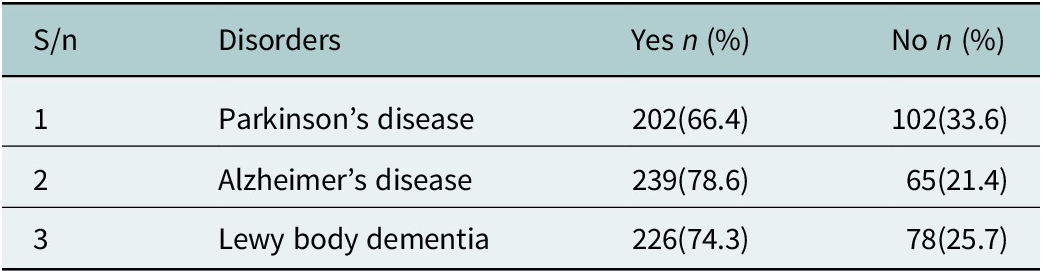
Among the 304 participants, the distribution of specialist-confirmed neurodegenerative diagnoses within this clinically selected sample was AD (78.6%), DLB (74.3%) and PD (66.4%). These proportions describe the composition of the recruited sample and do not represent prevalence estimates of neurodegenerative disorders in the wider population. These conditions were not mutually exclusive, as some participants had more than one diagnosis documented in their medical records. See Table 3 for full details.
Prevalence of neurodegenerative conditions in older Nigerian adults (N = 304)

Table 3. Long description
The table consists of four columns: S forward slash n, Disorders, Yes n (percent), and No n (percent). There are three rows of data representing different conditions:
* Row 1: Parkinson’s disease. Yes: 202 (66.4 percent). No: 102 (33.6 percent).
* Row 2: Alzheimer’s disease. Yes: 239 (78.6 percent). No: 65 (21.4 percent).
* Row 3: Lewy body dementia. Yes: 226 (74.3 percent). No: 78 (25.7 percent).
A note below the table indicates that participants could have more than one diagnosis documented in their medical records.
Note: Participants could have more than one diagnosis documented in their medical records.
Associations between depressive severity and sociodemographic or clinical variables
Chi-square analysis revealed statistically significant associations between depressive severity and multiple variables. All p values are now reported to three decimal places. Age: Participants aged ≥70 years were significantly more likely to exhibit severe depressive symptoms compared to those aged 60–69 years (χ2 = 22.89, p = 0.001). Gender: Males had a higher prevalence of severe depression than females (χ2 = 8.69, p = 0.001). Education level: Those with lower levels of education were significantly more likely to report severe depression (χ2 = 9.84, p = 0.001). Marital status: Being unmarried, separated, or widowed was associated with higher rates of severe depression (χ2 = 7.03, p = 0.001). Interestingly, participants living with family were more likely to report severe depressive symptoms compared to those living alone or in institutional settings (χ2 = 29.12, p < 0.001), consistent with the odds ratio analysis. Medication dependence: Participants who were rarely medication-dependent had significantly lower rates of severe depression compared to those always dependent (χ2 = 45.72, p = 0.001). Comorbidities: The presence of comorbid conditions was strongly associated with severe depressive symptoms (χ2 = 65.19, p = 0.001). No statistically significant associations were found between depressive severity and religious affiliation (χ2 = 2.74, p = 0.100) or duration of condition (χ2 = 0.02, p = 0.890). See Table 4 for full details.
Chi-square analysis of depressive severity by sociodemographic and clinical variables (N = 304)

Table 4. Long description
The table contains seven columns: Variables, Categories, N, Severe n (%), Mild n (%), Chi-square, and P value.
* Age: For those 70 years or older (N=192), 177 (92.2%) had severe depression. For those 60 to 69 years (N=112), 82 (73.2%) had severe depression. Chi-square 22.89, P value 0.001.
* Gender: Males (N=205) showed 184 (89.8%) severe cases; Females (N=99) showed 75 (75.8%) severe cases. Chi-square 8.69, P value 0.001.
* Religious affiliation: Christianity (N=183) had 161 (88.0%) severe cases; Others (N=121) had 98 (81.0%) severe cases. Chi-square 2.74, P value 0.100.
* Education level: Tertiary (N=106) had 82 (77.4%) severe cases; Others (N=198) had 177 (89.4%) severe cases. Chi-square 9.84, P value 0.001.
* Marital status: Married (N=126) had 115 (91.3%) severe cases; Others (N=178) had 144 (80.9%) severe cases. Chi-square 7.03, P value 0.001.
* Living situation: With family (N=244) had 222 (91.0%) severe cases; Others (N=60) had 37 (61.7%) severe cases. Chi-square 29.12, P value 0.001.
* Medication dependence: Always (N=232) had 218 (94.0%) severe cases; Rarely (N=72) had 41 (56.9%) severe cases. Chi-square 45.72, P value 0.001.
* Duration of condition: 5 years or more (N=107) had 91 (85.0%) severe cases; less than 5 years (N=197) had 168 (85.7%) severe cases. Chi-square 0.02, P value 0.890.
* Comorbidity (e.g., diabetes, C V D): Present (N=238) had 225 (94.5%) severe cases; Absent (N=66) had 34 (51.5%) severe cases. Chi-square 65.19, P value 0.001.
Note: Living situation “Others” includes participants living alone or in institutionalized settings; marital status “Others” includes single, divorced, or widowed; religious affiliation “Others” includes Pagan, African Traditional Religion and Islam; education level “Others” includes non-formal, primary, or secondary education. CVD: cardiovascular disease.
Predictors of severe depression: Odds ratio analysis
Multivariable logistic regression analysis was performed to identify independent predictors of severe depression, adjusting for potential confounders. Variables that were significant (p < 0.05) in the bivariate analyses were included in the model; however, all covariates were retained in the final model for theoretical and confounder adjustment purposes. All results presented in Table 5 are AORs, not CORs, and this has now been explicitly stated in both the table title and footnote to avoid ambiguity. Reference categories for each variable have now been clearly defined in Table 5 and are explicitly stated in the text to enhance interpretability. The results indicated several strong associations with severe depression: Participants aged ≥70 years were over 4 times more likely to report severe depression compared to those aged 60–69 (AOR = 4.32, 95% CI: 2.20–8.49; reference: 60–69 years). Male gender was significantly associated with severe depressive symptoms (AOR = 2.80, 95% CI: 1.49–5.27; reference: female). A lower level of education was associated with lower odds of severe depression (AOR = 0.41, 95% CI: 0.21–0.80; reference: non-tertiary education); however, this association is not interpreted as a causal protective effect of education but rather as likely reflecting residual confounding, survival effects, differential reporting patterns and variability in access to psychosocial and healthcare resources among older adults with neurodegenerative disorders. Being unmarried or separated/widowed was associated with increased odds of severe depression (AOR = 2.50, 95% CI: 1.22–5.13; reference: others). Participants living with family were over six times more likely to report severe depressive symptoms (AOR = 6.27, 95% CI: 3.19–12.31; reference: living alone/institutionalized), an association better understood as reflecting disease severity and functional dependence rather than a direct effect of living arrangement, with potential reverse causality and confounding by clinical status. Participants always dependent on medication had significantly higher odds (AOR = 11.8, 95% CI: 5.88–23.79; reference: rarely dependent). The presence of comorbidities emerged as the strongest independent predictor (AOR = 16.3, 95% CI: 7.70–34.57; reference: absence of comorbidity). Although religious affiliation and duration of neurodegenerative condition were not statistically significant in the adjusted model, they were retained because of their established relevance in the literature and their potential role as confounding variables influencing depressive symptom severity in older adults with neurodegenerative disorders. Their inclusion contributed to theoretical completeness, strengthened confounder control, minimized omitted-variable bias and enhanced comparability with previous epidemiological studies. Accordingly, nonsignificant variables were retained in the final model not on statistical grounds alone, but because of their recognized clinical and contextual importance, consistent with established epidemiological modeling practices. See Table 5 for full details.
Adjusted odds ratios (AOR) from multivariable logistic regression analysis of predictors of severe depression among older adults with neurodegenerative disorders

Table 5. Long description
The table presents multivariable logistic regression analysis results with five columns: Variables, Categories, Adjusted odds ratio (A O R), 95 percent C I, and P value.
* Age: greater than or equal to 70 years has an A O R of 4.32 (95 percent C I: 2.20 to 8.49, P = 0.001) compared to the reference group of 60 to 69 years.
* Gender: Male has an A O R of 2.80 (95 percent C I: 1.49 to 5.27, P = 0.001) compared to the reference group Female.
* Religious affiliation: Christianity has an A O R of 1.72 (95 percent C I: 0.90 to 3.29, P = 0.100) compared to Others.
* Education level: Tertiary has an A O R of 0.41 (95 percent C I: 0.21 to 0.80, P = 0.009) compared to Others.
* Marital status: Married has an A O R of 2.5 (95 percent C I: 1.22 to 5.13, P = 0.013) compared to Others.
* Living situation: With family has an A O R of 6.27 (95 percent C I: 3.19 to 12.31, P = 0.001) compared to Others.
* Medication dependence: Always has an A O R of 11.8 (95 percent C I: 5.88 to 23.79, P = 0.001) compared to Rarely.
* Duration of condition: greater than or equal to 5 years has an A O R of 0.98 (95 percent C I: 0.50 to 1.92, P = 0.950) compared to less than or equal to 5 years.
* Comorbidity (e.g., diabetes, C V D): Present has the highest A O R of 16.3 (95 percent C I: 7.70 to 34.57, P = 0.001) compared to Absent.
Note: All variables were retained in the model for confounder adjustment, theoretical justification and comparability with existing literature, rather than selection based solely on statistical significance. n: sample size, (): bracket sign, ≥: greater than sign, ≤: less than sign, f: frequency, %: percentage, CVD: cardiovascular disease. Living situation: Others (alone, institutionalized), marital status: Others (single, divorced/separated, widowed), religious affiliation: Others (Pagan, African Traditional Religion, Islam), education level: Others (non-formal, primary, secondary). All reported estimates are adjusted odds ratios (AORs) derived from multivariable logistic regression analysis. Reference categories (Ref) are indicated for each variable. P values indicate statistical significance at p < 0.05.
Discussion
This study examined the severity distribution and correlates of depressive symptoms among a clinically selected group of older adults with neurodegenerative disorders who already met criteria for depressive symptoms. The findings indicate that severe depressive symptoms constituted the predominant severity category within the sample. Importantly, because enrollment was restricted to participants with GDS-15 scores ≥5, this study was not designed to estimate the population-level prevalence of depression. Rather, it provides insight into the severity profile and associated factors among older adults with neurodegenerative disorders who already exhibited depressive symptoms. This figure starkly contrasts with global estimates for LLD, which range between 5% and 10% in general geriatric populations and approximately 35.1% in clinical cohorts (Cai et al., Reference Cai, Jin, Liu, Zhang, Su, Ungvari, Tang, Ng, Li and Xiang2023; Zhao et al., Reference Zhao, Wu, Tang, Shi, Gong, Mei, Zhao, He, Huang and Cui2023; Furrer and Handschin, Reference Furrer and Handschin2025). The predominance of severe depressive symptomatology within this selected sample not only highlights a deep-seated public health challenge in Nigeria’s neuropsychiatric settings but also reflects a broader crisis affecting aging populations in SSA, where health systems remain ill-equipped to address geriatric mental health (Gureje et al., Reference Gureje, Abdulmalik, Kola, Musa, Yasamy and Adebayo2015; Ojagbemi et al., Reference Ojagbemi, Bello and Gureje2020; Folorunsho, Reference Folorunsho2025). Consistent with existing literature, increasing age was significantly associated with severe depressive symptoms, aligning with findings that aging is associated with both neurodegenerative decline and depressive disorders due to accumulated stressors, cognitive impairment and social loss (Donovan and Blazer, Reference Donovan and Blazer2020; Roh et al., Reference Roh, Lee, Lee, Son and Hong2021; Furrer and Handschin, Reference Furrer and Handschin2025). Age-related frailty and declining executive function often compound emotional dysregulation, increasing susceptibility to LLD (Silva et al., Reference Silva, Fonseca, Ferreira, Weidner, Morgado, Lopes, Moritz, Jelinek, Schneider and Pinho2023; Courish et al., Reference Courish, O’Brien, Maxwell, Mekari, Kimmerly and Theou2025). Interestingly, male gender emerged as a significant risk factor, diverging from traditional Western findings where females exhibit higher depression rates in later life (Cai et al., Reference Cai, Jin, Liu, Zhang, Su, Ungvari, Tang, Ng, Li and Xiang2023). Recent regional studies suggest that older men with neurodegenerative conditions may manifest more severe depressive symptoms due to culturally influenced coping styles, under-recognition of emotional distress and expectations of stoicism (Girgus et al., Reference Girgus, Yang and Ferri2017; Ojagbemi et al., Reference Ojagbemi, Bello and Gureje2020; Roh et al., Reference Roh, Lee, Lee, Son and Hong2021; Hu et al., Reference Hu, Liu, Liu, Yuan, Duan, Luo, Min, Mei, Tao, Xuan and Zhang2024). In patriarchal societies, functional decline may pose an existential threat to male identity, contributing to mental health deterioration.
Our study found a significant association between higher education and lower odds of severe depressive symptoms after adjustment for key sociodemographic and clinical variables. This association should not be interpreted as a direct protective effect of education; instead, it is more plausibly explained by residual confounding, differential symptom recognition and reporting, health literacy–related awareness, survival bias and unequal access to psychosocial resources within a clinically selected neurodegenerative population (Keane et al., Reference Keane, Bright, Greenan and Grealish2025). This finding contrasts with the cognitive reserve hypothesis, which posits that education enhances resilience against neuropsychiatric decline (Kareem et al., Reference Kareem, Ogualili, Alatishe, Adesina, Ali, Alatishe and Uwakwe2024; Furrer and Handschin, Reference Furrer and Handschin2025). Our results suggest that this relationship may be more nuanced in clinically selected neurodegenerative populations, indicating a need for further context-specific research. The proposed mechanisms in the literature, including improved health literacy and coping strategies, remain plausible but may not fully account for the observed association in this setting (Keane et al., Reference Keane, Bright, Greenan and Grealish2025). Conversely, being unmarried (including widowed, divorced, or never married) was associated with a 2.5-fold increase in depression risk (Olutoki et al., Reference Olutoki, Olagunju and Adeyemi2014; Girgus et al., Reference Girgus, Yang and Ferri2017). The loss of a partner often leads to loneliness, emotional void and reduced caregiving, particularly in older Nigerian adults where family ties serve as critical social scaffolds (Alumona et al., Reference Alumona, Scott, Odole, Nweke, Kalu and Awosoga2024; Folorunsho, Reference Folorunsho2025).
Participants living with family demonstrated higher odds of severe depressive symptoms. Rather than being interpreted as a paradoxical finding, this association is better understood within a framework of confounding and reverse causality. In this clinical population, co-residence is more likely to reflect greater functional impairment, higher care dependency and advanced disease severity, rather than acting as a causal determinant of depression. (Groenvynck et al., Reference Groenvynck, de Boer, Beaulen, de Vries, Hamers, van Achterberg, van Rossum, Khemai, Meijers and Verbeek2022; Ojagbemi et al., Reference Ojagbemi, Daley, Feeney, Elugbadebo, Kola and Gureje2023; Alumona et al., Reference Alumona, Scott, Odole, Nweke, Kalu and Awosoga2024). Possible mechanisms include caregiver strain, intergenerational conflict and emotional neglect within multigenerational households facing financial or resource constraints (Ojagbemi et al., Reference Ojagbemi, Daley, Feeney, Elugbadebo, Kola and Gureje2023). Importantly, in this study context, “living with family” should not be equated with “receiving adequate emotional support.” Instead, it may reflect increased dependency due to advanced disease severity, whereby individuals with worse functional and cognitive impairment are more likely to reside with family members. In LMICs, family systems may be overwhelmed by chronic caregiving duties, insufficient medical knowledge and constrained resources, potentially leading to neglect or emotional isolation of older dependents (Ojagbemi et al., Reference Ojagbemi, Bello and Gureje2020; Alumona et al., Reference Alumona, Scott, Odole, Nweke, Kalu and Awosoga2024). Therefore, the observed association likely reflects disease severity and caregiving burden rather than the harmful effect of family support itself.
This study also identified medication dependence as a strong predictor of severe depression, likely reflecting underlying disease severity, side effects, or therapeutic fatigue (Kareem et al., Reference Kareem, Ogualili, Alatishe, Adesina, Ali, Alatishe and Uwakwe2024). Consistent with global evidence, polypharmacy and comorbidities amplify depressive severity in older adults (Roh et al., Reference Roh, Lee, Lee, Son and Hong2021; Furrer and Handschin, Reference Furrer and Handschin2025; Wang et al., Reference Wang, Tsai, Chou and Chung2026). Comorbid conditions, present in 78.3% of participants, were the most powerful predictor, reinforcing well-documented associations between multimorbidity, disability and depression (Gureje et al., Reference Gureje, Abdulmalik, Kola, Musa, Yasamy and Adebayo2015; Furrer and Handschin, Reference Furrer and Handschin2025; Zheng et al., Reference Zheng, Lin, Zhao, Qian, Xie and Xu2025). Chronic illnesses such as diabetes and cardiovascular diseases not only increase biological vulnerability but also exacerbate the psychosocial burden of living with neurodegeneration (Roh et al., Reference Roh, Lee, Lee, Son and Hong2021). Psychosocial determinants, including loneliness, social withdrawal, insufficient emotional support and functional decline, were highly prevalent. These factors have been linked to erosion of traditional support structures in Nigeria and SSA, highlighting the social vulnerability of older adults (Akosile et al., Reference Akosile, Mgbeojedo, Okoye, Odole, Uwakwe and Ani2024; Ugwu and Ene, Reference Ugwu and Ene2025a, Reference Ugwu and Ene2025b) These findings echo community-based studies in Nigeria linking social isolation with LLD and AD (Zhao et al., Reference Zhao, Wu, Tang, Shi, Gong, Mei, Zhao, He, Huang and Cui2023; Akosile et al., Reference Akosile, Mgbeojedo, Okoye, Odole, Uwakwe and Ani2024; Alumona et al., Reference Alumona, Scott, Odole, Nweke, Kalu and Awosoga2024; Ugwu and Ene, Reference Ugwu and Ene2025a, Reference Ugwu and Ene2025b). The erosion of traditional support structures due to urban migration and modernization has left many older adults without meaningful engagement or emotional companionship (Ojagbemi et al., Reference Ojagbemi, Bello and Gureje2020). In geriatric neurodegenerative populations, such deprivations compound cognitive loss, promoting helplessness and despair (Silva et al., Reference Silva, Fonseca, Ferreira, Weidner, Morgado, Lopes, Moritz, Jelinek, Schneider and Pinho2023; Keane et al., Reference Keane, Bright, Greenan and Grealish2025). The co-occurrence of AD, DLB and PD in our cohort underscores the complex neuropathological backdrop against which depression unfolds. This co-occurrence is discussed in light of neuropathological complexity and its role in worsening depression outcomes (Cai et al., Reference Cai, Jin, Liu, Zhang, Su, Ungvari, Tang, Ng, Li and Xiang2023; Kareem et al., Reference Kareem, Ogualili, Alatishe, Adesina, Ali, Alatishe and Uwakwe2024). Depression accelerates functional decline, reduces quality of life and increases mortality risk, highlighting the need for integrated neurology–psychiatry care models (Reynolds et al., Reference Reynolds, Jeste, Sachdev and Blazer2022; Szymkowicz et al., Reference Szymkowicz, Gerlach, Homiack and Taylor2023). Given this entanglement, integrated neurology-psychiatry care models are urgently needed to provide person-centered care that encompasses emotional, cognitive and physical health dimensions (Furrer and Handschin, Reference Furrer and Handschin2025).
The implications of these findings are profound. The global demographic shift toward aging necessitates urgent reform in geriatric mental health systems, particularly in SSA, where older adults face poverty, low literacy and inadequate healthcare (Ojagbemi et al., Reference Ojagbemi, Bello and Gureje2020; WHO, 2020; Khan et al., Reference Khan, Addo and Findlay2024). Several interlinked recommendations emerge: 1. Routine Mental Health Screening: Embed validated tools such as the GDS-15 in neurology and geriatric clinics to facilitate routine identification and monitoring of depressive symptom severity among older adults with neurodegenerative conditions, reflecting the substantial symptom burden observed in this sample (Gureje et al., Reference Gureje, Abdulmalik, Kola, Musa, Yasamy and Adebayo2015; Cai et al., Reference Cai, Jin, Liu, Zhang, Su, Ungvari, Tang, Ng, Li and Xiang2023). 2. Targeted Capacity Building: Train geriatric psychiatry personnel and caregivers to address the observed male-specific vulnerabilities and challenges in multigenerational households (Ojagbemi et al., Reference Ojagbemi, Bello and Gureje2020). 3. Tailored Psychosocial Interventions: Develop culturally adapted programs addressing loneliness, bereavement and social withdrawal, as these were highly prevalent in our cohort (87–92%) (Silva et al., Reference Silva, Fonseca, Ferreira, Weidner, Morgado, Lopes, Moritz, Jelinek, Schneider and Pinho2023; Keane et al., Reference Keane, Bright, Greenan and Grealish2025). 4. Medication and Comorbidity Management: Integrate depression monitoring with chronic disease management and polypharmacy reviews, given the strong predictive value of comorbidities and medication dependence in our findings. 5. Digital and Telehealth Solutions: Leverage telepsychiatry for regions with limited access, particularly to support families providing home-based care for highly dependent older adults who may experience caregiver strain despite co-residence (Riadi et al., Reference Riadi, Kervin, Teo, Churchill and Cosco2020; Sivakumar et al., Reference Sivakumar, SSR, Kar, Manjunatha, Phutane, Sinha, Kumar and Math2020). 6. Multisectoral Collaboration: Engage community, health and religious organizations to mitigate social isolation and provide structured bereavement and emotional support programs. Importantly, these interventions should focus not only on increasing co-residence but on improving the quality, capacity and sustainability of caregiving within households (Ojagbemi et al., Reference Ojagbemi, Bello and Gureje2020; Alumona et al., Reference Alumona, Scott, Odole, Nweke, Kalu and Awosoga2024). These recommendations are now explicitly supported by literature, transforming the discussion and implications into a narrative form that integrates regional, global and theoretical evidence.
Strength and limitations
This study draws strength from its multicenter design spanning Nigeria’s six geopolitical zones, large adequately powered sample, high response rate and reliance on specialist-confirmed neurodegenerative diagnoses using internationally recognized criteria. The use of a culturally adapted, validated instrument with strong internal consistency further enhances methodological rigor. However, the cross-sectional design limits causal inference, and the hospital-based sample may reduce generalizability to community-dwelling older adults. Depressive symptoms were assessed using a validated self-report instrument without study-specific psychiatric diagnostic interviews, which may have influenced symptom classification and severity estimates. The absence of biomarker or neuroimaging confirmation also reflects constraints typical of resource-limited settings. An additional limitation relates to the study’s sampling framework. Because eligibility required a GDS-15 score of ≥5, participants without depressive symptoms were excluded. Consequently, the study design does not support estimation of the prevalence of depression among the broader population of older adults with neurodegenerative disorders. The findings should therefore be interpreted as describing the severity distribution and correlates of depressive symptoms within a clinically selected sample rather than population-level epidemiological estimates.
Conclusion
This multicenter hospital-based study characterized the severity distribution and associated factors of depressive symptoms among a clinically selected sample of older adults with neurodegenerative disorders who already exhibited depressive symptoms. Because participant recruitment was restricted to individuals with GDS-15 scores ≥5, the findings do not provide estimates of population-level prevalence of depression. Instead, they demonstrate that severe depressive symptomatology constituted the predominant severity category within the study sample and was strongly associated with advanced age, male gender, lower educational attainment, marital disruption, medication dependence, living arrangements and comorbid medical conditions. Importantly, observed associations for education and living arrangement are interpreted as reflecting residual confounding and disease severity rather than causal effects. Severe depression was strongly associated with advanced age, male gender, lower educational attainment, marital disruption, medication dependence, living arrangements and the presence of comorbid medical conditions. The findings highlight the complex interplay between clinical, psychosocial and demographic factors in shaping mental health outcomes among this vulnerable population. Reliance on specialist-confirmed diagnoses across federally accredited neuropsychiatric hospitals strengthens the clinical validity of the results and reflects real-world neurodegenerative care in resource-constrained settings. Overall, the study underscores the urgent need for routine depression screening, integrated psychosocial support and multidisciplinary management within neurodegenerative care services. Future population-based and longitudinal studies that include both depressed and nondepressed individuals are needed to establish prevalence estimates, clarify causal pathways and better inform mental health policy and service planning for older adults with neurodegenerative disorders in Nigeria.
Open peer review
To view the open peer review materials for this article, please visit http://doi.org/10.1017/gmh.2026.10325.
Data availability statement
The datasets used and/or analyzed during the current study are available from the corresponding author on reasonable request.
Acknowledgments
The authors gratefully acknowledge the Federal Ministry of Health and the Federal Ethics Committee of Nigeria for ethical approval and institutional support. We thank the Chief Medical Directors and clinical teams of participating neuropsychiatric hospitals across Nigeria’s six geopolitical zones for their collaboration. Special thanks to the 18 dedicated research assistants, registered nurses at their respective centers, for their critical role in data collection. We also appreciate the expert panel for reviewing the study instrument. Most importantly, we extend our deepest gratitude to the older adult participants and their caregivers, whose trust and insights made this study possible.
Author contribution
All the authors contributed to the study conception and design. Material preparation, data collection and analysis were performed by U.C.U., A.N.O., O.C.E., C.M.J. and C.C.E. The first draft of the manuscript was written by U.C.U., and all the authors commented on previous versions of the manuscript. All the authors have read and approved the final manuscript.
Funding statement
No funding was received for conducting this study.
Competing interests
The authors declare that they have no competing interests.
Ethics and approvals
The approval for this study was obtained from the Research Ethics Committee of the University of Nigeria Nsukka (Ethical Approval Reference Number: REC/FE/2024/00072). This was in accordance with the tenets of the Declaration of Helsinki. Informed consent was obtained from all individual participants included in the study.




 Open access

