The great majority of studies of early language learning have focused on children growing up in monolingual environments who are learning a single language. However, many of the world's children are exposed to two languages from birth and begin to learn both over the first few years of life (McCardle & Hoff, Reference McCardle and Hoff2004). For example, as members of the largest and fastest growing minority group in the US, many first-generation Latino children are regularly exposed to both Spanish and English as infants and have the opportunity to become proficient in both languages prior to entering school. When learning two languages, do such emerging bilingual children follow developmental trajectories that are similar to those of children learning just one? Or do bilingual and monolingual children differ in important aspects of language development? Such questions are increasingly of interest to researchers exploring how young bilingual children begin to gain proficiency in two languages and are informative for theories of language development more generally (e.g. Werker & Byers-Heinlein, Reference Werker and Byers-Heinlein2008).
In this study, we examine vocabulary development and real-time lexical comprehension in children aged 2 ; 6 learning both Spanish and English at the same time. Studies of online lexical comprehension with monolingual Spanish and English learners show that over the second year toddlers get faster at identifying the referents of familiar words presented in continuous speech (Fernald, Pinto, Swingley, Weinberg & McRoberts, Reference Fernald, Pinto, Swingley, Weinberg and McRoberts1998; Hurtado, Marchman & Fernald, Reference Hurtado, Marchman and Fernald2007). Moreover, early efficiency in lexical processing is associated not only with faster vocabulary growth but also with long-term language and cognitive outcomes (Fernald, Perfors & Marchman, Reference Fernald, Perfors and Marchman2006; Marchman & Fernald, Reference Marchman and Fernald2008). Such links suggest that efficient real-time language use and lexical knowledge are directly coupled, working together to support language learning. Language processing has long been a focus of psycholinguistic research with bilingual adults, and there is now growing interest in studies of language processing by bilingual infants and children as well (see Werker & Byers-Heinlein, Reference Werker and Byers-Heinlein2008). One goal of the current study is to provide a first look at the real-time processing of spoken language in early simultaneous bilinguals, focusing on two questions. First, to what extent is children's efficiency in online interpretation of familiar words in one language predictive of their efficiency in online interpretation of familiar words in the other language? And second, do we see relations between speed of spoken word recognition and vocabulary knowledge in bilingual children that are similar to those previously reported in studies of monolinguals?
By studying bilingual children, we have a unique opportunity to distinguish among alternative explanations of relations between vocabulary and processing efficiency that cannot be disentangled in research on children learning only one language. In studies with monolinguals, it is difficult to rule out the possibility that vocabulary and lexical processing are associated simply because each is independently influenced by a third factor, such as intelligence or learning environment. Bilinguals, in contrast, serve as a sort of natural experiment in which different degrees of lexical knowledge can be achieved in two different languages although the language learner remains the same, i.e. ‘holding the child factor constant’ (Pearson, Fernández, Lewedeg & Oller, Reference Pearson, Fernández, Lewedeg and Oller1997: 43). Thus a second goal of this study is to contrast the view that links between early processing efficiency and vocabulary size can be explained in terms of relations to third-party factors with an alternative view, that efficiency in spoken word recognition is central to children's learning of language.
Individual differences in lexical development and spoken language understanding
By age 2 ; 6, children can typically say hundreds of different words and understand many more. Nevertheless, there is considerable variation in the timing and rate of early vocabulary growth (Fenson, Marchman, Thal, Dale, Reznick & Bates, Reference Fenson, Marchman, Thal, Dale, Reznick and Bates2006; Jackson-Maldonado, Thal, Marchman, Newton, Fenson & Conboy, Reference Jackson-Maldonado, Thal, Marchman, Newton, Fenson and Conboy2003). It is well documented that early language experience is one factor contributing to individual differences in vocabulary growth (e.g. Hart & Risley, Reference Hart and Risley1995; Huttenlocher, Haight, Bryk, Seltzer & Lyons, Reference Huttenlocher, Haight, Bryk, Seltzer and Lyons1991). At the same time, the link between what is ‘in’ the input and what children learn is necessarily indirect. Language outcomes are not only a function of the linguistic experience available to the child, but are also a function of the child's facility in encoding and manipulating that information (Hoff, Reference Hoff2006). Recent investigations of the mechanisms that guide early language learning have focused not only on the information potentially available in child-directed speech (Mintz, Newport & Bever, Reference Mintz, Newport and Bever2002), but also on the sophisticated processing skills that enable young language learners to make use of such information to segment words (Saffran, Aslin & Newport, Reference Saffran, Aslin and Newport1996) and to map those words onto meanings (Graf Estes, Evans, Alibali & Saffran, Reference Graf Estes, Evans, Alibali and Saffran2007).
Other research has shown that individual differences in information processing abilities are associated with variation in language outcomes. Auditory processing skills in infancy, such as the ability to discriminate native and non-native speech contrasts or to rapidly analyze formant transitions, predict early lexical development (Benasich & Tallal, Reference Benasich and Tallal2002; Tsao, Liu & Kuhl, Reference Tsao, Liu and Kuhl2004). Efficiency in spoken word recognition is also predictive of later language outcomes. A longitudinal study using real-time measures of language comprehension with monolingual English learners revealed that those children who were faster in lexical processing at age 2 ; 1 demonstrated faster vocabulary growth across the second year (Fernald et al., Reference Fernald, Perfors and Marchman2006). In a follow-up study with the same children six years later, Marchman & Fernald (Reference Marchman and Fernald2008) found that those who were more efficient in spoken word recognition as infants also performed better on standardized tests of language and cognitive outcomes at age 8 ; 0. The long-term predictive validity of early processing measures is further confirmed in ongoing studies of children with late-onset vocabulary. Those late talkers who are less efficient in speech processing are more likely than their peers to remain at risk for language delays throughout the preschool years, effects that are evident in both English- and Spanish-learning children (Fernald, Reference Fernald2009; Marchman & Fernald, Reference Marchman and Fernald2009).
How do we explain such links between individual differences in early speech processing efficiency and variation in both concurrent and long-term language outcomes in monolingual children? One way in which skilled language understanding could facilitate vocabulary growth is that more efficient processing frees up resources to attend to and encode co-occurring visual/auditory patterns that are critical in lexical learning (Fernald et al., Reference Fernald, Perfors and Marchman2006). Children who know more words may also have more richly instantiated lexical representations, which could lead to more efficient lexical access during real-time processing (e.g. Dapretto & Bjork, Reference Dapretto and Bjork2000). If so, then children with more efficient processing and with larger vocabularies are likely to be those children who can more effectively encode lexical–semantic or morphosyntactic regularities that obtain within and across words and that are crucial for building language.
Much less is known about early vocabulary development in young children learning more than one language at the same time. Although individual differences are also evident among bilingual children, the available research suggests that in each of their two languages, young bilinguals generally follow a developmental trajectory that is similar to that of monolinguals. However, early in development, those children who produce many words in Spanish are not necessarily those who produce many words in English. Thus correlations between the size of children's vocabulary in each of their two languages are typically only moderate (Pearson, Fernández & Oller, Reference Pearson, Fernández and Oller1993). Although in older bilingual children, across-language correlations have been demonstrated in several oral language and literacy skills (Cobo-Lewis, Eilers, Pearson & Umbel, Reference Cobo-Lewis, Eilers, Pearson, Umbel, Oller and Eilers2002), the unbalanced outcomes in early vocabulary among younger bilinguals are likely due to the fact that they are typically exposed to the two languages to different degrees and/or that exposure to each language is distributed over different learning contexts (e.g. home vs. daycare). And while bilingual children tend to score lower in vocabulary than monolinguals in each language evaluated separately, they generally perform at age level when assessed with composite measures that take both languages into account (Pearson et al., Reference Pearson, Fernández and Oller1993; Pearson & Fernández, Reference Pearson and Fernández1994). For example, Total Vocabulary Size (TVS) sums the words a child is reported to produce in each language (e.g. Spanish words+English words). Other measures like Total Conceptual Vocabulary (TCV) focus on the number of ‘concepts’ that the child is reported to produce, regardless of the language used (i.e. the number of words reported in Spanish only, in English only, and in both English and Spanish). Since translation equivalents (e.g. dog and perro) are counted only once, TCV provides a more conservative estimate than measures that do not correct for overlap in vocabulary across the languages. At the same time, TCV assumes that translation equivalents reflect the same basic underlying conceptual content in each language, and that knowing a word with roughly the same meaning in two languages is generally equivalent to knowing that word in just one (Patterson & Pearson, Reference Patterson, Pearson and Goldstein2004; Bedore, Peña, García & Cortez, Reference Bedore, Peña, García and Cortez2005). The assessment of vocabulary in bilinguals is clearly challenging and normative data are sorely needed. However, existing evidence based on observational and parent-report measures suggests that lexical development is not generally compromised in bilinguals, and that young learners are typically adept at handling the challenges of learning two languages at the same time.
A number of experimental studies have explored how young infants begin to make use of language-specific phonetic information in associating a novel word form with a particular object, using the ‘switch’ technique. Fennell, Byers-Heinlein & Werker (Reference Fennell, Byers-Heinlein and Werker2007) found that monolingual infants succeeded in this task a few months earlier than did bilingual infants. While such findings may reflect the additional demands that bilinguals face when tracking and organizing the multifaceted regularities in speech, this apparent developmental delay may instead point to a degree of flexibility that is adaptive for learning two languages at the same time. Other studies suggest that success at word learning in these tasks is influenced by the degree of concordance between phonetic features of the speech stimuli used in testing and those with which the child is most familiar. Both monolingual and bilingual infants perform best when tested with stimuli that closely match the speech they hear in their daily language experience (Mattock, Polka, Rvachew & Krehm, in press).
However, little is known regarding the impact of learning two languages on children's lexical processing during real-time spoken language comprehension. In the current study, we ask how bilingual two-year-olds interpret familiar words as the speech signal unfolds in time in both Spanish and English, examining their processing efficiency in each language in relation to their productive vocabulary in each language. Are children who are more skilled in online comprehension in Spanish also those who know more Spanish words, even when they are also learning English? Or, is children's skill in spoken language understanding linked to the total number of words that they know in both languages taken together, not each language individually? Two general patterns of outcomes are possible. First, children with more facility in processing in Spanish might also be more adept in English, while those who are relatively slower in processing in Spanish are slower in English as well. In this case, processing efficiency would be comparable between languages within a given child, unrelated to the child's particular lexical level in each language. Efficiency in lexical processing could reflect some more general cognitive skill in the child, and so we might also expect that speed in each language would be most strongly correlated with a general measure of success in lexical learning, i.e. a composite measure that takes into account the overall size of the lexicon across the two languages. An alternative possibility is that processing efficiency in one language is only weakly predictive of efficiency in the other. In this case, a bilingual child's processing efficiency might differ between the two languages, but would be associated with vocabulary size within each language, i.e. processing speed and vocabulary knowledge would be correlated within English and within Spanish. This latter pattern would suggest a tight link between speed of processing and vocabulary knowledge in bilinguals that is similar to that observed in monolinguals. We would also expect that any correlations between lexical processing in each language and composite measures of vocabulary would be moderate, reflecting individual differences in general information processing abilities that remain after within-language relations are taken into account.
Exploring associations between spoken language processing and vocabulary growth
Regardless of whether it is observed in monolinguals or bilinguals, a correlation between speed of spoken language understanding and vocabulary size in a particular language could result from a direct association – for example, if efficiency in information processing enables children to learn more words from the input they experience. However, this correlation could also be indirect, if children who are faster to recognize words in real-time comprehension are better word learners simply because both skills are independently related to other skills that influence learning and processing in a parallel fashion. For example, more intelligent children might be better at word learning and lexical access, not because these skills are intricately related, but because more intelligent children simply do better at each task in a non-overlapping way. Such ‘third-party’ explanations provide an alternative account of the observed correlations, undermining any explanation based on a direct relation between processing efficiency and vocabulary learning.
This conundrum is exemplified in recent research on the influence of early linguistic experience on later language outcomes. Given that vocabulary growth is influenced by the quantity and quality of talk that children hear (e.g. Hart & Risely, Reference Hart and Risley1995; Huttenlocher et al., Reference Huttenlocher, Haight, Bryk, Seltzer and Lyons1991), it could be that the observed correlations between vocabulary size and processing speed are explained by the fact that each is influenced independently by early language experience. And it is plausible that those features of the input that facilitate children's vocabulary learning could also have a positive yet independent impact on children's ability to interpret words in real time. A recent study of monolingual Spanish-language learners from low-income Latino families by Hurtado, Marchman & Fernald (Reference Hurtado, Marchman and Fernald2008) explored this possibility. Children's speed of spoken word recognition and vocabulary knowledge at ages 1 ; 6 and 2 ; 0 were examined in relation to features of maternal talk. Children whose mothers produced more talk during a naturalistic free-play session at age 1 ; 6 were those children who had bigger productive vocabularies and who were faster to recognize familiar words six months later. This study replicated with young Spanish learners the link between the quantity and quality of child-directed speech by the caregiver and the child's vocabulary that is well established for English learners. Moreover, Hurtado et al. also demonstrated for the first time that early language experience also affects the efficiency with which children process words in real-time comprehension. Finally, and most relevant here, the influences of maternal talk on vocabulary outcomes and processing speed were largely overlapping. Rather than input operating independently on both processing efficiency and vocabulary, as a third-party influence, vocabulary knowledge and facility in lexical comprehension shared their relation to input, suggesting that both aspects of language proficiency work together to support language learning.
Although the Hurtado et al. (Reference Hurtado, Marchman and Fernald2008) study helps rule out one alternative explanation for the link between vocabulary and processing, it is still possible that independent relations with some other cognitive ability account for this association. In studies of monolingual children, it is difficult to rule out such alternative explanations, since just one level of lexical processing skill and one body of vocabulary knowledge can be assessed for each child. However, by examining how spoken language processing relates to vocabulary knowledge in children learning two languages simultaneously, child factors are held constant while processing efficiency and vocabulary size in the two languages are free to vary. Thus, studies of simultaneous bilinguals enable researchers to evaluate explanations of links among factors that are difficult to tease apart in typical monolingual learning circumstances (Conboy & Thal, Reference Conboy and Thal2006; Conboy & Mills, Reference Conboy and Mills2005; Marchman, Martínez-Sussmann & Dale, Reference Marchman, Martínez-Sussmann and Dale2004).
Overview of current study
Here we examine relations between reported vocabulary and processing efficiency in children aged 2 ; 6 learning Spanish and English at the same time. These simultaneous bilinguals have been exposed to Spanish and English from a very young age, typically from birth. Nevertheless, in terms of their expressive vocabulary, they range from producing many words in Spanish with only a few words in English to producing many words in English and fewer words in Spanish. As in previous studies, we expect that vocabulary in Spanish will be only moderately correlated with vocabulary in English. But will a child's efficiency of lexical processing in Spanish predict their efficiency of lexical processing in English? It could be that within bilingual children, processing speed is similar across the two languages, unlike vocabulary size. In this case, speed of spoken language understanding in an online comprehension task could be an index of children's overall level of processing skill, regardless of their particular accomplishments in either Spanish or English. In that case, the best predictor of processing speed should be a general measure of vocabulary that takes into account both languages. Such a pattern of findings would suggest that the relations between processing efficiency and vocabulary size observed in monolingual children reflect the fact that processing speed and lexical knowledge are both independently related to some other cognitive ability. Or it could be that processing efficiency in Spanish and English are only weakly correlated, with speed in a particular language most strongly associated instead with the child's vocabulary level in that language. A pattern of strong within-language but weak between-language relations would suggest that the correlations previously reported for monolinguals reflect a common set of representations or mechanisms that are shared in the context of constructing a particular language.
METHOD
Participants
As part of an ongoing longitudinal study, 26 children (12 females, 14 males) learning both Spanish and English participated at age 2 ; 6 (range=2 ; 5–2 ; 10). This study was conducted in a community laboratory and resource center located in a family neighborhood a few miles from the Stanford University campus. The majority of residents in this community are Latino families, many of whom are immigrants to the USA from Mexico. The center is staffed by fully bilingual and bicultural researchers who conduct all recruitment efforts and communicate with the families in Spanish, English or both, depending on their preference. Families are recruited through various sources, including county birth records, the University hospital, community health facilities, preschools, library programs, email lists, mothers' clubs and word-of-mouth referrals.
Parents reported that all children had uncomplicated births and no serious illnesses, developmental delays or hearing loss. Half were first-born. Most parents (93%) were native speakers of Spanish, although more than 85% reported near-native proficiency in both Spanish and English. While 19% of the mothers and 16% of the fathers had less than a high school education, many mothers (62%) and fathers (54%) reported some college, with two fathers and three mothers reporting advanced degrees. The sample is middle class on average, however, all socioeconomic groups were represented. Scores on the Hollingshead Four Factor Index of Social Status (Hollingshead, Reference Hollingshead1975) ranged from 18 to 66 (M=41·3, SD=16·0). Income levels also spanned a broad range.
Measures
Language background interview
Following Marchman et al. (Reference Marchman, Martínez-Sussmann and Dale2004), a language environment interview was conducted by a bilingual research assistant (RA) in the language that was most comfortable for the parent. The RA probed how much time the child spent with each individual in regular contact with the child, noting the language(s) they spoke to the child. Total hours of Spanish and English exposure per week were summed across all individuals (excluding TV) and converted to a proportion. All children heard at least twelve waking hours/week in both Spanish and in English, with most (58%) hearing both languages from their parents. The relative balance of exposure to the two languages ranged from 86% Spanish (14% English) to 9% Spanish (91% English), with a mean Spanish:English ratio of 56:44. Approximately 46% of the participants (n=12) heard more Spanish than English, 23% (n=6) heard more English than Spanish, and the remainder (n=8) had balanced exposure, according to parental report.
Vocabulary
Caregivers completed two parent-report instruments: the Inventario del Desarrollo de Habilidades Comunicativas: Inventario II (Spanish) and the MacArthur-Bates Communicative Development Inventory: Words & Sentences (English). The instruments were typically completed by one of the child's parents; however, in a few cases, the reporter was another adult (e.g. nanny, grandmother) who spent time with the child on a regular basis. Reporters were selected who could read in that language and who were familiar with the child's use of that language. Vocabulary was the number of words reported as ‘comprende y dice’ or ‘understands and says’ (out of 680). Percentile scores were derived for each language score using monolingual norms (Fenson et al., Reference Fenson, Marchman, Thal, Dale, Reznick and Bates2006; Jackson-Maldonado et al., Reference Jackson-Maldonado, Thal, Marchman, Newton, Fenson and Conboy2003). For some analyses, children were grouped into higher and lower vocabulary groups based on median splits of raw scores for Spanish and for English.
We assessed children's composite vocabulary in Spanish and English in two ways. First, Total Vocabulary Size (TVS) was computed as the sum of the two language scores (reported words in Spanish+reported words in English). Second, Total Conceptual Vocabulary (TCV) captured the number of ‘concepts’ a child is reported to produce (of 804) in Spanish only+English only+both languages. Translation equivalents were based on Marchman & Martínez-Sussmann (Reference Marchman and Martínez-Sussmann2002) and available in the CDI Scoring Program (Marchman, Reference Marchman2004). Since bilingual norms are not available for these composite measures, they were compared to both English and Spanish monolingual norms (Fenson et al., Reference Fenson, Marchman, Thal, Dale, Reznick and Bates2006; Jackson-Maldonado et al., Reference Jackson-Maldonado, Thal, Marchman, Newton, Fenson and Conboy2003). Given the problems associated with comparing multilanguage composite scores to single-language norms, these values are provided for descriptive purposes only.
Spoken language understanding
Children's efficiency of spoken language processing was assessed in two visits using the ‘looking-while-listening’ procedure, which yields precise measures of the time course of spoken language interpretation from moment to moment (see Fernald, Zangl, Portillo & Marchman, Reference Fernald, Zangl, Portillo, Marchman, Sekerina, Fernández and Clahsen2008). Children viewed pairs of pictures on a screen, and their looking patterns were video-recorded as they listened to speech naming one of the pictures. The order of the testing sessions was established on an individual basis with the first visit conducted in the child's strongest language as reported by the parent. The speech stimuli were chosen to be as parallel as possible in Spanish and English, consisting of prerecorded sentences containing a common set of early learned nouns. Words were selected to be highly familiar to both Spanish- and English-learning children in this age range (Dale & Fenson, Reference Dale and Fenson1996; Jackson-Maldonado et al., Reference Jackson-Maldonado, Thal, Marchman, Newton, Fenson and Conboy2003). However, in order to ensure that these nouns were familiar to children learning both Spanish and English, parents completed two additional questionnaires where they indicated whether their child understood the particular target nouns used in this study in Spanish, English, or both Spanish and English.
In each language session, the target nouns occurred in sentence-final position in a familiar carrier frame on twenty-four trials (e.g. ¿Dónde está el carro?; Where's the car?). On an additional sixteen trials, the carrier phrase also included a color adjective (e.g. ¿Dónde está el carro azul?; Where's the blue car?), or a sentence-initial verb semantically related to the target noun (e.g. Cómete la galleta; Eat the cookie). All target nouns (Spanish M=735, 670–800; English M=720 ms, 650–875 ms) were presented in yoked pairs matched in duration and syllable length, and in Spanish, grammatical gender, except for eight familiar frame trials in which the target was paired with a noun of a different grammatical gender (e.g. el carro/la pelota). Three filler trials were interspersed (e.g. ¿Te gustan las fotos? ¡Aquí vienen más!; Do you like the pictures? Here are some more!). A female native Spanish–English bilingual recorded several tokens of each sentence in each language. Final tokens were chosen based on naturalness as well as cross-token comparability in duration of the carrier phrase and target word.
Visual stimuli were identical in Spanish and English, consisting of digitized photographs of real objects presented on gray backgrounds. Two different picture tokens were used for each target word, closely matched in size and brightness. Pictures were presented in pairs, with each object serving as both target and distracter. Side of target picture was counterbalanced across trials. Trials were presented in one of four pseudo-random orders, counterbalanced across participants.
Procedure
Testing in the looking-while-listening procedure was conducted in two sessions, one in Spanish and one in English, approximately one week apart. To the extent possible, within a given session all RAs consistently spoke only Spanish or English, as appropriate. During testing, the parent wore opaque sunglasses to obstruct their view of the images. On the forty critical trials, the two pictures were shown in silence for 2 seconds, continuing for 1 second after sentence offset, for a total trial duration of 6–8 seconds. Each session lasted about 5 minutes.
Children's eye movements were coded off-line without sound using custom software by highly trained observers blind to the side of the target picture. On each trial, coders noted frame-by-frame whether the child's eyes fixated the right picture, left picture, between the pictures, or away from both pictures. A second coder recoded 25% of the trials for 25% of the participants, yielding an overall inter-coder reliability of 97% for Spanish and 96% for English. Mean reaction time (RT) to shift to the correct referent was calculated for each child in Spanish and English based only on those distracter-initial trials where the child started on the distracter and shifted to the target picture within 300–1800 ms from target word onset. Trials on which the child shifted sooner than 300 ms or later than 1800 ms from noun onset were excluded, since these early and late shifts are not likely to be in response to the stimulus sentence (see Fernald et al., Reference Fernald, Zangl, Portillo, Marchman, Sekerina, Fernández and Clahsen2008). Moreover, trials on which the child was not reported to understand the target word were deleted from all analyses (Spanish M=1·2, range=0–6; English M=0·3 trials deleted, range=0–3). Thus, final mean RTs are based on different numbers of trials across participants and session (Spanish: M=10·7, 2–17; English M=10·0 trials, range=1–18).
RESULTS
Vocabulary outcomes
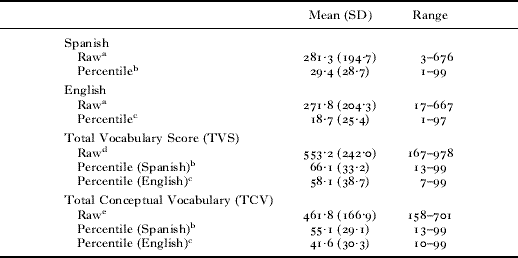
We first examine children's vocabulary outcomes in Spanish and English. As shown in Table 1, mean vocabulary sizes were comparable in Spanish and English, with a range of scores in both languages. However, percentiles show that children fell below age-based expectations compared to monolinguals, scoring on average significantly below the 50th percentile in both Spanish (t(25)=3·7, p=0·001) and English (t(25)=6·3, p=0·001). Table 1 also presents raw and percentile scores for the two composite measures, TVS and TCV. Because the composite estimates are by definition larger than the Spanish or English scores taken individually, the mean percentiles for TVS and TCV were also consistently higher, near or above the 50th percentile compared to either Spanish or English norms. While these comparisons should be viewed as only generally descriptive, the findings are consistent with those of previous studies in which bilingual children demonstrate progress in vocabulary comparable to monolinguals if assessed using a composite measure.
Mean, standard deviation (SD) and range of vocabulary in Spanish and English
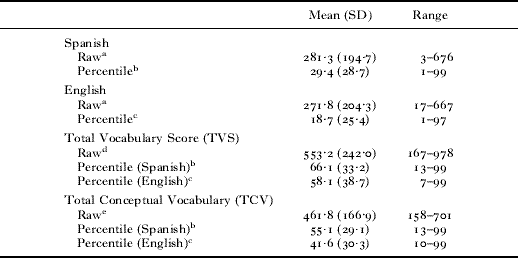
a Number of words reported as ‘comprende y dice’ or ‘understands & says’ on the CDI: Inventario II (Spanish) and CDI: Words & Sentences (English).
b Percentile score based on norms in Jackson-Maldonado et al. (Reference Jackson-Maldonado, Thal, Marchman, Newton, Fenson and Conboy2003).
c Percentile score based on norms in Fenson et al. (Reference Fenson, Marchman, Thal, Dale, Reznick and Bates2006).
d Number of words produced reported in Spanish+English.
e Number of concepts reported in Spanish Only+English Only+both Spanish and English, counting translation equivalents only once (adapted from Pearson & Fernández, Reference Pearson and Fernández1994, using translation equivalents defined in the CDI Scoring program (Marchman, Reference Marchman2004)).
Although Spanish and English vocabularies were similar in size overall, the correlation between vocabulary size in Spanish and in English was negative and non-significant (r(26)=−0·27, ns). That is, for individual children, the number of words produced in Spanish was not predictive of the number produced in English. This finding likely reflects the fact that most children had unbalanced Spanish–English exposure. Indeed, the Spanish:English ratio, indicating the relative balance of exposure to the two languages, was significantly positively correlated with Spanish vocabulary (r(26)=0·52, p<0·01) and negatively correlated with English vocabulary (r(26)=−0·63, p<0·001).
Speed of spoken language processing
Turning to children's performance in the online comprehension task, descriptive statistics for mean RT are shown in Table 2. Mean RTs in Spanish and English were virtually identical, indicating similar overall processing speed in Spanish and English for children as a group. However, the within-child correlation between mean RT in Spanish and in English was weak (r(26)=−0·04, ns). Those children who were more efficient at lexical processing in Spanish were not necessarily those who were more efficient in English. Thus, speed of spoken word recognition in Spanish did not predict speed of word recognition in English, indicating that lexical processing skills in the two languages were dissociable in these young bilingual children. As with vocabulary, we might see different levels of processing efficiency in two languages within a single bilingual child because these children are exposed to Spanish and English to different degrees. The Spanish:English ratio was modestly related to children's RT in English (r(26)=0·36, p<0·04, one-tailed). Children who heard relatively more English (and less Spanish) in their day-to-day interactions tended to be faster to interpret English words than were children with fewer daily opportunities to hear English. At the same time, RT in Spanish was only weakly related to the ratio of Spanish:English exposure (r(26)=−0·11, ns). A closer investigation of the data revealed that some Spanish-dominant children were slower in Spanish than what one would expect based on parental report of their child's relative exposure to Spanish and English.
Mean, standard deviation (SD) and range on reaction time (RT) in Spanish and English

a Mean latency to initiate an eye-movement (in ms) on distracter-initial trials.
Within- and across-language relations in vocabulary and speech processing efficiency
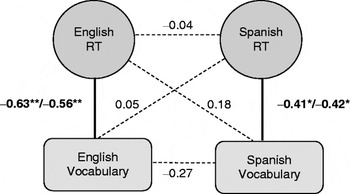
We next examine whether lexical processing efficiency is aligned instead with children's actual accomplishments in learning Spanish or English words, over and above their reported level of exposure to each language, focusing first on associations between processing efficiency and vocabulary size. To provide an overview of the specificity and strength of the relations, Figure 1 presents first-order correlations between processing and vocabulary both within and across languages. Note that correlations within each language were consistently significant, while correlations between the two languages were not. Mean RT in Spanish was significantly related to vocabulary in Spanish (r(26)=−0·41, p<0·04), and unrelated to vocabulary in English; and mean RT in English was significantly correlated with vocabulary in English (r(26)=−0·63, p<0·001), but unrelated to Spanish vocabulary. Thus, within each language, children with larger vocabularies were those children who were more efficient at identifying the appropriate referent of a familiar word during real-time language understanding. Analogously, children who were reported to know fewer words in Spanish or English were less efficient at processing familiar Spanish or English words. It is important to note that these analyses included only those trials with target words that children were reported to comprehend. Hence, the observed patterns cannot be due to the fact that children with smaller vocabularies were less likely to be familiar with the particular words they were tested on. Instead, children's efficiency in interpreting familiar words in Spanish and English was linked to the size of their overall vocabulary in each language.
Summary of correlation analyses examining within- and across-language associations between RT in the looking-while-listening task and reported vocabulary in Spanish and English. First-order correlation coefficients (r) are provided for all links. For within-language associations, the second number in the pair represents the partial coefficient, controlling for proportion of relative Spanish-to-English exposure, and vocabulary and RT in the other language.

The data presented so far indicate significant relations between vocabulary and speed of spoken language processing in bilingual learners, similar to those reported for monolinguals (Fernald et al., Reference Fernald, Perfors and Marchman2006; Hurtado et al., Reference Hurtado, Marchman and Fernald2007). While these results are promising, one must further establish that these relations remain significant after taking into account the variance associated with factors that operate outside the specific tasks of learning vocabulary words or interpreting words in real time. Figure 1 summarizes the correlation analyses examining within and across language associations between RT in the online comprehension task and reported vocabulary in Spanish and English. In the within-language analyses where two numbers are shown, the second number in the pair shows partial correlations after controlling for mean RT and vocabulary in the other language, as well as the relative balance of Spanish–English exposure. These partial coefficients are nearly identical to the first-order values, indicating that individual differences in vocabulary size and processing efficiency were related over and above the variance that is attributable to the child's particular diet of linguistic input in Spanish and English and their accomplishments in the other language. These analyses provide strong evidence for meaningful links between processing efficiency and vocabulary knowledge, and help rule out the possibility that analogous correlations previously observed in monolingual children are actually the result of independent relations to a third-party factor.
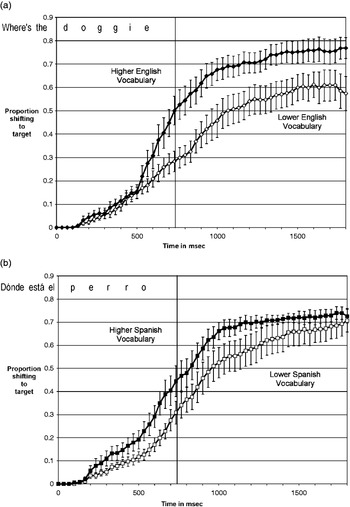
To further illustrate the relations between vocabulary size and processing efficiency, children were grouped based on a median split of vocabulary raw scores in Spanish and English. Figures 2a and 2b provide an overview of the time course of orienting to the target picture in children as a function of vocabulary group in English and Spanish, respectively. In each figure, the lines represent the mean proportion of distracter-initial trials on which children fixated the correct referent at every 33 ms interval, with error bars indicating the SE of the mean over participants. For English (Figure 2a), children who were reported to know more words in English fixated the target picture more than 125 ms sooner (M=788, SD 108) than did those children who knew fewer English words (M=922 ms, SD 158) (t(24)=2·5, p=0·03). A similar, albeit weaker, pattern was observed in Spanish (Figure 2b). Children with larger reported Spanish vocabularies demonstrated faster mean RTs to the target picture (M=811, SD=154), as compared to children with lower vocabularies (M=927, SD=149) (t(24)=2·3, p=0·07).
A and 2B. Mean proportion of trials on which children fixated the target picture on distracter-initial trials as a function of time (in ms) from the onset of the target noun in English (Figure 2A) and Spanish (Figure 2B). Based on a median split of vocabulary raw scores in each language, the top line represents the time course of correct shifting from distracter-to-target by children who knew more words, the lower line shows mean proportion shifting for those children who knew fewer words. The solid vertical lines represent target noun offset; error bars represent SEs over participants.

Finally, we examined the relation between the composite measures of vocabulary and children's speed of processing in Spanish and English. Correlations between TVS and RT approached significance in Spanish (r(26)=−0·29, p<0·08, one-tailed), and were somewhat stronger for English (r(26)=−0·39, p<0·03, one tailed). TCV was marginally related to mean RT in both Spanish (r(26)=−0·31, p>0·07, one-tailed) and English (r(26)=−0·33, p>0·06, one-tailed). These findings reveal that children who are faster in processing Spanish or English words are likely to know more words overall, regardless of language. Thus, some variance in children's efficiency in spoken language processing is associated with children's skill in learning words more generally. While these correlations are somewhat more modest than those observed between processing speed and vocabulary size within Spanish and within English, 8–15% of the variance in children's processing speed is accounted for by overall measures of vocabulary.
DISCUSSION
This study examined bilingual children's lexical knowledge and their fluency in understanding familiar words during real-time spoken language understanding. We found that these young bilingual children, as a group, were just as fast to identify the referents of familiar spoken words in Spanish as in English. However, children's mean RTs in Spanish and in English were uncorrelated. That is, in these two-and-a-half-year-old children learning Spanish and English at the same time, a child's facility with online spoken language comprehension in one language did not predict their facility in the other language. Instead, efficiency of online language understanding in Spanish was tightly linked to the number of words that the children knew in Spanish, and was unrelated to vocabulary size in English. Analogously, speed of processing in English was significantly correlated with vocabulary in English, but not with vocabulary in Spanish. Crucially, these patterns held even when variance attributable to exposure balance, as well as processing speed and vocabulary in the other language, were taken into account. For both languages, children's speed of spoken language understanding in Spanish or English was tightly yoked to their vocabulary knowledge in that language. These findings replicate, in a diverse population of Spanish–English bilinguals, the correlations between speed of lexical access and vocabulary knowledge that have been reported for monolingual children learning either English or Spanish (Fernald et al., Reference Fernald, Perfors and Marchman2006; Hurtado et al., Reference Hurtado, Marchman and Fernald2007). Moreover, these findings suggest that efficiency in spoken language understanding and vocabulary knowledge go hand-in-hand, regardless of whether a child is learning one language or two.
Understanding the links between efficiency in language processing and vocabulary learning
Taken together, strong within-language but weak across-language relations support the conclusion that the correlations between processing and vocabulary size observed here are not reducible to independent associations to child-based factors. While previous studies with monolingual children could not rule out such alternative explanations, research with children learning two languages allows an examination of the associations between lexical processing efficiency and vocabulary size in two different languages within a single language-learning child. Like the Hurtado et al. (Reference Hurtado, Marchman and Fernald2008) study, the current findings suggest that links between children's facility in spoken word recognition and vocabulary learning cannot be accounted for by links to other cognitive skills that have a positive but independent impact on children's language outcomes.
To be clear, these findings do not imply that the facility with which children process spoken words in real time is independent of information processing skills that operate outside the domain of language. We also found that processing speed in each language was associated with composite measures of vocabulary. Children's efficiency in identifying the referents of familiar words was linked, albeit more modestly, to how many words they could produce in both Spanish and English taken together. The fact that some variance in overall vocabulary growth was connected to speed of word recognition in Spanish and in English suggests a role for information processing skills that transcend a particular language. This interpretation is consistent with recent studies using the looking-while-listening procedure indicating that speed of spoken word recognition in infancy has long-term predictive validity for cognitive, as well as linguistic, outcomes in later childhood (Marchman & Fernald, Reference Marchman and Fernald2008). Associations between overall vocabulary size and familiar word processing likely reflect children's fundamental abilities to attend to, store and manipulate information over short periods of time, skills known to underlie language functioning in both typical and atypical populations (e.g. Gathercole, Reference Gathercole2006). Our ongoing longitudinal studies with Spanish-speaking monolinguals and bilingual populations are investigating the specificity of links between early vocabulary knowledge and lexical processing skill and later linguistic and non-linguistic outcomes, such as working memory, attention and inhibitory control.
Taken together, the current findings suggest that online lexical comprehension and knowledge are meaningfully related during early acquisition, and work together to support lexical development (Fernald et al., Reference Fernald, Perfors and Marchman2006). These skills operate jointly with a host of language-general skills that enable children to make sense of the linguistic input they experience during interactions with others and to put that information to use in constructing a working system of language. Over the course of development, children's growing efficiency in spoken language understanding and word learning continue to be refined in tandem, in interaction with facility in processing both linguistic and non-linguistic information, operating in a cascade of factors that influence children's outcomes.
Efficient spoken language processing could facilitate vocabulary development in a variety of ways. Learners who can more effectively tune into the spoken sentence are more likely to successfully integrate the auditory information with the visual scene, and to more quickly narrow in on the intended referent. These children would get more out of any given exposure to a word, assisting in the construction of richly specified lexical representations and leading to faster and more accelerated vocabulary growth. More efficient understanding is also likely to enable more effective tracking of distributional regularities in the speech signal as it unfolds in time (Saffran et al., Reference Saffran, Aslin and Newport1996), more rapid evaluation of statistical evidence in the scene across multiple instances of a word (Smith & Yu, Reference Smith and Yu2008), and better monitoring of distributional cues to meanings or grammatical categories of words (Cameron-Faulkner, Lieven & Tomasello, Reference Cameron-Faulkner, Lieven and Tomasello2003). Of course, it is also possible that such influences operate in the other direction as well. Having a larger vocabulary helps to fine-tune speech processing skills and further leads to facility in online lexical access (Dapretto & Bjork, Reference Dapretto and Bjork2000; Storkel, Reference Storkel2002). Children with larger vocabularies are likely to be more proficient in reliably accessing lexical representations during spoken language understanding, and in efficiently integrating multiple cues to meaning. According to this view, vocabulary knowledge and processing efficiency continue to collaborate as bidirectional influences that enable children to efficiently identify and extract patterns that exist within and across words and that are crucial for building increasingly complex systems of lexical–semantics and grammar.
In contrast, children who are slower to understand speech are less efficient at identifying the referents of an ongoing conversation and less able to narrow in on information in the speech signal that could provide useful cues to meaning. For these children, more exposures may be necessary before form–meaning mappings become sufficiently robust to support lexical access. Such children would require more experience with language to build a working vocabulary and would be more likely to display protracted growth in vocabulary. Indeed, limited vocabulary knowledge is associated with poorly specified phonological representations (Metsala & Walley, Reference Metsala, Walley, Metsala and Ehri1998), less robust skill at learning new words (Gershkoff-Stowe & Hahn, Reference Gershkoff-Stowe and Hahn2007), and weaker systems of relations across lexical and morphosyntactic forms (Moyle, Ellis Weismer, Evans & Lindstrom, Reference Moyle, Ellis Weismer, Evans and Lindstrom2007).
In children learning two languages, efficient spoken language processing could enable children to learn more words given a particular level of exposure to a given language than children with less efficient processing, and could enable more effective systems of organization that allow more robust lexical access within and across languages. As children continue to build repertoires of form–meaning mappings in both languages, language-specific vocabulary knowledge could further feed back on skill at differentiating and recognizing the words that children hear in continuous speech. Together, increased vocabulary and processing efficiency would sharpen the bilingual learner's ability to tune into and manage information in the input that could deepen language-specific, as well as language-general, features of existing representations. Such synergistic interaction between processing skills and vocabulary learning would also fine-tune patterns of interconnectivity across lexical forms and meanings, and sharpen the flexible use of form–meaning mappings during real-time language use. For both monolinguals and bilinguals then, the skills that young children use during the real-time comprehension of language are closely aligned with those skills involved in learning vocabulary words.
Previous research has documented several ways in which early language development in bilingual learners is parallel to that in monolinguals and remarkably robust in the face of diverse learning experiences (Genesee & Nicoladis, Reference Genesee, Nicoladis, Hoff and Shatz2007; Werker & Byers-Heinlein, Reference Werker and Byers-Heinlein2008). The current findings offer yet another parallel, showing that relations between individual differences in processing skills and vocabulary knowledge in children learning two languages are similar to those previously seen in children learning just one. In a series of follow-up studies, we are focusing on more direct comparisons of learners from bilingual and monolingual backgrounds, examining speed of spoken word recognition and vocabulary in SES-matched groups of children learning only Spanish compared to those learning both Spanish and English. These and other findings will contribute to an increasingly comprehensive picture of the flexibility of early processing abilities in children learning language in both monolingual and bilingual circumstances.
Sources of variability in processing efficiency and vocabulary learning
Where do these individual differences in word learning and processing come from? One source of variation is likely to be individual differences in the endogenous mechanisms that underlie children's skill at attending to and coordinating multiple sources of information in real time (Gathercole, Reference Gathercole2006; Bishop, Adams & Norbury, Reference Bishop, Adams and Norbury2004). At the same time, variation in lexical outcomes has been linked to differences in the quantity or quality of children's experiences with language (Hart & Risley, Reference Hart and Risley1995; Hoff, Reference Hoff2006). In the current study with bilinguals, children's relative balance of Spanish to English exposure significantly predicted vocabulary size. Thus, early vocabulary outcomes in Spanish and English reflected the different amount or types of experiences that these children have had with Spanish and English in their day-to-day lives. The relations between speed of lexical processing and Spanish–English balance were weaker, with some children demonstrating less efficient lexical access than would have been predicted by their reported level of exposure. In children who fall above some threshold of Spanish exposure, it could be that variation in processing efficiency is more attributable to individual variation in language learning skill than to small variations in the amount of Spanish input.
It is also important to note that we did not consider the potential influence of television in our exposure proportion scores. By excluding television, which for many young Latino children is a predominant source of English input, we may have overestimated the relative Spanish exposure that these children received. In general, the global measure of language input used here, while accounting for differences in vocabulary knowledge, may simply be an instrument that is too blunt to detect meaningful individual differences in exposure balance that influence variation in children's processing efficiency. Indeed, using more sensitive measures of language input based on a naturalistic observation session, Hurtado et al. (Reference Hurtado, Marchman and Fernald2008) reported significant links between the amount and quality of mothers' child-directed talk and children's speed of lexical access in monolingual Spanish learners. Ongoing studies in our laboratory are investigating links between spoken language understanding and more comprehensive measures of relative Spanish to English exposure in young bilingual learners, using both parent report and observational methods.
These findings do not suggest that early bilinguals have lexical systems which operate in isolation. It is well known that even the youngest bilingual learners produce mixed-language utterances (i.e. code-switch) and use translation equivalents that are systematically accessed in different contexts (Paradis, Nicoladis & Genesee, Reference Paradis, Nicoladis and Genesee2000). The current study was not designed to address whether there is between-language ‘cross-talk’ during real-time language comprehension for these bilingual language learners, an issue that is also being explored in our ongoing research. The current results should also not imply that children's learning of words in one language has no impact on their word learning in the other. While several studies have shown that early oral language skills, especially those involving vocabulary, are likely to be more independent across languages than are literacy skills (e.g. Cobo-Lewis et al., Reference Cobo-Lewis, Eilers, Pearson, Umbel, Oller and Eilers2002), more research is necessary to determine the degree to which early vocabulary accomplishments in Spanish might influence early vocabulary learning in English, and vice versa. Instead, we conclude from these findings that bilinguals approach the task of learning two languages in ways that are similar to children who are learning only one, at least in aspects that are relevant to this early phase of vocabulary development.
At the same time, differences between monolinguals and bilinguals have also been reported (e.g. Conboy & Mills, Reference Conboy and Mills2005; Fennell et al., Reference Fennell, Byers-Heinlein and Werker2007). For example, there was some evidence that bilinguals may be slightly delayed compared to monolinguals, scoring lower as a group in expressive vocabulary compared to norms based on monolingual Spanish and English populations (Pearson et al., Reference Pearson, Fernández and Oller1993). But note that these children moved into the age-appropriate range when both languages were assessed together using the composite scores. Although norms for bilinguals on such composite measures norms are not yet available, this preliminary finding underscores the importance of compiling a complete picture of lexical skill in bilinguals that takes into account children's knowledge in both of their languages, not just in one (Patterson & Pearson, Reference Patterson, Pearson and Goldstein2004; Bedore et al., Reference Bedore, Peña, García and Cortez2005). And, although many children who experience two languages early on will eventually achieve native-like proficiency in both languages, success is likely to depend on several factors, including continued exposure to each language, the contexts inside and outside the home in which children experience the languages they are learning, and the status of both languages in the minority and majority culture (de Houwer, Reference de Houwer2007).
CONCLUSIONS
The strength and specificity of links between lexical processing speed and vocabulary knowledge in these young bilinguals suggest that children's early efficiency in spoken language understanding in real time is directly related to their facility in word learning. These findings demonstrate that correlations between speed of spoken word recognition and expressive language outcomes are parallel in monolingual and bilingual learners, and that skill in online comprehension is associated with vocabulary outcomes regardless of whether the child is learning one language or two. Moreover, modest associations between processing efficiency and language-general measures of vocabulary offer additional evidence for meaningful links between information processing skills and success in language learning, links that transcend a particular language. By examining these relations in children learning two languages, the current study supports the view that children's skill at abstracting information from early language input as they are building a working lexicon relates fundamentally to the mechanisms underlying the construction of language.