1. INTRODUCTION
One of the major critical manoeuvres in this text consists of analytically provincialising some of the core ideas behind Acoustic Ecology in order to offer alternative models of collaborative work with sound. Dipesh Chakrabarty describes ‘provincialisation’, in the current hegemonic Anglo-European episteme, as a ‘task of exploring how this thought – which is now everybody’s heritage and which affects us all – may be renewed from and for the margin’ (Chakrabarty Reference Chakrabarty2000: 16). One might contend that oppositional terminologies, such as margin or North and South, are problematic. For instance, Gavin Steingo and Jim Sykes in their ‘Introduction’ for Remapping Sound Studies (Steingo and Skyes 2019) describe the extension of a particular binary conceptual overview of sound, the audiovisual litany critically portrayed by Jonathan Sterne in The Audible Past in which ‘Hearing immerses its subject; vision offers a perspective’ (Sterne Reference Sterne2003: 15) to a particular idea of the South. One, where the ‘global South, for its part, is often derided as stubbornly failing to obey the (supposedly rational) logic of the state’ and ‘The North is often presumed to be the home of rationality and science’ (Steingo and Sykes 2019: 2). Nonetheless, we think that these relative locations can be thought through constructively as a possible perspective/voice, a form of localised interpretation. To summarise Edward Said’s call in his essay Travelling Theories, there can be a fruitful resistance, a critique that engages in opening up originating theories elsewhere through the filtering combs of historical, societal and everyday circumstances (Said Reference Said1983).
This is our starting point in regards to the influential The Soundscape: Our Sonic Environment and the Tuning of the World (Schafer Reference Schafer1994).Footnote 1 We mention this book in particular because its terminologies and ideas have been influential to a generation of artists and scholars. For instance, in The Routledge Companion to Sounding Art (Cobussen, Mehlbeerg and Truax Reference Cobussen, Meelberg and Truax2017) the word soundscape is mentioned around 270 times throughout its 482 pages-long volume. In itself, the ‘soundscape’ concept has been criticised from a phenomenological standpoint in ‘Against Soundscape’ by Tim Ingold (Reference Ingold and Carlyle2007), and also for its problematic relationship with a particular sociotechnical framework, as described by Jonathan Sterne in ‘Soundscape, Landscape, Escape’ (2013). Sterne’s analysis points out how the notion of soundscape (through Schafer’s ear) was conditioned by the cultural context of the 1950s and 1960s, in particular the discussion of high-fidelity and its relationship with ‘the stereophonic reproduction of concert music’ (ibid.: 190–1). Our initial critical stance in this article further ‘localises’ R. Murray Schafer’s ideas in regards to the New Age cultural phenomena, while further detailing the influence of Western music tropes in his politics for acoustic design.
In particular, there is one transformative trope that is enmeshed within the Tuning of the World: that a well-informed artist can transform the way we listen to our environment. For instance, this is what Vincent Meelberg had to say in the introduction to part 4 (titled ‘Acoustic Spaces, Identities, and Communities’) of the aforementioned companion: ‘Sounding art has the potentiality to increase our sensitivity to the sonic environment we live in’ (Meelberg Reference Meelberg, Cobussen, Meelberg and Truax2017: 250). This is a recurrent idea that transverses much of the literature surrounding sound-based art and it would not be a stretch to ascertain that it comes partially from Schafer’s work and writings. Meelberg’s statement comes after quoting Salomé Voegelin’s (Reference Voegelin2010) analysis of soundscape compositions, specifically the work of Hildegard Westerkamp in Kits Beach Soundwalk (Westerkamp Reference Westerkamp1989). In a preceding note, Voegelin describes acoustic ecology and associated creative work as a “project … that pursues the subject directly, willing us to listen and to engage. Soundscape compositions are sonic works that pursue an investigative, research-driven tone, where to listen is a request rather than an ambiguous invitation” (2010: 32). There is an undertone to these statements that we find particularly problematic. Is the sonic world entirely the domain of sensitised listeners: academics, artists and informed practitioners who have been through disciplinary procedures such as ‘Ear Cleaning’?Footnote 2 What about other forms of non-accredited listening(s), those that take place among mass protests or forms of sonic violence and resistance practised by different actors? What about untold symbolic cultural norms that are part of a wider common sense? One that promotes conservatoire-based European art music as a universal good with an attached civilisatory role?Footnote 3 There simply is not one right way to listen or one way to be sonically aware for that matter (in terms of culture, perception and politics).
This patronising overview in regards to subject agency seems to echo Grant H. Kester’s (Reference Kester2011) description, in The One and the Many: Contemporary Collaborative Art in a Global Context, of how most contemporary art follows an avant-garde model (that finds a problematic home in most post-structuralist philosophy) of both a subjectivity in crisis (shackled by capitalism normative impediment of one’s ultimate desires) and a suspicion of collaborative-based political action (rooted in historical events, such as what happened in May 1968 in France). In order to jolt the individual to action, the avant-garde needs to enact a certain type of disruption as the primary artistic gesture, wherein the discussion of aesthetics is often animated by a strong stance against hermeneutics or thinking/reading artwork through the primer of context (Kester Reference Kester2011: 1–65).
This is not an exclusive action by ocular-centric theories. Nicola Gess details a sonic aesthetic discourse focused on presence,Footnote 4 a conceptual framework that has been perpetuated since the eighteenth century in a search for ‘immediacy and bodily presence’ manifested as a desire to surpass the hermeneutic paradigm in order to liberate the oppressed real from any interpretative shackle (Gess Reference Gess2015: para. 1). For Gess, this has been expressed as a
longing for a concealed, forgotten, or lost place of the originary and the authentic in which an unalienated existence was or would be possible … In Rousseau, this place is the primaeval community around the well … in Nietzsche, the primal German-Dionysian origin; in Bloch, the Gothic sanctum; in Sloterdijk, the uterine realm; in Gumbrecht, a pre-Cartesian culture of presence; in McLuhan, the African. (ibid.: para. 21)
As we will show, we believe that the same nostalgia and sonic essentialisation finds a home in Murray Schafer’s writings in the Tuning of the World. As a pointed warning, Gess reminds us of Kim-Cohen’s previous critique (focusing on contemporary sounding arts) in which a return to the aural (in essentialist terms) is a ‘turn away from power’ (Kim-Cohen Reference Kim-Cohen2009: 94 in Gess Reference Gess2015: para. 24). We purview the sonic – in all its different semantic and disciplinary connotations – as a significant index of how power exerts its action in conditioning/limiting the expression of our individuality. Our optimism comes from a more Gramscian approach to this discussion, wherein hegemony, the enactment of a particular economic, cultural and political consensus, is often negotiated between different actors.
Overall, this introductory discussion is aimed at providing a more nuanced relationship between author/composer and would-be participants. Thus, the critical observations of particular cultural and localised epistemic slippages in Schafer’s work are done so in order to offer more productive forms of collaborative sonic-based work while furthering a more optimistic and detailed outlook on listener agency. In this regard, we seek to tentatively upend the privileged role given to the artist or composer when developing sound-based works that deal with communities, everyday acoustic spaces and, by extension, the unavoidable issue of politics. Instead of a ‘request for listening’ there are ethical questions that precede the task of collaborative work with others: ‘Who says what? Whom are you speaking to? And why? Have you decided to speak in the name of? Have you left someone or somewhat behind? What has been left unspoken?’ (Iazzetta, Campesato and Chaves Reference Iazzetta, Campesato and Chaves2017). In the Tuning of the World what is left unspoken is the issue of sound as an index of how structural racism,Footnote 5 LGBTQ-phobia and capitalism operate. Instead, the subject appears as a transcendental blank score awaiting to be arranged by the wilful composer. In a similar vein, Meelberg asks, in the first paragraph of the aforementioned Introduction to part 4, to ‘next time you enter a space, close your eyes and just listen. What do you hear?’ (2017: 247). Now imagine being a person-of-colour, an LGBTQ individual or a woman entering a place in Brazil and simply closing one’s eyes. This can certainly be a powerful political statement, but it opens more questions than simply “How does the acoustics of this space make you feel” (ibid.). To be fair, the main theme of Tuning of the World dealt with the sonic relationship between (some) humans and nature, if such a distinction can be made – a relationship in which nature has almost no agency.Footnote 6 But does not the present political state of things globally, with the emergence of right-wing populism and the rearrangement of forces that promote the interdiction of the different, both in the institutional field and in everyday life, constitute an argument for a broader view of ecology, one that also deals with how humans interact with each other? In Brazil, specifically, the current political climate brings back authoritarian lines and practices from the dictatorial period, lived between 1964 and 1985.Footnote 7
This is the political and critical framework from which we will present Cildo Meireles’s LP Sal Sem Carne (1975) and Lilian Nakao Nakahodo’s soundmap of the city of Curitiba, Mapa Sonoro CWB: Uma cartografia afetiva de Curitiba (Nakahodo Reference Nakahodo2015). Cildo Meireles (born 1948) is a widely recognised contemporary artist on the international scene, with a body of work that spans sculpture, installation, everyday objects and the use of sound. One of the most iconic examples of this is Babel 2001, a ‘large-scale sculptural installation that takes the form of a circular tower made from hundreds of second-hand analogue radios that the artist has stacked in layers. The radios are tuned to a multitude of different stations and are adjusted to the minimum volume at which they are audible” (Barson Reference Barson2011: para. 1). Lilian Nakao Nakahodo (born 1980) is a composer, pianist and film sound designer. In 2020, she was part of an online showcase organised by the Dystopie Festival that focused on Brazilian sound art. Her piece Do Paço Ao Olho (2016) is an off-shot of the Curitiba soundmap she created, a web platform in which the map of the city is used as an interface to organise and make available field recordings and recordings of testimonies about places in Curitiba. In 2016, during the process of development/creation of the aforementioned sound-based cartography, Nakahodo ‘guided a group of people through the central region of Curitiba, where the heard soundscape was overlaid with a reproduction of previous … field recordings and interview-transcriptions read … through a megaphone’ (Nakahodo Reference Nakahodo2020a: para. 1). In 2020, the online archive of this piece (presented at the aforementioned showcase) included not only a video of the performance but also a booklet called Voicing(s), which asks would-be users to read some of the interview-transcriptions made during the adjunct field work that comprised the Mapa Sonoro CWB (ibid.).
To be clear, not all the preceding ethico-political questions will be answered or developed throughout the mentioned artworks. Nonetheless, we believe that both Sal Sem Carne and Mapa Sonoro CWB offer paradigmatic counterpoints to some of the practices promoted in Tuning of the World and later on developed by the World Soundscape Project. An example of this is the archival impulse that goes from recommending the creation of different cartographic endeavours (such as ‘Sample Sound Notation Systems’ or ‘Sound Event Maps’Footnote 8) to the publication of recordings with associated booklets (The Vancouver Soundscape). This archival motif is present in Sal Sem Carne, but it entails a more polyphonic account of cultural manifestations than for instance the homogenised version (Akiyama Reference Akiyama2015) of Canada presented in Soundscapes of Canada, a series of radio shows directed by Murray Schafer that aired on CBC-FMFootnote 9 in 1974. Another paradigmatic praxis mentioned in the Tuning of the World is ‘soundwalks’, an ‘exploration of the soundscape of a given area using a score as a guide’ (Schafer Reference Schafer1994). Nakahodo’s soundwalks, made during the creation of her Curitiba soundmap, sometimes strip away the need for a score or even communal silence, preferring a more playful approach to the sonic environment.
2. HOW TO TUNE THE WORLD
2.1. New age and platonic overtures
In 1994, The Soundscape: Our Sonic Environment and the Tuning of the World Footnote 10 was re-published by a company that is still associated with the New Age movement: Destiny Books (part of Inner Traditions International), publishing ‘titles with an emphasis on self-transformation … and pagan & occult spiritual traditions’ (Destiny Books n.d.). The Tuning of the World itself publicises, in the ‘Other titles of interest’ section (Schafer Reference Schafer1994), publications such as Harmony of the Spheres: A Sourcebook of the Pythagorean Tradition in Music (Godwin Reference Godwin1993) or Cosmic Music: Musical Keys to the Interpretation of Reality (Schneider, Haase, Lauer and Godwin Reference Schneider, Haase, Lauer and Godwin1989). What connects all these works is an adherence to a Pythagorean tradition in music and its underlying tropes.Footnote 11 Our focus lies in the New Age movement limitations from a political and ethical standpoint. In particular, we follow bell hooks’s cultural analysis of this phenomena and its underlying logic, a form of toxic individualism wherein ‘the poor have chosen to be poor, have chosen their suffering. Such thinking removes from all of us who are privileged the burden of accountability. Rather than calling us to embrace love and greater community, it actually requires an investment in the logic of alienation and estrangement’ (hooks 2001: 73).
This return to the self is in tandem with how Paul Heelas describes the New Age movement’s attempt to solve a specific ‘crisis’ of the subject, which could be crudely summarised as an attempt to overcome the traditional expectations exposed upon the individual in a capital-bureaucratic society (Heelas Reference Heelas1996: 136–51). The solution offered relies on: ‘self-responsibility, self-reliance, self-determination, equality, dignity, tranquility, harmony … the idea that it is possible to change for the better, the importance of being true to oneself and exercising expressive ethicality … the importance of liberating oneself from the restrictions imposed by the past’ (ibid.: 169). One thing to note is that these inherent calls for self-transformation, that are still very much a part of our cultural zeitgeist, seem to forget that our subjectivity (for better or worse) is tied up with the collective-social and often in contradictory terms.Footnote 12 Nonetheless, these enlightenment-esque archetypes of self-improvement and balance with our world return several times in The Tuning of the World. This quest can be summarised with the following statement: in order to change the sonic world, we need to change our relationship with sound and tweak our overall sensibilities. This is clear in the final paragraph of ‘Silence’ (chapter 19) wherein if ‘we have hope of improving the acoustic design of the world, it will be realizable only after the recovery of silence as a positive state in our lives. Still the noise in the mind; that is the first task: then everything will follow in time’ (Schafer Reference Schafer1994: 259).
Furthermore, if we wanted to make informed changes about noise pollution, this could only be done through ‘multitudes of citizens (preferably children)’ being ‘exposed to ear cleaning exercises in order to improve the sonological competence of total societies … if such an aural culture could be achieved, the problem of noise pollution would disappear’ (Schafer Reference Schafer1994: 181). Sonological competence is understood here as the ability to comprehend ‘sound formations’ and ultimately ‘express sonic perceptions’ (ibid.: 274). This grandiose educational project would enable us to achieve a form of ‘expressive ethicality’ (to return to Heelas’s description) that precludes a move towards a universal symphony (referencing Charles Ives’s work), where we would thus be able to give ‘more critical attention to our performance than is the case if we merely consider ourselves to be in a dumpyard …. It is here that the acoustic designer can provide us with portions of the score to perform’ (ibid.: 244). Our suspicion is that not everyone would be able to play in this orchestra. Even though his ideas about sonological competence recognises individual and cultural differences (ibid.: 274), his writings are embedded within Western epistemology and historical references, from a nostalgia of the sound of quaint Italian Renaissance gardens to the font used in the book itself.Footnote 13 To start, the acoustic design idea needs further consideration, one that accounts for intersectional difference.
2.2. The Western composer thinks about regulation, politics and revolution
For Murray Schafer, acoustic design would be an interdisciplinary affair led by musicians in order to create an orchestration of the acoustic environment that would never be harmful to ‘human health or welfare’ (Schafer Reference Schafer1994: 271). It is important to point out that Schafer arrives at this idea of acoustic design after showing a certain disenchantment at the time in regards to the state of noise abatement legislation that was often based on quantitative measures, that is, regulation that determines particular decibel limits for ‘undesirable sounds’ (ibid.: 183) or qualitative, that is, based on overall public opinion in regards to ‘unwanted’ sonic interruptions. In some sense, we share some of Schafer’s distrust in regards to noise abatement. This is an often messy legislative and bureaucratic assemblage, with several interested parties to manage, as shown by Cardoso in his work in São Paulo (Cardoso Reference Cardoso2019).
Nonetheless, although Schafer laments the dehumanisation of ‘noise’ in terms of regulation or intervention, at the same time he seems to disdain his very realisation that ‘noise equals power’ (Schafer Reference Schafer1994: 76). As already discussed, Schafer instead prefers an overall silencing of the world (based on overall auditory education and better acoustic design) to a ‘counter-revolution’ precluded on the ‘discovery of a more trustworthy proprietor to whom the power [to produce noise] may be bequeathed’ (ibid.: 87,). This problematic solution is further complicated by a particular sense of taste and cultural ideology. For instance, for the would-be acoustic designers/composers, Schafer gives cautionary insights in order to offer a grounding for such work to occur. One of them is a diagnostic of what he calls the unbalance of Western music, which ‘is inclined to be more static or more active’, wherein the soundscape of the West suffers from the same problem (ibid.: 238). In fact, for Schafer our acoustic environment is in need of a corrective balance to the following binaries: ‘Sound/Not-Sound’, ‘Technological sounds/Human sounds’, ‘Artificial sounds/Natural sounds’, ‘Continuous sounds/Discrete sounds’ and ‘Low-frequency sounds/Mid- or high-frequency sounds’ (ibid.: 239) – the right-hand terminologies are the ones that according to the author are being dominated. He continues such essentialised insights with complaints about the sound of the telephone bell and car horns, that are (for him) textbook examples of how these sounds were designed by people with poor musical education (ibid.: 241–3). This is the stage from which Murray Schafer wants composers to offer guidance to putative communities in order to retrieve a ‘significant aural culture’ (ibid.: 206) or to ‘create attractive and stimulating acoustic environments for the future’ (ibid.: 271).
Our main doubt is that the described ‘aesthetics’ could not properly include subaltern or marginalised groups. Would the imagined ‘Soniferous Garden’ with a design focus on musical water fountains and Aeolian harps, inspired by erstwhile European villas (ibid.: 247–50), be a safe place for indigenous, poor, Black people, women, gay and trans individuals that constantly suffer systematic violence and exclusion in Brazilian society? Would this garden with its intended respect for ‘a normal conversation at four meters’ (ibid.: 247) make it a more tolerable place in a society where families are broken apart by political lines? This, while we hear darker forms of sonic ‘orchestration’ occurring within Brazilian history and everyday life.
3. THE BRAZILIAN GARDEN
Just as silence is important for some cultures, buzz and noise are a fundamental part of the co-existence of some populations in the Brazilian context. However, the sounds that some vulnerable populations make are commonly used as an excuse to pursue them. Ideas like Schafer’s seem to have universal validity, but their thoughtless adoption can lead to adverse consequences elsewhere. From the beginning of the twentieth century until the Getúlio Vargas government (the 1930s), the popular genre of ‘samba’ (in clear racial lines) was considered as an ‘ato de vadiagem’, where vadiagem can be roughly translated as loitering. This prohibition came hand-in-hand with a need to control the actions of a population recently freed from slavery. In 2017, a São Paulo web designer launched a petition on the governmental portal e-cidadania, in order to create a federal law that sought to criminalise Brazilian funk, a musical genre that broke out at the end of the twentieth century, beginning from massive parties in the favelas and peripheral neighbourhoods of Rio de Janeiro and then spreading across the country. Later rejected in the Senate for being considered unconstitutional, the proposed law was entitled The Criminalization of Funk as Public Health Crime to Children, Teenagers and Family Footnote 14 and referred to the pancadões parties (pancadão being a genre of funk) as ‘a form of organized recruitment using the social networks from and for the criminals, rapists and paedophiles … sales and consumption of alcohol … rape and group sex between children and teenagers’. The parliamentary rapporteur himself criticised the association of this culture with criminal practices.
On the dawn between 30 November to 1 December 2019, police members of the 16th Battalion of the Metropolitan Police raided a well known ‘baile funk’ (Baile da 17), a party taking place in Paraisópolis (one of the poorest areas of São Paulo and one of the largest favelas of the city). The police action resulted in the death of nine young people. This operation was part of an ongoing preventive police initiative called Operação Pancadão that was created to guarantee ‘the right for each citizen to circulate freely and maintain an overall quietness’ (Pinhoni and Tomaz Reference Pinhoni and Tomaz2019). In total, more than 7,500 police operations were carried out in the State of São Paulo (ibid.). On that particular night, reports suggest that the police used gas bombs, fired rubber bullets and used pepper spray. Some media reports pointed out at the disproportionate use of force, bearing in mind that in fact one of the noisiest neighbourhoods in São Paulo (according to the overall number of citizens’ complaints in 2019) was Pinheiros (an affluent area of the city), where Paraisópolis was only responsible for 0.64% of all complaints (Acayba Reference Acayba2019).
For Raquel Rolnik (Reference Rolnik2015: 378), in the last years, we have been experiencing a ‘war of places’ or a war ‘for places’. Housing and urban policies, urbanism and land management operate in Brazilian cities to transform lived territories into abstract assets. ‘Contractors and real estate developers continue to command the logic of expanding large cities’, intensifying exclusion and inequality in the distribution of urban space (ibid.: 368). In the midst of the Covid-19 pandemic, a member of the board of the self-titled ‘largest union in the real estate sector in Latin America’Footnote 15 (active in São Paulo) wrote an article published in one of the largest newspapers in the country. In this opinion piece, entitled Planning the Soundscape, he states: ‘it is necessary to be aware that we are the composers of part of this incredible “urban symphony”’ (Bernardes 2020).Footnote 16
These few episodes that correlate acoustic regulation, cultural hegemony and violence resonate with the political limitations of Schafer’s sonic eco-aesthetics. His focus on ‘ear cleaning’ and ‘sonological competence’ avoids any discussion of the existing status-quo, capital and distribution of political representation. In this case, we can humorously imagine a future individual striving for adequate mobile phone ringtones, such as the ‘first bars of the Ode to Joy from Beethoven’s Ninth Symphony’ (Schafer 1994: 242) in a harmonious sonic existence that parallels the ‘go green’ ethos perpetuated by major corporations, in a society where ‘the world’s 26 richest people own as much as the poorest 50%’ (Elliott Reference Elliott2019). There are certainly lessons to be taken from acoustic ecology, but if sonic-based artists or collectives want to intervene in places, one needs to abandon the need for an educated acoustic designer to orchestrate our environment. Instead, the emphasis, we argue, should be in forms of collective listening and transformation of both artists and participating communities or individuals. This might lead to transactional forms of creativity, whereby resistance to established forms of authority is co-performed and re-contextualised.
4. SOUTHERN SOUNDS
4.1. The insurgent archive in Cildo Meireles work
In ‘Soundscapes of Canada and the Politics of Self-Recognition’, Mitchel Akiyama (Reference Akiyama2015) hears in the project Soundscapes of Canada Footnote 17 an idea of Canadianness as an extension of European settler-colonialism. The series of ten hour-long radio programs produced by the World Soundscape Project sought to ‘open the ears of Canadian listeners to the importance of sonic experience, and to alert them to what they warned was the degradation of the soundscape thanks to the mounting din of industrial modernity’ (Akiyama Reference Akiyama2015: para. 2). According to Akiyama, this archival endeavour demonstrated a focus on a quieter, rural Canada that was predicated on a representation of mostly white European Canadians. This de facto ‘othering’ excluded indigenous people (First Nations) and mostly ignored a wave of immigration taking place at that time that was non-European. For Akiyama, the archival impetus of the Soundscapes of Canada is intimately linked to a troublesome way in which Canadians see themselves. Akiyama’s description is a telltale story about how archives should perhaps work towards presenting a more polyphonic account of society, one that instead reflects the mobility and fluid nature of multiple cultures inhabiting a country. As the author reminds us, this cohabitation often entails violence and resistance and a selective earshot might only serve to silence historical grievances (ibid.: paras. 8–12). Ultimately, Akiyama’s analysis demonstrates Soundscapes of Canada adherence to a particular archival methodological approach marked by what Boaventura Sousa Santos would define as a ‘twofold power: the power to produce or select the kind of knowledge that is worthy of being stored, and the power of pretending that there is no selection at all … Rather than appear as an exercise of power, storing is justified as compliance with a cultural duty’ (Sousa Santos Reference Sousa Santos2018: 197).
In 1975, Cildo Meireles published Sal Sem Carne Footnote 18 (his second vinyl record after mebs/caraxia). Vivian Caccuri’s description of this work, in ‘Music is What I Make’ (Caccuri Reference Caccuri, Chaves and Iazzetta2019), describes that this piece resulted from Meireles’s interest in the history of what has been designated as the Massacre of Krahô Amerindians, whereby Mundico Soares (owner of three large farms in the Brazilian state of Tocantins) ordered the assassination of 26 Krahô Amerindians and one sertanejo (ibid.: 82–3). This is the backdrop for Sal Sem Carne, an LP published by the record label Tapecar, made from the recordings that Meireles collected and then went on to edit in order to represent the underlying conflict. This is included on how the end-listener can ‘regulate the volume of the discourse of the whites and the indigenous’ (Meireles Reference Meireles2009: 259 in Caccuri Reference Caccuri, Chaves and Iazzetta2019: 83, emphasis in original). In this case, the listener could use the left and right pan button in order to hear different sonic environments, stories and cultures. This conceptual approach is at the base of how Meireles edited and mixed this work. The record was produced in eight channels: four connected to white Portuguese cultures (right channel) and four connected to indigenous cultures (left channel). For Caccuri, the experience of listening to Sal Sem Carne is to aurally participate in the cultural diverse milieu that constitutes Brazil such as sertanejo songs from Goiás or the AM Clock Radio from Brasília that informs listeners of the official time. In this confluence of sonic indexes that often entail symbolic and cultural dispute in the country, Caccuri argues that in Sal Sem Carne, Meireles offers a utopian possibility: the existence of a conversation between the different stereo channels, wherein the would-be listener might recognise (through its interaction) the difficulty of this debate (Caccuri Reference Caccuri, Chaves and Iazzetta2019: 83).
In Sal Sem Carne, the idea of collaboration is poetically extended to a multi-situated and intersubjective experience that expands well beyond the time of its recording and publication. Although the LP itself came out of a particular biographical and historical remit, its archival organisation and themes resonate powerfully in the present pandemic, where at the time of this writing, the Brazilian government is not providing enough health-care to indigenous populations. Owing to its editing, mixing and conceptual approach, Meireles asks the end-listener to participate in the work, to navigate through preconceived ideas of a homogenous white culture and identity ruling the land. In this sense, one might see Sal Sem Carne as an ‘insurgent archive’, outside the traditional archive or museum form (Sousa Santos Reference Sousa Santos2018: 202), the ‘insurgent archive’ has the ‘potential’ to ‘allow the denied representations, memories, and experiences to assume their own forms of expression’ (ibid.).
4.2. The unruly soundwalks of Lilian Nakao Nakahodo
The act of soundwalking, taking strolls through a place with attentive ears, might become a difficult task for bodies whose permanence in the public sphere are marked by structural racism, misogyny, homophobia and systematic violence. This thematic is approached in ‘Soundwalking on the Edges: Sound, Safety and Privilege in São Paulo, Brazil’, where Paola Cossermeli Messina (Reference Messina2019) describes a form of awkward silence in her neighbourhood (in a recorded walk from her previous home to where she went to high school) that is reinforced by forms of hyper-vigilance:
Though nature sounds predominate in the clips from this walk, they seem to exist in a cement vacuum … The only other people outside, besides me, were a few construction workers … They watched me for a brief moment, concluding soon enough that I was no threat to the houses they were employed to protect. The heightened level of security on the street made me wonder if I was going to be questioned by them, but sure enough, I was deemed unthreatening. (Messina Reference Messina2019: para. 10)
Messina ends her text with a description of another soundwalk, but this time done at a rowdier place in São Paulo (Paulista Avenue), where the memories of adjacent streets and their LGBTQ bars made her feel more comfortable, with ample opportunities to engage as a citizen (ibid.: paras. 15–18). In fact, what Messina describes in her text is a form of cartographic exercise, not in the traditional sense of cartesian representation, but one that bears in mind the experiences of subjects and groups in a particular place. Thus, soundwalking,Footnote 19 far from only prompting a good measure of one’s eco-aesthetic awareness of prescribed ‘good sounds’ vs. ‘bad sounds’, might also aid in questioning forms of being-in, existing and assembling in public spaces.
In the case of Lilian Nakahodo’s work, this form of occupying public space is a collective endeavour that often encompasses different forms of sociability and playfulness within the everyday. Thaís Aragão in ‘Other Paths to Sonic Cartographies: “Mapa Sonoro CWB” and Its Untethered Soundwalks’ (Aragão Reference Aragão, Chaves and Iazzetta2019) describes Nakahodo’s approach to soundwalking and her collaborative workshops as being less interested in capturing with her participants hi-fiFootnote 20 soundscapes and performing silent walks, and more interested instead in rediscovering the sonic dimension of the everyday environment in a more effusive way, with less concern about the outcome of recordings and more enthusiasm for such unusual ride (which is fully noticeable in the resulting recordings): a poetic encounter of a subject with its listening through recording and sonically engaging in other forms of place-making, understood here as a cognitive, affective and political process (Aragão Reference Aragão, Chaves and Iazzetta2019: 177). This framework was witnessed by Chaves during a workshopFootnote 21 that Nakahodo developed in a Curitiba high-school:Footnote 22
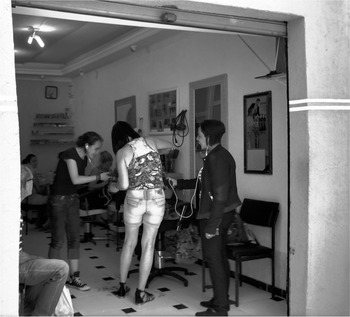
Nakahodo asked participants to imagine themselves as tourists … to assist in this process, Nakahodo gave portable audio recorders to some of the participants. During the walk, it was clear that this mediated form of listening allowed for a more exploratory and interactive engagement with passersby and places visited during the walk … using sound as a leitmotiv to explore the environment and the events that were happening during the walk. For instance, during the walk, the group stops to record the sound of a swing. In another moment, Kety (one of the workshop participants) enters a beauty parlour and starts to record the sound of someone having a haircut [Figure 1]. In the aftermath of the soundwalk, the group returned to the aforementioned high-school, and one of the things discussed was how noise regulation differed from different neighbourhoods in Curitiba. In particular, when it came to the issue of the carro de som, an automobile (with a loudspeaker installation in the trunk or in the top of the car) that criss-crosses many of the cities in Brazil selling different products. They particularly commented on how the carro de som was prohibited in the more affluent parts of the city. (Chaves Reference Chaves2016)
Workshop participant Kety Cristians da Silva ‘field recording’ in a hair salon. Picture by Rui Chaves (12 March 2016).

Lilian Nakao Nakahodo’s workshop was developed in the context of making the soundmap Mapa sonoro CWB: Uma cartografia afetiva de Curitiba.Footnote 23 This initiative was based on research that forwards critical questions in regards to contemporary practices of soundmapping, where Nakahodo questions the supposedly neutral, scientific and universal character of the ‘map’, much influenced by the post-representational turn in human geography. Nakahodo explores the recording process as a disruptive process in our relationship with the everyday. Against the implicit Cartesianism, abstraction and illusion of objectivity sometimes portrayed by soundmaps, turning on a mobile audio recorder and pointing a microphone is a process that allows discovering a world where ‘the listening of who engages in the act of recording becomes more intense and sensible, sharpening one’s curiosity and encouraging the recordist to explore new territories’ (Nakahodo Reference Nakahodo2014: 105). In doing so, Nakahodo prefers an idea of mapping that is essentially a subjective experience with collective implications, resulting in the delineation of creative strategies that foreground the aforementioned connection. The work implies that both author and listener are part of transformative assemblages, as clarified by Nakahodo’s statement to us:
I think that it is natural the existence of personal intakes and organizational strategies that come from me. This is something that necessitates from a creative process that most of times entails a nebulous thought-process. Nonetheless, the weight of this authorial impulse is balanced when I encounter a community that expresses a rich sonic diversity and plurality. Besides, I need to take into account what is uncontrollable and unexpected, the impulses and manifestations of others, in order to create a space where new perceptions and cartographies can emerge. (Nakahodo Reference Nakahodo2020b)
5. CONCLUSION
There is an urgent need to reevaluate Schafer’s description of one homogeneous self-listener, living in a sonic dumpyard. This is due the current state of affairs, in which authoritarian attitudes spread in the institutional field, with drastic effects on the daily lives of vulnerable populations, stifling the very validity of their experiences. Thus, critically reframing his project, within the context of our contemporary examples, aims to highlight the possibilities of a local intelligentsia that can create micro-political assemblages outside the inherent binaries Schafer’s work often incurs. This is not to mean that we purview collaboration itself as a positive ethos per se towards some sort of progressive political-aesthetic action, or that collaboration always functions in an overt manner. Nonetheless, the experience of sound should and can bring about forms of critical insight between different actors, perhaps foregrounding new vocabularies in regards to our sonic world, instead of relying on stifled orthodoxies. In this sense, we are reminded of Jean-Luc Nancy’s description of listening as a resonating intersubjective event wherein ‘listening is to be at the same time outside and inside, to be open from without and from within, hence from one to the other and from one in the other … the perceptible singularity that bears in the most ostensive way the perceptible or sensitive … condition as such: the sharing of an inside/outside, division and participation, de-connection and contagion’ (Nancy Reference Nancy2007: 14). In the case of our critique, the questions that arise are: can we listen to what the other person listens and learn, be transformed by it? Can artists and communities transform each other in the process of creating sonic-based work? This is not to dismiss the inherent subjective differences between involved actors and underlying privilege(s) (for instance class, ethnicity, gender and education). Such inherent hierarchies can never be displaced, but they should and can be recognised as part of the process. We are thinking about collaborative-based works that can generate empathy, new forms of sonic epistemological inquiries, creativity and dialogue in times of political polarisation. In this sense, we are advocating for sound-based art that focuses on finding common ground and co-existence between humans and non-humans, even if it happens in most cases at the micro-political level.
Schafer perhaps nurtures a return to a more pastoral world, one before the first industrial revolution, but he seems to ultimately dismiss that the biggest producer of noise is capitalism and its unchecked extractive endeavour on both labour and natural resources. To be clear, changes need to be made, but we think that the solution lies not in the betterment of an overall auditory culture, but in achieving auditory citizenship (this might even extend to non-human entities) and this affair might often incur into forms of noise-making, conflict and dialogue in order to achieve forms of acoustic conviviality and eco-sonic sustainability. This is not a wholesale negation of his influential work, but a reminder that the thematic of privilege, power and politics are part of our everyday sonic milieu. This is what we hoped to achieve in describing Nakahodo’s and Meireles’s work. We believe that both of these works engage within an ethical framework that pushes for a polyphonic and intersubjective creative process between the author-(listener-participant), (participant-listener)-author and (listener)-(participant)-(author). In these artworks, we describe forms of resistance in terms of representation (in Sal Sem Carne) and deconditioning in terms of our relationship with our everyday life in the city (in Mapa Sonoro CWB).