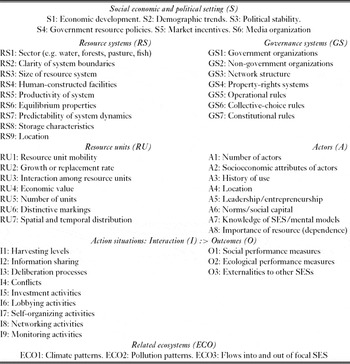
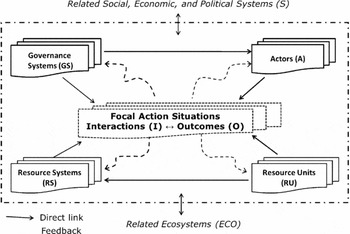
For scholars devoted to the analysis of social-ecological systems (SESs), overcoming the ‘panacea problem’ has been a major challenge. Panaceas or ‘overly simplified institutional prescriptions’ (Ostrom & Cox Reference Ostrom and Cox2010, p. 451) have recurrently misguided natural resource policies by proposing one-fit-all remedies to solve complex problems. Ostrom and Cox (Reference Ostrom and Cox2010) defined the panacea problem as a misfit between a set of institutions and SES considering that: (1) the institutional prescriptions are too narrow to fit the range of SESs considered, or (2) they are too broad to be articulated as effective institutions on the ground. To address this problem, Ostrom and her colleagues (Ostrom Reference Ostrom2007; Ostrom & Cox Reference Ostrom and Cox2010) have recently developed an interdisciplinary framework for the analysis of SESs (Fig. 1), hereafter called the SES framework. The decomposability of the first-tier variables of the framework into multiple tiers of sub-variables (second-tier shown in Table 1) should enable scholars to describe SESs potentially with a high clarity and precision, and to evidence their diversity and complexity. It also allows fine tuning of the governance system to the SESs, based on a typology of rules and actions situations previously defined and refined by Ostrom et al. (Reference Ostrom, Gardner and Walker1994) and Ostrom (Reference Ostrom and Sabatier1999, Reference Ostrom2005).
Grounded in two decades of observations and findings, the SES framework is a remarkable endeavour to capture and categorize the complexity and diversity of human-environment interactions, and offers a unique tool for conducting large-N (large sample) comparative studies. Such efforts certainly contribute to identifying the right institutional fit for a wide variety of SESs. Yet are these sufficient to overcome the panacea problem? This paper argues that SES studies need to go beyond identifying the right institutional fit, and place power and discourses at the core of their analysis. Anthropologists, sociologists and geographers have advanced similar arguments, notably in the field of political ecology, but it is only relatively recently that a few scholars have attempted to reconcile the rigour of an institutional analysis framework with the complexity of power dynamics in the field of common-pool resource management and SES (Agrawal Reference Agrawal2003; Franks & Cleaver Reference Franks and Cleaver2007; Armitage Reference Armitage2008; Clement Reference Clement2010). This paper proposes to further this debate by choosing the SES framework as a basis for discussion.
Missing variables: power and discourses
Power is one of the most contested concepts in the social sciences. The notion of power adopted in this paper recognizes the importance of discourses as an instrument and an effect of power at a strategic level (Foucault Reference Foucault1975), and the role of actors in constituting power through collective action at the micro-level, a stance close to that developed in the actor network theory and by some development scholars (Li Reference Li2007; Mosse Reference Mosse2005).
Compared to the institutional analysis and development (IAD) framework from which it derived, the SES framework includes a variable on the political-economic context, but tells little about power distribution. As a simple example, a certain set of rules effectively regulates timber extraction in the absence of markets. When markets become accessible, it is not only the economic value of the resource (Table 1, RU4) and the socioeconomic attributes of the actors (Table 1, A2) that might be affected, but also the power distribution among actors. A change in power can be partially captured by a change in the socioeconomic attributes, but power takes more subtle forms that are absent from the framework. Analysts may be interested in power-knowledge (Foucault Reference Foucault1976) if they follow the stance on power proposed here, or other forms of power such as ideological power (Lukes Reference Lukes2005). Political ecology scholars have demonstrated how a neglect of various types of power (structural, actor-based and discursive) is likely to lead to partial and naive understandings of human-environment interaction (Bryant Reference Bryant1998; Zimmerer & Bassett Reference Zimmerer and Bassett2003).
In a Foucauldian sense, discourses are both a vehicle and constitutive element of power, and can significantly drive institutional change by framing the way problems are perceived and potential solutions debated (Hajer Reference Hajer1995). Discourses (for example dominant global narratives on the causes of deforestation or localized production of knowledge on land degradation) can also influence actors’ beliefs and the perceived legitimacy of the rules (such as restricting access and use of forest products). A certain set of rules might fit the SES, but rule compliance and sustainability will be highly dependent on whether these rules are perceived as fair and legitimate.
From defining a common language to opening inclusive debates
An important proclaimed objective of the SES framework is to provide a common language (Ostrom & Cox Reference Ostrom and Cox2010). This ambition is plainly justified to foster interdisciplinary research, yet it is important to acknowledge that ‘the fact that actors debate nature in shared terms does not mean that they understand each other’ (Hajer & Versteeg Reference Hajer and Versteeg2005, p. 177). In many cases, each actor uses a simplified term for a complex meaning and assumes that the others share the same meaning. In this respect, the decomposability of each variable of the SES framework into sub-variables can contribute to the deconstruction of complex meanings. For example, monitoring can be proposed as a general prescription, but Ostrom and Cox (Reference Ostrom and Cox2010) acknowledged that it can take different forms and proposed to further decompose this variable into sub-rules adapted to the context. When trust is high, efficient monitoring can be ensured by mutual observation. In other settings, it might require written rules or a formal monitoring structure.
But ‘fixing’ a common language raises another issue, namely the risk of closing debates on contested meanings and social constructions of reality. How a problem is framed determines the way in which solutions are selected (Hajer & Versteeg Reference Hajer and Versteeg2005). For instance, the main issue to be addressed by users of the SES framework and for which it was designed is environmental protection (Ostrom Reference Ostrom2009; Ostrom & Cox Reference Ostrom and Cox2010). Scholars might consider the extent to which this implicit focus influences research design and outcomes. They might also reflect on the process of ‘fixing’ a common language, for example to which extent it supports the integration of multiple perceptions of environmental degradation and whether it contributes to acknowledging the way politics shape research and the way in which some disciplines and knowledge networks have greater authority than others.
Are panaceas only the result of poor science?
Detrimental panaceas do not result only from poor science. Once crafted, scientific theories and models are not immutable. They are continuously reinterpreted, redefined and often simplified by multiple stakeholders. The SES framework offers a useful tool to capture the complexity of a particular reality and translate it into articulated recommendations which are sensitive to the local context. However, policy-makers often prefer keeping recommendations fuzzy and ambiguous to secure an agreement among a wide range of parties, especially when decision-making is based on consensus. Researchers also have an interest in producing ‘facts’ by closing controversies (Latour Reference Latour1987). Development agencies have also continuously transformed scientific and political concepts and ideas like ‘participation’ or ‘empowerment’ to conform to organizational objectives (Cornwall & Eade Reference Cornwall and Eade2010).
Lastly, scientific knowledge is inherently political. For example, the fact that 86% of forests were still owned by governments in 2005 (Ostrom & Cox Reference Ostrom and Cox2010, p. 453) may not be solely the result of simplistic scientific recommendations; scientific knowledge may have been reshaped and selectively used to justify the vested interests of influential state forest departments. Conversely, examples where sound scientific evidence has failed to influence policies abound (Forsyth Reference Forsyth2003). In addition to good science, overcoming panaceas requires acknowledging the coproduction of science, policy and politics (see for example Goldman et al. Reference Goldman, Nadasdy and Turner2011).
Moving forward
A sound analysis of SESs is a critical step towards overcoming panaceas. Institutions may fit a particular system, but, to be effective and socially acceptable, they need to be supported by contextual elements, such as discourses and political, economic and cultural factors. This entails understanding power dynamics at multiple levels. Such an effort requires enlarging the analysis of institutions to the interaction of institutions with power and discourses.
I hope that in future the definition of institutions as ‘potentially linguistic entities’ (Ostrom & Cox Reference Ostrom and Cox2010, p. 454) will support a discursive approach to the production of knowledge on SESs. Several variables commonly used in the analysis of SESs (such as ‘appropriation’ and ‘resource dependence’) are ‘institutional facts’, that is, terms for which social functions are not necessarily shared by all society (Forsyth Reference Forsyth2003). Discourse analysis offers a critical approach to dissecting how environmental issues are framed and opens a deliberative space to discuss multiple constructions of reality (Fischer Reference Fischer2003). First steps in this direction within the SES framework could be to consider multiple arenas, representing the varying perceptions of facts of multiple stakeholders. Studies exploring different forms of ecological knowledge and its embeddedness with institutions and belief systems (Armitage Reference Armitage2003; Berkes, Reference Berkes1999) encourage such moves. In addition, scholars could integrate explicit second-tier variables on power and discourse into the SES framework (Table 1). In accordance with the representation of power adopted here, added variables could include: ‘dominant discourses’ and ‘knowledge systems’ in the social, economic and political setting (S), ‘power relations’ in interactions (I) and ‘power and knowledge’ as an outcome of collective action (O). These steps might seem simplistic and modest, and certainly need to be tested and refined, but hopefully will contribute to advance the integration of power and discourses in SES analyses and progressively pave the way for more critical studies.







 You have
Access
For scholars devoted to the analysis of social-ecological systems (SESs), overcoming the ‘panacea problem’ has been a major challenge. Panaceas or ‘overly simplified institutional prescriptions’ (Ostrom & Cox Reference Ostrom and Cox2010, p. 451) have recurrently misguided natural resource policies by proposing one-fit-all remedies to solve complex problems. Ostrom and Cox (Reference Ostrom and Cox2010) defined the panacea problem as a misfit between a set of institutions and SES considering that: (1) the institutional prescriptions are too narrow to fit the range of SESs considered, or (2) they are too broad to be articulated as effective institutions on the ground. To address this problem, Ostrom and her colleagues (Ostrom Reference Ostrom2007; Ostrom & Cox Reference Ostrom and Cox2010) have recently developed an interdisciplinary framework for the analysis of SESs (Fig. 1), hereafter called the SES framework. The decomposability of the first-tier variables of the framework into multiple tiers of sub-variables (second-tier shown in Table 1) should enable scholars to describe SESs potentially with a high clarity and precision, and to evidence their diversity and complexity. It also allows fine tuning of the governance system to the SESs, based on a typology of rules and actions situations previously defined and refined by Ostrom et al. (Reference Ostrom, Gardner and Walker1994) and Ostrom (Reference Ostrom and Sabatier1999, Reference Ostrom2005).
Unpacked SES framework. Source: Ostrom and Cox (Reference Ostrom and Cox2010), with permission.
Revised SES framework. Source: Ostrom and Cox (Reference Ostrom and Cox2010), with permission.
Grounded in two decades of observations and findings, the SES framework is a remarkable endeavour to capture and categorize the complexity and diversity of human-environment interactions, and offers a unique tool for conducting large-N (large sample) comparative studies. Such efforts certainly contribute to identifying the right institutional fit for a wide variety of SESs. Yet are these sufficient to overcome the panacea problem? This paper argues that SES studies need to go beyond identifying the right institutional fit, and place power and discourses at the core of their analysis. Anthropologists, sociologists and geographers have advanced similar arguments, notably in the field of political ecology, but it is only relatively recently that a few scholars have attempted to reconcile the rigour of an institutional analysis framework with the complexity of power dynamics in the field of common-pool resource management and SES (Agrawal Reference Agrawal2003; Franks & Cleaver Reference Franks and Cleaver2007; Armitage Reference Armitage2008; Clement Reference Clement2010). This paper proposes to further this debate by choosing the SES framework as a basis for discussion.
Missing variables: power and discourses
Power is one of the most contested concepts in the social sciences. The notion of power adopted in this paper recognizes the importance of discourses as an instrument and an effect of power at a strategic level (Foucault Reference Foucault1975), and the role of actors in constituting power through collective action at the micro-level, a stance close to that developed in the actor network theory and by some development scholars (Li Reference Li2007; Mosse Reference Mosse2005).
Compared to the institutional analysis and development (IAD) framework from which it derived, the SES framework includes a variable on the political-economic context, but tells little about power distribution. As a simple example, a certain set of rules effectively regulates timber extraction in the absence of markets. When markets become accessible, it is not only the economic value of the resource (Table 1, RU4) and the socioeconomic attributes of the actors (Table 1, A2) that might be affected, but also the power distribution among actors. A change in power can be partially captured by a change in the socioeconomic attributes, but power takes more subtle forms that are absent from the framework. Analysts may be interested in power-knowledge (Foucault Reference Foucault1976) if they follow the stance on power proposed here, or other forms of power such as ideological power (Lukes Reference Lukes2005). Political ecology scholars have demonstrated how a neglect of various types of power (structural, actor-based and discursive) is likely to lead to partial and naive understandings of human-environment interaction (Bryant Reference Bryant1998; Zimmerer & Bassett Reference Zimmerer and Bassett2003).
In a Foucauldian sense, discourses are both a vehicle and constitutive element of power, and can significantly drive institutional change by framing the way problems are perceived and potential solutions debated (Hajer Reference Hajer1995). Discourses (for example dominant global narratives on the causes of deforestation or localized production of knowledge on land degradation) can also influence actors’ beliefs and the perceived legitimacy of the rules (such as restricting access and use of forest products). A certain set of rules might fit the SES, but rule compliance and sustainability will be highly dependent on whether these rules are perceived as fair and legitimate.
From defining a common language to opening inclusive debates
An important proclaimed objective of the SES framework is to provide a common language (Ostrom & Cox Reference Ostrom and Cox2010). This ambition is plainly justified to foster interdisciplinary research, yet it is important to acknowledge that ‘the fact that actors debate nature in shared terms does not mean that they understand each other’ (Hajer & Versteeg Reference Hajer and Versteeg2005, p. 177). In many cases, each actor uses a simplified term for a complex meaning and assumes that the others share the same meaning. In this respect, the decomposability of each variable of the SES framework into sub-variables can contribute to the deconstruction of complex meanings. For example, monitoring can be proposed as a general prescription, but Ostrom and Cox (Reference Ostrom and Cox2010) acknowledged that it can take different forms and proposed to further decompose this variable into sub-rules adapted to the context. When trust is high, efficient monitoring can be ensured by mutual observation. In other settings, it might require written rules or a formal monitoring structure.
But ‘fixing’ a common language raises another issue, namely the risk of closing debates on contested meanings and social constructions of reality. How a problem is framed determines the way in which solutions are selected (Hajer & Versteeg Reference Hajer and Versteeg2005). For instance, the main issue to be addressed by users of the SES framework and for which it was designed is environmental protection (Ostrom Reference Ostrom2009; Ostrom & Cox Reference Ostrom and Cox2010). Scholars might consider the extent to which this implicit focus influences research design and outcomes. They might also reflect on the process of ‘fixing’ a common language, for example to which extent it supports the integration of multiple perceptions of environmental degradation and whether it contributes to acknowledging the way politics shape research and the way in which some disciplines and knowledge networks have greater authority than others.
Are panaceas only the result of poor science?
Detrimental panaceas do not result only from poor science. Once crafted, scientific theories and models are not immutable. They are continuously reinterpreted, redefined and often simplified by multiple stakeholders. The SES framework offers a useful tool to capture the complexity of a particular reality and translate it into articulated recommendations which are sensitive to the local context. However, policy-makers often prefer keeping recommendations fuzzy and ambiguous to secure an agreement among a wide range of parties, especially when decision-making is based on consensus. Researchers also have an interest in producing ‘facts’ by closing controversies (Latour Reference Latour1987). Development agencies have also continuously transformed scientific and political concepts and ideas like ‘participation’ or ‘empowerment’ to conform to organizational objectives (Cornwall & Eade Reference Cornwall and Eade2010).
Lastly, scientific knowledge is inherently political. For example, the fact that 86% of forests were still owned by governments in 2005 (Ostrom & Cox Reference Ostrom and Cox2010, p. 453) may not be solely the result of simplistic scientific recommendations; scientific knowledge may have been reshaped and selectively used to justify the vested interests of influential state forest departments. Conversely, examples where sound scientific evidence has failed to influence policies abound (Forsyth Reference Forsyth2003). In addition to good science, overcoming panaceas requires acknowledging the coproduction of science, policy and politics (see for example Goldman et al. Reference Goldman, Nadasdy and Turner2011).
Moving forward
A sound analysis of SESs is a critical step towards overcoming panaceas. Institutions may fit a particular system, but, to be effective and socially acceptable, they need to be supported by contextual elements, such as discourses and political, economic and cultural factors. This entails understanding power dynamics at multiple levels. Such an effort requires enlarging the analysis of institutions to the interaction of institutions with power and discourses.
I hope that in future the definition of institutions as ‘potentially linguistic entities’ (Ostrom & Cox Reference Ostrom and Cox2010, p. 454) will support a discursive approach to the production of knowledge on SESs. Several variables commonly used in the analysis of SESs (such as ‘appropriation’ and ‘resource dependence’) are ‘institutional facts’, that is, terms for which social functions are not necessarily shared by all society (Forsyth Reference Forsyth2003). Discourse analysis offers a critical approach to dissecting how environmental issues are framed and opens a deliberative space to discuss multiple constructions of reality (Fischer Reference Fischer2003). First steps in this direction within the SES framework could be to consider multiple arenas, representing the varying perceptions of facts of multiple stakeholders. Studies exploring different forms of ecological knowledge and its embeddedness with institutions and belief systems (Armitage Reference Armitage2003; Berkes, Reference Berkes1999) encourage such moves. In addition, scholars could integrate explicit second-tier variables on power and discourse into the SES framework (Table 1). In accordance with the representation of power adopted here, added variables could include: ‘dominant discourses’ and ‘knowledge systems’ in the social, economic and political setting (S), ‘power relations’ in interactions (I) and ‘power and knowledge’ as an outcome of collective action (O). These steps might seem simplistic and modest, and certainly need to be tested and refined, but hopefully will contribute to advance the integration of power and discourses in SES analyses and progressively pave the way for more critical studies.
Acknowledgements
This paper greatly benefited from the comments of three anonymous reviewers. Special thanks to Mark Giordano and Katherine Snyder for their valuable feedback and to Terry Clayton for his stylistic advice on an earlier draft.