In recent years there has been a change in European legislation on animal feed in order to control the use of animal feed additives (European Comission, 2003), and to consider consumers´ demand for healthier products, rejecting the use of synthetic antioxidants due to their low stability and association with carcinogenic diseases (Milos & Makota, Reference Milos and Makota2012). For this reason, many researchers and professionals from this sector are looking for alternatives, making it possible to obtained new value added products with natural compounds, leading to a positive impact on feeding costs, essential oils producers’ profitability and the environment. After observing the previous results reported by Nieto et al. (Reference Nieto, Díaz, Bañon and Garrido2010, Reference Nieto, Bañon and Garrido2011, Reference Nieto, Bañon and Garrido2012), who confirmed an antioxidant effect of distilled and non-distilled thyme leaves in fresh and cooked lamb meat, it has been considered appropriate to select those supplements for this study.
Others researchers attempted to use extracts of plant secondary metabolites like rosemary, such as Chiofalo et al. (Reference Chiofalo, Liotta, Fiumanò, Benedetta and Chiofalo2012), who concluded that the addition of rosemary extract to ewes’ diet affects milk composition due to the natural functional ingredients of rosemary extract, it is possibly a suitable feeding strategy to ensure quality of organic production. Moreover, Boutoial et al. (Reference Boutoial, Ferrandini, Rovira, Garcia and López2012) observed that the use of distilled rosemary leaves in goat diet results in a decrease in milk clotting time and an increase in the polyunsaturated fatty acid of milk. Jordán et al. (Reference Jordán, Moñino, Martinez, Lafuente and Sotomayor2010) published that the introduction of distilled rosemary leaves into goat diet increased concentration of polyphenolic components in the goats’ milk and in the plasma of the suckling goat kid.
The Mediterranean area is characterised by the frequent cultivation of plants with potentially useful secondary metabolites (sage, rosemary, thyme, etc.). Many authors have described their suitability as natural antioxidants as they contain major secondary metabolites, such as polyphenols, which are characterised by their redox properties (Aruoma et al. Reference Aruoma, Spencer, Rossi, Aeschbach, Kahn, Mahmood, Munoz, Murcia, Butler and Halliwell1996; Cuvelier et al. Reference Cuvelier, Richard and Berset1996).
Red thyme or Thymus zygis subsp. gracilis is one of the aromatic medicinal plants widespread in the Iberian Peninsula, and its essential oil has become one of the most widely used in the food industry, increasing its economic importance (Jordán et al. Reference Jordán, Martínez, Martínez, Moñino and Sotomayor2009). The studies carried out by Rota et al. (Reference Rota, Herrera, Martínez, Sotomayor and Jordán2008), regarding the essential oil variability of this species, describe the content of more than 60 bioactive compounds found in the essential oil of thyme and show that the most common chemotype of this thyme is thymol and pure linalool. The same author described an inhibitory effect of Thymus zygis subsp. gracilis essential oils on Salmonella enteritidis and Escherichia coli.
Thyme generates an excess of residues (distilled thyme leaves) after leaf distillation for the extraction of essential oils. Whereas distilled thyme leaves are currently underused, there are studies focused on the potential benefits of this source as natural antioxidants (Nieto et al. Reference Nieto, Díaz, Bañon and Garrido2010).
Few studies have considered the use of distilled and non-distilled thyme leaves for goats feeding and their effect on milk and cheese. The aim of this study is to evaluate the effect of the introduction of distilled and non-distilled leaves of Thymus zygis subsp gracilis into goat's diet at two levels of supplementation on the physicochemical composition of pasteurised milk, and physicochemical, oxidative stability, phenolic content, sensory and texture profile of Murcia al Vino cheese.
Materials and methods
Animals and dietary treatments
Animals were selected based on the age and milk yield (age: 3·2 years±2 months, milk yield: 2·2±0·1 kg of milk per day) and distributed into three groups. Two experiments (one per year) were carried out with 36 lactating Murciano-Granadina goats (47±5 kg weight).
All supplemented diets were balanced with protein and fat by Cargill Animal Nutrition (Torre Pacheco, Murcia, Spain) to obtain isoenergetic and isonitrogenous diets for all groups (control and supplemented).
The first experiment was divided into three groups, each consisting of 12 multiparous lactating goats. The first group (control) was fed the basal diet (2·3 kg/animal/day) consisting of wheat bran (26·65%), scale soy (25%), barley (15%), malt comb (8%), sunflower oil (7%); rye (6·99%), honey bean (4·16%), corn flower (3·67%), calcium carbonate (1·49%), cane molasses (1%) and, vitamin and mineral feed additives (1·04%). The second group (DTL1) was fed with the above basal diet but substituting 10% with pellets (50% distilled leaves of Thymus zygis subsp gracilis and 50% barley). The third group (DTL2) was fed the basal diet but substituting 20% with pellets (50% distilled leaves of Thymus zygis subsp gracilis and 50% barley).
The second experiment (second year) was also divided into three groups of 12 multiparous lactating goats. In this case, the second and third group received the basal diet replaced by 3·75% (TL1) and 7·5% (TL2) of non-distilled thyme leaves, respectively (pellet with a mixture of 25% fresh thyme leaves and 75% barley).
The thyme leaves (non-distilled) were obtained from a local company (Nutrafur-Furfural Español S.A., Murcia, Spain) and the distilled thyme leaves were obtained by the distillation of theses leaves for 3 h. Before use, the distilled product of thyme was dried and reserved at room temperature and the leaves and stems separated. The distilled and non-distilled leaves were incorporated into the feed by the company Cargill Animal Nutrition (Torres Pacheco, Murcia, Spain). This operation was repeated every 90 d in order to preserve the freshness of all the diet's compounds. The composition of non-distilled thyme corresponds to that reported by Jordán et al. (Reference Jordán, Martínez, Martínez, Moñino and Sotomayor2009) and the distilled to that published by Nieto et al. (Reference Nieto, Bañon and Garrido2011, Reference Nieto, Bañon and Garrido2012).
The milk was collected every week for seven months (each year) and identified by codes. Two samples of 50 ml per animal group and week (control and two levels of each supplementation) were analysed by a regional laboratory specialising in animal health (LAYSA, Laboratorio Agroalimentario y de Sanidad Animal, Murcia, Spain).
Physicochemical milk analysis
Dry matter, fat, protein and lactose contents were measured with an infrared spectrophotometer (Milko Skan in a combi Foss 5000, Foss Electric, Hillerød, Denmark) according to the International Dairy Federation (IDF, 1996a). The milk clotting time was measured by the Berridge clotting time method described in IDF (1997). Each sample was measured in duplicate.
To determine the total fatty acids composition of milk, lipid extraction was performed before derivatisation (IDF, 1996b) and quantified by gas chromatography (ISO, 1990), using a GC8000 series gas chromatograph (Fisons Instruments SpA, Milano, Italy) equipped with flame ionisation detector (FID-80). A capillary column with 5% crosslinked phenyl methyl siloxane, 30 m long, 0·25-mm i.d., and 0·25-μm film thickness (HP5; Hewlett-Packard, Barcelona, Spain), was used. The methyl esters were quantified using the methyl undecanoate acid (Sigma U 0250; Sigma-Aldrich Quimica SA, Madrid, Spain) as internal standard and from the calibration curves for each fatty acid (Ferrandini et al. Reference Ferrandini, Castillo, de Renobales, Virto, Garrido, Rovira and López2012). The reference standards adopted for identifying each fatty acid are as described by Ferrandini et al. (Reference Ferrandini, Castillo, de Renobales, Virto, Garrido, Rovira and López2012).
Experimental Murcia al Vino cheesemaking
The cheeses were produced at the University of Murcia Food Technology pilot plant. A total of six cheeses were made with each type of milk (control, DTL1, DTL2, TL1 and TL2). A 50-l double-O, stainless steel cheese vat (AISI-310 Cameselle SL, Vigo, Spain) was used for cheese manufacture. Milk was pasteurised at 78 °C for 30 s, then the mesophilic starter culture was preincubated in the milk at 32 °C for 20 min. After this time, CaCl2 and calf rennet were added at 0·3%, w/v. After 45–60 min the curd was cut and washed by removing 20% of the whey and added water. The curd was pressed in moulds of 1 kg. All cheeses were salted by brine immersion at 17o Baume for 15 h. After salting all cheeses were introduced into a ripening chamber with a relative humidity of 82% and a temperature of 11 °C. During ripening cheeses were submerged in red wine 15–30 s every week.
All cheese manufacturing processes were performed with the collaboration of an accredited expert cheesemaker and under the supervision of a representative of the board of P. D. O. Murcia al Vino cheese to ensure that the manufacturing process was carried out according to the standard procedure for Murcia al Vino cheese. Before sampling, the cheese rind was discarded and the cheeses were grated and kept in airtight plastic containers at −80 °C until the analyses were performed.
Cheese analyses
For the physicochemical measurements, cheeses were analysed after 45 d ripening. The pH measurements were made in grated cheese (5 g±0·1 mg) suspended in 30 ml distilled water and stirred for 10 min. The measurements were carried out using a Crison® pH meter (micro pH 2001, Barcelona,Spain) connected to a Crison® glass combined electrode (1952–2002) previously calibrated at room temperature. Dry matter was measured in grated cheese samples (3±0·1 g) dried to constant weight according to IDF (1982). The total nitrogen concentration was determined in 0·5±0·01 g cheese using the Kjeldahl method, according to IDF (2008).
The a w was measured with Novasina® equipment (TH 200, Zurich, Switzerland), using saturated salt solution patterns with known values of relative humidity for the calibration. The crushed sample was placed in the cell of the device and the reading was allowed to stabilise (∼1 h). Total fat content was measured according to ISO (2008a). Gerber method using Gerber Van Gulik butyrometers. Cheese yield was defined as the amount of cheese, expressed in kilograms, obtained from 100 kg of milk.
The amount of total soluble phenolic compounds was determined by the Folin-Ciocalteau method described by Capannesi et al. (Reference Capannesi, Palchetti, Mascini and Parenti2000). The quantification was obtained from a calibration curve using the galic acid (PANREAC Quimica SAU, Barcelona Spain) as a standard phenol (r 2=0·995) obtained by the use of 7 points for the calibration (0–0·12 mg of gallic acid/ml). Results were expressed as the equivalence of milligrams of gallic per kilogram of cheese (mg EGA/kg).
Oxidation level was measured through TBARs (Thiobarbituric acid reactive substances assay) as described by Tarladgis et al. (Reference Tarladgis, Watts, Younathan and Dugon1960), 49 ml H2O and 1 ml BHA (7% in ethanol 98%) reagent were added to 10 g cheese, and the resulting mixture was homogenised using an Ultra Turrax (Heidolph, Diax 600, Germany) for 1·5 min until the mixture appeared to be homogeneous. An aliquot of the suspension was transferred to 1 l flask and mixed with 5 ml 2 m-HCL and 45 ml H2O distillated at 130 °C. Then 5 ml TBA were added to the above distilled aliquot (5 ml). The mixture was placed in a water bath at 100 °C for 35 min and cooled with ice.
The orange-red cyclohexanone supernatant was decanted and the absorbance at 532 nm was measured spectrophotometrically (UV2 spectrophotometer Unicam Ltd., Cambridge, United Kingdom). The results were expressed as mg MDA per 1 kg cheese. As described by Tarladgis et al. (Reference Tarladgis, Watts, Younathan and Dugon1960), the value of the first term from the standard curve is 7·4×10−8, with a sample of 10 g and 68% recovery: k (distillation)=7·8.
Microbiology
Cheese microbiology analyses were made in duplicate using the following methods: for total aerobic bacteria (ISO, 2003b), Enterobacteriaceae (ISO, 2004), Esch. coli (ISO, 2000), Salmonella spp. (ISO, 2012), Staphylococcus aurues (ISO, 1999), Clostridium sulphite-redactors (ISO, 2003a), Listeria monocytogenes (ISO, 1998), yeasts and moulds (ISO, 2008b).
Sensory analysis
The sensory analysis was carried out as described by Ferrandini et al. (Reference Ferrandini, Castillo, de Renobales, Virto, Garrido, Rovira and López2012). The sensory evaluation was performed using a descriptive quantitative analysis and a trained panel. The sensory analysis was carried out to determine the existence of significant differences between control and supplemented cheeses at 45 d ripening by a panel of expert assessors who were members of the regulatory PDO Murcia al Vino cheese council. The panel was composed of an average of 10 panelists, the number of panelists never being below eight, the methodology carried out for the sensory analysis was described for the same type of cheese by Ferrandini et al. (Reference Ferrandini, Castillo, de Renobales, Virto, Garrido, Rovira and López2012).
Cheese texture analysis
Texture profile analysis (TPA) was carried out using a texture analyser QTS-25 (Brookfield CNS Farnell, Borehamwood, Hertfordshire, England) equipped with a load cell of 25 kg and Texture Pro V. 2.1 software. For TPA, four cube shaped samples (1 cm3) were cut from a rindless cheese, wrapped in aluminium foil and equilibrated at 20±0·5 °C for 3 h before testing. The testing conditions were: 20 °C room temperature; two consecutive cycles of 50% compression; cross-head moved at a constant speed of 30 mm/min and a trigger point of 0·05 N. Texture variables, hardness (expressed as N), gumminess (expressed as N), chewiness (expressed as N·mm), cohesiveness (adimensional), springiness (expressed as mm) and adhesiveness (expressed as N·s) were calculated as described by Bryant et al. (Reference Bryant, Ustonol and Steffe1995).
Statistical analysis
The statistical analysis was carried out using the statistical package for Windows (version 8.0, Analytical Software, USA) and Minitab software (version 16, Minitab Inc. USA). A one-way multivariate ANOVA and a post hoc Tukey test with a 0·05 significant level were carried out for the data analysis.
Results and discussion
Effect of thyme supplementation on milk composition
Mean values of the physicochemical composition of milk from goats fed the control or supplemented diets are shown in Table 1. All supplementations significantly affect any of the physicochemical parameters. The TL2 supplementation led to an increase in dry matter and fat content and a decrease in the lactose content. Savoini et al. (Reference Savoini, Cattaneo, Paratte, Varisco, Bronzo, Moroni and Pisoni2003) also observed an increase in milk fat content after rosemary extract supplementation of a goat diet. For the DTL2 supplementation significant differences were only observed for the protein content, which is also observed by Chiofalo et al. (Reference Chiofalo, Liotta, Fiumanò, Benedetta and Chiofalo2012).
Physicochemical composition of milks from the different supplementation

sem: Standard Error of Means, DTL1: Diet with 10% of distilled thyme leaves supplementation, DTL2: Diet with 20% of distilled thyme leaves supplementation, TL1: Diet with 3·75% of non-distilled thyme leaves supplementation. TL2: Diet with 7·5% of non-distilled thyme leaves supplementation; different letters in the same column indicate significant statistical differences (Tukey test P<0·05)
The MCP (milk coagulation properties), which are affected by physical and chemical parameters such as titratable acidity (Formaggioni et al. Reference Formaggioni, Malacarne, Summer, Fossa and Mariani2001), somatic cell count (Raynal et al. Reference Raynal-Ljutovac, Pirisi, de Crémoux and Gonzalo2007), casein contents and the calcium and phosphorus concentrations (Summer et al. Reference Summer, Malacarne, Martuzzi and Mariani2002) among others, is one of the principal parameters to be considered for cheese making. Significant differences were observed in milk clotting time between the control and the supplemented milks as was also observed by Han et al. (Reference Han, Britten, St-Gelais, Champagne, Fustier, Salmieri and Lacrois2011), when polyphenolic compounds were added to pasteurised milk. The same authors reported that the enzymatic gel-forming kinetics of rennet used in cheese production is affected by the presence of polyphenolic compounds. DTL1 and DTL2 led to a decrease in milk clotting time demonstrating their technological suitability for cheese making, while TL1 and TL2 supplementations increased it. This suggests that the first supplementation is more suitable for cheese making.
The fatty acids profile is shown in Table 2. Significant differences were only observed between the control and DTL1 for C6 and C10, TL1 for C6, C7, C8, C10, C17, C18:2 and C18:3, DTL2 for C6, C17 and C18:2, and TL2 for C6, C7, C8, C16:1 and C18:2 fatty acids. These results indicate that the introduction of TL1 and TL2 in goat's diet is a potential tool for modifying fatty acids profile, improving milk quality.
Percentage of milk total fatty acid content from the different supplementation

sem: Standard Error of Means; DTL1: Diet with 10% of distilled thyme leaves supplementation; DTL2: Diet with 20% of distilled thyme leaves supplementation; TL1: Diet with 3·75% of non-distilled thyme leaves supplementation; TL2: Diet with 7·5% of non-distilled thyme leaves supplementation; different letters in the same column indicate significant statistical differences (Tukey test P<0·05)
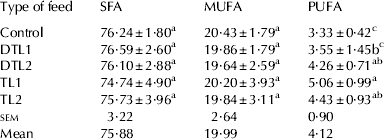
The highest value of PUFA was found in TL1. These results are in agreement with those observed by Boutoial et al. (Reference Boutoial, Ferrandini, Rovira, Garcia and López2012), who found an increase in milk PUFA content resulted from goats fed with rosemary by-products and with the findings of Kraszewski et al. (Reference Kraszewski, Strzetelski and Niwińska2004), who introduced a mixture of herbs (peppermint, wild pansy, chamomile, stringing nettle, common yarrow and thyme) rich in antioxidant in cows diet. Liu et al. (Reference Liu, Yang, Chen, Dong and Wang2008) suggest that unsaturated fatty acids (UFA) are susceptible to oxidation due to the double bonds in the fatty acids, while the antioxidant vitamin E inhibit the oxidation of the UFA. In our case, the introduction of thyme in the diet would have inhibited the oxidation of the double bonds in PUFA possibly due to the action of phenolic compounds of thyme transferred from the diet (Table 3).
Milk fatty acid content as a function of saturation (%)
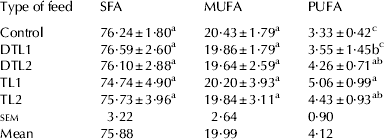
sem: Standard Error of Means; DTL1: Diet with 10% of distilled thyme leaves supplementation; DTL2: Diet with 20% of distilled thyme leaves supplementation; TL1: Diet with 3·75% of non-distilled thyme leaves supplementation; TL2: Diet with 7·5% of non-distilled thyme leaves supplementation, SFA: saturated fatty acid; MUFA: monounsaturated fatty acid; PUFA: polyunsaturated fatty acid. Different letters in the same column indicate significant statistical differences (Tukey test P<0·05)
Goat cheese composition
Table 4 details the physicochemical composition of cheeses produced from DTL and TL milks compared with the control cheeses. TL1 supplementation significantly decreased the cheese dry matter content, while the TL2 diet led to an increase in this value. A similar influence was observed by Foda et al. (Reference Foda, El-Sayed, Hassan, Rasmy and El-Moghazy2010) following spearmint essential oil supplementation after 15 d storage. This observation also agrees with El-Din et al. (Reference El-Din, Ghita, Badran, Gad and El-Said2010), who observed a decrease in the dry matter content of low fat UF-Soft cheese after a rosemary extract supplementation at 30 d ripening. The protein content and pH of TL1 and TL2-cheeses were significantly lower than in the control and the DLT cheeses, which is in disagreement with those observed by Foda et al. (Reference Foda, El-Sayed, Hassan, Rasmy and El-Moghazy2010), who found an increase in the protein content of white cheeses, and those results observed by El-Din et al. (Reference El-Din, Ghita, Badran, Gad and El-Said2010), who found an increase in cheeses pH . Abbeddou et al. (Reference Abbeddou, Rischkowsky, Richter, Hess and Kreuzer2011) explain that such a pH decrease may be related to the presence of phenolic compounds in cheese curd. It can be confirm that the addition of fresh thyme leaves into goats’ diets has different effects from those observed in the addition of other essential oils and aromatic plants.
Cheese physicochemical and microbiological composition

sem: Standard Error of Means; DTL1: Diet with 10% of distilled thyme leaves supplementation; DTL2: Diet with 20% of distilled thyme leaves supplementation; TL1: Diet with 3·75% of non-distilled thyme leaves supplementation; TL2: Diet with 7·5% of non-distilled thyme leaves supplementation; different letters in the same column indicate significant statistical differences (Tukey test P<0·05)
Cheese microbiology
As can be observed in Table 4, the addition of thyme leaves did not show inhibition of mesophilic aerobic and enterobacter, as there were no significant differences (P>0·05) between the control and any of the supplemented cheeses. Staph. aureus, sulphite-reducing Clostridium, Esch. coli, Salmonella spp and Listeria monocytogenes were absent from all the cheeses. Although, Smith et al. (Reference Smith, Stewart and Fyfe2001) observed an inhibition of List. monocytogenes and Sal. enteritidis as a result of supplementation with Thymus vulgaris essential oil in soft cheese.
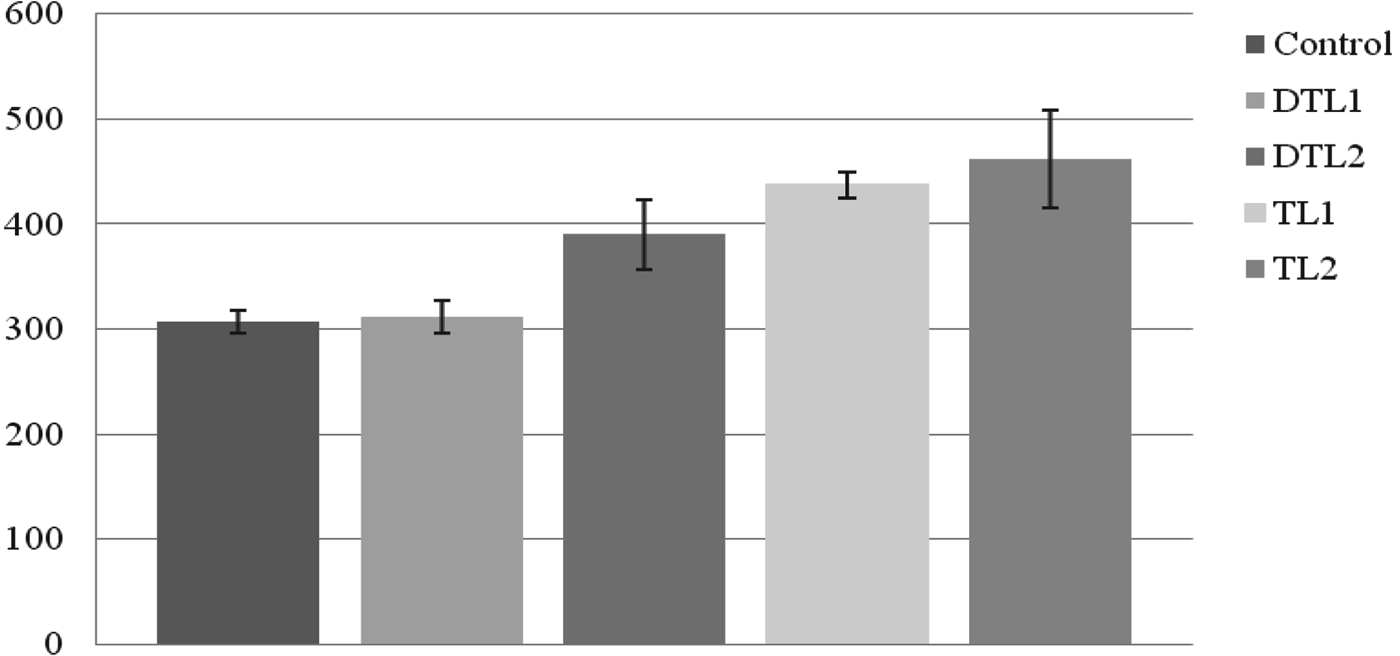
Total phenolic content of goat cheeses
Figure 1 details the results of the concentration of phenolic compounds in equivalence of mg gallic acid/kg cheese (mg EGA/kg cheese). All the supplementations showed significant differences in cheese's total phenolic content when comparing with the control cheese, except DTL1. The results observed can be related with the thyme leave extract composition described by Nieto et al. (Reference Nieto, Bañon and Garrido2011), who stated that there is a presence of 21·5±1·7 EGA/l extract, taking into account the total phenolic concentration of the extract from the water extraction of thyme leaves and the composition of essential oil detailed by Jordán et al. (Reference Jordán, Martínez, Martínez, Moñino and Sotomayor2009).
Cheeses phenolic concentration (mg of EGA/kg of cheese) from different supplementation. DTL1: Diet with 10% of distilled thyme leaves supplementation; DTL2: Diet with 20% of distilled thyme leaves supplementation; TL1: Diet with 3·75% of non-distilled thyme leaves supplementation; TL2: Diet with 7·5% of non-distilled thyme leaves supplementation.
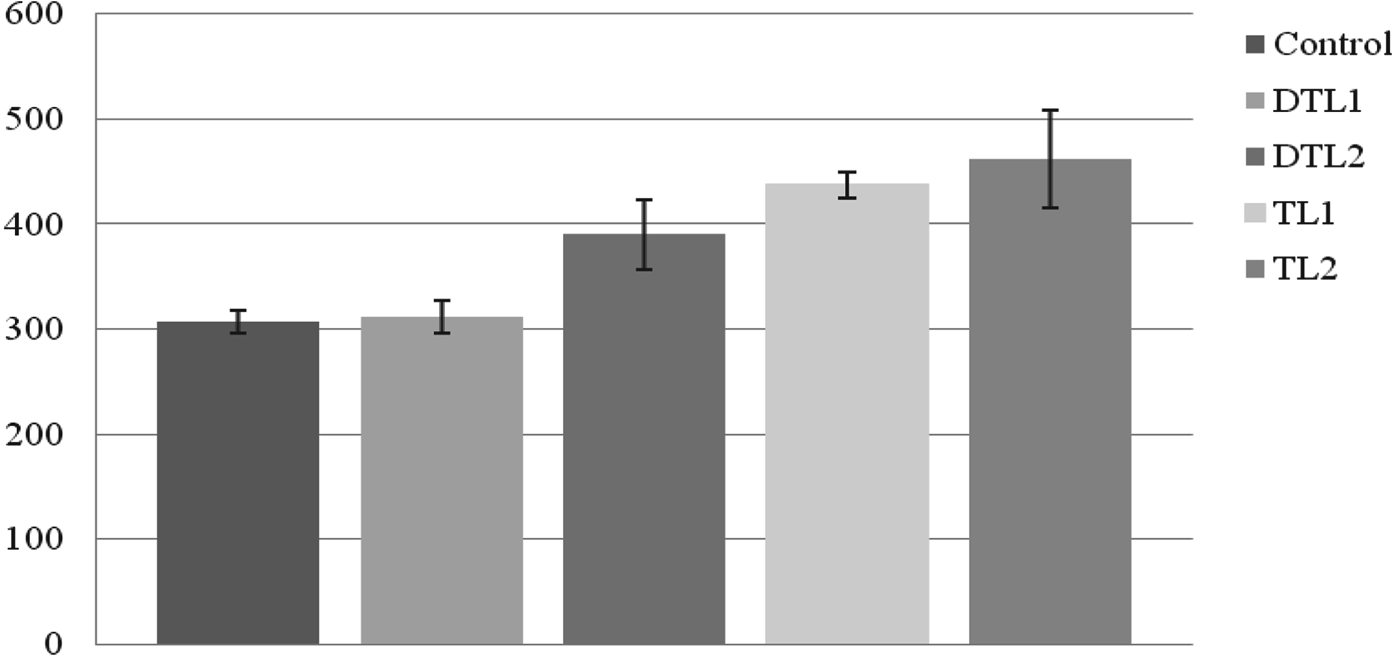
The higher value was observed in TL2-cheeses, which can be related to the higher consumption of polyphenols compounds (TL2 represents the 3% thyme essential oil), these compounds are probably related with thymol, carvacrol, eugenol and others bioactive compounds presented in Thymus zygis gracillis (Nieto et al. Reference Nieto, Bañon and Garrido2012). That agrees with the results observed by Cuchillo et al. (Reference Cuchillo, Puga, Ocaña and Romo2010), who found a high level of polyphenolic compounds in cheeses produced with milk from grazing goats with a rich content of secondary metabolites in comparison with other cheeses from goat fed with lucerne and protein concentrates. These authors also concluded that the high polyphenolic levels observed could be related to the higher consumption of polyphenols during grazing.
TBARs of goat cheeses
During the storage, cheeses are affected by the perception of light-induced oxidation that lead to the production of off-flavours. Theses off-flavours are caused by the production of volatile compounds like hexanal, heptanal, octanal, nonanal, 2-butanaol, acetaldehyde. The use of antioxidant can inhibit the oxidation of cheese lipids as described by Soto-Cantú et al. (Reference Soto-Cantú, Graciano-Verdugo, Peralta, Islas-Rubio, González-Có rdova, González-León and Soto-Valdez2008).
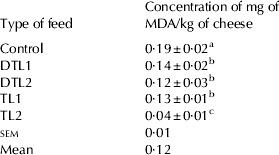
Table 5 details the results of the TBARs analysis. The ANOVA confirmed significant differences between the control and the supplemented cheeses. The control cheese, which has the lowest concentration of phenolic compounds, showed the highest oxidation degree. The lowest TBARs value was observed in TL2-cheese. This confirms the effect of supplementation minimising cheese oxidation stress. The success of distilled and non-distilled thyme leaves in improving the cheese stability can be attributed to the antioxidant activity of the phenolic compounds. These bioactive compounds that the leaves contain may interfere with the propagation reaction, which leads to inhibiting the enzymatic systems implicated in the initiation of oxidation reactions. Nieto et al. (Reference Nieto, Díaz, Bañon and Garrido2010, Reference Nieto, Bañon and Garrido2011) showed that the cooked and raw meat of lambs from ewes fed with distilled thyme leaves showed lower TBARs, hexanal values, rancid odour and rancid flavour scores, that led to increased stability and shelf life of meat.
TBARs in cheeses from the different supplementation
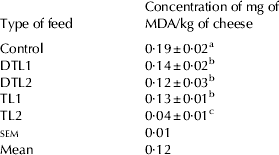
sem: Standard Error of Means; DTL1: Diet with 10% of distilled thyme leaves supplementation; DTL2: Diet with 20% of distilled thyme leaves supplementation; TL1: Diet with 3·75% of non-distilled thyme leaves supplementation; TL2: Diet with 7·5% of non-distilled thyme leaves supplementation; different letters in the same column indicate significant statistical differences (Tukey test P<0·05)
Therefore, it is possible to administer distilled and non-distilled thyme leaves as an alternative in goat feeding in order to increase the oxidative stability of Murcia al Vino Cheese.
Sensory analysis of goat cheese
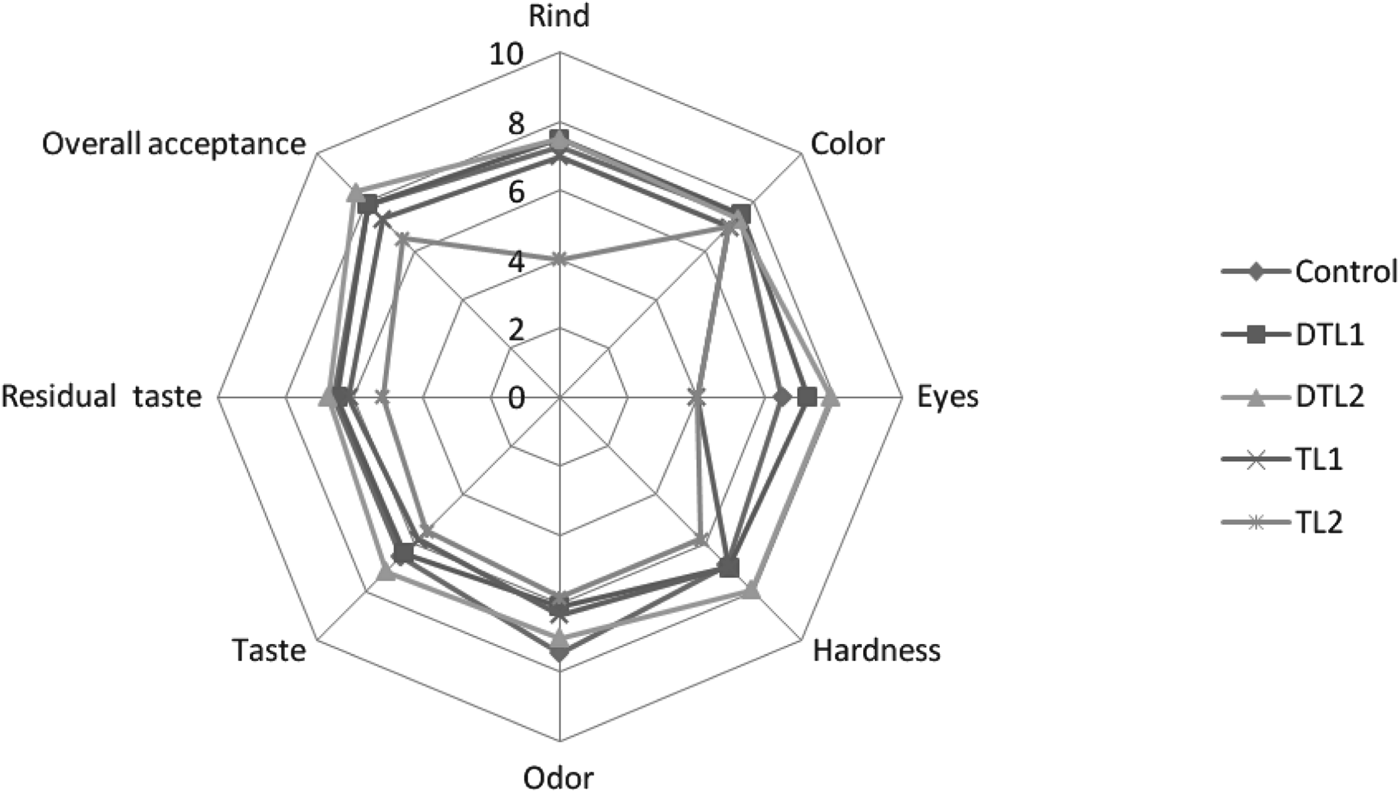
Figure 2 details the cheese sensory results. Statistically, differences were found for eyes and hardness between the control and DTL2-cheeses, and for eyes and odour between the control and TL1-cheeses. TL2-cheeses showed significant differences in all the sensory attributes, except colour. The most valued cheese for the panellists was the DTL2-cheese, which was characterised by having the best rind and taste. Although, TL2 seemed to be the supplementation with a more appropriate technological suitability, oxidation stability and physicochemical profile, is the lowest preferred by the trained panel.
Cheeses sensory profile. DTL1: Diet with 10% of distilled thyme leaves supplementation; DTL2: Diet with 20% of distilled thyme leaves supplementation; TL1: Diet with 3·75% of non-distilled thyme leaves supplementation; TL2: Diet with 7·5% of non-distilled thyme leaves supplementation.
Texture profile of goat cheeses
Table 6 shows the texture profile. No significant differences (P>0·05) were determined for any of the parameters studied between the control cheese and those supplemented with thyme, with the exception of hardness of first bite in DTL2 and TL1-cheeses. TL1-Cheeses were less firm. Abbeddou et al. (Reference Abbeddou, Rischkowsky, Richter, Hess and Kreuzer2011) explain that such a decrease in hardness may be related to lower pH values just as it was observed in Table 4. Abd El Aziz et al. (Reference Abd El-Aziz, Mohamed and Seleet2012) suggest that the pH of cheese affects texture of curd directly by influencing the solubility of the caseins as a result of the action of phenolic compounds in the cheese curd.
Cheeses texture profile
sem: Standard Error of Means; DTL1: Diet with 10% of distilled thyme leaves supplementation; DTL2: Diet with 20% of distilled thyme leaves supplementation; TL1: Diet with 3·75% of non-distilled thyme leaves supplementation; TL2: Diet with 7·5% of non-distilled thyme leaves supplementation; different letters in the same column indicate significant statistical differences (Tukey test P<0·05)
Conclusions
The results obtained in this study confirm DTL2 as an alternative feed for goats. This treatment provides milks and cheeses with added nutritional and sensory values, without changing properties of the cheese itself. The use of distilled thyme extract as an alternative for improving milk and cheese composition would make it possible to recovery thyme by-products improving the environment sustainability by reducing food waste.
This work was supported by LAYSA (Laboratorio Agroalimentario y de Sanidad Animal, Murcia, Spain). Regulatory Council of the PDO Murcia and Murcia al Vino cheese is also acknowledged.