Developmental trajectories of attention-deficit/hyperactivity disorder (ADHD) symptoms can be highly heterogeneous (Asherson & Agnew-Blais, Reference Asherson and Agnew-Blais2019) and there have been attempts to parse this into developmental subtypes. Traditional approaches have been based on a priori criteria such as whether supra-clinical threshold symptoms have an onset (or resolve) before a given age. Studies in this tradition have, for example, identified symptom severity, comorbidities, family disadvantage and lower IQ as predictors of belonging to a ‘persistent’ rather than ‘remitting’ subtype (e.g. Caye et al., Reference Caye, Spadini, Karam, Grevet, Rovaris, Bau and Kieling2016); and poorer executive functions and comorbidities as predictors of ‘later-onset’ symptoms among those who show few symptoms early in life (e.g. Manfro et al., Reference Manfro, Santoro, Polanczyk, Gadelha, Pan, Bressan and Rohde2019). Comparisons of ‘late-onset’ and ‘early-onset’ subtypes (defined as onset before age 7 in DSM-IV and before age 12 in DSM 5) have meanwhile mostly suggested similar patterns of impairment and treatment response but with some evidence for greater impairments among those with an earlier onset (e.g. Faraone, Kunwar, Adamson, & Biederman, Reference Faraone, Kunwar, Adamson and Biederman2009; Reinhardt et al., Reference Reinhardt, Benetti, Victor, Grevet, Belmonte-de-Abreu, Faraone and Rohde2007).
These a priori defined developmental subtypes may not, however, optimally reflect variation in ADHD symptom trajectories. Cut-offs for late-onset ADHD, for example, are necessarily arbitrary, as symptoms can cross into the clinically significant range at a range of ages (Asherson & Agnew-Blais, Reference Asherson and Agnew-Blais2019). Similarly, it is likely that there is long-term continuous variation in symptoms rather than abrupt onsets or remissions. An alternative approach that can take these forms of variation into account is to explore the trajectories of symptoms that emerge from longitudinal data drawing on data-driven techniques such as growth mixture modelling, latent class growth analysis, or group-based trajectory analysis (henceforth collectively ‘trajectory analysis’).
Only a small number of previous studies have used trajectory analysis to examine developmental subtypes of ADHD symptoms (Murray et al., Reference Murray, Booth, Eisner, Auyeung, Murray and Ribeaud2019, Reference Murray, Booth, Auyeung, Eisner, Ribeaud and Obsuth2020a; Pingault et al., Reference Pingault, Tremblay, Vitaro, Carbonneau, Genolini, Falissard and Côté2011; Riglin et al., Reference Riglin, Collishaw, Thapar, Dalsgaard, Langley, Smith and Thapar2016; Sasser, Beekman, & Bierman, Reference Sasser, Beekman and Bierman2015, Reference Sasser, Kalvin and Bierman2016). In many but not all cases, groups corresponding to the ‘late-onset’, ‘early-onset persistent’, ‘early-onset remitting’ and ‘unaffected’ groups commonly specified in a priori definitions have emerged using these more data-driven approaches. However, the specific developmental trajectories that correspond to these groups vary dependent on characteristics such as the nature of the sample, measurement methods and developmental period covered.
Irrespective of the approach used to define the trajectory groups, making qualitative distinctions between different trajectories is arguably only clinically useful to the extent that these distinctions are related to etiological and risk factors, prognoses, and treatment responses such that they can help provide guidance on the best treatment options and likely support the needs of an individual. Within the trajectory analysis approach, however, only a handful of studies have examined the clinically relevant correlates of a group membership. Riglin et al. (Reference Riglin, Collishaw, Thapar, Dalsgaard, Langley, Smith and Thapar2016) found that low IQ, social communication problems, pragmatic language impairment and conduct problems in childhood, as well as polygenic risk scores for ADHD, were higher in their persistent relative to childhood-limited (remitting) category, while Sasser, Kalvin, and Bierman (Reference Sasser, Kalvin and Bierman2016) identified aggression and hyperactivity at school and emotional dysregulation at home as predictors of being in their persistent relative to remitting category. Pingault et al. (Reference Pingault, Tremblay, Vitaro, Carbonneau, Genolini, Falissard and Côté2011) identified poorer academic outcomes in their early-onset persistent compared to their later-onset group while Murray, Eisner, Obsuth, and Ribeaud (Reference Murray, Eisner, Obsuth and Ribeaud2020) found that their later-onset group had lower levels of childhood anxiety, reactive aggression and risk-taking as compared to their earlier-onset/persistent group. The latter was, however, true only for inattention and not hyperactivity/impulsivity trajectories. In the same sample, Murray et al. (Reference Murray, Booth, Auyeung, Eisner, Ribeaud and Obsuth2020a) found that psychosocial impairments in late adolescence tended to be more severe for those who had early-onset/persistent symptoms compared to a later onset. There is also preliminary evidence that females are more likely to show later onsets of ADHD symptoms than males (Malone, Van Eck, Flory, & Lamis, Reference Malone, Van Eck, Flory and Lamis2010; Murray et al., Reference Murray, Booth, Eisner, Auyeung, Murray and Ribeaud2019). Finally, Sasser et al. (Reference Sasser, Beekman and Bierman2015) found that poor executive function skills and elevated opposition-aggression differentiated those who showed later-onset v. stably low inattention developmental trajectories, while Murray et al. (Reference Murray, Eisner, Obsuth and Ribeaud2020b) similarly found that high levels of sensation-seeking predicted being in a later-onset group compared to a group with stably low symptoms.
Building on these initial trajectory analysis findings, we investigate which developmental trajectory classes emerge from a large UK-population representative longitudinal study and whether the resultant classes can be differentiated on the basis of clinically relevant factors such as child gender, prematurity, low birth weight, maternal education, early-life cognitive ability, infant temperament, and co-occurring early childhood peer, emotional and conduct problems (Frazier, Demaree, & Youngstrom, Reference Frazier, Demaree and Youngstrom2004; Russell, Rodgers, Ukoumunne, & Ford, Reference Russell, Rodgers, Ukoumunne and Ford2014; Willoughby, Gottfredson, Stifter, & Investigators, Reference Willoughby, Gottfredson, Stifter and Investigators2017). While these factors have previously been associated with ADHD symptoms, it is not clear whether they differentiate specific developmental trajectories. We hypothesised that symptom trajectories associated with persistently high levels of symptoms from early in life would tend to be associated with a broader range of risk factors, reflecting a higher overall etiological load; that higher cognitive ability in particular would be associated with a more delayed onset of symptoms, reflecting the fact that children of higher cognitive ability may be better able to compensate for their difficulties until the demands of the late childhood to adolescence transition; and that among those who show no early evidence of ADHD symptoms, those who showed later onsets of symptoms would tend to score higher on established ADHD risk markers early in life.
Method
Participants
Participants (N = 11 315) were from the Millennium Cohort Study (MCS) who participated up to sweep 6 when the children were aged 14. Families were sampled using a stratified sampling procedure from the UK. Ethnic minority groups and disadvantaged families were oversampled in order to ensure adequate representation of these groups, with sampling weights used to post hoc correct model parameters to population-representativeness. MCS is fully documented and accessed at: https://ukdataservice.ac.uk. The current study uses the sweeps where the children are aged 9 months, 3, 5, 7, 11 and 14 years.
Ethical considerations
All participants provided informed consent/assent as relevant.
Measures
ADHD symptoms
ADHD symptoms were measured at ages 3, 5, 7, 11 and 14 using the hyperactivity/inattention subscale of the parent-reported Strengths and Difficulties Questionnaire (SDQ; Goodman, Reference Goodman1997). Items refer to: being restless, overactive, being unable to stay still for long; constantly fidgeting or squirming; being easily distracted; thinking before acting; and seeing tasks through to their end. The SDQ version administered at age 3 was adapted slightly to improve its age-appropriateness with the item ‘can stop and think before acting’ used in place of ‘thinks things out before acting’. Longitudinal invariance and reliability of the items over ages 3, 5, 7, 9 and 14 were confirmed, with ω values: 0.80, 0.84, 0.86, 0.86 and 0.85. Previous research in UK samples has also shown that the SDQ hyperactivity/inattention scale is highly correlated with ADHD diagnosis (Caye et al., Reference Caye, Agnew-Blais, Arseneault, Gonçalves, Kieling, Langley and Rocha2020; Riglin et al., Reference Riglin, Collishaw, Thapar, Dalsgaard, Langley, Smith and Thapar2016). For a sample and age groups similar to those in the present study, Riglin et al. (Reference Riglin, Collishaw, Thapar, Dalsgaard, Langley, Smith and Thapar2016) found an optimal cut-point for identifying clinically significant symptoms (based on DSM-IV diagnostic interview) to be a score of 7, with 6 representing a borderline score.
Predictors of developmental trajectories
Prematurity, low birth weight, maternal educational level and early child temperament were based on information reported in the caregiver interview when the child was 9 months. Infants were classified as premature if born before 37 weeks of gestation. We did not make a further distinction between very premature (born before 32 weeks) and premature infants in this study because we did not expect comparisons involving this group to be adequately powered. Infants were classified as having a low birth weight if they weighed <2500 g on delivery. Maternal educational level was based on an item in which participants reported their highest academic qualification: ‘higher degree’, ‘first degree’, ‘diplomas in higher education’, ‘A/AS/S levels’, ‘O level/GCSE grades A-C’, ‘GCSE grades D-G’, ‘Other academic qualifications’ and ‘None of these qualifications’. A/AS/A levels, O levels and GCSEs all refer to qualifications taken in secondary school with A/AS/S levels representing higher qualification levels than O levels and GCSE levels. Given that these levels do not form a hierarchy in all cases, this variable was treated as nominal-categorical.
Early child temperament at age 9 months was measured using the Carey Infant Temperament Scale (Carey & McDevitt, Reference Carey and McDevitt1978). Five items each were used to assess mood, adaptability, regularity and crying a sum of item scores used for each domain.
Early child cognitive ability, conduct problems, peer problems and emotional problems were assessed in caregiver interviews when the child was aged 3. Early child cognitive ability was measured using the composite percentile score on the Bracken School Readiness Assessment (Bracken, Reference Bracken2002) and the percentile score on the British Ability Scales – II (BAS-II; Elliott, Smith, & McCulloch, Reference Elliott, Smith and McCulloch1996) Vocabulary Naming test. The Bracken scales assess colours, letters, numbers, sizes, comparisons and shapes while the BAS-II Vocabulary Naming Test measures vocabulary. Conduct problems, peer problems and emotional problems were assessed using the parent-reported SDQ, with five items in each subscale.
Data analysis
Model selection
Latent class growth analysis models were fit with linear and quadratic growth because previous research has suggested that ADHD symptom trajectories tend to be curvilinear (e.g. Murray et al., Reference Murray, Booth, Eisner, Auyeung, Murray and Ribeaud2019). Intercept factor loadings were fixed to one; slope factor loadings were fixed proportional to the distance between measurement waves; and quadratic slope factor loadings were fixed to the square of the linear slope factor loadings. Fixing the loadings in this pattern results in the intercept factor for each group capturing age 3 levels of symptoms, the linear slope factor capturing linear change over time and the quadratic slope factor capturing quadratic change over time. Factor variances were fixed to zero to reflect the assumption of a mixture distribution and the corresponding assumption that the groups are a convenient discretisation of continuous distribution, rather than necessarily ‘true’ subtypes (see e.g. Nagin & Odgers, Reference Nagin and Odgers2010). Models were fit for between one and eight classes, with the decision to test no more than eight classes made a priori to preserve parsimony/interpretability and to ensure group sizes would be large enough to ensure adequate statistical power for comparisons. All models were fit in Mplus 8.4 using robust maximum likelihood estimation to account for the complex sampling design of the MCS (including weights, stratification and clustering). The attrition weights provide unbiased parameter estimates provided data are missing at random (MAR; Rubin, Reference Rubin1976), i.e. that missingness is predictable and that this is captured in the weights.
Model selection was based on the Lo-Mendall-Rubin (LMR) test where a p value <0.05 indicates that the k-class model is significantly better fitting than the k–1 class model. We also examined Akaike's Information Criterion (AIC), Bayesian Information Criterion (BIC) and sample size adjusted BIC (saBIC) to provide supplementary information on model fit. Smaller (more negative) values of AIC, BIC and saBIC indicate a better fit.
Predictors of class membership
After identifying an optimal latent class growth analysis model, the nominal class membership variable was regressed on candidate predictors in a multiple multinomial regression model, with all predictors entered at once. We did not adjust for multiple comparisons because of the exploratory nature of the study. Raw p values for the complete set of comparisons are provided in Supplementary Materials. To account for the uncertainty of class membership, the three-step method described by Asparouhov and Muthén (Reference Asparouhov and Muthén2014) was used. Missing data were dealt with using multiple imputation, using an ‘H0’ approach in which the imputation model was specified to match the main analysis model. Twenty imputations were used to strike a balance between using a sufficient number of imputations for variance estimation and computation time and parameter estimates and standard errors pooled according to Rubin's rules (Rubin, Reference Rubin2004). This method provides unbiased parameter estimates provided that MAR holds.
Results
Descriptive statistics
Descriptive statistics for all study variables are provided in online Supplementary Table S1.
Latent class growth analysis models
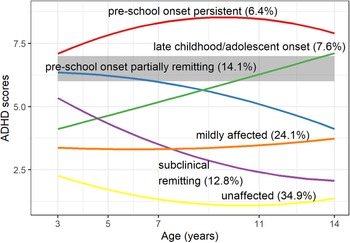
Online Supplementary Table S2 provides model fits for the longitudinal latent class models without any predictors. The LMR test suggested a six-class model as optimal. This model is summarised in online Supplementary Table S3 and plotted in Fig. 1. Figure 1 also shows the reference line for borderline (=6) and clinically significant (=7) ADHD symptoms based on a cut-point established in previous research (Riglin et al., Reference Riglin, Collishaw, Thapar, Dalsgaard, Langley, Smith and Thapar2016). The entropy value of 0.713 suggests that this model provides sufficient class separation for the three-step method of analysing predictors of class membership (Asparouhov & Muthén, Reference Asparouhov and Muthén2014). The full table of classification probabilities is provided in online Supplementary Table S4. A pre-school onset persistent class showed a trajectory characterised by consistently high scores from age 3 and had symptom scores in the clinically significant range for the entire developmental period studied. A pre-school onset partially remitting class showed scores that began in the borderline range but which declined into the non-clinical range by around age 7. A subclinical remitting class showed initially elevated but sub-clinical scores at age 3 that declined over development. A developmentally increasing class showed initially moderate (sub-clinical) symptom levels that increased over development to reach borderline levels by age 11 and clinically significant levels by age 14. A mildly affected class showed slightly elevated but sub-clinical symptom levels that remained fairly constant over development. Finally, an unaffected class showed consistently low levels of symptoms over development.
ADHD symptom trajectories for the six-class model. Note. Each solid line represents the trajectory for one of the six classes. The shaded area represents the borderline symptoms region based on predicting a clinical diagnosis of ADHD from the SDQ in previous studies.

Predictors of class membership
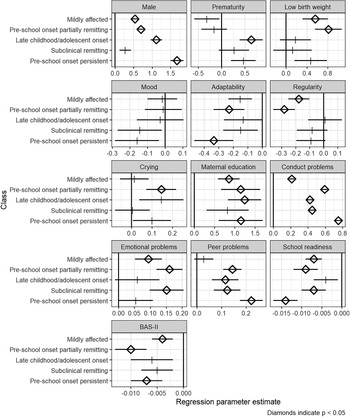
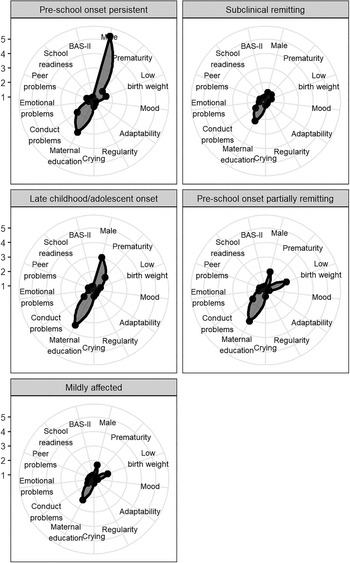
The results of the regression of class membership on gender, prematurity, low birth weight, maternal education, infant temperament, early cognitive ability, and early emotional, conduct and peer problems are provided in online Supplementary Tables S5–S10 and summarised in Figs 2 and 3. To compare each class against all others, classes 1–5 were used as the reference class in turn; however, key comparisons are highlighted.
Summary of comparison of predictors across classes. Note. Figures show b coefficients. Prematurity = born before 37 weeks; low birth weight = born <2500 g; mood, adaptability, regularity and crying are subscale scores from the Carey Infant Temperament Scale measured at 9 months; maternal education = educational qualifications of mother, with the effect of ‘None of these qualifications’ shown only for clarity; conduct problems, emotional problems and peer problems are subscale scores from the SDQ measured at age 3; school readiness = Bracken School Readiness Assessment composite scores measured at age 3; and BAS-II = British Ability Scales score measured at age 3.

Predictor profiles (odds ratios) of all classes compared to the unaffected class. Note. Figure shows odds ratios for each predictor using the unaffected class as the reference class. BAS-II = British Ability Scale score; ‘None of these qualifications’ only displayed for maternal education for visual clarity.

Individuals in the developmentally increasing class were more likely to be male, to have been born prematurely, to have a mother in the ‘GCSE Grades D-G’ or ‘None of these qualifications’ education categories, and to have higher levels of age 3 conduct and peer problems than those in the unaffected class. The developmentally increasing group were more likely to be female, had lower levels of conduct problems and higher school readiness scores than those in the pre-school onset persistent. Those in both the subclinical remitting and pre-school onset partially remitting classes were more likely to be female and had lower levels of conduct problems than those in the pre-school onset persistent class.
Discussion
We evaluated whether it was possible to summarise developmental trajectories of ADHD symptoms from age 3 to 14 in terms of a small number of potentially clinically meaningful developmental subtypes. Using latent class growth analysis, we found the optimal characterisation of ADHD symptom trajectories in a large UK-representative sample was a model with groups: unaffected, mildly affected, subclinical remitting, pre-school onset partially remitting, developmentally increasing and pre-school onset persistent.
The groupings were largely consistent with existing evidence, with the majority of the sample (86%) falling into a trajectory group that did not reach clinically significant levels at any point in development (the later-onset group accounting for 7.6% of the sample exceeded this threshold only at age 14). For the trajectories characterised by borderline or clinically significant levels of symptoms at some stage of development, most individuals were assigned to a group in which these were already evident at age 3, with approximately one-third of these falling into a group with persistent symptoms (Caye et al., Reference Caye, Spadini, Karam, Grevet, Rovaris, Bau and Kieling2016). The remaining group was characterised by symptoms that increased over the course of development, reaching borderline levels around age 11 and clinically significant levels around age 14.
We explored the differences between all trajectory groups emerging in this study with all others, on a set of perinatal, temperamental, cognitive and comorbidity variables. Consistent with previous research, trajectory groups characterised by an elevation of symptoms at some stage of development tended to score higher on ADHD risk factors and co-occurring issues and were more likely to be male, to have mothers with lower levels of education, and to show conduct problems, lower levels of school readiness and score lower on ability tests. The more severely affected trajectories characterised by higher and/or more persistent ADHD levels also tended to show more difficult infant temperaments (e.g. worse mood, poorer adaptability, lower regularity and more crying) and more peer and emotional problems than the unaffected group. They were also more likely to be born with low birth weight. One counter-intuitive finding was that the mildly affected group but not more severely affected trajectory groups was more likely to be born premature than the unaffected group. This will require further replication in independent data but may point to a specific prematurity phenotype involving mild ADHD-like difficulties that are etiologically dissociable from ADHD symptoms that are rooted in specific genetic and neurobiological risks for ADHD.
Other comparisons provided insights into the predictability of later-onset symptoms among those who show few symptoms early in life; possible differences between individuals with later v. earlier onsets of symptoms; and predictors of remission. Comparisons of the developmentally increasing and unaffected group suggested that key predictors of later developing ADHD symptoms were male gender, low maternal education, premature birth, and peer and conduct problems at age 3. These findings provide further confirmation that those with later onsets of symptoms may have many of the ‘hallmarks’ of ADHD despite not following a ‘classical’ trajectory.
When comparing the developmentally increasing category to the ‘classical’ ADHD symptom trajectory (pre-school onset persistent), we found that those in the developmentally increasing category were more likely to be female, to have lower levels of conduct problems and higher school readiness scores at age 3. These findings are consistent with previous research suggesting that later-onset ADHD symptoms are associated with a slightly milder – though still impaired – profile (e.g. Murray et al., Reference Murray, Booth, Auyeung, Eisner, Ribeaud and Obsuth2020a). The higher school readiness scores in the developmentally increasing group are consistent with the hypothesis that a delayed onset may reflect the presence of compensatory strengths that allow an individual to function well until life demands intensify (Agnew-Blais et al., Reference Agnew-Blais, Polanczyk, Danese, Wertz, Moffitt and Arseneault2020). Future research that assesses whether increases in symptoms track specific changes around this time (e.g. puberty onset, transition to high school, decreasing parental supervision) will be valuable for illuminating the proximal factors that lead to possible escalations in symptoms around late childhood/adolescence. The fact that the developmentally increasing subtype was associated with fewer early issues could, however, contribute to the under-identification of this group. It is important that teachers and frontline staff are aware that ADHD symptoms may appear later in the school-age years and possibly more subtly than in early childhood. The fact that females were more likely to show a ‘later-onset’ trajectory is also consistent with previous research (Murray et al., Reference Murray, Booth, Eisner, Auyeung, Murray and Ribeaud2019) and underlines the importance of ensuring that females with ADHD symptoms – who may already be more likely to go undetected – are not missed.
Finally, we evaluated the predictors of ADHD symptom persistence by comparing our pre-school onset persistent group to two groups characterised by initially elevated but declining symptoms. Only male gender and early conduct problems were associated with persistence. Conduct problems have previously been identified as a predictor of persistence (Caye et al., Reference Caye, Spadini, Karam, Grevet, Rovaris, Bau and Kieling2016; Riglin et al., Reference Riglin, Collishaw, Thapar, Dalsgaard, Langley, Smith and Thapar2016) as well as treatment resistance (Lee, Niew, Yang, Chen, & Lin, Reference Lee, Niew, Yang, Chen and Lin2012), suggesting that they may be a marker for more intractable ADHD symptoms.
Taken together, our results suggest that clinically-relevant early-life perinatal, temperamental, cognitive factors, as well as early comorbidities, differentiate individuals following different trajectories of ADHD symptoms. This provides preliminary evidence for the potential clinical utility of attending to an individual's developmental trajectory of ADHD symptoms when seeking to understand their condition, not only their current levels. Future research would be beneficial to establish whether these trajectories also differ in other etiological factors, longer-term outcomes and (where relevant) treatment responses. It will also be important to evaluate the generalisability of ADHD developmental trajectory groups across different cultures, settings and ethnicities.
Limitations
While the measure of ADHD used was well-validated, it does not distinguish inattention, hyperactivity and impulsivity and it does not provide diagnostic information. There is also no clear universal optimal cut-point on it to indicate clinically significant symptoms, partly reflecting the fact that the avoidance of false positives v. false negatives will differ in different populations and contexts. Similarly, only parent-reported data were available for all sweeps 2–6; however, symptoms may manifest differently across settings and in interaction with different informants (Murray, Booth, Ribeaud, & Eisner, Reference Murray, Booth, Ribeaud and Eisner2018). Further, data into adulthood are not yet available; therefore, how the trajectories develop in the long-term is not yet known. Information on ADHD interventions was also not available; therefore, the impact of treatment on trajectories was not possible to ascertain. Finally, our missing data methods assumed MAR. Missing not at random (NMAR, i.e. missing over and above the mechanisms of missingness modelled in the weights/imputations) could not be tested and to the extent that data were NMAR, parameter estimates could be biased. Based on previous research showing a slight tendency for young people with elevated ADHD symptoms to drop out of cohort studies (Eisner, Murray, Eisner, & Ribeaud, Reference Eisner, Murray, Eisner and Ribeaud2019), we would expect that the most likely form of bias would be an under-estimation of the class prevalence for the developmentally increasing class as well as the attenuation of covariate associations involving this class.
Conclusion
It may be possible to make clinically meaningful distinctions between a small number of ADHD trajectory groups, including pre-school onset persistent, pre-school onset remitting groups and a developmentally increasing group.
Supplementary material
The supplementary material for this article can be found at https://doi.org/10.1017/S0033291721000349.