Introduction
The late first-millennial ‘florescence of piracy, trade, migration, conquest and exploration’ (Barrett Reference Barrett2008, 671) known as the Viking Age has long fascinated researchers in its characterization, timing and origins (e.g. Ashby Reference Ashby2009; Barrett Reference Barrett2008; Barrett et al. Reference Barrett, Beukens, Simpson, Ashmore, Poaps and Huntley2000; Myhre Reference Myhre, Faulkes and Perkins1993; Sindbaek Reference Sindbaek, Graham-Campbell, Sindbaek and Williams2011). This paper is concerned with the last of these three issues. In particular, it is concerned with the genesis of Scandinavian raiding activity in the British Isles and continental Europe; the push and pull factors behind Viking Age migration and colonization are well treated elsewhere (e.g. McLeod Reference McLeod2014).
Any attempt at a comprehensive historiographical review of scholarship on the causes of the Viking Age would be misguided (given the scale of the task) and redundant (given that concise and critical reviews have recently been published by Barrett (Reference Barrett2008; Reference Barrett, Anderson, Anderson, Barrett and Boyle2010)). Nonetheless, it does serve us to spend a little time enumerating the most frequently invoked actors in making the Viking Age happen. Traditional approaches have tended to rest on assertions related to climate; environmental, social or political change; technological developments; demographic characteristics of populations; or ideological factors – indeed many such models are rather narrowly deterministic, even where they articulate multiple themes.
Barrett (Reference Barrett2008, 673) has shown that for reasons of chronology and logic, the development of maritime technology cannot be said to have caused the Viking Age, even if it was a prerequisite for extended sea voyages (see also Haywood Reference Haywood1999). Chronological insecurity and regional variability make the case for climatic amelioration as a driver for maritime activity equally difficult to assert (cf. Bradley, Hughes and Diaz Reference Bradley, Hughes and Diaz2003; Dahl-Jensen et al. Reference Dahl-Jensen, Mosegaard, Gundetrup, Clow, Johnsen, Hansen and Balling1998), while the evidence for population pressure – perhaps the most commonly cited candidate – is little more convincing, such is the level of spatial variation (e.g. Karlsson and Robertsson Reference Karlsson, Robertsson, Miller and Clarke1997; though note Skre's (Reference Skre2001) variant of this model, wherein the creation of freemen in order to cultivate new land constitutes an important driver for the collective desire to fare overseas). Moreover, Barrett (Reference Barrett2008, 675–76) has eloquently put the case for a ‘leapfrogging’ migratory network, rather than the traditionally assumed ‘wave of advance’ model, which has often been taken as circumstantial evidence for the action of population pressure as a driver.
Barrett also critiques arguments characterized by ideological determinism – that religious fatalism was somehow unique to early medieval Scandinavia – and political determinism, as the dynastic weakness and internecine warfare that are often proposed as temptations for ambitious potential pirates were characteristics of central and southern Britain no earlier than the mid-9th century (ibid., 678). Bjorn Myhre (Reference Myhre, Faulkes and Perkins1993) has argued that increasing political centralization in Scandinavia, together with emulation of and reaction against Carolingian power, may have acted as a catalyst for exploratory and predatory activity, though such a claim is difficult to substantiate in detail, not least because the earliest raiding parties seem to have reached the British Isles from western, rather than southern, Scandinavia.
Finally, Barrett questions arguments characterized by economic determinism, namely those that argue for Scandinavian raids on western European treasuries as the result of a kind of ‘fever’ driven by fluctuations in the availability of Arabic silver (see Duczko Reference Duczko2004, 62). Long-range trade was a fundamentally urban phenomenon at this point, while both the backgrounds and the destinations of the early Viking raiding parties appear to have been rural. For Barrett, then, the start of the Viking Age was a rural phenomenon, and urban trade cannot have been the key driver for raiding activity. Sindbaek (Reference Sindbaek, Graham-Campbell, Sindbaek and Williams2011) has questioned this assertion, arguing that urbanism is better defined in terms of networks of activities than by reference to settlement form and hinterland. He suggests that the widespread availability of products manufactured in urban workshops demands that we see the Viking world as one that was truly urbanized and that its origins, accordingly, lie in that network system. Recent work tracking the movement of Arctic resources lends some weight to this argument; it certainly appears that a long-distance supply network was in existence prior to the start of the Viking Age (Ashby, Coutu and Sindbaek, in press). Whether we see the Viking Age emerging from an urban or a rural context, the economic arguments for the onset of raiding activity are difficult to deny. Thus the basic argument that Viking raiding finds its origin in the lust for silver requires some elaboration.
Raiding as silver fever
Raiding was widespread in the Viking Age, and diverse in scale and organization (being by no means exclusively undertaken by Scandinavians). It is not possible to review the evidence in detail herein, and readers are referred to Williams (Reference Williams, Brink and Price2008) for an overview. Nonetheless, it is worth stating that the phenomenon with which we are concerned here – late 8th-century Scandinavian raiding in the British Isles – was characterized by isolated attacks focused on coastal targets: famously monastic sites with significant treasuries and meagre defences. Raiding parties were small, but well organized and highly mobile, and traditionally their chief quarries have been characterized as portable wealth (metalwork, glass, religious texts for ransoming) and slaves, though inevitably food and other supplies would have been targeted. Demands for tribute may also have been made; they certainly were in the 9th and 10th centuries (ibid., 194). Nonetheless, in the general absence of direct archaeological evidence for the destruction of monasteries (though see Carver Reference Carver2008, 209), the key material signature of this activity is in looted metalwork, and this is central to the present paper.
Indeed, the question ‘what caused the Viking Age?’ is closely linked to the question ‘what prompted groups to venture overseas to extract silver from foreign treasuries?’ It has long been known that Viking activity emerged in the context of the flourishing economic system of the North Sea's emporia system (Hodges Reference Hodges1982), though it is worth noting that these market sites do not appear to have been the victims of frequent raiding until the second third of the 9th century (Hill Reference Hill1981, 33). Nonetheless, it is likely that awareness of European trade and the diverse, wealthy kingdoms it connected exerted some pull on Scandinavian aristocracies. More precisely, there must have been an appreciation of the increasing quantities of silver entering the Baltic and North Sea regions from the south-east. The markets of the Caliphate were producing ever-growing demand for northern products such as slaves and fur, with increasing quantities of silver going in the other direction. Though the amount of silver present in Europe in the late 8th century appears to have been modest, that was emphatically not the case by the 9th century (Duczko Reference Duczko2004). Undoubtedly this encouraged mercantile and military operations in the east, but its relevance to the introduction of Scandinavian raiding to western Europe and the British Isles is less clear. Nonetheless, some have suggested that the influx of Arabic silver into northern Europe was indeed a catalyst for raiding in the west, while others have argued that this activity began in response to periodic scarcity of silver within this broader period of plenty (see Barrett Reference Barrett2008, 677, and references therein).
The drive to acquire silver (whether catalysed by abundance or scarcity) was, of course, an important element, and it has become a truism to explain the Viking Age as emergent from the nexus of pressure built up as a result of developing social hierarchy in Scandinavia and awareness of burgeoning mercantile activity to the south, set within the context of rapidly developing maritime technology. Such a view, however, rather omits the ‘social’. Barrett has attempted to correct this omission, by arguing from the existence of looted goods in Norwegian female graves, and the ethnohistorically informed possibility that raiding constituted a formative part of the Scandinavian male ‘life cycle’, that Viking Age expansion may well have been, at least in its initial phases, driven by the search for some form of bridewealth. This idea, first proposed by Burström (Reference Burström1993) to explain the concentration of evidence for hoarding on Viking Age Gotland, is an attractive proposition. More recently, Sheehan (Reference Sheehan, Reynolds and Webster2013) has proposed that Ireland's Viking Age proliferation of hoards relates to the need for silver in various forms of gift exchange. Barrett, however, highlights the issue of bridewealth for particular attention. He proposes that the start of the Viking Age saw a demographic change in which young men started to make up a disproportionately large component of Scandinavian populations, leading to increased competition in the field of marriage, ultimately crystallizing in the need to fare west over sea. More contentious, however, is the proposition that such a gender imbalance emerged from the practice of female infanticide, which itself had its roots in the context of incipient state formation and its demographic corollary: an increasing preference for male children. Female infanticide is indirectly evidenced in documentary sources, which include a reference to gender-selective exposure in the 13th-century Gunnlaug's Saga, and Al Turtūshi's oblique reference to the sacrifice of female children at 10th-century Hedeby (see Lunde and Stone Reference Lunde and Stone2012, 163). Archaeological evidence has also been proposed, though this is rather circumstantial: the paucity of identifiable female graves in Late Iron Age Scandinavia (Dommasnes Reference Dommasnes1982), and the occasional recovery of the scattered remains of immature individuals in excavated contexts relating to the Viking and medieval periods (e.g. Ritchie Reference Ritchie1977, 220–21; Roslund Reference Roslund1990; see Wicker Reference Wicker and Halsall1998 for a review).
In all, Barrett's suggestion – that the roots of the Viking Age are to be found in the desire for young men to seek out bridewealth – has much to recommend it. However, in the absence of evidence for the practice of female infanticide (proposed, in fairness, as a heuristic case), one might invoke alternative mechanisms that made it essential to travel overseas to seek this wealth. In particular, one must consider the possibility that the rationale was the desire not for wealth that was falling into short supply in Scandinavia, but rather for a form of wealth or prestige that had not been – and could never be – available without leaving those shores.
Moreover, while the models outlined above may explain why the Viking Age happened, they do not account for the actions of the individuals who organized the expeditions, for the actions of those who went along (assuming they did so of their own free will, given the unlikeliness of their return), or for the wider societal enthusiasm for such activity; in short, they do not leave sufficient space for human agency (cf. Barrett and Anderson Reference Barrett, Anderson, Anderson, Barrett and Boyle2010, 307–8). I would therefore like to suggest that the above models – whichever one we choose to accept – should be qualified with a more explicitly social element.
Or status fever?
What would make an individual fare overseas in pursuit of portable wealth? The demand for resources that could be used in various forms of exchange must have been an important component, but it does little to explain the particular types of artefact that were brought back to Scandinavia from raids on the Continent and the British Isles. It is worth noting that these objects are not just silver; at least on the basis of the material still available to us, artefacts were not routinely melted down and recast, and though they were often cut up or adapted in various ways, in many cases original elements are preserved.
An explanation is available when one considers anthropology. In her Ulysses’ Sail (Reference Helms1988; see also Helms Reference Helms, Schortman and Urban1992; Reference Helms1993), Mary Helms deconstructs the role and context of long-distance travellers in traditional society, with particular regard to their relationship with the political elite. Helms points out that elites have long controlled a body of esoteric knowledge as a basis of their power, and argues that this knowledge might be gathered not only from the ‘supernatural’ world – to which access could be gained through meditation or altered states of consciousness (this obviously has particular resonance in the context of Viking Age shamanism (see Price Reference Price2002) – but also from geographically distant parts of the ‘natural’ world, to which access could be gained by means of long-distance travel. This power comes from the fact that distant realms, and the people and animals who inhabit them, are seen as different from the axis mundi: morally different (for better or ill), different in terms of level of order and ‘civilization’, or simply as a sort of dangerous, uncontrolled Other (Helms Reference Helms1988, 262; cf. Said Reference Said1978). Such places may also be associated with times past, to the extent that travellers may assume the guise of ancestral figures.
It is important to appreciate the importance of social contingency if we are to attempt to grasp the rationale for travel in any given context (such as the birth of the Viking Age). Individuals who visit exceptional places often garner some sense of the extraordinary for themselves, but their travels may be motivated by political, ideological or intellectual concerns. In particular, ethnography records a quest for knowledge, fame and prestige, as well as the desire to escape the constraints (or, in some cases, punishments) of the home society, and the acquisition of valuable goods (both tangible and intangible). These things, information and experiences hold great power by virtue of their being acquired from distant places, and may enhance the political prestige of those who acquire them. Thus we see travelling wise men – shamans and priests who gather prestige when arriving at a settlement having travelled from a distance – but we also see the need for political elites to travel abroad themselves in search of new information, knowledge or goods. Indeed, it is notable that elites generally tend to have privileged access to these travellers (Helms Reference Helms1988, 264), and also become directly involved in such movement themselves. Thus elites may, perhaps counterintuitively, strategize by maintaining that their power comes from an external, rather than local, source; they may consort with travellers in order to partake of their knowledge and bathe in their fame, they may ‘walk in the wilderness’ in pursuit of knowledge, and they may themselves make overseas trips, whether military campaigns, exploratory expeditions or pilgrimages.
Moreover, members of the political elite have often particularly prized goods acquired from a distance, as well as faiths, behaviours, fashions and modes of dress. Power, following Helms (ibid., 265), has a particular ‘political–ideological dimension’, and for Lotte Hedeager (Reference Hedeager2011, 145–47), it is not held by an individual, but is rather a quality that may be embodied in objects, and accumulated by people. The movement of goods has long been an important element of long-distance contacts, and is, of course, central from an archaeological perspective. But we cannot hope to understand these movements, contacts and relationships by focusing on the objects alone (Helms Reference Helms1988, 266); to attempt to explain the Viking Age by reference to flows of silver is rather to miss the point.
In short, elites have long held the ability to garner power and prestige by reference to places of the ‘Other’. Travel beyond the pale ‘speaks of unusual things beyond the here and now and generally beyond the means of ordinary folk’ (ibid., 267). Similarly, as noted by Marianne Vedeler in her recent biographical study of Viking Age silks (Vedeler Reference Vedeler2014, 113), elites could be expected to particularly covet the acquisition of objects produced by skilled craftspeople at some distance from the home community. Such objects were seen to embody a particular ‘sacral’ power, inherent not only in the skill of their production or the beauty of their ornament (after Gell Reference Gell, Coote and Shelton1992), but also in their evidence of external contact. Moreover, these two elements of ‘enchantment’ should not be considered separate; skill of production and exotic origins could together be clearly manifest in a given element of design. Unusual form, materials or ornament thus spoke of exotic places, people, objects and behaviours, invoking a sort of spiritual foreignness or even supernatural quality in addition to mere geographical displacement. The unknown holds great power, by virtue of its very mystery. This power could be transmitted to the owners of these goods, investing them with a certain political and ideological legitimacy.
The raider's sail
Helms's work is well known, and indeed has been an influential model in prehistory (e.g. Bradley Reference Bradley1990; Edmonds Reference Edmonds1999; Giles Reference Giles2013), including the study of first-millennial Scandinavia (Hedeager Reference Hedeager2011, 145–47), but while occasionally being cited in studies of the Viking Age (e.g. Barrett Reference Barrett2013, 9; Vedeler Reference Vedeler2014, 113), it appears to have had little impact on our understanding of one of the period's key characteristics: aristocratic mobility. Such mobility is well exemplified in the travelogue attributed to Ohthere, a 9th-century Norwegian visitor to the court of Alfred of Wessex (see Bately and Englert Reference Bately and Englert2007). Ohthere's account is incorporated into Alfred's Old English Orosius, and preserves details of his voyages in northern Scandinavia and the Baltic. Søren Sindbaek (Reference Sindbaek, Graham-Campbell, Sindbaek and Williams2011, 45) has proposed that Ohthere's journey to Wessex in itself requires explanation: why would a successful chieftain from northern Norway risk time and livelihood to make a long-distance sea voyage to Anglo-Saxon Wessex? And such journeys were not uncommon amongst the elite; Orkneyinga Saga tells us about the prestige that could be gained from pilgrimage to Jerusalem (Anderson Reference Anderson1999, 128), while the recent excavations at Salme, Estonia, seem to suggest that – consistent with suggestions made by Guy Halsall (Reference Halsall2003) for early medieval warfare more generally – some ‘Viking’ parties, at least, were made up very largely of members of a warrior elite (Konsa et al. Reference Konsa, Allmae, Maldre and Vassiljev2008). The explanatory potential of an application of Helms's ideas is significant.
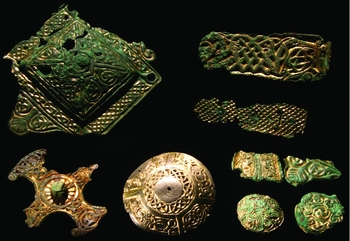
It serves us well to consider an example, and for this we turn to the furnished graves of early Viking Age Norway. Significant quantities of ornate insular objects have been found in Norway's early Viking Age graves (see Wamers Reference Wamers1985; Reference Wamers, Clarke, Mhaonaigh and Floinn1998; Reference Wamers and Skre2011; Heen-Pettersen Reference Heen-Pettersen2014). Well-known examples include jewellery and dress fittings (such as pennannular brooches and ringed pins), equestrian equipment (particularly harness mounts, often reworked), vessels (such as hanging bowls and buckets), scales and associated weights, and jet objects (Wamers Reference Wamers, Clarke, Mhaonaigh and Floinn1998, 37) (figure 1). Nonetheless, the material is dominated by fragmentary and reworked decorative metalwork, and a number of these artefacts appear to have ecclesiastical connections. Most of the associated burials can be dated to the 9th century (ibid., 51), and their distribution is focused in coastal Rogaland, Sogn, More, Trøndelag, Troms and Vestfold. This is all consistent with the arrival of these items in Norway as the products of raiding activity in the west (Bakka Reference Bakka1963; Wamers Reference Wamers1985, 39; Graham-Campbell Reference Graham-Campbell2011, 33), notwithstanding contrary suggestions that they represent Christian missionary activity in Scandinavia, or the products of second-hand trade in insular goods (Blindheim Reference Blindheim, Almqvist and Greene1976, 173–75). The latter does remain a possibility, not least given the small fragments of insular material known from sites such as Kaupang, and which no doubt constitute the waste produced when larger objects were reworked (Wamers Reference Wamers and Skre2011, 80–88). Indeed, it is increasingly clear that the insular style became popular across large areas of Scandinavia; such widespread popularity does not preclude the material's holding a particular resonance or even ‘magic’ relating to its exotic provenance (ibid., 96–97).
Insular objects found at Kaupang, Norway. Image Eirik Irgens Johnsen, © 2014 Kulturhistorisk Museum, University of Oslo, CC BY-NC-ND 3.0.

This curation of insular Christian art by Norse pagans is frequently explained in terms of aesthetic appreciation, or broad allusion to the complexity of Viking Age social dynamics (e.g. Williams and Ager Reference Williams and Ager2010, 17; Kleingärtner Reference Kleingärtner, Williams, Pentz and Wemhoff2014), and popularly has even been used as a way of ‘softening’ the image of the Vikings. There must have been a more specific, and probably more practical, motivation for the preservation of design elements within looted metalwork. Williams (Reference Williams, Brink and Price2008, 194) has suggested that material may have been held for ransom, and this may well have been the case for certain high-value items, but such an explanation surely cannot apply to the many small and widely dispersed objects of insular origin known from Norwegian graves. One is rather drawn to the idea that the very distinctiveness of such ornament allowed it to be identified as something alien, something Other, even something that related to this kind of raiding activity. In the first instance these objects stood as markers of sorties into the unknown, and with time they came to carry the stories of particular places, particular expeditions, particular people.
Indeed, as mementos of raiding activity, these objects speak of many things. They tell of great craftsmanship in an alien context. They tell of their – in most cases violent – acquisition, and of the effort exerted and status accrued in this quest. Many of the objects have been reworked into ‘bespoke’ pieces of jewellery, and if, as seems likely, they were gifted to wives and other women on return to Norway, before eventually going to the grave with their wearers, then these items were clearly intended for public display on the person (see Laino and Ashby, in prep.) One can imagine that to wear one of these evocative pieces was an act loaded with meaning and significance for both wearer and gift-giver, and one is reminded of Ibn Fadlān's note that women wore silver or gold neckrings according to the wealth of their husbands (Lunde and Stone Reference Lunde and Stone2012, 46). It is conceivable, even likely, that the wearing of such items bestowed a certain honour not only on the women themselves, but also on their husbands. Such use of women as ‘trophy wives’ drew on the power of such aesthetically alien pieces to enchant through reference to a foreign world, and to tell narratives of successful campaigns.
In order to perceive how this process may have operated, it is instructive to consider the roles played by visibly foreign objects in contexts at some remove from the Viking Age. Following Clarke's (Reference Clarke1978) belief that the power of artefacts was to be found not in their isolation, but in their cooperation, and drawing upon Appadurai's (Reference Appadurai1986) concept of object biography – which stresses that the quality of an item's value is not fixed but mutable – Gosden (Reference Gosden2005, 194) has argued that objects, and groups of objects, ‘set up universes of their own in which people need to fit’. In considering the role of material culture in the social construction of Roman Britain, he demonstrates the transformative power inherent in objects by virtue of their sources and ‘genealogies’, and argues that, whatever the intentions of people, the worlds formed by artefacts are governed by logics independent of these (see Gell Reference Gell1998). This realization demands that we cease attempting to assign labels to objects (Roman/British, or Anglo-Saxon/Viking), and instead consider the ways in which objects with different histories and geographies play off one another in social terms (Gosden Reference Gosden2005, 203). That is to say that while we may be able to trace an artefact to a particular region or site by virtue of its materials or style, we should take care to remember that this precise provenance may not have been significant or even relevant to those who appropriated that object in antiquity. Far more important was its relationship with local narrative, traditions or people (ibid., 198). Moreover, we need to think more about the cumulative effects of artefacts than about their individual meanings (ibid., 208). Gosden's approach, with its stress on provenance and history in generating an object's agency, has obvious relevance to the present case. It helps to explain how an object looted in the late 8th century might still have social impact decades or centuries later, as these objects develop something of their own momentum.
Similarly, studies of Western colonial activity in the Pacific have demonstrated the potential for ‘alien’ objects to retain their power over generations, through a process of mutation (Thomas Reference Thomas1991). More precisely, Thomas stresses the instability and transformativity of objects: their histories may be manipulated, their new host society effectively ‘re-authoring’ them, and empowering them to tell stories and accrete significance according to context (ibid., 5). Upon entering a new cultural context, an item may be understood as a subtype of an existing, better-understood category of things, or simply by reference to the properties of another familiar object (ibid., 104). Moreover, objects may have dual meanings in the ‘systemic’ and ‘personal’ worlds (ibid., 143) and may retain significance even when used in an inconsequential manner (ibid., 187). Perhaps most importantly, and following Gosden, Thomas notes that explorers associated indigenous objects that they collected with general narratives about the exchange of gifts, rather than granting significance to particular stories about particular objects (ibid., 151). The key lesson to be learnt here is that objects are promiscuous; while the function and significance initially designed into an object are, of course, relevant to us, once they are displaced from that initial context we should not fall into the trap of continuing to see such objects in the same terms; we need to consider ‘what they can be made to become’ (ibid., 4; see also Miller Reference Miller1987; Reference Miller and Buchli2002).
Returning to the Viking Age, the Vale of York hoard offers a good example of how the biographies of distinctive raided objects may have had particular agency long after their acquisition (Williams and Ager Reference Williams and Ager2010). This hoard, deposited in the late 920s, consists of a variety of objects of precious metal, including a gold arm ring, silver ingots, and hacksilver, as well as 617 coins of Anglo-Scandinavian, Anglo-Saxon, Frankish and Arabic origin, demonstrating a breadth of contacts, and highlighting the political and economic complexity of this period. The presence of a single example of Athelstan's REX TOTIUS BRITANNIAE penny allows the hoard to be given a precise terminus post q. of A.D. 927–29, and it has been proposed that it was deposited by a Scandinavian warlord or political leader in the wake of Athelstan's conquest of Northumbria.
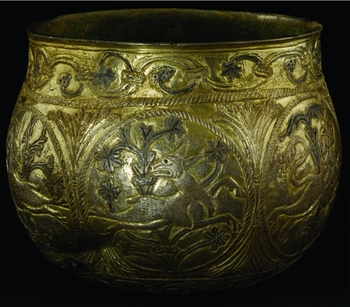
Of particular interest herein is the gilt-silver vessel within which the rest of the hoard's contents were deposited (ibid., 14–17) (figure 2). This ornate vessel is somewhat bulb-shaped, with an opening some 12 centimetres in diameter. It is gilded on internal as well as external surfaces, and its ornate engraved decoration is picked out with niello inlay. The decoration itself consists of vinescroll ornament, enclosing a series of six roundels, each containing the figure of a moving animal in a wooded landscape. These, no doubt, are allegorical hunting scenes, and denote a Christian context of production and intended use. Indeed, the piece is clearly of mid-9th-century Carolingian origin, sharing significant similarities with a number of vessels, including the Halton Moor cup (Graham-Campbell Reference Graham-Campbell2011, 238–41). It has been suggested that it initially had a role as a ciborium (a vessel used to hold the bread of the sacrament during mass), though the communication of status would have been an important component of its function, whether ecclesiastical or otherwise.
The Carolingian cup from the Vale of York hoard. Image © York Museums Trust (Yorkshire Museum).

The cup is in relatively good condition, the only significant damage relating to a post-depositional ploughstrike. It is notable, then, that this object was retained for over half a century, whereupon it was deposited as part of a hoard. We do not know if it held a function in curating portable wealth throughout its life in Norse hands, or whether it was simply put to this purpose on its subterranean secretion, and the aim of this article is not artefact biography. Nonetheless, we can say that, for one reason or another, this piece was retained intact, rather than being either melted down or modified. This cannot be explained by mere reference to an appreciation of fine art, but must be seen in terms of the object's agency: what power did it convey on its owner, or hold over others who came into contact with it? I would argue that, like the ‘loot’ deposited in Norwegian graves discussed above, the Vale of York cup served to signal long-distance travel, and to celebrate military success in areas not well understood. These stories would originally have related to the object's owner, but later, as it was passed from hand to hand, the narrative would recount the exploits of ancestors real or imagined, binding communities together through shared memories and heritage. Such items were thus evidence of having travelled, and evidence of having undertaken celebrated group activity. They could be doled out to followers, but as more than silver: as objects with stories, objects that ‘carried people’ (Edmonds Reference Edmonds1999). It is telling, indeed, that the Halton Moor cup appears to have had an even longer life: manufactured, like the Vale of York cup, in the mid-9th century, it was eventually deposited as a hoard-containing vessel in the 1020s, suggesting that it may have circulated in Norse hands for up to 150 years. No doubt this object's narrative in the 11th century was very different to its mid-9th-century experience, but the end result is the same. This cup was used (presumably amongst others) as part of an ideological toolkit to empower an elite, to bind in followers, and to materialize hierarchy.
And these are far from isolated examples. One might equally point to the status associations that attached themselves to Byzantine silks in early Viking Age Norway (see Vedeler Reference Vedeler2014), or the initial appearance of beads made from Mediterranean tesserae, their Middle Eastern successors, or cowrie shells in northern Europe (e.g. Callmer Reference Callmer, Rasmussen, Lund Hansen and Nasman1995; Trotzig Reference Trotzig, Hårdh, Larsson, Olausson and Petré1988). Obviously, in most cases these objects reached northern contexts by different mechanisms – trading rather than raiding – such that their allusion to the exotic was differently framed, but nonetheless present and active. But we know that other goods must have been looted, most notably glass vessels and slaves. While the latter are not well evidenced in the archaeological record, one might imagine the former could have attained a similar role, particularly given the fact that vessel glass does not appear to have been manufactured in Scandinavia at the time (Ljungkvist Reference Ljungkvist, Brink and Price2008, 190). The case studies outlined in detail above serve to demonstrate an important point about early Viking Age raiding activity and its motivation: that the acquisition of souvenirs and mementoes, rather than simply ‘portable wealth’, was an important outcome. Moreover, they demonstrate that significance and power was retained in these objects, and persisted – albeit probably not unchanged in content – over several generations. These objects were more than just the spoils of military activity, more than booty: they carried people, places and stories with them. For this reason, they held significant power as the possessions of members of the elite, while also offering particular potential as a means of instilling loyalty, reinforcing ideas of kinship and binding individuals and groups to their leaders.
So much for the motivations of the leadership. What was in it for other members of the aristocracy, or, insofar as they existed, members of the lower elite? Moreover, while warfare was a fundamentally aristocratic pursuit, it was dependent on the labours of non-elite freemen and slaves: for provisioning, for craft, for technology, for support. Individuals involved in these activities were not equal partners in the venture, but we might suggest that they had some incentive to become involved. Was it, again, purely economic: the promise of rich pickings, a sort of ‘trickle-down’ effect?
This must have been one element, but there is reason to believe that the rewards were more complex than this. We know from ethnographic survey that raiding frequently fulfils roles that are not strictly economic, but rather sociocultural (Nugent Reference Nugent1993; Sweet Reference Sweet1965; Kurtz Reference Kurtz1969). Indeed, in tribal societies, individuals implicated in low-intensity forms of warfare (such as raiding) tend to attain elevated social status, while the heightened experience of the military context provides the opportunity not only for the doing of great deeds, but also for the display and recognition of skill sets and personal qualities that might otherwise go unnoticed. Individuals might be lauded for their strength or speed, courage or cunning, for skills in combat or caring for the sick, for sailing or ship repair. It is easy to imagine that this was the means by which warriors received their ‘eke-names’, and this alone may have been justification enough for a young, ambitious man to want to join a raiding party. This situation has been recorded in diverse non-western societies (see examples cited above), wherein raiding provides something of an initiation experience for some individuals, and an opportunity for others to gain prestige by proximity to, and association with, members of the warrior aristocracy. Followers also had the opportunity to create and maintain relationships with other members of the retinue, through communication of shared values and bonding through experience. The formation of such group identities and dynamics may well have been a key motivating factor for many freemen involved in overseas expeditions (see Collins Reference Collins2012, 70; cf. Barrett and Anderson Reference Barrett, Anderson, Anderson, Barrett and Boyle2010, 307–8).
Ethnography also tells us that elite leaders may maintain and further enhance their status through the successful planning and leading of such enterprises, while simultaneously cementing relations with members of their retinue, not only through the giving of booty as gifts, but through the intimacy of fighting shoulder-to-shoulder on campaign. Such a situation has been proposed for late and post-Roman Europe (Collins Reference Collins2012, 70), and obviously accords well with what we know of early medieval warfare from documentary and literary sources (see Halsall Reference Halsall2003). For both leaders and followers, then, raiding was never a baldly economic pursuit, but rather a socially meaningful activity that fostered the maintenance, reinforcement and renegotiation of relationships within and between tribal groups (Collins Reference Collins2012, 70).
Discussion
An explanation that fails to address why a particular event or phenomenon happened at a particular time and place is no explanation at all (see Carver Reference Carver, Hamerow and MacGregor2001; see also Sindbaek Reference Sindbaek, Graham-Campbell, Sindbaek and Williams2011). With this in mind, we might ask whether this essay on the motivations for raiding activity actually adds anything to the discussion of the causes of the Viking Age at large. I believe that the proposition that raiding was motivated by a desire not just for wealth that could be carried, but also for wealth that carried information, offers more than a qualifying statement. In conjunction with Barrett's (Reference Barrett2008) and Sindbaek's (Reference Sindbaek, Graham-Campbell, Sindbaek and Williams2011) ideas about the search for bridewealth, it allows us to posit a social component to an otherwise largely economic and demographic argument (accepting that these are themselves social phenomena at some remove).
A useful starting point is Sindbaek's proposal that, rather than demographic pressures, it was political changes of the late 8th century that led many young members of the lower elite to seek their fortune overseas. For Sindbaek, political centralization made it difficult for individuals to raise bridewealth at home, and, becoming increasingly aware of the silver available in the incipient European urban network, necessarily sought their fortune overseas. But perhaps the fortune sought consisted not of silver, but also of fame, reputation and narrative.
It is possible, then, that increasing political centralization led to a rush not just for silver, but also for a sort of social capital, a magic that allowed an individual to lead. It led to a desire for objects that possessed qualities that allowed them to be doled out to followers, creating a sense of identity, unity and loyalty. Objects could thus materialize relations, by making reference to past shared experiences, creating a heritage of obligation. Simultaneously, bonded individuals, as well as magnates and other freemen holding a certain degree of independence, also stood to gain from military activity, and from its material references. Such individuals could gain status through proximity to the aristocracy and other respected members of local communities, and could build new relations from the camaraderie of campaigning. The objects acquired through these expeditions carried all these stories, acting as resonators (cf. Lemonnier Reference Lemonnier2012) that could remind individuals of their own personal achievements, as well as of the standing in which they were held. They also spoke eloquently of the importance of group unity, and could act as a call to arms for future military or exploratory activity.
The result of the first phases of raiding was something of a snowball effect. It became clear, not just from the actions, lifestyles and stories of the parties involved, but also from the objects that materialized these narratives, that both elite and non-elite stood to gain from campaigning overseas. Indeed, the successes of the first expeditions (limited as they were in terms of scale and time spent in the field) would have been recounted, celebrated, and – no doubt – exaggerated, with the effect of encouraging interest in future expeditions, which would take place more frequently, and on a somewhat grander scale, ultimately leading to settlement (compare entries for A.D. 789, 793, 835, 836 and 851 in the Anglo-Saxon Chronicle; e.g. Ingram Reference Ingram1912).
However, the treatment of the items recovered from insular contexts cautions us against interpreting the escalation of military activity as a purely economically motivated phenomenon, driven by ‘silver fever’ (cf. Duczko Reference Duczko2004, 62, for this phenomenon in the east). Rather, it is important to note the social component in such predatory behaviour: participants stood to gain status through personal involvement. From the very notion of having travelled – materialized in the distinctively foreign goods acquired on campaign and bestowed upon family and followers – raiders were able to influence their lives and places in the local community. We should not be surprised that such social success was coveted by others, or that such a situation would lead to an escalation of military activity. There is thus no need to invoke demographic phenomena such as gender imbalance in order to explain the events recorded in the Anglo-Saxon Chronicle, the Royal Frankish Annals or the Annals of Ireland.
On the face of it, these proposals are uncontroversial. Popular accounts of the Viking Age do, after all, suggest that raiding activity was motivated by the search for treasure and fame, fortune and glory. Conversely, however, archaeological explanations have frequently sought to explain the phenomenon in rather reductive economic (or at best socio-economic) terms, and any reference to the significance of travel in and of itself has tended to be oblique or implicit, rather than explicitly theorized (notwithstanding some awareness of Helms's work). While it is not my intention to underplay the economic lure of raiding, trading and settlement, it is necessary to throw a light on their sociological content. Though this article has focused on the first category of activity, the second and third categories might also be explained in similar ways. Indeed, travel seems to have had a prestige value, whatever its form; Ohthere certainly seems to have taken pride in recounting his travels in the north, while Alfred's scribe records him very much as an embodiment of the Other, living the furthest north of any Norseman. It is easy to imagine the prestige available to both Alfred and Ohthere upon the latter's visit to the former's court. Nonetheless, this is an experience different to those of the Viking Age's first coastal raiders. In a world in which the obligations of the lower elite and sub-elite freemen were variable and often flexible (see, for instance, Barrett Reference Barrett, Ballin Smith, Taylor and Williams2007), it was possible for an individual to draw upon campaigning experiences in order to negotiate and navigate their way up the social hierarchy. Such individuals stood to gain particular status through the magic of having travelled.
Postscript
In closing, it is instructive to reflect on our own practice as archaeologists and historians of the Viking Age. From a certain perspective, our explorations in temporal distance parallel the spatial mobility of our Viking Age subjects. It is tempting to conclude that, no longer seeking structural commonalities across time and space (Lévi-Strauss Reference Lévi-Strauss1963), we are rather playing a game of power drawn from the enchantment of the exotic that is not entirely dissimilar in motive to that played by Ohthere or any of the leaders of late 8th-century Scandinavia's raiding parties.
Acknowledgements
This paper emerges from reflection on a number of conversations I have had with colleagues, notably Søren Sindbaek, Rob Collins, Shannon Lewis-Simpson and Howard Williams, though perhaps not all would endorse the ideas expressed herein. Thanks are also due to Mark Edmonds for commenting on an early draft of this paper, and to the two anonymous referees, whose comments made this version immeasurably stronger. All errors remain the author's own.