INTRODUCTION
Trypanosoma (Megatrypanum) theileri is a cosmopolitan parasite of cattle with a high prevalence on every continent except Antarctica. Tabanidae (Diptera) are thought to be the most important vectors of T. theileri; the parasites develop in their digestive tract and are then transmitted by a contaminative route (Hoare, Reference Hoare and Hoare1972; Bose and Heister, Reference Bose and Heister1993). This species is not considered pathogenic, despite the fact that it induces chronic infections and is a potential factor in illness when associated with concurrent diseases (Schafler, Reference Schafler1979; Doherty et al. Reference Doherty, Windle, Voorheis, Larkin, Casey, Clery and Murray1993; Seifi, Reference Seifi1995). There are still many unclear aspects of host and parasite interactions, including immune response and evasion strategies, and the multiplication of T. theileri in mammalian hosts.
Morphology is the traditional taxonomic criterion for the classification of T. theileri and allied species, which comprise trypanosomes that share large blood trypomastigotes, restricted mammalian hosts, worldwide distribution, lack of pathogenicity and contaminative transmission by tabanid or hippoboscid flies (Hoare, Reference Hoare and Hoare1972; Wells, Reference Wells, Lumsden and Evans1976). We demonstrated through phylogenetic analysis that T. theileri of cattle (Bos taurus) from distinct regions of America (Brazil and USA), Europe (Scotland and Germany) and Asia (Japan) were highly related phylogenetically and tightly clustered into the T. theileri clade, a homogeneous and strongly supported monophyletic assemblage exclusive to artiodactyls whose position is well resolved in the genus Trypanosoma (Rodrigues et al. Reference Rodrigues, Paiva, Campaner, Stevens, Noyes and Teixeira2006). T. theileri from cattle grouped together with T. theileri-like trypanosomes from water buffalo (Brazil), deer (Europe and Asia) and antelopes (Africa), forming the T. theileri clade in phylogenies inferred using SSU rRNA and gGAPDH genes. In all analyses, this clade was positioned well apart from species infecting orders other than Artiodactyla, which were morphologically classified as T. (Megatrypanum) (Stevens et al. Reference Stevens, Teixeira, Bingle and Gibson1999; Rodrigues et al. Reference Rodrigues, Paiva, Campaner, Stevens, Noyes and Teixeira2006; Hatama et al. Reference Hatama, Shibahara, Suzuki, Kadota, Uchida and Kanno2007; Hamilton et al. Reference Hamilton, Gibson and Stevens2007, Reference Hamilton, Adams, Njiokou, Gibson, Cuny and Herder2009). Discovery of a strongly supported monophyletic assemblage formed by very closely phylogenetically related and morphologically similar trypanosomes, all from ruminant artiodactyls but from distinct species and with widespread geographical distribution (Rodrigues et al. Reference Rodrigues, Paiva, Campaner, Stevens, Noyes and Teixeira2006), allowed validation of the subgenus T. (Megatrypanum) with T. theileri as its type species, as established by Hoare (Reference Hoare and Hoare1972). Experimental infections and positioning of tabanid-infecting trypanosomes together with T. theileri in phylogenetic analysis corroborated these flies as vectors of T. theileri (Bose et al. Reference Bose, Friedhoff, Olbrich, Büscher and Domeyer1987; Wells, Reference Wells, Lumsden and Evans1976; Rodrigues et al. Reference Rodrigues, Paiva, Campaner, Stevens, Noyes and Teixeira2006).
Phylogenies based on SSU and ITS1 rDNA sequences revealed a complex branching pattern within the clade T. theileri, with separation of the isolates into 5 lineages: (A) represented by genotypes found in Brazilian water buffalo; (B) and (C) consisting of 2 divergent genotypes found in Brazilian cattle isolates; and (D) and (E), genotypes assigned to European cattle and deer isolates, respectively (Rodrigues et al. Reference Rodrigues, Paiva, Campaner, Stevens, Noyes and Teixeira2006). Recently, African T. theileri trypanosomes of ‘antelopes’ were compared using V7-V8 rDNA, and 1 isolate from sitatunga was assigned to a new lineage F, whereas isolates from duikers were assigned to lineages (C) or (E) despite also showing unique genotypes (Hamilton et al. Reference Hamilton, Adams, Njiokou, Gibson, Cuny and Herder2009). Description of species allied to T. theileri was based on host restriction, which was experimentally demonstrated for trypanosomes infecting cattle, sheep and goats (Hoare, Reference Hoare and Hoare1972; Wells, Reference Wells, Lumsden and Evans1976). However, the existence of separate species and/or lineages restricted to host species and/or geographical origin has not been corroborated by SSU rRNA phylogenies, which support the polyphyly of cattle isolates and close relationships among isolates from distinct host species from distinct continents (Rodrigues et al. Reference Rodrigues, Campaner, Takata, Dell' Porto, Milder, Takeda and Teixeira2003, Reference Rodrigues, Paiva, Campaner, Stevens, Noyes and Teixeira2006; Hamilton et al. Reference Hamilton, Gibson and Stevens2007, Reference Hamilton, Adams, Njiokou, Gibson, Cuny and Herder2009).
Analysis of genes that are more polymorphic than SSU rRNA of a larger number of trypanosomes of the T. theileri clade, from broader host species and geographical origins, can help to evaluate genotype diversity and lineage segregation associated with host and/or geographical origin. Previous analysis using the more variable ITS rDNA sequences already distinguished cryptic genotypes that had remained undiscovered using conserved SSU rDNA genes in T. theileri (Rodrigues et al. Reference Rodrigues, Paiva, Campaner, Stevens, Noyes and Teixeira2006), T. rangeli (Maia da Silva et al. Reference Maia Da Silva, Junqueira, Campaner, Rodrigues, Crisante, Ramirez, Caballero, Monteiro, Coura, Añez and Teixeira2007) and T. vivax (Cortez et al. Reference Cortez, Ventura, Rodrigues, Batista, Paiva, Añez, Machado, Gibson and Teixeira2006). Although the full phylogenetic range is unknown, trans-splicing in Euglenozoa has been described as a mechanism for the generation of mature messenger RNAs (mRNAs): the 5′ ends of precursor mRNAs are replaced by a short spliced leader (SL) exon from a small SL RNA. SL RNA repeats are organized as large multicopy tandem arrays and have been used as taxonomic markers for trypanosomatids of several genera (Fernandes et al. Reference Fernandes, Teixeira, Sturm, Sousa, Camargo, Degrave and Campbell1997; Serrano et al. Reference Serrano, Nunes, Campaner, Buck, Camargo and Teixeira1999a, Reference Serrano, Campaner, Buck, Teixeira and Camargob; Podlipaev et al. Reference Podlipaev, Sturm, Fiala, Fernandes, Westenberger, Dollet, Campbell and Lukes2004; Westenberger et al. Reference Westenberger, Sturm, Yanega, Podlipaev, Zeledón, Campbell and Maslov2004; Thomas et al. Reference Thomas, Westenberger, Campbell and Sturm2005; Maslov et al. Reference Maslov, Westenberger, Xu, Campbell and Sturm2007). Moreover, SL sequences have been valuable for genotyping and analysis of genetic relatedness and populational structure of T. cruzi (Souto et al. Reference Souto, Fernandes, Macedo, Campbell and Zingales1996; Fernandes et al. Reference Fernandes, Santos, Cupolillo, Mendonça, Junqueira, Santos, Derré, Sturm, Naiff, Barrett, Campbell and Coura2001; Brisse et al. Reference Brisse, Verhoef and Tibayrenc2001; Westenberger et al. Reference Westenberger, Sturm and Campbell2006; Herrera et al. Reference Herrera, Bargues, Fajardo, Montilla, Triana, Vallejo and Guhl2007; Mejía-Jaramillo et al. Reference Mejía-Jaramillo, Arboleda-Sánchez, Rodríguez, Cura, Salazar, del Mazo, Triana-Chávez and Schijman2009; Falla et al. Reference Falla, Herrera, Fajardo, Montilla, Vallejo and Guhl2009), T. rangeli (Urrea et al. Reference Urrea, Carranza, Cuba, Gurgel-Gonçalves, Guhl, Schofield, Triana and Vallejo2005; Maia da Silva et al. Reference Maia Da Silva, Junqueira, Campaner, Rodrigues, Crisante, Ramirez, Caballero, Monteiro, Coura, Añez and Teixeira2007, Reference Maia da Silva, Marcili, Lima, Cavazzana, Ortiz, Campaner, Takeda, Paiva, Nunes, Camargo and Teixeira2009) and T. vivax (Ventura et al. Reference Ventura, Paiva, Silva, Takeda, Buck and Teixeira2001) isolates. The potential for using the SL gene as a marker for phylogenetic analysis of the genus Trypanosoma was assessed in a previous study in which comparison of 27 trypanosomes revealed the SL intergenic region to be far too variable for informative comparison of any but the most closely related trypanosomes (Gibson et al. Reference Gibson, Bingle, Blendeman, Brown, Wood and Stevens2000).
At present, available sequences (GenBank) of whole repeats of the SL genes of trypanosomes from mammals are restricted to T. cruzi, T. rangeli, T. brucei, T. congolense, T. vivax, T. conorhini and T. lewisi, while data from other species are limited to the small transcript regions, which are only available for European T. theileri from cattle and deer, and consist of ~200 bp from a whole SL repeat of ~900 bp (Gibson et al. Reference Gibson, Bingle, Blendeman, Brown, Wood and Stevens2000). Analysis of entire SL repeats of T. theileri and related species are essential to elucidate the organization of the SL repeats, and intergenic regions of the SL gene are valuable for the assessment of the genetic variability of trypanosomes from different hosts and geographical regions. Here, we characterized whole SL repeats of Brazilian isolates of T. theileri, including 21 isolates from cattle and 2 from water buffalo, from a wide range of geographical origins, with the aim of investigating: (a) genotype diversity; (b) phylogeographical patterns; and (c) the congruence of phylogenetic analyses and parity of taxonomic markers based on SL and ribosomal genes.
MATERIALS AND METHODS
Origin and growth of T. theileri isolates
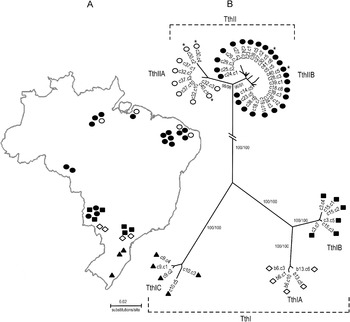
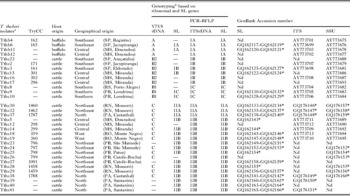
In this study, we characterized SL genes from a total of 23 cultures of Brazilian T. theileri isolates. Thirteen new isolates in this study were obtained from cattle: 8 were from cross-bred dairy cattle from the Northeast states of Paraíba (PB) and Rio Grande do Norte (RN), 3 were from zebuine beef cattle, and 2 were from cross-bred dairy cattle from the state of Pará (PA). New isolates were obtained by haemoculture as previously described (Rodrigues et al. Reference Rodrigues, Campaner, Takata, Dell' Porto, Milder, Takeda and Teixeira2003). We also included in this study 8 T. theileri isolates from a previous study (Rodrigues et al. Reference Rodrigues, Campaner, Takata, Dell' Porto, Milder, Takeda and Teixeira2003, Reference Rodrigues, Paiva, Campaner, Stevens, Noyes and Teixeira2006), which were obtained from taurine beef cattle from the Southern (states of Rio Grande do Sul – RS, and Paraná – PR) and Southeastern (São Paulo – SP) regions, cross-bred beef cattle from the Northwest (Rondonia – RO) and zebuine beef cattle from the Central (Mato Grosso do Sul – MS) region. We also characterized SL genes from 2 isolates from water buffalo (Bubalus bubalis) from MS (Pantanal) and SP (Vale do Ribeira), also from our previous studies (Rodrigues et al. Reference Rodrigues, Campaner, Takata, Dell' Porto, Milder, Takeda and Teixeira2003, Reference Rodrigues, Paiva, Campaner, Stevens, Noyes and Teixeira2006) (Fig. 1; Table 1). Additional cattle and buffalo isolates were tested by genotyping methods based on SL and ITS rDNA sequences (Table 1).
Phylogeographical analysis of Brazilian Trypanosoma theileri isolates. (A) Geographical origin of 32 isolates from cattle and water buffalo used in this study. (B) Neighbour-joining tree of the most divergent SL sequences (49 sequences from 23 isolates) showing geographical structuring of T. theileri population clustered in lineages TthI and TthII comprising genotypes TthIA-C and TthIIA-B. Symbols correspond to T. theileri genotypes TthIA (◊), TthIB (▪), TthIC (▴), TthIIA (○) and TthIIB (•). The codes used for SL sequences indicate the number of T. theileri isolates from cattle (Tthc) or buffalo (Tthb) in the Trypanosomatid Culture Collection, followed by the number of cloned and sequenced SL gene repeats. *Indicates 2 mixed cultures showing sequences from both genotypes IIA and IIB. The numbers at the nodes correspond to the percentage bootstrap support values derived from 100 replicates respectively for NJ and ML analyses.

Trypanosoma theileri trypanosomes used in this study and genotypes (TthIA-C and TthIIA-B) defined based on SL and ribosomal (SSU rDNA and ITS rDNA) sequences
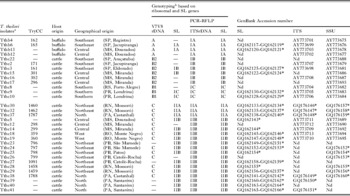
TryCC, code number at Trypanosomatid Culture Collection from the Department of Parasitology, University of São Paulo, ICBII, Brazil.
a , Tthc, isolates from cattle; Tthb, isolates from water buffalo.
b , Genotypes of T. theileri lineages TthI (IA-C) and TthII (IIA-B).
Nd, sequences not determined, isolates were genotyped using one or more sequences from the different molecular markers used in this study: SL or V7V8 or ITSrDNA genes.
* Sequences determined in the present study.
PCR amplification of SL and ribosomal sequences
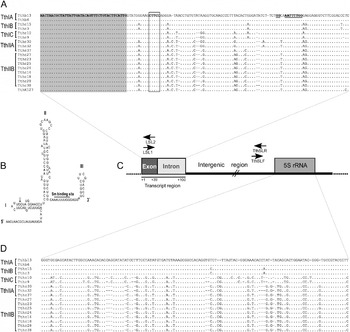
Trypanosome DNA used as template for PCR amplification was obtained from cultured trypanosomes by the classical method of phenol-chloroform extraction. The location of the oligonucleotides employed as primers for PCR amplification of the SL gene is depicted in Fig. 2C. Amplification of whole SL gene repeats (~900 bp) was performed using LSL1 (TTCTGTACTTCATGGTATG) and LSL2 (CCAATGAAGTACAGAAACTG) primers with 2.0 μm of each primer in 50 μl reaction mixtures containing 50 ng of DNA, 200 μm of each dNTP and 2.5 units of Taq DNA polymerase. PCR amplification of partial SL sequences (~400 bp), corresponding to the transcript region of SL plus ~270 bp of a contiguous intergenic region between the intron and the 5S rDNA sequences, was carried out using LSL1 and TthSLR (GGCAAAA(A/G)T(G/C)ACCAA(A/C)AC) primers. PCR conditions were the same for both reactions and consisted of 30 cycles as follows: 1 min at 94°C, 2 min at 50°C and 2 min at 72°C (with an initial cycle of 3 min at 94°C and a final cycle of 10 min at 72°C). PCR products were eletrophoresed in a 2% agarose gel and stained with ethidium bromide. PCR-amplification of V7-V8 SSU rDNA and ITS rDNA of the new T. theileri isolates were performed as previously described (Rodrigues et al. Reference Rodrigues, Paiva, Campaner, Stevens, Noyes and Teixeira2006).
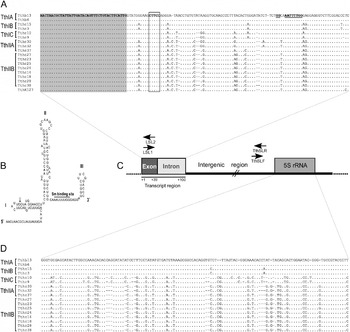
(A) Alignment of SL transcript sequences from 5 main genotypes Trypanosoma theileri trypanosomes. The 39 nt corresponding to the exon sequences are in bold type within a grey box. Within the intron sequences, the conserved CUUCC motif is boxed, and the GG motifs demarcating stem–loop II and the Sm binding sites are underlined. Dots indicate identical nucleotides. (B) SL RNA structure of isolate Tthb6 from water buffalo with the splice donor site indicated by an arrow. (C) Schematic diagram of the SL gene showing the exon, intron and intergenic regions, and annealing sequences for oligonucleotides used as primers for PCRs. (D) Alignment of 5S rDNA sequences inserted within the intergenic regions of SL repeats of T. theileri trypanosomes.
Sequencing and data analyses
PCR-amplified fragments of whole SL repeats from cattle and buffalo isolates were purified (Spin-X, Costar) from agarose gels and cloned, and 3–7 clones from each isolate were sequenced using the internal primers TthSLR (GGCAAAA(A/G)T(G/C)ACCAA(A/C)AC) and TthSLF (GGGT(G/T)TTGGT(G/C)AC(G/T)TTTTGCC). The sequences obtained were aligned with sequences from GenBank using ClustalX (Thompson et al. Reference Thompson, Gibson, Plewniak, Jeanmougin and Higgins1997). The resulting alignments were manually refined. Poly(A) tails of SL transcripts were removed from final SL gene alignments. Sequences of V7-V8 SSU rDNA and ITS rDNA were determined as previously described (Rodrigues et al. Reference Rodrigues, Paiva, Campaner, Stevens, Noyes and Teixeira2006). Six alignments were created: (1) whole SL (wSL) sequences; (2) exon and intron (SL transcript) sequences; (3) SL transcript plus intergenic sequence between intron and 5S rRNA; (4) ITS1 rDNA sequences; (5) V7V8 SSU rDNA sequences from 30 T. theileri trypanosomes from distinct host species; and (6) concatenated alignment generated by SL transcripts plus 5S and ITS1 rDNA data sets. Accession numbers of the GenBank sequences, including those determined in this study, are listed in Table 1.
Phylogenetic inferences were carried out by the parsimony (P) and maximum likelihood (ML) methods, and cluster analysis was performed using neighbour-joining (NJ) distances. The NJ trees were estimated for alignments 1 and 3 using the Kimura 2 Parameter algorithm in Mega 4 software, and nodal support was estimated with 500 bootstrap replicates. Parsimony and bootstrap analyses were employed for all alignments and carried out using PAUP* 4.0b10 (Swofford, Reference Swofford2002) with 100 replicates of a random addition sequence followed by branch swapping (RAS-TBR), as previously described (Ferreira et al. Reference Ferreira, de Souza, Freitas, Campaner, Takata, Barrett, Shaw and Teixeira2007). ML analyses were performed for alignments 1, 4, 5 and 6 using RAxML v.7.0.4 (Stamatakis, Reference Stamatakis2006), as previously shown (Ferreira et al. Reference Ferreira, de Souza, Freitas, Campaner, Takata, Barrett, Shaw and Teixeira2007). Tree searches used the general time reversible (GTR) model of nucleotide substitution with proportion of invariable sites and gamma distribution, with 500 maximum parsimony starting trees. Model parameters were estimated in RAxML over the duration of the tree search and nodal support was estimated with 300 bootstrap replicates. RNA structures were predicted using the RNAdraw program (Matzura and Wennborg, Reference Matzura and Wennborg1996).
Restriction analysis of PCR-amplified SL repeat and ITS rDNA (PCR-RFLP)
Polymorphisms on the aligned whole SL gene sequences of T. theileri trypanosomes were investigated using the software Webcutter 2.0 (Heiman, Reference Heiman1997) to detect restriction enzyme sites that generated DNA fragments of different length according to clades/lineages. For restriction analysis, amplified DNA corresponding to whole repeats of SL and entire ITS rDNA genes were both digested with BshI 1236 enzyme (Fermentas); the resulting DNA fragments were analysed on 2.5% agarose gels stained with ethidium bromide, as previously described (Rodrigues et al. Reference Rodrigues, Paiva, Campaner, Stevens, Noyes and Teixeira2006).
RESULTS
Structural and sequence characterization of SL repeats from T. theileri trypanosomes
Full-length SL unit repeats were PCR-amplified from DNA of Brazilian T. theileri trypanosomes from cattle (21 isolates) and water buffalo (2 isolates), including isolates representative of lineages A, B and C previously defined by ribosomal markers (Rodrigues et al. Reference Rodrigues, Paiva, Campaner, Stevens, Noyes and Teixeira2006). SL repeats (~900 bp) of similar lengths were observed for all T. theileri trypanosomes in agarose gels, as was previously shown for European T. theileri from cattle and related T. theileri-like trypanosomes from deer (Gibson et al. Reference Gibson, Bingle, Blendeman, Brown, Wood and Stevens2000). However, sequences showed significant length variability among previously defined ribosomal lineages (Rodrigues et al. Reference Rodrigues, Paiva, Campaner, Stevens, Noyes and Teixeira2006), enabling the identification of the 5 genotypes defined in the present study according to polymorphism on the SL gene. The SL repeats of the various genotypes ranged from 855 to 940 bp. SL repeats of ~860 bp were found for the genotypes TthIA/B, which correspond to previously defined ribosomal lineages A and B2; 927 bp for TthIC, formerly lineage B1; 855 bp for TthIIB, comprising isolates assigned to ribosomal lineage C; and 940 bp for TthIIA isolates, not included in our previous study using ribosomal genes (Rodrigues et al. Reference Rodrigues, Paiva, Campaner, Stevens, Noyes and Teixeira2006) but also assigned to ribosomal lineage C in the present study (Table 1).
We determined a total of 98 sequences of whole SL genes, 3–5 from each of the 23 isolates examined, and 76 sequences were found to be unique. Comparison of SL repeats revealed an identical exon (39 nucleotides) shared by T. theileri from cattle and allied species from water buffalo and fallow deer. However, the intron sequences varied from 94 bp (TthI) to 98 bp (TthII). The intron and exon sequences together account for 133 to 137 bp of the whole SL transcripts of T. theileri lineages TthI and TthII, respectively. T. theileri-like trypanosomes from deer (Cervus dama) also had an SL intron of 94 bp (Gibson et al. Reference Gibson, Bingle, Blendeman, Brown, Wood and Stevens2000). Sequence divergence in the intergenic regions among different copies of SL repeats from the same isolate was due mostly to long segments of variable numbers of A and T nucleotides. Simple sequence repeats such as AC3-8, GT3-8, CA3-5, TG3-4 and three repeats each of TCG, TTC, CCA and CAC were found in sequences from all isolates, whereas long repeats, such as AAG>5, ACACCC>3, CCCCT4 and GGGAG3 were exclusive to the TthII lineage. The existence of various microsatellites in the intergenic regions is also responsible for length and sequence variability among the SL genes of other trypanosomes (Gibson et al. Reference Gibson, Bingle, Blendeman, Brown, Wood and Stevens2000; Ventura et al. Reference Ventura, Paiva, Silva, Takeda, Buck and Teixeira2001; Maia da Silva et al. Reference Maia Da Silva, Junqueira, Campaner, Rodrigues, Crisante, Ramirez, Caballero, Monteiro, Coura, Añez and Teixeira2007, Reference Maia da Silva, Marcili, Lima, Cavazzana, Ortiz, Campaner, Takeda, Paiva, Nunes, Camargo and Teixeira2009).
Despite differences in length and sequence among SL transcripts of T. theileri trypanosomes, isolates from cattle, water buffalo and deer shared identical secondary structures for the SL genes, with 3 stem–loop folded structures as reported for T. theileri K127 and other trypanosomes (Gibson et al. Reference Gibson, Bingle, Blendeman, Brown, Wood and Stevens2000). T. theileri from cattle and buffalo presented a second stem–loop varying from 50 to 54 nucleotides and the conserved motif GG(C/T)AAAUUUUGG of the Sm binding site with C or T in the third position for TthI or TthII, respectively. The third stem–loop exhibited a conserved UUCG motif and 21 nucleotides for all T. theileri isolates. The secondary structure of the SL transcript from T. theileri from buffalo is represented in Fig. 2B.
Determination of whole sequences of SL repeats of T. theileri trypanosomes revealed a copy of the 5S ribosomal RNA (5S rRNA) gene inserted in the 3′ end of the intergenic region of all isolates, in the same orientation as the SL gene (Fig. 2D). Comparison of 5S rDNA sequences of isolates from different T. theileri genotypes revealed variable length of 121 (IA/B), 116 (IC) or 114 (IIA/B) bp. There was large divergence in the 5S rDNA sequences between lineages ThI and TthII. Identical 5S rDNA sequences were observed for genotypes within the TthII contrasting to more divergent sequences from TthI genotypes (Fig. 2D).
Phylogenetic analysis of SL sequences from T. theileri isolates
Phylogenetic analysis of wSL (exon, intron and intergenic region) sequences from trypanosomes found in cultures from 21 isolates from cattle and 2 from buffalo corroborated data on length and sequence polymorphism of SL repeats, providing evidence for 2 major lineages and 5 main genotypes among Brazilian T. theileri trypanosomes. Although different copies of the SL gene from a single isolate might diverge in their intron and intergenic sequences, the sequences were similar enough to cluster together individual repeats from the same isolate in the same genotype, separated from the repeats from isolates of other genotypes. According to the dendrograms derived from wSL sequences, sequences from all genotypes were nested in 2 major clades, lineages TthI and TthII, separated by ~33% divergence (Fig. 1B). Dendrograms showing the same topologies were constructed using the whole set of 76 unique wSL sequences from 23 isolates (data not shown) or restricted to 49 sequences representing the most divergent wSL sequences (Fig. 1B).
Lineage TthI includes 3 subclades: IA, exclusively found in buffalo, and IB and IC, which comprise genotypes restricted to cattle. Genotype IA formed a very homogeneous clade (~0.4% divergence) closest (~6.0%) to the genotype IB (~0.5%). Genotypes IA and IB were found respectively in buffalo and cattle from neighbouring regions in the Central and Southeastern states of MS and SP. Genotype IC harbours more heterogeneous sequences (~2.0% divergence) than cattle isolates from the Southern region (states of RS and PR). Genotypes IB and IC were separated by ~26% divergence, whereas IA diverged by ~25% from IC.
The second assemblage within the clade T. theileri, lineage TthII, comprises 2 main genotypes found in cattle. Lineage TthII showed lower overall internal divergence (~5.0%) compared to TthI (~14%) but more intra-genotype polymorphisms. One clade of TthII contains sequences assigned to genotype IIA (~4.0%), found in cattle from RN (Northeast) and PA (North). Interestingly, sequences from primary cultures (cattle isolates Tthc30 and Tthc40 from RN and PA, respectively) were assigned to both IIA and IIB, indicating the existence of mixed genotypes (Fig. 1B). T. theileri of genotype IIB (~3.0%) were from cattle from the Centre (MS), Northwest (RO), North (PA) and Northeast (RN and PB). High intra-genotype divergence in IIA and IIB suggests that these genotypes may split into new subclades upon analysis of more isolates from their regions of origin, which are separated by large geographical distances.
Phylogenetic inferences using combined data set and parity between taxonomic markers for T. theileri lineages/genotypes based on SL and ITS1 rDNA sequences
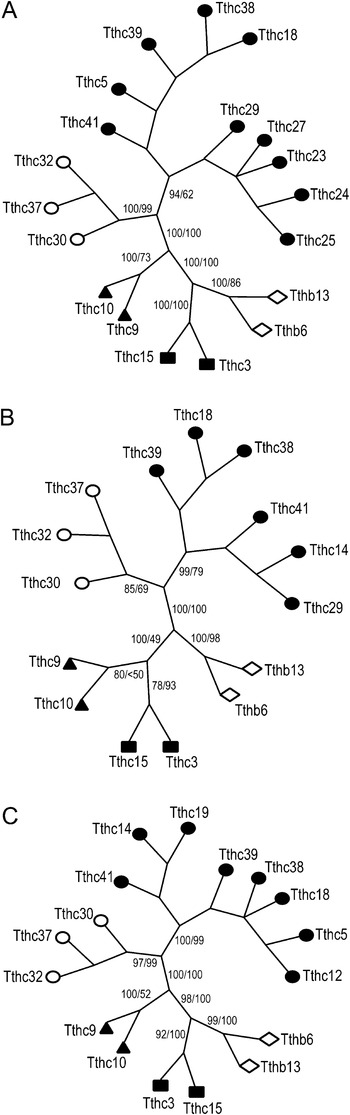
Phylogenetic analysis of wSL sequences confirmed 2 major lineages and resolved at least 5 main genotypes (Fig. 1B). Parity analyses disclosed the same patterns using wSL and ITS1 rDNA sequences (Fig. 3A,B). Analyses using sequences more conserved than SL repeats (5S rDNA and V7-V8 SSU rDNA) confirmed the 2 major lineages, but they were unable to resolve the 5 main genotypes (data not shown). Analysis restricted to conserved exon and intron sequences (alignment 2) was unable to distinguish TthIIA from TthIIB (data not shown), but inclusion of the whole (alignment 1, Fig. 1B) or partial intergenic sequence between the SL intron and 5S rRNA (alignment 3, data not shown) resulted in dendrograms congruent with those from wSL sequences. This finding dispensed the need of whole SL repeats sequences demonstrating that partial sequences from SL gene repeats, which are easily amplified and sequenced, is enough for genotyping and phylogeographical analysis of T. theileri.
Phylogenetic trees inferred by maximum parsimony showing total congruency among phylogenetic relationships of Trypanosoma theileri isolates with parity of all genotypes (TthIA-C and TthIIA-B) based on: (A) whole SL sequences; (B) ITS1 rDNA sequences; and (C) the combined data set of SL transcript, 5S rDNA and ITS1 rDNA sequences. The numbers at the nodes correspond to the percentage bootstrap support values derived from 100 replicates for MP and ML analyses.
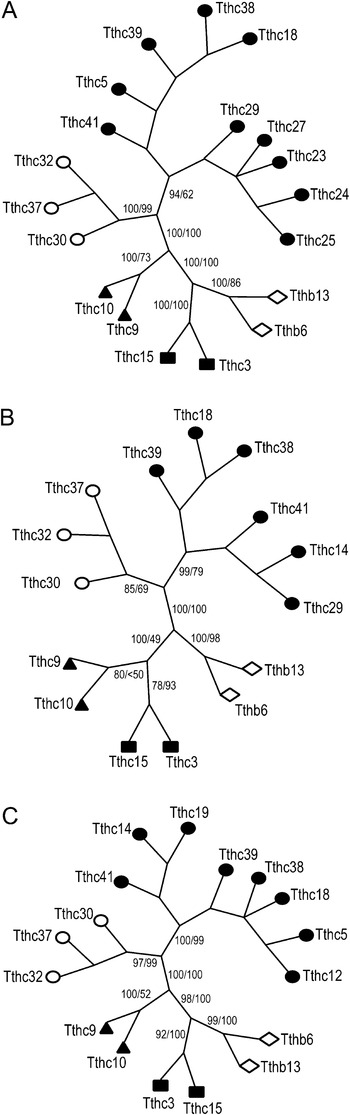
A combined data set of SL transcript plus 5S and ITS1 rDNA sequences was employed to infer phylogenetic trees aiming to corroborate the relationships among T. theileri genotypes and to improve support for all lineages/genotypes. All inferences (P, ML and NJ) generated congruent phylogenetic trees supporting both the 2 major lineages and the 5 main genotypes. The phylogeographical pattern generated by the combined data set was totally congruent with genotype relationships and divergences based on independent sequences, supporting the geographical structuring of T. theileri populations (Fig. 3C).
Parity of genotyping using PCR-RFLP of wSL and ITS rDNA genes
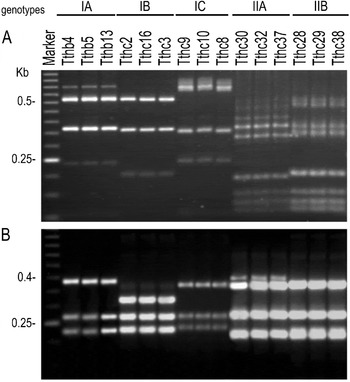
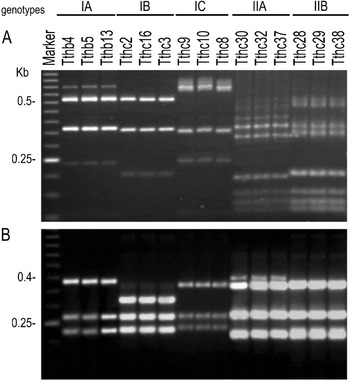
Restriction patterns of PCR-amplified (PCR-RFLP) wSL were evaluated for isolates representing all 5 genotypes, with the aim of developing an easy tool for genotyping T. theileri that dispenses with the need for both established cultures and DNA sequencing. Restriction patterns generated with BshI 1236 enzyme displayed 5 restriction profiles, each one corresponding to one previously defined genotype. The developed genotyping method separated even the most closely related genotypes (Fig. 4A). Parity analysis demonstrated that restriction analysis of PCR-amplified ITS rDNA also displayed banding patterns supporting the same 5 main genotypes defined by the SL gene. However, genotypes within TthII lineage were clearly distinguishable by SL profiles, whereas they showed very similar patterns of ITS rDNA PCR-RFLP (Fig. 4B). Both methods proved to be useful for rapid genotyping of T. theileri and suitable for use with crude DNA templates from easily obtained primary cultures (1–15 days), and they are thus useful for field epidemiological surveys of T. theileri populations.
Agarose gels (2.5%) stained with ethidium bromide (EtBr) showing DNA fragment profiles resulting from restriction analyses of PCR-amplified (PCR-RFLP) genes from Trypanosoma theileri isolates selected to illustrate the 5 genotypes, TthIA-C and TthIIA-B, described in this study. (A) PCR-RFLP of whole SL gene repeats. (B) PCR-RFLP of ITS rDNA.
DISCUSSION
Despite a broad geographical distribution around the world and their ability to infect virtually all species of domestic bovids (cattle, buffalo, goats, and sheep) and wild species of cervids and antelopes, knowledge about T. theileri and allied species is not sufficient to make robust conclusions about the genetic variability and evolutionary relationships of these closely related trypanosomes. Low genetic variability among these trypanosomes, as revealed by conserved SSU rRNA and gGAPDH genes in previous studies, is insufficient to hypothesize about their distribution in phylogenetic clades (lineages) (Rodrigues et al. Reference Rodrigues, Paiva, Campaner, Stevens, Noyes and Teixeira2006; Hamilton et al. Reference Hamilton, Adams, Njiokou, Gibson, Cuny and Herder2009). Data from these studies have suggested that clades might not be strictly related to either host species or geographical origin. However, data from zymodemes (Bose et al. Reference Bose, Petersen, Pospichal, Buchanan and Tait1993; Dirie et al. Reference Dirie, Bornstein, Wallbanks, Stiles and Molyneux1990), RAPD patterns (Rodrigues et al. Reference Rodrigues, Campaner, Takata, Dell' Porto, Milder, Takeda and Teixeira2003), and ribosomal sequences (Rodrigues et al. Reference Rodrigues, Paiva, Campaner, Stevens, Noyes and Teixeira2006; Hamilton et al. Reference Hamilton, Gibson and Stevens2007, Reference Hamilton, Adams, Njiokou, Gibson, Cuny and Herder2009) have distinguished between trypanosomes from cattle, buffalo, cervids and antelopes.
Understanding population structure and lineage segregation within the clade T. theileri requires genetic analysis of polymorphic genes of a larger number of isolates from artiodactyls and vectors from a broad geographical origin. Here, to further evaluate genetic diversity, host association and geographical patterns within the clade T. theileri as suggested in our previous studies (Rodrigues et al. Reference Rodrigues, Paiva, Campaner, Stevens, Noyes and Teixeira2006), and aiming for better-resolved intra-clade phylogenetic relationships, we determined sequences of whole SL gene repeats. We characterized, for the first time, whole SL repeats of T. theileri from cattle (Bos taurus) and related trypanosomes from water buffalo (Bubalus bubalis). Results showed that the 5S rRNA gene is inserted within the intergenic region of all isolates examined from cattle and buffalo. This type of structural arrangement of 5S rRNA in trypanosomes has thus far been reported in SL repeats of T. rangeli, T. conorhini and T. vivax (Aksoy et al. Reference Aksoy, Shay, Villanueva, Beard and Richards1992; Roditi, Reference Roditi1992; Stevens et al. Reference Stevens, Teixeira, Bingle and Gibson1999; Gibson et al. Reference Gibson, Bingle, Blendeman, Brown, Wood and Stevens2000; Ventura et al. Reference Ventura, Paiva, Silva, Takeda, Buck and Teixeira2001; Maia da Silva et al. Reference Maia Da Silva, Junqueira, Campaner, Rodrigues, Crisante, Ramirez, Caballero, Monteiro, Coura, Añez and Teixeira2007). Contrasting to data from SSU rRNA genes, divergence between 5S rDNA sequences was found to be higher within the clade T. theileri compared to lineages/genotypes of T. rangeli (Maia da Silva et al. Reference Maia Da Silva, Junqueira, Campaner, Rodrigues, Crisante, Ramirez, Caballero, Monteiro, Coura, Añez and Teixeira2007) and T. cruzi (Westenberger et al. Reference Westenberger, Sturm and Campbell2006). Although we also found the same organization of 5S rRNA within the intergenic SL regions of T. cyclops (data not shown), which is the species closest to T. theileri in phylogenetic trees (Hamilton et al. Reference Hamilton, Stevens, Gidley, Holz and Gibson2005, Reference Hamilton, Gibson and Stevens2007), trypanosomes showing this peculiar organization of 5S rRNA are not monophyletic and were positioned in distant clades in the phylogenetic tree of Trypanosoma. The nuclear 5S rRNA genes are known to have moved in and out of tandemly repeated eukaryotic gene families (rDNA, SL and histones) during the evolution of fungus, protist, nematode and arthropod species. To date, these genes have been reported to be linked only to the tandem repeats of SL genes in trypanosomatids (Drouin and de Sá, Reference Drouin and de Sá1995; Westenberger et al. Reference Westenberger, Sturm, Yanega, Podlipaev, Zeledón, Campbell and Maslov2004; Thomas et al. Reference Thomas, Westenberger, Campbell and Sturm2005).
To assess the consistency of T. theileri lineages/genotypes by comparing sequences showing different evolutionary rates, we compared phylogenetic analyses with SL and rDNA (SSU and ITS1) sequences. These genetic loci were analysed separately as well as with a combined approach. The results showed parity between phylogeographical patterns based on SL and ITS1 rDNA sequences. Only analyses including highly polymorphic sequences from the intergenic region of SL and ITS1 rDNA showed cryptic genotypes that were not found using conserved SSU rDNA sequences (Rodrigues et al. Reference Rodrigues, Paiva, Campaner, Stevens, Noyes and Teixeira2006). T. theileri isolates showed relevant polymorphisms in the intergenic regions of SL gene repeats.
Phylogeographical analysis of 21 T. theileri isolates from Bos taurus from the North, South, West, Southeast and Central regions of Brazil, plus 2 isolates from Bubalus bubalis from the Southeast and Central regions, was performed using phylogenetic analysis of the SL gene. The phylogenies inferred using either wSL (~900 bp) or partial SL repeat (~400 bp) sequences were totally congruent, with a total of 76 different sequences assigned to lineages TthI and TthII, which comprise respectively 3 and 2 genotypes strongly supported in all analyses. TthI comprises genotypes IA and IB from buffalo and cattle, respectively, from the nearby Southeast and Central regions, and IC, which is restricted to cattle from the Southern region. TthII comprises genotypes IIA, restricted to cattle from the North and Northeast, and IIB, found in cattle from the Central, West, North and Northeast regions. Besides the 5 main genotypes characterized in this study, analysis of primary cultures from the North and Northeast regions allowed the discovery of at least 3 sequences that did not cluster with any of these genotypes, indicating the existence of many more genotypes (data not shown). Intra-array variation could affect taxonomic interpretations made using a randomly isolated repeats of the SL gene (Thomas et al. Reference Thomas, Westenberger, Campbell and Sturm2005; Maslov et al. Reference Maslov, Westenberger, Xu, Campbell and Sturm2007). For this reason, we examined 3–7 cloned sequences from each culture. The polymorphisms found in different cloned SL sequences from each established culture did not prevent their clustering together. However, cattle harbouring more than 1 genotype could be detected directly by PCR of DNA from primary cultures, but not from established lineages, thus demonstrating selection by successive passages in culture. Parity of independent molecular markers defining the same genotypes indicated clonal propagation of T. theileri isolates. Phylogeographical analysis reveals geographical structuring of T. theileri genotypes found in cattle, apparently, related to geographical distances and livestock transit. Accordingly, genotypes restricted to the Southern (IC) and Northern (IIA) regions, which are too far from one another for normal livestock transportation, were separated by large genetic distances and do not share the same area.
The states of MS and PA, together with adjacent states in the Central and Northern (Amazonia) regions, are the largest cattle production areas in Brazil, from which herds of cattle are sent to neighbouring regions. The state of MS, in central Brazil, was the only region showing cattle infected with both TthI (IB) and ThII (IIB) lineages. The states of SP and MS had both genotypes IB and IA, an expected result since there is an intense transit of livestock between these nearby regions. The states of PA, RN and PB showed only TthII genotypes. The coexistence of IIA and IIB genotypes in the Northeast and North may be due to sporadic contact between cattle from these regions. The constant high abundance of tabanids in the Central (Pantanal), Southeasthern (Vale do Ribeira) and Northern (Amazonia) regions could play a role in the dispersion and heterogeneity of T. theileri populations. The hypothesis that hybridization events should occur in tabanids finds support in the strong variability among sequences of ribosomal genes amplified directly from isolates parasitizing the gut of the same tabanid specimens (Rodrigues et al. Reference Rodrigues, Paiva, Campaner, Stevens, Noyes and Teixeira2006). The species diversity and amount of tabanids largely varied according to geographical regions, probably determined by the ecotopes and food availability. Therefore, different genotypes could be at least partially related to distinct vector species. Further studies of T. theileri in tabanid flies and other vectors are required to clarify all these questions.
Buffalo isolates from SP and MS share one SL genotype, so far exclusive to this host species. Isolates from water buffalo clustered together in this and in previous studies using ribosomal and RAPD markers (Rodrigues et al. Reference Rodrigues, Campaner, Takata, Dell' Porto, Milder, Takeda and Teixeira2003, Reference Rodrigues, Paiva, Campaner, Stevens, Noyes and Teixeira2006). Clustering of all buffalo genotypes in a homogeneous clade closest to cattle genotype TthIB from the same regions suggested both geographical and host species association. However, elucidation of this question requires further studies with more buffalo isolates from a broad range of geographical origins. Phylogenetic studies using several genes showed that cattle isolates of T. theileri are not monophyletic, and could be closest to buffalo, cervid and antelope isolates. However, isolates from distinct host species can be differentiated by genetic polymorphisms detected even in the conserved rRNA gene (Rodrigues et al. Reference Rodrigues, Paiva, Campaner, Stevens, Noyes and Teixeira2006; Hamilton et al. Reference Hamilton, Adams, Njiokou, Gibson, Cuny and Herder2009). Findings from the present study suggested that data from these previous studies using SSU rRNA and gGAPDH sequences might not reflect the real heterogeneity of T. theileri populations from cattle and other artiodactyls around the world.
Altogether, data from the present study demonstrate that the clade T. theileri is composed of isolates that can be genotyped into highly consistent phylogenetic lineages, defined by combinations of SL and ribosomal markers. Overall, data demonstrated a complex geographical clonal population structuring of T. theileri found in cattle from distant geographical regions, independent of breed but apparently shaped by geographical distance and livestock transportation by man. SL sequences proved to be excellent targets for understanding the populational structure of T. theileri trypanosomes. The genotyping method that we have developed for T. theileri lineages through PCR-RFLP of SL sequences, which were totally congruent with the previously described ITS rDNA-derived genotyping method (Rodrigues et al. Reference Rodrigues, Paiva, Campaner, Stevens, Noyes and Teixeira2006), proved to be a valuable tool for large studies of population structure of T. theileri trypanosomes.
ACKNOWLEDGMENTS
We are indebted to several students and collaborators from USP, UNIFERSA, UFMS, and UFPA for their inestimable help in the fieldwork. We specially thank Kedson A. L. Neves, a recipient of scholarships from FMVZ-USP, for his invaluable support in fieldwork in Santarém (PA). This work was supported by grants from the Brazilian agency CNPq within the UNIVERSAL program. A. C. Rodrigues and R. C. Ferreira are postdoctoral fellows of PROTAX-CNPq and Maia da Silva F. from PNPD-CAPES. H. A. Garcia is a recipient of scholarships from CDCH-UCV in Venezuela.