Introduction
Recent research by historians, geographers, animal biologists and archaeologists emphasises the importance of interdisciplinary approaches in understanding the complicated relationship between humans and animals. There is now a considerable body of research on the history and geography of hunting.Footnote 1 Rather less attention has been paid to those species that can be seen as a threat to humans, especially in Europe. The relationship between wolves and humans is particularly fraught and fascinating. Aleksander Pluskowski, for example, has drawn on place name evidence, archaeological remains in medieval contexts and literary and documentary sources for his study of responses to wolves in Scandinavia and Britain between the eighth and the fourteenth centuries. This allows him to examine ‘the wolf's complex role – good, bad, horrific and entertaining – in medieval European societies’.Footnote 2 Luigi Boitani argues that there are two wolves, one fantastical and one real. The first (lupo fantastico) ‘is the product of an infinite number of histories, legends, stories, traditions, projections and fantasies that have accumulated over the course of centuries through the complex evolution of the perception that humans have created about nature and animals’. The second (lupo reale) ‘is the Canis lupus of Linnaeus, an animal in flesh and bone with all of their morphological characteristics and behaviour defined by their biology’.Footnote 3
The central premise of Ortalli's work on wolves in Italy is that in the Roman period they were no more reviled by human protagonists than the next wild animal preying on wild and domestic species. However, Ortalli argues that after the Roman period the perception of the wolf changed, from being a pest to livestock to a danger to people. Based on a highly analytical, deep reading of the available sources, he argues that this ‘invention of a new wolf’ was the product of the collapse in demographics and subsequent increase in lupine habitat and the opening up of new woodland economies that placed people and wolves in closer proximity. In the medieval period, the perception of the wolf underwent a series of major changes that cast the species in the guise of a wanton, rapacious, diabolical and insatiable fiend.Footnote 4
Studies of heightened periods of human-eating wolves in northern Italy between the fifteenth and nineteenth centuries have made use of documentary evidence located in chronicles, annals, civil and religious archives. Oriani argues that the ‘invention’ of the man-eating wolf was the result of a confluence of crudely anthropogenic factors. Through drawing on a range of case-studies in northern Italy, Oriani proposes the hypothesis that periods in which wolf attacks on humans were heightened coincided with the expansion of the rural population and the improvement and conversion of previously ‘marginal’ territories leading to a reduction and modification of the habitat of wolves. The intensification of land use led to the displacement and reduction in the populations of wild prey species, and as a result, the effectiveness of the wolf pack as a hunting unit decreased. These dynamics are coupled with increasing numbers of domestic livestock in these lupine ranges which replaced wild prey as sources of sustenance for wolves, thereby bringing wolves and people into closer proximity.Footnote 5
The nature of animal husbandry practices and patterns meant that in the areas where domestic livestock increased, individuals and particularly children who were looking after the flocks either alone or in small groups were increasingly threatened by wolves. Cagnolaro et al identified 440 cases of reported wolf attacks in central Padania between the fifteenth and nineteenth centuries. The majority of those attacked were under twelve years old and the attacks were recorded at altitudes and in locations associated with animal husbandry patterns during the summer months when transhumant livestock were in the area. The number of attacks peaked in the seventeenth century and then gradually declined until the wolf is considered to have become extinct in the area. While the number of wolf attacks was declining, there was an increase in the number of wolves being killed and presented for bounty.Footnote 6 Fabrizio Nobili's research on the relationship between humans and wolves in Piedmont, Valle d’Aosta, and the Franco-Italian borderlands from the seventeenth to the nineteenth century supports the findings of Oriani and Cagnolaro. Rather than the elimination of wolves being motivated by a culturally engendered irrational fear of wolves, with humans seeking to destroy Boitani's ‘lupo fantastico’, the wolf was eliminated because it was seen as a direct threat to agricultural activities.Footnote 7
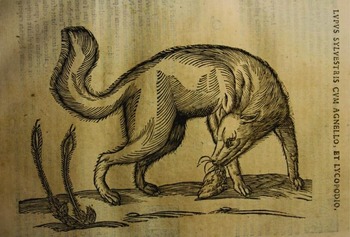
‘Wild wolf with lamb and Lycopodium’ from Ulisse Aldrovandi's De Quadrupedibus viviparis et oviparis (Bologna, 1645), Sezione Conservazione, Biblioteca Berio, Genoa, p. 173.

In this paper we consider evidence for the wolf in medieval Liguria. We focus in particular on an account of a wolf attack in the small town of Varese Ligure written by a local landowner and priest Antonio Cesena. The account is in his Relatio dell’origine et successi della Terra di Varese. The Relatio was a type of written document that had been extensively developed by Genoese merchants and seafarers from the fourteenth century. It was a common literary style in the late Middle Ages, and one that had started out as a diplomatic report and developed by the time Cesena wrote his history of Varese Ligure into any detailed report dealing with a particular country or town. Cesena was an educated and intelligent observer of the history, agriculture and natural history of his birthplace and we explore different interpretations of his narrative to provide a fresh perspective on the relationship between wolves and humans in the sixteenth century.
Antonio Cesena
Antonio Cesena was born on 13th June 1507 and, aged only seven years old, was appointed as canon by the archbishop of Genoa, Lorenzino Fieschi in 1514. The Fieschi family were the feudal lords of the Val di Vara and Counts of Lavagna. It would appear that Cesena remained in his home parish of Varese Ligure until the early 1530s when he followed Cardinal Gerolamo Doria to Rome, before also spending time in Naples, Sicily and Sardinia probably acting in some way for the Cardinal. He died between 1559, the last date recorded in his Relatio, and the 6th November 1604, when he was asked by the Genoese Senate to provide them with information concerning the ancient boundaries of the commune of Varese Ligure and his nephew Quiritio Cesena replied telling the Senate that his uncle was dead.Footnote 8
Cesena's Relatio dell’origine et successi della Terra di Varese was probably written in the 1550s and survives in the form of several mainly eighteenth-century manuscript copies. Varese is located in the north of the province of La Spezia, the most easterly of the four provinces that comprise the region of Liguria.Footnote 9 The town was defended by a castle and was on an important trading route. There was a mixed agricultural economy which included chestnut cultivation, temporary and permanent arable plots, vines and fruit trees, the use of oak and ash trees for leaf fodder and the grazing of large flocks on the higher pastures of the Apennines in the summer months.Footnote 10
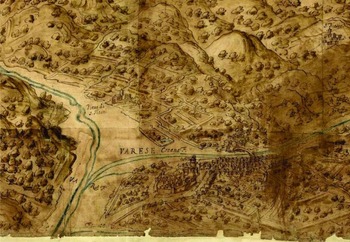
Varese Ligure in c. 1600. Detail. Archivio di Stato Genova Raccolta Cartografica n.g.117

From the autobiographical information in the Relatio, we know that Cesena was a well educated priest who travelled widely. He frequently quotes classical Latin authors, directly referencing passages from Solinus, Horace, Cicero, Plutarch, Sallust and Valerius Maximus, as well as alluding to works by Apuleius, Seneca, Lucan, Isocrates, and Aulo Gellius. But he is also familiar with, and quotes, contemporary Italian authors and commentators, such as Corio Milanese, Giovanni Simonetta, Volaterrano, Platina, Sannazzaro, Paolo Giovio, Petrarch and Andrea della Vigna. Whilst prone to frequent digressions on wider Italian and Ligurian history and political cultures, the ‘grand narrative’ of Cesena's work was the failed conspiracy of Gian Luigi Fieschi against Andrea Doria in 1547, of which the Relatio is thought to be the earliest surviving detailed account.Footnote 11 However, within this overarching narrative Cesena provides meticulous descriptions of the local history of Varese Ligure, as well as the surrounding topography and environment, from which it is possible to investigate the area micro-historically and micro-geographically.
The Relatio can be divided into two main sections, the first concerning events that happened before he was born and the second those that occurred during his life and while he lived in Varese Ligure. The first section accounts for just under the first third of the Relatio, and outlines the history of the town. Cesena provides information concerning the ancient boundaries of the commune, and descriptions of the landscapes and environment within them, the way in which they were managed and the link with local toponyms. Within the ancient confines of Varese Ligure, Cesena identifies key dates and protagonists in the foundation, construction, and development of the principal structures, such as the castle, the adjoining planned Borgo Rotondo, and the Ponte Vecchio across the river Vara. In addition he details the construction of various villas belonging to prominent seigniorial families as well as churches, oratories, and bell towers. The information disclosed by Cesena in this section was by his own admission based on received wisdom and the linguistic nuances and style of the first part of the Relatio convey the sense of reported knowledge.
Cesena ends the first section by writing that ‘Up to this point I have, by my own great effort and research, spoken of things very obscure because of their great age, that is those things which due to the great interval of time one cannot see clearly’. He then goes on to state that in the next sections ‘I shall tell you things that are more clear and certain, narrating for you more faithfully the sequence of events of my own time, of the times of those who told things to me’.Footnote 12 From this point Cesena's writing tends to be more florid and more hyperbolic as his principal sources of evidence shift from those based on received wisdom to personal experience.
In the second section of the Relatio Cesena describes various disputes between seigniorial houses from both within and outside the Val di Vara, often contextualising such conflicts in the wider discussion of the failure of great men and dynasties, individuals whose corruption and vested self-interest left them with blood on their hands. Here the ‘grand narrative’ of the failed Fieschi conspiracy begins. Within this narrative, Cesena dedicates significant tracts of the Relatio to describing the various human tragedies that befell the inhabitants of Varese Ligure especially the regular cycles of plagues and famines which struck the Val di Vara during the 1520s. For example, he wrote that in 1524, the ‘Peste du Madin’ killed over 100 people in Varese Ligure, the fear of contracting the disease resulting in ‘unnatural behaviours’. Cesena dedicates a significant proportion of his text to the description of famines in the mid to late 1520s, the most dramatic of which struck Varese Ligure in 1527. Attributing the famine to a confluence of factors, amongst which the failure of the chestnut crop ranked prominently, the poorer inhabitants of Varese Ligure resorted to eating virtually any possible source of sustenance from roots and grasses to chicken tripe and cats. The hills and valleys, towns and villages of the Val di Vara fell silent as human and animal corpses littered the landscape surrounding Varese Ligure. Wild animals fed on the putrefying, half buried remains of the deceased, the ghost-like survivors too sickly or fatigued by starvation to bury them satisfactorily. Cesena faithfully relays several ‘superstitious’ beliefs present amongst the inhabitants of the Val di Vara although he is explicitly sceptical of such beliefs.
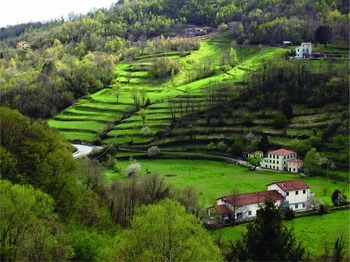
An example of Cesena's precise description of changes in the landscape is provided by his account of the construction of the terraces at Bertignana just to the south of the town of Varese. Here in ‘the year of our health 1557 they made a vineyard all in 56 days’ in an area which had formerly been ‘open and abandoned’ land which did not have any sign of ‘domestic use, it being pasture for all the animals’. The new terraces were constructed with strong stone walls and were built by men from the area who were paid ‘in food and drink’ and who also planted ‘the fruit trees which were transplanted like everyone's are without expense’. Here Cesena sees the new terraces as domesticating the ‘abandoned’ land, which had no fruit trees or vines. The accuracy of Cesena's description is shown by the terraces and walls which survive to this day.Footnote 13 Moreover, in another section Cesena mentions that the owner of the land adjoining Bertignana was Geronimo Rollandetti and this family ownership is confirmed independently by an inventory of lands in the parish of Varese, which shows that lands bordering the Cesena property were owned in 1606 by the ‘heirs of Hieronymus Rolandelli’.Footnote 14 The same inventory records that Andrea Cesena, Antonio's brother, had bequeathed Bertignana in his testament of 1591.
The terraces at Bertignana, Varese Ligure, 2012 (Charles Watkins)

In the Relatio, Cesena drew a clear distinction between different types of landscapes, describing them as ‘known and domestic’ on the one hand and ‘wild and uncultivated’ on the other. He identified changes in the landscape such as the making of new agricultural terraces and new roads but also noted the existence of ‘wild and uncultivated places, inhabited only by wild beasts, full of very thick woods and forests of beech, turkey oaks, evergreen oaks, blackthorn, alders, firs, Manna ash, pines, maples, galle and wild chestnuts’.Footnote 15 He positioned the cultural world, the world of humans, as the binary opposite of the natural, the world of animals. And it was in the countryside ‘outside of the parts which had been wooded and then felled with fire and axe’ where bears, wolves, and wild boar ‘roamed about without any fear at all’.Footnote 16 The three species explicitly named by Cesena are often found together in late medieval and early modern Ligurian statutes.Footnote 17 Wolves, however, receive the most attention in the Relatio, and are identified as normal, if dangerous, components of rural, pastoral life. For example, Cesena describes the shepherds’ use of ‘large numbers of mastiff dogs to defend their animals [. . .] that are in constant danger from wild animals whilst in pasture’. But these ‘bold, gross, raw, wild and thieving animals’ were also protagonists in a series of remarkable occurrences, particularly in 1516, but also sporadically after this date.
The ‘invasion of wolves’, Varese Ligure 1516
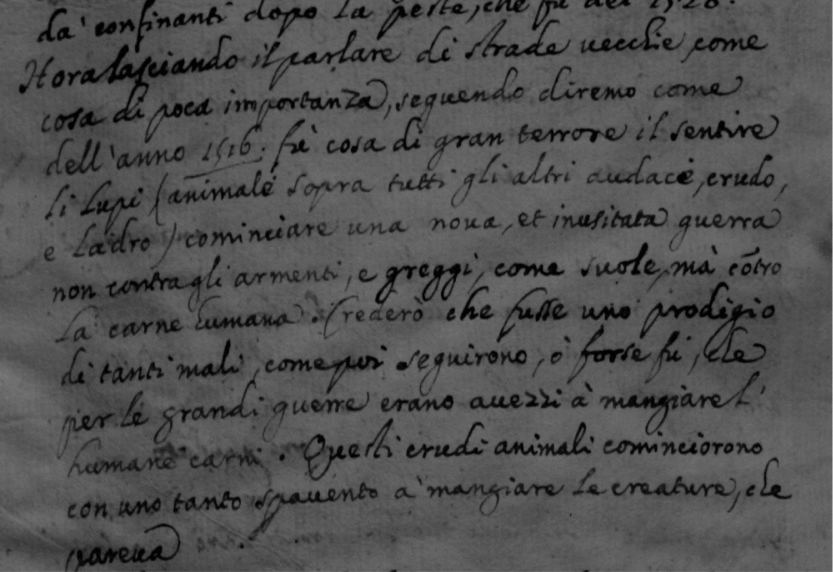
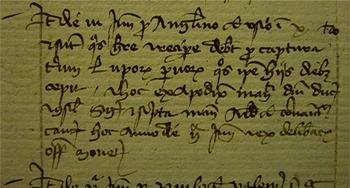
Cesena paints a vivid picture of the events of 1516 ‘when a great fear arose about wolves [that] began a new and unaccustomed war, not against herds and flocks as normal, but against human flesh’. In this year, ‘when these gross animals began to eat creatures it caused such fear that it seemed that they were the fiercest animals in existence’. The aggressive, hostile adjectives employed and images conjured in his introduction continue throughout Cesena's prolonged narrative concerning the lupine invasion of 1516, the following transcription and translation are from a version of the Relatio housed in the Biblioteca Civica di Varese Ligure that immediately overlooks the piazza and Borgo Rotondo in which the events relayed unfolded nearly 500 years ago.
The opening section of the ‘invasione dei lupi’ 1516 in Cesena's Relatione dell’origine et successi della Terra di Varese l’anno 1558, Biblioteca Civica di Varese Ligure, La Spezia, p. 158

The first of all was the terrible fear caused by wolves in 1516. The accustomed cruelty of this guilty animal towards human beings caused such fear amongst everyone that even brave and courageous men refused to go about by themselves or unarmed. For example, it was a hard thing to credit that in the valley of Cavalieri there was a valiant and famous bandit, armed with sword, dagger and spear, who, having put up a long fight, was eaten by wolves. But it is much more difficult for me to relate the awful sights in our valley, in all parts of which these voracious beasts were found. They besieged the roads as enemies assaulted people there. But even worse was when these evil animals were to be found among a flock of sheep and the sheep ran off in search of the unfortunate shepherds; an unheard of thing. But the most miserable thing of all was the sight of a poor and pious father and mother who, with shouts and screams, ran after the ruthless and ferocious animal which had taken their unfortunate and unlucky son; it's hard to know which of them to feel most compassion for – the poor son or the poor father, who found first the torn clothes, then the blood, now a piece of flesh, and now another limb all lacerated and torn by the deadly teeth of the vicious beast.
Every day one heard shouts and screams, and everywhere lamenting, arising from new cases of the terrible spectacle, that was happening everywhere. Everyone kept very alert and when one person shouted, everyone, with shouts, went out with their weapons and dogs. Men came with dogs, lances, swords, skewers, sticks or other weapons, whatever first came to hand, shouting in such a way that instantly everyone came together in the hunt for these ruthless beasts, everyone running and following the voice of the person in front. This was the reason that many were saved, because, although some unfortunate people were taken, such was the crowd of people from all parts running as fast as they could, that the wolves were forced, especially by the dogs, to let go of a very few people, amongst whom are a few still alive now, including three of my own friends and relations: my cousin Agostino Calcagnino; Antonio Zerio, my dear godfather, marked on the face by a vicious bite from a wolf; and Guglielmo Gioco called ‘il Corsetto’, from Cassego, hideously scarred on the head. Many people believed, credulously, that these animals were men transformed into wolves, and they stuck to their opinion even though it was obviously false. One of these was Francesco from Zanega, at that time a notary. I completely proved him wrong both by argument and by the authority of Saint Augustine's ‘City of God’,Footnote 18 and because even the Romans thought it false, for example Pliny in his ‘On Nature’ (De Natura), Book 8, Chapter 22, who said as follows: ‘regarding men transformed into wolves and turning themselves back again, we must say that this is beyond any doubt untrue, as all now believe and which was over fantastic centuries ago’. If you want to find out what was the origin of this fable, to our mind ludicrous fable, read the aforementioned chapter (of Pliny) but further down and you will find it.Footnote 19
Supplication, fasting, processions and various offerings were made to our Lord God, so that his divine majesty would deign to assist us against such a serious evil. Then hunting with dogs and weapons was carried out with great care, so that they took and killed many wolves.
It was a notable thing when two wolves from among the rest, having entered by the piazza gate, got into the Borgo Rotondo. They were seen entering by the castle guard (which they had at that period) and he shouted and sent signals to certain men. Then they simultaneously locked both gates, that from the piazza and the lower gate, which at that period was always left open. Then they began to shout and ring the bells. All the men from the castle began to shout so that those who lived inside the borgo were the first to leap out of their beds, both naked and semi-clothed, together with their wives and children. And such was their desire to kill those wolves, so hated by then and such a menace, that many, both women and men, ran outside naked having remembered their weapons but forgotten their clothes.
At once these people surrounded the wall of the moat so that the wolves could not jump in the moat and get away via the piazza, or in the garden, which was hard because the moat was full of water.Footnote 20 The noise got louder and louder as the number of people got greater. Once everyone was up and a great number of lamps had been lit, they began to hunt these two animals, who ran so fast along the arcades that people thought there were more wolves than there in fact were. It was a long time before they were harmed, to the great pleasure of all. Tired and wounded they hid, one in the courtyard of the Casa della Ragione, which at that time was opposite the church in the west of the borgo, the house above the road between the church and the castle, at present derelict, and owned by the heirs of the Mutini family. The other wolf hid behind the altar of the church. In each place they killed one of them, either because of divine providence or from fear, and so having killed in part those (beasts) which had caused such evil, this great curse came to an end.Footnote 21
The key points of this narrative are that the events described by Cesena occurred in ‘our valley’ and given that in 1516 he would have been nine years old he may at the very least have heard of the invasion directly from those who witnessed it even if he was not an eyewitness himself. During this time, the sheep were so afraid of wolves that they ran in search of the shepherds to protect them, yet the wolves attacked and killed many of those young people tending the flocks. When there was a wolf attack, the people of Varese Ligure would chase the animals with weapons and would often repel them.
A number of individuals were injured by the wolves whom Cesena identifies by name, including one who was a relative of his, and Cesena provides specific information concerning the nature of their injuries. Although some in Varese Ligure believed the wolves attacking the inhabitants were people turned into wolves, Cesena refutes these claims by reference to classical texts. Cesena details the occasion on which two wolves entered the Borgo Rotondo in Varese Ligure via the Piazza gate, so that the bells were rung, to which the inhabitants responded by running from their homes in such urgency that they did not clothe themselves, chasing the animals with lit torches and lamps through the arcades and alleyways of Varese, the course of the chase being described precisely by Cesena. The chase resulted in the killing of the wolves in different locations, one beneath the altar of the church, and the other in the courtyard of the Casa della Ragione, the seigniorial home of the Mutini family.
Whilst the invasione dei lupi of 1516 is the most conspicuous reference to the species in the manuscript, elsewhere in the Relatio Cesena tells of instances when wolves came into contact with the human inhabitants especially during periods of famine, plague and war. During the periodic disease outbreaks during the late fifteenth and sixteenth centuries, Cesena reported wolves feeding on the putrefying, half buried remains of the deceased, or attacking and consuming people too fatigued by starvation or illness to defend themselves, as when ‘a poor child was attacked by a wolf, and too weak to defend himself or to cry for help, the wolf decapitated him, taking the head, but leaving the body’.
The wolf as a prodigy of bad things
Cesena was a vernacular humanist priest and this raises the question of the extent to which he employed and evoked the imagery and symbolism of wolves as a literary device to convey deeper didactic messages. The wolf invasion of 1516 is part of the manuscript described by Cesena as having been based on personal, first hand observation. The vividness of the prolonged narrative, together with the naming of individuals we know to exist from other sources and the precise geography of the movement of the wolves which ties in closely with our knowledge of the form of the town in 1516, all suggest that he was describing an actual event, one that did take place in the streets and squares of the town. However, prior to the section of the text describing the various human tragedies befalling the inhabitants of the valley, of which the wolf attacks are a conspicuous example, he remarked that a plague of 1497 was ‘one of many prodigies that I will now impart’. Cesena reasserted his perception of the events he described in the final paragraphs of the Relatio and cited Livy in doing so which is significant in terms of the portrayal of wolves.
That Cesena lumps the events of 1516 with other events as ‘the prodigy of many bad things’ suggests that he also attached a symbolic and profound significance to the invasion of wolves. This is reminiscent of the interpretation of lupus urbem intravit in works by classical Latin authors. In these works, such events were described as ‘prodigium’, ‘portentum’, ‘ostentum’ and ‘monstrum’ and, while scholars of classical antiquity have highlighted subtle differences between these categories, they share a common characteristic; namely that they were interpreted as divine warnings, expressions of the disruption of the pax deorum. These portents could take a variety of different forms including the appearance of certain animals and birds in towns. There are several examples in Livy's History of Rome and he includes the appearance of wolves in towns. At Capua ‘a wolf had entered the gate by night and mauled one of the watch’Footnote 22 while ‘a wolf was pursued even in Rome by day, after entering by the Porta Collina, and escaped by the Porta Esquilina amid great uproar on the part of pursuers’.Footnote 23 The portentous nature of wolves entering cities would have been well known to Cesena and his readers and the implicit analogy between the small town of Varese and Rome and other cities might even have helped raise its status in the eyes of Cesena and his contemporaries.Footnote 24
Sixteen years after the Varese wolf invasion another Ligurian small town priest and chronicler described a similar situation. Father Calvi's Cronica detail the various trials and tribulations of life between 1454 and 1623 in the convent of P. P. Domenicani in Taggia, a town located at the opposite end of Liguria to Varese Ligure in what is now the province of Imperia. Albeit part of a different historiographical and literary tradition, Calvi's Cronica have various similarities with Cesena's Relatio, particularly the attention that the author paid to providing highly detailed descriptions of the physical as well as socio-political and religious landscapes in their immediate surroundings. In 1532 it is reported that a large number of ‘predacious wolves devoured not only sheep, but also cows and mules, and, what is worse, even humans, amongst these, the son of Giorgio Turdini,. . . and also others’. The chronicler adds that ‘In my youth, I met other old people with scarred faces, those people said that they had been attacked by wolves.’Footnote 25
In the same period as the incursion of wolves in Taggia, Calvi provides details of a large, malformed cetacean being found on the shoreline at Santo Stefano al Mare, the rotting stench of which polluted the area. This ‘horrendous spectacle’ was removed from the beach and taken out to sea, its bones appearing some days later, the flesh having been stripped by sharks. Calvi's interpretation of the combination of the appearance of this mysterious sea creature and of the lupine depredation on the inhabitants of Taggia is similar to that by classical Latin authors and of Cesena. There are also parallels with Villani's fourteenth century Nuova Cronica of Florence when the appearance, pursuit and killing of a wolf in January 1345, combined with other incidents, were seen as ‘ominous signals for the future’, clearly signaling ‘malign spirits’ at work in the city.Footnote 26
The real wolf
Cesena's description of wolves can be compared with documentary and other evidence for Liguria and northern Italy. From the fourteenth century we have statutory evidence dealing with payments made to individuals for the capture of wolves which indicate that the elimination of wolves was considered sufficiently important to merit the demarcation of funds to offer as incentives. The statutes for Rossiglione, a small town forty-five kilometres north west of Genoa, were first issued in 1301, and frequently revised until 1385 when the local regulations required formal approval from the Senate of the Republic of Genoa.Footnote 27 There are two statutes referring to wolves in the surrounding landscape both of which specify payments to be made for killing a wolf. These are located in sections of the statutes concerning animal husbandry and hunting practices respectively: fifty-four, De capientibus lupum vel lupam rubrica, stipulates a payment twenty Genoese soldi for an adult wolf,Footnote 28 and ninety-five, Si aliquis de Ruxilono juerent ad cazam idem, details a prize of the same value for three or more young wolves, and one quartarola d’oro for any fewer.Footnote 29
The oldest records actually detailing payments made for killing wolves are for thirteen wolves in the city of Genoa in May 1377. Details concerning these payments were found in documents concerning the various financial in and outgoings of the city of Genoa during the fourteenth century kept by Anthonio Ganducio and Francisco de Ancona. The documents are difficult to read but indicate when and by whom the wolf was presented to the administration, where they and the wolf came from and how much they were paid. For example, the entry shown in Figure 5 states that on 3rd May 1377 the city of Genoa paid twelve lire for four wolves.Footnote 30
Example of a Genoese fourteenth century wolf bounty payment, May 1377, Antico Comune 15, Archivio di Stato di Genova.

The amount paid per wolf in Genoa is roughly approximate to that stipulated in the statutes of Rossiglione from the same period. Although it is not explicit from this document why the wolves were presented to the commune, it is evidence that wolves existed and were seen as such a significant a threat as to merit the allocation of a reward for their capture and destruction. Indeed, through contextualising the records found at the Archivio di Stato di Genova in the wider historical documentation, it would appear that based on the potential threats posed by wolves to sheep and goats and to those that looked after them, a number of Ligurian municipalities offered bounties for the killing of wolves.
Other evidence for the presence and threat of wolves in the fourteenth century is provided by later descriptions of Genoa. It was reported, for example, by a Genoese Domenican priest in 1324 that ‘a great many wolves descended on Polcevera, Bisagno (the two main rivers at Genoa) and almost all of the Riviera and gathered at the walls of the city, arousing great fear and danger to the population of young children’.Footnote 31 The writer Franco Sacchetti (1332–1400) in Novella CLXXVII of his Il Trecentonovelle states that the landscape around Portovenere, to the east of Genoa towards Pisa, was populated by ‘a quantity of many wolves that would sometimes arrive at the shoreline and board boats in search of bread and meat that had been left on them’.Footnote 32 In another story, novella XVII recounts the tale of Piero Brandani from Florence tracking and killing a wolf before finally presenting it to the Pisan administration for the allocated fifty lire prize. These fictional accounts complement the documentary evidence from Rossiglione and Genoa concerning the importance of prizes or bounties for the killing of wolves.
Wolves were widely seen as a threat in the thirteenth and fourteenth centuries. The ‘statutes of Mantua envisaged the possibility of wolves coming right into the towns’.Footnote 33 In the same period statutes from Vicenza reveal that walls were to be specifically created and maintained so that ‘said wolves could not enter’.Footnote 34 The threat of wolves continued to be recognised in the sixteenth century and larger cities such as Milan were not immune to attack. In 1528, for example, it was reported that large numbers of ‘voracious wolves attacked and ate people during the night, entering their homes and even during the day they consumed whoever they could’. The wolves ‘dig the bodies buried in the cemeteries and consume them, causing much misery and fear’.Footnote 35 Two years later the ‘countryside surrounding the city was full of wolves who caused a great and widespread fear, killing many people, mainly lone prostitutes and women’. People were so frightened that they ‘refused to leave their houses in groups of less than three or four. The wolves caused an enormous fear.’Footnote 36 In 1591 at Bergamo, fifty kilometres south west of Milan, a female wolf ‘and three pups risked entering the Borgo Santa Caterina at midnight, and entered the house of a blacksmith, which she found open, and attacked two little children, who were playing with a dog’. Luckily the crying children roused their father who was able to protect them, although ‘the wolf pups attacked the dog and took it away’.Footnote 37 In certain urban areas, the likelihood of wolves entering was regarded as sufficiently high to merit considerable extensions to defences, as at Ascoli Piceno, in Marche, where walls were built during the sixteenth century so that ‘wolves and other brutish animals could not enter’.Footnote 38
The Ligurian statutes from the period when Cesena wrote his description of the invasion of wolves indicate that lupine depredations of herds and flocks were recognised as a normal part of rural life. Varese was an important node in a network of transhumance routes and sheep were crucially important in the local economy. Statutes from the sixteenth century onwards imply that such instances were a regular and frequent part of life in areas where sheep and goats were kept. For example, in the 1569 statutes from Triora, Imperia, a decree entitled ‘de lupis interfectis et capris’, or ‘of the killing of wolves and goats’, explicitly sought to safeguard livestock from depredation by wolves:
It has been decreed that should someone intercept, capture or kill a large wolf the commune will pay ten shillings per head, five for the presentation of a single wolf cub of either gender. In order to receive this, the wolf or part of the wolf must be brought to council with testimony that it was killed in the communal lands.Footnote 39
Ligurian statutes demonstrate incontrovertibly that the threat posed by wolves to livestock was a preoccupation. Statutes from Sassello, Savona, dated 1533, 1633, and 1729, all provide information concerning bounties to be earned on the presentation of a dead wolf to the commune administration. In 1533 it is stipulated that ‘anyone who catches a wolf’ from the common lands of Sassello ‘had the right to claim . . . forty Genoese shillings for a large and twelve for a small’. The equivalent payments for a bear were significantly lower: ‘thirty Genoese shillings for a large and ten for a small.’Footnote 40 In 1633 the payments offered are similar:
If anyone kills or capture a wolf or bear in the area around Sassello, they are entitled by law to claim compensation. Forty shillings for every large wolf, be it male or female, twelve for a cub, thirty for a large bear, and ten for every small.Footnote 41
By 1729 bears are no longer mentioned but wolves continue to be stipulated:
If you kill a large wolf in this jurisdiction you have the right to a prize from the Comune: five Lire for a male wolf, six for a pregnant female, two lire for a wolf less than a year old.
The statute notes that the prizes ‘can only be claimed upon the presentation of the wolf to the administration of the commune’ and the person claiming the prize had to assure the commune that s/he was the person ‘responsible for its capture’.Footnote 42
Historical documentation from this period indicates that there were many ways in which to hunt, trap and kills wolves, from nets, trammels and poisoned baits to ingenious pit fall traps and elaborate techniques. Several wolf pits have been identified near Varese Ligure and one has recently been excavated.Footnote 43 It is apparent that the eradication of the wolf from the landscape was seen to be necessary in order to ensure the safety of flocks, herds and people. The hunting of wolves was certainly a form of pest control rather than an aristocratic leisure pursuit. The specific allocation of funds to reward the hunting of wolves was primarily based on the threat to the livestock reared in these areas, but also, by extension, on the danger to those involved with their husbandry especially young people tending flocks and herds in the Ligurian interior. The wolf was also perceived as a threat to small towns like Varese and even cities such as Genoa.
Conclusion
During the late fifteenth and early sixteenth century the Val di Vara was subject to various periods of war and disease. Cesena in his description of the invasion of Varese by wolves could have been using them as faunal symbols of the chaos he perceived to be occurring around him. The wolves were part of ‘the prodigy of the many bad things’ that befell the inhabitants of the Val di Vara. This encroachment of the fundamentally wild on the intrinsically domestic could have served as a device by Cesena to indicate divine displeasure reflected in the tumultuous times. However the Relatio and other contemporary documents reveal that the wolf existed as a real animal whose survival was interdependent with the Apennine pastoral economy. The events that befell the inhabitants of the Val di Vara and the disruption to the local economy during the period in which Cesena wrote his Relatio will have had an influence on the wolves venturing into ‘domestic’, ‘cultured’ areas from the ‘wild’ and ‘natural’ landscapes that they both physically and conceptually linked. Notions such as these are important in explaining the relative ease with which the wolf as a ‘biological animal’ was transformed into the vicious chimera of the ‘mythological beast’.
Cesena remarks that whilst the war of the animals against human flesh was unprecedented, their depredation on livestock was ‘usual’, remarking elsewhere that people often took numbers of large dogs to protect their flocks from attack. Examination of documentary evidence from the sixteenth and seventeenth centuries reveals that the presence of wolves and their depredation on livestock was usual in other parts of Liguria and north Italy. In addition there were instances when the animals also approached and entered villages, towns and cities and when they entered human settlements those writing chronicles and annals in these areas recorded the events in significant detail. While it is clear that the wolf existed in metaphor and allegory, Cesena's description of the wolves in 1516 also reveals that the species was a regular, frequent and normal part of the faunal assemblage of the Val di Vara in the sixteenth century.
Acknowledgements
The authors would like to thank Sandro Lagomarsini, Diego Moreno, Roberta Cevasco, Elsa and the late Bartolomeo ‘Bertin’ Semenza, the late Franco Pessagno, Mario Gotelli, Raffaella Bruzzone, Alberta Dellepiane, Rodolfo Savelli, Mika Rissanen and Paola Volvera for help and assistance with this research.