Much debate in formal SLA theory has focused on the language learning capacity in adulthood as compared to childhood (e.g., see Lakshmanan, Reference Lakshmanan1994; Slabakova, Reference Slabakova2009; Unsworth, Reference Unsworth2005; White, Reference White2003, for discussion). It is well established that children, barring pathology, acquire their first language (L1) with relative ease, rapidity, and ultimate relative uniformity (within the expected variation). Adult second language (L2) acquisition is decidedly different in this respect in that the initial state, the developmental sequence, and the variability in outcomes are observably distinct. Under the generative view of acquisition, the path of acquisition and success in childhood are, in large part, consequences of the theorized biologically determined linguistic endowment, or Universal Grammar. Universal Grammar (UG) is hypothesized to innately provide the child with the general building blocks of natural language, which, when coupled with the learning of the language-specific lexicon, account for the mature state of linguistic knowledge. If this theoretical account is on the right track, then it seems reasonable to expect that if adults indeed continue to have access to UG, the outcomes of adult L2 acquisition would not differ so significantly from the outcomes of normal childhood acquisition.
As pointed out by Schwartz (Reference Schwartz1986), the null hypothesis for adult L2 acquisition within the UG perspective is that the same language-specific mechanisms involved in L1 acquisition are involved in adult L2 acquisition. Of course, this can be falsified if unassailable evidence to the contrary is provided. It has been suggested by many and formalized under Bley-Vroman’s fundamental difference hypothesis (Bley-Vroman, Reference Bley-Vroman1990; see Bley-Vroman, Reference Bley-Vroman2009, for history and updates) that the general lack of complete success of adult L2 learners can be attributed to, among other variables, a maturationally conditioned cessation of access to UG. In other words, there is a critical period for accessing universal linguistic properties from UG’s inventory. One consequence of direct inaccessibility to UG is that adult L2 learning of linguistic properties in the target language that are not instantiated within the L1 is limited to whatever can be deduced via domain-general learning on the basis of input and instruction alone. Since the late 1980s and early 1990s, there has been no shortage of studies that cast doubts on (some of) the assertions of the fundamental difference hypothesis. To date, many formal linguistic studies have shown that L2 learners, despite their differences as compared to natives, come to acquire sophisticated knowledge about the target L2 that is not transferrable from their L1, that is not taught, and for which available input is degenerate (e.g., see Slabakova, Reference Slabakova2008, for discussion). In other words, it seems reasonable to claim that L2 acquisition can be characterized as embodying a logical problem of acquisition similar to (but not the same as) the case of child L1 acquisition.
That adult L2 learners show evidence of poverty of the stimulus (POS) properties is taken by many to indicate that accessibility to UG has no inherent endpoint. Under such a position, the child L1-adult L2 differences become even more intriguing and must be accounted for. One can embrace the expectation of L1-L2 differences while maintaining the position that mechanisms in child acquisition are available for adults, because what is at stake is not determining the mere presence of such differences alone but rather determining what is the best explanation for them. One appealing aspect to positions claiming UG inaccessibility as the most deterministic factor for L1-L2 differences is that such positions neatly explain everything under one proverbial blanket. If tenable in light of all the empirical predictions that emerge from it, then this is exactly the type of theory one wishes to have. However, given the fact that study after study has shown L2 success in at least some domains claimed to be impossible if UG were truly unavailable postpuberty, it seems reasonable to claim that the story is not as simple as UG inaccessibility. In fact, it seems doubtful that there is one or even only a mere few factors that contribute to L1-L2 differences. To start with, L1 and L2 learners are inherently different on many fundamental planes. Children undertake the process of acquisition as novice language learners whose overall cognitive capacity, which clearly interacts with the language learning task, is immature. Conversely, adult L2 learners start the process with a fully developed L1 linguistic system and a fully mature cognition. Furthermore, the linguistic environment itself is usually distinct from L1 learning; the environment of L2 learning is oftentimes a classroom. Bley-Vroman (Reference Bley-Vroman1983) warns of the comparative fallacy between these groups for these reasons, among others. So, it is not clear that it is fair, much less prudent, to believe or to expect a priori that the route and outcomes of these two distinct instances of acquisition could be uniform. Perhaps the fact that L2 acquisition, despite the general lack of complete success that seemingly characterizes it, is often so good in many domains for at least some learners should be highlighted more (Rothman & Guijarro-Fuentes, Reference Rothman and Guijarro-Fuentes2010). As much as it is true that we must account for apparent failure, we also need to account for apparent success.
Those who claim some type of a lack of accessibility to UG in adulthood must explain any apparent convergence on the target grammar. There are a range of hypotheses of UG impairment, from complete inaccessibility (Bley-Vroman, Reference Bley-Vroman1990, Reference Bley-Vroman2009) to more localized, specific impairments. For example, Hawkins and Hattori (Reference Hawkins and Hattori2006) and Tsimpli and Dimitrakopoulou (Reference Tsimpli and Dimitrakopoulou2007) offer a model of inaccessibility to new L2 formal syntactic (uninterpretable) features only, known as the interpretability hypothesis. Approaches like this, which claim only partial accessibility to UG, are in a stronger position to explain some successes in L2 acquisition; however, they too make precise predictions of which properties should and should not be acquirable. Because a shared goal of research is one of accounting for data-driven facts, the fact that UG inaccessibility accounts can offer reasonable explanations for L2 divergence does not absolve them of explanatory adequacy in the opposite direction. Proponents of adult UG continuity must be held to the same standards. Thus, showing L2 POS in no way absolves proponents of full access to UG from accounting for L2 divergence.
The full access/full transfer model (Schwartz & Sprouse, Reference Schwartz and Sprouse1996) asserts that the L1 grammar serves as the initial state of L2 acquisition and that UG is fully available to guide the acquisition process in adulthood. Because it is proposed that target L2 input is first filtered through the L1 grammar, it follows that the mere presence of the L1 grammar will result in (predictable) differences in L2 developmental sequencing and possibly even in ultimate attainment. Recognizing that L1 transfer is not entirely explanatory by itself, several hypotheses in generative L2 acquisition have been appended to this model or exist agnostically to it as explanations of nonnative competence or performance in the L2. Such approaches claim that UG is fully available, yet, in an effort to explain the nonnative behavior of L2 learners, they appeal to problems with morphology-syntax mappings (e.g., the missing surface inflection hypothesis, Prévost & White, Reference Prévost and White2000; the feature reassembly hypothesis, Lardiere, Reference Lardiere2009; the bottleneck hypothesis, Slabakova, Reference Slabakova2008), interference of the prosodic system from the L1 (e.g., the prosodic transfer hypothesis, Goad & White, Reference Goad and White2006), and consequences of cognitive and processing resources related specifically to linguistic interfaces (e.g., the interface hypothesis, Sorace, Reference Sorace2011), among other influential variables. It is doubtful that there is one factor that can account for all L1-L2 differences, and the aforementioned hypotheses do not attempt to explain all such differences, but, rather, they focus on specific types of L2 divergence. Together, they offer a promising answer to the obvious question of how UG can be accessible to adults and still lead to the observable differences of the L2 acquisition process and outcome. They do this not only by offering plausible accounts for some domains of divergence but also by highlighting that much more than UG accessibility is implicated in any instance of acquisition. As such, they contend that it is possible that the many attested differences in L2 acquisition may be better explained by investigating beyond the question of UG accessibility itself.
The present study joins others that claim full UG accessibility while also presenting data that show significant differences between the L2 group and the native control. Although we will claim that some of our data are suggestive of continued accessibility to UG in adulthood, we will focus more on data that embody the role that L1 transfer and L2 learnability can play in differences in L2 ultimate attainment. As pointed out by Trahey and White (Reference Trahey and White1993), acquiring new L2 syntax, despite implicating a role for UG in L2 acquisition, does not guarantee that the L1 syntax is completely abandoned. This is known as the preemption problem of adult L2 acquisition. To weigh in on the preemption issue, we present a study that tests the knowledge of adult Brazilian Portuguese (BP)-speaking learners of Spanish for properties related to object drop, a property that has apparent overlap on the surface between these languages but stems from different underlying syntactic structures. Via a scalar grammaticality judgment task with context, we examine competence of restrictions on the syntactic and semantic distributions of phonetically null objects in Spanish. We focus on L2 learners at the advanced level to investigate what we maintain are language-pairing-specific learnability issues for development and ultimate attainment, which surface as a result of the ostensibly (partial) overlap of the two grammars.
Spanish input embodies a surface-level subset to the superset of BP in this domain. We consider the possibility, however, that this is superficial only, because it does not meet strict criteria for a true subset-superset relationship (e.g., Berwick, Reference Berwick1985; Manzini & Wexler, Reference Manzini and Wexler1987). Like BP, Spanish allows phonetically absent objects in simple clauses. Unlike BP, phonetically unrealized objects are only possible in Spanish when the object is [−definite]. So far, a proper subset-superset relationship seems viable. Nevertheless, the underlying syntax that gives rise to what appears to be the same surface phenomenon in the two languages is unique in each. Brazilian Portuguese licenses a pro in situ (e.g., Farrell, Reference Farrell1990), or a true null object, whereas Spanish dropped objects obtain via topic-operator movement (Campos, Reference Campos1986; Sánchez, Reference Sánchez2004). Because movement is implicated in Spanish only, subjacency restrictions obtain solely in Spanish. Although all surface realizations of phonetically null objects in Spanish are grammatical in BP, the underlying syntactic differences between the grammars nullify any claim that Spanish is a proper subset of BP.Footnote 1
Standard assumptions stipulate that parsing failures are needed for grammatical development under all acquisition scenarios. For L2 acquisition, insofar as the initial state is the transferred L1 (Schwartz & Sprouse, Reference Schwartz and Sprouse1996), parsing failures drive L2 development when the target L2 input cannot be accommodated by the transferred initial L1 grammatical configuration. As a result of the apparent surface overlaps of the two grammars within the domain under investigation, parsing failures may be absent or costly to obtain, from which we believe several developmental and ultimate attainment predictions emerge for BP learners of Spanish:
1. BP learners may take longer to converge, if ever, on the target syntax of Spanish as compared to learners of Spanish whose L1s do not have phonetically unrealized objects. This is a reasonable expectation because parsing failures are not guaranteed or as easily perceived for BP learners. This can be assessed by juxtaposing our data with the successful case of English native and even European Portuguese (EP; see note 1) L2 learners of Spanish in Bruhn de Garavito and Guijarro-Fuentes (Reference Bruhn de Garavito, Guijarro-Fuentes, Costa and Freitas2001).
2. Because BP lacks the [−definite] restriction for phonetically unrealized objects, which regulates the distribution of possible dropped objects in Spanish, the acquisition of this semantic constraint, given clear positive evidence from input, should not lead to any differences between English, EP, and BP adult learners of Spanish at the advanced proficiency levels we test.
3. We predict that the [−definite] restriction will be acquired by BP learners of Spanish and could be extended to phonetically absent objects in their L2 Spanish even when the BP syntax is employed. In other words, BP learners of Spanish may continue to license pro for objects in Spanish, allowing null objects in strong islands, yet judge their grammaticality in such environments depending on the Spanish definiteness constraint.
Because BP, unlike English and EP, has a syntactic mechanism to license null object pro, it is reasonable to anticipate that even if our participants demonstrate target knowledge of the Spanish semantic restrictions, they may still show a higher level of variability for syntactic reflexes (i.e., island effects) compared to English and EP natives of L2 Spanish at the same proficiency levels. As will be shown, the data demonstrate that advanced BP learners of Spanish show robust knowledge of the semantic restrictions along with acceptability indeterminacy for null objects across various syntactic cases (of strong islands). Nevertheless, our data, as we interpret them, provide support for all predictions above. Thus, we contend that our data provide strong support for the full access to UG position (e.g., Schwartz, Reference Schwartz1986; Schwartz & Sprouse, Reference Schwartz and Sprouse1996; White, Reference White1989). Additionally, because lingering L1 effects can, to some extent, explain and predict the L2 target-deviant behavior, we conclude that our data also support the developmental consequences of full transfer at the initial state (Schwartz & Sprouse, Reference Schwartz and Sprouse1996). Ultimately, we explain the lingering L1 effects—as well as the differences between BP learners of Spanish as compared to the more successful English and EP learners of Spanish from Bruhn de Garavito and Guijarro-Fuentes (Reference Bruhn de Garavito, Guijarro-Fuentes, Costa and Freitas2001)—by appealing to differences in learnability and the likelihood of a L1 preemption problem (Trahey & White, Reference Trahey and White1993) for BP learners only.
BACKGROUND
The Syntax and Semantics of Nonovert Objects in Spanish and Brazilian Portuguese
Spanish has a full paradigm of accusative clitics (distinguished by person, number, and gender). Additionally, as first pointed out by Campos (Reference Campos1986), Spanish also has the possibility of phonetically empty (i.e., nonovert) objects in simple clauses, understood under Huang’s (Reference Huang1984) empty topic variable approach. However, there are apparent semantic featural restrictions on its use that relate to [±definite] as follows: [+definite] objects may not be dropped, as in (1), whereas [−definite] objects can be, as in (2).Footnote 2 That is, Spanish dropped objects are taken to be a variable or topic operator in the specifier (Spec) of the complementizer phrase (CP) that must agree with [−definite, −specific] features in the determiner (D) head of the object (Franco, Reference Franco1993; Sánchez, Reference Sánchez2004).
(1) ¿Trajo Carmen el helado para la cena?
Brought-3.sg Carmen the-[+def] ice cream to the dinner?
“Did Carmen bring ice cream to the dinner?”
Sí, lo trajo. *Sí, Ø trajo.
Yes, it-clitic brought-3.sg Yes, Ø brought-3.sg.
“Yes, she brought it.” “Yes, she brought it.”
(2) ¿Sirvió Pablo cerveza en la fiesta?
Served-3.sg Pablo beer [−def] in the party?
“Did Pablo serve beer at the party?”
Sí, Ø sirvió. #Sí, la sirvió.
Yes, Ø served-3.sg. Yes, it-clitic served-3.sg.
“Yes, he served it.” “Yes, he served it.”
Phonetically null accusative objects in Spanish show an additional syntactic restriction: As traces of a null variable operator (following Campos, Reference Campos1986, and Huang, Reference Huang1984), which are assumed to move in the syntax, they show evidence of subjacency effects. Phonetically null objects in Spanish are therefore illicit in strong islands, including determiner phrase (DP) islands, subject-CP islands, and adjunct islands, as seen in the examples in (3), (4), and (5).Footnote 3
(3) Complex DP islands
¿Quién encontró dinero?
Who found-3.sg money?
“Who found money?”
No conozco a la persona que *(lo) encontró.
Neg know-1.sgDOM the person that *(it) found.
“I do not know the person who found it.”
(4) Subject-CP islands
¿Trajo Carlos vino a la fiesta?
Brought-3.sg Carlos wine to the party?
“Did Carlos bring wine to the party?”
Que *(lo) trajo es obvio.
That *(it) brought-3.sg is obvious.
“That he brought it is obvious.”
(5) Adjunct islands
¿Trajo Carlos vino a la fiesta?
Brought-3.sg Carlos wine to the party?
“Did Carlos bring wine to the party?”
Sí, todos nos emborrachamos porque *(lo) trajo.
Yes, all 1.pl drunk-1.pl because *(it) brought-3.sg.
“Yes, we all got drunk because he brought it.”
Brazilian Portuguese, like Spanish, has a full paradigm of accusative clitics that are distinguished by person, number, and gender. However, in contrast to Spanish, BP employs a wider distribution of phonetically null objects, both syntactically and semantically (see Schwenter, Reference Schwenter, Face and Klee2006). Semantically, there is no restriction on definiteness, and phonetically null objects can occur in both definite and indefinite contexts.Footnote 4 This is seen in (6) and (7), which are BP translations of the Spanish examples in (1) and (2) above.
(6) A Carmen trouxe o sorvete ao jantar?
The Carmen brought-3.sg the-[+ def] ice cream to-the dinner?
“Did Carmen bring ice cream to the dinner?”
#Ela a trouxe, sim. (ela) Ø Trouxe, sim.
She it-clitic brought-3.sg, yes. (she) Ø brought-3.sg, yes.
“Yes, she brought it.” “Yes, she brought it.”
(7) O Pablo serviu cerveja na festa?
The Pablo serve-3.sg beer[-def] in-the party?
“Did Pablo serve beer at the party?”
Ø Serviu, sim. #Ele a serviu, sim.
Ø served-3.sg, yes. He it-clitic served-3.sg, yes.
“Yes, he served it.” “Yes, he served it.”
In addition to the difference in semantic constraints, the underlying syntax of phonetically empty objects in BP is quite different from that of Spanish and gives rise to different syntactic restrictions. Focusing on null object properties in adjunct islands, Farrell (Reference Farrell1990) showed that phonetically empty objects in BP are truly null objects (i.e., an in situ pro). Such an analysis explains the asymmetry in subjacency restrictions that do not apply to null object licensing in BP, as opposed to Spanish (Campos, Reference Campos1986) and even EP (Raposo, Reference Raposo, Jaeggli and Silva-Corvalán1986), in which subjacency restrictions must obtain because movement is implicated to license dropped objects but extraction is blocked within islands. This difference can be seen in the examples in (8)–(10), which are BP translations of the Spanish examples in (3)–(5). Note that the semantic notion of [±definite] seen in simple clauses is no longer relevant in the case of island contexts in Spanish precisely because phonetically empty objects are simply prohibited from these syntactic contexts.
(8) Complex DP islands
Quem encontrou dinheiro?
Who found-3.sg. money?
“Who found money?”
Não conheço a pessoa que (#o) encontrou.
Neg know-1.sg the person that (#it) found-3.sg.
“I do not know the person who found it.”
(9) Subject-CP islands
Carlos trouxe vinho para a festa?
Carlos brought-3.sg wine to the party?
“Did Carlos bring wine to the party?”
Que (#o) trouxe é claro.
That (#it) brought-3.sg is obvious.
“That he brought it is obvious.”
(10) Adjunct islands
Carlos trouxe vinho para a festa?
Carlos brought-3.sg wine to the party?
“Did Carlos bring wine to the party?”
Sim, todos nós ficamos bêbados porque (#o) trouxe.
Yes, all we got-1.pl drunk because (#it) brought-3.sg.
“Yes, we all got drunk because he brought it.”
The Learning Task
To converge on the Spanish distribution of dropped objects, BP learners of Spanish must acquire several new properties. They must (a) acquire the proper L2 syntactic representation from which the resulting island constraints obtain, (b) acquire the Spanish semantic restriction on dropped objects, and, assuming L1 transfer, (c) eliminate their native grammar syntax for pro object licensing. Nonovert objects are used much more frequently in BP than in Spanish (see Schwenter, Reference Schwenter, Face and Klee2006). All uses of Spanish dropped objects are possible in the same syntactic and semantic contexts in BP, but the converse is not true. Given the aforementioned information, and despite the different syntaxes that give rise to nonovert objects in both languages, the distributions of nonovert objects at the input level are in a seemingly subset-superset relationship. Because the L2 target, Spanish, is the apparent subset, BP learners of Spanish would have to restructure their L2 grammar on the basis of negative evidence that is likely not readily salient in this superficial subset-superset relationship. Given the possible absence or costly nature of parsing failures in this domain, a potential learnability problem for BP learners of Spanish presents itself (and is different from that of English and even EP learners of Spanish; see Bruhn de Garavito & Guijarro-Fuentes, Reference Bruhn de Garavito, Guijarro-Fuentes, Costa and Freitas2001).Footnote 5
The logical possibilities are that the present learners acquire (a) the target semantic restriction; (b) the target syntax; (c) neither a nor b; (d) both a and b, converging on the target grammar; or (e) both a and b without abandoning their L1 syntax (i.e., a preemption problem). In scenario (e), BP learners of Spanish would show robust evidence of acquisition of the target syntax and semantics but, at the same time, would demonstrate target-deviant variability in a way that can be likened to the L1 transfer of object pro licensing.
Assuming that the syntax and the semantics of phonetically null objects are regulated independently by the grammar,Footnote 6 full accessibility approaches that assume a L2 initial state as full L1 transfer make certain predictions for L2 acquisition of this language pairing. In general, they predict the possible acquisition of new features, both semantic (interpretable) and syntactic (uninterpretable) ones. However, keeping in mind the relationship of the two grammars implicated herein for this domain in light of the subset principle (Manzini & Wexler, Reference Manzini and Wexler1987), if the syntactic configurations of the Spanish and BP grammars are in a true subset-superset relationship, a learnability problem should arise. Starting the acquisition process with L1 BP as the initial state, BP learners of Spanish would need to restrict their grammar but would not receive the unambiguous, nonparsable data from Spanish input that is needed for success.
The definiteness constraint on nonovert objects should present less difficulty for the BP learners. The frequency of dropped objects in Spanish input that clearly relates to definiteness should, in principle, constitute sufficient positive evidence for the remapping or reassembling of this L1 feature (±definite) to a more restricted distribution of nonovert objects in the L2. There is nothing inherent to the Spanish definiteness distinction for dropped objects that is incompatible with any syntactic mechanism that gives rise to nonphonetically realized objects. As a result, it is possible for BP learners of Spanish to acquire this distinction before the target Spanish syntax is acquired. In other words, even if they maintain the underlying syntax for pro object licensing from BP, the semantic distribution of Spanish can, in principle, come to restrict their interlanguage pro object licensing. Evidence for this hypothesized situation would come from BP learners showing robust knowledge that indefinite objects can be dropped but definite ones must be phonetically realized in Spanish, even in environments in which the dropping of objects is syntactically prohibited in Spanish (i.e., in strong island contexts) but is possible with a BP syntactic representation. That is, evidence showing that the semantic acquisition precedes the syntactic acquisition in this domain for this language pairing could be shown if the BP learners’ Spanish grammar allows null objects in island conditions but makes a measurable distinction of acceptability between definite and nondefinite objects in island contexts. The experiment is designed to tease apart the possibilities discussed thus far in this section.
In this study, to further explore these predictions, BP learners of Spanish are administered a contextualized question-answer rating task adapted from Bruhn de Garavito and Guijarro-Fuentes (Reference Bruhn de Garavito, Guijarro-Fuentes, Costa and Freitas2001) and Bruhn de Garavito, Guijarro-Fuentes, Iverson, and Valenzuela (Reference Bruhn de Garavito, Guijarro-Fuentes, Iverson and Valenzuela2009). Target items explore the effect of object definiteness and syntactic structure (i.e., island or not) on the licensing of phonetically null objects. Target items are limited to third-person inanimate referents; the effect of person and animacy is left for future research. Assuming transfer, if there is a true learnability problem at play, then BP learners of Spanish should not converge on the target syntax, at least not as quickly as English and EP learners have been shown to do successfully.
Previous Studies
The adult acquisition of phonetically unrealized objects in Spanish has not been readily studied, but here we highlight the two research projects on which the present study is based. Bruhn de Garavito and Guijarro-Fuentes (Reference Bruhn de Garavito, Guijarro-Fuentes, Costa and Freitas2001) tested the knowledge of object drop in L2 Spanish by L1 speakers of English and L1 speakers of EP and contrasted their results with that of a native Spanish control group. Object drop is simply unavailable in English. In EP, its syntactic distribution is similar to Spanish (i.e., ungrammatical in island contexts and, thus, considered a topic-operator or null operator/variable relationship; Raposo, Reference Raposo, Jaeggli and Silva-Corvalán1986). Semantically, however, both definite and indefinite objects can be dropped in BP (and EP for that matter) but not in Spanish. Participants completed a grammaticality judgment rating task in which they were asked to rate test items on scale of 1 to 5. Target items tested specifically for knowledge of (a) the definiteness constraint in simple clauses, (b) the ungrammaticality of dropped indefinite objects in island contexts (DP, subject-CP, and adjunct islands), and (c) the grammaticality of overt definite objects in island contexts (DP, subject-CP, and adjunct islands).
The results of this study showed that, overall, the learner groups had knowledge of both the semantic restrictions and subjacency constraints on object drop in Spanish, although the EP group was more accurate than the English group. Both groups distinguished between licit and illicit cases of object drop in simple clauses, which implied knowledge of the semantic constraint on dropped objects in Spanish. As for the syntactic constraint, the L1 EP group distinguished between grammatical and ungrammatical instances of object drop in all island types, whereas the L1 English group did so for DP and subject-CP islands but not for adjunct islands. Importantly, the EP learners of Spanish were able to restrict the semantic space in which null objects were available, which suggests that the subset-superset learnability problem may not apply to semantic constraints. On the basis of the results, and given the lack of object drop in English, the authors concluded that UG is still operative in adult L2 acquisition.
Bruhn de Garavito et al. (Reference Bruhn de Garavito, Guijarro-Fuentes, Iverson and Valenzuela2009) employed the same grammaticality judgment rating task used in Bruhn de Garavito and Guijarro-Fuentes (Reference Bruhn de Garavito, Guijarro-Fuentes, Costa and Freitas2001) to test for similar knowledge in BP learners of L2 Spanish. Both intermediate and advanced L2 learners were tested. Learners at the intermediate level of Spanish accepted all types of object drop with no apparent semantic or syntactic restrictions. This suggested transfer of and adherence to their native grammar. Learners at a more advanced level of Spanish showed less conclusive results, demonstrating indeterminate knowledge of null objects. The advanced learners slightly favored grammatical instances of overt objects in island contexts but failed to reject object drop in most ungrammatical contexts. The advanced learners did, however, show target trends in judgment for DP islands, which suggests that the Spanish syntax was acquired without excluding the L1 syntax. As it relates to the semantic side of Spanish object drop, the advanced learners showed clear sensitivity to the definiteness constraint.
Both of these studies tested for knowledge of the semantic and syntactic restrictions on object drop in Spanish. However, the definiteness constraint was not tested within syntactic islands: In target items containing possible island contexts, overt objects were used only when the antecedent was definite, and dropped objects were used only when the antecedent was indefinite. There was no combination of definite-dropped objects or indefinite-overt objects in these contexts. This left the authors unable to determine fully if the learners would show sensitivity to definiteness in these environments. Moreover, the authors did not provide a robust explanation for why the advanced learners showed native target tendencies for DP islands yet seemingly L1-influenced disparity for the other island contexts. Remedying these apparent shortcomings is one element that we aim to address in the present study.
METHODOLOGY
A total of 56 subjects participated in this study, divided across two control groups and an experimental group. The experimental group consisted of 25 BP natives who were advanced speakers of L2 Spanish.Footnote 7 All experimental participants were students enrolled in advanced-level Spanish courses at the Instituto Cervantes in Salvador, Brazil at the time of testing. All began learning Spanish in adulthood, at, at least, 18 years of age. Advanced-level proficiency was classified by the Diplomas de español como lengua extranjera (Diplomas of Spanish as a Foreign Language; DELE) battery of tests administered by the Instituto Cervantes.Footnote 8 The Spanish control group consisted of 16 monolingual native speakers of Spanish from Spain. This group was recruited in Spain because Peninsular Spanish was the dialect of Spanish to which these BP learners had exposure. The second control group consisted of 15 native speakers of BP from Salvador, Brazil. The members of the BP group were tested in their native language using a translated version of the experimental task. The purpose of the two control groups was to determine the target performance for L2 acquisition on this particular experiment and also to determine what one could expect in terms of performance from BP speakers in their own language on this same task. All participants completed a scalar grammaticality judgment task modified from Bruhn de Garavito and Guijarro-Fuentes (Reference Bruhn de Garavito, Guijarro-Fuentes, Costa and Freitas2001). In this task, participants were presented with a question-answer pair in the language of testing and were asked to rate the naturalness of the answer on the basis of the question by assigning values from 1 (i.e., totally unnatural) to 5 (i.e., totally natural). If they had no intuition on a given exemplar, they were able to indicate this by selecting a question mark. In addition to the 105 counterbalanced target items, there were 34 fillers.
The 105 target question-answer pairs were divided into 15 item types (n = 7 of each type) on the basis of the definiteness of the referent in the question, the presence of an overt or dropped object clitic in the answer, and the syntactic context (simple clause vs. syntactic island). Three of the target item types consisted of varying definiteness of a referent and the presence of an object clitic in simple clauses, as seen in the examples in (11)–(13):
(11) Simple clause, definite antecedent, overt object clitic
-¿Carmen trajo el helado para la cena? 1 2 3 4 5 ?
-Sí, lo trajo.
“Did Carmen bring the ice cream for the dinner?”
“Yes, she brought it.”
(12) Simple clause, indefinite antecedent, no object clitic
-¿Clara sirvió pollo? 1 2 3 4 5 ?
-Sí, sirvió.
“Did Clara serve chicken?”
“Yes, she served.”
(13) Simple clause, definite antecedent, no object clitic
-¿María compró los regalos? 1 2 3 4 5 ?
-Sí, compró.
“Did Maria buy the gifts?”
“Yes, she bought.”
As accounted for syntactically in the previous sections, the example in (12) is grammatical in Spanish, whereas the examples in (11) and (13) are not. All examples are grammatical in BP.
The remaining item types tested for acceptance of object drop in various types of possible island contexts, again varying definiteness and the presence of an object clitic, as seen in (14)–(17):
(14) DP island, indefinite antecedent, overt object clitic
-¿Luis compró regalos? 1 2 3 4 5 ?
-Sí, oí el rumor de que los compró.
“Did Luis buy gifts?”
“Yes, I heard the rumor that he bought them.”
(15) DP island, definite antecedent, overt object clitic
-¿Quién sirvió los bizcochos? 1 2 3 4 5 ?
- No conocemos a la mujer que los sirvió.
“Who served the pastries?”
“We don’t know the woman who served them.”
(16) DP island, indefinite antecedent, no object clitic
-¿Rosa sirvió cerveza en la fiesta? 1 2 3 4 5 ?
-Sí, oí el rumor de que sirvió.
“Did Rosa serve beer at the party?”
“Yes, I heard the rumor that she served.”
(17) DP island, definite antecedent, no object clitic
-¿Quién recibió el premio? 1 2 3 4 5 ?
-No conozco a la persona que recibió.
“Who received the prize?”
“I don’t know the person that received.”
The variations of definiteness and presence of an object clitic exemplified in (14)–(17) were also repeated with both subject-CP islands and adjunct islands, so all three island types were tested with the same types of counterbalances. In Spanish, dropped objects are not allowed in any island context, regardless of the definiteness of the referent. This would render (14) and (15) grammatical options in Spanish and (16) and (17) ungrammatical. In BP, however, object drop is licit in almost any island context, so (16) and (17) should be grammatical in BP. Example (15), with a definite referent and overt clitic, is grammatical but may be dispreferred to the use of a null object. Finally, the example in (14) may be considered ungrammatical or odd in BP due to the presence of an overt object clitic with an indefinite referent.
RESULTS
This section presents both descriptive and inferential statistics analyzing the groups’ performance on the experimental task. The inferential statistical analyses consisted of repeated-measures ANOVAs followed by Sidak post hoc tests when an ANOVA produced a significant result. The error rate for comparisons was held at α = .05.
Within this section, the performance of the experimental group (L1 BP-L2 Spanish) is compared separately to that of the Spanish control group and the BP control group. Comparison against the Spanish control group examines, in a straightforward way, whether the experimental group converges on the target grammar. Comparison against the BP control group allows us to see explicitly if any lack of convergence can be explained by lingering L1 effects.
Each intergroup comparison attempts to establish the sensitivity to both the semantic and syntactic restrictions on nonovert objects. To do this, the results of the simple clause contexts are presented first to check that the native Spanish and L2 Spanish groups are sensitive to the semantic restriction for object drop in Spanish. Then, items with dropped objects (in both island and nonisland contexts) with indefinite referents are examined to see if these groups have knowledge of the syntactic restrictions on object drop in Spanish. Finally, object drop in island contexts is examined to establish if definiteness of the referent is a determining factor in accepting object drop in islands for the BP learners. These analyses were repeated to compare the L1 BP-L2 Spanish and BP control groups and to verify if any L1 behavior carried over to the L2.
Spanish Control and Experimental L1 BP-L2 Spanish Groups
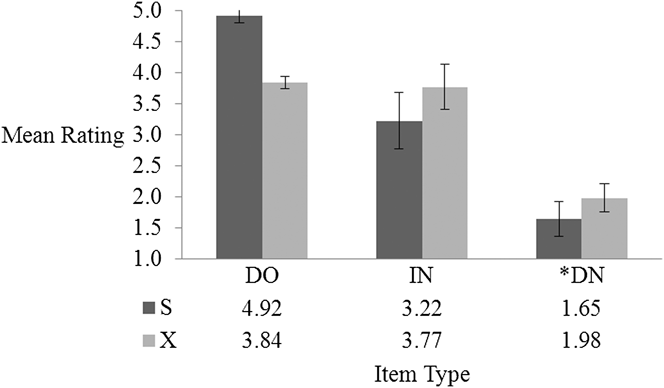
Figure 1 shows the mean ratings of the Spanish control group and the L1 BP-L2 Spanish experimental group for item types involving simple clauses: 1 is the low rating (indicating unnatural) and 5 is the high rating (indicating natural). Error bars designate a 95% confidence interval. As seen in Figure 1, both the Spanish control and experimental group reject cases of definite object drop, which is ungrammatical in Spanish; each group’s mean rating was below 2. Both groups also accepted overt object clitics when the referent was definite, with mean ratings of at least 3.80 out of 5.00. Cases of dropped indefinite objects fell between the other two cases, with respective group ratings of 3.22 (Spanish control) and 3.77 (experimental group).
Simple clauses (S = Spanish control group; X = L1 BP-L2 Spanish experimental group; DO = overt object with definite referent; IN = dropped object with indefinite referent; DN = dropped object with definite referent; * = ungrammatical in Spanish).

Results of the repeated-measures ANOVA revealed a significant Group × Item Type interaction, F(2, 78) = 211.10; p < .001. Sidak post hoc tests indicated no significant differences between the two groups with respect to items containing dropped objects with indefinite referents (p = .063) and dropped objects with definite referents (p = .066). There were significant differences between the mean ratings of the two groups only in cases of items with overt objects with definite referents. However, it should be noted that both groups still accepted tokens of this item type, with the Spanish control and experimental groups’ mean ratings of 4.92 and 3.84 out of 5.00, respectively. Furthermore, both groups assigned the ungrammatical items—dropped objects with definite referents—a low rating (Spanish control: 1.65, experimental group: 1.98) and rated them significantly differently than the grammatical item types: overt objects with definite referents and dropped objects with indefinite referents (p < .001 for all comparisons). Both groups are sensitive to the definiteness of the object pronoun’s referent, rejecting dropped objects when the referent is definite and rating more favorably those items in which the object is dropped but the referent is indefinite and those in which the object is overt and the referent is definite. We thus claim that these learners respect the semantic requirements of object drop in Spanish, meaning that, through the course of their Spanish acquisition, these BP learners of Spanish have come to know that the semantic feature [definite] regulates the licensing of whatever syntactic representation they have for nonphonetically realized objects. Left to be determined, however, is what their syntactic representation in this domain looks like.
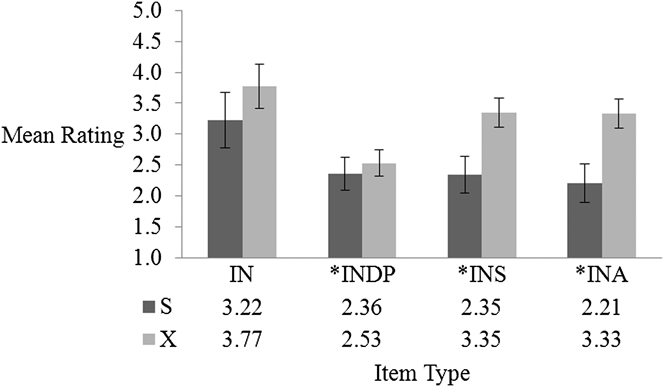
We now turn to syntactic island contexts to see if BP learners of Spanish have acquired the syntax of dropped objects in Spanish. Conversely, if they do not show knowledge of the Spanish syntax and, instead, rely on the L1, which would allow null objects in island conditions, we are interested in knowing if the sensitivity to the semantic restriction of object drop shown by the learners from the cases of simple clauses just examined is carried over into island contexts. Figure 2 shows the native Spanish and L2 groups’ mean ratings of dropped objects with indefinite referents in both simple clauses and syntactic island contexts (DP, subject-CP, and adjunct islands). Error bars indicate 95% confidence intervals.
Dropped objects with indefinite referents (S = Spanish control group; X = L1 BP-L2 Spanish experimental group; IN = dropped object with indefinite referent in simple clause; INDP = object with indefinite referent dropped from complex DP island; INS = object with indefinite referent dropped from subject-CP island; INA = object with indefinite referent dropped from adjunct island; * = ungrammatical in Spanish).
As seen in Figure 2, the Spanish native group rejected indefinite object drop in all syntactic island types, assigning mean ratings of 2.36 out of 5.00 or lower. The L2 group rejected only indefinite objects dropped from complex DP islands, with a mean rating of 2.53, whereas they rated indefinite dropped objects in subject-CP islands and adjunct islands much more favorably, with mean ratings of 3.35 and 3.33, respectively. The ANOVA results indicated a Group × Item Type interaction, F(3, 117) = 10.74, p < .001. Post hoc tests showed significant differences in ratings between the native and L2 Spanish groups for dropped indefinite objects in subject-CP and adjunct islands only (p < .001 for both comparisons); the groups’ difference with respect to dropped indefinite objects in DP islands was not significant (p = .313). The clause type (i.e., simple vs. island) was significant in the ratings of the native Spanish group, who distinguished significantly between indefinite object drop in simple clauses, on the one hand, and the three types of syntactic islands, on the other (p < .001 for all comparisons). The L2 learners made a three-way distinction: They rated dropped indefinite objects in simple clauses the highest, followed by subject-CP and adjunct islands (with no significant difference between these two island types, p = 1.0), and gave the lowest rating to indefinite dropped objects in DP islands. Simple clauses were rated differently than subject-CP islands (p = .039), adjunct islands (p = .009), and DP islands (p < .001); DP islands were also rated differently than subject-CP islands (p < .001) and adjunct islands (p < .001). These results indicate that the native Spanish participants rightly disallow dropped objects within syntactic islands as a result of having the correct syntax in place in their grammar. The L2 group allows dropped objects in both subject-CP and adjunct islands; however, one cannot say that the learners are solely using BP syntax because they show nativelike knowledge that objects cannot be dropped in DP islands, a licit environment in BP. We return to these interesting data in the Discussion and Conclusion sections.
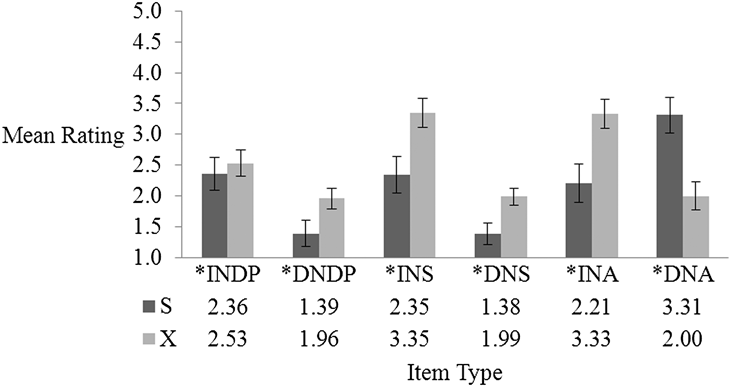
Finally, we look to see if the sensitivity to definiteness of the object in acceptability of object drop carries over into syntactic island contexts. In Figure 2, we saw that the experimental group allowed for dropped objects in two out of the three strong island conditions, which is not in line with the target grammar. However, it could be the case that the experimental group applied the semantic constraint (as seen in Figure 1) without regard for the syntactic restrictions of object drop in Spanish. To check this, we look at the native Spanish and L2 groups’ performance with respect to definite and indefinite dropped objects in syntactic island contexts. Mean ratings and 95% confidence intervals are presented in Figure 3.
Dropped objects with (in)definite referents in syntactic islands (S = Spanish control group; X = L1 BP-L2 Spanish experimental group; INDP = object with indefinite referent dropped from complex DP island; DNDP = object with definite referent dropped from complex DP island; INS = object with indefinite referent dropped from subject-CP island; DNS = object with definite referent dropped from subject-CP island; INA = object with indefinite referent dropped from adjunct island; DNA = object with indefinite referent dropped from adjunct island; * = ungrammatical in Spanish).
As seen in Figure 3, the native Spanish group rates almost all instances of object drop from syntactic islands unfavorably, with mean ratings below 2.40 out of 5.00. The one exception is those items that contain a dropped object with a definite referent in adjunct islands, with a mean rating of 3.31. The experimental group rated definite object drop from islands unfavorably, with mean ratings of 2.00 or less, and also rated indefinite object drop in DP islands unfavorably, with a mean rating of 2.53. However, as pointed out in the explanation of Figure 2, these learners failed to strongly reject indefinite object drop in both subject-CP and adjunct islands.
The repeated-measures ANOVA showed a significant Group × Definiteness × Island Type interaction, F(2, 78) = 118.64, p < .001, with post hoc tests indicating significant differences (p < .001) between the two groups for nearly all item types. The exception was dropped indefinite objects in DP islands, in which there was no significant difference (p = .313). Both the native Spanish and experimental groups demonstrate sensitivity to definiteness (p < .001 for all comparisons) for each island type: For instance, whether or not an object was definite influenced the native Spanish group’s rating of a sentence with a dropped object in a DP island. However, whereas the native Spanish group’s ratings (with the exception of adjunct islands) alternated between more weakly rejected definite dropped objects and more strongly rejected indefinite dropped objects, the L2 group’s ratings (with the exception of DP islands) varied between acceptance and rejection.
In sum, the native Spanish group performs more or less like one would expect given the theoretical descriptions of the Spanish grammar. The NS group rejects dropped objects in island contexts regardless of definiteness (although definite dropped objects in islands are rated as worse), whereas the L2 group does not. The L2 group allows dropped objects in two of three island conditions yet clearly respects the Spanish constraint on definiteness. The behavior of the L2 group with the different island types still needs to be explained; we address this in the next section.
BP Control and Experimental L1 BP-L2 Spanish Groups
In light of the experimental group’s less-than-nativelike behavior detailed in the previous subsection, the group’s performance was compared to a group of monolingual speakers of BP, tested in BP, in an effort to identify any possible L1 effects. The results of these comparisons are detailed in this subsection. The results of the simple clause contexts are presented first to check for sensitivity to the semantic restriction for object drop. Then, items with dropped objects (in both island and nonisland contexts) with indefinite referents are examined to investigate any syntactic restrictions on object drop. Finally, object drop in island contexts is examined to establish if definiteness of the referent is a determining factor in accepting object drop in islands. The reader is reminded that the syntactic literature claims that inanimate object drop in BP is felicitous regardless of the definiteness of the referent or the syntactic context in which the object appears. Accordingly, all instances of object drop used in our experiment should be acceptable in BP.
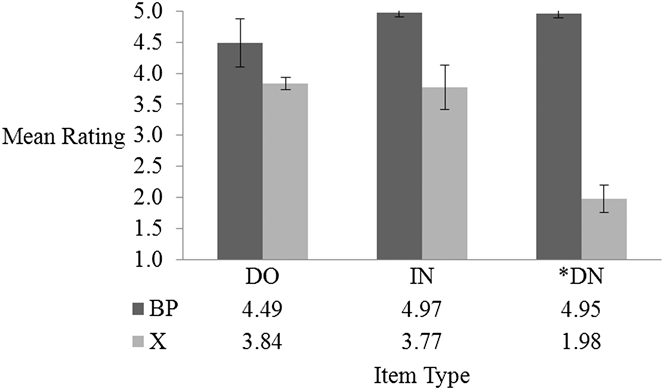
Figure 4 shows the results of simple clauses. Error bars indicate a 95% confidence interval. As seen in Figure 4, the native BP participants accept the overt expression of a definite object with a mean rating of 4.49 out of 5.00; they also accept null objects, regardless of the definiteness of their referent, with a mean rating of 4.97 for indefinite null objects and a mean rating of 4.95 for definite null objects. This contrasts with the experimental group’s performance in the Spanish version of this experiment; the experimental group gave favorable ratings to overt definite objects and dropped indefinite objects and an unfavorable rating to dropped definite objects.
Simple clauses (BP = BP control group; X = L1 BP-L2 Spanish experimental group; DO = overt object with definite referent; IN = dropped object with indefinite referent; DN = dropped object with definite referent; * = ungrammatical in Spanish).
Results of the ANOVA showed a Group × Item Type interaction, F(2, 76) = 118.43; p < .001. Post hoc tests of intergroup differences showed a significant difference between the BP native group and the experimental group for each item type (p < .001 for all comparisons). This indicates that, for each item type, the ratings of the BP monolingual native group were significantly higher than those of the experimental group of BP learners of Spanish tested in Spanish. Post hoc tests of within-group comparisons revealed that the BP monolingual group rated those items with an overt object less favorably than those with no object (p < .001). Items with a null object were not rated significantly differently, whether the referent of the object was definite or indefinite. This suggests that object drop is actually preferred in BP. As seen in the previous subsection, the experimental group performed more in line with the Spanish grammar, rating both overt definite objects and dropped indefinite objects significantly more favorably than dropped definite objects. So, whereas the native BP group accepts null objects regardless of definiteness, definiteness seemed to condition the experimental group’s acceptability of object drop in L2 Spanish. There is, thus, no detectable L1 influence seen in the set of item types presented in Figure 4.
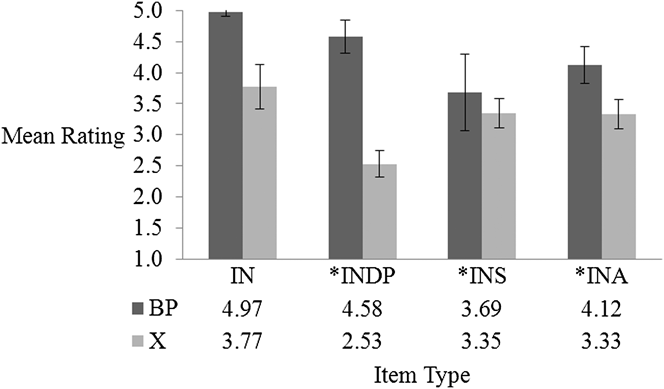
Next, we examined if there are any syntactic restrictions on null objects in BP, similar to Spanish and EP, and if the experimental group’s performance in Spanish could be accounted for by this. Figure 5 shows the BP native and experimental groups’ mean ratings on items with null indefinite objects, in both simple clauses and island environments.
Dropped objects with indefinite referents (BP = BP control group; X = L1 BP-L2 Spanish experimental group; IN = dropped object with indefinite referent in simple clause; INDP = object with indefinite referent dropped from complex DP island; INS = object with indefinite referent dropped from subject-CP island; INA = object with indefinite referent dropped from adjunct island; * = ungrammatical in Spanish).
Figure 5 shows that the native BP group rated instances of indefinite object drop in syntactic islands favorably, including in DP islands (M = 4.58), subject-CP islands (M = 3.69), and adjunct islands (M = 4.12). The learners in the experimental group rejected indefinite object drop in DP islands for Spanish, whereas they rated the other item types more favorably (i.e., above 3.00).
The inferential statistical analysis indicated a significant Group × Item Type interaction, F(3, 114) = 31.38; p < .001. Post hoc tests to identify intergroup disparities showed that the native BP group rated all item types significantly higher than the experimental group (p < .001), with the exception of subject-CP islands (p = .162). Items exhibiting indefinite object drop in subject-CP islands were also rated higher by the native BP group but not to a significant extent (p = .162). Turning to within-group comparisons, the native BP group rated simple clauses the highest, followed by DP islands, then adjunct islands, and finally subject-CP islands; furthermore, the native BP group distinguished each item type from the others at a statistically significant level. Simple clauses were rated higher than DP islands (p = .002), adjuncts islands (p < .001), and subject-CP islands (p < .001); DP islands were rated higher than adjunct islands (p = .002) and subject-CP islands (p < .001); and adjunct islands were rated higher than subject-CP islands (p = .012). The experimental group, however, made a three-way distinction, rating simple clauses the highest, followed by both subject-CP and adjunct islands, and then DP islands. Therefore, although both groups rated indefinite nonovert objects lower in syntactic islands than in simple clauses, they differed when judging the different island types.
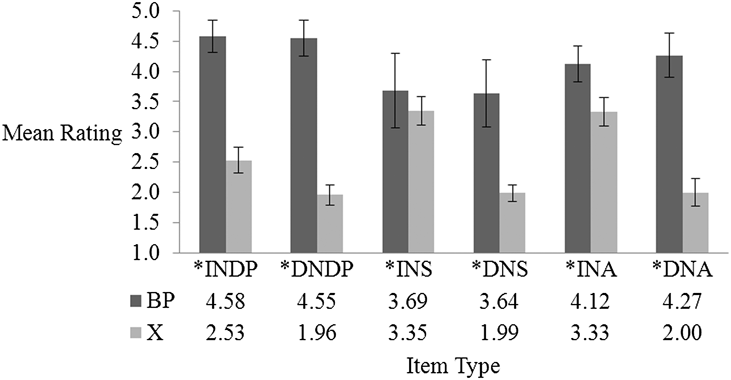
Finally, we checked to see if definiteness of the object had any effect in different syntactic islands. Figure 6 shows the BP native and experimental groups’ ratings for both indefinite and definite object drop in each island type (i.e., DP, subject-CP, and adjunct islands). Error bars indicate a 95% confidence interval. The BP native group seems to accept all instances of object drop regardless of the definiteness of the object or the island type in which it appears. Its members rate object drop the least favorably in sentential subject-CP islands, with null indefinite and definite objects receiving ratings of 3.69 and 3.64 out of 5.00, respectively. Null objects in other island types received ratings of at least 4.12. As seen in the last subsection, the experimental group generally rated indefinite object drop higher than definite object drop, and only indefinite object drop in subject-CP and adjunct islands received ratings above 3.00 out of 5.00.
Dropped objects with (in)definite referents in syntactic islands (BP = BP control group; X = L1 BP-L2 Spanish experimental group; INDP = object with indefinite referent dropped from complex DP island; DNDP = object with definite referent dropped from complex DP island; INS = object with indefinite referent dropped from subject-CP island; DNS = object with definite referent dropped from subject-CP island; INA = object with indefinite referent dropped from adjunct island; DNA = object with indefinite referent dropped from adjunct island; * = ungrammatical in Spanish).
A repeated-measures ANOVA showed that there was a significant interaction among group, definiteness (of the object), and island type, F(2, 76) = 24.77; p < .001. Post hoc tests that compared the BP native and experimental groups at each level of definiteness by island type showed significant differences between the two groups in all categories (p < .001 for all comparisons), with the exception of indefinite dropped objects in subject-CP islands (p = .162). Although it was shown in the previous subsection that the experimental group’s performance was influenced by definiteness of the object in that the learners rated instances of indefinite object drop in any given island type significantly higher than their definite counterparts, the participants in the native BP group did not exhibit any such performance. Definiteness showed no effect on their judgments, with no significant differences between ratings of indefinite and definite object drop for each of the island types: DP (p = .742), subject-CP (p = .665), and adjunct islands (p = .214).
Overall, both of the control groups behaved as expected (on the basis of claims from the literature). In general, the Spanish control group only accepted dropped objects when they were indefinite and did not violate subjacency. The BP control group generally accepted all instances of null objects. In contrast, the experimental group did not strongly conform to either grammar. A discussion of the interpretation of these results and of their implications is presented in the next section.
DISCUSSION
The experimental tasks were designed to tap speakers’ intuitions on the availability of nonovert objects in Spanish (in the case of the native Spanish and experimental groups) or BP (in the case of the monolingual BP group) on the basis of definiteness of the object and the syntactic context in which an object was overtly expressed or not. The learning task of the experimental group, BP native speakers learning Spanish, was not only to converge on the target grammar by acquiring a new syntactic option for nonovert object licensing as well as a new semantic restriction but also to preempt the learners’ L1 option as ungrammatical in the L2. Because preemption may be problematic in the acquisition of object drop in Spanish for this particular group of learners, examining the phenomenon in BP monolinguals was necessary. We now discuss the results to see what they can tell us about the particular behavior of each group with respect to object drop, the experimental group’s acquisition of object drop in Spanish, any possible effects of the native language that may hinder the acquisition process, and what unexpected behavior was found in the data.
The behavior of the native Spanish group was generally in line with expectations based on claims in the literature. As detailed previously, object drop in Spanish is subject to both semantic and syntactic restrictions: Dropped objects must be indefinite, and, because syntactic movement is involved, the syntactic environments of the dropped objects are subject to subjacency constraints. Effectively, this means that any dropped object that was definite or occurred in a syntactic island should be rejected by natives. This was the case, as items that met either of these criteria were rejected by the native Spanish group. Additionally, items that met both of these criteria (i.e., dropping a definite object from a syntactic island context) received the lowest ratings from the Spanish native group. The one anomaly in the Spanish native data was the case of dropped definite objects in adjunct islands, which received a neutral rating.
The behavior of the native BP monolingual group was also in line with claims from the BP syntactic literature. Because null objects in BP are not subject to a definiteness restriction as in Spanish, and because they do not show subjacency effects (as no movement is implicated), the native group was not expected to reject any of the item types presented here. This expectation held in our data. Furthermore, those items with null objects were generally rated more favorably than their counterbalances (with an overt object), although not always to a significant degree. This offers modest empirical support to the general claim in the literature that null objects may be preferred to their overt counterparts at least in some dialects of BP.
To satisfy any claim that the experimental group’s performance is converging on the target grammar, evidence that they respect, at least in part, both the semantic and syntactic restrictions of object drop in Spanish should be demonstrated. As seen in the Results section, the experimental group does show knowledge of the semantic constraint on object drop. In simple clauses, the learners in the experimental group reject cases of definite object drop, whereas in complex clauses with syntactic islands, they continue to make the semantic distinction, systematically rating items exhibiting definite object drop lower than those exhibiting indefinite object drop. Their performance related to knowledge of the syntactic constraint is less consistent. In syntactic island contexts, the learners did reject items with definite dropped objects, but they failed to do so with those items containing indefinite dropped objects. In fact, they exhibited an asymmetry in this respect: The experimental group learners rejected indefinite dropped objects in DP islands, but they rated indefinite dropped objects in both subject-CP and adjunct islands significantly higher (i.e., above the middle rating on the scale used in the task). As such, although the learners do seem to grasp the semantic restriction of the target grammar, they do not show consistent knowledge of the Spanish syntax implicated. Thus far, the data presented here are consistent with the interpretability hypothesis (Tsimpli & Dimitrakopoulou, Reference Tsimpli and Dimitrakopoulou2007), which states that interpretable features are acquirable in L2 acquisition but uninterpretable (i.e., syntactic) ones are not.Footnote 9 However, their asymmetrical judgment in island contexts may indicate that they do have knowledge of the syntactic properties of object drop in Spanish, particularly based on their performance with DP islands, but that they may not apply this knowledge in all cases, instead resorting to their L1 syntactic option in other island contexts. Questions remain as to why the semantic restriction seems to be more acquirable than the underlying syntax of dropped objects in L2 Spanish given this language pairing and why we see divergent judgments on different syntactic island types.
Part of the learning problem could be the result of the L2 learners’ inability to preempt their L1 option, which might stem from the particular properties of null objects in BP combined with effects of the potentially ambiguous nature of the Spanish input as received by native speakers of BP. In Spanish, dropped objects are a relatively lower frequency phenomenon that alternates with overt object clitics, which are exhibited in the input with a high frequency but low phonological saliency. In BP, null objects are certainly preferred in the colloquial dialect, and, although the existence of third-person object clitics is debated, they do exist in formal registers, especially in writing. If educated native speakers of BP have the option of using either overt or null objects (in the case of inanimate third-person clitics), the Spanish input becomes potentially ambiguous: Object clitics may be seen as preferred but not obligatory. Additionally, the BP speaker may not experience the necessary parsing failures for grammatical restructuring because the L1 grammar is seemingly equipped to interpret overt object clitics. Over time, the overwhelming frequency with which definite objects are expressed may lead the learner to (unconsciously) conclude that these clitics are highly preferred or perhaps even obligatory.
The syntactic restriction is a different story. Acquiring both the semantic and syntactic restrictions on object drop in Spanish is necessary to converge on a targetlike grammar, but the two restrictions seem to be independent of each other, and neither one, on its own, is sufficient for successful acquisition. Although an understanding of the semantic restriction may be gleaned from exposure to simple clauses only, knowledge of the syntactic restriction would require sufficient exposure to input that demonstrates that syntactic movement is involved in object drop in Spanish. This type of input, such as sentences containing indefinite objects in potential syntactic islands, is assumed to be of exceedingly low frequency as compared to the type of input that exemplifies the semantic requirements of object drop in Spanish. The quantitative difference in the input of these two related, yet independent, restrictions that are associated with object drop may be the source of the discrepancy in their acquisition by the experimental group.
Although the experimental group does show some knowledge of the syntactic restriction, the learners’ performance is inconsistent. They correctly reject instances of object drop in DP islands, and, like the Spanish group, distinguish between definite and indefinite object drop in this island type. However, more in line with the participants in the native BP group, they fail to reject indefinite object drop in subject-CP and adjunct islands. The learners’ performance in these two island types may be the result of a type of hybrid of the Spanish and BP grammars: They apply the Spanish semantic restriction, but, like the BP grammar, there is no syntactic restriction. Consequently, they only reject definite object drop. We take this as evidence that they still entertain some options from their L1 grammar, at least in the syntactic realm; they face a preemption problem that they cannot overcome at this stage of development. Again, these data alone are consistent with the interpretability hypothesis (Tsimpli & Dimitrakopoulou, Reference Tsimpli and Dimitrakopoulou2007). However, bringing this data set together with the data from Bruhn de Garavito and Guijarro-Fuentes (Reference Bruhn de Garavito, Guijarro-Fuentes, Costa and Freitas2001) for English and EP learners of Spanish will oblige us to better understand our data as being consistent with full accessibility approaches, a point to which we return in the Conclusion section.
The question remains, however, as to why these BP learners of Spanish seemingly apply the Spanish syntax asymmetrically, as in the case of DP islands, while opting for the BP syntax in other environments. We have already seen that the patterns are not random, which suggests that there is an underlying explanation for the consistency of choosing one syntactic option over another. It has been observed and accepted that, although subjacency conditions (or general locality conditions) are existent, some level of unexpected extraction is evidenced in naturally occurring speech and reflected in various levels of gradient judgments across different types of islands for native speakers. In the Barriers framework (Chomsky, Reference Chomsky1986), the observation that CP and adjunct islands are perceived as more unacceptable than certain DP islands (i.e., extraction from complement clauses) was explained by the fact that these DP islands have fewer barriers as compared to other islands. Whatever the minimalist explanation for this turns out to be, these DP islands are generally accepted to be a less difficult island condition from which to extract.
If BP L2 learners of Spanish have the underlying Spanish syntax, as we argue, but fail to preempt the BP syntax, this could explain why they would be more nativelike with DP islands. If certain DP islands are found less unacceptable as compared to other strong islands, this may be because they are not as costly to process. Additionally, if the BP learners of Spanish have not preempted their L1 grammar as a possibility for use in the L2, they may resort to using their L1 syntax when trying to interpret structures that demand a high processing load, such as CP and adjunct islands. Subsequently, the DP islands with lower processing costs are interpreted and judged with the L2 (Spanish) syntax; the other island types tax the processor to such an extent that learners resort to the L1 syntax. This would lead to low ratings for the DP islands and higher ratings with the CP and adjunct islands. In other words, learners’ L1 grammar is unconsciously preferred—without modification—to handle Spanish input for subject-CP and adjunct islands but not for DP islands.
CONCLUSION
Our data indicate that the experimental group successfully acquired the semantic constraint for object drop in Spanish but showed somewhat variable knowledge of the syntax of Spanish dropped objects. As we have acknowledged, if we consider our data in isolation, the results are consistent with the interpretability hypothesis (Tsimpli & Dimitrakopoulou, Reference Tsimpli and Dimitrakopoulou2007), which claims that problems in L2 ultimate attainment arise when the property in question hinges on the acquisition of new, uninterpretable (i.e., syntactic) features. Because the interpretability hypothesis does not claim that evidence of seeming (surface) L2 learning when new syntactic features are implicated is impossible, it predicts variability as opposed to categorical lack of knowledge. In many ways, it predicts what our data show. However, taking into account the success of English learners of Spanish (as in Bruhn de Garavito & Guijarro-Fuentes, Reference Bruhn de Garavito, Guijarro-Fuentes, Costa and Freitas2001), who also must acquire the same new, syntactic features but whose L1 presents no stumbling blocks in this regard, support for the interpretability hypothesis seems less justified: If English learners of Spanish can acquire the syntactic features needed to instantiate object drop in a L2, it is impractical to claim a priori that BP learners cannot do the same.
In light of the problems for the interpretability hypothesis that arise when the L1 English-L2 Spanish data are taken into account, we must offer another explanation for our data. We maintain that the performance of the experimental group stems from a competition in the learners’ Spanish grammar between the target syntactic option—a topic-operator structure—and the option from their L1—a licensing of pro in object position. Both L1 English and L1 BP learners of Spanish must acquire the target syntax. However, unlike L1 English speakers, L1 BP learners must also discard their L1 option (i.e., pro) from the L2 grammar. As Trahey and White (Reference Trahey and White1993) have convincingly shown, acquisition of target L2 syntax does not necessarily entail that transferred L1 syntactic options are replaced. We therefore propose that the present data are best explained as resulting from proper acquisition of the necessary target semantics and that the L2 syntax has been acquired but is obscured by an L1 preemption effect.