“Farewell to Ireland” is the title of a reel recorded in the United States by three of Ireland's great fiddle players, Michael Coleman (1891–1945), James Morrison (1893–1947), and Paddy Cronin (b. 1925). The feeling expressed in the title of this tune surely reflects the sentiments many of the emigrants must have felt when leaving Ireland, with little prospect of ever returning home, exacerbated in that era by the limitations of mass communication and transportation. Musicians who left the homeland brought with them the styles of playing and repertoire prevalent in their particular areas at the time. Now in a new country, their music came under various influences, including some from other parts of Ireland. Among these musicians was Paddy Cronin, a highly regarded fiddle player from Sliabh Luachra (pronounced shleev loo-a-khra) in the southwest of Ireland, who emigrated to Boston in 1949 at twenty-four years of age.
From a personal perspective, and as a fiddle player myself, I recall hearing about Paddy long before I heard him play either on recordings or live. In the fiddle world, he was highly respected for the standard of his playing, for his knowledge of the music, and for his unusual and wonderful versions of tunes. Although Paddy's playing reflected the characteristics of Sliabh Luachra music,Footnote 1 it also showed other elements and features, primarily from the Sligo style in the northwest part of the country. In this article, I consider Paddy's personal performance style and the ways in which it was influenced during his time away from Ireland.
Sliabh Luachra and the Fiddle Playing of Pádraig O'Keeffe
Sliabh Luachra (The Rushy Mountain or The Mountain of Rushes) is situated in the southwest of Ireland on the Cork/Kerry border along the upper reaches of the river Blackwater. It extends over areas in east Kerry, northwest Cork, and southwest Limerick and includes places such as Ballydesmond, Brosna, Gneeveguilla, Knocknagree, and Scartaglen. These villages, as well as others, have given their titles to various tunes in the local repertoire, for example, “The Scartaglen Slide” and “The Ballydesmond Polka.” Although the exact location of the region is difficult to outline geographically, its place on the musical landscape is much more clearly defined. Because the dancing of “sets of quadrilles” has featured prominently in the area, the music is lively and rhythmic, with polkas and slides being prominent tune types. The style of playing is very distinctive. Fiddle and accordion, the main instruments in this style, have shaped to a great extent the music as we hear it today. The fiddle, in particular, has assumed marked importance because of the influence of Pádraig O'Keeffe (1887–1963), often referred to as the Sliabh Luachra Fiddle Master.Footnote 2
Pádraig was born in Gleanntán, about midway between Ballydesmond in County Cork and Castleisland in County Kerry. His father, John O'Keeffe, was master in the local school; his mother, Margaret O'Callaghan, played the concertina and fiddle. She was one of a very musical family from Doon, near Kiskeam, on the Cork side of the county bounds. From a young age, Pádraig showed great aptitude for music and learned to play the fiddle, accordion, and concertina. Having trained as a teacher, he took over as master in Gleanntán school in 1915, on the unexpected death of his father. Increasingly, however, Pádraig lost interest in this way of life, and music with its associated lifestyle took over. He relinquished the position of schoolmaster in 1920, and from then on devoted the rest of his life to his real calling, that of playing and teaching the fiddle throughout the Sliabh Luachra area.Footnote 3
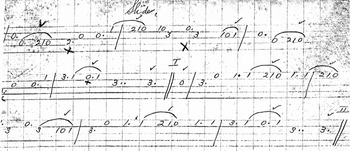
When writing out tunes for his pupils or other musicians, Pádraig used two different systems of notation, one for the accordion and one for the fiddle. In the accordion “code,” figures (numerals) and symbols were used to indicate the buttons (keys) to be pressed, as well as the direction (“press” or “draw”) in which the bellows were to be moved. Thus Pádraig provided a type of tablature notation by which he could specify the particular sequence of notes required to play a tune. In the fiddle code the four spaces of the standard five-line staff were used to represent the four fiddle strings. Figures 0 to 4, placed in the appropriate spaces, indicated the fingers required to play particular notes. Various other symbols specified other aspects of the music, such as the relative note lengths and ornamentation.Footnote 4 An important feature is that bowing marks were always included. (An example of the notation is shown in Figure 1a below.)
Untitled “Slide” in Pádraig O'Keeffe's fiddle code. This manuscript was received from the late Johnny O'Leary. It is included in Matt Cranitch, “Pádraig O'Keeffe,” 354. Some figures were missing from the left-hand side of the manuscript. However, the notes can be deduced from the context of the tune itself. For example, the lead-in note, the anacrusis to bar 1, is the note B, played with the first finger on the A (second) string.

Pádraig played a central role in creating the style of playing as it is known today. Many of the tunes that now constitute the general repertoire of the area are attributable to him. He was particularly renowned for the manner in which he performed slow airs, through which he inspired many other fiddle players. Perhaps his greatest contribution, however, was as a teacher, not only in terms of the number of people he taught, but also because of the legacy of tunes and the style of playing he transmitted through his unique manuscripts. Among his many protégés were the “greats” of the Sliabh Luachra tradition, such as Denis Murphy (1910–74), Julia Clifford (1914–97), Johnny O'Leary (1923–2004), and Paddy Cronin—a virtual “roll call” that today would be the envy of many Irish musicians.
On his peregrinations throughout the Sliabh Luachra area, Pádraig did not carry any writing materials, and so he wrote the tunes on any available sheets or even on scraps of paper, including, at times, his pupils' school copy-books. A large number of these manuscripts, in various states of repair, have been preserved to this day. Many musicians, and indeed also some nonmusicians, possess photocopies of the manuscripts; few, however, own “originals.” Although Pádraig's manuscripts are not available in a unified compilation, scholars of Irish music estimate his total output to be in excess of a thousand works.Footnote 5 Because Pádraig included bowings, both slurring and markings for bow directions, as well as indications for ornamentation for the entirety of every tune that he notated for his fiddle pupils, these manuscripts constitute an extremely valuable record of the performance style of his time and region.
Paddy Cronin
Paddy Cronin was born in 1925 in Ré Buí (Reabue), about three miles north of Gneeveguilla, near Killarney, County Kerry. He was one of a family of nine, five boys and four girls. His mother, Hannah Nagle, played the concertina in her young days. His father, Michael, a farmer, enjoyed music but did not play any instrument. Paddy got a fiddle from his aunt Hannah Cronin, his father's sister, who had spent some time in Boston but now lived nearby; at about the age of nine he started to learn from Pádraig O'Keeffe. Initially, Pádraig came to Paddy's home and showed him how to read the notation system of figures and symbols. He also wrote out a number of tunes on each of these visits, sometimes as many as twelve or thirteen, which gave Paddy plenty of work to be done. If Paddy was not at home when Pádraig called, he wrote the tunes nonetheless, leaving them with Paddy's mother. In later years Paddy generally met Pádraig in Lyons' pub in Scartaglen, where they both played along with Denis Murphy. Denis, who was fifteen years Paddy's senior, lived nearby in Lisheen and was both a source of help and a playing companion. Paddy graciously credits Denis for, as he says, “bringing him along.”Footnote 6 Paddy recounted these early experiences in a field recording interview in 1999:
Whenever he'd [Pádraig] be in the area, or whenever he'd get the notion, he'd show up, and then he'd write a whole bunch of tunes. He done all the explaining to me the first few times he came, bowing and the figures. He wrote in figures. . . . He'd show me how to do the thing. Then he'd write them down and if I wasn't home in the house, then my mother, Lord have mercy on her, would be there and he'd write away. I'd meet him again after that in Scartaglen. . . . He'd write all kinds of tunes. He'd never play it on the fiddle or anything, he'd just whistle it and write it down. Sometimes he'd write as much as twelve or thirteen tunes, and he'd take off again. He'd give you plenty work. And then of course you'd rehearse them with Denis and himself in Scartaglen. . . . I had Denis near me and that helped a lot.Footnote 7
What wonderful music must have been played on those occasions in Scartaglen by these three great fiddle players of Irish traditional music! The prospect, now impossible, of being present at one of those sessions would tantalize many of today's musicians.
“Slide” recorded in Baile Mhúirne
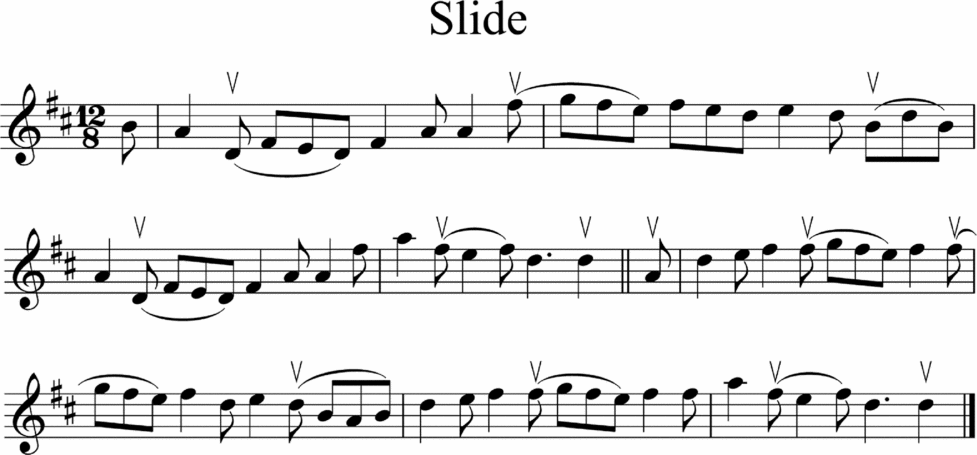
In the economically depressed Ireland of the 1940s, there were few employment opportunities or prospects for Paddy, and, like so many others, he decided to “take the boat,” that is, emigrate to the United States. As he himself says, his reason, “like everybody else,” was to look “for employment. Things were bad here in Ireland in them days,” he recalled years later.Footnote 8 Shortly before he left Ireland in June 1949, he was recorded by Séamus Ennis for Radio Éireann (now Radio Telefís Éireann or RTÉ). This recording was made in Baile Mhúirne in County Cork on 28 May 1949.Footnote 9 Among the tunes Paddy played on that occasion were a set of two slides,Footnote 10 titled on the notes accompanying the recording as “The Dark Girl in Blue”/“Across the Road,” and designated as “single jigs.”Footnote 11 (Although generally seen as a distinct tune type, at least within the Sliabh Luachra tradition, the slide may be considered a single jig, and therefore a subset of the jig genus. The slide's predominant note pattern per beat consists of a quarter note followed by an eighth note, which, with their “long-short” time distribution, impart a distinctive rhythmic impetus to the music. This note combination is interspersed with groupings of three eighth notes, in the style of double jigs.) The first of these tunes is widely played in the Sliabh Luachra area and is known by various names, including “Pádraig O'Keeffe's Slide,” “Denis Murphy's Slide,” and “Julia Clifford's Slide.” The uncertainty and variability of names for many slides and polkas reflects the opinion, often expressed anecdotally, that these tune types “have no names” and so are frequently referred to by the identities of the region's iconic musical legends. This particular slide is also found in one of Pádraig manuscripts, notated in his code system. As can be seen in Figure 1a, he referred to the tune simply as a “Slide.” A transcription in standard notation is given in Figure 1b.
Untitled “Slide” in standard notation.
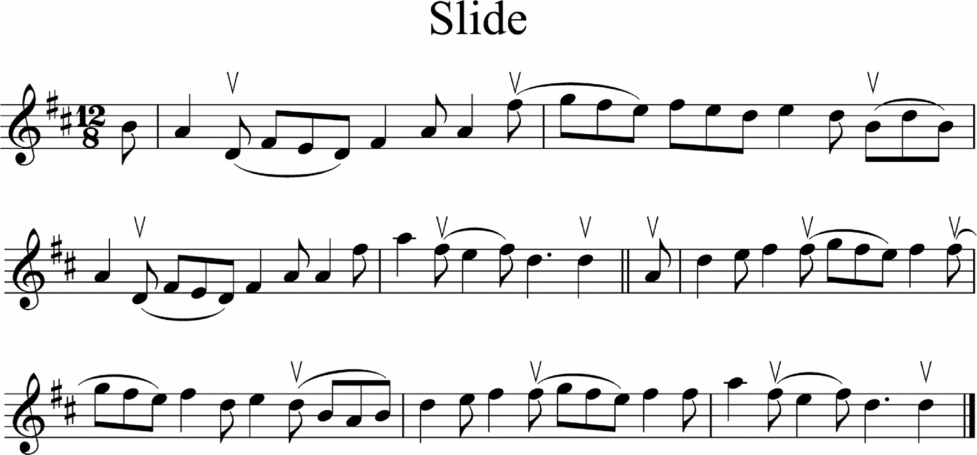
On the 1949 recording of this slide by Paddy, we can clearly hear the strong rhythmic playing of a very accomplished musician in a style that displays the hallmarks of Sliabh Luachra fiddle music. The idiomatic bowing, such as phrasing across the beat, as seen in Pádraig's own notation, is definitely audible. A comparison with Pádraig's own playing of this same tune on a recording made in 1955 corroborates this particular point in relation to the distinctive enunciation of the slide and reveals further insights.Footnote 12 The tune is played somewhat faster by Paddy than by Pádraig, perhaps not surprisingly, given their relative ages; by 1955 Pádraig was likely to have been beyond his best. Paddy uses ornamentation, such as rolls, to a greater extent. He also includes a particular upward glissando feature on the high G (second finger on E string), for instance at the beginning of bar 2.Footnote 13 This effect is also to be heard in Pádraig's playing, but not necessarily at the same points in the tune. In emulating his master in the use of this decoration, Paddy integrates this idea into his own playing, but expresses it in an individualistic way. Although it is clear that Paddy's style of playing owes much to his master, it still is very personal.
Paddy in Boston
After Paddy's arrival in the United States in June 1949, he lived and worked in Boston, where he married his wife, Connie, and raised a family. Paddy resided in Boston for the next forty-one years, with the exception of three years in Chicago. After his arrival, he had the opportunity to hear other fiddle players performing in different styles, particularly Canadian musicians, who, he said, “played all kinds of nice music, and . . . always had a piano player, and the piano player usually hit the chord right.”Footnote 14 He liked this kind of sound, and, from what we hear of his own music from that era, he himself adapted quickly to playing with piano accompaniment. As he says, he likes someone to “chord the piano”Footnote 15 when he is playing, and he likes the accompanist to be very familiar with the tune being played. In this respect, he observes, perhaps somewhat cryptically and wryly, but nonetheless characteristically of his turn of phrase: “You can't do much with a piano-player unless they know the tune!”Footnote 16
Paddy made a number of 78 rpm recordings in Boston at the invitation of the owner of the Copley record label, Justus O'Byrne DeWitt, who, according to Mick Moloney, “carried on the tradition in the Irish ethnic recording business of recording certain musicians simply because they represented artistic excellence. One of the musicians he recorded was . . . Paddy Cronin.”Footnote 17 This point is reiterated by Susan Gedutis in her book about Irish music and dance in Boston, when she says that “solo instrumentalists . . . were recorded solely for their artistry or their ability to preserve “stylistic nuances” of the time.”Footnote 18 O'Byrne DeWitt, when interviewed by Mick Moloney in 1977, reiterates these points in outlining his reasons for recording Paddy, emphasizing how highly he rated him, and how he considered him on a par with Michael Coleman: “I thought Paddy was the best fiddler I ever heard. . . . With the exception of maybe [Sean] Maguire, I think he is as close to Coleman as any one could get to. I heard him and I liked his playing and I made a couple of records with him. . . .”Footnote 19
“Cailleach an Airgid” (The Hag with the Money)
Among the 78 rpm records made by Paddy was one that featured the set of reels “The Templehouse”/“The Duke of Leinster” and the set of jigs “Boys of the Town”/“Hag with the Money.”Footnote 20 This recording was made ca. 1952 with Hermeline German on piano.Footnote 21 The second of these two jigs, however, had also been recorded by Paddy in 1949, during the recording session in Baile Mhúirne cited above. On that occasion, the tune was titled by its Irish-language name, “Cailleach an Airgid.” Certain differences stand out between these two recordings, one made in Ireland before his emigration, the other after three years living in the New World. The Baile Mhúirne version is unaccompanied, whereas the Boston recording includes piano accompaniment, which has a significant effect on the overall sound, as well as, to a lesser extent, on the fiddle playing itself. In the Boston recording, Paddy's playing is more deliberate and the tempo is slower, about 128 to the dotted quarter note, compared to approximately 152 on the Baile Mhúirne recording. In the earlier recording as well, one can hear the influence of the slide rhythm on his jig playing to a greater extent. In addition to the obvious tempo difference, the bowing and idiomatic rhythmic articulation of the slide also come into play. The later version includes greater use of the roll as a feature of ornamentation. There is little doubt that these various differences in approach imbue the same tune with two very contrasting sets of dynamics, which thereby create, from an overall perspective, a very different aesthetic in each of these great performances.
Stylistic Features
Before he had left Ireland, Paddy was familiar with the music of Michael Coleman and James Morrison, both of whom had emigrated to the United States many years before he had (Coleman in 1914 and Morrison in 1915). In New York, their individual musical output on record (78 rpm) during the 1920s, 1930s, and 1940s was prolific. Coleman recorded in excess of ninety sides, and Morrison recorded eighty-four sides.Footnote 22 Through their seminal influence, as well as that of others, New York City in effect became “a centre of Sligo-style fiddle playing.”Footnote 23 Their recordings were sent home by many emigrants and in some cases brought back by those returning home to Ireland. As Paddy himself says, “Their records were [brought]back here by people coming back on holidays,”Footnote 24 thereby indicating that 78 rpm records had reached Sliabh Luachra before Paddy left for the United States. He admired the playing of Coleman mostly for listening, and that of Morrison as a dance player, but still could not decide who was the better of the two. He compares them thus:
I liked a lot of stuff that Coleman done, just to listen to it, but he wasn't a dance man. But he done a lot with it, you know. He done a lot with it, but Morrison was dance, you know. . . . When he played you wanted to dance, you know, but which of them was the best I'm not good enough at it to tell you that. I don't know, but they both would satisfy me.Footnote 25
Among the specific stylistic characteristics notable in Paddy's playing, particularly of reels, is his use of “trebles.” A “treble” involves playing three notes of the same pitch, in a triplet-like pattern, in place of a quarter note. The notes are bowed separately (i.e., one bow stroke per note) with very short bow-strokes, achieved primarily by a flick of the wrist, rather than with the bow arm as a whole. The effect created by “trebling” is, to a great extent, rhythmic rather than melodic and, depending on the particular emphasis given to these notes by the player, may even have percussive qualities.Footnote 26 This form of ornamentation is generally not considered to be a significant feature of the Sliabh Luachra style, although it may occasionally be heard, and some examples are to be found in Pádraig O'Keeffe's manuscripts. On the other hand, it is an integral part of Sligo-style fiddle playing. The influence in this regard that Coleman and the other great Sligo fiddle players had on Paddy's playing, as well as on his extensive repertoire of tunes, is discussed by David Lyth, who also cites specific recordings as excellent examples of Paddy's music:
Their tunes and technique formed the basis of most of the Irish music that Paddy encountered. Within a short time he was playing the great Sligo selections in superb style, emulating the great masters in technique, verve and interpretation. His 1950s recordings include an outstanding “Wheels of the World/Rakish Paddy” selection which has a definite Morrison influence—not to mention a “Millstone/Dairymaid” set in the same style.Footnote 27
A significant feature of Paddy's playing is his sense of timing. The term is taken here to refer to both the tempo at which a tune is played as well as to the temporal features of ornamentation, particularly with regard to the way in which decorations such as the roll are expressed. This understanding of timing echoes the view of Liz Doherty, who defines it as “a rather general term used to denote both tempo, and also the related areas of phrasing and articulation.”Footnote 28 In Paddy's case, his sense of tempo is impeccable, with the tunes being played at a “rock-steady” and unwavering pace. In a comprehensive sense, his overall approach to timing, in its various manifestations, is one of the hallmarks of his style of playing.
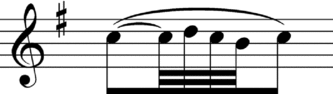
The roll is probably the most widely used type of ornament in Irish fiddling, perhaps even in Irish traditional music. The effect created can be both rhythmic and melodic, depending on how it is enunciated. Two auxiliary notes, one higher in pitch and one lower, decorate a dotted quarter note in a five-note sequence, as shown in Example 1. When played on the fiddle, the five notes are slurred as indicated. In the particular case of a “short roll,” the decoration starts immediately on the first sixteenth note, with no preliminary eighth note.Footnote 29
Example of a five-note “roll.”
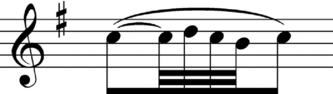
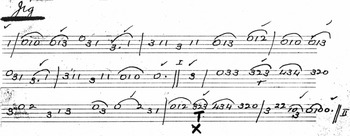
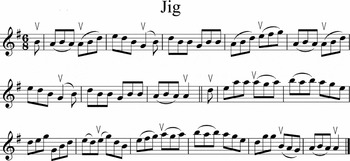
Notwithstanding the relative note lengths implied by the notation, the roll may be articulated in a variety of ways in performance. At one end of the spectrum, some of the notes can be compressed into a very tight cluster, thereby creating a more rhythmic, if not percussive effect. Alternatively, the notes may be enunciated in a more open and melodically expressive manner. The latter approach can be heard in the playing of Pádraig O'Keeffe, Denis Murphy, and others. Pádraig referred to this decoration as a “Trill” and used the letter “T,” particularly in his notation of jigs, to indicate the use of this feature at a particular point in a tune, as shown in Figure 2a. For reels, he usually specified fully the actual notes to be played.Footnote 30 Paddy Cronin's interpretation of the roll owes much to both the Sligo and Sliabh Luachra traditions and is a particular feature of his playing. A somewhat unusual and humorous description of the timing of this ornament is given by Ciaran Carson in his book about “Music, Food and Time”:
To define a roll is difficult—it must be heard in order to be understood, or grasped. Basically, a roll consists of a five-step rhythmical cluster . . . and seem[s] to exist outside conventional time, since the quintuple movement happens in triplet time. . . .
So, the fiddle-player Michael Coleman has been deified because he rolled a lot. Some think he rolled too much, and might prefer the playing of his contemporary Paddy Killoran, who got great bounce and rasp from the bow and used the roll for occasional rhythmic variation. Sometimes it seemed as if the time of the tune had been momentarily changed, and you glimpsed another time, another destination, beyond the current run of notes; as if the bus company had found room for one more intermediary stop, yet still managed to de-bus its final passengers on schedule.Footnote 31
Pádraig O'Keeffe appears in his teaching to have paid a great deal of attention to bowing, which “more than any other element, is the key to understanding and reconstructing the performance of a tune in a specific style.”Footnote 32 As Paddy recalls, “He was very very very fussy about the bowing.”Footnote 33 The role that bowing plays in Irish traditional fiddle playing is very much underappreciated (on both sides of the Atlantic). Given that it is with the bow that fiddler players get to the soul of the music, bowing plays a central part in the creation of this style. Pádraig's pupils who remained in the Sliabh Luachra area generally adhered to his guidelines to a significant degree. However, the bowing of others, such as Paddy, Denis Murphy, and Julia Clifford who traveled away from home, does not conform to it to the same extent. Nonetheless, although their bowing does not follow Pádraig's in the literal manner of up-down sequences, the overall way in which they express their music owes a great deal to his teachings.
Untitled “Jig” in Pádraig O'Keeffe's fiddle code. This manuscript was received from Máire O'Keeffe and is included in Matt Cranitch, “Pádraig O'Keeffe,” 351.

In the particular case of jigs, where the primary note cluster per beat consists of three eighth notes, these notes are frequently played in three separate bows or slurred in one bow. Such bowing patterns are widely used and may be seen, for example, in Pádraig's notation of an untitled jig, shown in Figure 2a, with a transcription to standard notation in Figure 2b. Within the tradition, this tune is commonly referred to as “Tom Billy's Jig.” An exception to the pervasiveness of the three-note slur appears in bar 12, where the bowing pattern of 2–2–1–1 imparts a binary feeling and resulting syncopation across the inherent phrasing of the 6/8 meter. This bowing feature is found in many of Pádraig's jig manuscripts and also appears in a transcription by David Lyth of Julia Clifford's playing of “Art O'Keeffe's Jig.”Footnote 34 Such nonmetrical bowing is a particular feature of Paddy's playing, which, when coupled with his very individual and somewhat detached bow-stroke enunciation, helps to create his special and unique way of expressing jigs. From a personal perspective, and on the basis of reasoning similar to that given here, I have indicated the inverse form of this pattern, that is, 1–1–2–2, in a number of instances in my own Irish Fiddle Book.Footnote 35
Untitled “Jig” in standard notation.

“Farewell to Ireland”
As stated earlier, “Farewell to Ireland”Footnote 36 is the title of a reel recorded in the United States by three of the great players in the Irish fiddle tradition. The respective recordings by Michael Coleman in 1921,Footnote 37 James Morrison in 1935,Footnote 38 and Paddy Cronin ca. 1952Footnote 39 afford the opportunity to hear some wonderful music from these three masters, “brought together” in a virtual sense through their individual versions of the same reel. A very valuable comparison of their playing styles can also be made, showing both similarities and differences. In an overall sense, the Sligo-style aesthetic comes through in terms of repertoire, flamboyance of the playing, and detailed aspects of idiomatic expression in the reel rhythm. Coleman's performance displays extensive use of left-hand ornamentation, including rolls and triplets, as well as trebling, all well-known facets of his music. On the other hand, Morrison's playing has more rhythmic drive, as would be expected in the dance domain, due in part to the presence of other instruments, such as accordion and banjo. These contrasting features echo Paddy's opinion, cited earlier, that he preferred Coleman for listening and Morrison as a dance player.
In Paddy's own performance, various points made earlier about his playing are clearly audible, as is the characteristic “swing” of the Sliabh Luachra style. From the point of view of mastery of the instrument and musical confidence, he was on a par with the more famous Coleman and Morrison, many people considering him to be one of the greatest Irish fiddle players. In particular, those facets distinctive to Paddy's playing—such as timing, rhythmic enunciation, and bowing—are clearly heard in his performance of this reel. The inclusion of an upward glissando feature on the high G (second finger on E string), previously discussed in relation to the untitled slide on the Baile Mhúirne recording of 1949, is heard at the beginning of the second bar of part II. This specific type of decoration also occurs in Pádraig O'Keeffe's reel playing, a fact that serves to underscore Paddy's indebtedness to his teacher, especially in terms of the detailed aspects of fiddle playing.Footnote 40
In summary, then, Paddy's music represents a very fine example of how an individual can encapsulate a range of different strands of influence, yet create something that is uniquely his own. At home in Sliabh Luachra, his undoubted talents received their initial development and stimulation from his teacher and mentor, Pádraig O'Keeffe. This comprehensive grounding was reinforced through his ongoing extensive musical interaction with Pádraig, as well as with Denis Murphy. Through the 78 rpm recordings from the United States that reached Sliabh Luachra, he became familiar with Sligo-style fiddle playing and repertoire. On arriving in Boston, he encountered first-hand a great deal of this kind of music, as well as music from the Canadian tradition of Cape Breton, in both of which piano accompaniment featured prominently. Within this milieu, with new creative possibilities, Paddy's music evolved and blossomed, integrating the diverse elements that, taken together in a holistic manner, constitute his musical persona.
Home in Ireland
During his years in Boston, Paddy made many return visits to Ireland, usually to coincide with Fleadh Cheoil na hÉireann,Footnote 41 an all-Ireland annual festival of music at which competitions are a central feature. He was a welcome visitor, with many people eager to hear his music, and “where he played seemingly endless sessions, with rare tunes, great style and exceptional virtuosity.”Footnote 42 For fiddle players particularly, it was considered a special opportunity to hear him play in person. During these years, he was recorded a number of times by RTÉ for both radio and television. He can also be heard on various commercial recordings including The Rakish Paddy and Kerry's Own Paddy Cronin.Footnote 43 In 1990, after forty-one years in the United States, Paddy moved back to Ireland and now lives in Killarney. He still plays the fiddle at sessions and concerts, and attends many festivals, where his presence is eagerly awaited.
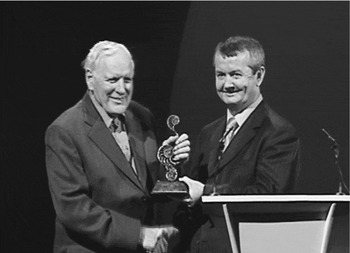
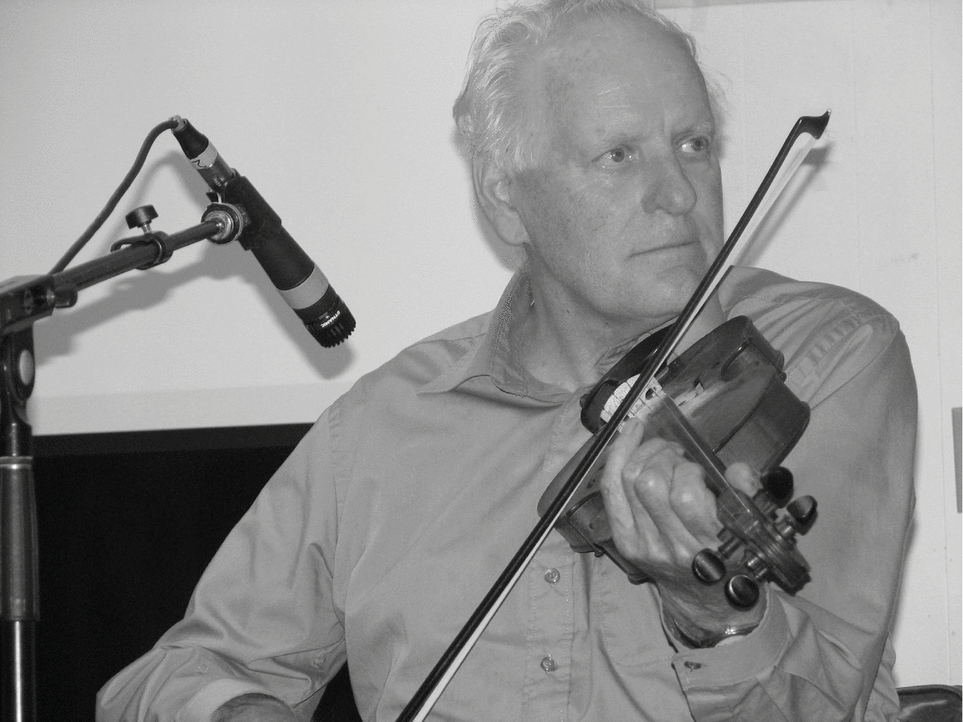
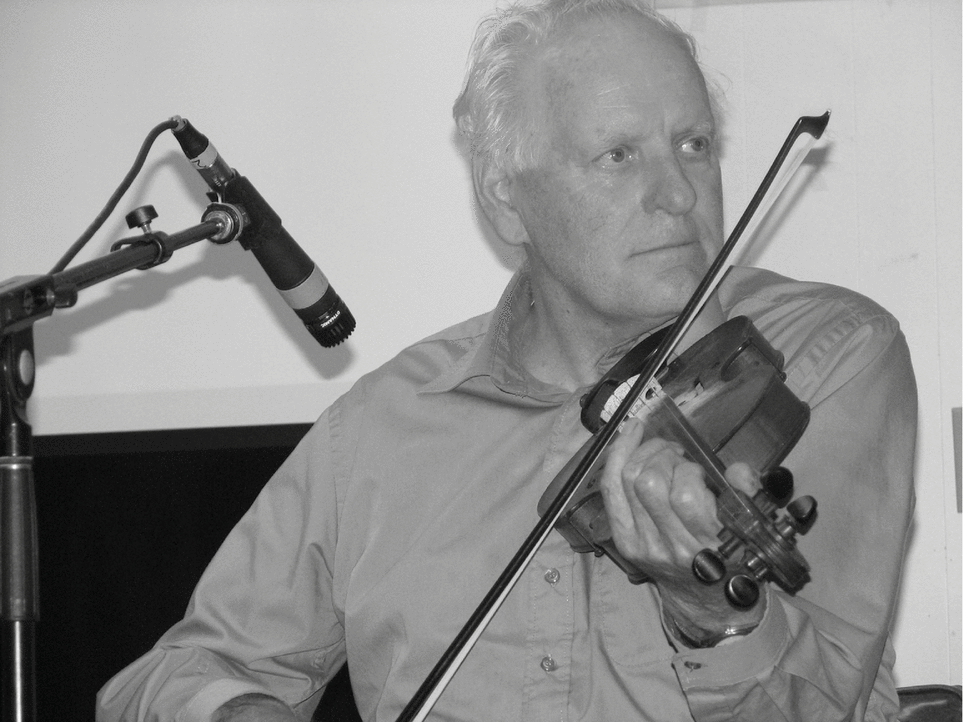
In 2007 Paddy received the TG4 Gradam Saoil (Lifetime Achievement Award) at a ceremony that took place during a gala concert at the Cork Opera House on 8 April 2007, an event that was subsequently broadcast.Footnote 44 As part of the presentation that night, a video collage of Paddy's musical life, compiled from archival footage, was shown. He also played a selection of slides with Jackie Daly (accordion) and Dónal O'Connor (fiddle). Figure 3 shows Paddy being presented with his award. In July of the same year, he was a special guest at the Catskills Irish Arts Week, during which a tribute lecture was presented by this writer. Following an exposition of Paddy's life and music, a video recording of the TG4 Gradam Saoil award ceremony was shown. He himself then spoke and played some music with Felix Dolan (piano), Jackie Daly (accordion), Paul De Grae (guitar), and myself (fiddle). Figure 4 shows Paddy on that occasion.
Paddy Cronin being presented with the TG4 Gradam Saoil (Lifetime Achievement Award) by Pól Ó Gallchóir, Ardstiúrthóir (Director General), TG4, Cork Opera House, Cork, Ireland, 8 April 2007. Photo from video screen shot. Reproduced by permission of TG4 and ForeFront Productions.

Paddy Cronin performing at a special session honoring his life and music, organized and hosted by the author. Catskills Irish Arts Week, East Durham, New York, 18 July 2007. Photo by Paul F. Wells. Reproduced by permission.
Throughout his life, Paddy has always been a very keen student of music. In Boston he learned to read standard music notation, which gave him access to the various tune collections. Virtually every day, he went through one or more of these books, particularly The Dance Music of Ireland,Footnote 45 searching for new tunes and for alternative versions of those that he already knew, frequently “improving” them. Many tunes in his extensive repertoire provide eloquent testament to this study. His lifelong practice of perusing these sources continues to this day.
After a lifetime of creating superb music with his fiddle and bow, from Sliabh Luachra to Boston and back, Paddy Cronin enjoys a very significant personal reputation in the world of fiddle playing, thereby occupying an assured place in the annals of Irish traditional music.