Introduction
Brazil is the world’s largest producer of sugarcane (Kassab et al. Reference Kassab, Loureiro, Rossoni, Pereira, Mota, Barbosa and Costa2015). The main pests affecting this crop are the sugarcane borer, Diatraea saccharalis (Fabricius) (Lepidoptera: Crambidae), and the leafhopper Mahanarva fimbriolata (Stål) (Hemiptera: Cercopidae) (Kassab et al. Reference Kassab, Loureiro, Rossoni, Pereira, Barbosa, Costa and Zanuncio2014; Rossoni et al. Reference Rossoni, Kassab, Loureiro, Pereira, Costa, Barbosa and Zanuncio2014a, Reference Rossoni, Loureiro, Pereira, Kassab, Costa and Barbosa2014b). The direct damage caused by D. saccharalis can lead to loss of biomass and death of apical buds in sugarcane plants (Dinardo-Miranda et al. Reference Dinardo-Miranda, Fracasso and Perecin2011, Reference Dinardo-Miranda, Anjos, Costa and Fracasso2012). Indirect effects include the reduced production of sugar and alcohol, due to the presence of microorganisms in the affected stems (Simões et al. Reference Simões, Letícia, Bento, Solter and Delalibera2012; Rossato et al. Reference Rossato, Costa, Madaleno, Mutton, Higley and Fernandes2013).
Chemical insecticides are inefficient in controlling D. saccharalis, because the first instars feed on the cartridge leaves and subsequently migrate to the sugarcane stalk where they are protected from topical applied insecticides (Antigo et al. Reference Antigo, Oliveira, Carvalho and Pereira2013; Oliveira et al. Reference Oliveira, Antigo, Carvalho, Glaeser and Pereira2013). This has led to research on biological methods to control of this pest (Rodrigues et al. Reference Rodrigues, Pereira, Kassab, Pastori, Glaeser, Oliveira and Zanuncio2013).
Diatraea saccharalis is attacked by a large number of micro-Hymenoptera and several species of fungi, of particular importance are the parasitoids Palmistichus elaeisis Delvare and LaSalle, Tetrastichus howardi (Olliff), and Trichospilus diatraeae Cherian and Margabandhu, (Hymenoptera: Eulophidae) (Cruz et al. Reference Cruz, Redoan, Silva, Figueiredo and Penteado-Dias2011; Chicera et al. Reference Chichera, Pereira, Kassab, Barbosa, Pastori and Rossoni2012; Vargas et al. Reference Vargas, Pereira, Calado, Glaeser, Rodrigues and Silva2014; Pereira et al. Reference Pereira, Kassab, Calado, Vargas, Oliveira and Zanuncio2015). The entomopathogenic fungi Beauveria bassiana (Balsamo) Vuillemin (Cordycipitaceae) and Metarhizium anisopliae (Metchnikoff) Sorokin (Clavicipitaceae) also can provide significant levels of control. For example, M. anisopliae is produced in rice and applied to sugar cane fields in Brazil to reduce populations of M. fimbriolata (Loureiro et al. Reference Loureiro, Batista Filho, Almeida and Pessoa2005).
Concurrent use of these fungi and parasitoids might work in a synergistic or antagonistic manner (Roy and Cottrell Reference Roy and Cottrell2008) to enhance control D. saccharalis, but further research is required to clarify the nature of their interactions when co-occurring in the same host (Santos et al. Reference Santos, Marques, Barros and Gondim2006; Rossoni et al. Reference Rossoni, Kassab, Loureiro, Pereira, Costa, Barbosa and Zanuncio2014a, Reference Rossoni, Loureiro, Pereira, Kassab, Costa and Barbosa2014b; Ibrahim Reference Ibrahim2015). This fact motivated us to investigate whether B. bassiana and M. anisopliae compromise the development of P. elaeisis, T. howardi, and T. diatraeae in pupae of D. saccharalis. Specifically, we assessed the effect of exposure to these fungi on the percentage of hosts from which parasitoids emerged, the number of parasitoids emerging per pupa, egg-to-adult development time, sex ratio, and adult longevity.
Materials and methods
Experimental work was conducted in the Biological Control of Insects (LECOBIOL) and Microbiology Laboratories of the Universidade Federal da Grande Dourados (UFGD) in Dourados, Mato Grosso do Sul, Brazil.
Source of fungi and insects
The formulations of fungi used in the experiment were the commercial products Metiê WP® (M. anisopliae – IBCB 425) and Ballvéria WP® (B. bassiana – IBCB 66) provided by the company Ballagro Agro Tecnologia (Atibaia, São Paulo, Brazil). Both formulations had more than 95% spore viability.
Diatraea saccharalis eggs were obtained from laboratory colonies maintained by LECOBIOL (UFGD). Eggs were packed into glass vials (8.5 cm diameter×13 cm height) containing an artificial diet based on wheat germ (150 g), soybean (540 g), and the phagostimulant, sugarcane yeast (450 g) (Saccharomyces cerevisiae Meyen ex Hansen; Saccaromycetales: Saccaromycetaceae) to provide nutrition for the newly hatched larvae that remained in situ until the final instar was reached (Parra Reference Parra2007). Larvae were then transferred to disposable Petri dishes (6.5 cm diameter×2.5 cm height) with a feedback diet based on soya bean and sugarcane yeast until the formation of pupae was observed. Pupae were collected and placed in clear plastic pots (rectangular, 500 mL, 14.2×9.8×4.7 cm) where they remained until adult emergence. The adults were sexed and 50 adults (30 males and 20 females) were placed in polyvinyl-chloride-tube cages (10 cm diameter×22 cm height), internally coated with bond paper for harvesting eggs. The cages were closed with bond paper and elastic. Eggs were collected daily, washed with a solution of copper sulfate (1%), and stored in a climatic chamber at 25±2 °C, 70±10% relative humidity, and 14:10 hours light:dark cycle, a methodology adapted from Parra (Reference Parra2007).
Populations of P. elaeisis, T. howardi, and T. diatraeae were maintained separately in glass tubes (2.5 cm diameter×8.5 cm height) sealed with cotton, and fed with droplets of pure honey. To propagate these species, pupae of D. saccharalis (24–48 hours old) were exposed to female parasitoids. The parasitised pupae were individually placed in glass tubes and maintained at 25±2 °C, 70±10% relative humidity, and 14:10 light:dark hours until the emergence of adults (Vargas et al. Reference Vargas, Pereira, Tavares and Pastori2011; Chichera et al. Reference Chichera, Pereira, Kassab, Barbosa, Pastori and Rossoni2012).
Experimental development
For each parasitoid species, pupae of D. saccharalis (24 hours old) were exposed to parasitism by three females over 72 hours. Females were 24 hours in age for T. howardi (Pereira et al. Reference Pereira, Kassab, Calado, Vargas, Oliveira and Zanuncio2015) and T. diatraeae (Pastori et al. Reference Pastori, Zanuncio, Pereira, Pratissoli, Cecon and Serrão2013), and 72 hours in age for P. elaeisis (Andrade et al. Reference Andrade, Sousa, Santos, Gama, Serrão and Zanuncio2012). These ages were selected to optimise the abundance of oocytes. After exposure, the pupae were placed in individual glass tubes (1.5 cm diameter×10 cm height) and capped with hydrophilic cotton.
A piece of filter paper (1×9 cm) either untreated (control) or treated with 1 mL of fungal suspension was placed inside with the parasitised pupae each tube for 96 hours (Rossoni et al. Reference Rossoni, Kassab, Loureiro, Pereira, Costa, Barbosa and Zanuncio2014a, Reference Rossoni, Loureiro, Pereira, Kassab, Costa and Barbosa2014b) at concentrations of 1×10⁹, 5×10⁹, and 10×109 con mL−1 of Metiê® (M. anisopliae) and Ballvéria® (B. bassiana). The tubes were incubated in a growth chamber (BOD) at 25±2 °C, 14:10 hour light:dark cycle, and 70±10% relative humidity until the emergence of parasitoids. The filter papers remained in the tubes for a period of 96 hours before removal. Thus, for each parasitoid species, data was collected for six treatments and a control, replicated 10 times (five parasitised pupae), totaling 50 pupae per treatment.
To measure the effect of fungi exposure on parasitoid fitness, data were recorded for percentage of exposed pupae with adult parasitoid emergence, the number of parasitoids emerging per pupa, and development time (the number of days from date of pupa exposure until emergence of adult parasitoids). Data also were recorded for the frequency of female progeny and the longevity of adult parasitoids. This latter assessment was measured for, 20 females and 20 males of each species of parasitoid, randomly selected for each treatment.
Statistical analyses
To test for an effect of fungi exposure, separate Scott-Knott tests (critical P=0.05) were performed using percentage emergence, number of progeny, developmental time, female frequency, and adult longevity as dependent variables, with treatment as the independent variable. These tests were performed for each combination of fungi and parasitoids. Comparisons were not made across species, because differences in natural history could potentially confound the interpretation of the data.
Results
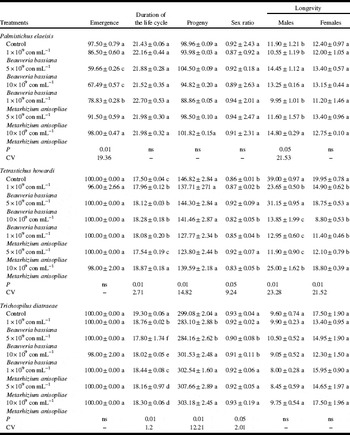
Fitness parameters for the three parasitoid species developing in pupae exposed to the different concentrations of B. bassiana and M. anisopliae are reported in Table 1.
Biological aspects of Eulophidae parasitoids that emerged from pupae of Diatraea saccharalis (Lepidoptera: Crambidae) following exposure to various concentrations of Beauveria bassiana (Cordycipitaceae) and Metarhizium anisopliae (Clavicipitaceae).Footnote *

Notes:
* Means followed by the same letter do not differ by the Scott-Knott test, with up to 5% probability.
con mL−1, conidia of B. bassiana and/or M. anisopliae per mL; CV, coefficient of variation.
The emergence of T. howardi and T. diatraeae from pupae was not affected (P>0.05) by fungal exposure. The emergence of the parasitoid P. elaeisis was affected (P=0.01), with values ranging from 67% to 98%. Development time, progeny, and the female frequency of P. elaeisis were not affected by fungal exposure (P<0.05). Adult longevity values for P. elaeisis females did not differ among treatments, but the values for males ranged from 9.95±1.01 to 14.80±0.29 days.
The development time of T. howardi ranged from 17.54±0.19 to 18.28±0.18 days, which may be related to the natural history of this parasitoid. The number of progeny of T. howardi emerging from pupae ranged 123.80±2.44 to 146.82±2.84 days, the highest value being that of the control. The female frequency of T. howardi ranged from 0.82±0.05 to 0.92±0.09 for all treatments. The longevity of males and females of T. howardi was affected by treatment, with values ranging from 8.80±0.53 to 19.95±0.78 days.
The development time of T. diatraeae was affected by treatments (P=0.01), and ranged from 17.80±1.74 to 19.30±0.06 days. The number of progeny of T. diatraeae emerging from pupae of exposed to fungal treatments ranged from 283.10±2.8 to 307.66±2.89. The frequency of females for T. diatraeae ranged from 0.90±0.08 to 0.93±0.19 across different fungal treatments. The longevity of T. diatraeae males and females did not differ among treatments.
Discussion
The negligible variations in emergence of T. howardi and T. diatraeae from hosts in contact with B. bassiana and M. anisopliae fungi suggest that the exposure of parasitised pupae to the biopesticides did not affect parasitoid fitness. This observation has been demonstrated in the parasitoids Trichogramma galloi Zucchi (Hymenoptera: Trichogrammatidae) in D. saccharalis eggs treated with isolated IPA 159E (Broglio-Micheletti et al. Reference Broglio-Micheletti, Santos and Pereira-Barros2006) and in Cotesia flavipes (Cameron) (Hymenoptera: Braconidae) exposed to the microbial insecticides Biometha WP Plus® (M. anisopliae), Biovéria G® (B. bassiana), Metarril WP® (M. anisopliae), Boverril WP® (B. bassiana), and Metiê WP® (M. anisopliae) (Rossoni et al. Reference Rossoni, Kassab, Loureiro, Pereira, Costa, Barbosa and Zanuncio2014a, Reference Rossoni, Loureiro, Pereira, Kassab, Costa and Barbosa2014b). The parasitoids Psyttalia concolor (Szépligeti) and Psyttalia cosyrae (Wilkinson) (Hymenoptera: Braconidae) successfully emerged from Ceratitis capitata (Weidemann) and Ceratitis cosyra (Walker) (Diptera: Tephritidae) exposed to M. anisopliae in treated soil at 0 and 183 days after treatment application, indicating that the fungus did not exert an adverse effect on their development (Ekesi et al. Reference Ekesi, Maniania, Mohamed and Lux2005). Similar results were observed for the parasitoid Phradis morionellus (Holmgren) (Hymenoptera: Ichneumonidae) developing in Meligethes aeneus (Fabricius) (Coleoptera: Nitidulidae); i.e., M. anisopliae was shown to be effective in controlling the pest beetle, but did not affect the development of the parasitoid (Husberg and Hokkanen Reference Husberg and Hokkanen2001).
Emergence of female P. elaeisis was reduced with exposure B. bassiana and M. anisopliae, but development time, number of progeny, and female frequency were not affected. A similar result was observed for C. flavipes following exposure to these fungi (Rossoni et al. Reference Rossoni, Kassab, Loureiro, Pereira, Costa, Barbosa and Zanuncio2014a, Reference Rossoni, Loureiro, Pereira, Kassab, Costa and Barbosa2014b). In certain instances, parasitoids may be susceptible to infection by entomopathogenic fungi, but can still reproduce, thus, fungi and parasites can be applied simultaneously for pest control (Nielsen et al. Reference Nielsen, Skovgård and Steenberg2005).
Development times of T. howardi and T. diatraeae in hosts exposed to fungi were affected, but the variation across treatments was small, i.e., 1.28 days for T. diatraeae and 0.78 days for T. howardi. This suggests that the observed variation was unrelated to treatment and maybe attributed to natural history. This, observation has been reported for these parasitoids in research conducted by Vargas et al. (Reference Vargas, Pereira, Tavares and Pastori2011), Rodrigues et al. (Reference Rodrigues, Pereira, Kassab, Pastori, Glaeser, Oliveira and Zanuncio2013), Costa et al. (Reference Costa, Pereira, Kassab, Rossoni, Favero and Barbosa2014a, Reference Costa, Pereira, Kassab, Rossoni, Pastori and Zanuncio2014b), Glaeser et al. (Reference Glaeser, Pereira, Vargas, Calado and Favero2014), and Pereira et al. (Reference Pereira, Kassab, Calado, Vargas, Oliveira and Zanuncio2015). These results differ from those found in Aphidius colemani (Viereck) (Hymenoptera: Braconidae), which displayed a decreased development time when its host, Myzus persicae (Sulzer) (Hemiptera: Aphididae), was treated with a suspension of B. bassiana (Emami et al. Reference Emami, Alichi and Minaei2013).
The number of progeny for T. howardi and T. diatraeae emerging from pupae was affected by treatment, but this maybe due to other factors. Previous research has indicated that the numbers of produced maybe related to the quantity of eggs and toxins deposited during egg laying by the female parasitoid, the immune response of the host, and host biomass (Andrade et al. Reference Andrade, Serrão, Zanuncio, Zanuncio, Leite and Polanczyk2010; Cusumano et al. Reference Cusumano, Peri, Bradleigh and Colazza2010; Harvey et al. Reference Harvey, Poelman and Tanaka2013). Inadequate doses of toxins injected by female parasitoid may reduce numbers of progeny emerging from the host (Cusumano et al. Reference Cusumano, Peri, Bradleigh and Colazza2010; Harvey et al. Reference Harvey, Poelman and Tanaka2013). Host hemocytes can encapsulate the eggs and larvae of parasitoids to reduce parasitoid emergence (Strand Reference Strand2008; Andrade et al. Reference Andrade, Serrão, Zanuncio, Zanuncio, Leite and Polanczyk2010). Variations in host biomass also can affect parasitoid propagation, as shown for T. diatraeae in pupae of D. saccharalis (Glaeser Reference Glaeser2011).
The frequency of female progeny for P. elaeisis, T. howardi, and T. diatraeae was not predictably affected by treatment, suggesting that host exposure to fungi did not affect sex ratio. Frequency exceeded 0.82; 0.50 is the minimum value required by quality control processes (Navarro Reference Navarro1998). This high female bias increases the efficiency of parasitism in field releases, because females are responsible for subsequent generations (Rodrigues et al. Reference Rodrigues, Pereira, Kassab, Pastori, Glaeser, Oliveira and Zanuncio2013; Costa et al. Reference Costa, Pereira, Kassab, Rossoni, Favero and Barbosa2014a, Reference Costa, Pereira, Kassab, Rossoni, Pastori and Zanuncio2014b; Barbosa et al. Reference Barbosa, Kassab, Pereira, Rossoni, Costa and Berndt2015). For example, a low frequency of females has been shown can to compromise the parasitism efficiency of parasitoids (Pereira et al. Reference Pereira, Zanuncio, Serrão, Oliveira, Favero and Grance2009a, Reference Pereira, Zanuncio, Serrão, Patrick and Ramalho2009b, Reference Pereira, Zanuncio, Pastori, Chichera, Andrade and Serrão2010, Reference Pereira, Zanuncio, Oliveira, Grance, Pastori and Gava-Oliveira2011). We therefore propose that the changes in sex ratio of Eulophidae within pupae observed in this experiment can be attributed to the availability of host resources, as reported for T. diatraeae in pupae of D. saccharalis and Tenebrio molitor Linnaeus (Coleoptera: Tenebrionidae) (Chichera et al. Reference Chichera, Pereira, Kassab, Barbosa, Pastori and Rossoni2012; Favero et al. Reference Favero, Pereira, Kassab, Oliveira, Costa and Zanuncio2013, Reference Favero, Pereira, Kassab, Costa and Zanuncio2014), P. elaeisis in pupae of Anticarsia gemmatalis Hübner (Lepidoptera: Erebidae), Bombyx mori Linnaeus (Lepidoptera: Bombycidae), and D. saccharalis (Pereira et al. Reference Pereira, Zanuncio, Serrão, Oliveira, Favero and Grance2009a, Reference Pereira, Zanuncio, Serrão, Patrick and Ramalho2009b, Reference Pereira, Zanuncio, Pastori, Chichera, Andrade and Serrão2010, Reference Pereira, Zanuncio, Kassab, Pastori, Barbosa and Rossoni2013; Chichera et al. Reference Chichera, Pereira, Kassab, Barbosa, Pastori and Rossoni2012), and T. howardi in pupae of D. saccharalis (Vargas et al. Reference Vargas, Pereira, Tavares and Pastori2011; Costa et al. Reference Costa, Pereira, Kassab, Rossoni, Favero and Barbosa2014a; Pereira et al. Reference Pereira, Kassab, Calado, Vargas, Oliveira and Zanuncio2015) and Erinnyis ello (Linnaeus) (Lepidoptera: Sphingidae) (Barbosa et al. Reference Barbosa, Kassab, Pereira, Rossoni, Costa and Berndt2015).
The longevity of females of P. elaeisis and T. diatraeae emerging from pupae was not affected by treatment. However, a decreased longevity was observed in both sexes of T. howardi and in males of P. elaeisis. It has previously been suggested that this biological characteristic correlates positively with increased parasitism in field conditions (Pratissoli et al. Reference Pratissoli, Polanczyk, Pereira, Furtado and Cocheto2007). Thereby, a greater longevity can increase the search and parasitism capabilities of parasitoid females, contributing to the reduction of the pest population and an increased effectiveness in controlling outbreaks. However, we believe that the reduction of this biological feature in T. howardi and P. elaeisis was insufficient do compromise the propagation and parasitism of these parasitoids.
In general, the exposure of pupae parasitised by P. elaeisis, T. howardi, and T. diatraeae to entomopathogenic fungi did not affect the development or biological characteristics of these parasitoids. This observation is important, given that, entomopathogens can come into contact with pupae parasitised by these species under field conditions. Because, these biological characteristics (emergence, duration of life cycle, progeny, and sex ratio) are correlated with the biological qualities of parasitoids, we propose that use of these parasitoid species is compatible with the entomopathogenic fungi B. bassiana and M. anisopliae.
Acknowledgements
To the Brazilian institutions, Coordenação de Aperfeiçoamento de Pessoal de Nível Superior (CAPES) for granting the scholarship, Fundação de Amparo à Pesquisa do Estado de Minas Gerais (FAPEMIG), and Conselho Nacional de Desenvolvimento Cientifico e Tecnológico (CNPq) for funding the project approved by the Chamada Universal 14/2012-Faixa A (process CNPq number 482174/2012-9).