





Introduction
Large-scale disasters, including climate-related hazards, increasingly threaten health systems world-wide. Reference Romanello, Walawender and Hsu1 These events expose gaps in systems designed to protect vulnerable populations. Children, particularly newborns, face unique and disproportionate risks during disasters. As the American Academy of Pediatrics (Itasca, Illinois USA) has emphasized, children are not “small adults;” their anatomical, physiological, and psychological characteristics require pediatric-specific disaster planning and response strategies. 2 Recent disasters, including Hurricane Sandy in the United States in 2012 and the 2016 Kumamoto Earthquake in Japan, have demonstrated that neonatal and pediatric evacuations pose substantial challenges under resource-constrained conditions. Reference Espiritu, Patil and Cruz3,Reference Iwata, Kawase and Iwai4
These challenges are most acute in neonatal intensive care units (NICUs), where critically ill neonates depend on continuous access to life-sustaining technologies. Reference Barfield and Krug5 Hospital-wide evacuation requires coordination across departments with competing priorities. Without a shared, objective triage framework, neonatal patients may be under-valued or deprioritized when rapid decisions are required under resource constraints. Reference Barfield and Krug5,Reference Janvier, Leblanc and Barrington6 Effective disaster planning therefore requires triage systems that can guide evacuation priorities based on clinical urgency, technology dependence, or specialized resource requirements.
The appropriate evacuation order may vary by disaster context. Reference Espiritu, Patil and Cruz3–Reference Barfield and Krug5 When a hospital is relatively safe but losing resources, evacuating the sickest patients first may allow more severely ill neonates to continue intensive care at an undamaged center. Conversely, in time-critical events such as fire or structural collapse, least sick first evacuation may maximize rapid clearance from the damaged hospital. Disaster coordinators must therefore choose evacuation priorities according to residual hospital function, time pressure, transport capacity, and receiving capacity.
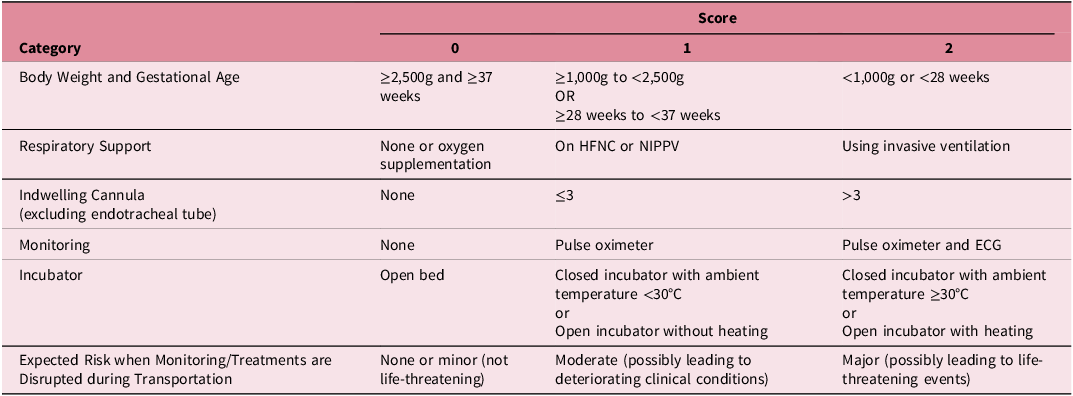
Several neonatal or pediatric in-patient triage systems have been proposed, including the five-level Simple Triage and Rapid Treatment for Neonates, Revised (START-Neo-R; Supplementary Material 1) and Triage by Resource Allocation for IN-patients (TRAIN). 7,Reference Lin, Taylor and Cohen8 However, experience from the 2016 Kumamoto Earthquake suggested that applying START-Neo-R in a NICU could concentrate many patients within a single category, leaving limited granularity for deciding evacuation order. Reference Iwata, Kawase and Iwai4,Reference Imai, Suzuki and Fukaya9 In response to this problem, Neonatal Extrication Triage (NEXT) was developed as a quantitative composite score for neonatal medical resource dependency (Table 1). Reference Imai, Suzuki and Fukaya9 In its development study, NEXT showed criterion-related validity against the Neonatal Therapeutic Intervention Scoring System (NTISS) Reference Gray, Richardson and McCormick10 and high inter-rater reliability among NICU physicians and nurses, while providing finer patient dispersion than START-Neo-R. Reference Imai, Suzuki and Fukaya9
Neonatal Extrication Triage

Table 1. Long description
A table categorizing neonatal triage scores based on various medical parameters. The table has six rows and five columns. The columns are labeled Category, Score 0, Score 1, and Score 2. The categories include Body Weight and Gestational Age, Respiratory Support, Indwelling Cannula (excluding endotracheal tube), Monitoring, Incubator, and Expected Risk when Monitoring/Treatments are Disrupted during Transportation. Each category lists specific criteria for scores 0, 1, and 2. For example, under Body Weight and Gestational Age, Score 0 includes weights of 2,500g or more and gestational ages of 37 weeks or more, while Score 1 includes weights between 1,000g and 2,500g or gestational ages between 28 and 37 weeks. The table provides a detailed framework for assessing the medical dependency and evacuation priority of neonatal patients.
Note: A score of 0–2 was assigned for each of the six domains to give a composite score of 0–12.
Abbreviations: ECG, electrocardiogram; HFNC, high-flow nasal cannula; NIPPV, noninvasive positive-pressure ventilation.
Even with these triage tools, quantitative evaluation of evacuation triage has been limited by the absence of a standardized method for comparing evacuation-order strategies. Most prior work has focused on conceptual development, expert consensus, feasibility, or reliability rather than reproducible quantitative validation of evacuation order. This gap is understandable: actual NICU evacuation cannot be ethically studied under controlled conditions, and real disaster events are rare, heterogeneous, and strongly influenced by local resources, transfer routes, staffing, equipment, and receiving capacity.
To address this methodological gap, the Total Evacuation Score (TES) was developed as a distribution-based metric linking evacuation order to the cumulative burden of illness among patients remaining in the NICU. In this study, TES was constructed using NTISS, a validated therapy-based neonatal severity index; Reference Gray, Richardson and McCormick10 NTISS was selected as the reference severity measure because no universally accepted neonatal evacuation-priority standard was available and because it had been used to assess the criterion-related validity of NEXT in the preceding development study. Reference Imai, Suzuki and Fukaya9 Its therapy-based structure captures treatment intensity and technology dependence, which are directly relevant to evacuation prioritization. Reference Gray, Richardson and McCormick10 The TES framework itself is not limited to NTISS and could be adapted to other locally or nationally accepted severity measures.
Within this framework, the present simulation study used real-world NICU patient data to evaluate two structured triage strategies: NEXT and START-Neo-R. Because descending and ascending evacuation orders are reciprocal when each evacuation step is assigned an equal interval, this study focused on descending evacuation as an analytically tractable baseline. The aims were to develop and apply a reproducible simulation framework for NICU evacuation-order evaluation, to compare structured triage with evacuation without triage, and to compare NEXT with START-Neo-R as quantitative and categorical triage approaches, respectively. As a simulation-based approach, the study was intended to support transparent and reproducible comparisons of evacuation-order strategies under explicit assumptions.
Methods
Study Design and Setting
This retrospective simulation study used a dataset assembled from routinely recorded clinical triage assessments that had been used to develop and evaluate the NEXT system. Reference Imai, Suzuki and Fukaya9 The source data were obtained from clinical assessments conducted from August 1, 2019 through February 28, 2020 at a single tertiary NICU in a university hospital in Japan. During routine clinical practice, NEXT, START-Neo-R, and NTISS had been recorded before the present simulation analysis was conducted.
Patient Cohort and Data Collection
Detailed characteristics of this patient cohort have been previously published. Reference Imai, Suzuki and Fukaya9 At each assessment point, a physician evaluated each neonate using NEXT and START-Neo-R and calculated NTISS.
This study was approved by the Institutional Review Board (IRB) of Nagoya City University (Nagoya, Aichi Prefecture, Japan; Approval number: 60-20-0110). The requirement for informed consent was waived by the IRB owing to the retrospective nature of the analysis and anonymization of data in accordance with institutional ethical standards and the 1964 Declaration of Helsinki and its later amendments.
Triage Systems and Severity Assessment
The NEXT triage system is a quantitative tool designed to assess dependency on medical resources. Reference Imai, Suzuki and Fukaya9 It evaluates six domains, including immaturity, respiratory support, and indwelling cannula, and assigns a score of zero-to-two to each. The sum of these scores yields a composite score ranging from zero to 12 (Table 1).
The START-Neo-R triage system is a five-level color-coded categorical system (Green, Yellow, Red-I, Red-II, and Gray) that classifies neonates based on clinical severity and care dependency (Supplementary Material 1). 7
The NTISS tool is a therapy-based neonatal severity assessment tool comprising 64 items, with higher scores indicating greater illness severity. Reference Gray, Richardson and McCormick10 It had been recorded in the source dataset and had been used as the reference severity measure when assessing the criterion-related validity of NEXT because it is a validated neonatal severity index and captures the intensity of therapeutic interventions relevant to evacuation prioritization. Reference Imai, Suzuki and Fukaya9,Reference Gray, Richardson and McCormick10 Unlike adult critical care, neonatal intensive care does not have a single universally adopted severity score comparable to commonly used adult organ-failure scores. The NTISS tool was not assumed to represent a direct measure of evacuation outcome, transport complexity, or survival benefit.
Evacuation Simulation and Efficacy Metric
Evacuation simulations were conducted using a single pre-defined evacuation direction. Both descending (sickest first) and ascending (least sick first) evacuation strategies were considered conceptually because the appropriate direction may differ by disaster context. Under the simplifying assumption that each evacuation step has an equal interval, descending and ascending orders are mathematically reciprocal. Accordingly, descending evacuation was analyzed as a controlled baseline to isolate the effect of prioritization order.
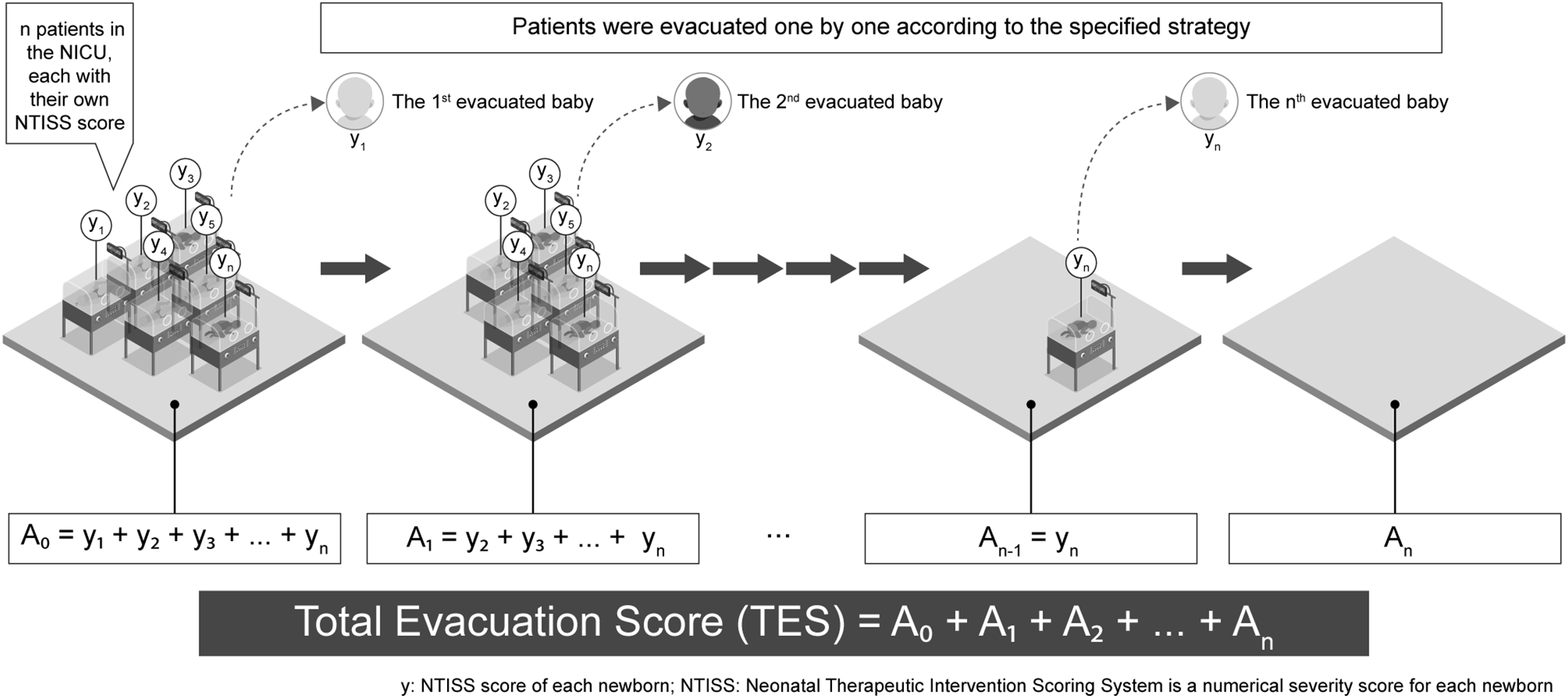
To quantify evacuation-order performance, TES was defined as the time integral of cumulative NTISS severity among patients remaining in the NICU throughout the simulated evacuation process. Under the equal-step assumption, this time integral was represented as the discrete sum of the remaining NTISS burden after each evacuation step. Specifically, TES was calculated as:
 $$TES = \Sigma \,Ai, from \,i = 0 \,to \,n,$$
where Ai is the total NTISS score of patients remaining after the i-th evacuation (Figure 1).
Definition of the Total Evacuation Score (TES).
Note: The TES measures the cumulative severity of illness of patients remaining in the neonatal intensive care unit (NICU) during a simulated evacuation sequence. It is calculated by summing the total Neonatal Therapeutic Intervention Scoring System (NTISS) scores of all patients remaining in a particular unit at each sequential evacuation step. Lower TES values indicate earlier positioning of higher-acuity patients in the evacuation order under the equal-step assumption. Abbreviations: NICU, neonatal intensive care unit; NTISS, Neonatal Therapeutic Intervention Scoring System; TES, Total Evacuation Score.

Lower TES values indicated that patients with higher NTISS scores were positioned earlier in the evacuation sequence.
The equal-step assumption was used to isolate evacuation order from site-specific operational variables. In actual evacuation, transport time and staffing requirements may differ according to respiratory support, hemodynamic instability, infusion pumps, incubator requirements, transport route, transfer distance, and receiving capacity. Because the source dataset did not contain measured data on transport time, staffing burden, or other operational factors, assigning weights to these factors would have required post hoc assumptions; therefore, such weights were not included in the primary model.
Simulations were performed for three strategies: (1) evacuation based on descending NEXT scores; (2) evacuation based on descending START-Neo-R categories; and (3) the no-triage strategy, defined as evacuation without triage, with patient order randomly assigned.
Statistical Analysis
For each observed triage day, TES distributions were analyzed separately. Because TES values vary according to the number and acuity of patients present on each day, direct pooling of TES values across days was not appropriate. Instead, each strategy was compared within each observed triage day.
For NEXT and START-Neo-R, all possible permutations of patient order within tied scores or categories were exhaustively enumerated to generate the complete TES distribution under each rule. For the no-triage strategy, the total number of possible sequences was computationally prohibitive (up to 1028), so random sampling with replacement was used to approximate the no-triage permutation distribution. For this approximation, the relevant sampling uncertainty was the accuracy of approximating the full permutation distribution, rather than uncertainty around a population-level effect estimate. The sampling procedure was validated by confirming that sampled TES distributions reproduced the mean and variance of complete permutation distributions in settings where complete enumeration was feasible. Details are provided in Supplementary Material 2.
The TES distributions of each system were visualized side-by-side as histograms (Figure 2). A vertical dashed line was drawn at the worst-case TES of the evaluated triage system. The pre-defined shaded-area probability was defined as the proportion of comparator TES values on or below this line, representing comparator TES values that were equal to or more favorable than the evaluated system’s worst-case TES. The threshold of 0.5 was specified a priori as a conservative distribution-based benchmark: the evaluated strategy was considered favorable only when the pre-defined shaded-area probability was <0.5, meaning that worst-case TES was lower than more than one-half of the comparator distribution. This threshold was not intended as a clinically validated cutoff.
Comparison of Total Evacuation Score (TES) Distributions.
Note: The TES distributions for an evaluated strategy and a comparator are shown. The vertical line indicates the evaluated strategy’s worst-case TES. The highlighted portion of the comparator distribution at or below this line represents the pre-defined shaded-area probability: the proportion of comparator TES values that are equal to or more favorable than the evaluated strategy’s worst-case TES. The evaluated strategy is considered favorable under the pre-defined distribution-based criterion if the pre-defined shaded-area probability is <0.5. Abbreviation: TES, Total Evacuation Score.

Because the objective was to describe TES distributions generated by pre-defined evacuation-order rules within the observed dataset, the primary analysis was descriptive and distribution-based rather than inferential. The study did not estimate an intervention effect or a population-level association; therefore, conventional confidence intervals and effect sizes were not pre-specified as primary summaries. Results were instead reported using distribution-based descriptive summaries, including the number of observed triage days on which the pre-defined shaded-area probability criterion was met, the number of days with the maximum unfavorable value of 1.0, day-level values, and the relative dispersion of TES distributions.
Results
Patient Characteristics
The study cohort comprised 1,079 patient evaluations of 162 neonates across 49 simulation days. Baseline scores included a median NTISS score of six (interquartile range [IQR], 3-13) and a median NEXT score of six (IQR, 3-8). Patients were classified by START-Neo-R as follows: Green, 30.2%; Yellow, 19.0%; Red-I, 23.0%; Red-II, 25.3%; and Gray, 2.5%.
Simulation Parameters
The number of simulated evacuation patterns varied according to patient census and triage score distribution across the 49 days. For the no-triage strategy, the random sampling approach produced between 8.2 × 10⁵ and 3.3 × 10⁸ simulations per day. For the structured triage strategies, the number of unique evacuation sequences ranged from 2,304 to 5.8 × 10⁷ for NEXT and from 5.2 × 10⁷ to 3.3 × 10¹³ for START-Neo-R. The random sampling method for the no-triage strategy was validated by confirming consistency between sampled and full-set TES distributions where enumeration was feasible (Supplementary Material 2).
Comparison of Triage Efficacy
Within the observed dataset, both structured triage systems generated more favorable TES distributions than evacuation without triage. When each structured triage system was evaluated against the no-triage strategy as the comparator, the TES distributions for both NEXT and START-Neo-R were lower than those for the no-triage strategy on all 49 simulation days, with complete separation of the distributions. Under the assumptions of the simulation model, even the least favorable triage-guided sequence within tied scores or categories produced a lower TES than the sampled no-triage evacuation sequences (Figure 3A and Supplementary Material 3).
Distribution Patterns of Total Evacuation Scores (TES) Across Triage Days.
Note: Panel A shows the comparison of structured triage (NEXT and START-Neo-R) with untriaged evacuation. Panels B-F display the five representative patterns observed when comparing the quantitative (NEXT) and categorical (START-Neo-R) triage systems, ranging from complete separation to varying degrees of overlap. Abbreviations: TES, Total Evacuation Score; NEXT, Neonatal Extrication Triage; START-Neo-R, Simple Triage and Rapid Treatment for Neonates, Revised.

Figure 3. Long description
Panel A: A histogram shows the distribution of total evacuation scores (TES) by evacuation strategy on day 2. The x-axis represents TES, and the y-axis represents density. Three strategies are compared: NEXT, START-Neo-R, and Evacuation without triage. NEXT shows the highest density at lower TES values, followed by START-Neo-R, and Evacuation without triage has the lowest density spread across higher TES values. Panel B: Another histogram displays Pattern 1 on day 20, showing complete separation with NEXT superiority. The x-axis represents TES, and the y-axis represents density. NEXT has a higher density peak at lower TES values compared to START-Neo-R. Panel C: A histogram illustrates Pattern 2 on day 26, showing partial overlap with general NEXT superiority. The x-axis represents TES, and the y-axis represents density. NEXT has a higher density peak with some overlap with START-Neo-R. Panel D: A histogram shows Pattern 3 on day 17 and day 28, indicating substantial overlap. The x-axis represents TES, and the y-axis represents density. Both NEXT and START-Neo-R have overlapping density peaks. Panel E: A histogram depicts Pattern 4 on day 38, showing extended overlap with NEXT not superior. The x-axis represents TES, and the y-axis represents density. Both NEXT and START-Neo-R have overlapping density peaks. Panel F: A histogram illustrates Pattern 5, showing reversed separation with START-Neo-R superiority. The x-axis represents TES, and the y-axis represents density. START-Neo-R has a higher density peak at higher TES values compared to NEXT. Panel G: A table summarizes the TES distribution patterns and triage days, listing the distribution type, number of days, and specific triage days for each pattern.
When NEXT was evaluated against START-Neo-R as the comparator, the pre-defined shaded-area probability was below the 0.5 threshold on 34 of the 49 observed triage days (69.4%). This condition was not satisfied on the remaining 15 observed triage days. The pre-defined shaded-area probability was 1.0 on five of the 49 observed triage days, indicating days on which all TES values under NEXT were higher than those under START-Neo-R in this descriptive comparison. Day-level pre-defined shaded-area probabilities for all 49 days are provided in Supplementary Material 4.
The TES distributions were classified into five representative patterns based on the degree of overlap between NEXT and START-Neo-R (Figure 3B-F). Full TES distribution plots for all 49 days are presented in Supplementary Material 5.
Discussion
Interpretation
Previous neonatal and pediatric disaster triage studies have largely focused on tool development, feasibility, reliability, or expert consensus rather than quantitative evaluation of evacuation-order performance. 7–Reference Imai, Suzuki and Fukaya9 The principal contribution of this study is the development and application of a reproducible simulation framework for evaluating NICU evacuation order using observed patient-level clinical data. Although this simulation cannot show whether a triage strategy improves patient outcomes during an actual disaster, TES makes it possible to examine whether simulated evacuation orders align with a pre-specified measure of patient burden. A more favorable TES distribution means that patients with greater measured burden are less likely to remain in the NICU until later evacuation steps under the modeled order. In this study, NTISS was used as that reference measure, but the TES concept is not inherently NTISS-specific and could be recalculated using other locally accepted severity or transport-burden measures.
Within this framework, structured triage generated more favorable TES distributions than evacuation without triage. In the comparison between NEXT and START-Neo-R, the pre-defined shaded-area probability was below the 0.5 threshold on 34 of the 49 observed triage days. The TES histograms also suggested more concentrated distributions for NEXT than for START-Neo-R, consistent with the greater granularity of its quantitative structure. These findings suggest that structured triage may support more favorable evacuation-order planning than evacuation without triage and that, when structured triage is used, NEXT may provide more reproducible prioritization than START-Neo-R.
Comparison of Triage Systems
The observed pattern favoring NEXT over START-Neo-R can be understood in relation to score granularity and alignment with NTISS burden within the TES framework; NEXT more often generated evacuation orders aligned with higher NTISS burden, whereas START-Neo-R groups diverse patients into a smaller number of categories, creating ties and ambiguity in prioritization. This categorical structure may widen TES distributions because the order within each category remains less constrained. Conversely, NEXT provides greater granularity, reduces ties, and generates a more constrained evacuation hierarchy.
The degree of alignment with NTISS burden varied across observed triage days. A one-point change in NEXT or one-category change in START-Neo-R does not necessarily correspond to a fixed increment in NTISS, so the relative performance of the two systems may depend on the patient mix present on a given day. This variability supports evaluating triage systems across multiple observed census patterns rather than relying on a single representative scenario.
Other in-patient or pediatric disaster triage systems, such as TRAIN, address related questions of resource allocation and prioritization. Reference Lin, Taylor and Cohen8 Additional systems were not applied retrospectively because the variables required to assign them reliably were not recorded in a standardized manner, and post hoc classification without those variables could introduce misclassification bias. Future studies should prospectively collect the variables needed to compare multiple neonatal and pediatric evacuation triage systems within the same TES-based framework.
Assumptions and Future Extensions of the TES Framework
The TES framework was intentionally implemented in its simplest order-based form to isolate the effect of evacuation order from site-specific operational factors. This study simulated descending evacuation, a strategy that may be relevant when hospital function is deteriorating but downstream transport and receiving capacity remain partially preserved. Time-critical disasters, such as fire or structural collapse, may instead require least-sick first evacuation to maximize speed and clearance. Under the equal-step assumption, descending and ascending evacuation orders are reversible, allowing the same framework to evaluate alternative evacuation directions.
This simple formulation also provides a foundation for future weighted models. Mechanically ventilated, hemodynamically unstable, or technology-dependent neonates may require more time, staff, equipment, and coordination than stable patients, but the degree of additional burden is likely to vary across institutions. Rather than assigning universal weights without empirical data, future studies could extend TES by deriving patient-or site-specific weights from evacuation drills, transport-time measurements, staffing experiments, or real evacuation records.
Clinical and Disaster-Preparedness Implications
The TES framework may help NICUs translate patient-level clinical information into a transparent evacuation-order plan and test how different prioritization rules behave before an actual disaster occurs. This may be particularly useful because NICU evacuation may be led by clinicians with limited disaster training or limited real evacuation experience. Reference Barfield and Krug5
For facility-level planning, the TES framework may help NICUs compare alternative evacuation-order rules before a disaster occurs, identify how much prioritization depends on tied scores or categories, and make the assumptions behind evacuation plans explicit and testable. If externally validated, evacuation orders that reduce the burden of high-acuity patients remaining in the unit may plausibly reduce time pressure, staffing burden, equipment bottlenecks, or transport-resource constraints during evacuation. In this sense, the availability of a reproducible simulation metric is itself a practical methodological advance in a setting where controlled evaluation of actual evacuation is rarely feasible.
Research Implications
The broader implication of this work is methodological: TES can be extended from an equal-step model to a weighted model if empirical coefficients for transport time, staffing burden, equipment requirements, or transfer distance become available. For example, evacuation drills or transport simulations could estimate the additional time associated with mechanical ventilation, multiple infusion pumps, incubator transport, or hemodynamic instability; these coefficients could then be incorporated into a weighted TES model.
Future research should focus on multicenter datasets, standardized collection of variables required for multiple triage systems, empirical measurement of evacuation time and staffing burden, and linkage of simulated prioritization to real or drill-based outcomes. These steps would allow TES-based evaluation to progress from a proof-of-concept framework toward externally validated evacuation planning tools.
Limitations
This study has several limitations. First, it was conducted using a single-center dataset, and the patient case-mix, staffing model, equipment availability, transfer routes, and receiving capacity may not be representative of other institutions. Second, the source data were collected between 2019 and 2020. Changes in neonatal care, respiratory support, transport equipment, and NICU case-mix since that period may affect generalizability.
Third, this was a simulation-based study and did not evaluate actual evacuation time, adverse events during transport, mortality, deterioration after transfer, or receiving-unit outcomes. The TES should therefore be interpreted as an evacuation-order metric rather than a validated surrogate for clinical outcomes. Fourth, external validation of TES was beyond the scope of this study and should be addressed in future studies using real evacuation records, evacuation drills, transport-time measurements, or post-transfer outcome data. Fifth, NTISS was used as a reference severity measure because it had been recorded in the source clinical dataset and is validated as a therapy-based neonatal severity score, but it may not perfectly reflect logistical evacuation priority in every clinical scenario.
Sixth, the equal-step model does not capture variation in transport time, staffing burden, or equipment needs across patients. This simplification was used to isolate prioritization order, but future weighted models should incorporate empirical data on transport time, personnel requirements, transfer distance, and local resources. Seventh, additional triage systems were not applied retrospectively because the variables required to address them reliably were not recorded in a standardized manner, and post hoc classification could introduce misclassification bias. Finally, implementation during an actual disaster may be influenced by human factors, such as stress, fatigue, communication challenges, incident command decisions, or team performance; therefore, the observed TES advantage of NEXT should not be directly extrapolated to real-world evacuation effectiveness.
Conclusion
In this simulation study using real-world NICU data, structured triage generated more favorable evacuation-order distributions than evacuation without triage, and NEXT provided more consistent prioritization than START-Neo-R. The main contribution of this study is a reproducible TES-based framework for comparing neonatal evacuation-order strategies under explicit assumptions. Although these findings should not be interpreted as evidence that NEXT improves actual evacuation time or patient outcomes without further validation, the TES framework may help NICUs develop more transparent, testable, and adaptable evacuation plans.
Supplementary Materials
To view supplementary material for this article, please visit https://doi.org/10.1017/S1049023X26109157
Data Availability
The analysis dataset used for the evacuation simulations is provided as Supplementary Material 6.
Acknowledgements
The authors thank Ms. Takako Nishio and Ms. Yuko Karasawa for their valuable assistance with data collection, and all staff of the NICU at Nagoya City University Hospital for their continuous support throughout the study.
Author Contributions
Kazunori Imai: Conceived the study, designed the simulations, collected data, and drafted the manuscript.
Chunxi Xu: Contributed to data analysis and co-wrote parts of the methods section.
Shoya Oikawa: Conducted the simulations and performed the primary data analysis.
Yuko Araki: Supervised the statistical analysis.
Shinji Saitoh: Reviewed and provided critical feedback on the manuscript.
Osuke Iwata: Supervised the study design and overall project, and critically revised the manuscript.
All authors approved the final manuscript as submitted and agree to be accountable for all aspects of the work.
Funding Statement
This study was supported by Grant-in-Aid for Scientific Research (C), grant number 21K11151.
Competing Interests
Kazunori Imai: The author declares none. Chunxi Xu: The author declares none. Shoya Oikawa: The author declares none. Yuko Araki: The author declares none. Shinji Saitoh: The author declares none. Osuke Iwata: The author declares none.
Use of AI Technology
Artificial intelligence (AI) tools, including ChatGPT (OpenAI - San Francisco, California USA; accessed during manuscript drafting and revision in 2025-2026) and Gemini (Google Inc. - Mountain View, California USA; accessed during manuscript revision in 2026), were used to assist with language editing, summarization, and drafting of figure legends. Model versions available through these platforms changed during the drafting and revision period; therefore, a single fixed model version was not specified. These tools were not used for data generation, statistical analysis, or scientific interpretation. All AI-assisted content was critically reviewed, verified, and revised by the authors.


 Open access

