Performance on nonword repetition (NWR) tasks is associated with language outcomes for both monolingual (Adams & Gathercole, Reference Adams and Gathercole1996; Gathercole & Baddeley, Reference Gathercole and Baddeley1993) and bilingual (Cheung, Reference Cheung1996; Masoura & Gathercole, Reference Masoura and Gathercole2005) children. However, the processes underlying performance on this task are not fully understood, especially for children with experience in more than one language. Both the structure of a language (Summers, Bohman, Gillam, Peña & Bedore, Reference Summers, Bohman, Gillam, Peña and Bedore2010) and a speaker's experience with that language (Gutiérrez-Clellen & Simon-Cereijido, Reference Gutiérrez-Clellen and Simon-Cereijido2010; Parra, Hoff & Core, Reference Parra, Hoff and Core2011; Thordardottir & Juliusdottir, Reference Thordardottir and Juliusdottir2012; Thorn & Gathercole, Reference Thorn and Gathercole1999) predict child performance on NWR tasks, but the relative contribution of each is not known. Estimating the relative contribution of cross-linguistic structure (i.e., differences in phonological structure across languages) and comparison of first and second language experience provide a way to understand better children's performance on such tasks.
Differences in NWR performance across languages
Children generally have more difficulty repeating longer nonwords than shorter nonwords, which is termed the length effect (Gathercole, Willis, Emslie & Baddeley, Reference Gathercole, Willis, Emslie and Baddeley1991). The length effect has been identified in a variety of languages including English (Dollaghan & Campbell, Reference Dollaghan and Campbell1998), Italian (D’Odorico, Assanelli, Franco & Jacob, Reference D’Odorico, Assanelli, Franco and Jacob2007), Spanish (Girbau & Schwartz, Reference Girbau and Schwartz2008; Windsor, Kohnert, Lobitz & Pham, Reference Windsor, Kohnert, Lobitz and Pham2010), Swedish (Radeborg, Barthelom, Sjöberg & Sahlén, Reference Radeborg, Barthelom, Sjöberg and Sahlén2006), Dutch (Gijsel, Bosman & Verhoeven, Reference Gijsel, Bosman and Verhoeven2006), Greek (Masoura & Gathercole, Reference Masoura and Gathercole1999, Reference Masoura and Gathercole2005), French (Klein, Watkins, Zatorre & Milner, Reference Klein, Watkins, Zatorre and Milner2005), Portuguese (Santos, Bueno & Gathercole, Reference Santos, Bueno and Gathercole2006), and Cantonese (Stokes, Wong, Fletcher & Leonard, Reference Stokes, Wong, Fletcher and Leonard2006).
The pattern of the length effect, however, is not uniform across languages. For example, Dollaghan and Campbell (Reference Dollaghan and Campbell1998) found that for monolingual, English-speaking children, there was no statistically significant difference in NWR performance at the one-, two-, and three-syllable levels, but there was a statistically significant drop in performance at the four-syllable level. On the other hand, Ebert, Klanek, Cordero and Kohnert (Reference Ebert, Kalanek, Cordero and Kohnert2008) reported that for four-year-old Spanish-speaking children, the drop in performance did not occur until the five-syllable level, which was consistent with Guiberson and Rodriguez's (Reference Guiberson and Rodriguez2013) study of Spanish-speaking five-year-old children. Both differences in phonological structures across languages and language experience may contribute to variation in NWR performance across languages.
The role of phonological structure in NWR performance
It is likely that cross-linguistic differences in phonological structure contribute to variation in NWR performance across languages. Because of a variety of historical and cognitive–linguistic processes (Nettle, Reference Nettle1995, Reference Nettle1998), languages vary in the size of their phonemic inventories (Maddieson & Disner, Reference Maddieson and Disner1984) and their phonotactic constraints. For example, Spanish has 20 consonants and 5 vowels, but English has 24 consonants and 13 vowels (Hammond, Reference Hammond2001). Languages with large phonemic inventories can create more contrasting words with a single syllable than languages with small phonemic inventories (Nettle, Reference Nettle2012) and consequently have more monosyllabic words. Contrasts between words in languages with small phonemic inventories are created by concatenating syllables, resulting in multisyllabic words (Nettle, Reference Nettle2012). Spanish and English vary along these dimensions, with Spanish having a smaller phonemic inventory and more multisyllabic words relative to English with its larger inventory and greater number of single-syllable words (Navarro, Reference Navarro1968; Shriberg & Kent, Reference Shriberg and Kent1982). Differences in phonotactic constraints result in language-specific syllable patterns across Spanish and English. For example, closed syllables with syllable initial or syllable final consonant clusters are more common in English, but in Spanish open syllables, initial consonants, or initial clusters are most prevalent. Such differences potentially can impact NWR performance.
Phonological structure and memory load
Differing demands on memory associated with the phonological characteristics of each language might result in differential performance on NWR tasks. As the average number of syllables per word in a given language increases, the number of phonemes per syllable decreases (Fenk & Fenk-Oczlon, Reference Fenk, Fenk-Oczlon, Kohler and Rieger1993). This trade-off is probably due to the limited capacity of human working memory (Fenk & Fenk-Oczlon, Reference Fenk-Oczlon, Fenk, Miestamo, Sinnemäki and Karlsson2008; Nettle, Reference Nettle1995); a high frequency of multisyllabic words made up with complex syllable shapes (which requires a high number of individual phonemes; Fenk & Fenk-Oczlon, Reference Fenk-Oczlon, Fenk, Miestamo, Sinnemäki and Karlsson2008) would be inefficient and unwieldy. Distinct patterns of trade-offs made between phonemic inventory and word length in English and Spanish might result in differing demands for memory resources. Because, on average, Spanish has fewer segments to remember for any single syllable than English, memory load for individual syllables in Spanish is likely to be lighter than it is in English. The lighter syllable-level demand in Spanish possibly offsets memory to a point that it allows for retention of longer strings of syllables. Phonotactic patterns also might influence memory load since it is easier to chunk familiar patterns than unfamiliar patterns.
The role of language experience in NWR performance
Practice with long words might also influence NWR performance. Children who speak a language with more multisyllabic words (e.g., Portuguese and Swedish) repeat longer nonwords with less difficulty than children who do not have such multisyllabic language experience (Radeborg et al., Reference Radeborg, Barthelom, Sjöberg and Sahlén2006; Santos, Bueno & Gathercole, Reference Santos, Bueno and Gathercole2006; Summers et al., Reference Summers, Bohman, Gillam, Peña and Bedore2010). Patterns of NWR performance such as these appear consistent with usage-based approaches to language (Tomasello, Reference Tomasello2003), which argue that those linguistic constructions that occur most frequently are easiest to access and are therefore performed most accurately (Bybee & Hopper, Reference Bybee and Hopper2001). The relatively high frequency of multisyllabic words (e.g., Spanish compared to English) might result in a frequency effect benefiting Spanish speakers when repeating Spanish nonwords.
Extended experience in a language results in the development of long-term representations that can interact with and aid short-term memory performance (Munson, Kurtz & Windsor, Reference Munson, Kurtz and Windsor2005). For example, real words are easier to repeat than nonwords (Hulme, Maughan & Brown, Reference Hulme, Maughan and Brown1991); nonwords are easier to repeat if they are more word-like (Gathercole et al., Reference Gathercole, Willis, Emslie and Baddeley1991); and nonwords that follow the phonotactic constraints of the individual's language are easier to repeat than those following the phonotactics of a foreign language (French & O’Brien, Reference French and O’Brien2008). These phenomena are due to a process of analogy called redintegration (Thorn, Gathercole & Frankish, Reference Thorn, Gathercole and Frankish2002), which is an “automatic clean-up process” (Thorn, Gathercole & Frankish, Reference Thorn, Gathercole and Frankish2005, p. 134) that is activated when a just-heard phonological representation is underspecified. Knowledge from long-term memory representations supplies the information missing from the incomplete representation in short-term memory. For example, imagine that the stimulus pling is provided for an English speaker to repeat, and part of the representation, plin, is adequately represented, but g is degraded. The redintegration process will recognize the pattern ing as occurring much more frequently in English than other possibilities like ind, ink, int, etc., and will use that information to complete the representation of pling.
Bilingual children's NWR performance
Both phonological structure and language experience appear to influence bilingual children's NWR performance. Further, research has shown that the phonological structure of one of the bilinguals’ languages affects performance in the other. For example, there is no /ɪ/ sound (as in big) in Spanish, so when pronouncing the word big, Spanish-dominant bilingual speakers might inaccurately fit the /ɪ/ phoneme from English into a similar Spanish vowel category, /i/ (as in bee), which results in big being pronounced beeg (Flege, Reference Flege, Meyer and Schiller2003). Such influence might result in lower NWR performance compared to monolingual peers. Alternatively, children might be able to use similarities in the phonological structure of their languages to improve NWR performance. For example, when comparing tongue-twister performance of Spanish–English and Mandarin–English bilingual adults, Gollan and Goldrick (Reference Gollan and Goldrick2012) suggested that the Spanish–English bilinguals benefited from phonological similarities between Spanish and English. A similar benefit was not observed for the Mandarin–English bilinguals, presumably due to phonological differences between the two languages.
In addition to phonological structure, several studies have identified a role for language experience in bilingual children's NWR performance (Gutierrez-Clellen & Simon-Cereijido, Reference Gutiérrez-Clellen and Simon-Cereijido2010; Parra, Hoff & Core, Reference Parra, Hoff and Core2011; Summers et al., Reference Summers, Bohman, Gillam, Peña and Bedore2010; Thorn & Gathercole, Reference Thorn and Gathercole1999; Windsor et al., Reference Windsor, Kohnert, Lobitz and Pham2010). For example, Gutiérrez-Clellen and Simon-Cereijido (Reference Gutiérrez-Clellen and Simon-Cereijido2010) found that six-year-old Spanish–English bilingual children achieved higher scores on NWR in their most familiar language. A similar result was observed by Thorn and Gathercole (Reference Thorn and Gathercole1999) in a study of French–English bilingual children. However, studies of the role of language experience on NWR performance have been equivocal. In fact, a number of studies have found no role for language experience on NWR in some languages (Namazi & Thordardottir, Reference Namazi and Thordardottir2010; Thordardottir & Brandeker, Reference Thordardottir and Brandeker2012; Thordardottir & Juliusdottir, Reference Thordardottir and Juliusdottir2012). The variability in findings was likely due to differences in the language in which the task was administered and the degree to which the nonwords resembled real words (Gathercole et al., Reference Gathercole, Willis, Emslie and Baddeley1991; Gathercole, Frankish, Pickering & Peaker, Reference Gathercole, Frankish, Pickering and Peaker1999.)
Usage-based approaches (Langacker, Reference Langacker, Nuyts and Pederson1997; MacWhinney, Reference MacWhinney, Kroll and de Groot2005; Tomasello, Reference Tomasello2003) to language development might add insight into the contributions of both phonological structure and language experience on nonword repetition performance. These theories argue that linguistic units including phonemes and syllables, the components of nonwords, are learned through interactions with other users of the language. All things being equal, as language use increases so do the number of linguistic units learned (Tomasello, Reference Tomasello2003). Both the frequency with which the linguistic units appear in the language (Ellis, Reference Ellis2008) and their complexity (MacWhinney, Reference MacWhinney, Kroll and de Groot2005) play a role in their acquisition. Common syllable shapes are more likely to sound like real words than are uncommon syllable shapes (Gathercole et al., Reference Gathercole, Willis, Emslie and Baddeley1991). Therefore performance on nonwords that sound like real words (wordlike nonwords) tends to be more accurate than on nonwords that do not sound like real words (non-wordlike nonwords).
The use of non-wordlike nonwords in both languages should allow for a less biased comparison of NWR performance across languages. In addition, bilingual children's linguistic experience in their two languages is rarely evenly distributed (De Houwer, Reference De Houwer2007; Oller, Pearson & Cobo-Lewis, Reference Oller, Pearson and Cobo-Lewis2007). Controlling for both current and cumulative language experience would assist in better understanding variability in bilingual children's performance on nonwords.
Research questions
To date, research shows that phonological structure and language experience both can affect NWR performance. The joint contributions of bilingual children's language experience and phonological structure is not well understood. Therefore, the purpose of the current investigation was to extend previous studies by evaluating the roles of phonological structure and language experience on bilingual children's NWR performance by controlling for experience. We ask the following questions:
Phonological structure
-
(1) Does the language of testing moderate accuracy in children's syllable length?
Language experience
-
(2) Does language experience impact NWR performance?
-
(3) Do Spanish–English bilingual children who differ in language experience perform similarly at all syllable lengths?
-
(4) Is performance on English vs. Spanish nonwords affected by language experience?
Method
Participants
The sample of 52 children from this study was drawn from a larger sample of 166 English–Spanish bilingual children who participated in a longitudinal study of the diagnostic markers of language impairment (Gillam, Peña, Bedore, Bohman & Méndez-Pérez, Reference Gillam, Peña, Bedore, Bohman and Mendez-Perez2013). Here, we report on participants in kindergarten. All participants were considered bilingual because they had at least 20% input (current experience) in both English and Spanish as determined by a language-use questionnaire completed by each participant's parents (Gutiérrez-Clellen & Kreiter, Reference Gutiérrez-Clellen and Kreiter2003).
Participants were selected for the current study on the basis of inclusionary and exclusionary criteria. The inclusionary criteria included the participants’ status as both typically developing and bilingual. All participants included in this study were identified as typically developing in the longitudinal study (Gillam et al., Reference Gillam, Peña, Bedore, Bohman and Mendez-Perez2013) on the basis of expert judgment. Three bilingual speech-language pathologists independently rated bilingual children's performance in the domains of morphosyntax, vocabulary and narration in both English and Spanish when they were in the first grade. Children's performance was rated using a six-point scale adapted from Records and Tomblin (Reference Records and Tomblin1994), with 0 indicating severe/profound impairment, 1 indicating moderate impairment, 2 indicating mild impairment, 3 indicating low normal performance, 4 indicating normal performance, and 5 indicating above normal performance. Ratings were based on clinical observations during structured tasks as well as a narrative task. All children in the current analysis scored a 3 (low normal language ability) or above. Children were excluded from the study if they failed a hearing screening, if parents or teachers reported a history of social, emotional, or behavioral concerns, or if children demonstrated cognitive deficits as measured by the Universal Nonverbal Intelligence Test (Bracken & McCallum, Reference Bracken and McCallum1998).
Measures
Language-use and history questionnaires
Parent questionnaires (Gutiérrez-Clellen & Kreiter, Reference Gutiérrez-Clellen and Kreiter2003; Restrepo, Reference Restrepo1998) were administered by bilingual research assistants by telephone and took place across the year as children were enrolled in the research program. Parents reported their children's year-by-year history with both English and Spanish and their current daily language input and output through an hour-by-hour analysis. Kindergarten teachers also completed an hour-by-hour report of the daily use of language in their classrooms. Teacher questionnaires were administered in person at schools throughout the year as children entered the study. Teacher and parent reports were combined to calculate Spanish and English input/output as a measure of current language experience. Teachers reported that children in the current study received on average 65% of their input in English during the school day. Previous research using these language-use and history questionnaires correlated significantly (Spanish vs. English) to performance on measures of morphosyntax and semantics (Bedore, Peña, Joyner & Macken, Reference Bedore, Peña, Joyner and Macken2011; Bohman, Bedore, Peña, Mendez-Perez & Gillam, Reference Bohman, Bedore, Peña, Mendez-Perez and Gillam2010; Gutiérrez-Clellen & Kreiter, Reference Gutiérrez-Clellen and Kreiter2003).
NWR tasks
Two nonword repetition tasks were used in the study to reflect both of the languages spoken by these bilingual children (Calderón, Reference Calderón2003; Dollaghan & Campbell, Reference Dollaghan and Campbell1998; Gutiérrez-Clellen & Simon-Cereijido, Reference Gutiérrez-Clellen and Simon-Cereijido2010). Nonwords were recorded at a sampling rate of 41 kHz for high quality resolution and were produced at native-level proficiency by an adult speaker who had spoken both English and Spanish since birth. The English-like stimuli were the nonwords from Dollaghan and Campbell (Reference Dollaghan and Campbell1998) and were constructed to be non-wordlike. No syllable in isolation was an actual English word. To control for articulatory difficulty, consonant clusters and late-developing sounds like /z/ were not included. To maximize perceptibility, only tense vowels were included. Examples included /teɪvɑk/, /dɔɪtɑʊvæb/, and /nɑɪtʃɔɪtɑʊvub/. The English tasks contained four nonwords at one-, two-, three-, and four-syllable lengths. The Spanish-like stimuli included in the current study were nonwords from Calderón (Reference Calderón2003) and described by Gutiérrez-Clellen and Simon-Cereijido (Reference Gutiérrez-Clellen and Simon-Cereijido2010). Like the English stimuli, the Spanish stimuli were constructed to be non-wordlike. Spanish nonwords were constructed of syllables that occur infrequently in Spanish; only tense vowels were included, and late-developing sounds were omitted. The Spanish tasks contained four nonwords at two-, three-, four-, and five-syllable lengths.Footnote 1 In Spanish, the two-, three-, and four-syllable nonwords were taken directly from Calderón (Reference Calderón2003), while the five-syllable nonwords were assembled by rearranging syllables provided by Calderón (Reference Calderón2003). Examples included /gɑɪβuɾ/, /tʃeɾuɣua/, and /nuɛɣuifaɪpos/. For the purposes of the current study, only two-, three-, and four-syllable nonwords were analyzed as the common syllable lengths across languages. Although administered, the one-syllable nonwords in English and the five-syllable nonwords in Spanish were not included in the analysis.
Bilingual Spanish English Assessment (BESA)
Children completed the 2010 experimental version of the BESA (Peña, Gutiérrez-Clellen, Iglesias, Goldstein & Bedore, Reference Peña, Gutiérrez-Clellen, Iglesias, Goldstein and Bedore2014), which is a standardized measure that includes subtests of phonology, semantics, and morphosyntax. The normative database includes 951 children with typical development, including the full range of Spanish and English language dominance. Children selected for the Spanish normative comparison are those who presented as monolingual Spanish, dominant Spanish, and balanced Spanish–English bilinguals. Similarly, for the English norm, children were included if they were monolingual English, dominant in English, or balanced Spanish–English bilinguals.
Only the semantics subtest is reported in the current study and consists of expressive and receptive tasks. There are seven types of items (linguistic concepts, similarities and differences, categorization, characteristic properties, functions, analogies, and comprehension of passages) including both expressive and receptive types. Children were tested on the 48 items in English and 49 items in Spanish of the 2010 experimental version. Individual raw scores were converted to standard scores with reference to the normative database. Coefficient alpha for the semantics subtest indicate high levels of internal consistency as follows: English semantics .88; Spanish semantics .85. Split-half coefficients are all .85 and above. Studies of interrater reliability show 95% reliability.
Procedures
Parent questionnaires were administered by bilingual research assistants by telephone and took place across the year as children were enrolled in the research program. Administration time was approximately 10–15 minutes. The teacher questionnaires were administered in person by bilingual research assistants with an administration time of approximately 10 minutes.
The nonword repetition tasks were administered during one of the testing sessions as part of a longitudinal study (Gillam et al., Reference Gillam, Peña, Bedore, Bohman and Mendez-Perez2013). Participants were tested in a quiet room by a bilingual research assistant who presented participants with a recording of each nonword through headphones. Digital recordings of children's nonword repetitions were made. Nonwords were presented only once and in accordance with conventional administration procedures based on Dollaghan and Campbell (Reference Dollaghan and Campbell1998). Participants repeated the nonwords immediately after hearing them. Spanish nonwords were administered first and, on a subsequent day, English nonwords were administered.
Using the procedure established by Dollaghan and Campbell (Reference Dollaghan and Campbell1998), two bilingual research assistants scored the NWR tasks from the digital recordings. A Percent Phoneme Correct (PPC) score was generated by scoring each phoneme. Incorrect scores included omissions and substitutions for the intended phoneme. Distortions were accepted as correct. Additions were ignored. Thirteen percent of the English sample was scored by both research assistants with reliability of 89% for English NWR and 91% for Spanish NWR. The percent of phonemes correct (PPC) was calculated for each syllable level. Testing occurred throughout the year, however, NWR and BESA measurements were administered within three weeks of each other.
Matching
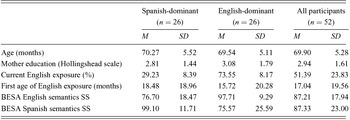
Potential participants for the current analysis were selected from the larger sample by pairs on the basis of two measures of language experience. First, pairs were matched on inverse exposure to Spanish and English (e.g., a child with 60% exposure to English matched to a child with 60% exposure to Spanish) to within 10 percentage points. Second, children were matched within one year of first exposure to English to ensure that they had relatively equal amounts of previous experience with English. This procedure ensured that age of English exposure was held constant, but current English experience varied. The two groups demonstrated no difference by year of first English exposure, F(1,50) = .258, p = .61, but differed on the basis of current language exposure (input and output), F(1,50) = 372.65, p < .001 (see Table 1). Finally, we only selected children with a standard score of 80 or greater on the semantics subtest of the BESA in their dominant language (see Table 1 for participant information by group). This ensured that participants had relatively comparable semantic knowledge in their stronger language. This process resulted in 26 matched pairs (n = 52) divided into two groups: English-dominant bilinguals and Spanish-dominant bilinguals. A preliminary one-way ANOVA revealed no statistically significant difference between the English-dominant and Spanish-dominant groups’ performance in their dominant language on the BESA semantics subtest, F(1,50) = .223, p = .638. However, there was a statistically significant difference for semantics between language dominance groups in English, F(1,50) = 28.86, p < .001, and Spanish, F(1,50) = 18.17, p < .001.
Participant characteristics.

SS = standard score
The Hollingshead (1975) education categories: 1 = less than 7th grade education; 2 = 9th grade education; 3 = partial high school; 4 = high school graduate; 5 = partial college; 6 = college degree; 7 = graduate degree
Results
We asked if NWR performance was related to the phonological structures of English and Spanish and sought to identify the role of language experience in performance, specifically to determine if the influence of language experience was similar in each language and at all syllable lengths. Results identified roles for all three variables.
Statistical analysis
A repeated measures analysis of variance (ANOVA) was performed to compare the NWR performance between the two dominance groups. In order to compare across languages, we included for analysis only two-, three- and four-syllable nonwords from both languages. The between-subject variable was dominance group (English-dominant or Spanish-dominant) and the within-subjects variables were language (Spanish and English) and syllable length (two, three, and four syllables). Partial eta squared (ηp 2 ) was selected for the effect size measure. Effect sizes were interpreted as follows: an effect size under .01 is a small effect; between .01 and .09 is a medium effect, and between .09 and .25 is a large effect (Green & Salkind, Reference Green and Salkind2011). Scheffé's method for post-hoc complex comparisons was used for follow-up examination of interactions. Post-hoc within-language comparisons of syllable length were performed using paired Tukey HSD.
Phonological structure and NWR performance
To identify the role of phonological structure on NWR performance, our first research question asked whether NWR performance varied by syllable length equally for English and Spanish nonwords. We compared NWR scores at different syllable lengths in both Spanish and English.
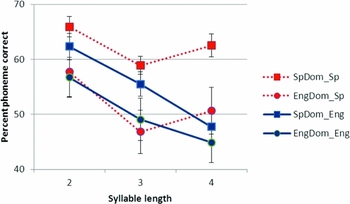
Repeated-measures ANOVA results showed significant main effects for Test Language, F(1,50) = 8.19, p = .006, ηp 2 = .14 (with Spanish > English) and Syllable Length, F(2,100) = 22.69, p < .001, ηp 2 = .31 (with shorter > longer). There was also a statistically significant interaction between Test Language and Syllable Length, F(2,100) = 6.40, p = .002, ηp 2 = .11 (see Figure 1). Post-hoc Scheffé's test of complex comparisons demonstrated that there were no differences in children's performance for two- and three-syllable nonwords in English and Spanish, but scores were significantly higher on four-syllable nonwords in Spanish (M = 56.59, SD = 17.99) compared to four-syllable nonwords in English (M = 46.31, SD = 16.55). To identify where differences within each language occurred, we performed post-hoc comparisons using the Tukey HSD test, which indicated that in English, two-syllable nonword performance (M = 59.52, SD = 15.70) was significantly different from four-syllable nonword performance (M = 46.31, SD = 16.55), but there were no statistically significant differences between three-syllable nonword performance (M = 52.27, SD = 16.22) and performance for nonwords of other syllable lengths. In Spanish, however, there was a statistically significant difference between two-syllable (M = 61.81, SD = 17.78) and three-syllable nonwords (M = 53.37, SD = 16.64), but not between three- and four-syllable (M = 56.59, SD = 17.99) or two- and four-syllable nonwords.
Group mean English and Spanish NWR performance by syllable length. Bars indicate Standard Error.
SpDom_Sp = Spanish-dominant group tested in Spanish; EngDom_Sp = English-dominant group tested in Spanish; SpDom_Eng = Spanish-dominant group tested in English; EngDom_Eng = English-dominant group tested in English

Language experience and NWR performance
To examine the impact of language experience on NWR performance, we compared the performance of Spanish-dominant to English-dominant bilinguals. Repeated-measures ANOVA results revealed a significant main effect for Language Dominance, F(1,50) = 5.07, p = .03, ηp 2 = .09, with the average PPC scores for the Spanish-dominant group being higher overall, M = 57.26, SD = 15.48, than the PPC scores for the English-dominant group, M = 52.70, SD = 13.61.
To further investigate the role of language experience, we evaluated whether Spanish–English bilingual children's performance by syllable length was moderated by their language dominance. There was no statistically significant Language Dominance and Syllable Length interaction F(2,100) = .53, p = .59, ηp 2 = .01.
Finally, to determine if the impact of language experience varied by test language, we compared children's performance in each language. Repeated measures ANOVA did not reveal a statistically significant interaction between language of testing and children's language dominance, F(1,50) = 3.65, p = .06, ηp 2 = .07.
Discussion
We sought both to explore the role of phonological structure on the NWR performance of bilingual children and to determine whether language experience influenced performance similarly across two-, three-, and four-syllable nonwords in two languages. By comparing two groups of children with different levels of language experience who were matched on age and time of first English exposure, we were able to explore the role of current exposure on performance. Additionally, by comparing two sets of nonwords that were based on the phonology of each language we were able to explore potential language-specific influences on language performance. Findings showed that not only language experience but phonological structure has effects on nonword repetition performance in bilingual children.
Like monolingual children (Dollaghan & Campbell, Reference Dollaghan and Campbell1998; Weismer, Tomblin, Zhang, Buckwalter, Chynoweth & Jones, Reference Weismer, Tomblin, Zhang, Buckwalter, Chynoweth and Jones2000), the performance of bilingual children on English NWR tasks reveals a length effect in which accuracy in nonword repetition decreases as syllable length increases. This diminution in English NWR performance is similar to the pattern of results in other studies of Spanish–English bilingual children (Gutiérrez-Clellen & Simon-Cereijido, Reference Gutiérrez-Clellen and Simon-Cereijido2010; Kohnert, Windsor & Yim, Reference Kohnert, Windsor and Yim2006; Windsor et al., Reference Windsor, Kohnert, Lobitz and Pham2010). A notable difference between the current study and previous studies is that the percent phoneme correct reported here is considerably lower. We suspect this is attributable to the young age of the children in the current study compared to the participants in the other studies. This converges with others’ observations of developmental changes in NWR performance in English (Gathercole, Pickering, Ambridge & Wearing, Reference Gathercole, Pickering, Ambridge and Wearing2004) and Spanish (Guiberson & Rodriguez, Reference Guiberson and Rodriguez2013).
The pattern of Spanish NWR performance in the current study corresponds to the observation that children from languages where multisyllabic words are highly frequent are more successful at repeating longer nonwords than are children from languages where multisyllabic words appear less frequently (Girbau & Schwartz, Reference Girbau and Schwartz2007; Masoura & Gathercole, Reference Masoura and Gathercole1999; Reference Masoura and Gathercole2005; Radeborg et al., Reference Radeborg, Barthelom, Sjöberg and Sahlén2006; Santos, Bueno & Gathercole, Reference Santos, Bueno and Gathercole2006; Summers et al., Reference Summers, Bohman, Gillam, Peña and Bedore2010). Unlike their near step-wise decline in English, children in the current study had a drop in Spanish performance when comparing two- and three-syllable nonwords, but then reached a plateau between three- and four-syllable nonwords where no statistical difference in scores was observed. These cross-linguistic patterns of performance appeared to diverge at the four-syllable level. While performance on Spanish nonwords was higher than on English nonwords at every syllable length, these differences were statistically significant only at the four-syllable level. Additionally, effect sizes in the current study generally were medium to large, while variability was not dissimilar to the variability found in comparable studies of bilingual children (Gutiérrez-Clellen & Simon-Cereijido, Reference Gutiérrez-Clellen and Simon-Cereijido2010 Thordardottir & Brandeker, Reference Thordardottir and Brandeker2012). Small differences between the phonological structures of the two languages and differences in children's experience with the languages had a large effect on children's productions.
Differences in the phonological structure of the languages may have resulted in discrepant recruitment of memory resources and contributed to the observed pattern of NWR performance. As a language's phonemic inventory increases, the average number of phonemes per syllable increases, while the average number of syllables per word decreases (Fenk & Fenk-Ozclon, Reference Fenk, Fenk-Oczlon, Kohler and Rieger1993). These trade-offs are the result of limited capacity in human working memory (Fenk & Fenk-Oczlon, Reference Fenk-Oczlon, Fenk, Miestamo, Sinnemäki and Karlsson2008; Nettle, Reference Nettle1995). Differences in the number of phonemic elements in Spanish and English may have had an impact on memory load and thus affected outcomes on NWR tasks in the current study. Because there are fewer possible combinations of sounds to remember in Spanish syllables than English (Hammond, Reference Hammond2001), memory for syllables might be less taxing in Spanish than in English. Perhaps practice with longer words in Spanish helps children hold longer English nonwords in memory long enough to analyze the varying details, remember them, and reproduce them. This possibility is not inconsistent with theories of redintegration (Gathercole et al., Reference Gathercole, Frankish, Pickering and Peaker1999) in which representations from long term memory ‘fill in’ missing elements from underspecified representations in short term memory (Thorn, Gathercole & Frankish, Reference Thorn, Gathercole and Frankish2002). All children in the current study were exposed to Spanish from birth and English at 1.5 years, on average. The additional 1.5 years of Spanish exposure may have resulted in more robust long-term representations in Spanish that may have aided in NWR performance through redintegration.
Not only phonological structure but language experience might also have contributed to NWR performance in the current study. Children here were matched on age of first regular exposure to English and on the percent of language exposure in their dominant language, e.g., a child whose current exposure to English was 70% was matched to a child whose current exposure to Spanish was near 70%. Age of first regular exposure to English is a measure of cumulative language experience and has been identified as a predictor in NWR performance (Summers et al., Reference Summers, Bohman, Gillam, Peña and Bedore2010). Few studies have focused on the role of current language experience on NWR performance. Results here suggest that current language exposure plays an important role in NWR performance as demonstrated by Spanish-dominant children's better performance in general.
The pattern of Spanish NWR performance in the current study corresponds to the observation that children from languages where multisyllabic words are highly frequent are more successful at repeating long nonwords than are children from languages where multisyllabic words appear less frequently (Dollaghan & Campbell, Reference Dollaghan and Campbell1998; Masoura & Gathercole, Reference Masoura and Gathercole1999, Reference Masoura and Gathercole2005; Radeborg et al., Reference Radeborg, Barthelom, Sjöberg and Sahlén2006; Summers et al., Reference Summers, Bohman, Gillam, Peña and Bedore2010). However, it is not clear how practice speaking multisyllabic words in Spanish affects English NWR performance. One possibility is that there is a frequency effect. The high frequency of multisyllabic words in Spanish results in increased practice saying multisyllabic phonological forms, and the benefits of this practice transfers when saying multisyllabic phonological forms in English. Such an outcome is consistent with usage-based models of language development like the Unified Competition Model (MacWhinney, Reference MacWhinney, Kroll and de Groot2005, p. 76), where “whatever can transfer will”. MacWhinney (Reference MacWhinney, Kroll and de Groot2005) identified positive and negative effects of language transfer. In the domain of phonology, second language learners can benefit when the same phonemes appear in the native language (L1) and the second language (L2).
In the current study, practice that successfully produces multisyllabic words in the L1 might result in another form of beneficial phonological transfer. Usage-based models of language development seem to focus on cumulative as opposed to current language experience (Tomasello, Reference Tomasello2003). For example, Bybee's Network Model (Reference Bybee2010) argues that as encounters with individual lexical items increase, those items require fewer cognitive resources for storage and retrieval; therefore, it is the frequency of encounters over time, i.e., cumulative experience, that is privileged. A similar emphasis on frequency can be seen in other usage-based models (Kroll & Stewart, Reference Kroll and Stewart1994; MacWhinney, Reference MacWhinney, Kroll and de Groot2005). In our study, language groups were created on the basis of current language experience, while cumulative language experience, measured by age of first regular exposure to English, was controlled through matching. Therefore, the influence of language experience in the current study appears to result primarily from current practice with a language. Future models of usage-based language development may need to account for the differing contributions of cumulative and current language experience.
A potential weakness of the current study is the fact that we may have created an order effect privileging Spanish by consistently administering Spanish testing before English. Indeed the order of presentation was based on our previous experience that shows that it is more difficult for bilingual children in the U.S. to shift from English to Spanish than vice versa. However, if order effects were present, they likely would be identified across tests. No such effect was observed in BESA testing, where performance was tightly linked to language dominance. Furthermore, within sessions NWR was administered after other testing, thereby priming children to either English or Spanish; such priming likely reduced the probability that Spanish performance was enhanced by order effects. Five-syllable Spanish nonwords were not included in the current analysis.
Conclusion
By controlling for the language experience of the participants and the wordlikeness of the NWR stimuli, the current study contributes to our understanding of the roles of language experience and phonological structure on NWR performance at varying syllable lengths. Spanish-dominant children performed NWR tasks better than English-dominant children in both Spanish and English, probably as a result of the extra practice the Spanish speakers had in saying multisyllabic words. Additionally, although they experienced significantly more English than the Spanish-dominant group, the English-dominant children did not appear to benefit from this increased exposure. Future research should determine if these patterns generalize to other nonwords that control wordlikeness.