INTRODUCTION
Cuttlefish is one of the major marine food resources and it constitutes the second most important marine product exploited in Tunisia. Like other cephalopods, the cuttlefish Sepia officinalis, produces for defence a dark ink constituted of a suspension of melanin granules in a viscous colourless medium (Prota, Reference Prota and Jovanovich1992; Hanlon & Messenger, Reference Hanlon, Messenger, Hanlon and Messenger1996). This ink is used as a food product in different countries. Moreover, it was demonstrated that cephalopod ink has many interesting properties (antiseptic, chemical and immunizing properties, etc.) useful in many biotechnological sectors (pharmaceutical, agro-alimentary and environment, etc.). For example, it has antibacterial activities against different types of micro-organisms (Mochizuki, Reference Mochizuki1979; Takai et al., Reference Takai, Yamazaki, Kawai, Imoune and Shirrano1993). It was also reported that the ink of sepia can be used to visualize functionally important transparent structures of gelatinous zooplankton and can be used as a colloidal marker in feeding experiments of some filter feeders (Flood et al., Reference Flood, Deibel and Morris1990). Moreover, other works have demonstrated that squid ink contains a strong antitumour activity against meth-A fibrosarcoma in BLAB/c mice (Prota et al., Reference Prota, Ortonne, Voulot, Khatchadourian, Nardi and Palumbo1981; Takaya et al., Reference Takaya, Uchisawa, Matsue, Seiya, Okusaki, Narumi, Sasaki and Ishida1994).
The ink gland of the cuttlefish Sepia officinalis represents a convenient model system for investigating melanogenesis (Ortonne et al., Reference Ortonne, Voulot, Khatchadourian, Palumbo, Prota and Seiji1981; Prota, Reference Prota and Jovanovich1992). This gland has been reported to contain a variety of melanogenic enzymes including tyrosinase, a dopachrome-rearranging enzyme and peroxidase. It was demonstrated that peroxidase could act in the later stages of the biosynthesis of melanin, promoting the formation of eumelanin polymers from monomers, such as 5,6-dihydroxyindole and 5,6-dihydroxyindole-2-carboxylic acid. During the melanogenesis process, all factors participating in melanin formation, such as hydrogen peroxide, enzymes, starting products and intermediates, etc., are present (d'Ischia et al., Reference d'Ischia, Napolitano and Prota1991). Therefore, the complexity of the melanogenesis process and the interesting composition and properties of ink, provides an opportunity to investigate ink characteristics and this would be beneficial for finding new methods of utilization for this product. The present study was conducted to determine the physicochemical characteristics of ink of Sepia officinalis, caught in the Tunisian coastal waters, and the effects of storage conditions on the melanin coagulation process.
MATERIALS AND METHODS
Animals
Specimens of Sepia officinalis were collected from the Gulf of Gabès (Tunisia). The ink- sacs were removed from fresh individuals and the ink was collected and stored at 4°C.
Physical and chemical characterization of Sepia officinalis ink
Fresh ink was centrifuged at 20 g for 4 hours at 4°C under vacuum. The melanin substance and the colourless phase (melanin-free ink) were collected separately and their mass proportions were determined. Crude ink, melanin, and melanin-free ink samples were subjected to physical and chemical characterization.
The pH was determined with a pH meter (Mettler MP 220 model). Water content was determined by drying a sample of crude ink at 100°C. Proteins were determined by the Kjeldahl method. Lipids were measured after extraction with chloroform by the Soxhlet method. Ash was measured after incubation in an oven at 550°C (AOAC, 1984). The morphology and the elemental composition of lyophilized ink samples were determined by a scanning electron microscope (SEM, type Philips XL 30) equipped with energy dispersion spectrometer (EDS, EDAX).
Effects of physical parameters on ink coagulation
To evaluate the effects of temperature (2–4°C, room temperature: 18–22°C, 30°C), the aeration in terms of presence or absence of atmospheric oxygen (aerobic and anaerobic atmospheres) and the light/darkness on the coagulation process, a series of tubes containing 5 ml of fresh crude ink were incubated under different conditions of storage. The same storage conditions were applied for heated ink (100°C for 5 minutes). Physical state of ink samples was observed after 24 to 72 hours of incubation.
Effect of melanin-free ink and H2O2 on the coagulation process
The effect of the hydrogen peroxide on coagulation was assessed using either fresh crude ink or treated ink (100°C for 5 minutes). Samples of treated and untreated ink supplemented with H2O2 (10%) were examined for coagulation. Moreover, the effect of the addition of the melanin-free ink phase (5% and 10% v/v) to the heated crude ink samples was also studied. Physical state of ink samples was observed immediately after incubation at 37°C for 3 minutes.
RESULTS
General composition of the Sepia officinalis ink
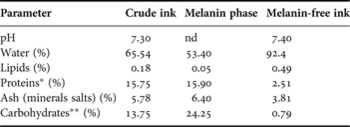
The centrifugation of fresh ink allowed the collection of two phases: the melanin substance and the colourless phase that is called in this work melanin-free ink. The mass proportions were about 71.55% and 28.45% for the melanin phase and the colourless phase, respectively. The general composition (moisture, lipids, proteins, ash and carbohydrates) of the crude ink and the two phases are presented in Table 1.
Chemical composition of different fractions of Sepia officinalis ink.

nd, not determined; *proteins obtained by Kjeldahl method; **carbohydrates were calculated by the difference (100%−(water+proteins+lipids+ash)).
The pH value of ink samples was around 7. Water content was generally high in all samples and the maximum was indicated for the melanin-free ink (92.4%). The Kjeldahl protein concentration of both crude ink and melanin phase were similar (15.75% and 15.90%, respectively). Compared to water and protein content, lipid represented the lowest concentration (ranged between 0.05% and 0.49%). Calculated carbohydrate value for the crude ink and the melanin phase was definitely higher than that obtained for melanin-free ink. These values were about 13.75% and 24.25%, for the crude ink and the melanin substance, respectively.
Scanning electron microscopy observation of Sepia officinalis ink
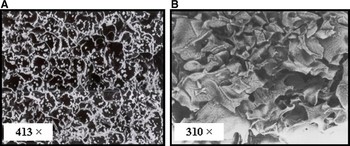
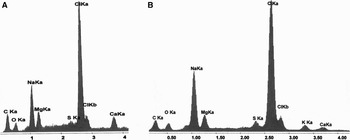
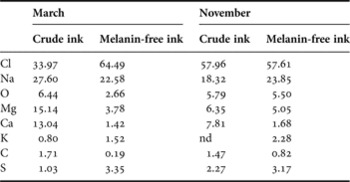
The SEM of the lyophilized crude ink (Figure 1) showed the presence of melanin granules with homogeneous distribution in the crude ink. The granule diameter ranged from 118 to 950 nm. We tried also to determine the elemental composition of two ink samples, collected in November and March, by scanning electron microscope. The obtained spectrum (Figure 2) showed the elements present in the ink sample (collected in November) bombarded by electrons. Figure 2 revealed a slight variation in elemental content between crude and melanin-free ink, due to the elimination of melanin substance after centrifugation. Comparable spectrum was also observed for the sample collected in March (spectrum not shown). The examination of the spectrum obtained by SEM makes it possible to determine the weight percentage of elements present in each sample. According to Table 2, the weight percentage of each element varied depending on the period of sampling for both crude and melanin-free ink samples.
SEM images of Sepia officinalis ink: (A) crude ink; (B) melanin-free ink.

SEM spectra of Sepia officinalis ink sampled in November: (A) crude ink; (B) melanin-free ink.

Elemental composition of crude ink and melanin-free ink analysed by SEM (weight %).

nd, not detected.
Effects of storage conditions on Sepia officinalis ink coagulation process
The physical state of Sepia officinalis ink depends on the storage conditions of the animal. It was found that ink from a fresh animal preserved at 2–22°C remained under liquid state. However, under 0°C, the ink crystallizes or coagulates and the liquid state cannot be reached after freezing–thawing. In our study, this phenomenon seemed to be the result of the presence of higher water content which may damage the structure of polymers and proteins contained in crude ink during the freezing–thawing process.
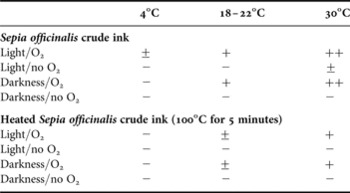
In order to understand the ink coagulation process, it was interesting to study the evolution of the physical proprieties of Sepia officinalis ink under various environmental conditions of storage (temperature, light/darkness, aeration, etc.). According to Table 3, temperature, light and oxygen can be considered as coagulation factors of Sepia officinalis ink. It seems that ink coagulation over time exhibited a temperature dependency observed under light and aeration conditions. Incubation of ink at 30°C gave strong coagulation. This implies that the coagulation path progressed much faster at higher temperature. However, the storage of ink at lower temperature (4°C) had a generally unfavourable effect on the coagulation process. Moreover, the lack of air oxygen and darkness greatly inhibited ink coagulation independently of the storage temperature. As can be seen in Table 3, coagulation can occur not only under air oxygen, but also under light and, in all cases, light or oxygen are important for the coagulation process. As indicated in Table 3, once heated (100°C, 5 minutes), the coagulation process is reduced or absent compared to the crude ink.
Effects of storage conditions (temperature, light/darkness and aeration) on the coagulation process of Sepia officinali s ink (observation during 24 to 72 hours of incubation).

−, no coagulation; ±, very little coagulation (started after 24 hours); +, little coagulation (started after 4 hours); ++ , rapid and strong coagulation (started after 2 hours).
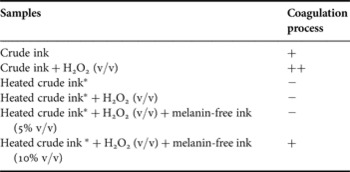
Table 4 shows that H2O2 and the melanin-free ink play an important role in the coagulation process. H2O2 supply enhanced the coagulation of crude ink, however, no effect was observed on the heated crude ink sample. The addition of an adequate volume of fresh melanin-free ink to the heated ink allowed the coagulation process in the presence of H2O2.
Effect of melanin-free ink and H2O2 on the coagulation process of the crude ink of Sepia officinalis (37°C, light and aeration).

−, no coagulation; +, little coagulation; ++ , rapid coagulation; *crude ink heated at 100°C for 5 minutes.
DISCUSSION
From the first part of this work, devoted to specimens of Sepia officinalis collected from the Gulf of Gabès, it can be concluded that the melanin substance contains mainly carbohydrate polymers and proteins. This was demonstrated by other studies suggesting that sepia melanin is a mixture of oligomeric structures incorporating over 75% of DHICA (5,6-dihydroxyindole 2-carboxylic acid)-derived units and only 20% of DHI (5,6-dihydroxyindole)-derived units, degraded for the most part to pyrrole-2,3-dicarboxylic acid and pyrrole-2,3,5-tricarboxylic acid, respectively. It is also interesting to note that melanin contains peptide fragments called melano-proteins (Knicker et al., Reference Knicker, Almendros, Gonzàlez-Vila, Lüdemann and Martin1995; Pezzella et al., Reference Pezzella, d'Ischia, Napolitaono, Palumbo and Prota1997). It can be stated that, in general, the approximate composition of ink varied from one species to another. Hence, compared to the squid ink, Sepia officinalis crude ink contained higher crude protein. For example, it was reported that boreo Pacific gonate (Gonatopsis borealis) squid ink contained 11% of protein, however, ink of other squid species, such as neon flying (Ommastreohes bartrami) and boreal club-hook (Onychoteuthis borealijaponica) contained respectively only 1% and 5% of protein (Shirai et al., Reference Shirai, Kikuchi, Matsuo, Inada, Suzuki and Hirano1997). Therefore, it is very important to note that the variation of ink composition could be related to many factors such as the biological stage, the animal diet, fishing location, ocean temperature, etc. In the same context, it was reported that the body compositions of Sepia officinalis from the Mediterranean waters were obviously affected by gonads maturation and environmental conditions (El-Sayed et al., Reference El-Sayed, Riad and Halim1995). It seems also that the granule diameter depends on many factors (the biological stage, environmental conditions, etc.). Indeed, the SEM of the lyophilized crude ink showed the presence of melanin granules with homogeneous distribution in granule diameter (from 118 to 950 nm) which is larger than the 45–230 nm range determined for the same species by Nofsinger et al. (Reference Nofsinger, Weinert and Simon1999). The same authors showed a real effect of granule sizes on the photochemical characteristics of Sepia officinalis melanin granules (Nofsinger et al., Reference Nofsinger, Weinert and Simon1999).
The SEM spectrum showed the presence of elements (C, O, S and minerals) taking part in the structure of carbohydrate polymers and proteins. Generally, minerals are implicated in the maintenance of normal metabolic and physiological functions and they are important components of enzymes and structural proteins. According to Liu & Simon (Reference Liu and Simon2005), Sepia officinalis melanin contains a large amount of functional groups for various metal ions with different binding affinities. The multiply-charged ions may play an important role in assisting or templating the assembly of the metal-free organic compounds to form a three-dimensional substructure distributed along the protein scaffold within the melanin granules (Liu & Simon, Reference Liu and Simon2005). However, the elemental composition of ink (crude ink and melanin-free ink) varied depending on the sampling period and this variation could be related to many factors (biological stage, the animal diet, ocean temperature, etc.). Consequently, ink content is very variable from the chemical point of view and careful procedures are needed to obtain reproducible results.
In the second part of this work, we studied the parameters influencing ink coagulation and showed that it depends on several physico-chemical and biological parameters. The first parameters are temperature, light and oxygen. The coagulation path progressed much faster at temperature around 30°C. The storage of ink at lower temperature (4°C) had a generally unfavourable effect on the coagulation process. The lack of air oxygen and darkness greatly inhibited ink coagulation independently of the storage temperature. Light might favour polymerization of melanin as it is known as a potential photo-reactive substance (Nicolaus et al., Reference Nicolaus, Bolognese, La Vecchia, Mazzoni, Nicolaus, Romano and Nicolaus2004). Interestingly, the coagulation process was affected negatively after treatment of crude ink at 100°C (5 minutes). However, the addition of an adequate volume of fresh melanin-free ink to the heated ink was beneficial for the coagulation. This led us to a very important conclusion that compounds catalysing the ink coagulation were included in the melanin-free ink fraction and the heating process destroyed these compounds. Regarding these results, it can be stated that ink coagulation in an oxidation process is controlled by the action of light, oxygen, H2O2 and thermo-labile compounds (enzymes) contained in the ink. Hydrogen peroxide is present in all living cells but can also be formed by action of atmospheric oxygen on phenolic compounds of melanin and can be considered as a normal product of melanogenesis (Nicolaus et al., Reference Nicolaus, Bolognese, La Vecchia, Mazzoni, Nicolaus, Romano and Nicolaus2004). The involved enzymes in the coagulation process are probably peroxidases.
CONCLUSION
In conclusion, we showed that the melanin substance contains mainly carbohydrates polymers and proteins. It is also interesting to note that melanin contains peptide fragments called melano-protein. It can be stated that, in general, the approximate composition of ink varied from one species to another. In a second part, we studied the parameters influencing ink coagulation and showed that it depends on several physico-chemical (temperature, light, oxygen, H2O2) and biological parameters related to ink composition. Interestingly, the coagulation process was affected by boiling temperature. Therefore, the coagulation seems to be catalysed by some compounds (probably enzymes) contained in the ink and not only by light, oxygen and temperature.
ACKNOWLEDGEMENTS
We thank Zouhir Fakhfak for expert technical assistance in scanning electron microscopy. Choumous Kallel and Wassim Kamoun are deeply thanked for their help.