Introduction
The gold- and bronze-adorned burials discovered at the site of Ingombe Ilede in Zambia in 1960 are iconic in the archaeology of south-central Africa. Located 1000km inland along the Zambezi River (Figure 1), the burials contained quantities of gold, glass beads and marine shell that are matched only at some stone-built zimbabwe sites hundreds of kilometres to the south and south-east. They also contain large copper ingots, bronze bangles and trade wire that link the site to copper-production sites in both the Copperbelt region along the Zambia-DR Congo border and the Hurungwe district in north-western Zimbabwe. These items account for Ingombe Ilede's key position in discussions of trade networks and the nature and volume of goods moving along them at various points in time. Thus, the chronology of the Ingombe Ilede burials is of particular significance. Until now, the burials have not been directly dated, but rather dated by association with nearby fourteenth- to fifteenth-century AD domestic deposits with distinctive, finely made pottery (Phillipson & Fagan Reference Phillipson and Fagan1969). It has, therefore, generally been accepted that the burials pre-dated the Portuguese presence on the East Coast of Africa, which began with Vasco da Gama's 1497 voyage. This dating has also been fundamental to arguments linking the decline of Great Zimbabwe's political influence by AD 1450 to Ingombe Ilede's success in attracting trade northward along the Zambezi River and away from the southern Save/Sabi River route. In the sixteenth century, the Portuguese joined existing Swahili and inland African trade networks from the coast along the Zambezi, where they traded with the Mwene Mutapa state (Mudenge Reference Mudenge1988). They established market settlements (feira) along the lower Zambezi and near copper and gold sources in north-western Zimbabwe over the course of the century. New AMS dates for the two richest Ingombe Ilede burials situate them in this dynamic sixteenth-century period, with important implications for historical narratives about changing trade relations, political alignments and diachronic shifts in the scale of metal production and trade within southern and central Africa.
Location map. Light shading shows the copper-production areas along the northern Zambian border, and the Hurungwe district.

The Ingombe Ilede burials
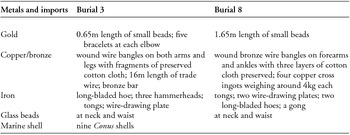
In 1960, potsherds and human long bones encircled by bronze wire bangles were discovered while excavating the foundation for a new water tank at Ingombe Ilede, located on a low ridge 2km upstream of the confluence of the Lusitu River with the Zambezi. This necessitated rapid rescue excavations, which were undertaken by James Chaplin (Inspector of Monuments). Eleven burials were revealed. Two of these (Burials 7 and 9) had only a few glass beads and a single shallow bowl as grave goods. The individuals were later identified as females (Gibbon et al. Reference Gibbon, Lancaster and Huffman2014). The other burials had iron, copper/bronze, gold, and glass beads in varying amounts (Fagan et al. Reference Fagan, Phillipson and Daniels1969: 71–75). Four of these (Burials 1, 2, 3 and 8, for which sex could not be determined based on skeletal analysis; Gibbon et al. Reference Gibbon, Lancaster and Huffman2014) were exceptional in the type and quantity of grave goods. The main items (excluding pottery and animal bone) in the two re-dated burials (3 and 8) are summarised in Table 1.
Metals and imported items in redated Ingombe Ilede Burials 3 and 8.

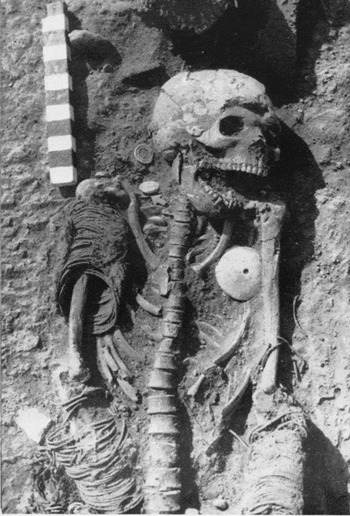
The square-sectioned bronze trade wire (based on one compositional analysis; Fagan et al. Reference Fagan, Phillipson and Daniels1969: 256–57) found under the head and torso of Burial 3 and the iron wire-drawing plates would have been used to create the very fine wire that was wound around bobbins, examples of which were found in Burials 1 and 2. The bangles from Burial 3, also crafted in bronze (based on analyses of two of the bangles; Fagan et al. Reference Fagan, Phillipson and Daniels1969: 105), were created by wrapping fine wire in a tight spiral around a raffia-palm fibre core (Figure 2). Spiral-wound copper bangles have a lengthy history in Zambia (Bisson Reference Bisson1975: 281).
Burial 3, showing wound bronze wire bangles with fragments of cloth on the right upper arm. The left forearm bangles are covered by cloth. Two gold wire bangles are visible at the elbow. The white discs in the thorax region and above the right shoulder are Conus shells. A considerable length of bronze trade wire, bent into sections, is in shadow beneath the skull, along with iron tongs. Scale is in inches. (Photograph: B.M. Fagan.)

In addition to the large quantities of bronze and gold and the large copper ingots in the burials, Burial 3 had nine Conus shells from the Indian Ocean Coast, one with a gold-foil backing plate. When David Livingstone crossed Central Africa, two such shells purchased a slave (Livingstone Reference Livingstone1857: 206). The thousands of glass beads in the burials have yet to be fully described (du Toit Reference du Toit1965; Phillipson Reference Phillipson1977: 193), but include beads of Indo-Pacific origin (‘trade wind beads’; Davison & Clark Reference Davison and Clark1974). The finely woven cotton cloth is thought to be of Indian origin, while the coarser-weave material was probably locally produced. The flanged iron gong in Burial 8 is a traditional symbol of chiefship in the southern savannah kingdoms (Vansina Reference Vansina1969). All four of the richest burials included artisan's tools for drawing and hammering bronze/copper wire. These were clearly high-status individuals.
The excellent preservation of organics and the volume and type of trade goods recovered suggested a date between AD 1500 and 1700 for the burials. Radiocarbon dates on charcoal from excavations undertaken by Fagan in 1961 (in cuttings located 10–20m from the burials) indicated, however, that the site was occupied in the later first millennium AD (Fagan et al. Reference Fagan, Phillipson and Daniels1969: 81). Fagan excavated a further 31 burials (22 of which were infants or children)—all with limited or no grave goods—in a cemetery of unknown date located 40m south of the central burials. The conundrum was resolved in 1968 when David Phillipson, then Secretary/Inspector of Monuments, returned to Ingombe Ilede during the excavation of foundations for two more water tanks. A small test excavation carried out nearby encountered sterile subsoil at a depth of 2m (Phillipson & Fagan Reference Phillipson and Fagan1969). Fromthe uppermost occupation deposits that extended 30cm below sterile surface material, he obtained a large radiocarbon sample from a mass of charcoal sealed below clay wall rubble on a fragmentary beaten clay floor. The sample was divided into two in the laboratory and yielded two dates: 610±85 BP and 505±85 BP. When later calibrated (a practice unknown in 1968), the probability curves at 95.4% confidence lie predominantly within the fourteenth to early fifteenth centuries (calibrated in OxCal v4.2 using the SHCal13 curve; Bronk Ramsey Reference Bronk Ramsey2009; Hogg et al. Reference Hogg, Hua, Blackwell, Niu, Buck, Guilderson, Heaton, Palmer, Reimer, Reimer, Turney and Zimmerman2013). Phillipson argued that stratigraphic data showed this later occupation to be short, occurring 400–500 years later than the component dated by charcoal from the 1961 excavations. The latter corresponded to the lower midden component in his 1968 excavation. Sherds of finely made and distinctive comb-impressed ‘beaker’ bowls from the upper component closely resembled sherds found in the rich burials. Thus, he concluded that the Ingombe Ilede burials dated to a period immediately preceding the Portuguese arrival on the Indian Ocean coast, a time when coastal trade was burgeoning far into the remote interior. The revised dates, based on Phillipson's perceptive stratigraphic analysis, have long been widely accepted.
Redating the burials
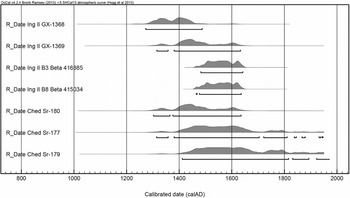
The possibility of directly dating the 1960 burials presented itself in 2014 during recording and analysis of human skeletal remains curated at the Livingstone Museum in Zambia. Although nearly all of the Ingombe Ilede skeletal material had been previously transferred to the University of the Witwatersrand, where it is now part of the Raymond Dart Skeletal Collections, two boxes of wound bronze wire bangles with preserved cloth, labelled as Ingombe Ilede Burials 3 and 8, were encountered. Permission was received from the Museum to take two small (50mm × 25mm) fragments of the preserved cloth for 14C dating. Both fragments were submitted to Beta Analytic for AMS dating. The date for the cloth from Burial 3 is 360±30 BP (Beta 416885), which when calibrated at 95.4% confidence gives a range of AD 1480–1640 (dates calibrated in OxCal v4.2 using the SHCal13 curve; Bronk Ramsey Reference Bronk Ramsey2009; Hogg et al. Reference Hogg, Hua, Blackwell, Niu, Buck, Guilderson, Heaton, Palmer, Reimer, Reimer, Turney and Zimmerman2013). The cloth from Burial 8 produced an almost identical result: 370±30 BP (Beta-415034), or cal AD 1465–1635. This places the burials approximately a century later than previously thought, with the bulk of the calibration curves falling in the sixteenth century (Figure 3). As Burial 8 was overlain by a later burial (7), the use of the central area as a cemetery continued for an unknown period of time. Burial 7 appears to mark the final phase of the site. The location of the settlement contemporaneous with the burials has yet to be identified.
Comparison of the 1968 dates for Ingombe Ilede upper component midden deposits (GX-1368, 1369), the new dates on cloth from Burials 3 and 8 (Beta), and the 1970 dates for deposits with Ingombe Ilede-style pottery at Chedzurgwe in north-western Zimbabwe, all calibrated using the most recent Southern Hemisphere calibration curves (Hogg et al. Reference Hogg, Hua, Blackwell, Niu, Buck, Guilderson, Heaton, Palmer, Reimer, Reimer, Turney and Zimmerman2013).

Rethinking Ingombe Ilede
From the occupation deposits alone, Ingombe Ilede would appear to be an unexceptional Iron Age village site, with daga rubble and beaten clay floors marking former domestic structures, and rare imports (e.g. glass beads, cowries, copper). The central burials, however, provide a different account, indicating large-scale participation in trade networks involving copper, bronze, gold, cloth and marine shell. The new dates situate the burials in a dynamic period when the Mutapa state emerged as a northern expression of the Zimbabwe tradition (later fifteenth century). The Portuguese were concurrently establishing forts on the coast (Sofala, AD 1505) and market settlements (feira) on the lower Zambezi at Sena (AD 1531) and Tete, areas where Shona and Swahili traders had been active for centuries (Mudenge Reference Mudenge1988; Pikirayi Reference Pikirayi1993; Pwiti Reference Pwiti1996). Earlier trade networks were almost certainly disrupted and reconfigured. It has been suggested that the decline in trade goods reaching Great Zimbabwe after 1450 may be due to the shift to Zambezi-oriented trade at the expense of southern routes along the Save River (Garlake Reference Garlake1973: 198; Pwiti Reference Pwiti1996; Pikirayi Reference Pikirayi2001). Mudenge (Reference Mudenge1988: 43–44) describes the Zambezi vs overland routes used by two fifteenth-century Muslim factions competing for the Zimbabwe gold trade. Ingombe Ilede may have played a role, although the new dates make it equally probable that the major trade activity at the site post-dates Great Zimbabwe's decline.
The cross-shaped copper ingots in the Ingombe Ilede burials have particular relevance for interpreting trade networks. Copper was internally mined, smelted and traded in central and southern Africa from the mid first millennium AD (Killick Reference Killick, Roberts and Thornton2014), but it began to circulate in distinctive ingot forms several centuries later. The chronology of ingot shapes that circulated in different areas is now well established (de Maret Reference de Maret and Heusch1995; Swan Reference Swan2007). Large flanged ingots, such as those in the Ingombe Ilede burials, appear in the fourteenth century in the Copperbelt area on the Zambian-DR Congo border (Bisson Reference Bisson1975, Reference Bisson1982, Reference Bisson and Vogel2000). Somewhat later, production of these ingots appears at sites near the copper ore deposits of north-western Zimbabwe, where they co-occur with finely made beakers and beaker bowls identical to those from Ingombe Ilede. Radiocarbon dates from Garlake's (Reference Garlake1970) excavations at Chedzurgwe are consistent with those from Ingombe Ilede (Figure 3). Garlake (Reference Garlake1970: 41–43) convincingly associates the archaeological evidence for copper mining and flanged ingots in the Hurungwe district with oral traditions and sixteenth-century Portuguese documents that refer to copper ingot trade on the Zambezi between the Mobara or Ambar people, Muslim traders and the Karanga of Mutapa (see also Lancaster & Pohorilenko Reference Lancaster and Pohorilenko1977; Mudenge Reference Mudenge1988). He notes (Garlake Reference Garlake1970: 43) that the ingots and moulds found at Great Zimbabwe were of a different, unflanged type, which Swan (Reference Swan2007) locates in an earlier time period.
Glass beads provide additional information. Unpublished chemical analyses by Marilee Wood and Peter Robertshaw show that the Indo-Pacific beads in Burials 1, 2, 3 and 8 belong to the Khami series (M. Wood pers. comm.). These originated in India and circulated from the early fifteenth century into the seventeenth century (Robertshaw et al. Reference Robertshaw, Wood, Melchiorre, Popelka-Filkoff and Glascock2010; Wood Reference Wood2011, Reference Wood2016). Du Toit's (Reference du Toit1965) limited description of the glass beads suggests that ‘Indian reds’ were common in all the burials, except Burial 5 (which had no beads) and Burial 10 (which had a string of green beads). His description, however, in no way conveys the quantity of beads at the neck, waist and pelvis of the other nine burials, which numbered in the “tens of thousands” (Phillipson Reference Phillipson1977: 193; Katanekwa Reference Katanekwa2016: 309). Unlike Chedzurgwe, where few glass beads were found, the Ingombe Ilede burials provide evidence of robust involvement with trading networks extending to the east coast. This, in addition to the exceptional quantities of copper and gold in the burials, has made Ingombe Ilede a key site for considering the development and scale of inland trade and the penetration of coastal networks to the middle Zambezi. The fourteenth- to fifteenth-century radiocarbon dates (Phillipson & Fagan Reference Phillipson and Fagan1969) supported a case for significant activity by Swahili and Shona-speaking traders linking Ingombe Ilede to both the coast and Great Zimbabwe (Lancaster & Pohorilenko Reference Lancaster and Pohorilenko1977: 6, 18; Katanekwa Reference Katanekwa and Shillington2005), and a vastly increased scale of internal copper production and trade (Phillipson & Fagan Reference Phillipson and Fagan1969; Bisson Reference Bisson1982)—all occurring before the arrival of the Portuguese. While Copperbelt copper had been mined and traded internally since the fourth or fifth century AD, and glass beads were reaching inland sites in south-central Africa in the later first millennium AD (e.g. Denbow et al. Reference Denbow, Klehm and Dussubieux2015), no other sites in Zambia or northern Zimbabwe have produced copper/bronze, glass and gold on the scale of Ingombe Ilede.
The new dates relocate the trading activity represented by the grave goods to sometime between the late fifteenth and early seventeenth centuries. At that time, Ingombe Ilede appears to have been a western outpost of people trading copper from the Hurungwe district in north-western Zimbabwe. Trade networks were prominently directed towards the Mutapa state and the Swahili and Portuguese traders who worked the Zambezi route to the coast. They may have extended to other Zimbabwe tradition successor states to the south, where rare flanged ingots have also been found (Garlake Reference Garlake1970). Whether copper was also arriving from Copperbelt sources to the north may eventually be clarified by current research using lead isotope analysis to identify source ores and match them to artefacts (Killick pers. comm.). The precise source of the Ingombe Ilede gold is also as yet unidentified, although the goldfields in northern Zimbabwe are probable. Local ivory and salt may have been the goods offered in trade (Fagan Reference Fagan1969).
The richly accoutred individuals at Ingombe Ilede were apparently artisans who produced bronze wire and the wire-wrapped bangles that Gaspar Boccaro described in 1616 as a universally accepted currency on the lower Zambezi (cited in de Luna Reference de Luna2010: 281). It remains unknown whether these were elites who were themselves metalworkers, or individuals who derived their prestige through association with or control of metalworking. The burials with copper ingots and iron gongs recall the chiefly regalia of the southern savannah kingdoms. They combine elements familiar from burials in the Upemba basin (ingots, iron hoes; de Maret Reference de Maret1992) and other areas of the Democratic Republic of Congo with trade goods from the coast (e.g. Indian fine-weave cloth, glass beads, Conus shell). For 45 years, Ingombe Ilede has been viewed as an important trade nexus linking the Copperbelt and Great Zimbabwe. The new dates suggest more direct involvement with the Mwene Mutapa confederacy, with the probability that the burials post-date Great Zimbabwe's era of long-distance trade. They invite a reconsideration of narratives concerning the chronology and scale of Swahili trade to the middle Zambezi, and open new interrogations into the effects of the early European presence far inland. The quantity of copper in the burials and the likelihood, based on three analyses, that a significant proportion of the wire at Ingombe Ilede was bronze, focus new attention on possible sources for tin. The authors of the comments that follow this piece provide expert viewpoints on these and other potential implications of the new dates. Furthermore, rescue excavations at Ingombe Ilede in July 2016 may offer significant new information about this enigmatic site after a hiatus of more than 50 years.
Acknowledgements
We thank the Director of the Livingstone Museum in Zambia, Dr Simunchembu, for permission to take cloth samples for dating. The collections staff at the Museum were unfailingly patient and helpful in locating boxes of excavated materials. McIntosh's museum research was funded partially through a grant from the Social Sciences Research Institute at Rice University. We are grateful to David Phillipson and Innocent Pikirayi for their helpful reviews of the manuscript.