Introduction
While population estimates suggest that nearly one in three older Canadian adults has mobility limitations (Statistics Canada 2006), to date, little research has examined how individuals ageing with mobility impairments perceive and experience the changes to their bodies that often occur in later life, especially in relation to the use of power mobility technology. In this paper, we use the conceptual distinction proposed by Bury to investigate the ‘meanings as significance’ and ‘meanings as consequence’ (1988: 91) of power mobility device use for 29 Canadian men and women aged 51–92. Describing the experiences of individuals living with rheumatoid arthritis, Bury conceived of chronic illness as an ambiguous, uncertain event that unsettles a person's life trajectory and undermines ‘the structures of everyday life and the forms of knowledge which underpin them’ (1982: 169). Bury contended that the experience of pain, suffering and the awareness of death that accompany chronic illness constitute a ‘biographical disruption’ that requires a ‘fundamental rethinking of the person's biography and self-concept’ (Bury Reference Bury1982: 169), particularly in light of the strong emphasis on ‘achievement, action, and success in contemporary society’ (Bury Reference Bury, Anderson and Bury1988: 90). Arguing that chronic illness is socially situated, Bury additionally distinguished between ‘meaning as consequence’, or the practical repercussions of illness and impairment on everyday life, and ‘meaning as significance’, or the symbolic, and at times stigmatising, cultural connotations of illness (Bury Reference Bury, Anderson and Bury1988: 91).
Since its introduction, the concept of biographical disruption has been the subject of on-going debate. For instance, medical sociologists have explored the possibility that chronic illness may not necessarily be disruptive or that illness may affect individuals differently in later life. Using terms such as ‘biographical continuity’ (Williams Reference Williams2000: 52) and ‘biographical flow’ (Faircloth et al. Reference Faircloth, Boylstein, Rittman, Young and Gubrium2004: 242), Williams and Faircloth et al. have argued that illness and impairment may not be disruptive for those who have previously experienced trauma and adversity. In addition, older individuals may regard chronic illness as ‘normal illness’ (Williams Reference Williams2000: 49) or as part of their expected biography at a time in their lives when the occurrence of chronic and disabling health conditions is commonplace (Faircloth et al. Reference Faircloth, Boylstein, Rittman, Young and Gubrium2004; Pound, Gompertz and Ebrahim Reference Pound, Gompertz and Ebrahim1998; Priestley Reference Priestley, Goodley and Lawthom2006). Studies that have examined older adults’ experiences of chronic conditions such as osteoarthritis, stroke and heart disease have shown that the symptoms and consequences of illness and impairment in later life may be both disruptive and expected (Hurd Clarke and Bennett Reference Hurd Clarke and Bennett2013; Lorenz Reference Lorenz2009; Pound, Gompertz and Ebrahim Reference Pound, Gompertz and Ebrahim1998; Torres and Hammarstrom Reference Torres and Hammarstrom2006; Wilkins Reference Wilkins2001). For example, even as they reported that their lives had been severely disrupted by the symptoms of their illness, the participants in Sanders, Donovan and Dieppe's (Reference Sanders, Donovan and Dieppe2002) study of older men and women with osteoarthritis-related joint pain also regarded their physical limitations as a natural aspect of ageing and an expected outcome of their difficult life histories. Moreover, Tagizadeh Larsson and Jeppsson Grassman (Reference Tagizadeh Larsson and Jeppsson Grassman2012) have contended that biographical disruption does not represent a single event characteristic of the early stages of chronic illness, but rather that chronically ill individuals in later life experience a series of recurring bodily transitions and losses over time that may be simultaneously anticipated and feared. Challenging Williams’ (Reference Williams2000) notion of ‘normal illness’, Tagizadeh Larsson and Jeppsson Grassman (Reference Tagizadeh Larsson and Jeppsson Grassman2012) have suggested that instead of mediating and normalising bodily losses, old age and past experiences of illness and hardship may actually augment the disruptiveness of further health complications and losses to those who have been struggling to maintain valued activities and social roles.
Furthermore, biographical disruption has been critiqued within disability studies for its representation of illness and impairment as inherently negative and disruptive. By contrast, disability scholars have maintained that some people may experience illness and impairment as affirmative sites of resistance, liberation, personal development and self-expression (Gabel and Peters Reference Gabel and Peters2004; Loja et al. Reference Loja, Costa, Hughes and Menezes2013). Swain and French have asserted that ‘being disabled need not be a tragedy for disabled people, but may, on the contrary, enhance life or provide a lifestyle of equal satisfaction and worth’ (2000: 570). Others have contested biographical disruption's emphasis on the personal over the political, and its subsequent neglect of the ways in which disability is the product of ‘society's failure to provide appropriate services and adequately ensure the needs of disabled people are fully taken into account in its social organisation’ (Oliver Reference Oliver1996: 32). Arguing that disability is the result of societal oppression rather than bodily limitations, proponents of the social model of disability have regarded sociological analyses that centre the body as complicit in the reproduction of oppressive ableist ideology (Hughes Reference Hughes, Barnes, Oliver and Barton2002; Oliver Reference Oliver1990). Indeed, ableism has been defined as a ‘network of beliefs, processes and practices that produces a particular kind of self and body … that is projected as the perfect, species-typical and therefore essential and fully human. Disability then, is cast as a diminished state of being human’ (Campbell Reference Campbell2001: 44). This position has been challenged by some scholars (Thomas Reference Thomas, Barnes and Oliver2002; Williams Reference Williams, Albrecht, Seelman and Bury2001), who have contended that ‘disability has undeniably to do at some level with the pain or discomfort of bodies’ and that bodily loss is ‘a dimension of the oppressive quality of chronic illness and disability for large numbers of people’ (Williams Reference Williams, Albrecht, Seelman and Bury2001: 135). However, Williams has also cautioned against examining the embodied experience of illness without giving due attention to the history and politics of ableism, noting that doing so may lead researchers ‘further and further away from any sense of the society in which the anguish of experience is embedded and indeed, shaped’ (2001: 132).
In this paper, we use Bury's (Reference Bury, Anderson and Bury1988) distinction between the ‘meanings as significance’ and ‘meanings as consequence’ of illness and impairment to investigate both the embodied experiences of power mobility use among individuals ageing with mobility impairments and the societal context in which these experiences occurred. We consider the perspectives of long-term power mobility device users as well as those who have acquired mobility impairments later in life to examine the consequences of employing a power mobility device in spaces unaccommodating of one's body. Additionally, we draw on Gilleard and Higgs’ (Reference Gilleard and Higgs2013) concepts of the third and fourth ages to discuss the cultural significance of employing a power mobility device in later life, specifically as it relates to the negative meanings associated with disability and old age. Gilleard and Higgs (Reference Gilleard and Higgs2013) have suggested that for older adults, the occurrence of physical and social losses later in life frequently signifies a passage from a third age of health, prosperity and vitality to a fourth age that is characterised by dependence, passivity, vulnerability and marginalisation. As such, in addition to bringing about unwelcome and unsettling bodily changes, the experience of age-related illness and impairment threatens individual identity as a result of one's forced transition into the fourth age, where individuals become more vulnerable to ageist and ableist stereotypes, discrimination and societal exclusion (Gilleard and Higgs Reference Gilleard and Higgs2013).
Method
Study design
The study was approved by the Behavioural Research Ethics Board at the University of British Columbia and was the first phase of a broader interdisciplinary project (CanWheel) that examined the power mobility technology needs of individuals aged 50 and older. The study reported on in this paper entailed in-depth, qualitative interviews with Canadian men and women aged 51–92 (average age of 67) who used a power mobility device such as a power wheelchair or a scooter. Under the supervision of the study's Principal Investigator (the second author), the first author and a graduate research assistant interviewed each participant once for an average of 1.5 hours at a time and location of their choosing. To achieve consistency across interviews, we utilised an interview schedule that was informed by a pilot study with two power wheelchair users. This interview schedule included questions regarding the participants’ past and current perceptions and experiences of using a power mobility device in their daily lives, particularly following the adoption of the power mobility devices they presently employed. At the same time, the participants were encouraged to guide the conversation and focus on those aspects of their experiences that they considered to be most important. The interviews were digitally recorded and transcribed verbatim by trained research assistants. To preserve his or her anonymity, each participant was assigned a pseudonym. The original interviewer subsequently reviewed each transcript to ensure the accuracy of the transcription relative to the digital recording. The participants were provided with a summary report outlining the key themes identified across the set of interviews and invited to provide feedback (although none of the participants opted to do so). All participants were offered an honorarium of Can $25 to recognise their time commitment and cover any incidental costs incurred.
Sample
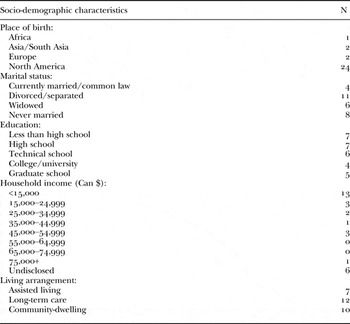
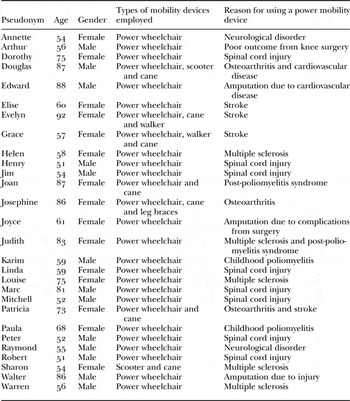
We recruited the participants through advertisements placed in community centres (N = 3), illness-related support organisation newsletters (N = 1) and gatekeepers in the community (N = 25). To be included in the sample, participants needed to be 50+ and reliant on a power wheelchair or a scooter for mobility. While the majority of the participants were Canadian-born, single and of lower income, the men and women had diverse educational attainments and living arrangements (see Table 1). Similarly, the participants varied with respect to the types of mobility aids they employed and their reasons for using power mobility devices (see Table 2).
Socio-demographic characteristics of participants

Note: N = 29.
Descriptive characteristics related to power mobility use

Note: N = 29.
Data analysis
Each of the transcripts was analysed by the first and second authors using a thematic analysis (Patton Reference Patton2002). Conducting a line-by-line reading of each interview using QSR International's NVivo 9 computer software, we focused specifically on the text passages that related to the participants’ experiences and perceptions of utilising their power mobility devices in their everyday lives, and where appropriate, their transition into a power mobility device. A continual reading and re-reading of the transcripts resulted in the identification of two key themes in the data, namely ‘embodied meanings of power mobility device use’ and ‘managing power mobility device use’. We further analysed the interviews to examine the similarities and differences between participants with varying health conditions and compared the remarks of those who had used power mobility devices for ten years or longer and those who had acquired their power wheelchairs and scooters more recently. In the two findings sections that follow, we elucidate the ways in which the participants perceived, experienced and responded to their transition into and use of their power mobility devices, focusing particularly on the ‘meanings as significance’ and ‘meanings as consequence’ (Bury Reference Bury, Anderson and Bury1988) they attributed to their power mobility devices.
Findings
‘Becoming disabled yet again’: embodied meanings of power mobility device use
Eight men and 11 women who had begun to use a power wheelchair or a scooter later in life associated their acquisition of a power mobility device with the age-related bodily changes they were experiencing and the concomitant sense that they were transitioning into a period of physical decline, dependence and marginalisation (resonant with the ‘fourth age’ as described by Gilliard and Higgs Reference Gilleard and Higgs2013). Noting that their bodies were ‘falling apart’ and becoming increasingly ‘uncooperative’, these participants indicated that they had come to view themselves (and perceived that others viewed them) as less capable, active and independent following the adoption of a power mobility device. For instance, Karim, who had been proud of the proficient way in which he had ambulated with the help of crutches and a manual wheelchair before switching to a power wheelchair, and who still hoped to be able to use a manual wheelchair for mobility in the future, observed:
[Using a power wheelchair] did affect my self-esteem in the sense that I perceived myself to be going one step lower … In my mind, going from a manual chair to a power chair was a step down because … people in power chairs are perceived as more disabled. The manual chair is perceived as a recognition of a person's ability … When you see a person in a manual chair who is really ambulating well, popping wheelies and going down curbs … they are perceived as less disabled. Whereas a power chair is just a mechanical device that you're driving, and it inadvertently gives other people the impression that you need more assistance and you are more dependent.
Similarly, Mitchell recalled his transition from a manual to a power wheelchair close to ten years ago:
I was using a manual chair for years and years, and I went to a power chair because I started getting older and … I ended up with a really bad shoulder … and that was the end of it … It wasn't just a switch [to a different mobility aid] – it was a mental shift too. It was almost like giving up, because it was so ingrained in me … that you're supposed to use your body, to do what you can do to compensate for [being unable to walk] … To [go from a manual chair to a power chair] was giving up, it was almost like a defeat … [And that] made me feel like I was more disabled.
The participants’ experiences of utilising a power mobility device were thus profoundly affected by the ‘meanings as significance’ (Bury Reference Bury, Anderson and Bury1988) they attributed to power mobility technology, especially as it related to the negative, devalued meanings of the ill and impaired body, and the cultural valorisation of independence and physical ability.
At the same time, the ‘meanings as significance’ of power mobility technology were intrinsically linked to the participants’ decreasing ability to negotiate able-bodied spaces as a result of their transition into a power mobility device. While we have reported on the multiple environmental barriers our participants encountered in their everyday lives elsewhere (Korotchenko and Hurd Clarke Reference Korotchenko and Hurd Clarke2014), it is worth noting how the consequences of using a power mobility device within a disabling environment shaped the participants’ perceptions of their bodies and selves. For instance, Annette, who had suffered rapid declines in her health two years ago as a result of a degenerative neurological condition that compelled her to utilise a cane, a walker and eventually a power wheelchair, described her experiences of navigating unaccommodating spaces in this way:
[At first], I was actually so excited to get my power chair. I still remember [thinking], ‘I can go places, I can be out there in the world!’ … But that was kind of the honeymoon phase [and it] died down. [Sometimes] I can feel this feeling of sadness coming. The tears start welling up, and I'm all telling myself, ‘Stop feeling sorry for yourself’, but I don't want to be like this, I want to get up and walk like everybody else. Every so often I go through that still, [like when] I'm going through line-ups in a store and someone barges right in front of me, and I'm sitting there like I'm invisible, just insignificant, and all these other people are up there. The majority of people in the world are up there on their feet. That's the way we're meant to be.
In addition to encountering physical barriers, the use of a power mobility device complicated social interactions by affecting able-bodied people's perceptions of the participants’ health statuses and abilities. This was articulated by Linda, who had this to say of switching from a manual to a power wheelchair:
I felt like I was becoming disabled yet again. I mean, let's face it … Does it give me mobility? Yes. Would I prefer to walk like other people? Of course … I find people are more patronising now. They come up, [and] they don't know what your disability is so they'll yell at you and come in really close like you might be blind and pat your head. I don't like people fussing around me and grabbing me and doing things for me … If I need some help, I'll ask you. I work hard for my independence. I don't need it taken away.
In this way, the realities of using a power mobility device in social and physical environments that privileged the able, youthful body provided daily reminders to the participants of the negative social connotations of having mobility impairments.
For six men and four women who had operated their power wheelchairs for long periods of time, as well as three men and five women who were facing rapidly changing health conditions, the ‘meanings as consequence’ and ‘meanings as significance’ (Bury Reference Bury, Anderson and Bury1988) ascribed to the use of a power mobility device additionally had to do with the participants’ fears concerning potential bodily declines that might result in an inability to operate a power mobility device in the future. Judith, who had multiple sclerosis and post-poliomyelitis syndrome, had this to say of her worsening symptoms:
The working [of my body] is changing far too rapidly for me. Some things change before I get a chance to catch up and then there's something else … I can feel the weakness in my body, and that's a little frightening because you're threatened by loss of independence … I've always felt that I could look after myself … [But now] there's a vulnerability … I guess what I'm saying is that my body felt strong and it doesn't now. It's weak and I know that it's not going to get a lot better. You know, you go from walking ten kilometres a day to being in a wheelchair within a year – what's next? How long before the wheelchair isn't enough? Yeah, it's a big threat.
Alarmed by their decreasing independence, many of these participants echoed Peter's statement that losing the ability to operate a power wheelchair would be ‘basically like a loss of life. You've already got a loss of limbs. You lose your chair, you lose your life’. Louise, who had used a power wheelchair for over 40 years, explained what loss of autonomous mobility might mean to her:
I don't even want to think about [not being able to use the power wheelchair] … You could be in a chair that has to be pushed around but man that would drive me nuts, quickly! I think at that point I would consider assisted suicide. I don't think I'd want to go on. And that sounds really bad but I wouldn't be a competent member of society. I wouldn't be anything – I'd just be a lump in a chair that I can't work … It would be the end, so I hope that doesn't happen … I don't want to lose my dignity … That to me is no way to live.
For these participants, the significance and consequences of having an impaired body within an ageist and ableist world were magnified by fears of a future where further health and physical declines would lead to increased dependence, marginalisation and exclusion, and as such, a life not worth living.
‘You've got to get on with your life as best you can’: managing power mobility device use
While we did not specifically ask the participants to discuss how they managed, mitigated or reframed their experiences of using a power mobility device, two-thirds of the participants (eight men and ten women) spontaneously conveyed ways in which they attempted to find ways to ‘make adaptations’ and ‘make [their] own opportunities’ in order to ‘get on with [their lives] as best [they] can’. Four men and five women stressed the importance of being pragmatic as a response to the undesirable consequences of power mobility use. For instance, while Edward had been disheartened to exchange his prostheses and manual wheelchair for a power wheelchair, he reasoned: ‘I don't like it, but there's nothing I can do about it so I accept it’. Likewise, Linda contended:
I have no choice but to use [the power wheelchair] if I want to live life and do things … I've got two choices, I can stay in bed and be a vegetable or I can get up and do things. So, do I wish I didn't use the power chair? Of course I do. Do I have to use the chair to live life? Does that make me happier than lying in bed? Yes. But am I glad to do it? No, of course not.
Notably, unlike previous research (Hurd Clarke and Bennett Reference Hurd Clarke and Bennett2013; Lorenz Reference Lorenz2009; Pound, Gompertz and Ebrahim Reference Pound, Gompertz and Ebrahim1998; Sanders, Donovan and Dieppe Reference Sanders, Donovan and Dieppe2002; Torres and Hammarstrom Reference Torres and Hammarstrom2006; Wilkins Reference Wilkins2001), relatively few participants (three women) rationalised the need for a pragmatic attitude by asserting that the bodily losses they experienced, and their subsequent move into a power mobility device, were a normal part of ageing. One of these three women, Louise, accounted for her declining health, which threatened her future ability to operate a power wheelchair in this way:
[My body] is falling apart. But then why wouldn't it be? I'm 75, so it's going to anyway … And it works not bad for somebody that's 75 with MS [multiple sclerosis] … The chair for me at this time of my life is not a problem. If I had been 30 or 40 [years old], it would be a problem, because you're not very mobile [in the chair], but you're younger and would like to do some things … [But] I'm not doing those things. I'm not going to the theatre. I'm not wearing long dresses or going to formal dinners … That time is over anyway.
Thus, as noted in the first findings section, while Louise felt that a life without independent mobility would be terrible, she also contended that the bodily limitations that had necessitated her use of a power wheelchair were a natural and expected part of growing older.
Additionally, even as they lamented the changes in their health that necessitated their use of a power mobility device, five men and seven women contrasted their declining abilities against the gratitude and appreciation they felt for their remaining cognitive and/or physical capabilities. These participants echoed the sentiments of Mitchell, who underscored the need to keep his focus on ‘things that are available to you … instead of focusing on things that you can't do anymore’. Some of the men and women emphasised their robust cognitive abilities, noting that despite their physical losses, they were ‘still on the ball’, they ‘[had] a brain that works’, they could ‘still put ideas together’ and they were ‘able to think for [themselves]’. Moreover, these participants often distinguished themselves from those they perceived to be in poorer cognitive condition, as exemplified by Henry, who contrasted his own abilities with some of the other residents in the long-term care facility in which he resided:
I feel like [my body] is dead weight but as long as I can control my chair I'm okay. You know, I've got my mind … A lot of people here are incapable because they have diseases like multiple sclerosis or you know, their memories are going, so they're not really there … So yeah, I'm glad I can use my mind … That's the most important thing.
Others minimised the impact of the bodily changes they had experienced over time by focusing on the positive physical attributes they had retained, contending that they were ‘still in fairly decent shape’, ‘in good health’ and ‘pretty active’. Sharon had this to say:
I like my body. It's a pretty good body. I think it's fairly attractive. I think I've got some good things going for me. I tend to focus on those, and not so much on the parts of me that I don't like. Because there are parts I don't like. I don't like how my legs look anymore … I've lost my muscle tone and now I tend to always have swelling in my ankles … you know, things like that. So I kind of go, ‘Oh, that doesn't look very good’. But then I think, ‘Let it go. You've got plenty of other good things going on … You're still doing pretty good’.
In addition, eight men and ten women highlighted the many ways in which they utilised their power mobility devices to negotiate disabling environments and negate others’ perceptions of them as frail and dependent, thereby shoring up their membership in the third age (Gilleard and Higgs Reference Gilleard and Higgs2013). For example, power wheelchairs and scooters enabled seven men and eight women to maintain their ability to ‘go and do things on [their] own’ and be ‘independent from having people do things for [them]’, thus avoiding becoming ‘a burden to society’. Arthur contended that his power wheelchair compensated for the strength he had lost over time and enabled him ‘do all kinds of things and be totally independent again’. Judith likewise explained how her power wheelchair permitted her to retain a degree of autonomy, assuaging her fears that she might over-tax her relationships with her friends and neighbours:
[With the power wheelchair], I can get around and I don't have to depend on anybody … I can be much more independent from pain, as well as independent from having to have neighbours or someone else do things for me … As you gather, it's just me and I have no family, so you become so worried that you'll bore your neighbours or your friends and have to ask them to come and they'll get tired of it altogether. So having the wheelchair is just a real blessing. I can be independent. I can enjoy life.
Moreover, two men and one woman contended that transitioning into a power mobility device had enabled them to be more physically and socially engaged than they had previously been. Echoing the sentiments of Swain and French (Reference Swain and French2000), these participants reported that while their health and physical abilities had decreased over time, the adoption of a power mobility device ultimately improved their quality of life. For instance, Mitchell, had this to say:
You know, [using the power wheelchair] was something I had to get used to … I was self-conscious about it … But after probably a couple of months, I was happy to do it, because it just gave me so much more freedom, and much less to worry about [with respect to] what I was doing to myself [by using a manual chair]. [My power wheelchair] has given me the ability to do a lot more things on my own that I couldn't do before … If I want to go anywhere I can do that on my own… so it's just a huge freedom that I didn't have before … I'm really enjoying life.
It is interesting to note that these three participants were community dwelling and had considerable financial resources that enabled them to perform regular maintenance on their power mobility devices, quickly replace malfunctioning parts, and equip their homes and vehicles with accessibility features. As such, these participants were able to employ their power mobility devices as a way of gaining access to previously inaccessible spaces and as a means of presenting themselves as independent, capable and active individuals, thus countering the negative connotations associated with ill and impaired bodies. In contrast, the majority of our sample consisted of individuals of lower socio-economic status who resided in long-term care or assisted living facilities. Lacking financial means and constrained by their living arrangements, these participants turned to more readily available ways of managing the use of a power mobility device, such as being pragmatic or focusing on their positive attributes.
Discussion
In this article, we have presented findings from interviews with men and women who were ageing with mobility impairments about their perceptions and experiences of transitioning into and using power mobility devices. In particular, we have focused on the ‘meanings as significance’ and ‘meanings as consequence’ (Bury Reference Bury, Anderson and Bury1988) that participants ascribed to their use of a power mobility device within the context of the cultural privileging of youthful, healthy, autonomous and able bodies. Echoing the findings of previous research (Hurd Clarke and Bennett Reference Hurd Clarke and Bennett2013; Lorenz Reference Lorenz2009; Pound, Gompertz and Ebrahim Reference Pound, Gompertz and Ebrahim1998; Sanders, Donovan and Dieppe Reference Sanders, Donovan and Dieppe2002; Torres and Hammarstrom Reference Torres and Hammarstrom2006; Wilkins Reference Wilkins2001), our participants reported that the progressive, ever-more devastating and often unpredictable age-related bodily changes that they experienced, and their subsequent use of a power mobility device, hindered their daily lives and disrupted their perceptions of their bodies and selves. Similar to the men and women interviewed in Tagizadeh Larsson and Jeppsson Grassman's (Reference Tagizadeh Larsson and Jeppsson Grassman2012) study, our participants considered the continued deterioration of their physical abilities and their transition into a power mobility device to be particularly distressing indicators of their diminishing independence and well-being rather than ‘normal illness’ (Williams Reference Williams2000: 49). In this way, our findings differ from previous research, which has indicated that older adults do not necessarily find declines in health to be biographically disruptive due to the expected nature of these bodily changes with age and their previous experiences of poor health (Hurd Clarke and Bennett Reference Hurd Clarke and Bennett2013; Lorenz Reference Lorenz2009; Pound, Gompertz and Ebrahim Reference Pound, Gompertz and Ebrahim1998; Sanders, Donovan and Dieppe Reference Sanders, Donovan and Dieppe2002; Torres and Hammarstrom Reference Torres and Hammarstrom2006; Wilkins Reference Wilkins2001). Furthermore, while previous research has suggested that illness and impairment in later life may be experienced as sites of personal growth, liberation and self-expression (Swain and French Reference Swain and French2000), only a small number of our participants viewed the transition into a power mobility device positively. These participants, who were community-dwelling and indicated that they had considerable financial means at their disposal, discussed the ways in which they utilised their power mobility devices to achieve greater community engagement and quality of life. In contrast, the majority of our sample consisted of individuals who resided in assisted living or long-term care facilities and were of lower socio-economic status, suggesting that the affirmative meanings of adopting power mobility technology may not be available to all individuals, and may be dependent on one's personal resources.
Our findings illustrate how the negative connotations of illness and impairment in later life compounded and augmented the disruptiveness of the age-related bodily changes our participants faced. Indeed, we argue that the importance placed on physical autonomy and independent mobility, both in the design of public spaces that are unaccommodating of ageing and impaired bodies, and in cultural expectations of the successfully ageing body, greatly contributed to the sense of disruption our participants experienced when transitioning into a power mobility device. In addition to becoming restricted in their mobility and ability to negotiate able-bodied spaces, our participants were threatened by the significance of employing a power mobility device, which made it progressively more difficult for them to present themselves as healthy, self-reliant and able-bodied members of the third age (Gilleard and Higgs Reference Gilleard and Higgs2013). Although our participants considered their power wheelchairs and scooters to be instrumental to achieving bodily autonomy and wellbeing, they also perceived their power mobility devices to be potent reminders of their bodily losses, increasing mobility impairment, and pending transition into a fourth age of dependence, marginalisation and exclusion (Gilleard and Higgs Reference Gilleard and Higgs2013). Deeply aware of their social and physical vulnerability, our participants expressed appreciation for their remaining physical abilities, highlighted their cognitive functioning and distanced themselves from those they perceived to be members of the fourth age, namely older adults who were cognitively impaired or non-ambulatory. In this way, our findings suggest that the internalisation of autonomous mobility and self-reliance as markers of citizenship and membership in the third age further augmented our participants’ suffering.
Limitations and future studies
Our study is limited by its relatively homogeneous sample. While our participants varied with respect to their ages, educational attainments and living arrangements, the majority were of lower income and of European descent. Further research should explore the everyday lived experiences of older adults with mobility impairments with a focus on racialised communities and social class. In addition, while our participants ranged in ages from 51 to 92, the majority of individuals in our sample were in their fifties and sixties. It would be beneficial to explore the experience of power mobility use in relation to the third and fourth ages in advanced old age, when declines in health and resultant societal marginalisation become increasingly present.
Conclusion
In conclusion, our findings highlight the complexities of ageing with mobility impairments, particularly for those reliant on power mobility devices. Autonomous mobility is perceived to be vital for wellbeing as well as an indicator of one's ability to remain a healthy, active and independent member of the third age. As such, the transition into a power mobility device constituted an uncertain and unsettling situation for our participants, further devaluing their bodies and diminishing their capacities to negotiate social and physical spaces privileging physical ability and youthfulness. It is imperative that we question the narrow standard of valuable human experience and the correlation between human worth and ability to enable individuals who are growing older with mobility impairments to age with dignity and autonomy.
Acknowledgements
The authors would like to thank the individuals who took part in this research for their time and valuable insights. We would also like to thank Erica Bennett, Lauren Courtice and Chris Liu for their assistance with data management. This research was supported by a Canadian Institutes of Health Research Emerging Team Grant awarded to the CanWheel research group, as well as a Social Sciences and Humanities Research Council Joseph-Armand Bombardier Doctoral Scholarship awarded to Alexandra Korotchenko.