Introduction
Following the introduction of antiretroviral therapy, the increase in the number of individuals living with human immunodeficiency virus (HIV) as a chronic disease has led to a rise in the number of older individuals with the virus, which is accentuated by more common patterns of sexual risk behavior in comparison to older individuals in the past (Valcour, Shikuma et al., Reference Valcour, Shikuma, Watters and Sacktor2004). Due to the bell curve of the demographic distribution of HIV, in which the peak age is from 35 to 44 years, the Centers for Disease Control (CDC) in the USA proposes that patients over 50 years of age with the virus be considered “older adults” with HIV (Luther and Wilkin, Reference Luther and Wilkin2007).
With the institution of treatment, the prevalence of opportunistic infections has dropped considerably. However, the same cannot be said with regard to HIV-associated dementia, which, despite the drop in incidence, has maintained a stable prevalence (Dore et al., Reference Dore, Correll, Li, Kaldor, Cooper and Brew1999; Wong et al., Reference Wong2007). This prevalence is quite variable, ranging from 7% to 90% depending upon the diagnostic criteria and the population evaluated (Brew, Reference Brew1999).
This stable prevalence of HIV-associated dementia has added to an aging HIV-positive population, leading to a higher frequency of cognitive impairment and resulting in greater difficulty in work and activities of daily living (Albert et al., Reference Albert1995). Furthermore, cognitive impairment and older age, independently, were associated with a significantly lower medication regimen adherence rates (Hinkin et al., Reference Hinkin, Castellon, Durvasula, Lam and Stefaniak2002), one of the main factors to uncontrolled HIV replication and resistance (Gifford et al., Reference Gifford, Bormann, Shively, Wright, Richman and Bozzette2000).
Another important and frequent neurobehavioral morbidity – depression – also plays a role in the lower adherence to medication and self-care with regard to health among patients with HIV (Berg et al., Reference Berg, Michelson and Safren2007). Depression is disproportionally associated with HIV infection, but a causal relationship is unclear. A variety of causes can predispose to depressive disorder including direct injury to subcortical areas of the brain, chronic stress, worsening social isolation, and demoralization (Berg et al., Reference Berg, Michelson and Safren2007). Also, drugs as efavirenz can have neuropsychiatric effects (Lochet et al., Reference Lochet, Peyrière, Lotthé, Mauboussin, Delmas and Reynes2003). Depression is associated with poor self-care and worse health outcomes in those with HIV (Berg et al., Reference Berg, Michelson and Safren2007).
The aim of the present study was to estimate the frequency of HIV-associated neurocognitive disorder (HAND), with or without dementia and depressive symptoms, assessing risk factors through a retrospective analysis of a population of older adults (aged 50 years or older) treated in an outpatient setting.
Methods
Study population
Patients in outpatient care were followed up and randomly selected at two reference units for HIV care (Correa Picanço Hospital and the University Hospital of the Universidade Federal de Pernambuco (UFPE)) in the city of Recife between March and November 2008. Patients with HIV-1 infection (according to medical charts) and aged 50 years or older were evaluated. In an attempt to diminish the confounding factors, individuals with any of the following findings were excluded from the study: history of hospitalization in the previous three months (diminishing the risk of an unstable clinical course due to other co-morbidities); focal neurological deficit; history of fever in the previous seven days; current or past history of central nervous system infection; and current or past history of psychiatric disorder reported by the patient (previous known diagnosis or internment in a mental health facility). Outpatients from the general clinic of the UFPE Hospital were also evaluated in order to generate normative values for the cognitive assessment. The study received approval from the Ethics Committee of the UFPE Center for Health Sciences (CAAE 0362.0.172.000–07), and all participants signed terms of informed consent.
Study design
A cross-sectional analysis of individuals randomly selected in outpatient care at the Correa Picanço and UFPE Hospital was carried out. Patients aged 50 years or older with HIV whose last appointment occurred during the evaluation period were contacted on the day of their outpatient visit and evaluated based on cognitive status and other variables.
Determination of neurocognitive impairment, dementia, and depression
After selection based on the eligibility criteria, each HIV positive patient was submitted to a cognitive assessment. In an attempt to bestow greater subsequent reproducibility of the study, this assessment was carried out with the modifications proposed by the HIV Neurobehavioral Research Center (Antinori et al., Reference Antinori2007) for situations in which there is no easy access to neuropsychological evaluations.
The patients were submitted to two cognitive tests: the Mini-Mental State Examination (MMSE) and the International HIV Dementia Scale (IHDS). The MMSE was analyzed based on a cutoff score validated for the Brazilian population, with scores below 24 points considered indicative of cognitive impairment and, correcting for schooling, a cutoff value of 20 points for illiterate individuals (Almeida, Reference Almeida1998). For the IHDS analysis, patients with a score of less than 10.5 were selected (Sacktor et al., Reference Sacktor2005) and this group was considered to have cognitive impairment following the evaluation of five subscales (at least five domains should be evaluated according to the HIV Neurobehavioral Research Center proposal) – three on the IHDS (motor speed, psycho-motor speed, and verbal memory) and two on the MMSE (registration memory and attention). These five subscales were also evaluated in 30 patients from an external control group, stratified by schooling (literate or illiterate) – all over 50 years of age and submitted to the same exclusion criteria as the group with HIV. Individuals in the group selected by IHDS score were considered to exhibit cognitive impairment when achieving at least a 1.5 standard deviation below the mean of the external normative group on at least two of the five subscales.
After determining the presence of cognitive impairment, the patient was classified as having HAND and considered to have dementia if exhibiting functional impairment, established as any impairment on Lawton's Instrumental Activities of Daily Living (IADL) scale.
Depression was determined by the administration of the 15-item Yesavage Geriatric Depression Scale, with a 5/6 cutoff point for non-depressed/depressed individuals (Almeida and Almeida, Reference Almeida and Almeida1999; Paradela et al., Reference Paradela, Lourenço and Veras2005).
Variables analyzed
The evaluation of the patients was complemented with the analysis of other data obtained during the interview and confirmed by data on the patient charts when pertinent: biological variables (gender, age, self-reported race); level of schooling (illiterate, literate with no university education, literate with a university education); CD4 T lymphocyte count on medical chart (most recent and lowest (nadir) historical value of the series); use of highly active antiretroviral therapy (HAART); and use of neuroactive regimen (considered when using three or more following drugs with penetration in the central nervous system: lamivudine, stavudine, zidovudine, efavirenz, nevirapine, indinavir, and abacavir). Among the patients with depressive symptoms, the use of efavirenz was assessed.
Statistical analysis
The frequencies of cognitive impairment and depression were analyzed based on the proportion of patients identified with these conditions in relation to the number of patient selected. For the identification of risk factors, the frequencies of demographic, clinical, and laboratory risk factors were compared in relation to the patients with and without cognitive impairment as well as those with and without depression. The chi-square test and Fisher's exact text were used for the analysis of the categorical variables and the Mann-Whitney test was used for the continuous variables. The MS Office Excel program (version 2003) was used to manage the databank and the Statistical Package for the Social Science (version 12.0) was used for executing the statistical calculations.
Results
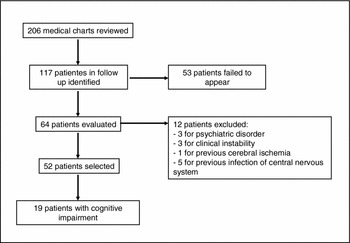
Among a total of 206 patient charts examined, 117 patients in current follow up were identified. Among these, 53 did not appear for their scheduled appointments. Twelve of the remaining 64 patients were excluded (three for psychiatric disorders; three for clinical instability (one for clinical instability and fever and another for clinical instability and focal neurological impairment); one for focal neurological impairment; and five for a history of central nervous system infection (three for neurotoxoplasmosis, one for neurosyphilis, and one for progressive multifocal leukoencephalopathy)), thereby forming a sample of 52 patients (Figure 1).
Selection, assessment, and classification of cognitive impairment among patients aged 50 years or older with HIV.

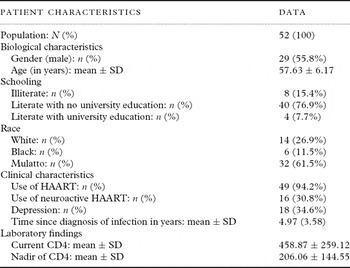
Mean age was 57.63 (±6.17) years, with a predominance of the 50–59-year-old age group (67.3%). In the assessment of schooling level, the majority of patients were literate with no university education (76.9%). These and other biological characteristics and data, e.g. time since diagnosis, use of HAART, CD4 T lymphocyte count, etc., are presented in Table 1.
Biological, clinical, and laboratory characteristics of patients aged 50 years or older with HIV/AIDS

Note: SD = standard deviation; HAART = highly active antiretroviral therapy; CD4 = CD4 T lymphocytes in cells/mL.
Assessment of cognitive impairment, dementia, and depression
The frequency of cognitive impairment was 36.5%. Among the 52 patients evaluated, four had a lower-than-expected MMSE score (corrected for schooling) and no alteration on the IHDS; ten had a lower-than-expected MMSE score (corrected for schooling) and an IHDS score equal to or less than 10; and 17 had only an IHDS score equal to or less than 10. Stratification was carried out of the patients with an IHDS score equal to or less than 10, with at least two of the five subscales analyzed (verbal memory, motor speed, psychomotor speed, registration memory, and attention) being lower than a 1.5 standard deviation in relation to the mean of the external control group. Among the total of ten patients with low scores on the MMSE and IHDS, three exhibited impairment on at least two of the five subscales. Among the 17 patients with low scores on the IHDS alone, five exhibited impairment on at least two of the subscales selected.
Thus, a total of 19 patients were identified as having HAND (36.5%), with 14 of these patients achieving a lower-than-expected score on the MMSE. Among the total sample, 13.5% exhibited both cognitive impairment and at least some functional difficulty (as assessed using Lawton's IADL scale) and were therefore considered as having dementia.
A total of 34.6% (18 patients) of the sample achieved a score of 6 or more on the 15-item Yesavage Geriatric Depression Scale and were therefore considered as having depression.
Evaluation of risk factors for cognitive impairment and depression
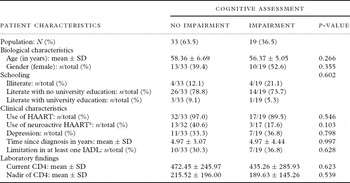
The univariate analysis revealed no statistically significant differences between patients with and without cognitive impairment in relation to age, gender, schooling, use of antiretroviral therapy, current use of neuroactive antiretroviral regimen, depression, duration of infection, current CD4 lymphocyte count, or nadir of CD4 count (Table 2). There was also no difference between patients with and without cognitive impairment in relation to functional impairment (36.8% and 30.3%, p = 0.628).
Comparison of biological, clinical, and laboratory characteristics of patients aged 50 years or older with HIV/AIDS according to presence or absence of cognitive impairment

a Calculation base of 49 patients in HAART use.
Note: SD = standard deviation; IADL = instrumental activities of daily living; HAART = highly active antiretroviral therapy; CD4 = CD4 T lymphocytes in cells/mL.
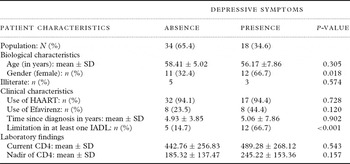
The female gender proved to be a risk factor for depression, with a frequency of 66.7% among depressed individuals and 32.4% among non-depressed individuals (p = 0.018). There were no differences between depressed and non-depressed individuals in relation to mean age, schooling, duration of infection, use of efavirenz, CD4 T lymphocyte count, and nadir of CD4 T lymphocyte count (Table 3). Functional impairment was more pronounced in patients with depressive symptoms, with a frequency of 66.7% among those with depressive symptoms and 14.7% among those without depressive symptoms (p < 0.001).
Comparison of biological, clinical and laboratory characteristics of patients aged 50 years or older patients with HIV/AIDS according to the presence or absence of depressive symptoms

Note: SD = standard deviation; IADL = instrumental activities of daily living; HAART = highly active antiretroviral therapy; CD4 = CD4 T lymphocytes in cells/mL.
Discussion
The present study found a 36.5% frequency of HAND and a 13.5% frequency of dementia among patients with HIV/AIDS infection aged 50 years or older, with no specific risk factors for these conditions and a principally cortical presentation. Depression was found in 34.5% of the patients, with the female gender at greater risk. Functional impairment was significantly more pronounced among depressed individuals.
Studies carried out in developed countries prior to the introduction of HAART found a prevalence of HIV-associated dementia ranging from 7.3% to 15% (Janssen et al., Reference Janssen, Nwanyanwu, Selik and Stehr-Green1992; McArthur et al., Reference McArthur1993; Portegies et al., Reference Portegies1993). Although the introduction of HAART has improved the prognosis of these patients, there has been no change in the prevalence of this condition (Dore et al., Reference Dore, McDonald, Yueming, Kaldor and Brew2003). Studies carried out in developing countries report a prevalence ranging from 11.7% in Asia and the Pacific (Wright et al., Reference Wright2008) to 31% in Sub-Saharan Africa (Wong et al., Reference Wong2007).
In Brazil, Oliveira et al. (Reference Oliveira, Greco, Oliveira, Christo, Guimarães and Corrêa-Oliveira2006) carried out a study with inpatients at a healthcare service in the southeastern region of the country and found a 4.6% prevalence of HIV-associated dementia. The patients assessed in the study exhibited a greater degree of immunosuppression, with a mean CD4 lymphocyte count of 93.9 (±110.6) cells/mL versus 487.87 (±259.12) cells/mL in the present study. The patients also had a lower frequency of HAART use, with 76.1% versus 94.2% in the present study. We may suppose that the different mean age (35.8 (±0.6) years in the study cited versus 57.63 (±6.17) in the present study) as well as possible differences in the diagnostic criteria employed were the greatest determinants of this difference in frequency.
A greater prevalence of dementia associated to HIV in individuals over 50 years of age has been described in other studies. Valcour et al. (Reference Valcour2004) found that the frequency of HIV-associated dementia rose from 13.7% to 25.2% (p = 0.041) when comparing patients with a mean age of 34.9 (±4.74) years and those with a mean age of 55.4 (±4.85) years. Another study found an increase in frequency from 9% to 23% (p = 0.036) comparing patients with HIV under and over 50 years of age, respectively (Becker et al., Reference Becker, Lopez, Dew and Aizenstein2004).
For the characterization of functional impairment and, consequently, dementia, the present study employed Lawton's IADL scale. However, no differences were found in functional impairment between the individuals with and without cognitive impairment, for whom frequencies were 36.8% and 30.3% (p = 0.628), respectively. This corroborates previous findings of no significant difference in relation to functional impairment as assessed using the IADL scale and other scales, regardless of the presence or severity of cognitive impairment (Schifitto et al., Reference Schifitto2001; Becker et al., Reference Becker, Lopez, Dew and Aizenstein2004). The recognition of the classification as asymptomatic neurocognitive impairment with no functional repercussions in patients having HAND has been proposed as a way to limit the subsequent underdiagnosis (Antinori et al., Reference Antinori2007).
The clinical presentation of cognitive impairment also merits attention. Brief instruments, such as the MMSE, were designed to screen for cortical dementia such as Alzheimer's disease, which are therefore less sensitive for detecting a subcortical dementia as such HIV dementia (Sacktor et al., Reference Sacktor2005). Among the 19 patients classified as exhibiting cognitive impairment, 14 (73.7%) had a lower-than-expected score on the MMSE, as did five of the seven (71.4%) classified as having dementia. In the era of HAART, the HIV-associated dementia has had changes in the clinical profile of cognitive impairment, as having an increasingly more cortical presentation (Valcour and Paul, Reference Valcour and Paul2006). These data deserve elucidation in further studies.
No risk factors were identified through the comparison of patients with and without cognitive impairment, although some risk factors such as female gender, age, and CD4 T lymphocyte count have been described (McArthur et al., Reference McArthur, Brew and Nath2005; Wong et al., Reference Wong2007). A previous study found that within the subgroup of patients over 50 years of age, CD4 count, nadir of CD4 T lymphocyte count, duration of infection, and age demonstrated no influence over the frequency of HIV-associated dementia (Oliveira et al., Reference Oliveira, Greco, Oliveira, Christo, Guimarães and Corrêa-Oliveira2006).
A 34.62% frequency of depression was found among the patients evaluated. Although the Brazilian version of the 15-item Yesavage Geriatric Depression Scale has an adequate correlation with the diagnosis of depression through the Diagnostic and Statistic Manual of Mental Disorders-IV, with sensitivity ranging from 81% to 90.9% and specificity ranging from 64.5% to 71% (Almeida and Almeida, Reference Almeida and Almeida1999; Paradela et al., Reference Paradela, Lourenço and Veras2005), it, as other scales, serves mainly as a screening test for the diagnosis of depressive symptoms. Previous studies on the evaluation of depressive symptoms report frequencies ranging from 30% to 60% (Rabkin et al., Reference Rabkin, Elhiney and Ferrando2004).
The female gender was a risk factor for depressive symptoms, with double the frequency among the depressed individuals (p = 0.018). There was also greater functional impairment among those with depressive symptoms, increasing from a 14.7% frequency of at least one limitation in IADL among those with a Yesavage scale score of up to 5 points to 66.7% among those with a score equal to or greater than 6 (p < 0.001).
The present study had limitations that should be addressed: Neuroimaging and cerebrospinal fluid studies, which are normally proposed for ruling out other possible differential diagnoses such as infection and neoplasm (Brew, Reference Brew1999), were not carried out in the present study. The aim of the exclusion criteria was to minimize these possible confounding factors. Furthermore, since the original consensus of the American Academy of Neurology (Neurology AIDS Task Force, 1991), the presence of other neurological conditions does not invalidate the diagnosis of HIV-associated dementia and the presence or non-evaluation of these conditions makes the diagnosis “possible” rather than “probable.” One study assessing confounding factors found that as many as 70% of patients with cognitive impairment had some modifier of the diagnostic status to “possible” (Valcour et al., Reference Valcour2004).
Another limitation of the present study was the small external control group used for the normalization of the tests. However, ethnic background and level of schooling (among other factors) have an influence over neurocognitive tests in populations (Antinori et al., Reference Antinori2007), and it is preferable for this sample to be used in comparison to normative data on populations from developed countries.
The large number of losses among patients sought for evaluation was another limiting factor and more control over absentee patients is needed. Elderly patients have greater limitations, which may have contributed to the large number of losses and had an influence over the comparisons between the groups of patient evaluated.
The present study has considerable importance due to the use of the new criteria proposed for the diagnosis of HIV-associated dementia in populations with limited access to neuropsychological tests (Antinori et al., Reference Antinori2007). The use of the MMSE (validated and stratified for level of schooling in Brazil) in association with the recent IHDS, which is easy to use in both developed and developing countries (Sacktor et al., Reference Sacktor2005), allows the easy reproducibility of this study in other healthcare services, thereby permitting comparisons over time in accordance with the most recent research consensuses (Antinori et al., Reference Antinori2007). There may also be a greater possibility of diagnostic evaluation in developing countries, which concentrate the largest contingent of infected patients, who are therefore at risk of developing dementia.
The present study identified a high frequency of HAND, including both asymptomatic neurocognitive impairment and dementia, and depressive symptoms in the sample studied. Patients with cognitive impairment achieved lower scores on the cortical assessment test, but did not exhibit greater functional impairment than those without cognitive impairment, based on the assessment scale used. Patients with depressive symptoms more frequently exhibited functional repercussions and the female gender was identified as a risk factor for depression. New scales and further studies with a broader scope and longer follow up are needed for a better understanding of HIV and its effects.
Conflict of interest
None.
Description of authors' roles
S. M. M. Fernandes Filho designed the study, realized the data collection, carried out the statistical analysis and wrote the paper; H. R. L. de Melo assisted in designing the study and writing the paper.
Acknowledgments
This study was realized at Correa Picanço Hospital and the University Hospital of the Universidade Federal de Pernambuco (UFPE), Recife, Brazil. The study was financed/supported by the authors.