Introduction
In light of significant benefits associated with physical activity (PA) engagement in older age (Pereira, Baptista and Cruz-Ferreira Reference Pereira, Baptista and Cruz-Ferreira2016), such as prevention of falls and consequent injuries (Sherrington et al. Reference Sherrington, Tiedemann, Fairhall, Close and Lord2011), coupled with a majority of older adults not meeting the current PA guidelines (Sims et al. Reference Sims, Birrell, Hunt, Browning, Burns and Mitchell2014; Sun, Norman and While Reference Sun, Norman and While2013), several reviews have been conducted to assess the effectiveness of PA interventions targeting older adults. Overall, these reviews found a lack of interventions targeting specifically older adults (Chase Reference Chase2015), with existing interventions producing only small effects on PA (D. P. French et al. Reference French, Olander, Chisholm and Mc Sharry2014). Furthermore, maintenance of improvements in PA behaviour over the long term (>12 months) is unclear (Hobbs et al. Reference Hobbs, Godfrey, Lara, Errington, Meyer, Rochester, White, Mathers and Sniehotta2013). The reasons for the limited effects of PA programmes may be due, in part, to a lack of clarity about key intervention components (S. D. French et al. Reference French, Green, O'Connor, McKenzie, Francis, Michie, Buchbinder, Schattner, Spike and Grimshaw2012), lack of a theoretical framework to inform intervention development (Baert et al. Reference Baert, Gorus, Mets, Geerts and Bautmans2011) and/or behaviour change techniques (BCTs) being inappropriate for the target population (Fleig et al. Reference Fleig, McAllister, Chen, Iverson, Milne, McKay, Clemson and Ashe2016). Prior research has indicated that intervention effectiveness may be improved by using theory to develop programmes (Chase Reference Chase2015; Prestwich, Webb and Conner Reference Prestwich, Webb and Conner2015), as well as by tailoring programmes to the relevant population (King and King Reference King and King2010; Müller-Riemenschneider et al. Reference Müller-Riemenschneider, Reinhold, Nocon and Willich2008; Ziegelmann and Knoll Reference Ziegelmann and Knoll2015). It is therefore important that PA interventions are designed based on theory and to suit the specific needs and preferences of older adults.
Extant research reports a wide range of barriers to older adults’ PA, such as health/physical impairment, and lack of willpower, competence, and time and social support (Arnautovska, O'Callaghan and Hamilton Reference Arnautovska, O'Callaghan and Hamilton2017a; Baert et al. Reference Baert, Gorus, Mets, Geerts and Bautmans2011). Additionally, the endorsement of ageing stereotypes and the negative view of ageing can also negatively impact one's PA participation (Emile et al. Reference Emile, Chalabaev, Stephan, Corrion and d'Arripe-Longueville2014; Ory et al. Reference Ory, Hoffman, Hawkins, Sanner and Mockenhaupt2003). While a long list of perceived barriers to PA can inform the development of targeted PA programmes, a selection of useful BCTs to facilitate PA effectively can also be guided by carefully integrating multiple theories (Prestwich, Webb and Conner Reference Prestwich, Webb and Conner2015), allowing identification of the most parsimonious set of factors to target in interventions delivered across various social settings. Indeed, by applying an integrated theory-based approach, recent studies have demonstrated that multiple decision-making processes, including reflective (consisting of motivational and volitional factors) and automatic (habitual) processes, impact health behaviour (Hagger et al. Reference Hagger, Trost, Keech, Chan and Hamilton2017; Hamilton et al. Reference Hamilton, Kirkpatrick, Rebar and Hagger2017), including PA engagement (Allom et al. Reference Allom, Mullan, Cowie and Hamilton2016; Hagger and Chatzisarantis Reference Hagger and Chatzisarantis2014; Mullan et al. Reference Mullan, Henderson, Kothe, Allom, Orbell and Hamilton2016). Within motivational processes, the key factors include attitudes, social norms, self-efficacy and behavioural control, and intention (Sheeran et al. Reference Sheeran, Maki, Monanaro, Avishai-Yitshak, Bryan, Klein, Miles and Rothman2016a), in line with the theory of planned behaviour (TPB; Ajzen Reference Ajzen1991). However, experimental evidence from at least two TPB-based interventions to promote walking is equivocal (Darker et al. Reference Darker, French, Eves and Sniehotta2010; Williams et al. Reference Williams, Michie, Dale, Stallard and French2015). Williams et al. (Reference Williams, Michie, Dale, Stallard and French2015), who failed to find significant effects of their intervention on participants’ walking, concluded that the lack of effects may have resulted from the unsuitability of included BCTs for the population investigated, thereby highlighting the importance of tailoring programmes to the specific population.
Studies within the PA domain have indicated that belief-based TPB constructs may be predicted by autonomous motivation, characterised by a sense of autonomy and inherent joy in engaging in PA (Hagger and Chatzisarantis Reference Hagger and Chatzisarantis2009; Hamilton, Cox and White Reference Hamilton, Cox and White2012; Kosma Reference Kosma2014). For example, individuals with higher levels of intrinsic motivation (Thøgersen-Ntoumani et al. Reference Thøgersen-Ntoumani, Shepherd, Ntoumanis, Wagenmakers and Shaw2016), and autonomous forms of extrinsic motivation (Ferrand, Martinent and Bonnefoy Reference Ferrand, Martinent and Bonnefoy2014), tend to engage in more PA. Thus, techniques targeting autonomous motivation from the self-determination theory (Deci and Ryan Reference Deci and Ryan2008), may also be important in promoting older adults’ PA.
Furthermore, in line with theories of volition, such as the health action process approach (Schwarzer Reference Schwarzer2008), individuals are more likely to realise their health-related intentions by employing volitional strategies to bridge the intention–behaviour gap (Orbell and Sheeran Reference Orbell and Sheeran1998; Rhodes and de Bruijn Reference Rhodes and de Bruijn2013; Reyes Fernández et al. Reference Reyes Fernández, Knoll, Hamilton and Schwarzer2016; Zhou et al. Reference Zhou, Gan, Miao, Hamilton, Knoll and Schwarzer2015a). Indeed, there is growing evidence for the use of self-regulatory strategies (e.g. implementation intention, action planning and coping planning) in interventions promoting health behaviour (Hagger et al. Reference Hagger, Luszczynska, de Wit, Benyamini, Burkert, Chamberland, Chater, Dombrowski, van Dongen, French, Gauchet, Hankonen, Karekla, Kinney, Kwasnicka, Lo, López-Roig, Meslot, Moreira Marques, Neter, Plass, Potthoff, Rennie, Scholz, Stadler, Stolte, ten Hoor, Verhoeven, Wagner, Oettingen, Sheeran and Gollwitzer2016; Kwasnicka et al. Reference Kwasnicka, Presseau, White and Sniehotta2013; Sniehotta et al. Reference Sniehotta, Schwarzer, Scholz and Schüz2005; Zhou et al. Reference Zhou, Sun, Knoll, Hamilton and Schwarzer2015b). However, a meta-analysis of the effectiveness of BCTs aimed at increasing self-efficacy and PA in older adults (D. P. French et al. Reference French, Olander, Chisholm and Mc Sharry2014) identified specific self-regulatory strategies, such as goal setting and planning for relapses, to be associated with decreased levels of both self-efficacy and PA behaviour. More recently, Warner et al. (Reference Warner, Wolff, Ziegelmann, Schwarzer and Wurm2016) also failed to find positive effects of including self-regulatory techniques in an intervention to increase PA among older adults. It is possible that the effectiveness of planning strategies for facilitating PA in older adults may depend on a person's cognitive capacities, particularly prospective memory (Wolff et al. Reference Wolff, Warner, Ziegelmann, Wurm and Kliegel2016). Alternatively, self-regulatory BCTs may not suit older adults’ preferences about planning where, when and how to do PA (action planning) and how to deal with potential barriers (coping planning) because of lack of time, perceived low value (and that of broader society; Emile et al. Reference Emile, Chalabaev, Stephan, Corrion and d'Arripe-Longueville2014) of PA (Barnett, Guell and Ogilvie Reference Barnett, Guell and Ogilvie2012), or low awareness of perceived environmental support, such as people, to rely on in their neighbourhood and PA opportunities (Addy et al. Reference Addy, Wilson, Kirtland, Ainsworth, Sharpe and Kimsey2004).
One desired outcome of PA interventions across all settings is habit formation (Fleig et al. Reference Fleig, McAllister, Chen, Iverson, Milne, McKay, Clemson and Ashe2016). By repeating an activity in a consistent context, the behaviour becomes triggered automatically, without a person's conscious control and deliberation (Lally and Gardner Reference Lally and Gardner2013; Verplanken and Melkevik Reference Verplanken and Melkevik2008). BCTs to facilitate repetition frequency include behavioural-type components, such as prompting rehearsal of the behaviour in the same context, behaviour substitution or restructuring the physical environment by introducing prompts and cues for the desired behaviour (Michie et al. Reference Michie, Richardson, Johnston, Abraham, Francis, Hardeman, Eccles, Cane and Wood2013). Indeed, a meta-analysis of interventions to promote PA in older adults (Chase Reference Chase2015) found that a combination of cognitive-type (e.g. problem solving) and behavioural-type (e.g. self-monitoring and prompting) intervention components is more effective in increasing PA than interventions with either a cognitive or behavioural component alone. Thus, behavioural techniques that would strengthen automatic engagement in behaviour (Gardner Reference Gardner2015) may be useful in complementing cognitive strategies to facilitate regular PA.
However, in developing health behaviour interventions, while theory and empirical evidence are of paramount importance (Chase Reference Chase2015; Hamilton and Hagger Reference Hamilton and Hagger2014; Prestwich, Webb and Conner Reference Prestwich, Webb and Conner2015), practical issues determine which BCTs are appropriate for a specific target group and setting (S. D. French et al. Reference French, Green, O'Connor, McKenzie, Francis, Michie, Buchbinder, Schattner, Spike and Grimshaw2012). While standardised taxonomies of BCTs have been developed (Kok et al. Reference Kok, Gottlieb, Peters, Mullen, Parcel, Ruiter, Fernandez, Markham and Bartholomew2015; Michie et al. Reference Michie, Richardson, Johnston, Abraham, Francis, Hardeman, Eccles, Cane and Wood2013), currently, there is a limited understanding of how specific theory-based targets for promotion of PA should be implemented in order to produce positive behavioural outcomes (S. D. French et al. Reference French, Green, O'Connor, McKenzie, Francis, Michie, Buchbinder, Schattner, Spike and Grimshaw2012). In addition, given the equivocal evidence on the use of certain BCTs, such as those based on self-regulatory or planning principles, for promotion of PA in older adults (D. P. French et al. Reference French, Olander, Chisholm and Mc Sharry2014), it remains unclear which BCTs are acceptable for older adults specifically. The BCTs that have been identified to increase intervention effectiveness for older adults’ PA include barrier identification/problem solving, provision of rewards contingent on successful behaviour and modelling/demonstrating the behaviour (D. P. French et al. Reference French, Olander, Chisholm and Mc Sharry2014).
There is, however, a gap in understanding how these potentially effective BCTs should be matched with the needs and characteristics of the older adult population. This lack of understanding is particularly significant given that studies consistently demonstrate that tailoring health behaviour interventions can produce significantly larger effect sizes than no tailoring at all (Courtney et al. Reference Courtney, Edwards, Chang, Parker, Finlayson and Hamilton2009; Noar, Benac and Harris Reference Noar, Benac and Harris2007). To address this gap, the use of qualitative methodology has been suggested to explore the acceptability of BCTs for promoting PA in older adults (S. D. French et al. Reference French, Green, O'Connor, McKenzie, Francis, Michie, Buchbinder, Schattner, Spike and Grimshaw2012). Previous qualitative studies have provided valuable insight into the strategies employed by older athletes in sustaining their PA performance (Dionigi, Horton and Baker Reference Dionigi, Horton and Baker2013), as well as into the needs regarding appropriate strategies for delivering a PA programme among specific population groups such as parents of young children (Hamilton and White Reference Hamilton and White2014). It may be beneficial to apply a similar approach to examine what older adults would like from a PA intervention, and how PA programmes targeting older adults should be delivered to be acceptable for them. Such formative research in developing theoretically and empirically based health interventions may improve the effectiveness of future interventions (Epton et al. Reference Epton, Norman, Harris, Webb, Snowsill and Sheeran2014; Hagger Reference Hagger2010).
The purpose of the current study was to explore strategies for the development and implementation of intervention programmes designed to increase PA in older adults, using a mixed-method approach. To achieve this, we aimed to investigate what specific BCTs would be most useful for facilitating PA in older adults, and second, explore the strategies for how best to design and deliver such techniques in a PA intervention for older adults. The uniqueness of this study is in its focus on the perspective of older adults in understanding which strategies they prefer and how they should be included in interventions designed to increase PA levels in older age.
Method
This study builds on previous work which has provided preliminary evidence of factors that may influence older adults’ PA (Arnautovska, O'Callaghan and Hamilton Reference Arnautovska, O'Callaghan and Hamilton2017b; Arnautovska et al. Reference Arnautovska, Fleig, O'Callaghan and Hamilton2017). Specifically, the current study focused on strategies for the development and implementation of interventions aimed at increasing PA in older adults.
Participants and procedure
Participants were older adults (64.6% women) who participated in a previous study investigating older adults’ PA and who provided consent to be contacted for future research. Selection criteria included being 65 years of age and over, residing independently in a community dwelling and being able to engage in PA of at least moderate intensity (determined by the absence of medical advice to refrain from PA due to health reasons). All participants received a hard-copy of the survey, and if they provided consent to participate in a follow-up interview, they were subsequently contacted to arrange an interview.
Measures
Quantitative measures
Participants completed questions assessing their socio-demographic characteristics (age, sex, employment status and multi-morbidity) and current level of PA, using a single item that assessed the number of days in the past week that participants accumulated at least 30 minutes of at least moderate-intensity PA (Hamilton, White and Cuddihy Reference Hamilton, White and Cuddihy2012). Moderate-intensity PA was defined as activity that causes faster heartbeat and some shortness of breath, while still being able to talk comfortably. Participants were informed that in the remainder of the survey, regular PA was defined as behaviour that is of at least moderate-intensity and performed for at least 30 minutes on five or more days of the week. To assess the functionality of the survey, four older adults completed a pilot version and provided their feedback on individual questions as well as the overall survey. Following feedback, minor formatting and language adjustments were made (e.g. adding ‘indicate by ticking or circling the number’ and simplifying the descriptions of some BCTs), and scale descriptions for the 1 to 5 ratings were slightly modified to improve clarity among ratings.Footnote 1
The survey involved seven groups of techniques, selected predominantly based on recent empirical evidence (Arnautovska et al. Reference Arnautovska, Fleig, O'Callaghan and Hamilton2017), to target the constructs of autonomous motivation, attitudes, self-efficacy and behavioural control, social influences, intention, planning, and habit. These constructs have been positively associated with PA also in previous research across a range of population groups (Cowie and Hamilton Reference Cowie and Hamilton2014; Hagger and Luszczynska Reference Hagger and Luszczynska2014; Hamilton and White Reference Hamilton and White2012; Maher and Conroy Reference Maher and Conroy2015; Sheeran et al. Reference Sheeran, Bosch, Crombez, Hall, Harris, Papies and Wiers2016b; Warner et al. Reference Warner, Ziegelmann, Schüz, Wurm and Schwarzer2011). For each construct, participants were provided with five examples of BCTs, which were chosen based on prior qualitative studies about older adults’ views and experiences of PA (Arnautovska, O'Callaghan and Hamilton Reference Arnautovska, O'Callaghan and Hamilton2017a), as well as the taxonomy of BCTs (Michie et al. Reference Michie, Richardson, Johnston, Abraham, Francis, Hardeman, Eccles, Cane and Wood2013). The techniques were chosen from the taxonomy by matching the content of each construct with a relevant group of BCTs. For example, the natural consequences technique was considered to tap into the concept of attitudes, so BCTs to target attitudes were predominantly chosen from this group. In the same manner, the concept of habit was found to be included in the group repetition and substitution, so habit-stimulating BCTs were chosen from this group. For each construct, the participants were asked to indicate one strategy that they considered would be most useful for helping them improve and/or maintain their PA. For instance, for intention, one of the BCTs listed was ‘Advising on how to set a general goal; for example, to make a resolution, such as “I will do daily walks of 20 minutes next week”’.
Qualitative measures
Participants who agreed to take part in a semi-structured interview were interviewed by author UA two weeks after receipt of the survey. The interview began by asking participants what kind of techniques would motivate them to engage or continue engaging in PA. Subsequent questions focused on the techniques that, in the survey, the participant had selected as the most useful technique from each of the seven groups (e.g. ‘Can you please explain in more detail how you see this technique being used in your everyday life?’; ‘How could we use this technique in a programme?’; ‘How, in your view, should this technique be delivered to be most effective for you?’). We included prompts regarding intervention delivery, based on previous studies investigating techniques and interventions to promote PA in older adults (Chase Reference Chase2015; D. P. French et al. Reference French, Olander, Chisholm and Mc Sharry2014). At the end of the interview, the participants were asked for other useful ways of facilitating PA that had not been mentioned previously. Interviews, lasting between 13 and 30 minutes, were audiotaped and transcribed verbatim by the first author.
Data analysis
For the quantitative data, frequencies of responses regarding the most useful BCTs for all participants, and separately for active and non-active participants, were calculated. For the qualitative data, the Framework Method (Gale et al. Reference Gale, Heath, Cameron, Rashid and Redwood2013) was used to facilitate systematic analysis of the interview data. Authors UA and FO independently familiarised themselves with the interview transcripts and coded six of the interviews, then together identified a working analytical framework of codes for BCTs that emerged in the interviews. Author UA applied the analytical framework to the remaining transcripts by coding the interviews line-by-line, using a combination of a deductive approach (coding based on a pre-existing code of BCTs) and an inductive approach (adding any new codes), to ensure all important aspects of the data were considered (Gale et al. Reference Gale, Heath, Cameron, Rashid and Redwood2013). Charting the data (summarising data by codes from each transcript) was done first manually on paper, followed by recoding the data into a generated framework matrix (rows presenting codes and columns presenting cases) in an Excel spreadsheet. The matrix output allowed all the authors to compare and contrast summarised data across both cases and categories of codes, obtaining a comprehensive, descriptive overview of the data-set. The Framework Method has been used in previous studies exploring older adults’ perceptions of the feasibility of a PA intervention (Fleig et al. Reference Fleig, McAllister, Chen, Iverson, Milne, McKay, Clemson and Ashe2016).
Findings were summarised within two broad categories: (a) what techniques to include and (b) how to implement them in a PA intervention. Identified themes were supported by relevant quotes; with each quote, we added sex (M for male, F for female), age and PA level, indicating whether the participant met Department of Health (2014) guidelines for PA (ACT) or not (NACT).
Results
Of a total of 113 older adults, 66 (58.4%) returned the survey (57.6% women; age range = 65–92 years, mean = 74.2, standard deviation (SD) = 6.3). The majority (86.4%) reported being retired and 13.6% were working part-time. Regarding education, 29.2 per cent completed grade 12 or less, 24.6 per cent had a diploma or trade certificate, and 46.2 per cent completed a university degree. Over two-thirds (81.8%) reported experiencing at least one health condition, and nearly half (45.5%) reported at least two, with the most common being arthritis (33.3%) and high blood pressure (31.8%). According to the physical activity recommendations for older adults (Department of Health 2014), 31 (47%) participants were sufficiently active (i.e. engaging in a minimum of 30 minutes of at least moderate PA on five or more days per week) and 35 (53%) were insufficiently active.
Of those who returned the survey, 50 (75.8%) participants agreed to engage in a follow-up interview. Phone-based interviews were conducted with 48 older adults (60.4% women; age range = 65–91 years, mean = 73.3, SD = 5.3) of whom 89.8 per cent were retired. According to the PA guidelines (Department of Health 2014), 22 participants were sufficiently and 26 were insufficiently active.
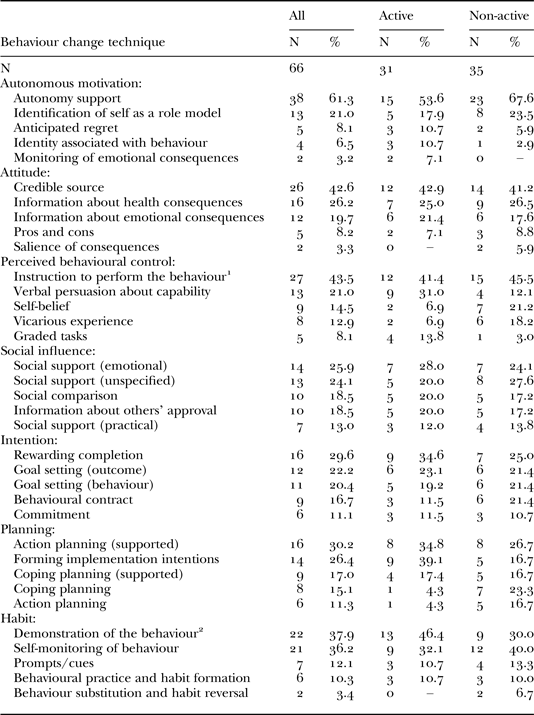
Table 1, referring to the results obtained in the survey, provides participants’ nominations of BCTs considered useful for facilitating PA across the seven groups. Participants selected autonomy support as the most useful technique (61.3%), followed by behavioural instruction (43.5%) and information provided from a credible source (41.9%). In addition, behavioural demonstration including practice and rehearsal, as well as self-monitoring of PA, were also considered useful, both by active and non-active participants (46.4% and 30.0%, and 32.1% and 40.0%, respectively). Techniques selected by the least participants (3.2%) were monitoring of emotional consequences, provision of information about emotional consequences of PA and tips on replacement of sitting activities with more active activities.
Participants’ nominations of the most useful techniques to facilitate physical activity
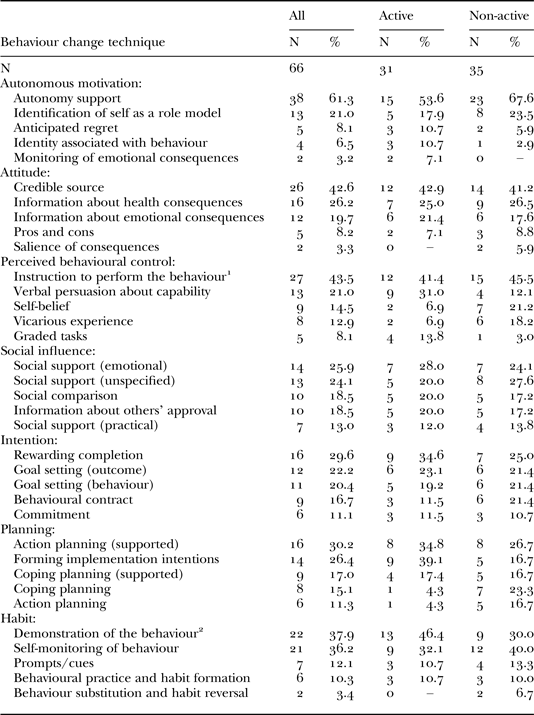
Notes: 1. Includes demonstration and modelling. 2. Includes behavioural practice and rehearsal and modelling. Data were missing as follows: four (6.1%) for ‘autonomous motivation’ and ‘perceived behavioural control’; five (7.6%) for ‘attitude’; eight (12.1%) for ‘habit’; 12 (18.2%) for ‘social influence’ and ‘intention’; and 13 (19.7%) for ‘planning’.
The following two sections are based on interview data. The section ‘What techniques to include’ includes eight themes which are presented according to the three processes of decision-making (i.e. motivational, volitional and automatic).
What techniques to include
Motivational processes
Providing support in making an informed choice: A common theme, discussed among participants, revolved around the importance of being supported in making an informed choice about the type of appropriate exercise. They expressed the need for ‘guidance, someone to sort of lead me down the right path’ (M, 75, NACT), to ‘make sure that I'm doing the right exercises’ (F, 70, ACT). In particular, participants wanted to be informed about ‘things that are safe and are not going to risk my health or my joints too much’ (F, 67, NACT), activities that would complement their usual PA type (‘I need to think about something else, apart from just walking … Possibly if advised on the best form of activity for my age’; F, 76, NACT) and benefit their specific health condition (‘Somebody who'd say “look that's not a wise idea, because you've got osteoarthritis”. That … would be useful’; F, 72, ACT).
Most commonly, participants thought that providing such informative advice was a role for health professionals, with their advice most needed regarding specific health restrictions: ‘It would need to be a specialised person to say “Look, I think we probably need to stop doing this at the moment, but perhaps you can replace it with whatever”’ (F, 70, NACT); ‘The exercises that I do all came either from my doctor or from my physio, and of course they know limits, they can keep an eye on me’ (F, 75, ACT).
Instruction on how to perform behaviour: In discussions about how to increase older adults’ beliefs about control and ability to engage in PA, providing instruction on how to perform an activity safely and correctly, in order to avoid injury, emerged as an important strategy for over half of participants. Participants suggested having ‘someone who's actually at the front and I can follow’ (F, 69, ACT) and
who has some skills to advise how to do the exercise without injuring yourself … it doesn't necessarily have to be somebody with a physiology degree, as long as someone has done even a short course, so that older people don't get injured. (F, 69, NACT)
Being provided with behavioural instruction was particularly relevant in the context of managing or recovering from a health issue:
If anything happened to me, where I couldn't be physically active, say for instance I was sick for a prolonged period of time and I wasn't able to participate in PA, and then I'd gone on the road to recovery, then probably programmes would help me. (F, 75, ACT)
Information about health consequences: The need to be informed about the PA–health link was discussed in almost half of participants (‘Knowledge about health is probably the most important for me’; F, 68, ACT). This information appeared to be valuable mainly because it reassured the person that they are doing something beneficial for themselves:
The main thing that keeps me going is that feeling of wellbeing and I guess a certain sense of pride and achievement that I'm sort of keeping up with it … Because I am aware of the positive health outcomes of staying active. (F, 73, NACT)
Some participants wanted to be reminded ‘why I need to do this [exercise]’, which was discussed in the context of maintaining health and independence as they aged: ‘I still want to be able to bounce in and out of the chair, and look after myself. And so keeping the weight under control, avoiding chronic diseases, and stiffness and arthritis’ (F, 67, NACT). However, messages regarding PA benefits tended not to be appreciated if loss-framed: ‘I find it annoying if people try to scare you into doing it because of all sorts of things that might happen: “you might have a heart attack, stroke”. I feel insulted by that sort of treatment’ (F, 73, NACT).
Furthermore, the source of information appeared to determine whether a person would be receptive to it: ‘If it's from somebody that I thought “well, this person knows what they're talking about”, I probably would take it under consideration’ (M, 73, ACT). Having trust and respect in the person delivering the intervention seemed crucial: ‘Depends on how it is presented … You need to get a certain respect from that person’ (M, 83, ACT). Additionally, there was a preference for the intervention provider being ‘somebody specific to older people’ (F, 76, NACT), having personal experience in PA engagement (‘I haven't got a lot of faith in these people who are not out there in the real world … They don't know how people live in the real time, so not just out of a textbook’; M, 75, NACT).
Social support: About half of participants considered social support an important part of a PA intervention. This support included general support in the form of checking about a person's PA (‘Even if it's just somebody who says “have you gone for a walk today?”’; M, 72, ACT), informational support about local opportunities to do PA (‘Just to point you in the right direction … “Here's a list of activities in this area for people over 50”’; M, 70, ACT) as well as practical support (‘When my arm was so sore recently, to have someone that would drive me to something like hydrotherapy, I'd love that!’; F, 70, NACT). It also involved emotional support: ‘If someone would come to you and say “I'm here and I'm waiting for you, and this is what we're going to do” … that would help. It's all about the connection’ (F, 66, ACT).
The most motivating aspect of social support was ‘having somebody who's prepared to join in’ (F, 70, ACT), such as ‘having a friend to go with [to the gym]’ (F, 73, NACT). Participants explained that ‘it's safer to be in a group … gives you more encouragement’ (F, 91, NACT) and ‘it's more fun’ (F, 71, NACT). However, although participants enjoyed the group setting, they ‘wouldn't go just for that. I'd need to be doing exercises as well’ (F, 73, NACT). The power of engaging in PA together with someone was also in making a commitment to another person: ‘You'd get a responsibility to go because if you didn't go, then maybe they wouldn't go, and if they didn't go, then you'd feel as if you'd let that person down’ (M, 65, NACT).
Goal setting: Techniques to strengthen an individual's intention for regular PA were considered useful by a few participants. These techniques involved goal setting in several different ways: achieving a minimum set of exercises (‘My intention when I get to the pool is to do ten laps of the pool’; M, 66, ACT); performing an activity by a certain age (‘I'm making a commitment to myself that I'd like to continue playing tennis until I'm 90. And I do the same with golf. While I can walk around 18 holes, then I will keep playing’; F, 75, ACT); and conditioning a goal to an outcome, which tended to be related to losing weight (‘I've actually set myself that very goal in my diet diary app … Since I've started it at the beginning of the year, I've lost 3 kilos’; F, 70, ACT). For some participants, having the capacity to achieve a goal elicited a sense of competence (‘It makes you feel as if you've achieved something’; F, 91, NACT), which appeared motivating: ‘Setting yourself a 20 kilometre ride it's something that you do and so it's rewarding in itself to be able to do that’ (M, 71, ACT). However, setting goals was not appreciated by participants who were satisfied with their current PA level (‘I'm happy with my goal right now. I play croquet once a week and I swim twice a week, and that's what my programme is’; M, 82, NACT).
Volitional processes
Action and coping plans: The value of specific strategies for planning PA appeared in discussions with some participants. For example, to ensure time for PA, participants used a diary (‘I keep them in my head at the moment, but I do have a diary to note things’; F, 69, ACT) or calendar (‘I actually do put gym appointments in my calendar so that I get a reminder. I still sometimes dismiss them, but it does make me stop and think’; F, 67, NACT). However, participants found it important that such plans are flexible: ‘I will have my own plan in my head and I will do my best to achieve it and if things get in the way, I'll adjust and then get back into it’ (F, 70, ACT); ‘I normally go on a Monday, Wednesday and Friday. But if something comes up, well I won't go that day and I'll go the following day, to make up’ (M, 72, NACT).
On the contrary, some older adults’ reservations about planning specifically when, where and how to do activities seemed to reflect a personal preference for a more spontaneous lifestyle. As one participant explained:
I'm not a person big on plans. In my life, I've tried to plan daily routines and all that type of things, and it takes one or two phone calls to throw it all into chaos. So to me, if something came up, then, I'd go and do it. (M, 65, NACT)
One strategy suggested to organise PA-specific times was ‘learning a better time management … to manage my time well enough so that I can do what I want to do’ (F, 70, NACT). However, it appeared that older adults perceived support in planning PA as intruding on their autonomy: ‘I'm capable of managing my own life’ (F, 73, NACT); ‘You have to be a bit of a problem-solver. You don't need someone else to tell you’ (F, 73, NACT).
A few participants also contemplated planning how to overcome potential barriers of PA engagement, which appeared closely related to the reason obstructing one's PA (‘Would depend on why I couldn't do it’; F, 68, ACT). As participants explained: ‘I'd stop, I'm ok with that. I wouldn't keep going. If that would be something that happened just occasionally, that's ok, but if that's something that's happening consistently, I'd have to go and find out what does this mean’ (F, 69, ACT); ‘If all of a sudden I had a stroke or, I was debilitated in any way, I'd want to investigate what options I would have to keep physically fit’ (F, 75, ACT).
Automatic processes
Demonstration of the behaviour and behavioural practice and rehearsal: Nearly half of the participants discussed the importance of being provided with a demonstration of an activity, in order to then continue practising it alone: ‘My tummy-strengthening exercises, as I call them, are specific from my physio. I need to be shown, and then I'm pretty good at doing them, at keeping up with it’ (F, 75, ACT). It was acknowledged that demonstration would be more appropriate for less-active individuals:
Certainly some sort of teaching, showing how and what to do, and talking you through with your walk, or your gym programme, and if you personally feel it's beneficial, then I guess you're in a position to create a habit out of it … I think it's more for a beginner. (M, 72, ACT)
Those with an established routine of activities, however, suggested someone ‘reviewing those, every now and again’, in order to ‘set more targets for various things’ (M, 73, NACT).
However, demonstration of PA with the view to practising and rehearsing on their own was not appreciated when a person's established daily life precluded them from having set times of PA (‘The problem is that my life is quite complicated and I can't always make it totally predictable’; F, 69, NACT), which was either due to work commitments (‘Because of time restraints, I'm quite happy doing as much as I can now. I work part time’; M, 72, NACT) or preferring a more incidental PA engagement (‘Gardening and walking is all I do, and I've got no inclination to go to a gym whatsoever. I'm in this routine now that I please myself and do what I like’; F, 71, NACT).
Self-monitoring of behaviour
Monitoring PA was considered useful by about a third of participants. Using a Fitbit (Fitbit 2017) or pedometer helped older adults to reach their target PA amount (‘I wear one of those Fitbit watches to try and get in my 10,000 steps every day’; M, 73, NACT), maintain their PA routine (‘I like doing that because it keeps me quite focused’; F, 69, ACT) and motivated them by demonstrating their progress:
To have a record would be an incentive for me to say ‘well, I could only do this in January, but I can now do this in March and I can do this in June’, so there's some sort of written record that I can see that I've improved’. (F, 70, NACT)
Participants also appreciated that monitoring devices enabled them to understand better the effects of an activity on one's body: ‘Anything that shows you what's happening when you're exercising would be good’ (F, 76, NACT). While overall positively accepted, self-monitoring of PA was believed to have only short-term effects: ‘It is quite useful up to a point. After a certain point, you kind of think “yeah, all right”’ (F, 68, ACT); ‘Because when you go write things down, you keep it up for a while and then you get a bit slack with it’ (F, 71, NACT).
How to implement techniques
Participants discussed several ways of delivering a PA intervention for older adults. This typically included a combination of multiple cognitive and behavioural components, tailored to the individual's capacities and health condition. The majority of participants reported face-to-face delivery as the most useful strategy to deliver a PA intervention: ‘Face-to-face [interaction] would be better’ (F, 82, NACT), since it would ‘remove a lot of barriers … you build a relationship with that person and you put more trust in your judgements about that person when you meet them face-to-face than you do on the phone’ (M, 83, ACT). However, older adults also suggested a face-to-face intervention should be followed up with additional instructional materials:
The follow-up of a leaflet or a brochure, it's there with you all the time. You don't always remember every detail of what someone tells you, so for me to have someone tell you, that's great, but it would be backed up by something that you've got … You've got the brochure there to look up. (F, 69, ACT)
Online videos were also frequently mentioned as a feasible mode: ‘A video might because I could just be here [at home], I wouldn't need to go anywhere, it wouldn't cost me anything’ (F, 70, NACT); ‘You can up-date it regularly … personalised would always work better’ (M, 71, NACT). Material related to PA published in newspapers and magazines, however, tended to be viewed as a less-credible source of information.
While having a ‘physical instructor that knows exactly how to do it’ was considered ‘the ideal situation’ (M, 81, ACT) for delivering a PA intervention, the cost involved with such an approach was considered to be a notable barrier:
A personal tuition of maybe a day, or half day to start with and left you with maybe rough diagrams, little bit of plans to follow, that would be a help … You really need some little description of the individual exercises to be able to follow it … That's beyond my pocket, I'm afraid. (M, 72, NACT)
Similarly, the importance of a low-cost programme was also discussed regarding group activities: ‘There would be a cost factor that because I'm retired, I don't want to spend a lot of money paying for an exercise group’ (F, 69, NACT). Thus, subsidising an exercise programme was considered helpful in enabling older adults to access PA classes:
I belong to a health benefits fund and I pay $6 for every session and the fund pays about $8. The idea is to make it cheap enough for any seniors … Otherwise you'd think twice. Gym memberships are very expensive. (F, 73, NACT)
Furthermore, participation in a PA programme was conditional upon the appropriate level (intensity) of activities, reflecting older adults’ preference for a same-aged group: ‘Probably for me, similar age. I'm 67 so I have some limitations and if I was to be exercising with 30-year-old men, I wouldn't feel right’ (F, 67, NACT). A preference for similar age was also noted with respect to the intervention provider: ‘That would be better for me than someone who's 30 … They don't know how an older person feels, it might be great advice, but they don't know what an older person is going through’ (F, 69, ACT). Older adults also discussed the importance of gaining physical benefits from a PA intervention: ‘I'd want to join with something that was going to make me puff a little bit and feel like I have done something at the end of it’ (F, 72, ACT).
In the discussions about supporting older adults in planning PA, as well as in making an informed choice regarding changing their activities, it seemed that an individualised approach appealed to this target group: ‘I suppose a GP. He knows the histories of your health and everything’ (F, 68, ACT). It was suggested that the intervention would incorporate an initial assessment of an individual, which would then allow planning appropriate activities:
They'd do the assessment of you, then they'd be able to determine your current level of fitness and they'd be able to determine what you could cope with in the short, medium and longer term and then build a plan on that. (M, 71, NACT)
To assist older adults in establishing a PA routine by monitoring one's PA engagement, it was revealed that older adults would benefit from a combination of self-monitoring devices (e.g. pedometers and Fitbits) and recording sheets: ‘I think both of them would be good, because then you can record on your sheet’ (F, 70, NACT). E-mail monitoring of one's progress in PA activities was generally positively accepted. In addition, to promote the use of self-monitoring devices, older adults thought that these ‘would need to come with fairly explicit directions as to how to use them’ (F, 80, ACT).
Discussion
Tailoring health interventions to the needs of the target population (Ziegelmann and Knoll Reference Ziegelmann and Knoll2015) is considered to facilitate intervention effectiveness. Gathering evidence on how specific BCTs could be best delivered in practice is particularly important within the context of promoting PA among population groups at risk for physical inactivity, such as older adults. The aim of the current study was to explore strategies for the development and implementation of intervention programmes designed to increase PA in older adults, to understand better what older adults would need to benefit from such a programme. Specifically, we investigated which BCTs would be most useful for facilitating older adults’ PA and, in addition, explored the strategies for designing and delivering such techniques in a PA intervention targeting older adults.
Using a mixed-methods approach, the data indicated a range of cognitive- and behavioural-type techniques that older adults considered useful. In the survey, the majority of older adults nominated being supported in making an informed decision about PA as the most useful technique. Other techniques considered useful were credible information about health consequences of PA, instruction to perform behaviour, social support (e.g. engaging in PA with others) and goal-directed strategies (e.g. goal setting). In addition, self-regulatory strategies (e.g. action planning) as well as behavioural-type techniques to help with maintenance of PA (e.g. demonstrating behaviour with practice/rehearsal and self-monitoring) were nominated as useful components of a PA intervention.
In contrast, techniques such as monitoring of emotional consequences and provision of information about emotional consequences of PA were among the least frequently reported. This finding is somewhat surprising given that studies on younger adults (Rhodes and Courneya Reference Rhodes and Courneya2003) and adult samples in general (Lawton, Conner and McEachan Reference Lawton, Conner and McEachan2009) indicate that affective attitudes are stronger predictors of PA than cognitive attitudes, while in older adults, the experience of pleasure is an important aspect of PA among those already active (Phoenix and Orr Reference Phoenix and Orr2014). One reason why appeal to positive emotions was not considered particularly useful for older adults in the current study may be that 53 per cent of the sample represented insufficiently active older adults. Having fewer opportunities to experience positive emotions due to lower PA engagement, they may find it harder to recognise the value of PA for their psychological health. In addition, given that a larger body of empirical evidence underpinning PA recommendations for older adults relates to benefits of physical health compared to psychological health (Sims et al. Reference Sims, Hill, Hunt, Haralambus, Brown, Engel., Huang, Kerse and Ory2016), this is likely to be reflected in the public debate, making benefits of PA on older adults’ physical health more, and emotional consequences of PA less, prominent.
Supporting the quantitative findings, older adults were strongly in favour of techniques that could inform their decisions regarding appropriate activities. In particular, health professionals were perceived as crucial in providing advice about activities that would suit an individual's needs. Provision of information about health benefits of specific activities by a credible source, such as a general practitioner or physiotherapist, in combination with information about local opportunities to engage in PA, were emphasised. Highlighting one's ability to gain health benefits might improve the feasibility of this strategy, as older adults often spoke about the importance of obtaining various benefits from PA.
Professional support in choosing the right activity was perceived as particularly important when experiencing a health condition, such as a stroke or hip replacement. This finding is not surprising, given that chronic conditions through experience of various symptoms (e.g. loss of balance, pain) can undermine a person's confidence in performing a specific activity (Clarke and Bennett Reference Clarke and Bennett2013). However, what our findings add to this relationship, in the context of facilitating PA, is the important role of a person's autonomy in choosing particular activities. While techniques such as provision of relevant and credible information may assist older adults’ PA decision-making, it may also be important that such information is delivered in a way that reinforces a person's sense of agency for facilitating change. This assumption is supported by the majority of participants reporting autonomy support as the most useful technique in helping them engage in regular PA. In addition, the importance of autonomy was mirrored in other themes throughout the interviews (e.g. ‘I do as I please’). These findings complement and extend research demonstrating that autonomous motivation, characterised by a sense of choice and autonomy, in accord with the self-determination theory (Deci and Ryan Reference Deci and Ryan2008), is one of the key influences on PA (Brunet and Sabiston Reference Brunet and Sabiston2011; Hagger and Chatzisarantis Reference Hagger and Chatzisarantis2014; Hamilton, Cox and White Reference Hamilton, Cox and White2012; Kosma Reference Kosma2014; Thøgersen-Ntoumani et al. Reference Thøgersen-Ntoumani, Shepherd, Ntoumanis, Wagenmakers and Shaw2016).
The importance of behavioural demonstration, as identified in the current study, is consistent with recent research examining the effectiveness of BCTs on older adults’ PA (D. P. French et al. Reference French, Olander, Chisholm and Mc Sharry2014), as well as the benefits of individualised exercise classes on some falls risk factors (Lord et al. Reference Lord, Tiedemann, Chapman, Munro, Murray and Sherrington2005). However, this study extends knowledge about what older adults specifically value about this technique, and how it should be delivered in a PA programme to be feasible for them to use. Specifically, having an example to follow, preferably face-to-face, provided older adults with a sense of confidence – akin to the concept of self-efficacy, a person's belief in their ability to perform a specific activity – in engaging in activities that are safe and meaningful for their personal health condition, which was considered crucial in the rehabilitation context. As such, it was suggested that intervention providers (e.g. rehabilitation therapists, physiotherapists conducting an exercise class) conduct an overall assessment of a person, and based on the results provide suggestions about appropriate activities, as well as plan relevant goals. This finding underscores the value of interventions that would facilitate PA engagement specifically among older rehabilitation patients, in line with existing interventions (Fleig et al. Reference Fleig, Pomp, Schwarzer and Lippke2013).
In addition, the importance of confidence, obtained through a face-to-face demonstration, implies that future interventions should include BCTs that will increase older adults’ self-efficacy beliefs as one of the key programme objectives, which is then likely to lead to changes in PA behaviour (Sheeran et al. Reference Sheeran, Maki, Monanaro, Avishai-Yitshak, Bryan, Klein, Miles and Rothman2016a). Current findings corroborate research evaluating older adults’ preferences about the implementation of home- and group-based exercise falls prevention programmes (Day et al. Reference Day, Trotter, Donaldson, Hill and Finch2016), which highlighted the importance of ensuring balance safety across different capability levels. Furthermore, considering the cost-effectiveness of face-to-face interventions, it may be useful to examine whether the level of confidence and motivation to engage in health-protective behaviours such as PA could also be effectively facilitated with other delivery methods, such as the provision of an educational DVD, as this was demonstrated in the context of falls prevention education for older adults in hospital (Hill et al. Reference Hill, McPhail, Hoffman, Hill, Oliver, Beer, Brauer and Haines2009).
Previous research suggests that older adults with a supportive social environment engage in more PA behaviour (Baert et al. Reference Baert, Gorus, Mets, Geerts and Bautmans2011). Our findings add to this evidence by identifying key aspects of social support and providing insight into how these could be implemented in PA interventions targeting older adults. Of greatest importance was engaging in PA with others, such as a friend or group of people with similar physical capacities. Setting up a community buddy system may be one strategy of facilitating PA among older adults. Our findings suggest that older adults would feel obliged to follow through with their PA arrangements with a peer. In addition, making group activities enjoyable and fun may be appealing to older adults. However, while the social interaction obtained by engaging in PA with peers may be valuable for older adults (Welmer, Morck and Dahlin-Ivanoff Reference Welmer, Morck and Dahlin-Ivanoff2012), our findings also suggest that the level of social PA activities should be appropriate to a person's individual capacities, so that they can obtain health benefits that they expect from PA. In designing group PA interventions, it may, therefore, be important to offer different levels of PA as well as a possibility to tailor activities to the individual's capacities.
Concerning strategies to target volitional constructs, in line with the health action process approach (Schwarzer Reference Schwarzer2008), our findings provide some support for their usefulness in PA interventions targeting older adults. However, older adults also discussed their reservations about making specific plans for when, where and how to do PA, and preferred any plans made to be flexible to accommodate their more spontaneous lifestyle and difficulty in managing competing priorities (e.g. family commitments, paid or voluntary work). Using a diary, calendar or learning better time management skills may be useful techniques for some individuals, especially for those with weak PA habits (Maher and Conroy Reference Maher and Conroy2015). While these findings do not entirely support a large body of previous evidence emphasising the role of planning for health behaviour such as PA (Hagger et al. Reference Hagger, Luszczynska, de Wit, Benyamini, Burkert, Chamberland, Chater, Dombrowski, van Dongen, French, Gauchet, Hankonen, Karekla, Kinney, Kwasnicka, Lo, López-Roig, Meslot, Moreira Marques, Neter, Plass, Potthoff, Rennie, Scholz, Stadler, Stolte, ten Hoor, Verhoeven, Wagner, Oettingen, Sheeran and Gollwitzer2016; Hamilton, Cox and White Reference Hamilton, Cox and White2012; Kwasnicka et al. Reference Kwasnicka, Presseau, White and Sniehotta2013), they do corroborate recent evidence investigating the effectiveness of self-regulatory strategies such as action planning for PA interventions targeting older adults specifically (D. P. French et al. Reference French, Olander, Chisholm and Mc Sharry2014; Warner et al. Reference Warner, Wolff, Ziegelmann, Schwarzer and Wurm2016).
While evidence indicates that PA interventions can increase PA over the long term (Müller-Riemenschneider et al. Reference Müller-Riemenschneider, Reinhold, Nocon and Willich2008), long-term effectiveness of PA interventions targeting older adults, who are challenged by a range of age-related illness and disease, is unclear (Hobbs et al. Reference Hobbs, Godfrey, Lara, Errington, Meyer, Rochester, White, Mathers and Sniehotta2013). Our findings indicate that to facilitate habitual engagement in and maintenance of PA, it may be useful for older adults to be provided with demonstrations of behaviour to practise and rehearse, as well as tools to self-monitor their behaviour (e.g. Fitbit, daily recording sheet). While habits are conceptualised as automatic cue–response behaviours, their formation is subject to conscious cognitive processes (Gardner Reference Gardner2015). Thus, through the facilitation of the repetition of a specific activity, by demonstrating the behaviour and providing means to monitor an individual's subsequent performance, such a combination of strategies may assist in strengthening the automaticity towards behavioural performance leading to maintenance of PA engagement. Indeed, recent research emphasises targeting multiple cognitive processes, eliciting behaviour change both through a conscious and non-conscious pathway (Rebar et al. Reference Rebar, Dimmock, Jackson, Rhodes, Kates, Starling and Vandelanotte2016), when promoting PA.
Strengths and limitations
Some limitations of this study should be noted. First, while the mixed-method approach allowed for triangulation of data, the extent to which participants’ understanding of the descriptions of techniques in the survey may have affected their responses in unclear. To improve understanding of the techniques, the survey was prepared following feedback from four pilot participants, who provided detailed feedback about understanding of all BCTs. Nevertheless, interpretation of quantitative data should be conducted in combination with qualitative findings which provide a more rich understanding of survey responses. Second, the questions asked participants about the usefulness of techniques in a hypothetical situation (e.g. if something interfered with their PA plans), which may be different to what an individual would do in a real-life situation. Thus, assessing the actual feasibility of a theory-based PA intervention for older adults (Fleig et al. Reference Fleig, McAllister, Chen, Iverson, Milne, McKay, Clemson and Ashe2016) could not be fully explored. Third, although the interview started with an open question about potentially useful techniques to facilitate regular PA behaviour, not all participants were able to verbalise their preferences about what they would want from a PA intervention. This was demonstrated by very short or off-the-topic answers. It might, therefore, be useful to try alternative procedures, such as thought listing (Rhodes and Mistry Reference Rhodes and Mistry2016), to triangulate the results further. In addition, it would be beneficial to validate the findings on a larger sample size, given that a relatively small sample size in both groups may have limited the ability to obtain any other, additional ideas that older adults may have about facilitating PA behaviour.
Despite these limitations, the current study is unique in exploring the usefulness of theory-based BCTs for promotion of PA by eliciting from the target population (older adults) what strategies they would consider useful in a PA intervention. This knowledge is especially important considering the limited effectiveness of existing PA interventions targeting older adults (Chase Reference Chase2015), as well as inconsistent evidence regarding the use of self-regulatory strategies (e.g. planning) in PA interventions targeting older adults (Warner et al. Reference Warner, Wolff, Ziegelmann, Schwarzer and Wurm2016). The findings of this study have important practical implications because they may assist intervention developers in designing theory-based PA programmes targeted at older adults.
Overall, this study was able to match theory-based influences on behaviour from multiple decision-making processes with relevant BCTs, and using a mixed-method approach, to provide insight into specific techniques within each of these processes considered to be useful in increasing PA among community-dwelling older adults. Unfortunately, this step within the process of developing health interventions is often missed (Lloyd et al. Reference Lloyd, Logan, Greaves and Wyatt2011). In addition, the findings highlighted commonly considered appropriate strategies for delivering a PA intervention for this population group (i.e. face-to-face, followed up with other material, low cost, of age-appropriate activity level and individualised). This study extends prior research on the factors moderating the effectiveness of PA interventions (Chase Reference Chase2015) by providing insight into aspects of programme delivery that may either contribute towards or undermine the effectiveness of interventions designed to increase PA in older adults across a wide range of settings. For instance, older adults’ preferences regarding delivery of a PA intervention may be important to consider when contemplating the use of non-face-to-face methods (Müller and Khoo Reference Müller and Khoo2014), by means of advanced technologies such as eHealth (Muellmann et al. Reference Muellmann, Forberger, Möllers, Zeeb and Pischke2016).
Given that tailoring PA programmes to the preferences and needs of the target group is likely to improve intervention effectiveness (Noar, Benac and Harris Reference Noar, Benac and Harris2007), such a formative approach to developing and implementing PA programmes may also need to be applied to other sub-groups, such as older adults with physical disabilities and those from culturally diverse backgrounds. Future PA research may benefit from translating older adults’ voices and specific needs regarding regular PA into a theory-based intervention that includes a combination of BCTs, targeting key factors within both conscious and non-conscious processes (Sheeran et al. Reference Sheeran, Bosch, Crombez, Hall, Harris, Papies and Wiers2016b) and deliver them in an autonomy-supportive and individualised approach. Overall, it is recommended that strategies directed at older adults, their care-givers, health professionals and other relevant community members consider older adults’ circumstances and preferences regarding PA engagement, in order to increase their potential for regular PA participation and, thus, create healthier societies.
Acknowledgements
This research is supported by the Griffith University International Postgraduate Research Scholarship, awarded to the first author, UA. The funding body played no role in designing and carrying out this research. Ethical approval was obtained from the University Human Research Ethics Committee and all participants provided written consent. All authors were involved with the discussions on the purpose and focus of the manuscript; UA designed the study and study materials, collected and analysed data, and wrote the first draft of the manuscript; FO and KH commented on subsequent drafts of the manuscript. The authors disclose no conflict of interest.