Introduction
Modern universities are discipline-based and are strongly subjected to the necessities of increased specialization (but also, and perhaps even more strongly, to new demands of cost-efficient professionalization, i.e. the needs of the job-market). Although this ‘disciplinarization’ is to a large extent unavoidable, their broader educational mission invites (and perhaps forces) universities to embrace a different perspective, in which the boundaries between the humanities, natural sciences, social sciences and life sciences, between theoretical and practical or abstract and hands-on thinking, but also between tertiary education and creative arts cease to be absolute. More and more voices are thus raised in favour of, for instance, the interweaving of university education (supposedly abstract and theoretical) and creative arts (supposedly practical and concrete). The advantages of such a relationship have been demonstrated in various domains: certain authors have stressed the educational value of creative arts (e.g. Schaeffer et al.Reference Schaefer, Simpkins, Vest and Price1 and KuhReference Kuh2), others have foregrounded its societal and ethical values (e.g. ReevesReference Reeves3) still others have put an emphasis on the economic advantages (e.g. Dell’EraReference Dell’Era4). More recently, the institutional changes in the field of practice-based PhD research in the arts has offered an opportunity to highlight the possible benefits prompted by the interaction between arts and science, artists and researchers (e.g. StrosbergReference Strosberg5). More generally, one can add that the elaboration of an up-to-date cultural policy has become a staple characteristic of modern democracies.Reference Poirrier6
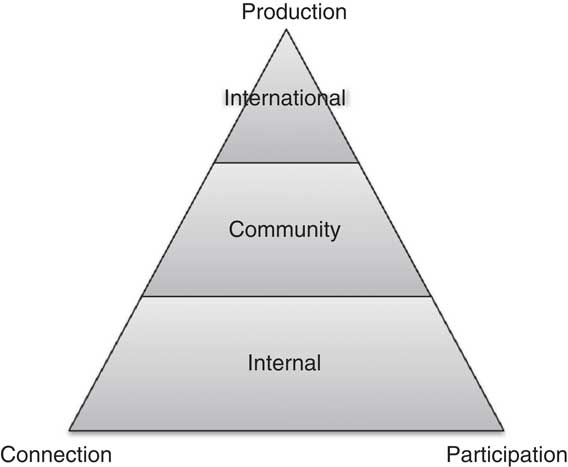
Given the observations and findings of these studies it is clear that a well-defined cultural policy plan should be an integral part of the overall strategy of universities and university colleges, a viewpoint that has been documented previously. For example the LERU-advisory paper on this topic by Buekers and NugterenReference Buekers and Nugteren7 proposed a model that can be useful for developing an institutional cultural policy plan. Actually, this model starts from what the authors define as the cultural policy triangle (see Figure 1), referring to Participation, Production, and Connection as the three key building blocks. In fact these building blocks represent the central objectives of the institutional policy that universities and university colleges need to pursue in the domain of creative arts. It must be mentioned however that these objectives can be weighted differently according to the overall strategy of the specific institute.Reference Buekers and Nugteren7 The advantage of such a customized model is apparent as it enables the institutions to take into account their particular strengths and aspirations by focusing to a greater or lesser extent on the individual elements.
The cultural policy triangle.Reference Buekers and Nugteren7
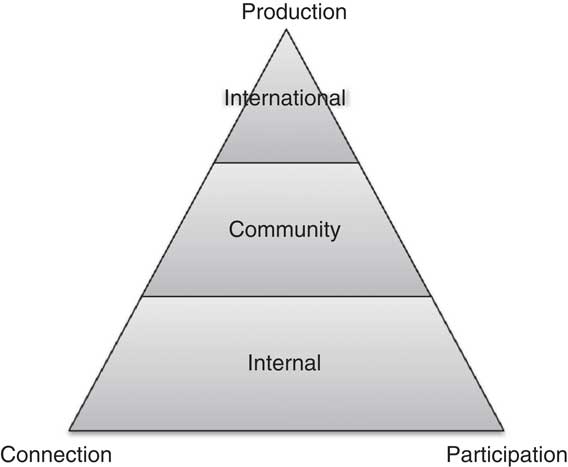
A second dimension of the policy triangle relates to a possible differentiation between three different organizational levels or different ‘areas of influence’ covered by the potential actions of the plan. The authors propose a multi-layered model starting from the internal institutional area over the regional area (referring to the interaction with the regional community: city, province, cultural partners and art centres) to the ultimate step of the international level of operation. This latter cooperation mainly refers to the collaboration with the cultural services of partner universities from other countries. However, it is also worthwhile to fuel the interaction with the international cultural scene, albeit through the facilitating channels of the local partners.
Here, we are not seeking to go into a more detailed discussion on the legitimation for tertiary education, nor on the nature and content of the different building blocks. However, we do want to explain briefly how the cultural policy triangle could be implemented. More specifically, we want to identify a number of contextual factors that should be taken into account to translate the plan from a theoretical issue into feasible actions. According to Buekers and NugterenReference Buekers and Nugteren7 these contextual constraints relate to (1) the commitment of the entire university, that is to say a strong support from the different echelons of the institution. This ‘backing flow’ must start at the highest level of the university board and trickle down to the faculties, departments, staff and students. Appointing an accountable academic to oversee this process is mandatory. (2) The creative arts in the classroom, pointing to the importance of adding ingenuity and imagination to the learning process. It goes without saying that creativity is not a unique property of the art world. However, it is certainly not an overstatement to claim that artists in particular thrive on this specific ability. An interesting example of such a classroom practice has been documented by Goulding,Reference Goulding8 revealing the benefits for further education construction students of being involved in constructing an artwork. (3) The regional and international exchange, referring to the importance of bringing together different views and (cultural) backgrounds to enhance interactions resulting in a ‘conflit des idées’ that stimulates new insights and knowledge. Note that the international exchange has a much broader scope than the cultural dimension, as the universities try to expand their global network primarily for scientific and scholarly cooperation. However, as these networks are in place already, it would be unwise to forego the benefits they can generate for students and staff in the field of creative arts.
Even though the previous paragraphs provide strong support for the benefits of integrating creative arts in tertiary education, it is not clear to what extent the institutions actually implement a corresponding policy. Therefore, we want to investigate to what degree European universities apply in their institutional policy the necessary elements to safeguard this field so crucial for students and academics. To do so, we developed a web-based questionnaire encompassing a large number of questions examining if and how the selected institutions conceive, construct and apply a specific cultural policy plan. The contents of the questionnaire are discussed in the next section.
Method
The Questionnaire
To arrive at a better understanding of the actual state of affairs in the institutions we opted for a web-based survey via an electronic questionnaire using the Limesurvey software. The items of the questionnaire focused primarily on the presence or absence of the various art disciplines made available by the institute in the form of extra-curricular activities: performing arts, literature, music, fine arts and media. Each of these disciplines was divided into a number of relevant sub-disciplines. These questions provided information on whether the students had the opportunity to be involved in the given cultural activities. Since the items also differentiated between active and passive participation, we were able to find out to what extent the students were not limiting their artistic interest to passive involvement, e.g. watching movies, going to the theatre, reading books, but were also engaged in the artistic production process. Another topic of interest was whether the cultural programme was supplied by the university itself or in cooperation with the cultural partners of the surrounding city or region.
The questionnaire also investigated a number of additional contextual factors at institutional level: the existence of a cultural policy plan, the presence of an art school, an academic responsible and/or a cultural service, the cooperation with cultural partners, the availability of a cultural budget, project money for students and specific cultural activities for international scholars.
The Selected Universities
The selection of our survey sample was guided by two imperatives. The first originated from the question of to what extent universities admitting exchange students of the Erasmus mobility programme provided a compelling supplementary programme for creative arts. For this reason we invited a number of universities (n=2 3) that were listed as popular or unpopular destinations for the exchange students in Europe (http://euxtra.com/en/2012/02/08/erasmus-top-100-universities). Second, we considered the viewpoint of the major research universities in Europe to be of particular interest as these institutes could be suspected to focus mainly on their scientific ambition, leaving the field of creative arts undervalued. For this reason the members (n=21) of the League of European Research Universities (LERU) were invited to take part in our study.
From the total of 44 universities that were invited, 26 institutions filled out the questionnaire, representing a total response rate of 59%. Note that 19 of the 21 LERU universities and only seven of the 23 other institutions participated. The list of the participants can be found in Appendix 1.
Data Collection and Analysis
The selected universities received a letter explaining the objectives of the study together with an invitation to fill out the web-based questionnaire. After finishing the questionnaire, an automatically generated email was delivered to the respondent to thank the organization for taking part in the study.
The responses of the different universities were summarized per item and where appropriate the related percentages were calculated. Given the low response rate for the ‘Erasmus universities’ we decided not to analyse the data separately, but consider the sample as a whole. The summarized results of the participating universities are discussed in the next section.
Results
As explained in the method section, we will examine the different items of the various response options. In order to arrive at a more structured idea of the situation, we will combine specific items. For example, the category ‘contextual factors’ covers questions related to the presence of specific cultural features within the institute (e.g. a cultural service, responsible academic, etc). Where appropriate these items will be discussed in greater detail.
The Contextual Elements
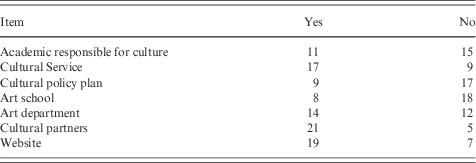
In the first category we will focus on what could be labelled the ‘supporting elements’ that are crucial to achieve a useful and productive cultural atmosphere. As can be seen in Table 1, less than half of the universities laid the responsibility for the cultural policy in the hands of an academic staff member. Note that we do not want to insinuate that members of the supporting staff would not be up to the job. However, we need to admit that appointing an academic in the university board (e.g. a vice-rector) as the responsible person for creative arts can have a beneficial effect as it will put the cultural policy higher on the agenda. In any case, the finding that more than 50% of the universities have decided not to appoint a designated academic shows that there is still a long way to go.
Availability of supporting cultural elements (in %).
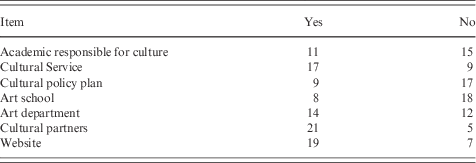
The two elements for which the participating universities achieve the highest scores are (1) the presence of an internal cultural service and (2) the cooperation with cultural partners of the surrounding region. These observations are very satisfying as they show that the large majority of the institutions recognize the importance of creative arts for their students. However, still one out of three universities seems to overlook this, as they apparently have decided not to invest in an internal cultural service unit. While seven universities had no organized cultural programme at all, two universities compensated for this flaw via cooperation with external partners (see Figure 2). As mentioned in the introduction, forging partnerships with the cultural stakeholders from the city or region is a positive practice, even though it can only partially replace the actual benefit of an internal service under the supervision of an academic. The best practice in this respect is without any doubt to go for the double, i.e. a combination of internal and external activities. Apparently, ten universities did so as they are offering an internal cultural programme and also cooperate with external partners. The seven remaining institutions focused exclusively on internal activities.
Overview of the organization of the cultural activities for the participating universities.

The data for the presence of art schools or art departments indicate that these institutions are often not integrated in the universities, a situation that seems at odds with the so often cited advantages of a close art–science interaction. Even though some inspiring examples exist, showing the various win-win situations originating from such a cooperation, the often-cited practice-theory cliff still hampers a full-blown integration.
Given the importance of communication we also examined the availability of dedicated webpages for the cultural activities on the main website of the university. Most institutions do advertise the different activities and events on their website although in a number of cases the information was not easy to find.
A final, but certainly not the least important, element concerns the budget allocated for cultural activities. As can be seen in Figure 3, the situation is not very promising, as six out of 26 institutions chose not to invest in a cultural programme. Moreover, for 14 institutions the budget set aside for culture is limited to €200k. The six remaining universities appear to translate the important role of cultural activities for their students in a considerable budget, which reaches more than half a million euros in three cases. It is interesting to note that the budget originates from different sources. According to our data, five institutions received subsidies from the city, two from the province, and six from the country, and finally one from Europe.
Overview of budget available for artistic culture for the participating universities.

The Cultural Activities
One of the main objectives of a cultural policy plan is to facilitate access to cultural activities for the students, in terms of both passive and active participation. The provision of activities to choose from in a large number of disciplines mirrors the equally large interest and needs of the scholars. As we noticed in the previous paragraph, these activities can be provided and organized through internal channels as well as by means of external providers (e.g. art centres, cultural partners from the city). It is clear that this latter option is of great importance, for the organization of cultural activities can of course not be the priority objective of an educational institution. However, it is also clear that the presence of university choirs, symphonic orchestras and theatre groups, among other things, constitutes a very valuable asset for these institutions of higher education. In the next few paragraphs we will focus on the various art disciplines to sort out if and how the universities organize cultural activities for their students.
The availability of the different art disciplines for internally versus externally organized activities.
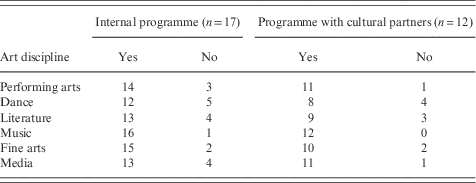
As we stated previously, a mature university strategy for creative arts is characterized by a strong internal organization combined with a solid and durable cooperation with the external cultural partners. Given this observation, we wanted to find out to what extent the participating universities actually act accordingly. To arrive at a more detailed understanding we added the different art disciplines into the equation. As can be seen in Table 2, most of the art disciplines are represented in the programmes, for internal as well as external activities. Actually, the availability rate of the specific art disciplines as external activities ranges from the lowest value of 67% for dance to the highest value of 100% for music.
Overview of the internal and external availability of the different art disciplines.
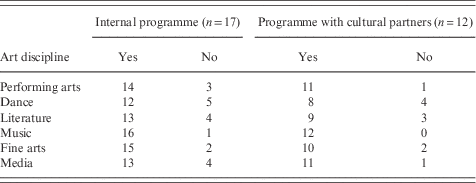
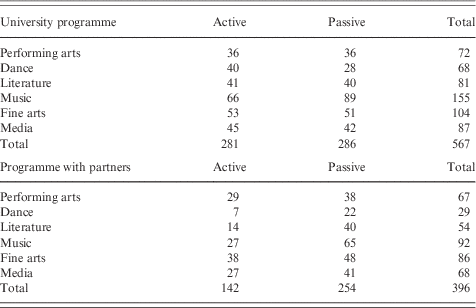
For the internal activities these figures vary between 71% for dance and 94% for music. These figures seem to draw a rather positive image of the current situation. However, we need to keep in mind that they only represent the ‘culturally active’ universities as the seven institutions without a programme are not represented in the figures. Apparently, for one reason or another, these latter institutions prefer not to enter the field of creative arts, leaving the responsibility in the hands of the students. Notwithstanding this lack of concern, the least one can say is that if there is an organized offer, it is well balanced over the variety of art disciplines. However, as can be seen in Table 3, some disciplines can rejoice in a stronger interest as the universities provide, for example, a considerable number of activities in music (n=247), while dance (n=97) is only weakly represented. Since this difference can be explained in part by the variation in the number of sub-disciplines (more sub-disciplines enabling more activities), we also provide the percentages of availability of the six disciplines. A somewhat different ranking order then materializes from the data, as the disciplines rank from the highest percentage for Media (53.4%) to the least represented activity for Dance (18.6%).
Overview of the availability of cultural activities (overall; active and passive) for the different art disciplines in the university programme and the external programme.
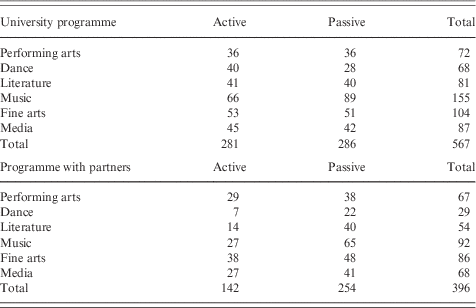
Active versus passive participation in the different art disciplines.
Even though it is generally understood that for most activities active participation is to be preferred over the passive version, the cultural variant deserves at least a somewhat different approach. Certainly acting in theatre plays or performing in an orchestra is much more demanding than just attending these activities, writing books requests more from the creative mind than just reading them. However, reading books, listening to music, or going to a museum to admire ancient or modern masterpieces holds a strong ‘Bildung’ value. So, one can argue that these activities have the potential to raise the cultural capital of the students. In addition, passive participation can serve as a bridge to active participation as the contact with new experiences may act as an open invitation for students to become actively involved in art disciplines that engage their attention. These arguments indicate that both types of participation need to be facilitated.
We will examine the issue of active versus passive participation in the next few paragraphs. To gain a deeper insight we will first discuss the findings for the six art disciplines (Table 3) followed by a more detailed discussion of each of these disciplines with their respective sub-disciplines (Table 4). In addition, a distinction will be made between activities internally organized and those organized in cooperation with external partners. All these data are shown as percentages. Note that the data for the internal programme relate to 17 universities, whereas the data for activities with external partners represent 12 universities. Given the rather wide range of data, we will focus on the most important results.
Overview of the availability of active and passive cultural activities for the different sub-disciplines in the university programme (n=17) and the external programme (n=12).

The data in Table 3 reveal that active and passive participation in cultural activities is rather balanced within the university programme (except for music), it is less so for the external activities, as the cultural partners are solicited more frequently for passive (n=254) than for active (n=142) participation. Most probably, the reason for this disparity resides, not only in the extensive passive programme the cultural houses and art centres offer their citizens, but also in the fact that their programmes for active participation (e.g., theatre companies, orchestras) aim primarily at professional artists.
For the disciplines, the most important findings concern music, literature and dance. The difference between the availability of active and passive activities is rather large for music both in the internal and the partner programme. For literature, the active versus passive difference only materializes for the partner programme. As mentioned before, dance does not score very high. This is not only true for the university programmes but is substantiated by the data for the partner programmes. However, the number of activities for active participation in dance (n=40) is comparable to that of the other disciplines.
Performing arts
As can be seen in Table 4, the universities focus predominantly on theatre and singing, both in their internal programmes and with their external partners. Cabaret and circus are found to be less attractive, with the latter available in only two universities, in each case through an external partner. The pole position for theatre as the most popular activity of the performing arts could be due to the long-standing tradition of this discipline. Also note that for the performing arts the external partners are very frequently solicited to deliver the necessary services. As a matter of fact these partners guarantee a higher supply than the universities themselves.
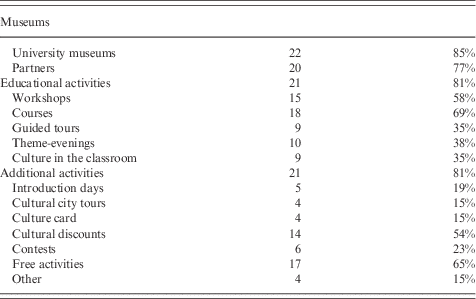
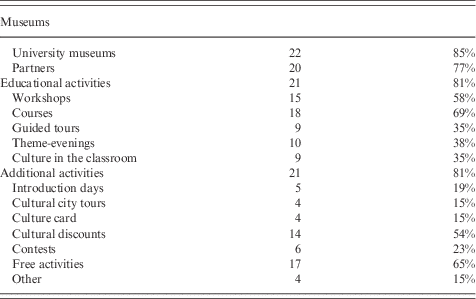
Overview of the additional cultural activities for the 26 participating universities.
Dance
We already noted that Dance is not the most popular among the art disciplines. However, this is not so for Modern dance as nine out of the 17 (active) and eight out of 17 (passive) institutions offer the possibility to participate in this sub-discipline. For the external partners these figures are respectively four (active) and eight (passive) out of 12. Except for Latin American dance and Classical ballet the availability of other sub-disciplines is very meagre.
Literature
Most sub-disciplines enjoy a reasonable popularity among the students, and hence also among the organizers of these artistic activities, with the exception of Comics and Graphic novels. Note that poetry occupies the first place both in the internal and the external programmes, most probably because it is a form of literature that is easy to integrate in life performances.
Music
It is interesting to note that classical music still plays the first violin, certainly when it comes to participation: all institutions except one organize this activity. The same holds for the external cooperation. When it comes to active participation, classical music also outnumbers all other activities, including those in the other art disciplines. As we argued before, this may be the result of the preference for tradition in most universities. Moreover, most institutions might consider it socially desirable (and politically ‘useful’, given the networking possibilities of this activity) to be involved in classical music. Note that the remaining sub-disciplines are also more than fairly represented, supporting the privileged role of music in the academic arena of creative arts.
Fine arts
The interest for Fine arts appears to be rather wide-ranging. Except for body and textile art, most sub-disciplines are fairly represented, with painting and drawing as the most popular activities. Also note that the external partners play an important role because they offer a wide range of activities. In contrast to the other art disciplines many of these offerings are related to active participation.
Media
As for the Fine arts, the interest in Media is certainly not limited to one sub-discipline, even though photography generates most interest. In addition, Film and Audio-visual art seem fairly popular. Moreover, both passive and active participations as well as internal and external activities are well balanced in the partners’ offers.
Additional activities
In this last part of the results section we will provide some insights into a number of additional events linked to the cultural activities. As can be seen in Table 5, universities tend to invest in museums, both in their own collections and in cooperation with external museums. This finding is not surprising as the artefacts and collections of the museums are very often study objects for the scientists and scholars. Moreover, as science museums have secured their own place in the landscape, they are able now to achieve one of the major objectives of tertiary education, that is to say, the transfer, also to the broader public, of the knowledge they generate.
As far as educational activities are concerned, workshops lead the dance followed by specific courses (e.g. photography). Note also that relevant classroom activities are organized in nine of the participating universities.
A note on the promotional organization of the cultural activities: even though this aspect is crucial for an efficient and successful programme, only just over half of the universities provided discounts, and student culture cards granting reduced entry or participation are rarely issued.
Discussion and Conclusions
The creative arts are an intrinsic part of tertiary education if we are to go by theoretical reflections on the issue. A number of compelling arguments are displayed in a book edited by Carafoli et al.Reference Carafoli, Danieli and Longo9 The thesis that scientists and artists are drenched in the same fluid of creativity, making them natural partners, is brilliantly applied to the issue of symmetry by Du Sautoy.Reference Du Sautoy10 More down to earth reasons have also been invoked. Banks and HesmondhalghReference Banks and Hesmondhalgh11 discuss the economic value of the creative industries, an aspect also strongly highlighted in the new cultural, scientific and educational policy of the EU (cf. Horizon 2020, http://ec.europa.eu/research/horizon2020/index_en.cfm). Given the many other arguments developed by Dell’EraReference Dell’Era4, GielenReference Gielen12, and Grossi et al.Reference Grossi, Sacco, Blessi and Cerutti13 one would expect the universities to fully embrace the benefits of the field of creativity. In our study we set out to find out if these institutes actually do so.
In order to achieve this goal, we conceived a web-based questionnaire that, along with an email clarifying the goals of our study, was sent to a selected number of universities. Twenty-six institutions returned the questionnaire, representing a total response rate of 59%. The responses were summarized per item, and where appropriate the related percentages were calculated. Here we focus on some implications of the results we obtained.
(1)Put the creative arts on the policy agenda of the uni versity
It is no news that university boards define the policy of their institute. It should be no news then that the boards also validate the importance of creative arts in their policy plans. Unfortunately this latter claim is far from the reality, as our survey demonstrates that only about one third of the participating universities actually have a concrete policy plan for creative arts. Most probably the lack of such a strategic note emanates from the absence of a designated academic charged with developing policy in this domain, as nine out of the 11 universities with an academic specifically responsible also have a policy plan. Appointing an academic might not guarantee a policy plan but it is certainly a strong facilitator.
Note that the absence of a centrally defined policy for creative arts does not necessarily interfere with the cooperation modus of the institutions, as the large majority (more than 80%) turns to cultural partners in the city or region to shape their cultural programme. As such, this is a very positive finding since it secures the cultural needs of the students. The same holds true for the availability of a cultural service. So one could argue that as the cultural content is warranted the need for a designated academic or a strategic plan is not a real issue. However, the greatest flaw of this argument rests in the assumption that the provision of content as such guarantees a well-balanced active and passive participation behaviour of the students. The crucial advantage of a well-conceived policy plan propagated by an academic lies in the possibility to achieve goals (educational, professional, personal) that are not only explicitly mentioned in the plan but also translated into action lines that can be followed up and evaluated.
(2)The cultural activities should enable both active and passive participation
Sometimes students need to be forced into the gracious arms of passive participation to just experience beauty, aesthetics and emotions of (dis)symmetry. Sometimes they want to be pressed to aim a little higher and acquire active artistic skills. Both types of experiences serve their own purposes, but even though passive and active participation serve specific goals, they also pursue a common educational goal. The latter is crucial for institutions of higher education. Next to the obvious need to receive a professional education, students also need to be educated in the broader context of the uomo universale. For this, offering them access to a broad range of cultural activities is a conditio sine qua non.
The findings of our study are univocal. In fact, most art disciplines figure in the internal and/or external programmes considered, albeit with a different number of activities. For both internal and external activities, for example, Music and more specifically Classical music score higher than Dance, reflecting the respective popularity of the disciplines involved. In spite of this apparent general availability of the major disciplines, however, there is still no reason to cheer. Even the most popular sub-disciplines, such as classical music, photography, theatre and painting, are far from available in every programme. The conclusion could be, then, that what is on offer is acceptable but not abundant.
(3)External partners are the muses of the internal cultural programmes
Universities are embedded in society, and if they are not they should hurry to be so. This embedding is very useful and valuable for the institutes of higher education as it enables them to nourish their proper internal programmes with activities that are compatible with their own goals. Apart from the obvious financial benefits that result from such a cooperation, the major advantage lies in the interaction with the professionals of the field. This is just as important for the students as for staff members, the former because of the added value of a reality check, the latter because of the already cited close relationship between science and art. The advantages of a close cooperation also extend to the university as a whole: not only does it add to the prestige of the institution in question, it also enables them to tap into local government subsidies. Apparently the participating universities have understood this message very well, as almost 90% (21 institutes) considered twinning with the cultural stakeholders of the city or region as a meaningful opportunity. We noticed that the activity supply focused more extensively on passive participation. This is not difficult to understand, since many of the culture houses and art centres have the specific mission to provide such activities for their citizens.
The current study was conducted to find out to what extent European universities validate the importance of creative arts in their institutional strategy. The findings of our survey show that the situation is somewhat mixed. Even though a considerable percentage of the participating institutions plan and organize an adequate cultural programme for their students, there are still a lot of weaknesses that go from non-existing cultural policy plans, over a limited cooperation with the regional stakeholders, to the lack of an academic responsible for culture. To our mind, a crucial part of the solution might precisely lie in the appointment of an academic to bring more focus to the issue.
Appendix 1

Martinus Buekers is professor of kinesiology at the University of Leuven, where he teaches tactics in sport games. As a former member of the university board at KU Leuven he was responsible for Culture and Sports. His research focuses on the control of human locomotion and feedback mechanisms in motor learning. He has written more than 45 peer-reviewed articles and four books on Volleyball and the Training process. He has also published policy papers in the domain of creative arts.
Jan Baetens is professor of cultural and literary studies at the University of Leuven, where he teaches in the cultural studies programme. He has published widely on word and image studies, mainly in the so-called minor genres (comics, photographic novel, novelization) as well as on French poetry and the theory and history of photography. He is involved in two major research projects, a Leuven-financed project on literary history in 1900–1950 (MDRN: www.mdrn.be) and a BELSPO/IAP funded programme on literature and media change (LMI: http://lmi.arts.kuleuven.be/).
Lieven Mees did a Master in Cultural studies at the KU Leuven, for which she presented a thesis on the topic of the creative arts in European universities in June 2013.