Introduction
In the aftermath of an injury to the brain, we brace the family for change. How many clinicians have said the words ‘they will never be the same’ to a family member by a hospital bedside? We tend to focus on the person who has experienced a brain injury; but what about the wider picture and the changes family members may experience after injury? How do they move forward in their lives and within their family? How do they understand their relationships and their new worlds, taking threads from the past into the future? Working with and involving families can sometimes feel like an add-on if we have time, a luxury, a role for a specialist. We suggest that this is because currently we have very limited clinical discourses around families and life post-injury. This can leave us with a sense of limited possibilities, stifling our engagement with families post-injury. While much of the current clinical and research perspectives focus on the injured person, in this paper we offer some new insights into how a narrative understanding of change post-injury can improve health care professional’s work with families. While the evidence base for the use of narratives with families is limited, we explore how narrative approaches can be used creatively with families and make recommendations to help support family members in a very practical way.
Change following brain injury: contesting the dominant discourse
Catastrophic and major change is an undisputed part of the brain injury journey (Yeates, Gracey, & McGrath, Reference Yeates, Gracey and McGrath2008). Original and dominant thinking about neurological damage to brain areas responsible for personality means that professional and lay persons are braced for difference post-injury. Change to the injured person post-brain injury has been examined empirically from the position of the injured person and their family members (Tyerman & Humphrey, Reference Tyerman and Humphrey1984; Weddell & Leggett, Reference Weddell and Leggett2006). Changes are typically spoken about in the context of the injured person, and these changes are predominantly negative. In seminal literature, ratings of personality change have been associated with raised levels of stress and burden for the family member (Brooks, Campsie, Symington, Beattie, & McKinlay, Reference Brooks, Campsie, Symington, Beattie and McKinlay1987; Oddy, Humphrey, & Uttley, Reference Oddy, Humphrey and Uttley1978; Weddell & Leggett, Reference Weddell and Leggett2006). The quotes below illustrate how family members have talked about their changed relative. Left unchallenged, such changes pose a substantial risk to the well-being of families:
‘the person who survived is someone else, someone other, who carries within haunting echoes of the lost one who was my wife’ (Godwin, Chappell, & Kreutzer, Reference Godwin, Chappell and Kreutzer2014, p. 402, caregiver)
‘I lost my husband the day he had the accident because [partner’s name] is not my husband’ (Bodley-Scott & Riley, Reference Bodley-Scott and Riley2015, p. 212, partner)
‘It’s like living with another person in your marriage. Only the name of that person is TBI. And you kind of have to figure out how you’re going to live—how the three of you are going to live together’ (Kratz, Sander, Brickell, Lange, & Carlozzi, Reference Kratz, Sander, Brickell, Lange and Carlozzi2017, p. 27, wife)
Such changes are of course important to validate. We do not seek to undermine this experience or mute this interpretation. However, this discourse of negative change alone tends to dominate post-injury and leaves little room for other dialogue and other opportunities to emerge. Evaluation of changes like this can severely challenge a person’s identity both in their own eyes (Nochi, Reference Nochi1998) and in the eyes of others (Bodley-Scott & Riley, Reference Bodley-Scott and Riley2015; Godwin et al., Reference Godwin, Chappell and Kreutzer2014). These changes present a biographical disruption in the continuity of their life severing the connection between their past, present and future (Ellis-Hill, Payne, & Ward, Reference Ellis-Hill, Payne and Ward2008). When pre-injury comparisons become all consuming, they can leave family members paralysed and without hope. Futures within this context are perceived to be of less value and become tainted with the knowledge that hopes and dreams as a family may be lost forever. These losses are felt acutely, families suffer within their wake and they may be unable to move forward.
This dominant discourse is being challenged and the literature is opening up to explore a broader understanding of change post-injury including positive aspects such as the presence of personal growth and positive meaning (Degeneffe & Olney, Reference Degeneffe and Olney2010; Lefebvre, Cloutier, & Josee Levert, Reference Lefebvre, Cloutier and Josee Levert2008; Mäkelä, Reference Mäkelä2017; Ownsworth & Fleming, Reference Ownsworth and Fleming2011). Furthermore, our understanding of change is evolving, becoming more open to the possibility of continuity instead of change or continuity as well as change. This continuity allows the possibility of a more coherent and connected sense of self and family after brain injury. In Whiffin, Ellis-Hill, Bailey, Jarrett, and Hutchinson (Reference Whiffin, Ellis-Hill, Bailey, Jarrett and Hutchinson2019) we discussed how biographical continuity co-exists in families alongside biographical attendance, disruption and reconstruction. We found that biographical continuity was strongly linked to the evaluation of recovery and biographical attendance (Biographical attendance involves family members actively looking for and describing known character traits, (Whiffin et al., Reference Whiffin, Ellis-Hill, Bailey, Jarrett and Hutchinson2019). These affirmations help to create positive predictions for the future:
‘Emma noticed and shared how her father spoke: ‘He’d say ‘yes, yes, boss, yes Fraulein’ …and he’d say that to everyone and it was like yes well that’s the kind of thing he says, and that was such a relief…’ (Whiffin et al., Reference Whiffin, Ellis-Hill, Bailey, Jarrett and Hutchinson2019, p. 7, daughter)
‘He just laughed ‘cause he’s got a tremendous sense of humor underneath it all. He had a tremendous sense of humor before, and it’s still somewhat there’ (Carson, Reference Carson1993, pp., p.165, parent)
‘He’s still my baby. He still has the same thoughts and the same wants. He still jokes, and he still kids around. We never have really dwelled so much on the fact that he is in the wheelchair and he can’t do certain things. As long as he’s still the same sweet person he was before, the physical part doesn’t bother me’ (Wongvatunyu & Porter, Reference Wongvatunyu and Porter2008, p. 1067, mother)
Attempts to create continuity are furthered through biographical reconstruction. In contrast to biographical disruption, reconstruction is a sense-making process that aims to repair ruptures in body and self (Williams, Reference Williams1984). This realigning preserves continuity of past and present selves for the whole family.
These findings show the importance of continuity in the stories of brain injury and the role this plays in how relationships and the future are perceived. In particular, specific elements of character, like humour for example, become windows to the pre-injury person and allow family members to retain their connection to the injured person:
‘the spouse who had been in a relationship prior to his wife sustaining a TBI reported a need to balance this sense of discontinuity regarding the implications of his partner’s injury against the personal and relationship characteristics which had endured’ (Knox, Douglas, & Bigby, Reference Knox, Douglas and Bigby2015, p. 749, spouse)
These connections serve to contribute to the preservation of relationships and the stability of the family system.
Narrative change for the uninjured family members
Change post-injury has tended to focus on the evaluation of the injured person and difference associated with their past and future selves. Less attention has been given to subjective changes that may be present in the lives of the family members. As can be seen above maintaining a coherent narrative is important during trauma, and disruption in this personal narrative is associated with greater emotional distress (Daisley, Pragnell, & Seed, Reference Daisley, Pragnell, Seed, Weatherhead and Todd2014). So, while there is no organic damage as a catalyst for change, family members live through many existential changes themselves. These include trauma, ambiguous loss, role change, supporting the injured person through illness to recovery and living day to day with many of the challenging neurological sequelae that remain (Braine, Reference Braine2011; Landau & Hissett, Reference Landau and Hissett2008; Leathem, Heath, & Woolley, Reference Leathem, Heath and Woolley1996; Tam, McKay, Sloan, & Ponsford, Reference Tam, McKay, Sloan and Ponsford2015; Whiffin, Bailey, Ellis-Hill, Jarrett, & Hutchinson, Reference Whiffin, Bailey, Ellis-Hill, Jarrett and Hutchinson2015). This can leave family members feeling different about themselves and their lives:
‘I’ve changed, and even to this day, I find myself not liking who I’ve become. I rationalize sometimes that I do what I do and act as I act, just to make it through life. Yes, I consider myself a survivor as well as my wife, because that is what I feel I have needed to do to make it in this new life’ (Godwin et al., Reference Godwin, Chappell and Kreutzer2014, p. 404, caregiver)
‘Joanna felt that a part of her had been torn away and was never coming back’ (Harris & Stuart, Reference Harris and Stuart2006, p.53, daughter)
Findings of a recent meta-synthesis of qualitative research papers of families post-TBI (Whiffin, Gracey, & Ellis-Hill, Reference Whiffin, Gracey and Ellis-Hill2021) confirmed that the subjective changes experienced by family members themselves included feeling disorientated and disconnected from themselves. Studies in this synthesis also revealed the immense amount of existential work required to reconnect themselves and their relationships and find a way to move forward:
‘You got to have something to make you feel at least happy a little bit of the day and to laugh and revive your own soul, because you just get so exhausted and so overwhelmed with all the time in the hospital. And they are not happy places’ (Wongvatunyu & Porter, Reference Wongvatunyu and Porter2008, p. 1070, mother)
‘I find the best thing for me is painting. When I go in my space, I feel I’m achieving something and also feel like I’m doing something. I’m something other than a carer’ (Tam et al., Reference Tam, McKay, Sloan and Ponsford2015, p. 6, mother)
These quotes illustrate the substantial amount of existential work required by family members in order to negotiate their lives in the context of brain injury and how this experience can also result in a shift in their own sense of self.
A threat to self-identity of family members
Sense of self is defined as ‘the perceived unique and persisting qualities that define who we are’ (Ownsworth, Reference Ownsworth2014, p. 1). In 2016, Ownsworth and Haslam conducted a systematic review to examine the impact of brain injury on self-concept after TBI within the context of rehabilitation. The importance of involving family in rehabilitation for the injured person and their self-continuity was examined. However, what was unclear in such studies was if and how such involvement may also support self-continuity for the family members. While there is little empirical evidence about the construction of self post-injury for family members, we argue that family self-identity and subjective change is also an important issue for these members of the brain injury community.
The subjective changes that family members experience aligns with what Kauffman (Reference Kauffman2002) defined as ‘loss of the assumptive world’. In this text, Kauffman (Reference Kauffman2002) writes that when the world as we know it or expect it to be is lost or is fundamentally changed this threatens our self-identity. Traumatic events therefore shatter people’s assumptions about the world and themselves (Ownsworth & Fleming, Reference Ownsworth and Fleming2011). In the example of brain injury, this experience challenges family members understanding of the world and when the world we understand fails to meet our expectations it can present as a crisis of meaning (Landsman, Reference Landsman and Kauffman2002).
‘the assumptive world concept refers to the assumptions or beliefs that ground, secure, or orient people, that give a sense of reality, meaning or purpose to life. The assumption may be that I am a good person, that I will grow old with my spouse, that God is just, that others may be trusted, that things are or will be a certain way, that there is a future. Or it may be that an assumption is such a familiar aspect of one’s sense of reality that its disruption is hard to conceive, the loss of confidence in its truth putting one’s very sense of identity at risk’ (Kauffman, Reference Kauffman2002, p. 1)
The review by Ownsworth and Haslam (Reference Ownsworth and Haslam2016) affirms the considerable loss and change in social relationships following brain injury and suggested that only when the importance of these to self-definition is understood is it possible to understand why these losses are felt so deeply. Narratives are an expression of how we see ourselves and our presentation to others (Easton & Atkin, Reference Easton, Atkin, Weatherhead and Todd2014). Therefore, we suggest that attending to the narrative changes felt and experienced by family members in their own right and helping them to make sense of what they themselves have been through may create opportunities to work in more positive ways with family members post-injury.
Everyday humanising narrative approaches with family members: opportunities for practice
While family members are recognised within ABI rehabilitation services Holloway, Orr, and Clark-Wilson (Reference Holloway, Orr and Clark-Wilson2019) found professionals exclude family who often feel they are not valued or believed. Despite this exclusion family members were relied on to provide support and prevent deterioration (Holloway, Orr and Clark-Wilson Reference Holloway, Orr and Clark-Wilson2019). As such within a medical model that focuses solely on the individual, family members, and their needs, are frequently neglected. Also, we recognise from the work of Ownsworth and Haslam that in brain injury rehabilitation the focus of service provision for the injured person is ‘typically on functional status and psychological distress, rather than changes in self-understanding in response to trauma and rehabilitation’ (Ownsworth and Haslam, Reference Ownsworth and Haslam2016, p.2). We feel that this holds as true for family members as it does for people with ABI. The focus is rarely on the sense making and the identity work of family members as described above and they are often left to try and work their way through these alone.
Narrative approaches are becoming a well-established part of the neurorehabilitation landscape (Weatherhead & Todd, Reference Weatherhead and Todd2014; D’Cruz, Douglas, and Serry, Reference D’Cruz, Douglas and Serry2019). Although, there has been some useful discussion of narrative approaches employed with families following ABI (Butera-Prinzi, Charles, & Story, Reference Butera-Prinzi, Charles and Story2014), descriptions of using narrative therapy techniques with children following parental ABI (Daisley, Prangnell and Seed, Reference Daisley, Pragnell, Seed, Weatherhead and Todd2014) and narrative therapy for TBI couples (Hawkins, Eggleston, & Brown, Reference Hawkins, Eggleston and Brown2018), there is little empirical evidence of its value reported in the literature. While we recognise that formal therapy can be very useful and is essential for complex psychological issues; we recognise that it is not available for the majority of family members. Also, we recognise the danger of ‘medicalising’ what is in effect a completely normal human response to a very unusual situation.
Even though people experience challenges at a deep existential level, drawing on our shared common humanity, narrative support transcends the boundaries of professional expertise and can be provided by many members of the ABI team. In this paper, we would like all ABI practitioners to consider their role and what narrative support they can offer in everyday practice. Currently, due to the dominant focus on ‘technical’ or task-based aspects in everyday ABI practice, we rarely have an awareness of the human relationships we are forming and the narratives we are creating in our interactions. We would like to invite practitioners to explore this awareness and to explore alongside family members how they can support them in their everyday interactions. This approach is based on a humanising lifeworld approach (Galvin & Todres, Reference Galvin and Todres2013). Using this approach, it is recognised that we create reality moment by moment, always in relationship to the world around us, including others; drawing on our lifelong embodied understandings, which can inform a fully human response (Galvin & Todres, Reference Galvin and Todres2009; Todres, Reference Todres2008). Using appreciative action research both Galvin et al. (Reference Galvin, Pound, Cowdell, Ellis-Hill, Sloan, Brooks and Ersser2020) and Gordon (Reference Gordon2020) used a humanising approach in their studies on stroke wards. Galvin et al. (Reference Galvin, Pound, Cowdell, Ellis-Hill, Sloan, Brooks and Ersser2020) spoke to service users, practitioners and academics and found their awareness changed and participants recognised humanising moments on the ward which they encouraged others to appreciate. Through this, they developed increased confidence in addressing the needs of service users. Gordon (Reference Gordon2020) used clinical observation and spoke to staff, patients and relatives and found all participants valued relational experiences and developed their practice to enhance human connection. Both studies needed the support of a facilitator who worked with ward staff to hold a space where this awareness could develop as it is easily lost within the dominant objective culture of tasks and predetermined outcomes. It is hoped that with growing awareness and the recognition of humanising practice, this will not be needed at some time in the future.
Life thread model – making narratives visible in everyday practice with families
Discussion of the idea and power of narratives is difficult within everyday ABI service culture as narratives are not ‘visible’ and sensed unless awareness has been developed. The lead author CW has considered the life thread model, which is allied to the humanising lifeworld approach, to be a useful model to develop her own awareness and practice; as ideas around narrative can be shared and discussed with others.
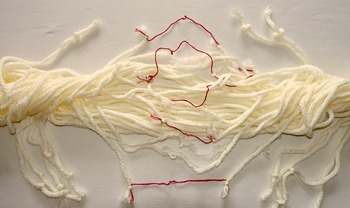
The Life Thread Model is a model to describe narrative change and has the potential to be used as a visual aid to support family interventions in the future. The Life Thread Model was developed following interviews with 20 people following a stroke and their partners from hospital up to one-year post-stroke and understandings based on theory related to life narratives. It focuses on interpersonal relationships and the power of everyday discursive practice (Ellis-Hill et al., Reference Ellis-Hill, Payne and Ward2008). The model was developed by CEH as a visual representation of the narrative threads that we use to create a sense of coherence and identity through life. The four stages describe i) the life threads (or life stories) as coherent, creating continuity with past present and future self, ii) how these life threads (or identities) are created in relation with others and wider society iii) the fraying which occurs with a sudden life disruption such as ABI and iv) how life threads can be reconnected, developed or safely tied off through physical and discursive interventions. The model suggests that positive emotional responses can be supported through (a) endorsing a positive view of self, (b) ‘being’ with somebody as well as ‘doing’ things for them; and (c) seeing acquired disability as a time of transition rather than simply of loss. By viewing the rehabilitation process as a transition, rather than solely coming to terms with loss, rehabilitation can be seen as an opportunity for discursive practices as well as the more traditional physical re-structuring of possibilities in the world. Such practices invite new ways of living which can be a very positive and creative process. The Life Thread Model is applicable to all injured and non-injured members living with ABI. While use of the model in family support interventions is in its infancy using the diagrams as a basis for discussion and exploration in informal settings has been found to be helpful (personal reflection) and further empirical research is needed.
Stories gain particular relevance at specific times (Bingley, Thomas, Brown, Reeve, & Payne, Reference Bingley, Thomas, Brown, Reeve and Payne2008) and a brain injury experienced by a relative is one of these. At such times the familiar life course is disturbed, the future that was mapped out is no longer in sight and what the brain injury means for the whole family needs to be negotiated. Sharing stories is not a process of problem solving but a process in and of itself. Within this context, stories can be traumatic, fragmented and painful. However, these stories can also be used to make sense of events in a way that brings some form of healing and peace and allows movement again towards a richer future not dominated by a discourse of loss. Making sense of an experience is important to psychological well-being and we can make sense of an experience through the stories we tell about them. Stories are constructed about our lives as a means of bringing some coherence and meaning to our experiences.
The telling of richer storied accounts creates room for hope, aspiration and a meaningful future. It offers an opportunity to allow people to make sense of the trauma, loss and change they experience. This can be through finding a way to recognise themselves again, reconnecting aspects of their past to their future or find an acceptable way to say goodbye to parts of themselves and their lives that are not able to be connected in this way.
Three practical applications of this model were used recently by CW in a family support group with eight family members, ten brain injury professionals at a conference workshop and over fifty people attending a regional brain injury forum meeting. At these events, CW explained how the life thread model could be used to make sense of brain injury, how to recognise threads that had not broken or identify those that could be, or had already been, reconnected (Fig. 1).
Practical application of the Life Thread Model.

The forums provided a platform for critical discussion of how the Life Thread Model was a useful way to engage with families that could be used in practice. The conversations contribute to the impetus to conduct empirical evaluations of the Life Thread Model within the context of brain injury. While we are unable to recommend this as an intervention, as we need to develop the evidence, we do suggest that being creative, open and active in our approaches to working with families and their stories is something all clinicians can do. Such an active approach would try to balance discussions about grief and loss by making room for opportunities to reflect on enduring characteristics and positive change.
We would recommend that research is undertaken that examines the effect of narrative approaches with family members after brain injury. When we listen to and validate relative’s stories, we are moving beyond our own professional scripts and agenda – the purely technical practical aspects of our roles. We allow ourselves to work at an existential level accessing family members’ subjective experiences, creating a space where people can address their deeply human existential needs.
Conclusion
Brain injury can threaten the stability of the whole family and the sense of self for uninjured members who must react, absorb and re-form. Change, therefore, is an uncontested part of the post-injury journey for both injured and non-injured members who must make sense of these changes in the context of all their lives. Negative changes and the presence of psychological distress have tended to dominate the professional and academic discourse. Such narrow perspectives can be limiting by closing down future possibilities. While the evidence base for narrative interventions tends to concentrate on the injured person we suggest here that there is also opportunity for family members to benefit and we call for further empirical evidence in this field. We suggest that many members of the ABI team can support families in their narrative work and have offered the Life Thread Model as a visible tool to support development. However, more empirical studies are required if we are to fully understand if and how such approaches are helpful in supporting humanising narrative healthcare responses for families post-brain injury.
Financial Support
This manuscript received no specific grant from any funding agency, commercial or not-for-profit sectors.
Conflicts of Interest
None
Ethical Standards
Ethical review not applicable for this manuscript.