Citizens’ trust in government institutions plays very important roles in politics and public administration. Citizens’ trust often allows more discretion to government agencies in policy implementation (Cooper et al., Reference Cooper, Knotts and Brennan2008), while a high level of trust provides democratic stability (Easton, Reference Easton1975). The continued decline in political trust in the US and other advanced democracies has given rise to much effort to understand the origins and sources of political trust ((Norris, Reference Norris1999), while some non-democratic regimes, such as China, Singapore, and Vietnam, have shown increased levels of political trust. Cross-national surveys, such as the World Values Survey and AsiaBarometer, often find close to 90% of citizens in these non-democratic countries expressing trust in their national government, while only 30–40% of US citizens do so. A wide range of work has examined the high level of political trust in China and similar non-democratic regimes, and scholars continue to debate the factors that explain it (Chen, Reference Chen2004; Chen et al., Reference Chen, Zhong and Hillard1997; Chen and Shi, Reference Chen and Shi2001; Li, Reference Li2013; Shi, Reference Shi2001; Wang, Reference Wang2005a; Wang et al., Reference Wang, Dalton, Shin, Dalton and Shin2006; Wang and Tan, Reference Wang and Tan2013).
The situations for these non-democratic regimes, however, are complicated. In China, for example, while its central government has generally enjoyed a relatively high level of trust from its citizens, this trust has been in decline of late. More importantly, internal disparities abound. Compared to its central government, China's local governments have long suffered a rather low level of political trust (Li, Reference Li2004; Wang, Reference Wang2005b). Partially as a response to this situation, in recent years local governance innovations have emerged in China, aiming to improve service provision and expand citizen participation (Perry and Goldman, Reference Perry and Goldman2007).
What makes citizens trust their government in the non-democratic political environment of China? How effective are government innovations in improving citizens’ trust in the government there? To answer these questions, we have surveyed more than 2,000 residents in more than 20 towns and townships across China. In this paper, we first build several structural equation models to extract the various factors that explain rural residents’ trust in town and township government. Then, with models fitted for communities that went through various types of governance innovation, we can explain why some innovations have worked to improved citizens’ trust, while others failed to do so. We find strong evidence supporting the institutionalist explanation of political trust, which emphasizes that opening the political process for public participation and empowerment contributes significantly to their trust in local government. This suggests that for the Chinese Communist Party to retain public support through innovations in governance, it needs to broaden political participation to the public, instead of focusing on administrative and other non-electoral changes.
Political trust and its sources
Trust in the government system or specific government institutions comprises a critical element of political support and government legitimacy (Easton, Reference Easton1975).Footnote 1 Since the late 1970s, trust in government institutions has continued to decline in advanced democracies, raising alarm bells, such as ‘crisis of regime’, ‘democratic malaise’, ‘democratic deficits’, and ‘disaffected democracy’, among others (Crozier et al., Reference Crozier, Huntington and Watanuki1975; Dalton, Reference Dalton2004; Easton, Reference Easton1975; Hetherington, Reference Hetherington2006; Norris, Reference Norris2011; Pharr and Putnam, Reference Pharr and Putnam2000; Pharr et al., Reference Pharr, Putnam and Dalton2000). In the Chinese case, recent years have seen riots, protests, or ‘mass incidents’ by Chinese villagers or urban residents gaining significant attention in Western media. Some critical Chinese newspapers are also pointing to government failures as the source of public mistrust. And on China's social media, such as Microblog (the Chinese equivalent to Twitter), critical voices abound. But to what extent the rising number of public protests and the increasingly intensive criticisms of the government constitute an erosion of political trust is still hard to tell. Interviews show that citizens’ trust in the central government may be resilient despite failures of specific institutions or actors in the regime (Li, Reference Li2013). In fact, survey researchers have found high levels of political trust in China (Chen, Reference Chen2004; Gilley, Reference Gilley2006, Reference Gilley2008; Shi, Reference Shi, Chu, Diamond, Nathan and Shin2008; Wang, Reference Wang2005a). These findings have been made by both Chinese and Western scholars, and taken from groups ranging from poor rural populations (Li, Reference Li2004) to wealthy entrepreneurs (Chen and Dickson, Reference Chen and Dickson2008). Overall, government performance – most notably rapid economic development in recent years – and political culture define citizens’ view of government authority and are found to explain this high level of political trust (Chu, Reference Chu2011; Nathan and Chen, Reference Nathan and Chen2004; Shi, Reference Shi2001; Wang, Reference Wang2005a). By contrast, democracies in Asia, such as Taiwan, Japan, and Korea, low level of political trust is often explained by the critical political culture typical for post-industrial societies and a democratic environment (Flanagan and Lee, Reference Flanagan and Lee2000; Norris, Reference Norris1999; Pharr and Putnam, Reference Pharr and Putnam2000).
The story for local governments in China might be quite different. Empirical research found that particular political support (i.e. support for or trust in local governments or other institutions within the political system) may not be transformed into diffuse support for the whole political system, and vice versa. The Swedish trust street-level bodies, such as the police, the courts, and hospitals, more than they do national institutions, such as political parties and the parliament (Rothstein, Reference Rothstein2009). US citizens’ trust in the federal vis-à-vis the state or city governments differ both in levels and sources (Cooper et al., Reference Cooper, Knotts and Brennan2008; Rahn and Rudolph, Reference Rahn and Rudolph2005; Wolak and Palus, Reference Wolak and Palus2010). In fact, past research shows that Chinese citizens’ grievances predominately target their local government (Li, Reference Li2004). While ‘crisis of governance’ abound in China, ranging from environmental disasters to government debts (Pei, Reference Pei2002), it is the local governments that are forced to face these problems directly (Sun and Zhao, Reference Sun, Zhao and Yang2007; Wong, Reference Wong2009). This paper therefore focuses on China's township governments, and examines the level of trust they enjoy and whether recent innovations in their processes and institutions have improved that trust.
Scholars have generally explained political trust from a culturalist and an institutionalist perspective. A culturalist view sees political culture as the key factor influencing citizens’ trust in government. This can be traced all the way back to Webber, who looks at traditional authority as one of the main sources of legitimacy in government. The public in the traditional and subsistence-agriculture society are prone to the influence of authoritarian values, which emphasize hierarchy and obedience to political authority. Once industrialization and modern urban life brought about a new type of political culture, citizens acquire pro-democratic values (Inglehart and Welzel, Reference Inglehart and Welzel2005). Citizens socialized in an urban, post-materialist, and democratic environment therefore become more critical toward government, leading to decline in political trust (Norris, Reference Norris1999), with self-expression values emerging as a main contributor to the rise in critical citizens (Flanagan and Lee, Reference Flanagan and Lee2000; Kim, Reference Kim2010; Wang, Reference Wang2005a). As a result, we see in East Asia, for example, post-industrial societies, such as Korea, Japan, and Taiwan, showing a rather low level of citizens’ trust in their government compared to less-developed China and Vietnam (Wang et al., Reference Wang, Dalton, Shin, Dalton and Shin2006). Given that a large part of rural China is still, at least until very recently, typified by non-urban, pre-industrialization socioeconomic life, we should expect to find that traditional Chinese culture, with its strong authoritarian values, still holds a heavy influence (Yang, Reference Yang, Lin, Tseng and Yeh1995). Solid empirical evidence shows that authoritarian or paternalistic orientation contributes to trust in government and diffused regime support in China, especially among the rural population (Chu, Reference Chu2011). They are also likely to lead to public support for authoritarian political regimes (Chu and Huang, Reference Chu and Huang2007). They therefore may constitute an important source of local government legitimacy among Chinese villagers.
An institutionalist view looks at the properties as well as the performance of government institutions as sources of political trust (Mishler and Rose, Reference Mishler and Rose1997, Reference Mishler and Rose2001). Weatherford's (Reference Weatherford1992) ‘the view from above’ of political legitimacy sees political support as deriving from institutional features, such as accountability, efficiency, and procedural and distributive fairness. Democratic institutions, such as elections and checks and balance, are believed to help achieve an accountable, responsible, and responsive government, hence generating the trust of citizens (Buchanan, Reference Buchanan2002; Dahl, Reference Dahl2006; Goodwin-Gill, Reference Goodwin-Gill2006). In contrast, a non-democratic government, such as China’s, lacks such institutions, and hence is believed to suffer low political trust and legitimacy deficits.
Another set of the institutionalist arguments prioritizes the output, results, or performance of government over the institutional structure and design (Yang and Holzer, Reference Yang and Holzer2006).Footnote 2 Rothstein (Reference Rothstein2009) rejects democratic institutions, such as elections, as being critical for political support, and sees as key whether the system can deliver quality governance. He found that Scandinavian citizens have much less confidence in the elected or election-related institutions, such as political parties, the unions, and the Parliament. Instead, they trust institutions whose leaders they have no right to elect, such as the healthcare system, the police, and social services, because these institutions deliver positive impacts on their life. Performance-based legitimacy has a long tradition in China's political history. In imperial China, citizens supported a dynasty if they believed it had the ‘mandate of heaven’. A dynasty would lose such a mandate if it failed to look after its people.Footnote 3 In today's China, it is argued that government performance, which specifically means the ability to promote China's economic development, has become ‘the sole source of legitimacy in China’ (Zhao, Reference Zhao2009: 428). In recent years, the performance matrix of Chinese central and local government has expanded to include areas such as environmental protection, promoting social justice, and providing public services, for example ensuring food safety, healthcare, and affordable housing. If the government can improve its services to citizens, then it may still generate satisfaction and trust from them even if economic development has slowed down. In this study, we will examine whether citizens’ perception of government performance in service provision contribute to their trust in township governments.
Rothstein (Reference Rothstein2009) sees the impartiality of government policies and actions as a critical factor determining public support for government. He found that the Serbian secessionism movement emerged in Croatia not because Serbians believed that they would be a permanent minority in the country, and hence would have no chance of winning an election, but because they encountered systematic discrimination and insufficient protection from government departments such as the police (Rothstein, Reference Rothstein2009; Rothstein and Teorell, Reference Rothstein and Teorell2008). In China, justice or impartiality as values in government have deep cultural and historic roots. The idea of impartiality, encapsulated in the concept of Yi Shi Tong Ren (treating every party with the same fairness), occupies a central position in traditional political thought of China.Footnote 4 When interviewing during our fieldwork in rural China, we noticed that those residents distrusting of, or dissatisfied with, local government usually felt that they were treated unfairly by local government agencies, police, and the court. Such unfair treatment often occurred in the implementation (output) of policies related to poverty relief, land expropriation compensation, and dispute settlement. People's assessment of institutional impartiality in these areas seems to significantly affect trust in local government.
Hypotheses
These various lines of scholarly argument lead us to formulate three hypotheses regarding Chinese rural residents’ trust in their town or township government (political trust):
Hypothesis 1 (H1): Authoritarian orientation contributes positively to political trust in local government.
Hypothesis 2 (H2): Township government's performance in service provision contributes positively to local political trust.
Hypothesis 3 (H3): Impartiality of township institutions and policies contributes positively to local political trust.
Government innovations and political trust
Amidst the global trend toward democratic government (Diamond, Reference Diamond2008; Huntington, Reference Huntington1993), many see China's one-party authoritarian system as unsustainable. Many are now suggesting transforming China's political system into a legal-electoral democracy as the only solution to its legitimacy crisis (Huang, Reference Huang2013; Zhao, Reference Zhao2009). But is full-scale democratization necessary? In Korea, government brought in administrative innovations, such as decentralization, to improve government performance, which contributes to public trust in government (Kim, Reference Kim2010). Can the Chinese Party introduce limited reforms while maintaining a one-party framework? Deliberative authoritarianism, for example, has emerged as one institutional alternative that may improve governance and renew the system's legitimacy (He and Warren, Reference He and Warren2011). Other forms of local democracy, such as village elections, participatory budgeting, or participatory public policy, may still serve to improve governance and boost public support for the governing body (Manion, Reference Manion2006; Schubert, Reference Schubert2009). Village elections can be perceived by citizens to be fair, competitive, and effective in improving governance, even though they are still controlled by the Party (Landry et al., Reference Landry, Davis and Wang2010; Su and Yang, Reference Su and Yang2005; Zweig and Chung, Reference Zweig and Chung2007). At the township level, Gunter Schubert (Reference Schubert2008) finds that ‘open nomination and direct election’ of township heads can help the Party to harness public support. Some argue that the township-level experiments with semi-competitive elections since the late 1990s contribute to the legitimacy of local government (Huang and Chen, Reference Huang and Chen2009; Lai, Reference Lai2009). In fact, such ‘democratic’ institutions increase residents’ connection to the central government, resulting in a positive impact on legitimacy of the central state (Kennedy, Reference Kennedy2009). Such ‘contained innovations’ within the one-party framework, at least in the short-run, have helped the regime's public legitimacy (Gilley, Reference Gilley2008). Against this background, we outlined the following types of innovations in township election and governance, and test their impact on political trust.
Governance innovations in rural China
Since the late 1990s, and especially since 2002, various types of ‘democratic reform’ and ‘institutional innovation’ have emerged in China's townships. The most well-known cases are either called by ‘open nomination and direct election (ONDE)’ (gongtui zhixuan) or ‘open recommendation and public elections (ORPE)’ (gongtui gongxuan). According to media reports, in selecting township leaders the local government allowed open nomination of candidates, and determined winners by direct elections participated in by all citizens of the community. In China's political system, nomination and selection of township leaders are controlled by the Party Committee at the county level. Hence, if indeed such a direct (ONDE) or public (ORPE) election has been installed, it amounts to a major breakthrough in democratizing China's local political system.
But a closer look into these cases revealed that the so-called open or direct elections did indeed include a very complicated range of electoral arrangements. Some so-called direct election, for example, only amounted to villagers having the right to vote, with the voting result serving only as an opinion poll for the Party's deliberation. Meanwhile, some so-called public elections were only open to Party members. To deal with this complexity, we have combined fieldwork investigation with a very careful study of media reports and scholarly publications in China to eventually identify five types of reform or institutional innovation at the township level that will serve as the basis of the analyses in this paper.Footnote 5 They could be variously called Direct election, Administrative reform, Competitive selection, Limited election, and Consultation.
Direct election: The so-called open nomination and direct election (ONDE) reform has aroused a large amount of media and academic interest (He and Lang, Reference He and Lang2001; Li, Reference Li2002; Manion, Reference Manion2000; Saich and Yang, Reference Saich and Yang2003). The first of such cases was reported in Shizhong District of Suining, Sichuan Province in 1998, and many cases have emerged post-2005. This type of reform includes open nomination and direct election of the head of the township government and/or the Party secretary of township Party committees. In the latter case, all Party members of a township participate in nominating and voting for the Township Party secretary. Our fieldwork covered three townships that have experimented with this type of reform in recent years.Footnote 6
Administrative reform: In the early 2000s, Xian’an District Government in Hubei Province pushed through what it called a ‘comprehensive administrative reform’. It mostly involved reorganization of the township government and Party committee, aimed at downsizing the Party-government payroll as well as streamlining government services. During our fieldwork in 2008 and 2010, villagers told us that no actual election of township government leaders was implemented; therefore the selection of township leaders followed the conventional Party-controlled practice.
Competitive selection: From 2001 onwards, Ya’an City in Sichuan Province implemented a series of reforms that included direct election of deputies to county-level Party committees and ‘Open Recommendation and Selection’ (gongtui gongxuan) of township leaders. Vote casting may take place in such a type of leadership selection, but poll results only serve in a consultative role when the Party committee decides on who gets to be the leader of the township government (Thøgersen et al., Reference Thøgersen, Elklit and Dong2008). Following some previous work (Saich and Yang, Reference Saich and Yang2003), we categorize this as Competitive selection type.
Limited election: In 2004, thirteen townships in Shuyang City of Jiangsu Province reportedly selected Party secretaries through ‘competitive direct elections’. During our fieldwork, however, we found no election had taken place in recent years. But in selecting local leaders, the county-level Party organizational department did employ a more competitive process, albeit within a limited circle. The candidates were often selected through a process of internal deliberation and public consultation, while the winners were subjected to an election by a selected group of people that often included leading government officials and a small number of citizen (villager) deputies. Hence we classified these two townships as the Limited election type.
Consultation: Since 1999, Wenling of Zhejiang Province started a type of institutional innovation called ‘Democratic Talk’ (minzhu kentan) which soon became well known among academia and the media as a model of consultative or deliberative democracy under the authoritarian regime (Fewsmith, Reference Fewsmith, Wong and Lai2005). In this innovation, the government would invite affected parties, such as villagers and workers and firm managers, to listen to their suggestions and concerns before a policy decision was made. He and Warren (Reference He and Warren2011) argue that this constitutes deliberative authoritarianism in which constituencies have the space and method to influence the exercise of government power. But it involves no reforms to the selection of government officials. We categorize this as the Consultation type.
Assuming these innovations took place because local or upper-level government saw the potential in them to improve governance, we hypothesize they have positive effects on citizens’ trust in township government.
Hypotheses 4 Institutional innovations have a positive influence on citizens’ political trust at the township level.
Operationalization and data
To measure rural citizens’ trust in township government (Political_Trust), we use villagers’ responses to three questions: how much they trust the township government (Trust_Gov), the township people's deputies (Trust_Deputy), and the local police (Trust_Police) (Actual survey questions are included in the Appendix). The main independent variables include the authoritarian orientation of rural residents, their evaluation of the performance of local government, and their evaluation of the impartiality of local government institutions. We measure these three factors using the following survey instruments:
Authoritarian orientation is measured by three likert-scale questions regarding:
(1) whether the villager thinks decisions made by government leaders are always right (Gov_Is_Right);
(2) whether the villager feels government leaders are like the head of a family and that villagers should all follow their decisions (Gov_Family); and
(3) whether the villager thinks the government should decide whether certain ideas should be allowed to be discussed in society (Gov_Decides).
These three statements have been well tested in the Asian Barometer survey and many other surveys. In general, those who support or agree with these statements tend to show more obedience toward the government or authority in general, and display higher levels of trust in the government too (Nathan and Chen, Reference Nathan and Chen2004).
Governance performance is measured by three likert-scaled questions inquiring on:
(1) whether the villager is satisfied with the performance of the township government (Satisfied_Gov);
(2) taking all factors into consideration, whether the villager thinks the township government officials are competent (chengzhi) (Competent_Gov); and
(3) how convenient the villager feels it is to go to a town government office for business (banshi) (Convenient_Gov)
These three indicators are far from sufficient in obtaining a deep and insightful understanding of residents’ experiences and feelings towards government, but they do allow us to coherently capture citizens’ overall view of the quality of local governance.
Citizen's perception of Institutional impartiality is measured by the following two vignettes:
(1) Imagine you quarreled with somebody and need to go to the police station, do you think the police will deal with your case fairly if you don't seek guanxi (social network resources) (Police_Fair)?
(2) Imagine you had an economic or other dispute with another person and need to go to court, do you think the court will deal with your case fairly if you don't seek guanxi (social network resources) (Court_Fair)?
The villager's response could range from ‘very unfair’ to ‘not quite fair’, ‘quite fair’, to ‘fair’.
Data
Between July 2009 and April 2011, we conducted our fieldwork in twenty townshipsFootnote 7 located in ten provinces or provincial level-municipalities (zhixiashi in Chinese terminology). At each selected town or township, we interviewed more than fifty local cadres at different government levels, surveyed more than 2,000 rural residents and more than 300 staff or officials working in township government using two questionnaires.Footnote 8 In order to compare the influence of institutional reforms on legitimacy and local governance, we purposely selected a number of townships in counties or districts where some type of institutional change was reported to have taken place. In total, we collected data in eleven towns or townships with at least one type of institutional innovation, and nine towns or townships across the country where no institutional innovation had taken place at all.
In each township, we aimed to achieve 100 respondents in the first cluster, sampling two villages. Once in a village, we went round inviting all households to participate in the survey. In each household, we explained the purpose and content of the survey to the person(s) at home, and expressed the hope that one member in their household would participate. We informed them that participation was completely voluntary and the participating person could withdraw at any point during the survey. In the process, we also tried to vary gender and age of the participants across households. Eventually, we achieved a total of roughly 100 participants in one or two days. If we could not achieve 100 respondents, we would cluster sample a third village. For the whole project, a total of 2,221 questionnaires were completed, and became our villager survey dataset.Footnote 9
Sources of political trust
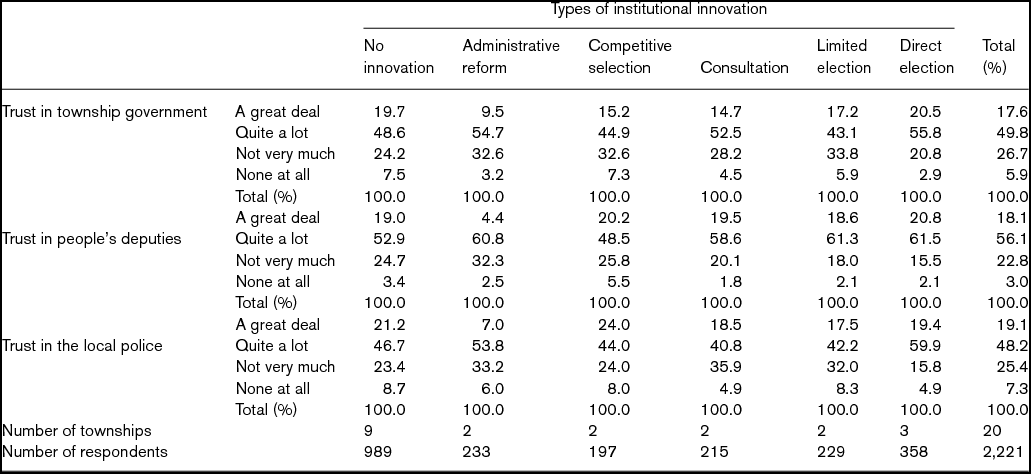
Table 1 reports the indicators of trust in the towns and townships we surveyed. A majority of rural residents feel they have either ‘quite a lot’ or ‘a great deal’ of trust in the various institutions of the township government. Excluding ‘don't know’ or ‘no answer’ responses, the average level of trust in township government stands at about 67%, and that of distrust 33%. The trust levels for the township people's deputies (i.e. members of the township people's congress) and local police stand at about the same level, at 74% and 67%, respectively.Footnote 10 This level of political trust appears rather high if compared with developed democratic countries (Pharr and Putnam, Reference Pharr and Putnam2000), but it is the lowest among the various levels of the Chinese government hierarchy. According to our own survey, villagers trust the county level government at 76%, provincial government at 86%, and central government at 95%.Footnote 11 These levels of trust in different levels of Chinese government appear consistent with previous research (Li, Reference Li2004; Wang, Reference Wang2005b). In any case, close to 70% of villagers perceive their township and county-level governments as trustworthy, and more of them think so regarding the provincial and central governments.
Percentages of trust and distrust in 20 townships

Note: Original question: To what degree do you trust in the institutions below? (1) township government; (2) township people's deputies; (3) the local police.
A structural equation approach
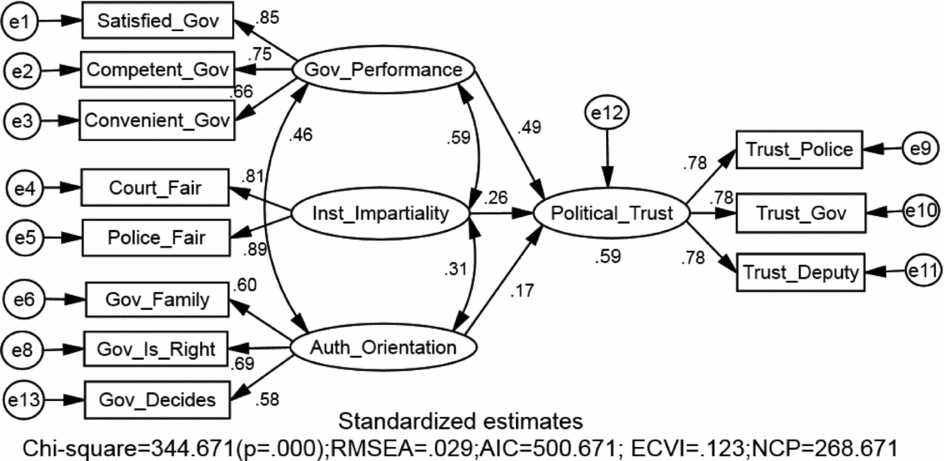
To explain this level of political trust in the township, we provided three hypotheses that link political trust to the independent variables, i.e. authoritarian orientations, government performance, and institutional impartiality. To test these hypotheses, we designed a structure equation model (SEM). Comparing to linear regression or hierarchical linear modeling, SEM allows testing and estimating causal relations using a combination of statistical data and qualitative causal assumptions (Bollen, Reference Bollen1993).Footnote 12 Our hypotheses can be converted into a confirmatory SEM that uses political trust as the dependent variable, and authoritarian orientation, quality of governance, and institutional impartiality as the independent variables. The confirmatory function of a SEM can show whether our operationalization captures the concepts, and whether a causal relation exists between each independent variable and the dependent variable. The modeling results are shown in Figure 1.
Sources of trust in township government (all townships) Note: 20 townships, N = 2,221.
The model shows that government performance has the strongest positive influence on legitimacy among all three independent variables, with a standardized regression coefficient of 0.49. Institutional impartiality ranks second, with a standardized regression coefficient of 0.26. Authoritarian orientation is the weakest, with a standardized regression coefficient of 0.17. All three coefficients are statistically significant at the 0.001level. The results also illustrate that these three variables explain about 59% of the variation in the dependent variable, which testifies to the model's sound explanatory power. Hypotheses H1, H2, and H3 are confirmed: a government enjoys higher levels of legitimacy when there is a culture that emphasizes authoritarian orientations, when the government offices and staff are viewed as providing quality services to the citizens, and when the justice institutions are viewed as impartial.
Innovations and political trust
Table 1allows us to compare levels of political trust for townships under conventional governance institutions and those that have experienced some kind of institutional reform. To enable easier comparison, Table 2 collapses the information presented in Table 1, and combines percentages of villagers who expressed either ‘quite a lot’ or ‘a great deal’ of trust. Contrary to the general expectation that governance innovation can improve citizens’ trust in the government, the various groups of townships where some innovations took place failed to show a higher level of political trust. Only in places where direct elections took place (the Direct election group) did citizens express a higher level of trust in township institutions. Clearly, regarding all three institutions, those townships where direct elections were held harvested a much higher level of trust (see the shaded column).
Percentages of villagers expressing ‘quite a lot’ or ‘a great deal’ of trust in the township institutions

Note: 20 townships, 2221 villager samples. Original question: To what degree do you trust in the institutions below? (1) township government; (2) township people's deputies; (3) the local police.
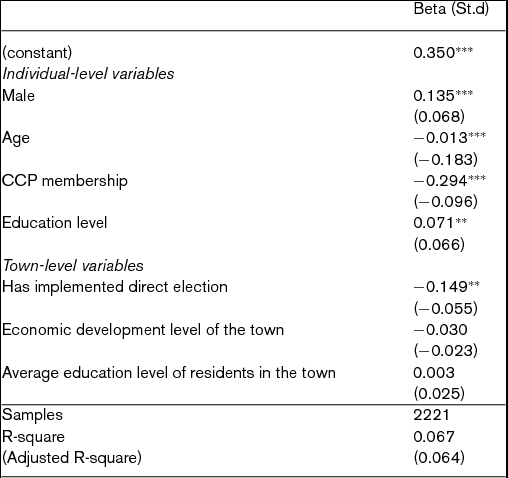
An ANOVA test shows that citizens in the Direct election townships trust their local government significantly more than those in all other groups (P < 0.05). No significant differences, however, exist between any other two groups (P > 0.05). The same is found in ANOVA tests of citizens’ trust in township people's deputies and the local police. To arrive at a rigorous conclusion, Table 3 presents the regression analysis that controls for a number of both individual-level and township-level variables.Footnote 13 We combined the three measurements of political trust into one composite score, to serve as the dependent variable. This is done by creating a standardized factor score out of the measurements of trust in township government, trust in deputies to the township assembly, and trust in the local police. These original indicators were measured on a 1–4 ordinal scale, while the resultant factor score is a continuous score with a mean of zero and a standard deviation of 1. For independent variables, we included three township-level variables and a number of individual-level variables. For town-level socioeconomic and ecological factors, we controlled for the level of economic development of the town, measured by the per capita GDP of the town, and the average level of the population's education.Footnote 14 As it turns out, township-level variables do not affect political trust.Footnote 15 Neither a town's level of economic development nor the education level of its population has an effect on township political trust.
Regression
Notes: **: P < 0.01; ***: P < 0.001.
Dependent variable: factor analysis value of three indicators: trust in township government, policemen, and deputies of township level.
Independent variables: Male: 1 = male, 0 = female; Age: from 18 to 90; CCP membership: 1 = CCP member, 0 = no; Education level: 1 = primary school and lower, 2 = middle school, 3 = high school, 4 = higher education and over; Direct election (town level): 1 = towns which have implemented the institutional innovation of Open recommendation and Direct election, 0 = no; Economic development (town level): 1 = low, 2 = middle, 3 = high; Average education (town level): percentage of high school education and over among respondents of each town.
Individual factors such as gender and age do result in great differences in citizens’ trust in the township of government. Men are more critical and less trusting, as are younger citizens when compared with older ones. More educated citizens are also more critical and less trusting, a finding that confirms modernization and ‘critical citizen’ theory (Inglehart, Reference Inglehart1997; Norris, Reference Norris1999). Party members seem more ready to give their consent and support to the government – probably good news for the Party, and an indication that the Party still enjoys a degree of cohesion and institutional integrity.Footnote 16
In the model reported here, for institutional innovation we only included one dummy variable for the Direct election reform. In earlier rounds of testing, we did include a dummy variable for each of the other types of reforms, but none of these dummy variables (that is, except for Direct election) had any significant effect compared to the townships where no reforms have taken place. Hence we removed these dummy variables from the final model specification. We conclude that the Direct election reform could positively influence villagers’ trust in the township-level government in China, while the other four types of institutional innovation have no such effect.
Some existing research suggests that the isolated cases of governance innovation emerged in places where socioeconomic development was stagnant, and government suffered low levels of public support (Saich and Yang, Reference Saich and Yang2003). If such cases do exist, our findings on innovations are seen as problem-driven local responses to difficulties in governance. Therefore, this regression result cannot prove that the innovations failed to improve political trust. We believe, however, that although some of the earliest innovations that happened in the late 1990s might have been driven by government concern regarding weak local governance, most if not all governance innovations in the later years emerged more or less randomly among all the thirty-five thousand China's townships. That is, the places where governance innovations occurred do not differ significantly from average townships where conventional modes of governance remain today. Our regression analysis above partially supports such an assumption: township-level variables do not affect our result in any significant way. Therefore, township governments in places where innovations did take place should enjoy the same previous level of trust as the non-innovation township. Our analysis shows that these various innovations indeed failed to improve political trust, with the only exception that of the Direct election type of reform.
Why election makes a difference
Some earlier studies, as reviewed above, do argue that some of these innovations, including the public consultation meetings, helped improve public support. These findings, however, were mainly derided from qualitative research, therefore may suffer impressionist bias. Ours represents a first effort to test such a hypothesis using a large-n dataset. While we recognize some weaknesses in our dataset,Footnote 17 based on the most rigorous analysis we can perform, we have to conclude that only one specific type of institutional innovation succeeded in improving citizens’ trust in township government. Interviews carried out during our fieldwork revealed that some of the so-called institutional innovations focused only on administrative reform, while others reformed or altered political processes that affect only government officials or local elites. All types of innovation except Direct election failed to engage ordinary citizens on a large scale. As a result, they resulted in low levels of identification among villagers, failing to generate a positive influence on citizens’ trust. Hence, innovations per se do not necessarily contribute to stronger public support or trust.
Only when an institutional innovation involves extensive citizen participation, in nominating or voting for a candidate, for example, can such institutional changes contribute positively to political trust. Therefore Hypothesis 4 is only partially confirmed: institutional innovations lead to higher levels of government legitimacy only in certain cases. Electoral participation appears to be critical for a certain innovation to boost political trust.
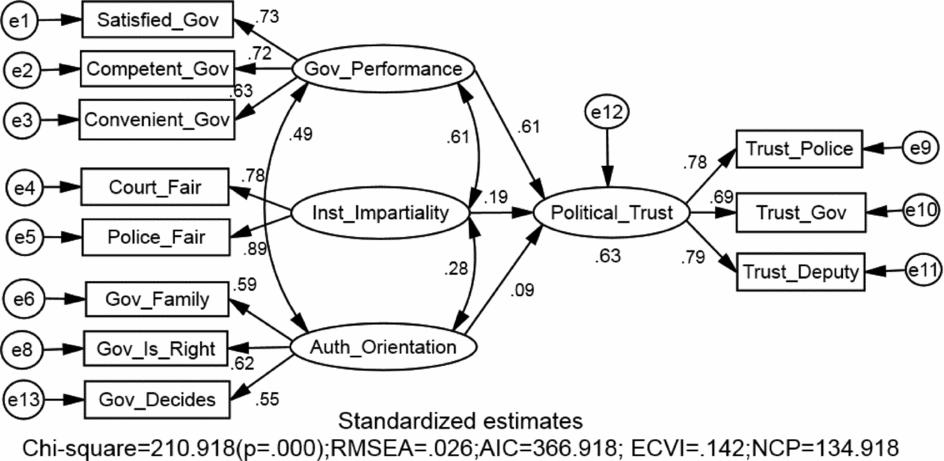
To understand why only the Direct election reform makes such a difference, we ran a separate SEM on data collected from the DE-type towns and townships (Figure 2). This model therefore can compare the sources of political trust in places running competitive elections with the model in Figure 1, which represents all towns and townships.
Sources of trust in township government, for direct election group Note: 3 townships, N = 358.
We find that among all rural residents we surveyed (Figure 1), authoritarian orientation has a significant influence on political trust (standardized regression coefficient: 0.18; P < 0.001). But once we move into an environment where open and direct elections are held (Figure 2), this causal relationship disappeared (with a standardized regression coefficient of 0.09 and a p-value of 0.231).Footnote 18 That is to say, while in general, authoritarian orientation among rural citizens in China helps buttress political trust, in an environment of direct election, it stops having a regime-supporting effect. The movement of power to select local leaders from the hands of upper-level government to local residents plays a large part in eliminating the influence of the so-called ‘traditional authority orientation’.
Furthermore, election also changes the role played by performance in generating political trust. In places with open elections (Figure 2, with a coefficient of 0.61), government performance has a bigger impact on political trust than is generally the case (Figure 1, with a coefficient of 0.47). It appears that once citizens start to participate in the election of local leaders, they are more likely to judge government's trustworthiness according to competence and performance. By contrast, without experiencing electoral participation, they are more likely to be influenced by traditional, authoritarian beliefs: their views of government are shaped by long-established hierarchical relations between the government and the people.
The introduction of elections also reduced the role of institutional impartiality on political trust. Between Figure 1 and Figure 2, institutional impartiality's contribution to political trust decreased from 0.27 to 0.19. Meanwhile, the impact of government performance has increased, from 0.49 to 0.61. Where no election exists, citizens are more likely to assess the government at its ‘output’ points, by way of feeling whether the government's judicial and law enforcement agencies have treated them fairly or not. Once elections are institutionalized, citizens are enfranchised in the ‘input’ process of government. A significant amount of their attention seems to shift from examining the fairness of the law enforcement institutions to the institutions that deal with more general governance and administrative tasks.
Discussion and conclusion
Local governance is increasingly affecting how Chinese people perceive their government. We found in our sample that while rural residents still show a high level of trust in the central government, the level of trust they ascribe to the local government is much lower. Local government's efforts to improve governance and sustain public satisfaction via various types of reform, however, are meeting different degrees of success. Our findings bring us to the important debate over electoral democracy and institutional quality as the main sources of government trust and legitimacy. Rothstein (Reference Rothstein2009) has most notably argued in favour of the latter, while others believe true political support must rely on formal democratic institutions such as competitive elections. For the Chinese case, with China's rapid socioeconomic modernization, it is inevitable that the number of ‘critical citizens’ will continuously grow, and that authoritarian orientations among citizens will be replaced by pro-democratic values (Inglehart, Reference Inglehart1990; Wang, Reference Wang2008). Relying on performance and quality of institutions (impartiality, for example) for political trust may prove increasingly difficult. Nathan (Reference Nathan2003) and others argue that institutional reforms and adaptations in China, while short of bringing in direct elections, may help renew governance capacity, and hence sustain government legitimacy. He and Warren (Reference He and Warren2011) also believe that institutional changes in the form of local deliberative democracy may enhance governance capacity, and help stall larger-scale democratization. Our findings request serious reconsideration of these arguments. While it is possible that some of these reforms have increased government efficiency, improved the quality of decision making, and served other good purposes, in most cases such innovations failed to improve citizens’ trust in the government. Only in places where some type of genuine open election was installed were we able to locate a tangible boost to political trust in the local government.
For democracy and governance theories, we found a unique impact on political trust when an innovation allows broad franchise and a degree of competition in electing government leaders. A genuine election seems to remove the impact of traditional values on political trust. That is, citizens become much more capable of rationally judging the government. Therefore, institutional innovations without an open election element, while considered ‘democratic’ by the Chinese Communist Party, actually have no positive contribution to political trust in the local government. For the Party to renew its one-party rule via such limited democratization, it must genuinely empower the large majority of the citizens in the electoral process. But then such efforts to retain citizens’ trust may indeed generate further need to open up elections at the higher levels in China's government system.
About the authors
Deyong Ma (Ph.D.) is an associate professor of Zhou Enlai School of Government, Nankai University and Marie Curie Fellow of the University of Nottingham (2010–12). He joined Nankai University after receiving his Ph.D. from Seoul National University in 2007. He published numerous articles and books on comparative politics (social capital, political trust, etc.) and local democratization in China in Chinese, English, or Korean language. In the past few years, he has focused on local democratization in China and political trust in East Asian societies. Related research results are expected to be published in Chinese, English, and Korean language academic journals.
Dr Zhengxu Wang is Associate Professor at the School of Contemporary Chinese Studies and Senior Fellow of the China Policy Institute (CPI), University of Nottingham. He researches on citizen values and political behaviours in China and East Asia, institutional changes and political reforms in China, perceptions of other powers in international politics, and elite politics in China among other topics. He publishes widely in the major academic journals, including The China Quarterly, Governance, International Review of Sociology, Journal of Contemporary China, and others.
Appendix
Dependent variable
Political trust
Q29. We would like to know the degree of trust you have for the following institutions. Please use ‘trust very much’, ‘trust somewhat’, ‘don't quite trust’, ‘don't trust at all’, or ‘don't know, don't want to say’ to show your position.
4. Government and Party committee of this town (township)
1, trust very much 2, trust somewhat 3, don't quite trust 4, don't trust at all
8. The police of this locality
1, trust very much 2, trust somewhat 3, don't quite trust 4, don't trust at all
9. The township people's deputies
1, trust very much 2, trust somewhat 3, don't quite trust 4, don't trust at all
Independent variables
Authoritarian values
Do you agree or disagree with the following statements? Would you say you somewhat agree, strongly agree, somewhat disagree, or strongly disagree?
[These variables are reverse-coded in analysis]
Q64. ‘I believe the decisions made by government leaders are always right.’
1, Strongly agree 2, Somewhat agree 3, Somewhat disagree 4, Strongly disagree.
Q54. ‘Government leaders are like the head of a family; we should all follow their decisions.’
1, Strongly agree 2, Somewhat agree 3, Somewhat disagree 4, Strongly disagree.
Q69. ‘The government should decide whether certain ideas should be allowed to be discussed in society.’
1, Strongly agree 2, Somewhat agree 3, Somewhat disagree 4, Strongly disagree.
Government performance
Q15. Do you think it is convenient to go to the town government office to make enquiries, such as obtaining a government document or permit?
1, very convenient 2, quite convenient 3, not very convenient 4, very inconvenient.
Q19. Generally speaking, do you think the township government officials are competent?
1, very competent 2, competent 3, not competent 4, not competent at all
Q20. Generally speaking, are you satisfied with the performance of town government?
1, very satisfied 2, quite satisfied 3, dissatisfied 4, very dissatisfied
Institutional impartiality
Q13. Imagine you had an economic or other dispute with another person and need to go to court, do you think the court will be fair when deal with your case if you don't seek guanxi (social network resources)?
1, it will be very fair; 2, it will be quite fair; 3, it will not be quite fair; 4, it won't be fair at all
Q14. Imagine you quarreled with somebody and need to go to the police station, do you think the police will deal with your case fairly if you don't seek Guanxi (social network resources)?
1, it will be very fair; 2, it will be quite fair; 3, it will not be quite fair; 4, it won't be fair at all