Schon 1918 hat Olmstead kenntnisreich, wenn auch nach heutigen Maßstäben nicht völlig korrekt, die Annalen des Assurnaṣirpal und die Reliefs im Thronsaal seines Nordwest-Palasts in Nimrud einander gegenübergestellt. Er konnte überzeugend darlegen, daß auf einer der Reliefplatten (B 17, vgl. Anm. 40) die Episode aus der 6. Kampagne dargestellt ist, bei der Kudurru, der Herrscher von Suḫu sich durch den Euphrat schwimmend der Verfolgung durch assyrische Soldaten entzieht (Olmstead Reference Olmstead1918: 242). Wäfler hat dann (Reference Wäfler1975: 238–241) in seiner Behandlung der „Nicht-Assyrer“ die Erkenntnis von Olmstead und die inschriftlich gesicherten Darstellungen der Tributbringer auf dem Schwarze Obelisken des Salmanassar zum Ausgangspunkt seiner Behandlung der Suḫäer genommen. Grundlegend, wenn auch kurz, hat Reade Reference Reade1985 das Relief mit der Kudurru-Episode und die weiteren Kriegsdarstellungen im Thronsaal in den Ablauf der Kampagnen eingeordnet.Footnote 1 Durch die Publikation der Bronzetore von Balawat des Assurnaṣirpal (Barnett u.a. Reference Barnett, Curtis, Davies, Howard, Walker, Curtis and Tallis2008) haben sich die bisher spärlichen inschriftlich gesicherten Suḫäer-Darstellungen und mit diesen die seltenen bildlichen Belege der Thronwagen wesentlich vermehrt, so dass eine erneute Betrachtung lohnend scheint.Footnote 2 In ihrer Dissertation hat Cifarelli (Reference Cifarelli1995: 271‒285) diese Tore bei ihrer Behandlung der Suḫäer zwar schon berücksichtigt, sie setzt sich allerdings mit den Deutungen von Wäfler und Reade kaum auseinander, weist lediglich die schon von Reade Reference Reade1985 korrigierten Deutungen von Winter (vgl. Anm. 1) zurück.
Während Cifarelli (Reference Cifarelli1995: 251) zwar durchaus die Fülle der “authentic details” bei der Darstellung von Fremden erkennt, warnt sie dennoch vor “a too-literal reading”. Demgegenüber hat Reade (Reference Reade1979: 31) schon zusammenfassend überzeugend dargelegt, daß “the most straightforward and effective way, however, of making a picture both interestingly relevant and self-explanatory, was to ensure that all participants were recognizable, with the right dress, the right hair, and the right objects associated with them.” Dieser Erkennbarkeit der Nachbarn der Assyrer auf den Darstellungen des 9. Jh.s nachzugehen, ist Ziel dieses Artikels.
Auch wenn methodisch nicht ganz korrekt, soll zunächst auf die jüngeren Fremdendarstellungen des Salmanassar III., eingegangen werden, da aus seiner Zeit besonders viele mit Beischriften versehen sind. Es zeigt sich, daß sie in vielen Details durchaus mit denen der nicht wesentlich älteren Darstellungen aus der Zeit des Assurnaṣirpal übereinstimmen. Es ist daher sinnvoll, beide Komplexe ‒ mit aller Vorsicht ‒ parallel zu behandeln.
Exkurs zu den Gewändern
Da die Gewänder, besonders die Mäntel mit all ihren Varianten, eine besondere Rolle spielen bei der Charakterisierung unterschiedlicher Völker, wird zunächst eine kurze Übersicht über die unterschiedlichen Gewandtypen gegeben.
Hemd
Sowohl die vornehmen Assyrer wie ihre Nachbarn tragen das lange Hemd mit unterem Fransensaum, die Soldaten, Lastenträger und Tierführer hingegen das kurze Hemd. Über das Hemd können unterschiedliche Überwürfe geschlungen werden.
Der lange Mantel
Bei Fremden: Der lange Mantel wird stets von den vornehmen Turbanträgern getragen, seltener von den Haarbandträgern. Er beginnt an der linken Schulter und führt über den Rücken unter dem rechten Arm wiederum zur linken Schulter; der letzte Zipfel ist über die Schulter nach hinten geworfen, oft ist er deutlich zu sehen, manchmal aber auch vernachlässigt.
Bei Mantelträgern in der Ansicht nach links (Abb. 3. 18–20) sind zwei Säume angegeben, die parallel von der linken Schulter ausgehend vor dem Körper herabführen; bei der Ansicht nach rechts hingegen variiert die Darstellungsweise: Die häufigste Variante a zeigt ebenfalls die beiden Vertikalsäume, so daß der Manteltyp in beiden Ansichten gleichermaßen erkennbar ist, so z.B. auf allen drei Balawat-Toren. Dies ist die Darstellungsweise, die sich dann durchsetzt.Footnote 3 Auf älteren Darstellungen ist nur der Saum vor der rechten Körperhälfte zu sehen (Variante b), der sich zur linken Schulter hinzieht, so z.B. bei den Fremden auf der Thronraumfassade des Nordwest-Palastes (Abb. 18), aber auch noch vereinzelt bei Salmanassar, z.B. bei der dritten Chaldäerdelegation auf seiner Thronbasis (Abb. 6). Eine seltenere Variante c dazu findet sich vereinzelt zur Zeit des Assurnaṣirpal (Abb. 17): Der umgeschlagene Teil des Tuchs unter dem rechten Arm erscheint wie üblich, der untere Saum führt jedoch nur wenig nach oben, zieht sich um den Körper und verschwindet in Kniehöhe.Footnote 4
Beim assyrischen Herrscher
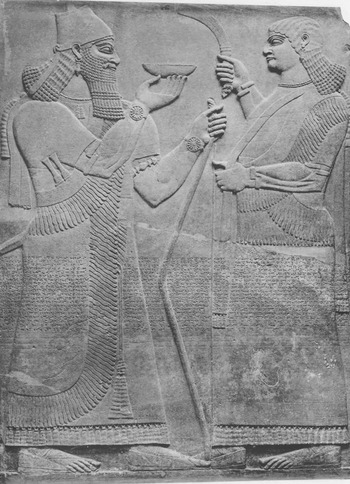
Die bei Fremden übliche Manteldrapierung entspricht weitgehend derjenigen des Herrschermantels,Footnote 5 der jedoch nicht an der linken Schulter, sondern über der linken Hüfte beginnt; der erste Fransenzipfel ist über der rechten Hüfte in den Gürtel gesteckt, er ist nur bei den Darstellungen nach rechts zu sehen (Abb. 1, Schalgewand 1).Footnote 6 Bei der Profilansicht nach rechts findet sich Variante a bei den Darstellungen des Assurnaṣirpal nicht, bei Salmanassar nur ausnahmsweise;Footnote 7 die Variante b zeigen die nicht kriegerischen Darstellungen der Reliefs des Nordwest-Palastes und mit einer Ausnahme (vgl. Anm. 7) die Darstellungen des Salmanassar;Footnote 8 die offenbar ältere Variante c ist wiederum nur vereinzelt bei Assurnaṣirpal belegt, auf seinen Balawat-Toren und bei der einzigen Manteldarstellung auf Reliefs im historischen Kontext (Abb. 15).
Nordwest-Palast G 10 (Budge Reference Budge1914: Taf. 35)
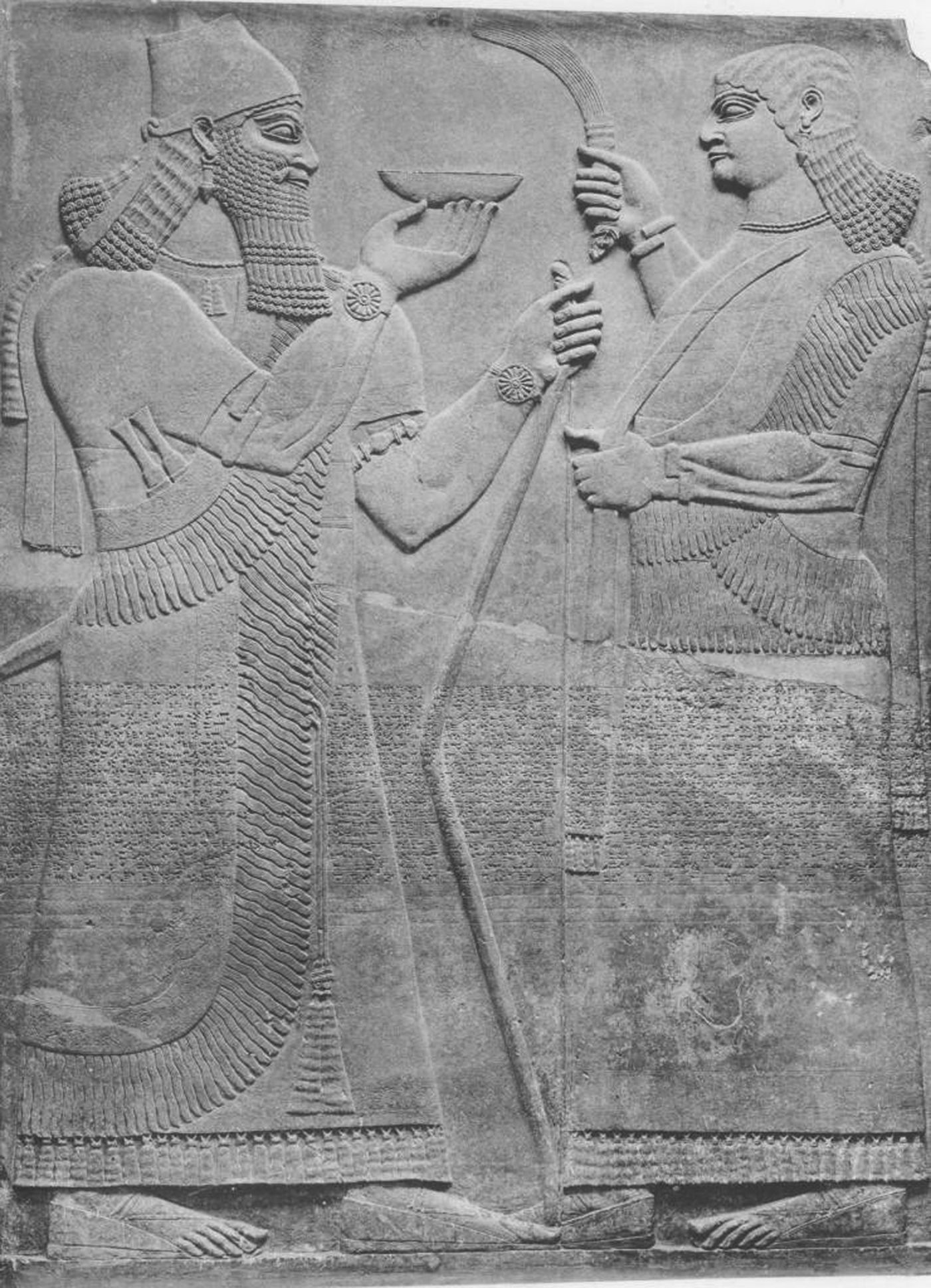
Der Fransenschal
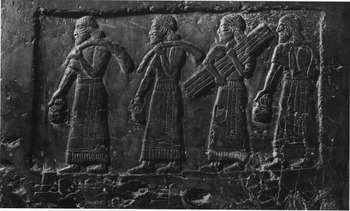
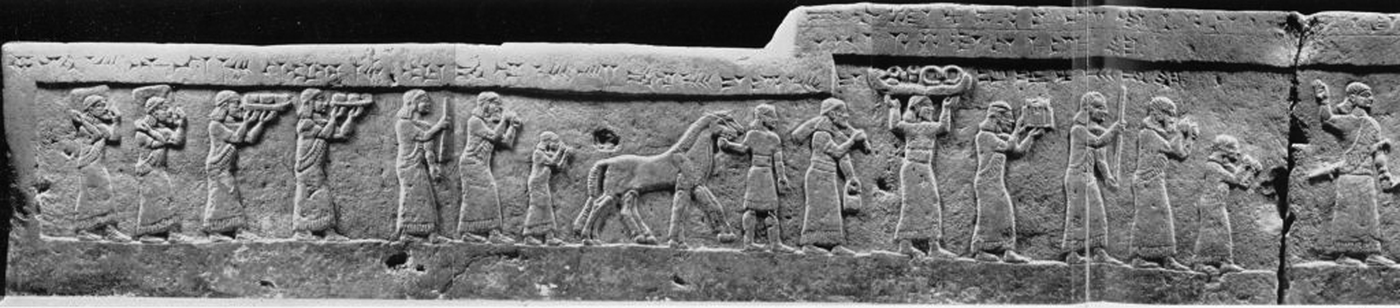
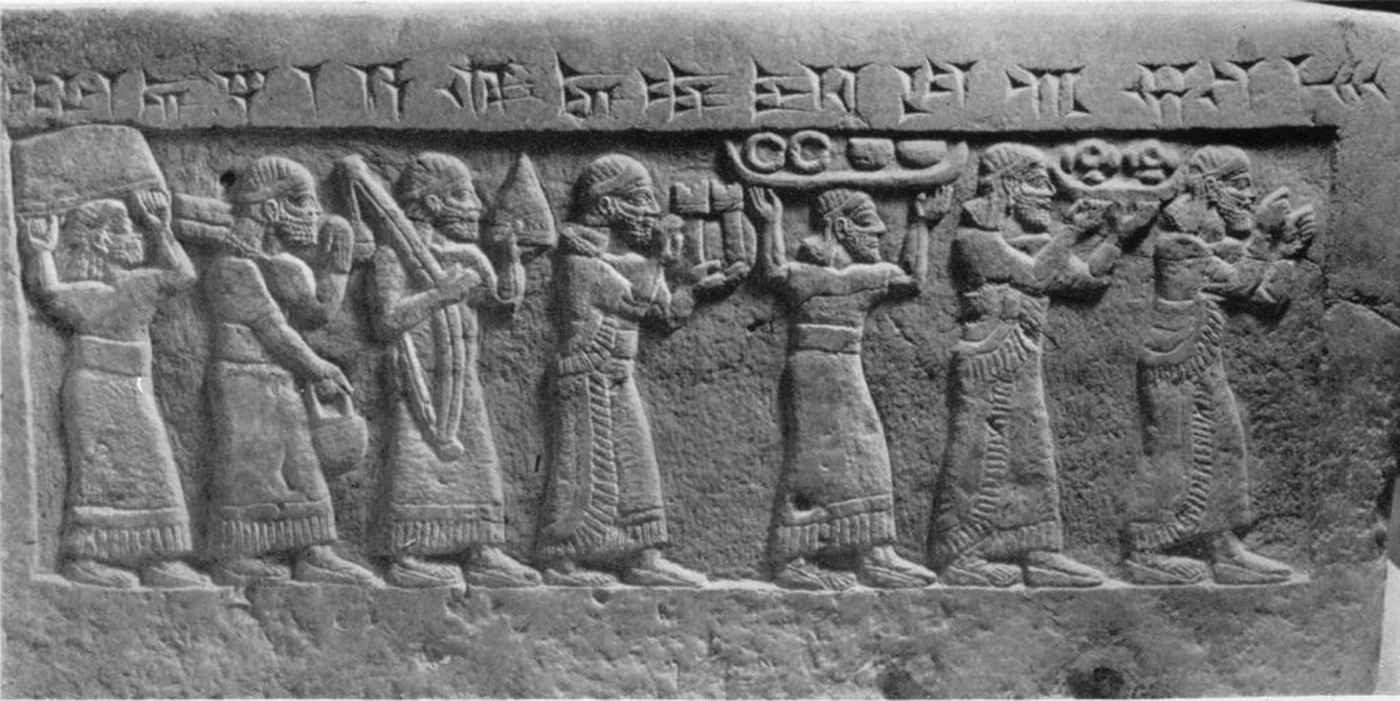
Bei den assyrischen Beamten wird er einmal um die Hüften geschlungen und über die linke Schulter geführt (Abb. 1, Schalgewand 3Footnote 9). Bei den Tributbringern von Sūḫu auf dem schwarzen Obelisken (Abb. 2) wird dieser Schal von einem Gürtel gehalten; das Ende, vom Rücken her über die linke Schulter geführt, hängt dann vorne über der linken Hüfte herab. In vereinfachter Form, nur lose über die Schulter geworfen, tritt er bei den beiden ersten Delegationen der Chaldäer auf der Thronbasis auf (Abb. 5). Da man auf den Bronzebändern des Assurnaṣirpal bei den Assyrern den kurzen Fransenschal meist nicht mehr erkennen kann, läßt sich auch bei den Fremden kaum feststellen, ob sie einen Schal über dem Hemd trugen. Nur bei den Suḫäern auf Tempel-Tor R 6 könnte man einen kurzen Schal vermuten.Footnote 10
Schwarzer Obelisk, Tribut von Suḫu (Börker-Klähn Reference Börker-Klähn1982: Abb. 152 C4)

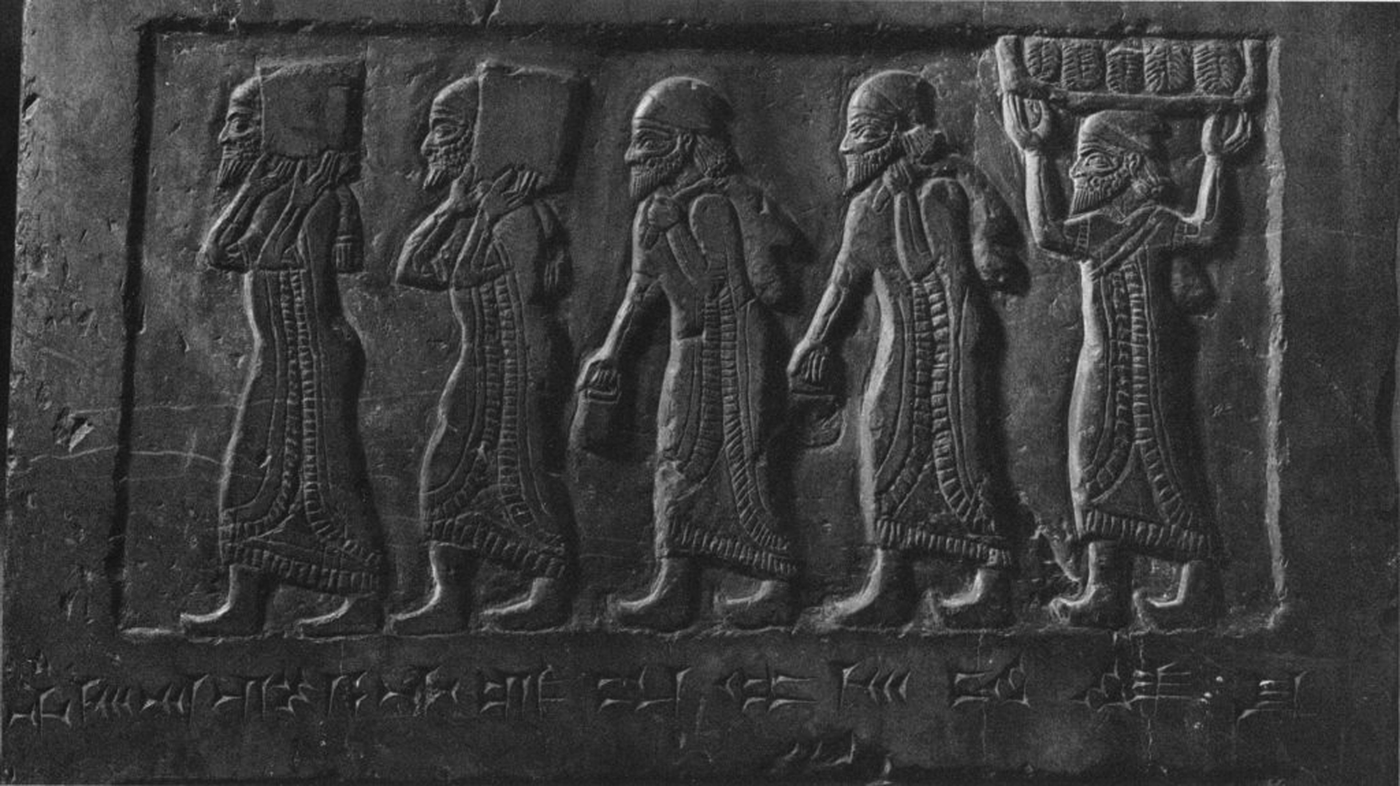
Schwarzer Obelisk, Tribut von Israel (Börker-Klähn Reference Börker-Klähn1982: Abb. 152 C2)

Darstellungen zur Zeit des Salmanassar III, Schwarzer Obelisk, Thronbasis, Bronzetor von Balawat Schwarzer Obelisk, Thronbasis, Bronzetor von Balawat.
Haarbandträger. Auf dem Schwarzen Obelisken ist im 4. Register auf drei Seiten, durch die Inschrift bezeichnet, der Tribut von Sūḫu dargestellt (Abb. 2);Footnote 11 auf der Vorderseite, unter den beiden Darstellungen des Herrschers, jagen zwei Löwen einen Hirsch in mit Laubbäumen bestandenem Gelände, sicherlich ein Bild der günstigen Jagdgründe am mittleren Euphrat.Footnote 12
Die Tributbringer tragen eine Frisur, die derjenigen der Assyrer, Babylonier, Chaldäer und anderer naher Nachbarn der Assyrer auf den Darstellungen des Salmanassar entspricht: Das Haar fällt halblang hinter den Ohren auf die Schultern und endet in einem lockigen Bausch. Im Unterschied zu den Assyrern tragen sie ein sich vorne verbreiterndes Haarband,Footnote 13 wie es z.B. auf der Thronbasis bei den Chaldäern (diese teilweise jedoch mit dicken Einzellocken!) (Abb. 5. 6) und bei den Babyloniern (Abb. 4) belegt ist.Footnote 14
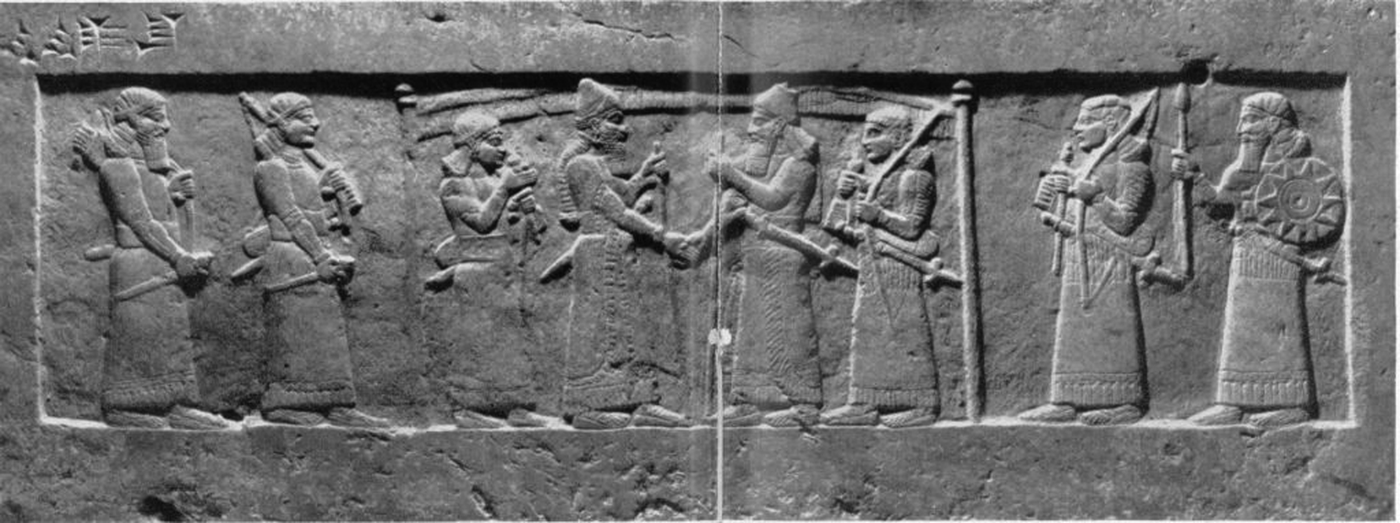
Thronbasis des Salmanassar, Begegnung des assyrischen und babylonischen Herrschers (Mallowan Reference Mallowan1966b: Abb. 371d)

Thronbasis des Salmanassar, Tribut der Chaldäer, 1. und 2. Delegation (Mallowan Reference Mallowan1966b: Abb. 371 g)

Auf den Bronzestreifen der Tore von Balawat läßt sich das Haarband nicht immer klar erkennen, ist aber bei der Frisur mit gelocktem Nackenbausch, wie sie viele Fremde tragen, anzunehmen: Unqi,Footnote 15 Bīt-Adini,Footnote 16 Gilzanu,Footnote 17 Hama,Footnote 18 Bīt-Agusi,Footnote 19 Bīt-Dakkūri,Footnote 20 Nähe der TigrisquelleFootnote 21 (zu den Belegen auf den Toren des Assurnaṣirpal s.u.).
Gemeinsam ist Babyloniern, manchen Chaldäern und in vielen Fällen auch den Assyrern das schlichte gegürtete Hemd ohne Überwurf. Das zeigt sich besonders anschaulich auf dem Relief an der Front der Thronbasis bei dem Treffen des Salmanassar und des Marduk-zākir-šumi von Babylon mit ihrem Gefolge (Abb. 4): Der babylonische Herrscher im Mantel Variante a mit Bordürensäumen ‒ nicht fransengesäumt wie beim assyrischen Mantel des SalmanassarFootnote 22 ‒, sein Gefolge im schlichten Hemd,Footnote 23 während das Gefolge des assyrischen Herrschers darüber den Fransenschal (Schalgewand 3) geschlungen hat.
Auf dem Balawat-Tor des Salmanassar ist das schlichte lange Hemd ohne Mantel als Tracht der Vornehmen nur bei den Herren aus Bīt-Dakkūri belegt (vgl. auch Anm. 27).Footnote 24 Babylonier sind auf den Bronzebändern nicht dargestellt.
Die Suḫäer hingegen zeichnen sich auf dem Schwarzen Obelisken durch einen schmalen, nahezu bandartigen Schal aus, der allerdings nur hier belegt ist (Abb. 2); er verläuft sehr ähnlich wie das Schalgewand 3 der Assyrer (s.o.). Die Strichelung dieses Schals gibt, wie bei allen Gewändern auf dem Schwarzen Obelisken, Fransen an, die sich deutlich von den Gewandsäumen der anderen Fremden auf dem Schwarzen Obelisken absetzen. Eine Angleichung an die assyrische Tracht (Schalgewand 3) scheint daher beabsichtigt.
Die Inschrift der Thronbasis nennt über den Darstellungen Tribute von Unqi und von zwei Chaldäerfürsten, von Bīt-Dakkūri und Bīt-Amukāni. Bei der Darstellung des chaldäischen Tributs sind es jedoch drei Delegationen, die jeweils von Vornehmen mit geballt erhobenen Händen angeführt werden. Die Anführer aller drei Delegationen tragen das Haarband mit seitlich kurz herabhängendem Bandende, das weitere Gefolge das einfache Haarband. Im Unterschied zu den sonst bordürengerahmten Gewändern der Fremden sind auch hier ihre Umhänge fransengesäumt wie bei den Assyrern. Bei den beiden ersten Delegationen,Footnote 25 wohl denen von Bīt-Dakkūri und Bīt-Amukāni, ist es jedoch nicht der Mantel, sondern der lose geschlungene Fransenschal (Abb. 5).Footnote 26 Die dritte Delegation (Abb. 6), deren Namen hier zwar nicht genannt ist, jedoch mit der von Bīt-Jakin, das in anderen Inschriften zusammen mit Bīt-Dakkūri und Bīt-Amukāni erwähnt wird,Footnote 27 identifiziert werden könnte, trägt den üblichen Fremdenmantel Variante b.
Thronbasis des Salmanassar, Tribut der Chaldäer, 3. Delegation (Mallowan Reference Mallowan1966b: Abb. 371f)

Turbanträger
Turbanträger, die auf den ersten Blick durch diese Kopfbedeckung und ihre in einem Schopf hochgebundenen Haare als Fremde erkennbar sind, tragen hingegen stets den langen Mantel (Abb. 3); bei sorgfältigen Darstellungen ist er deutlich von Bordüren gesäumt (Gilzanu, Unqi, Israel, Sidon, Karkemiš);Footnote 28 nur die beiden Herrscher in Proskynese auf dem Schwarzen Obelisken (Gilzanu und Israel) sind wohl wegen ihrer demütigen Stellung ohne Mantel wiedergegeben, im Gegensatz zu den ihnen folgenden Tributbringern.
Ungewöhnlich sind jedoch einige der Darstellungen von Leuten von Unqi und von Gilzanu. Sie sind die einzigen Mantelträger, die einerseits mit Haarband,Footnote 29 andererseits aber auch mit Turban (vgl. Anm. 28) dargestellt werden.Footnote 30 Auf dem Schwarzen Obelisken kommen sogar im untersten Register nebeneinander Leute von Unqi vor, die einen Turban, Bordürenmantel und Schnabelschuhe (Vorderseite) oder ein Haarband, Bordürenmantel und Schnabelschuhe (beide Seiten) oder die Tracht von Sūḫu, ohne Schuhe(!) (Rückseite) tragen.Footnote 31 Wie die gemischten Frisuren in diesem Fries zu verstehen sind, bleibt fraglich (s.u. zu Thronraumfassade des Nordwest-Palastes).Footnote 32
Daß die Leute von Gilzanu trotz ihrer Nähe zu Urartu anders dargestellt/behandelt wurden als die nackten, behelmten und besonders bestraften UrartäerFootnote 33 oder auch die nahezu kahlköpfigen Leute von Šubria,Footnote 34 könnte daran liegen, daß sie nicht als die wilden im Bergland besiegten Fremden auftreten, sondern als Tributbringer, mit denen die Assyrer wirtschaftlichen Kontakt pflegtenFootnote 35 und die man daher unter die zwar entfernteren, aber nicht wilden Fremden einordnete, deren Aussehen jedoch nicht einem festen Schema unterworfen war. Der lange Mantel war für sie naheliegend, die Kopfbedeckung auf dem Schwarzen Obelisken ist jedoch eher merkwürdig, da der Turban sonst auf westlichere Gegenden beschränkt war.Footnote 36
Zusammenfassung
Haarbandfrisur und Hemd zeichnen bei Salmanassar die nächsten Nachbarn der Assyrer aus (Babylonien, Sūḫu, Bīt-Dakkūri); selten tragen sie den assyrisierenden kurzen Beamtenschal über dem Hemd, sehr deutlich bei Sūḫu auf dem Schwarzen Obelisken (eventuell ebenfalls bei Sūḫu auf den Balawat-Toren des Assurnaṣirpal), bei Bīt-Dakkūri auf dem Balawat-Tor Band XI, abgewandelt bei Bīt-Dakkūri und Bīt-Amukāni auf der Thronbasis. Haarbandträger mit Mantel Variante a sind offenbar etwas entferntere Nachbarn;Footnote 37 so unterscheiden sich die entfernteren oder weniger bekannten Chaldäer von Bīt-Jakin durch diesen Mantel von den Chaldäern von Bīt-Dakkūri und Bīt-Amukāni. Vor Salmanassar scheint diese Tracht häufiger belegt (vgl. unten zu Nordwest-Palast, West Wing und Thronraumfassade, Rassam-Obelisk).
Die Haarbandträger tragen, wenn überhaupt Schuhwerk angegeben ist, wie die Assyrer Sandalen (zu Ausnahmen vgl. Anm. 32. 66). Daß die Leute von Sūḫu, die in ihrer Tracht besonders den Assyrern angeglichen sind, auf dem Schwarzen Obelisken als einzige keine Schuhe tragen, ist merkwürdig.
Fest geprägt, zumindest seit Assur-bēl-kala (Broken Obelisk)Footnote 38 ist jedoch, wie schon Cifarelli (Reference Cifarelli1995: 111 f.) dargelegt hat, das Bild der Bewohner der Levante und Syriens: Sie tragen den fremdartigen Turban und dazu stets den Mantel, oft mit capeartigem Gewandzipfel; für welche weiteren Gegenden diese Tracht dann ebenfalls zur Charakterisierung benutzt wurde, schwankt offenbar bei Salmanassar noch. Turbanträger tragen stets, wenn das Schuhwerk erkennbar ist, Schnabelschuhe.
Darstellungen zur Zeit des Assurnaṣirpal II
Nordwest-Palast, Thronsaal.Footnote 39
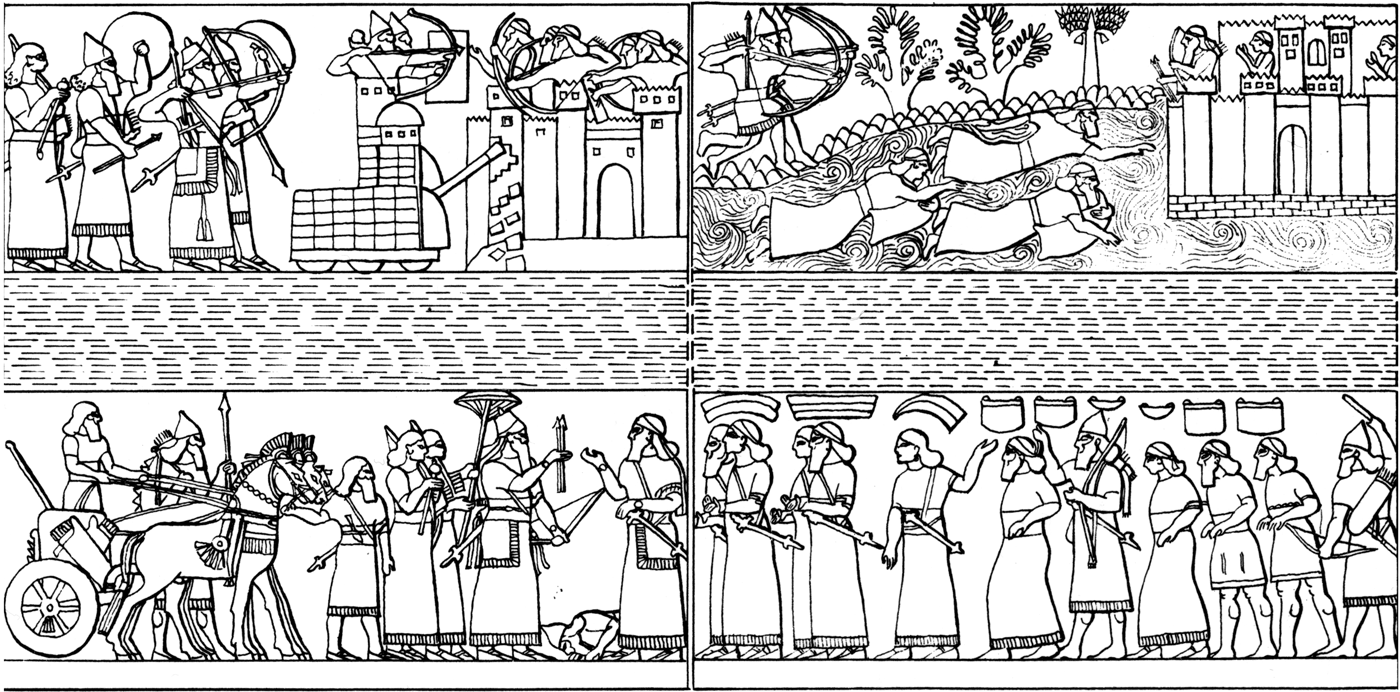
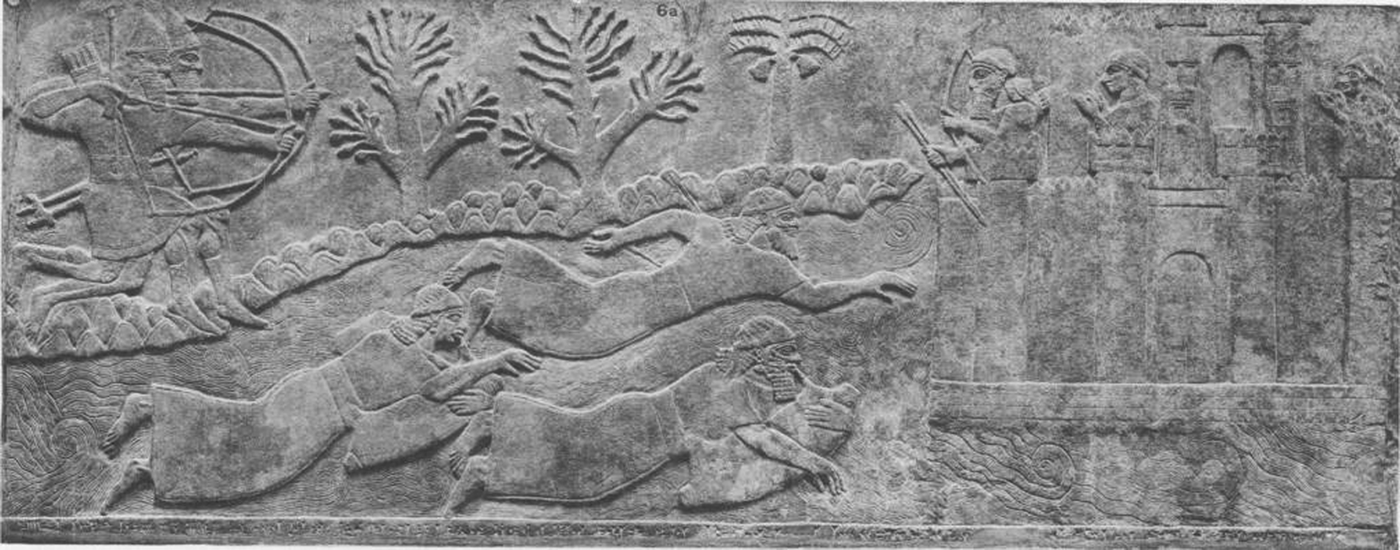
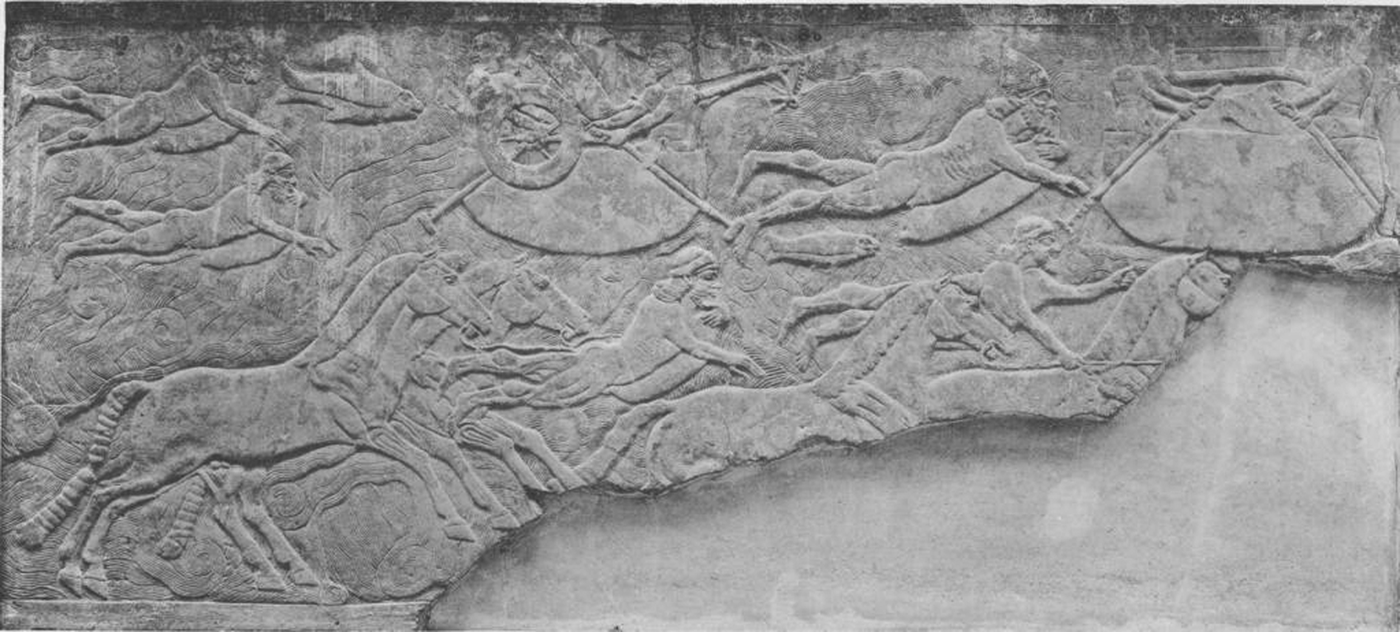
Wie schon zu Anfang erwähnt, war es Olmstead,Footnote 40 der als erster eine Begebenheit aus Assurnaṣirpals 6. Feldzug mit einem Relief des Thronsaales (B 17 oben) des Nordwest-Palastes zusammenbrachte, auf dem drei Schwimmer sich unter dem Angriff zweier assyrischer Bogenschützen zu einer Stadt im Wasser retten (Abb. 7. 9): Assurnaṣirpal berichtet, daß Kudurru, der Statthalter (LÚ.GAR.KUR/šakin māti) von Sūḫu, nach der Eroberung von Sūru sich zusammen mit 70 seiner Krieger in den Euphrat stürzte, um sein Leben zu retten.Footnote 41 Wäfler (Reference Wäfler1975: 239f.) hat dies aufgegriffen; Reade kam offenbar unabhängig von Olmstead zu dieser Erkenntnis.Footnote 42
Thronraum, Nordwest-Palast, Reliefs B 18–17 (Meuszińsky Reference Meuszyński1981: Taf. 1)

Thronraum, Nordwest-Palast, Relief B 18 oben (Budge Reference Budge1914: Taf. 13 oben)

Thronraum, Nordwest-Palast, Relief B 17 oben (Budge Reference Budge1914: Taf. 13 unten)
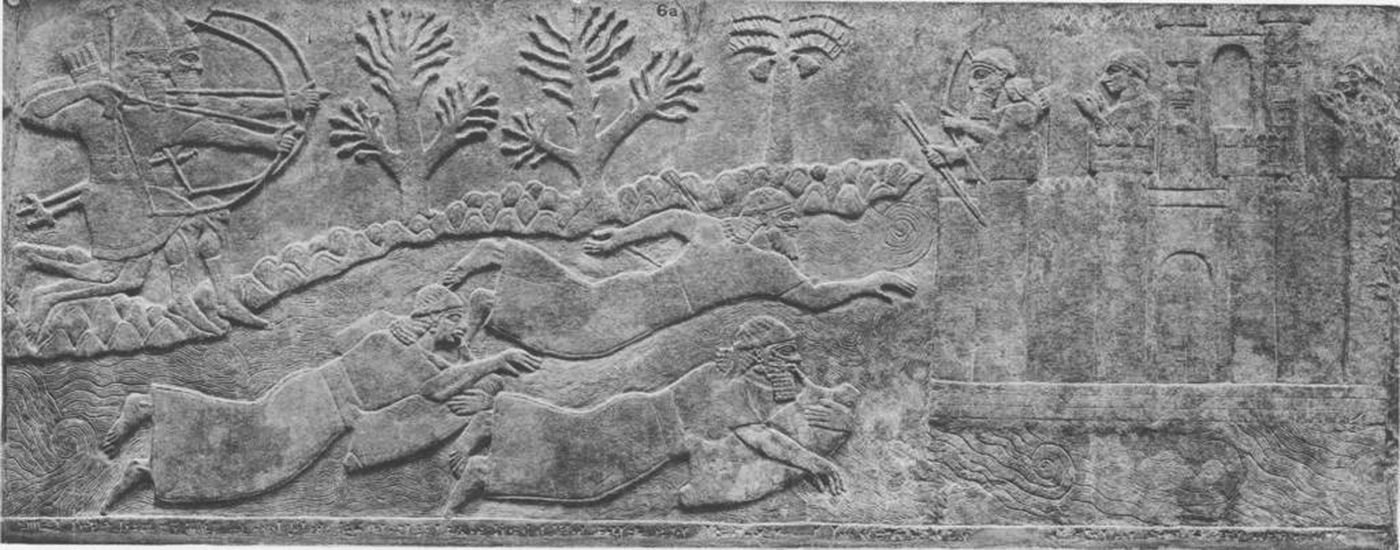
Diese Schwimmer-Szene gibt eindeutig eine bestimmte historische Situation wieder. Bemerkenswert ist, daß hier die Übermacht der Assyrer nur in wenigen Details zum Ausdruck kommt: Die Feinde fliehen, nur einer ist von Pfeilen getroffen, sie entziehen sich jedoch den assyrischen Soldaten und erreichen offensichtlich die rettende Stadt, die außerhalb der Reichweite der assyrischen Angreifer liegt. Am ehesten handelt es sich hier um Anat, das ja mitten im Wasser liegt und nach der Eroberung von Sūru als nächste sichere Zuflucht dienen konnte. Wie der Krieger auf der Zinne mit Bogen in der Linken und Pfeilen in der Rechten deutlich macht, ist diese Stadt zunächst auch keineswegs bedroht. Daß hier der ‚Hauptverteidiger‘ von Anat in dieser Pose dargestellt wird, ist erstaunlich, denn mit Bogen und Pfeilen in der Hand wird sonst der assyrische Herrscher dargestellt ‒ allerdings sind die Pfeilspitzen nach der Schlacht nach oben gerichtet. Nun bleibt ja Kudurru nach der rettenden Flucht weiterhin Herrscher seines Landes, wenn er auch zunächst, zumindest nach der Aussage des Tempel-Tors von Balawat, Band L6 und R1, Tribut nach Assyrien lieferte (vgl. Teil 2). Entscheidende Aussage dieses Bildes ist dennoch die Flucht vor assyrischen Soldaten, also die Niederlage des Kudurru.
Auch auf diesem Relief stimmen Frisur und langes Hemd der Flüchtlinge mit dem Erscheinungsbild der Assyrer überein. Da das Gefolge des assyrischen Herrschers auf diesen Reliefs mit Kampf- und Jagddarstellungen (B 18. 17) nicht den Fransenschal trägt, ist ein entsprechender Überwurf auch bei den schwimmenden Suḫäern nicht zu erwarten.
Das vorne breitere Haarband ist bei Schwimmern und Verteidigern auf der Mauer deutlich angegeben. Lang herabhängende Bandenden, die an die Tänie des assyrischen Herrschers und seines Feldherrn erinnern (vgl. Anm. 13), kennzeichnen auch bei den Suḫäern herausragende Personen, wie den Stadtfürsten auf der Zinne und einen der Schwimmer. Einer der Schwimmer ist bartlos, also ein LÚ.SAG (ša rē ši), eventuell mit Beutel über der Schulter? Dieser Schwimmer ist eindeutig nicht der Herrscher. Der einzige, der keine Schwimmhilfe braucht, schwimmt über den beiden anderen; er erreicht wohl als erster die Stadt, ist als einziger von Pfeilen getroffen; er trägt als einziger einen leicht schräg gestutzten Bart, er trägt als einziger keinen Ohrring. Der von den Pfeilen Getroffene setzt sich also von den beiden anderen ab. Der Schwimmer mit der langen Tänie entspricht ganz dem Bild eines assyrischen oder babylonischen Vornehmen ‒ wie auch der Hauptverteidiger auf der Zinne ‒ und ist so am ehesten mit Kudurru zu identifizieren, von dessen Verwundung durch Pfeile ja in den Annalen auch nicht die Rede ist.
Daß der Verwundete als einziger keine Schwimmhilfe braucht, könnte darauf hindeuten, daß er zu einer mit dem Wasser vertrauten Bevölkerungsgruppe gehört, die wie auf den Reliefs mit der Euphratüberquerung B 11‒9 (unten) als Spezialisten bei Wasserüberquerungen eingesetzt wird (s. dazu unten mit Abb. 14).
Neben zwei nicht zu bestimmenden Laubbäumen wächst eine Palme, die meist auf Babylonien hinweist und hier zum südlichsten Punkt der 6. Kampagne paßt (Bleibtreu Reference Bleibtreu1980: 24‒28). Da bei den Orthostaten B 20‒17 im Gegensatz zu allen anderen Orthostatenfolgen das obere und das untere Bild zusammengehören (Abb. 7), wie klar aus Stier- und Löwenjagdplatten hervorgeht, ist anzunehmen, daß B 18 und B 17, die unten eine fortlaufende Szene zeigen, auch oben inhaltlich zusammengehören, wie auch Reade und andere schon vorgeschlagen habenFootnote 43: oben auf B 18 (Abb. 8) die Eroberung von Sūru, das von Suḫäern mit langem Bart und vorne breitem HaarbandFootnote 44 verteidigt wird, darauf folgend die Flucht durch den Euphrat nach Anat (Abb. 9) und unten der Herrscher als Sieger mit den Gefangenen und der Beute, wie sie in den Annalen aufgezählt wird (Abb. 10. 11).Footnote 45
Thronraum, Nordwest-Palast, Relief B 18 unten (Budge Reference Budge1914: Taf. 20 oben)

Thronraum, Nordwest-Palast, Relief B 17 unten (Budge Reference Budge1914: Taf. 20 unten)

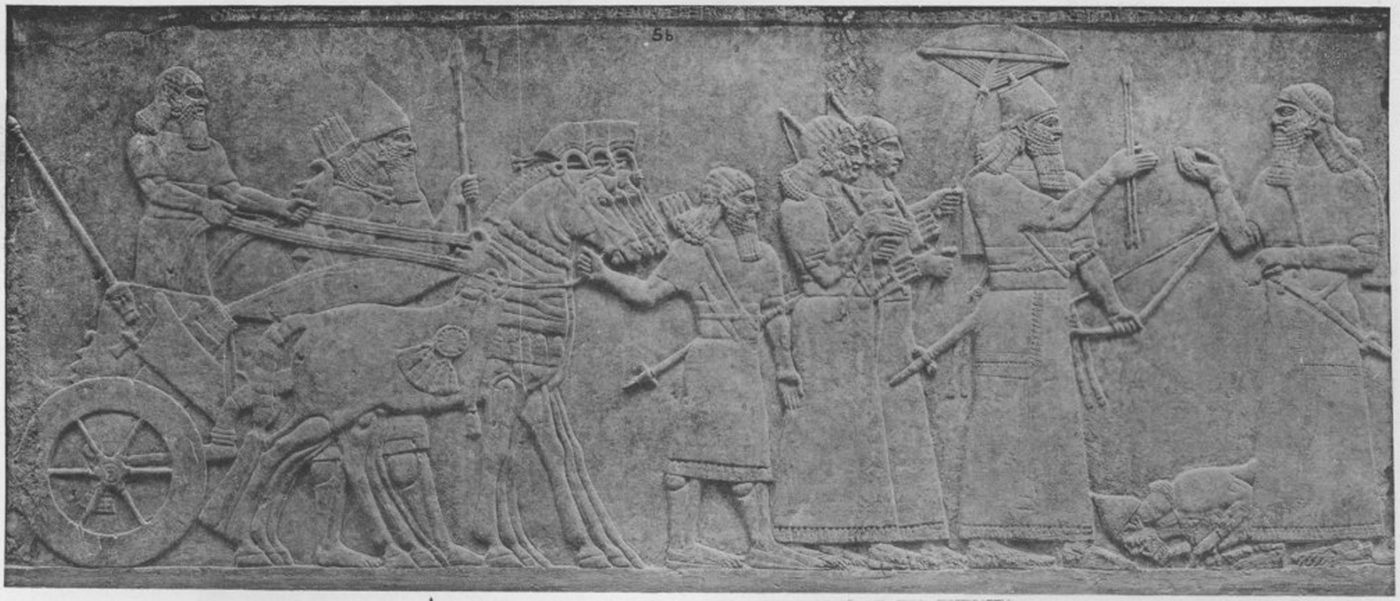
Die Gefangenen sind deutlich in ihrem Rang unterschieden; der vorderste, der einzeln vorgeführt wird, trägt das lange Hemd mit dem breiten Gürtel wie die Assyrer vor ihm, ebenso deren Frisur und langen Bart und einen bescheidenen Ohrring, jedoch das für die nächsten Nachbarn der Assyrer spezielle Haarband. Der zweite ist dargestellt wie die sog. assyrischen Eunuchen,Footnote 46 jedoch ebenfalls mit dem vorne breiteren Haarband mit kurzen Enden.Footnote 47 Die beiden letzten Gefangenen tragen nur das kurze Hemd wie auch die assyrischen Soldaten, aber wiederum das Haarband, das sie als Fremde kennzeichnet (ohne herabhängende Bandenden). Die Rangfolge der Assyrer spiegelt sich hier bei den Gefangenen in den unterschiedlich langen Hemden wider. Ob diese Gefangenen tatsächlich Suḫäer sind, ist jedoch nicht sicher, denn diese wurden von starken Hilfstruppen des babylonischen Herrschers unterstützt. In seinen Annalen (Grayson Reference Grayson1991: RIMA 2 A.0.101.1 III 20) erwähnt Assurnaṣirpal als Gefangene namentlich Zabdānu, den Bruder des babylonischen Herrschers, und Bēl-apla-iddina, den LÚ.ḪAL (bārû), den Truppenführer (a-lik pa-an ÉRIN.ḪI.A.MEŠ-šú-nu); darauf hat auch schon Reade (Reference Reade1985: 212) hingewiesen. Der Bärtige wäre dann Zabdānu, der Unbärtige der bārû;Footnote 48 die beiden einfachen Soldaten verkörpern die 3000 gefangenen Kämpfer, im Feld oben ‚schwebt‘ die Beute.
Da die Feinde der Assyrer in Kampfhandlungen bei Assurnaṣirpal nie mit Helm wiedergegeben sind – mit Ausnahme der Bergbewohner (Anm. 83) ‒, kann es sich bei dem sich vor dem Herrscher Niederwerfenden nur um einen Assyrer handeln (Abb. 10).Footnote 49
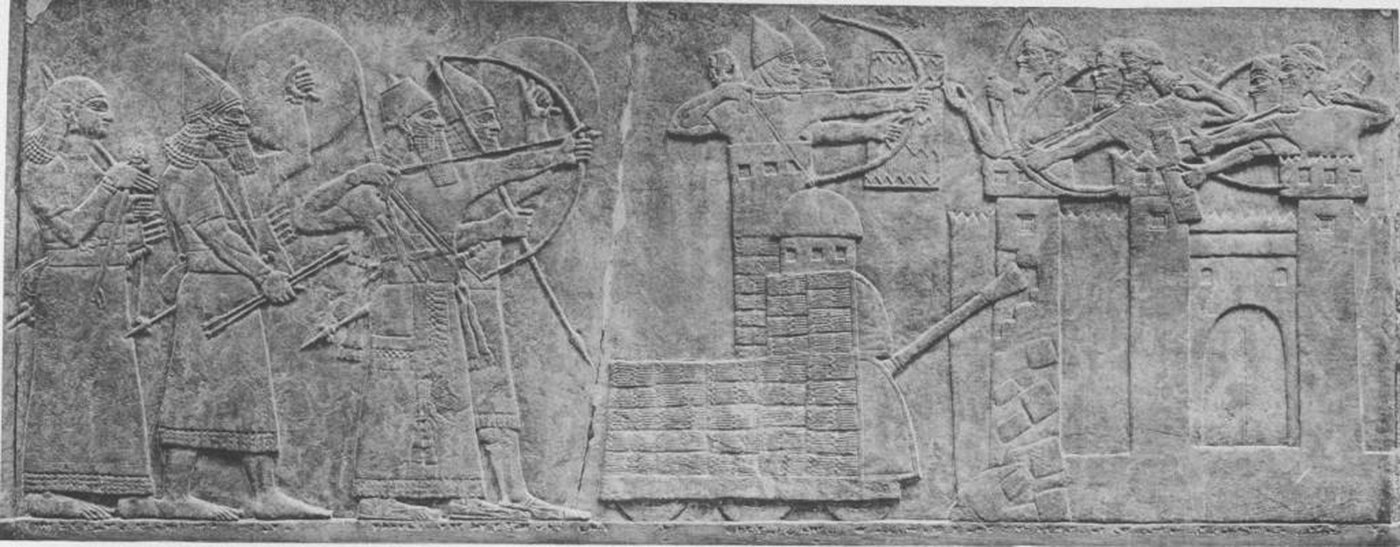
Reliefs B 11‒B3 (Abb. 12) geben ebenfalls einen Feldzug des Assurnaṣirpal gegen Euphrat-Bewohner wieder, die gleich dargestellt sind wie die Bewohner von Sūḫu. Im oberen und im unteren Register sind es drei ‚Bildfolgen‘, in denen der Herrscher jeweils ein Mal erscheint. Oben: 11‒8 offene Feldschlacht; 7‒5 triumphale Rückkehr ins Lager; 4‒3 Eroberung einer Stadt mit Bäumen am Wasser (eventuell dem Triumph vorausgehend). Unten: 11‒9 Flußüberquerung; 8‒5/Mitte Vorführung von Gefangenen; 5/Mitte‒3 Eroberung einer Stadt am Wasser.Footnote 50
Thronraum, Nordwest-Palast, Reliefs B 11–3 (Meuszińsky Reference Meuszyński1981: Taf. 2)
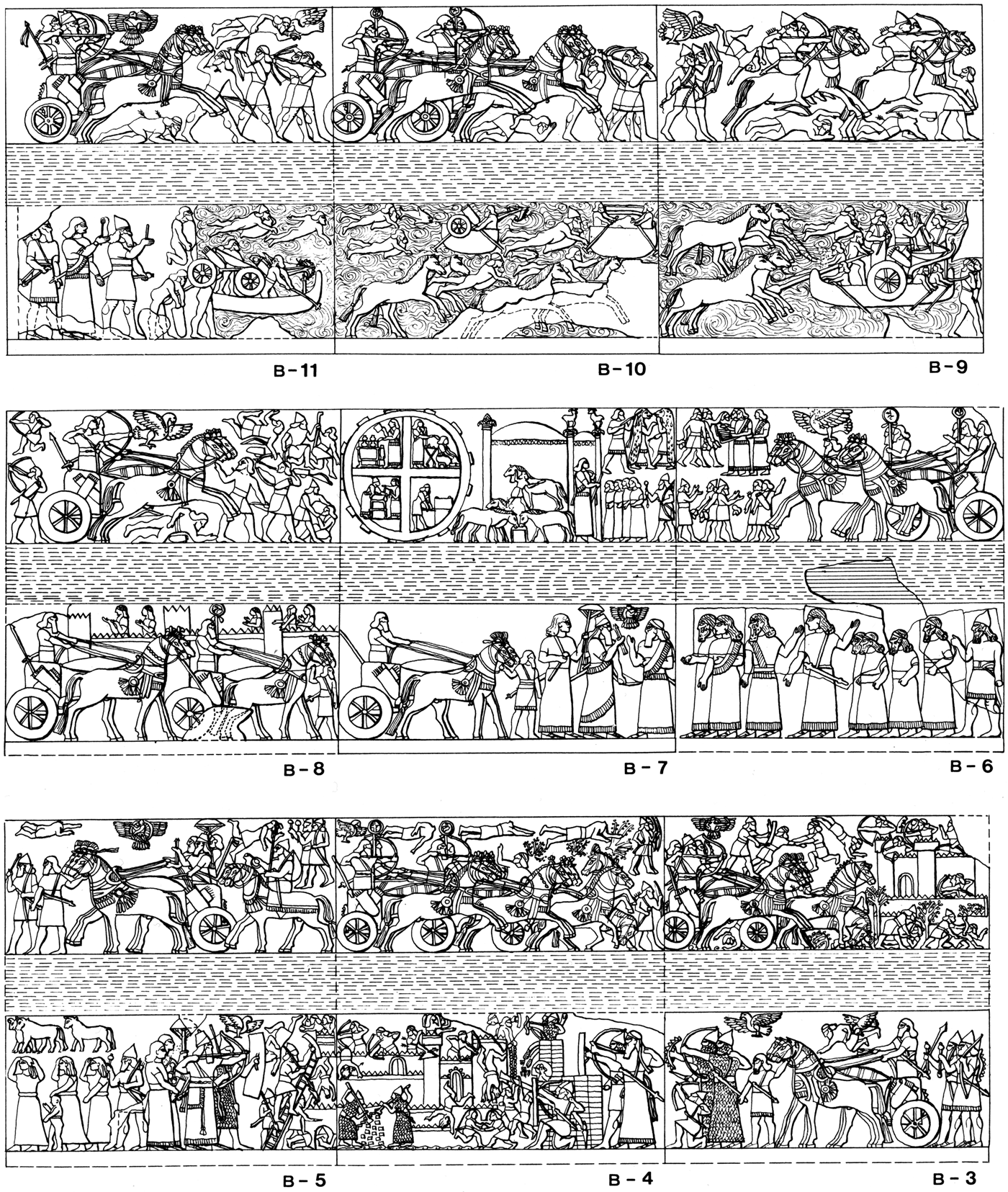
Da hier die Flußüberquerung so prominent ins Bild gebracht wurde, handelt es sich, wie schon Reade (Reference Reade1985: 212) vorgeschlagen hat,Footnote 51 am ehesten um den 7. Feldzug, bei dem Assurnaṣirpal nach einer Rebellion im Land Laqê, der Stadt Ḫindanu und im Land Sūḫu erstmals den Euphrat überschritten hat (Grayson Reference Grayson1991: RIMA 2 A.0.101.1 III 26‒50). In Sūru (Laqê/Bīt-Ḫalupê) baute er Schiffe, dann ging er weiter linkseuphratisch erobernd vor, auf der Höhe von Ḫaridu (Sūḫu) erfolgte die Euphratüberquerung, dann rechtseuphratisch die Eroberung der Städte von Ḫaridu bis Kipinu (Grenze Sūḫu zu Laqê). Einer der Rebellenführer, Azi-ili, ein LÚ.GAR (šaknu) von Laqê, entzieht sich Assurnaṣirpal endgültig durch Flucht.Footnote 52 Ilâ, ein na-si-ku (Scheich) von Laqê, wird nach Assyrien gebracht. Assurnaṣirpal macht reiche Beute und empfängt auch Tribut. Der Rebell Ḫemti-ili bleibt auf seinem Thron. Danach jagt Assurnaṣirpal Stiere und Strauße am Euphrat.Footnote 53 So weit die Annalen.
Auf den Reliefs wird neben den Kampfhandlungen und der Euphratüberquerung als Folge des Kampfes in der Mitte oben (B 7‒5) die Rückkehr ins Lager mit speziellen Gefangenen und den Siegesritualen wiedergegeben, unten hingegen der Herrscher, wie er die Gefangenen empfängt, die mitsamt Vieh aus der eroberten Stadt kommen.Footnote 54 Da im Bericht des 7. Feldzugs die Stadteroberungen nicht einzeln aufgeführt werden, sondern nur als Städte von Laqê und Sūḫu bis hin zu Kipinu erwähnt sind, sollten entgegen Reade (Reference Reade1985: 212) die beiden am Wasser liegenden eroberten Städte auch nicht benannt werden.Footnote 55
Die feindlichen Soldaten, im Bodenkampf und auf den Zinnen als Verteidiger, unterscheiden sich von den assyrischen nur durch die Kopfbedeckung: die Assyrer mit Helm, die Feinde mit dem Haarband. Sie tragen alle die gleiche Bewaffnung, auch die Bärte sind bei den assyrischen Soldaten und den Feinden teils lang und gerade abschließend, teils kürzer und spitz zulaufend (Abb. 13). Bei der Flußüberquerung sind einige Schwimmer und einer der beiden Männer, die das Boot des Herrschers an Land ziehen, deutlich mit Haarbändern gekennzeichnet (Abb. 14), es handelt sich wohl um Einwohner dieser Gegend, die sich mit Schiffen, dem Navigieren und Überqueren des Flusses auskannten, also am ehesten um Bewohner von Laqê.
Thronraum, Nordwest-Palast, Relief B 3 oben (Budge Reference Budge1914: Taf. 18 oben)

Thronraum, Nordwest-Palast, Relief B 10 unten (Budge Reference Budge1914: Taf. 21 unten)

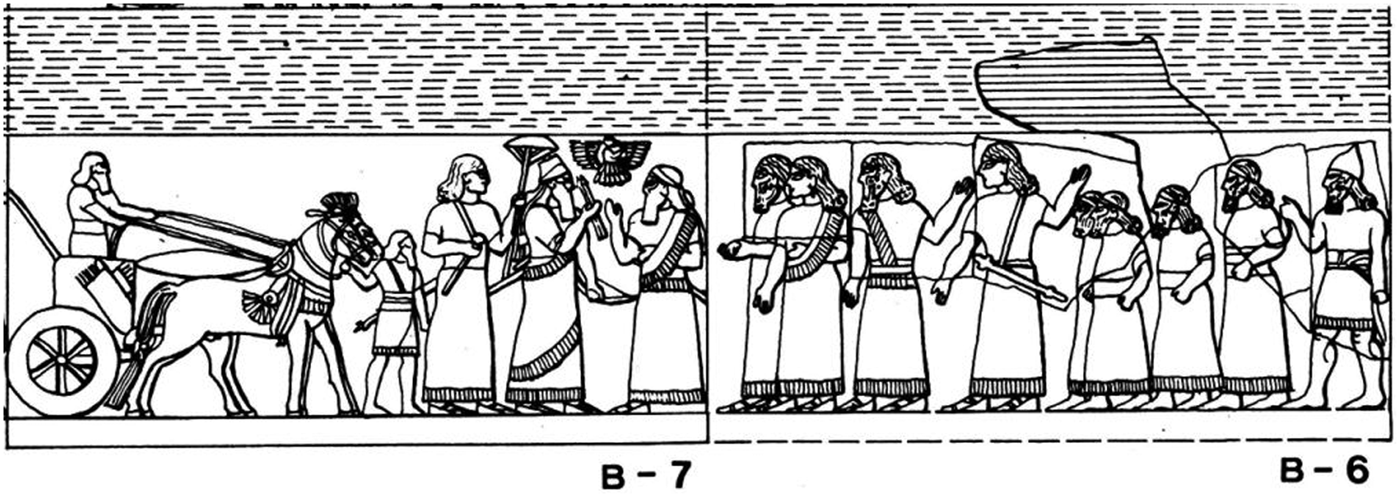
Zwei Mal werden in diesen Sequenzen vornehme Gefangene vorgeführt, die nicht in der kurzen Kriegstracht der Kämpfer der Schlachtszenen erscheinen, sondern im langen Hemd: Die Gefangenen auf B 6 unten sind leider nur fragmentarisch erhalten, die Rekonstruktion mit zwei Einführenden hintereinander ist problematisch. Von keinem der Gefangenen ist der Unterkörper erhalten. Die Köpfe zeigen alle den langen Bart und das Haarband (Abb. 15).Footnote 56
Thronraum, Nordwest-Palast, Reliefs B 7–6 (Meuszińsky Reference Meuszyński1981: Taf. 2,3)

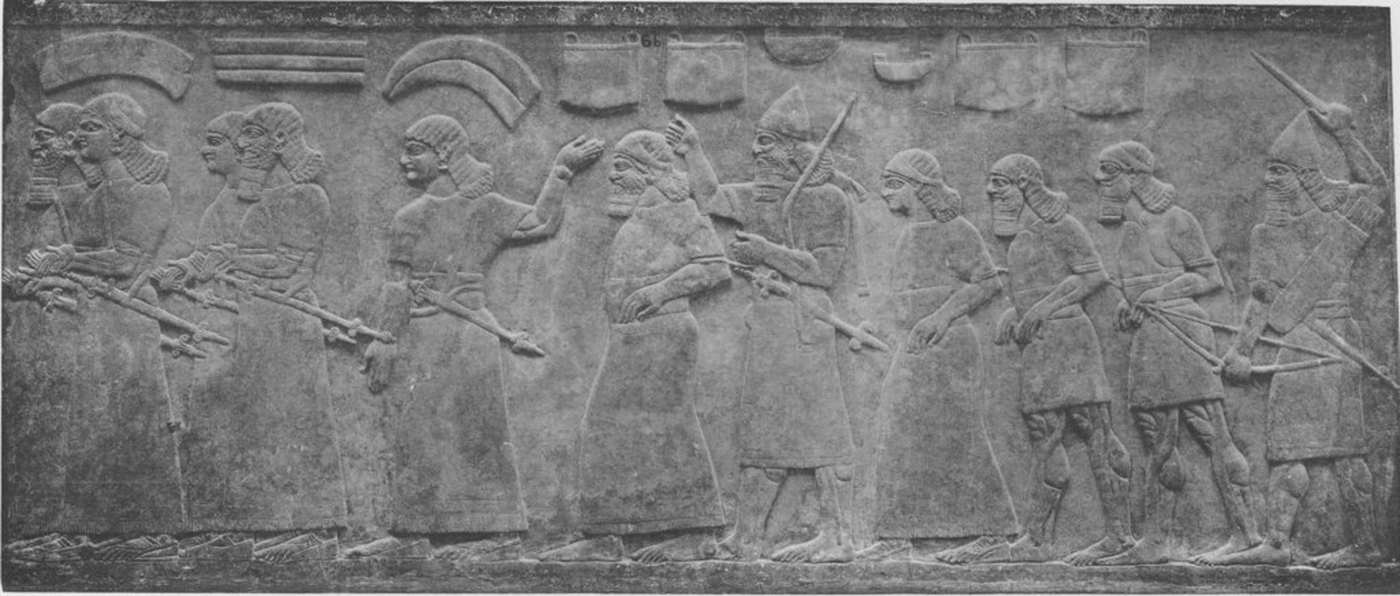
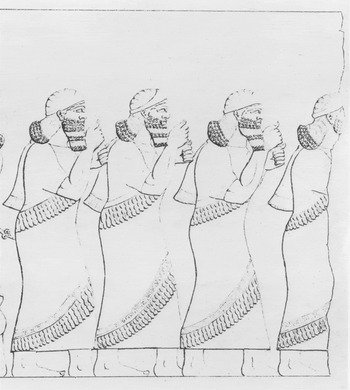
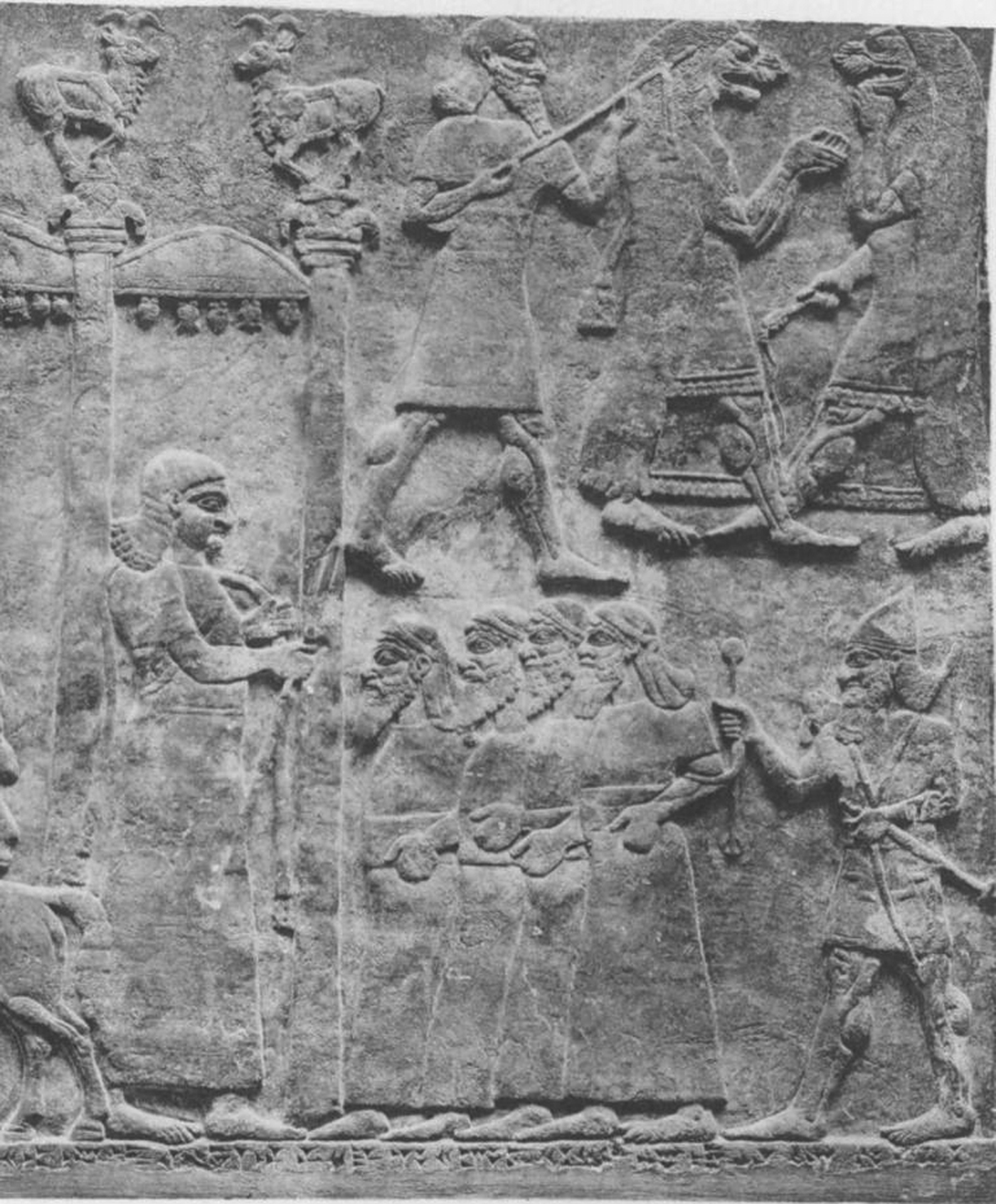
Auf B 7‒6 oben ist die triumphale Rückkehr des Herrschers dargestellt, dem hier die Gefangenen vorausgehen (Abb. 16), über denen sich die Szene eines Rituals mit Musik und Tanz(?) abspielt. Die ausgewählten vier Gefangenen mit dem für die Region üblichen Haarband stehen gestaffelt nebeneinander: Die mittleren tragen spitze Bärte, die äußeren lange; im Gegensatz zu der in Kombination mit dem Haarband üblichen Frisur mit lockigem Haarbausch im Nacken sind bei diesen Gefangenen die in den Nacken fallenden Haare in einige dicke Locken gebündelt. Diese Abweichungen von der sonst bei vornehmen Assyrern und deren Nachbarn üblichen Haar- und Barttracht sind bei diesen vier Gefangenen so deutlich herausgearbeitet, dass sie sicherlich beabsichtigt waren. Bei der Schwimmerszene diente die Barttracht zur Unterscheidung des Herrschers, seines ša rē ši und des dritten Schwimmers, eventuell ein lokaler Anführer. Bei diesen vier vornehmen Gefangenen weisen die auffallenden Bärte und merkwürdigen Nackenlocken noch deutlicher auf lokale Vornehme (Scheichs/nasīkāni),Footnote 57 die nicht der babylonischen oder assyrischen Haarmode folgten.Footnote 58 Hier könnten die vier als Stellvertreter für die Gefangenen dieser Kampagne gegen Sūḫu, Laqê und ḪindanuFootnote 59 stehen, die außerordentlich zahlreich waren. Namentlich genannt wird Ilâ, der „Scheich“ (nasīku) von Laqê, der nach Assur verbracht wurde.Footnote 60
Thronraum, Nordwest-Palast, Relief B 7 oben (Budge Reference Budge1914: Taf. 16 oben, Ausschnitt)
Auf diesen Thronsaalreliefs werden landschaftliche Elemente zur Kenntlichmachung der geographischen Lage der Kriegsszenen eingesetzt.Footnote 61 Besonders deutlich ist dies bei der Schwimmerszene gelungen, da die Zufluchtsstadt ja wirklich im Wasser liegt und durch Schwimmen erreicht werden muß, die Vegetation auf eine südliche Gegend hinweist (Abb. 9). Die ausführliche Darstellung der Flußüberquerung hingegen ist nur über die Annalentexte einzuordnen, die eindeutig auf den Euphrat hinweisen, weitere identifizierende landschaftliche Elemente fehlen; ebenso bei der dazugehörigen eroberten Stadt im unteren Register, bei der nur das Wasser auf die Euphratregion verweist und das Beutevieh auf eine landwirtschaftlich genutzte Gegend. Die Stadtbelagerung darüber (B 4‒3) findet in einer Gegend mit Sträuchern statt, wiederum an einem Fluß (Abb. 13).Footnote 62 Das Flußmotiv zieht sich so über fast alle hier besprochenen Reliefs hin.
Auf der Nordseite des Thronsaal haben sich nur zwei Reliefs erhalten (B 28‒27 unten), beide mit Fremden mit Turban im Kampf um eine am Wasser gelegene Stadt.Footnote 63
Nordwest-Palast, West Wing
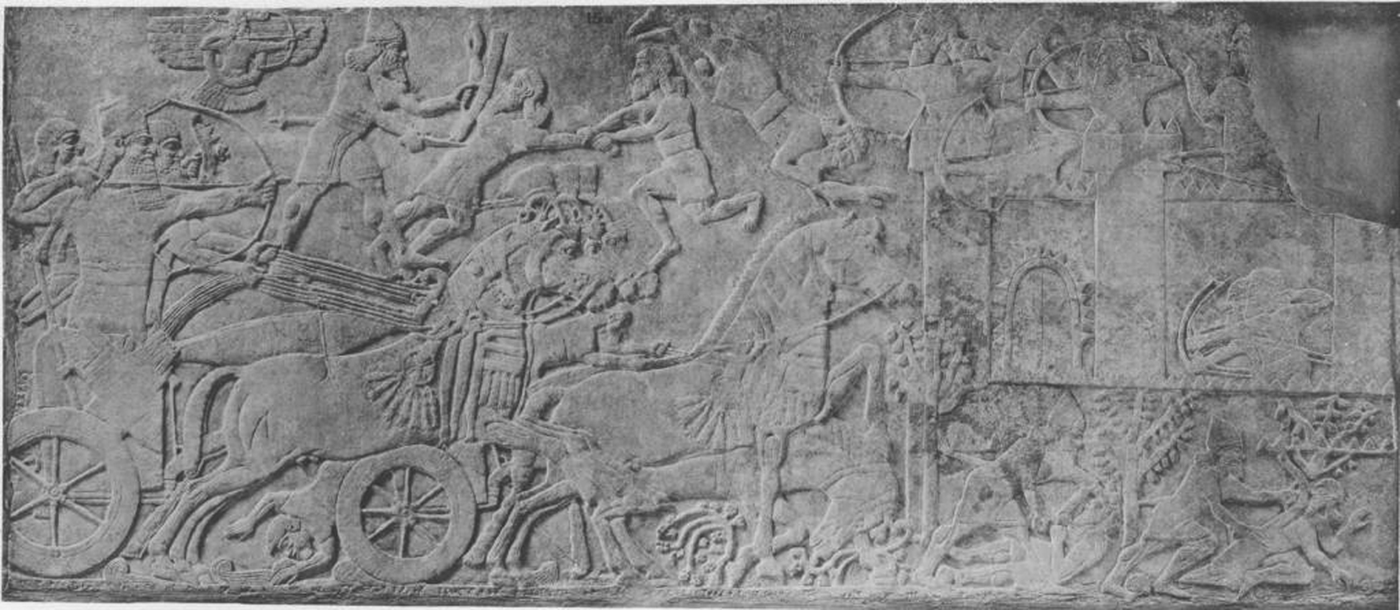
Auch bei den Reliefs aus dem West Wing des Nordwest-Palastes (Paley/Sobolewski Reference Paley and Sobolewski1987: Taf. 5) spielen die Feinde mit Haarband ein prominente Rolle; WFL 20 und 21 oben: assyrische Streitwagen fahren über die gefallenen Feinde hinweg; WFL 20 und 21 (Abb. 17) unten: Belagerung einer Stadt, die von Haarbandträgern verteidigt wird und aus der ‚Vornehme‘ mit Haarband im Mantel Variante c herausgeführt werden (ohne Sandalen, vgl. Anm. 67); dazu gehören wohl auch WFL 18 und 22 unten. Turbanträger im üblichen langen Mantel erscheinen auf WFL 27 als Tributbringer.
WFL 21, Nordwestpalast (Barnett/Falkner Reference Barnett and Falkner1962: Taf. 124)
Thronraumfassade des Nordwest-Palastes
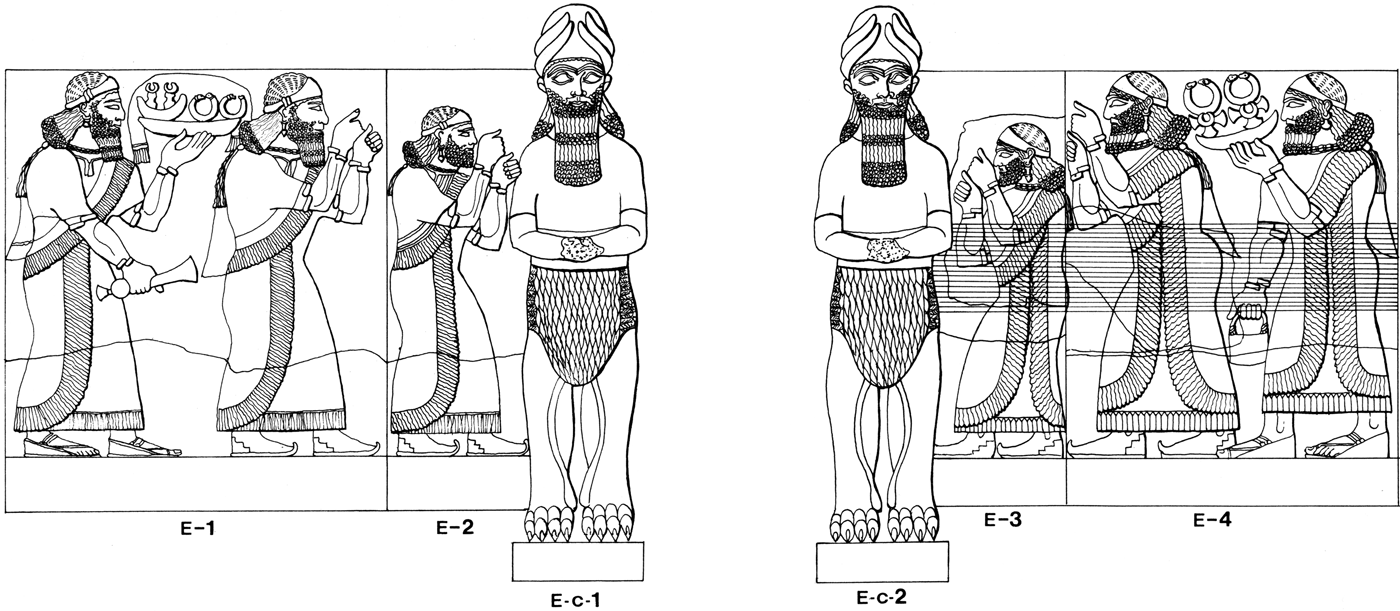
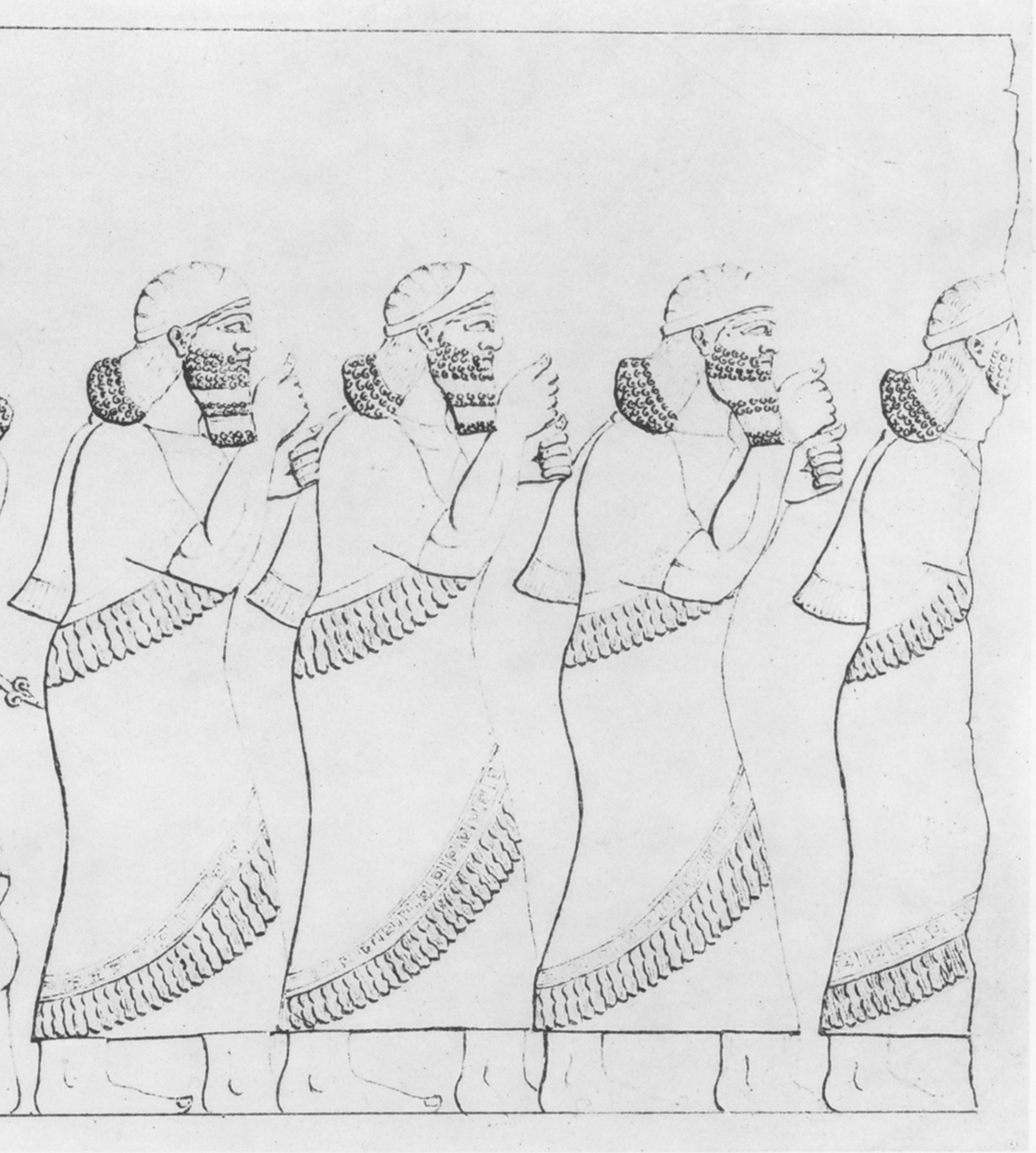
An der Thronraumfassade Abschnitte D und E sind unterschiedliche Delegationen dargestellt.Footnote 64 Rechts und links des Durchgangs c (Abb. 18) sind es jeweils drei Männer; eine Zuordnung dieser Figuren zu bestimmten Ländern ist schwierig. Es sind zwar von allen Männern die Füße mit der unteren Partie des Gewandes erhalten, jedoch nur einer der Köpfe mit Oberkörper (E 3)Footnote 65 und ein weiteres Oberkörperfragment (E 4). Der Kopf zeigt die übliche Frisur mit vorne sich verbreiterndem Haarband, das Gewand ist jeweils das Hemd mit langem Mantel, beim Profil nach rechts als Variante b. Es handelt sich jeweils um zwei Schnabelschuhträger, gefolgt von einem Sandalenträger, wobei die Sandalenträger von Layard als Gabenbringer gezeichnet wurden, die Schnabelschuhträger als Anführer mit erhobenen Händen, von denen der vordere mit kürzerem Bart jeweils kleiner ist (vgl. Anm. 25). Die Gabenbringer müßten demnach zu einer anderen ‚Gruppe‘ gehören als die Anführer.
Thronraumfassade E 1–4, Nordwest-Palast (Meuszińsky Reference Meuszyński1981: Taf. 6)

Die Tracht der beiden Anführer ‒ Haarband, Mantel und Schnabelschuhe ‒ ist sehr selten belegt, die Schnabelschuhe deuten auf westliche und nordwestliche Nachbarn.Footnote 66 Sandalenträger im langen Mantel sind die Tributbringer auf dem Rassam-Obelisken (s.u.), zur Zeit des Salmanassar sind es lediglich die Chaldäer der dritten Delegation auf dem Thronpodest.Footnote 67
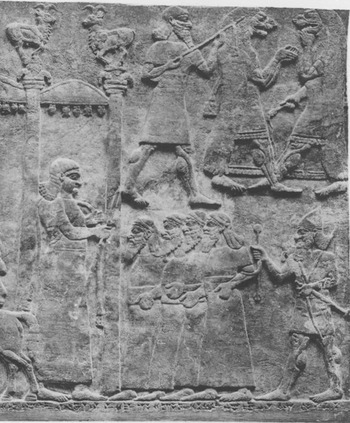
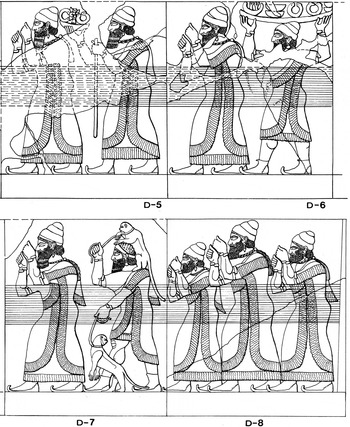
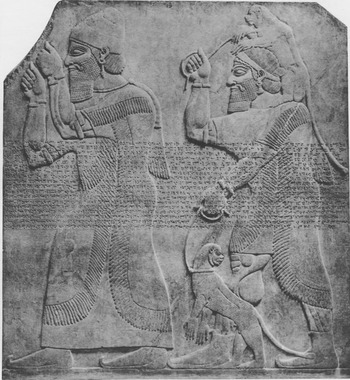
Einheitlicher ist der Zug an Eingang d (Abb. 19); auf den jenseits des Eingangs stehenden Herrscher bewegen sich neun Männer mit Turban, Mantel und Schnabelschuhen zu (nur der Affenführer mit Haarband). Auffallend ist, daß es sich offensichtlich um mehrere Delegationen handelt: 1. Platte (D 5), ein Anführer mit erhobenen Händen, gefolgt von einem Stabträger mit Tablett; 2. Platte (D 6), ein Anführer mit erhobenen Händen, gefolgt von einem Tablettträger im kurzen Mantel; 3. Platte (D 7), ein Anführer mit erhobenen Händen, gefolgt von einem Affenführer mit Haarband und kürzerem Bart (Abb. 20);Footnote 68 4. Platte (D 8), drei Anführer mit erhobenen Händen, der vorderste klein, aber bärtig, der mittlere sehr groß mit längerem Bart, der dritte etwas kleiner, es folgt kein Tributbringer.
Thronraumfassade D 4–8, Nordwest-Palast (Meuszińsky Reference Meuszyński1981: Taf. 5)
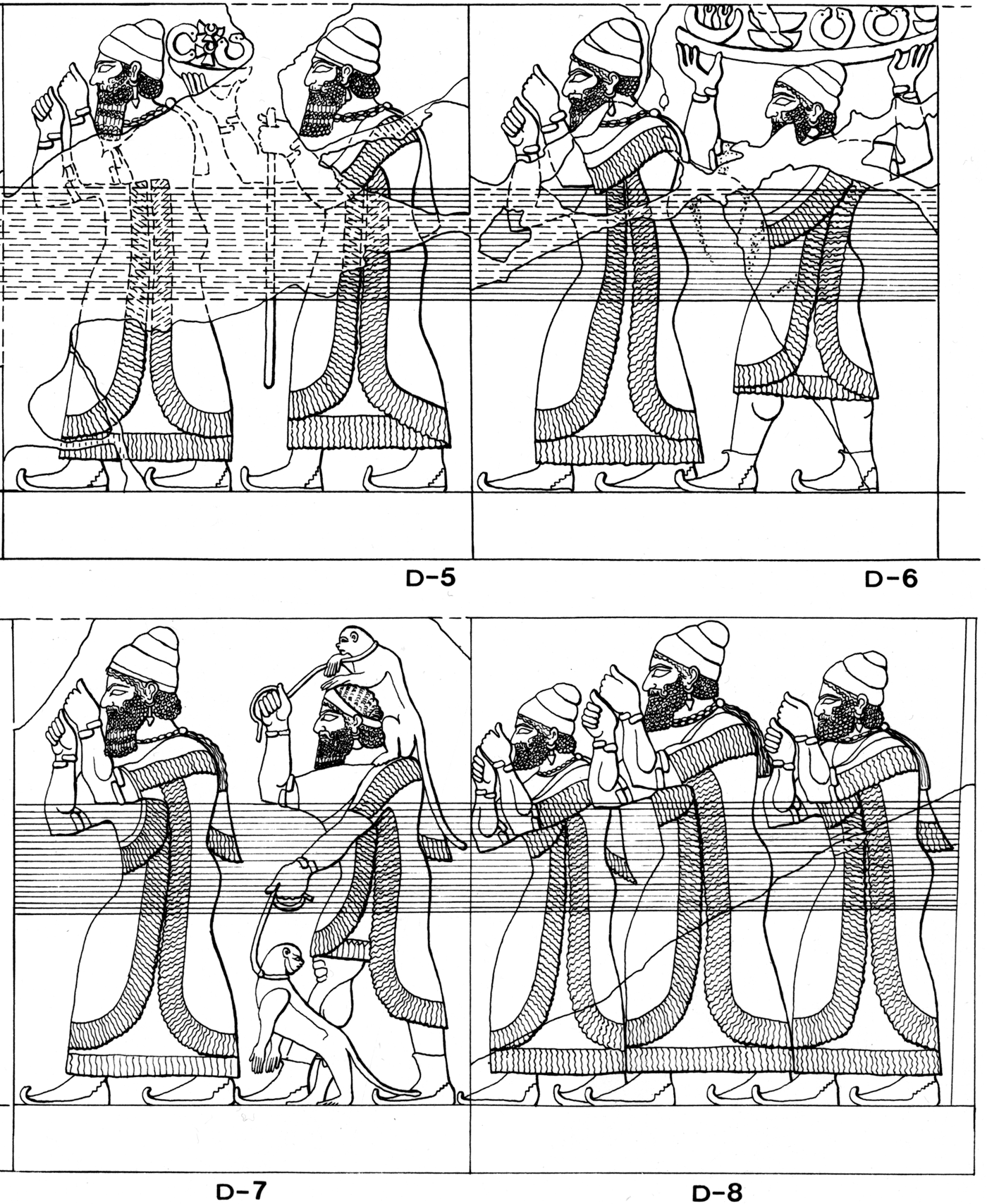
Thronraumfassade D 7, Nordwest-Palast (Budge Reference Budge1914: Taf. 28)
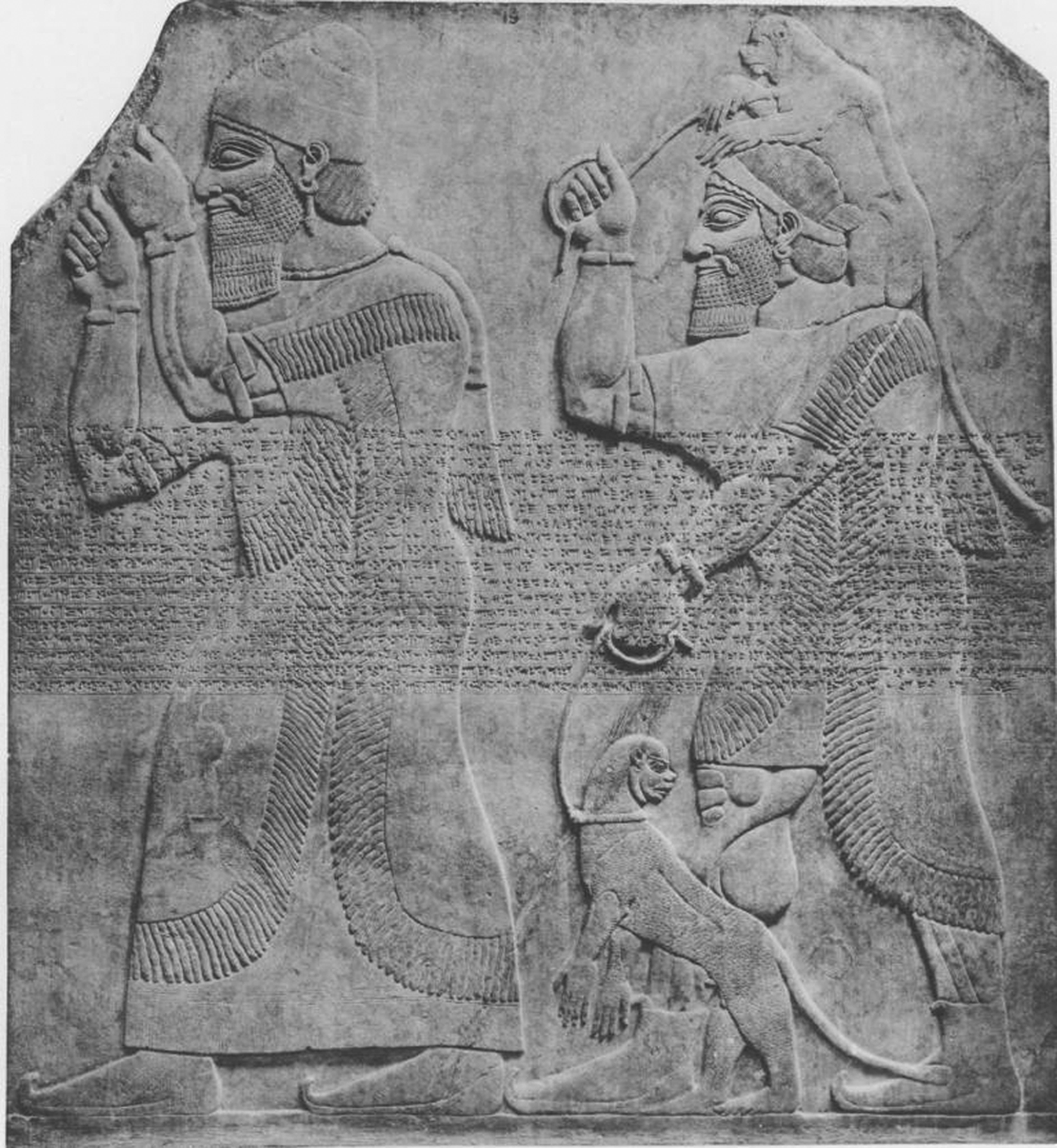
Sowohl bei E 1‒4 wie bei D 5‒8 überwiegen die Anführer. Dies verstärkt den Eindruck, daß es sich an der Fassade nicht um bestimmte historische Ereignisse handelt, sondern um ein ‚Bild‘ der unterschiedlichen fremden Bevölkerungsgruppen, die Assurnaṣirpal in seinem Machtbereich vereinte: am Eingang d um vier Delegationen aus dem Westen und am Eingang c um zwei weitere Delegationen, deren Herkunft unklar ist, deren Haarbandfrisur und die Sandalen der Gabenträger auf die nähere Umgebung Assyriens hindeuten, die Schnabelschuhe hingegen auf entferntere, keinesfalls südlichere Gegenden.
Die Qualität dieser Reliefs ist ganz hervorragend, vgl. z.B. die gut erhaltenen Köpfe der Platte D 8 und die naturnahe Darstellung der Affen. Die Details der Gewänder, die Kopfbedeckungen und das Schuhwerk sind daher sicherlich als Erkennungsmerkmale ernst zu nehmen, auch wenn wir sie bisher noch nicht korrekt lesen können.
Rassam-Obelisk
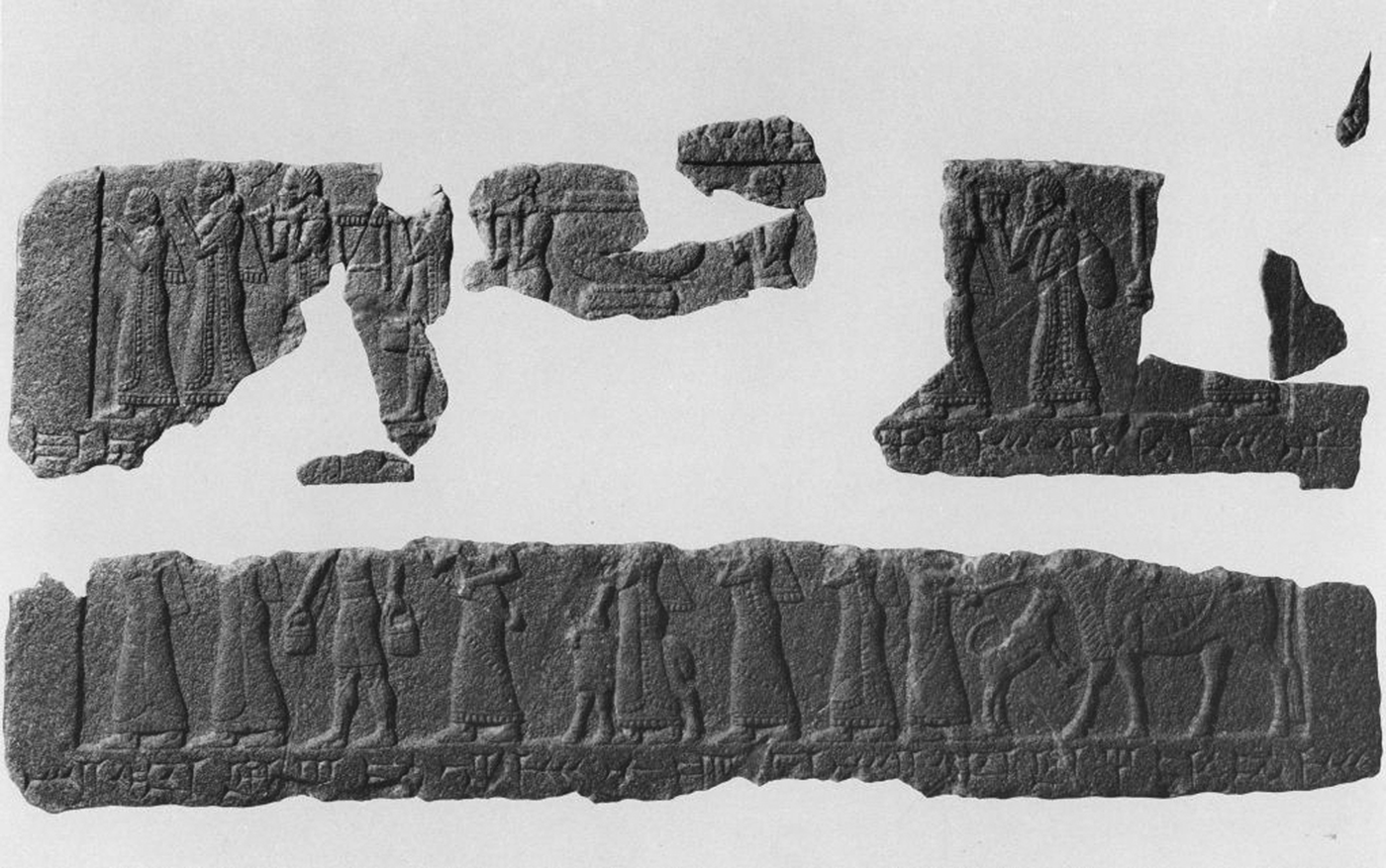
Auf Grund der Inschrift wird dieser von Reade aus vielen Bruchstücken rekonstruierte Obelisk Assurnaṣirpal zugeschrieben. Er zeigt ausschließlich Tributszenen, die jedoch nicht mit den Textpassagen korreliert werden können.Footnote 69
Die Tributbringer tragen ‒ mit einer Ausnahme ‒ das HaarbandFootnote 70 und meist den langen Mantel,Footnote 71 bei dem der über die linke Schulter geworfene Gewandzipfel sehr deutlich dargestellt ist;Footnote 72 sie tragen eindeutig keine Schnabelschuhe (Abb. 21).
Rassam-Obelisk (Börker-Klähn Reference Börker-Klähn1982: Abb. 138 f)

Diese Kombination findet sich bei Assurnaṣirpal zwar selten, ist aber auf der Thronraumfassade E und WFL 21 (Abb. 17. 18) ebenfalls bei Tributbringern belegt.Footnote 73 Daß auf den Balawat-Toren des Assurnaṣirpal unter den zahlreichen Tributbringern keine Haarbandträger im Mantel erscheinen (s.u.), ist bemerkenswert. Da sowohl auf dem älteren Broken Obelisk, eventuell auch auf älteren Obeliskenfragmenten aus Assur (Orlamünde Reference Orlamünde2011: Taf 18. 50), wie auch später vereinzelt bei Salmanassar (vgl. Anm. 37) diese Tracht durchaus belegt ist, muß den Handwerkern des Assurnaṣirpal diese Trachtvariante vertraut gewesen sein; auch auf Elfenbeinen erscheint sie (jedoch jeweils mit Schnabelschuhen kombiniert) als Unterscheidungsmerkmal gegenüber den Turbanträgern (vgl. Anm. 32).
Nimmt man die Darstellungsweise auf den Balawat-Toren ernst, muß es sich um Tributbringer handeln, die auf diesen Toren keine Rolle spielten.Footnote 74 Die Unsicherheit bei der Tracht der Leute von Unqi (vgl. Anm. 30, wie sie bei Salmanassar zu beobachten ist, könnte allerdings auch bei Assurnaṣirpal vorgeherrscht haben, für eine Gegend, in der Leute mit Turban und Mantel, mit Haarband und Mantel, Sandalenträger und Schnabelschuhträger eng benachbart waren (zur ähnlichen Problematik bei der Tracht von Karkemiš vgl. Anm. 88).
Balawat-Tore des Assurnaṣirpal
Auf den Bändern des Palast-Tores (Barnett u.a. Reference Barnett, Curtis, Davies, Howard, Walker, Curtis and Tallis2008) lassen sich folgende Themen unterscheiden: 1. Jagd gegen Löwen (Baliḫ) und Stiere (Euphrat), jeweils auf den beiden Mittelstreifen; 2. Kampf zu beiden Seiten einer sich ergebenden Stadt, ebenfalls weitgehend symmetrisch angeordnet (L2. 3. 7; R2. 3. 7 Tribut); 3. ebenfalls symmetrisch verteilt der ‚Triumphzug‘ des Herrschers mit Musikkapelle und Gefangenen, der sich auf eine Stadt zubewegt (L8; R8); 4. Vorführung von Tributbringern vor den König unter Sonnenschirm;Footnote 75 5. Vorführung von Gefangenen vor den König unter Baldachin (L6; R1).
Auf dem Tempel-Tor fehlen die Gefangenenzüge; die wenigen Kampfszenen sind symmetrisch angeordnet (L2. 7; R2. 7). Auf allen anderen Bändern (Ausnahme R5) stehen sich Tributszenen gegenüber. Dabei sind die außergewöhnlichen phönikischen Tribute L4. 5 und R4 mit der Angabe der Landschaft ‒ eine Stadt im Meer, zwei Boote setzen über ‒ in der Mitte angeordnet, vergleichbar der Jagd in der Landschaft auf dem Palast-Tor.
Städte (s. dazu auch Teil 2)
Bei einer Musterung der Stadtdarstellungen auf den Toren des Assurnaṣirpal muß man feststellen, daß alle Städte weitgehend einheitlich dargestellt sind, sowohl die, die erobert werden, wie die, aus denen Gefangene abtransportiert werden,Footnote 76 wie auch manche, vor denen Assurnaṣirpal den Tribut entgegennimmt.Footnote 77 Nur wenige bedeutende Städte werden durch Besonderheiten hervorgehoben.
Fremde Städte erscheinen in den Kampfszenen meist auf etwas höheren Hügeln und sind entsprechend kleiner dargestellt,Footnote 78 mit Ausnahme von Ulluba,Footnote 79 einer offensichtlich wichtigen, wenn auch sonst unbekannten Stadt des Sangara von Ḫatti auf Palast-Tor L3, die größer mit drei Türmen charakterisiert ist.
Während bei den Kampfszenen das Bild die umkämpfte Stadt nicht erkennbar macht, ist bei einigen Herkunftsorten der Tributzüge jedoch eine Charakterisierung beabsichtigt: So die phönikischen Städte, die zwar in ihrer einfachen Anlage sich nicht von den anderen unterscheiden, jedoch mitten im Meer liegen, dadurch klar erkennbar sind und keine Beischrift benötigen (Temepeltor L4. 5. R4).
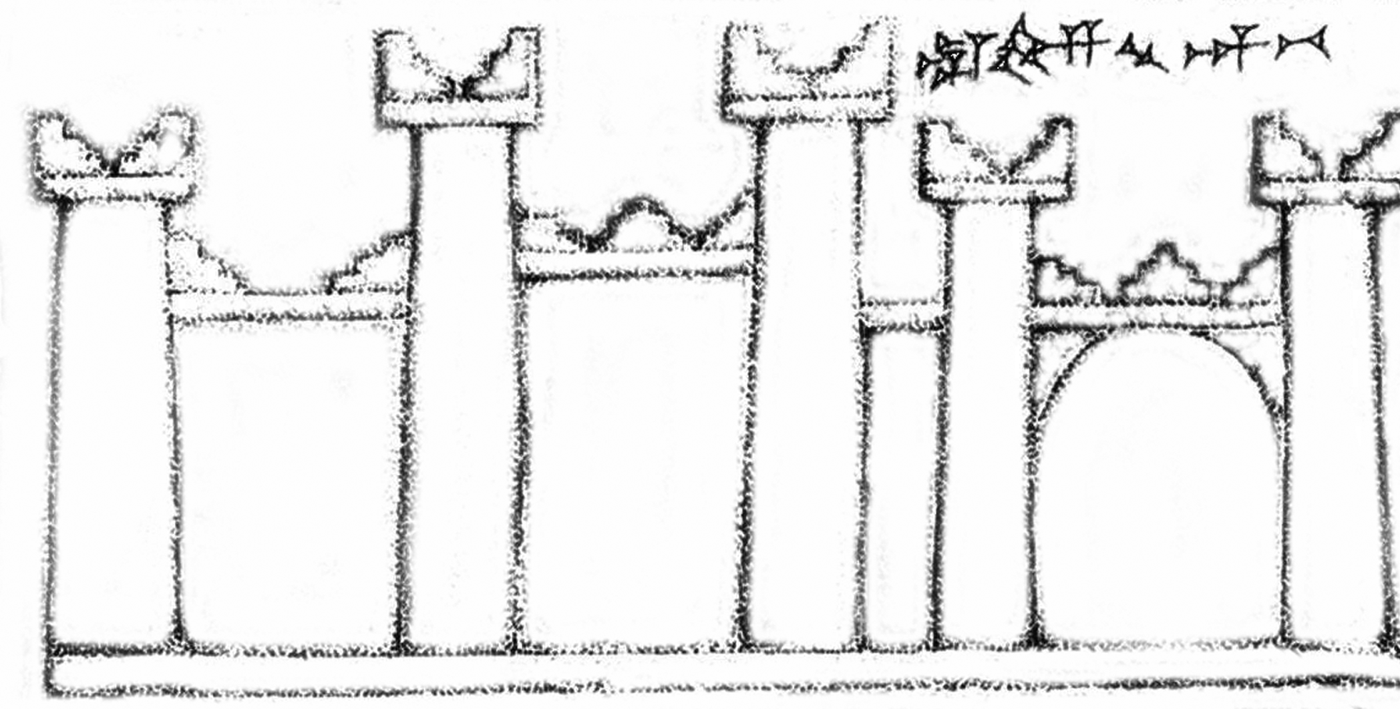
Bei den Städten, vor denen Assurnaṣirpal den Tribut empfängt, handelt es sich jedoch stets um größere mehrtürmige Anlagen. Teilweise deutlich an einem Fluß gelegen, stehen sie meist auf einer sehr niedrigen Erhöhung.Footnote 80 Daß es sich bei diesen Städten durchaus auch um assyrische handelt (Bär Reference Bär1996: 11‒16), geht aus der Beischrift zur Stadtdarstellung von Balawat auf Tempel-Tor R1 (Abb. 22a) hervor: URU im-gur-dEN.LÍL ma-da-tu ša ku-dur-ri ša KUR su-ḫi.
Balawat, Tempeltor des Assurnaṣirpal, R 1 (Ausschnitt)

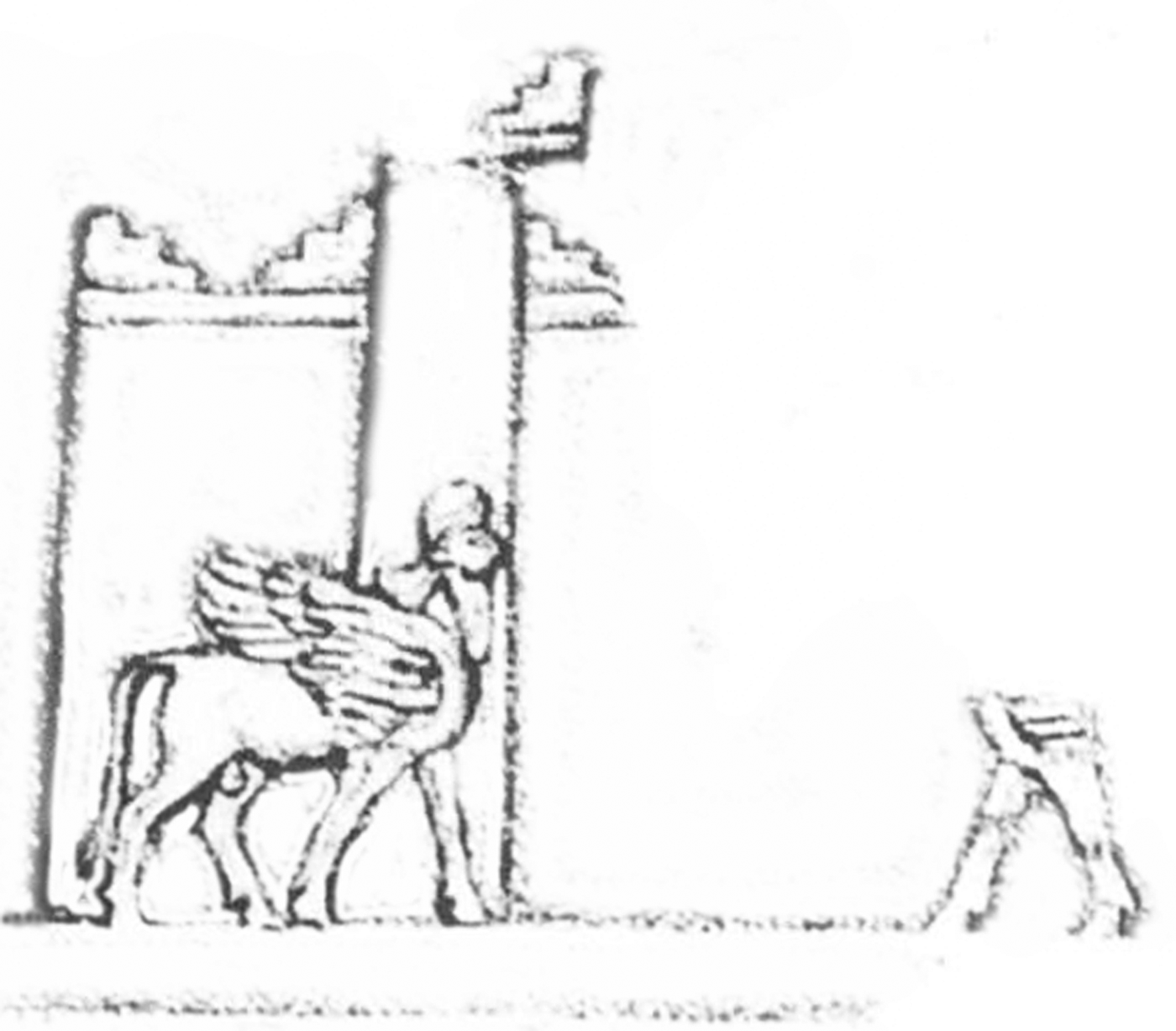
Balawat, Tempeltor des Assurnaṣirpal, L 6 (Ausschnitt)
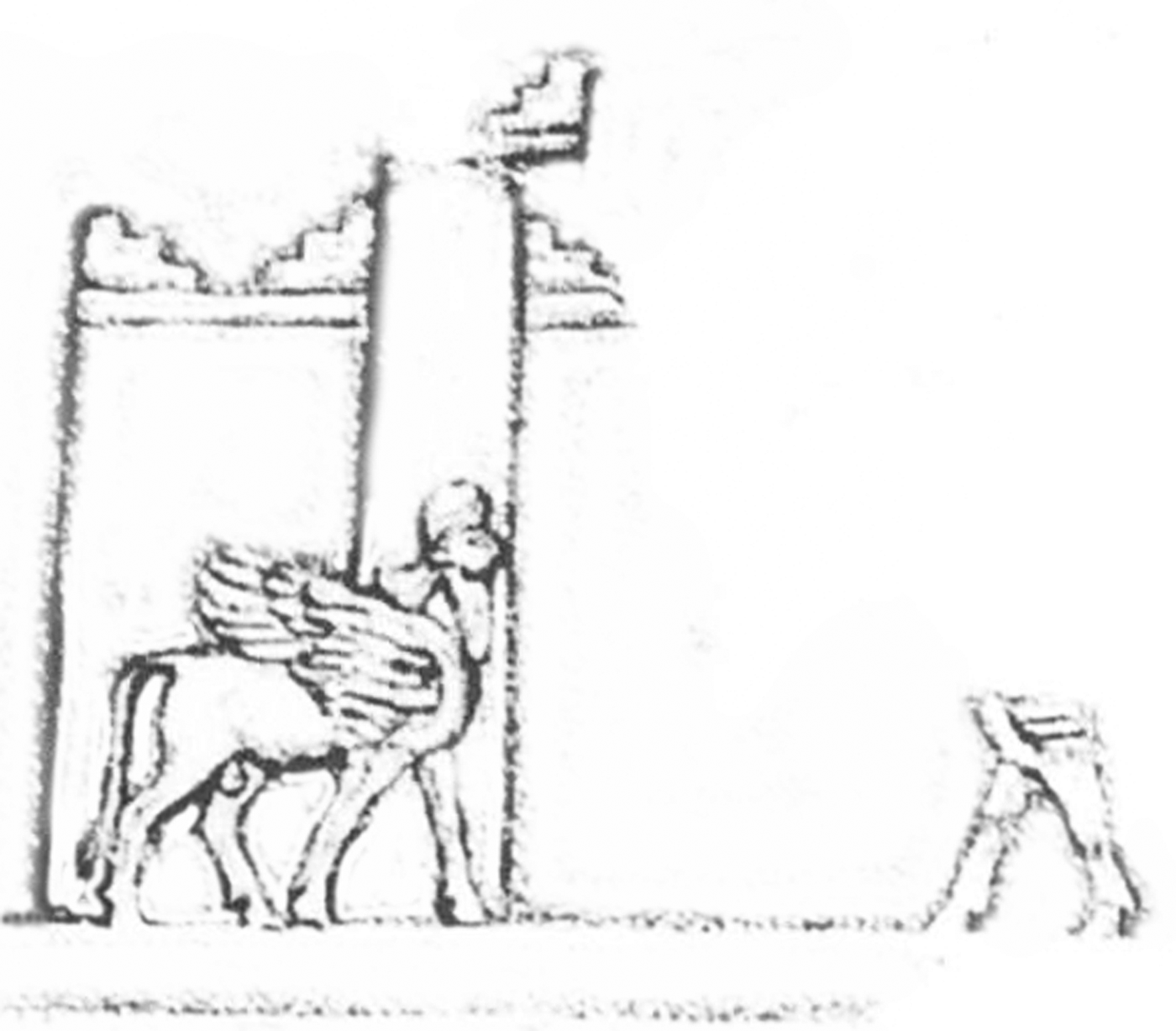
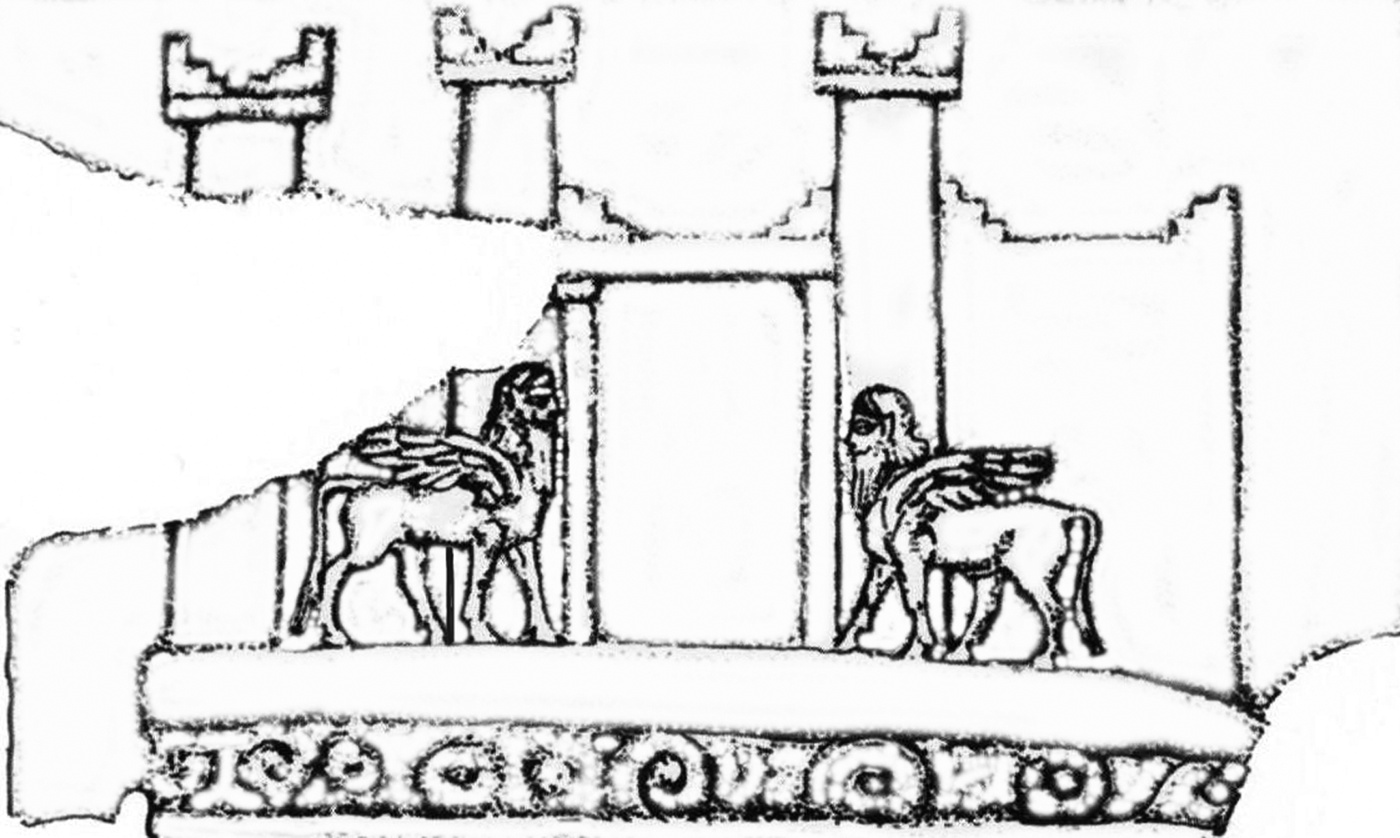
Balawat, Tempeltor des Assurnaṣirpal, R 6 (Ausschnitt)

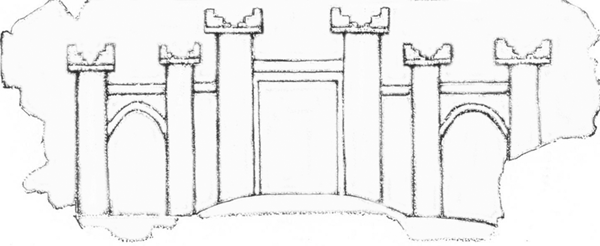
Balawat, Tempeltor des Assurnaṣirpal, R 3 (Ausschnitt)

Um Residenzstädte wird es sich wohl auch bei Tempel-Tor L6 und R6 (Abb. 22b.c) handeln, da im Unterschied zu allen anderen Städten ihre Tore mit Laibungstieren versehen sind. Daß eine Stadt/ein Palast durch Lamassu charakterisiert wird, ist ungewöhnlich. Diese Besonderheit und die Lage der Stadt/des Palastes an einem deutlich hervorgehobenen Fluß sollten beim Betrachter sicherlich die Assoziation mit einer der wichtigsten Residenzen hervorrufen. Da das Tempel-Tor sicherlich erst nach der 9. Kampagne (Mittelmeerkampagne, 875–867?) angefertigt wurde (zur Datierung der Tore vgl. Teil 2), war zu dieser Zeit der Palastbau in Nimrud schon weit fortgeschritten.Footnote 81 Sicherlich war damals allgemein bekannt, daß Nimrud mit seinem neuen Palast zur prächtigsten Residenz des assyrischen Reiches ausgebaut wurde; der Anfertigung der Laibungstiere kam dabei auf Grund ihrer kolossalen Erscheinung und des aufwendigen Transports eine hervorragende Rolle zu. Wenn nun eine assyrische Stadt im Unterschied zu allen anderen mit Laibungstieren charakterisiert wurde, verbanden die damaligen Betrachter diese Darstellung wohl am ehesten mit Nimrud, eine Beischrift war dann nicht nötig.Footnote 82
Auf Tempel-Tor R3 (Abb. 22d) ist nur noch Sūḫu zu lesen. Es handelt sich um die aufwendigste Stadtdarstellung, jedoch ohne Lamassu; der Mittelteil der Stadtanlage mit den erhöhten Türmen erhebt sich auf einem separaten Hügel, ebenso der rechte Anbau, während der linke auf ebenem Untergrund steht. Ob damit angedeutet werden soll, daß diese Stadt auf hügeligem Gelände liegt? Jedenfalls ist mit dieser aufwendigen Stadtanlage sicher eine bestimmte Residenzstadt gemeint; bei einem Tribut aus Sūḫu wohl am ehesten eine in Assyrien selbst, eventuell das hochgelegene Assur? Vergleichbare Darstellungen fehlen bei Salmanassar, da sich bei ihm alles Geschehen während der Feldzüge außerhalb Assyriens abspielt.
Darstellungsweise der Nichtassyrer
Teilweise entsprechen die Darstellungen der Nicht-Assyrer auf den Toren des Assurnaṣirpal denen bei Salmanassar, wie Wäfler sie Reference Wäfler1975 typologisiert hat und wie sie teilweise auch auf den erhaltenen Reliefs des Nordwest-Palastes dargestellt sind.
1. Nackte behelmte Bergvölker.Footnote 83 ‒ 2. Männer mit Turbanen, entweder im langen Mantel mit SchnabelschuhenFootnote 84 oder als Kämpfer im kurzen Rock oder als nackte Gefangene. ‒ 3. Männer mit ‚assyrischer‘ Haartracht, ohne Kopfbedeckung, wahrscheinlich mit Haarband bei unterschiedlich langen Bärten. Diese Haar- und Barttracht ist auf diesen Bronzebänder meist nicht genauer zu erkennen, ein Vergleich mit den differenzierten Darstellungen der Reliefs ist daher nicht möglich. In Tributszenen tragen sie nie den langen Mantel, sondern das lange Hemd,Footnote 85 einfachere Lastenträger auch den kurzen Rock,Footnote 86 wie auch die Soldaten in Kampfszenen.Footnote 87 Gefangene dieses Typs sind nicht dargestellt.
Fünf Mal ist auf dem Palast-Tor Ḫatti erwähnt, dargestellt sind Kämpfer im kurzen Rock und Turban (L3. 6. 8; R1. 8). Auf dem Tempel-Tor L1 ist der Tribut von Karkemiš dargestellt mit Tributbringern im Hemd mit Haarband; beide Toponyme scheinen nach den Annalen austauschbar,Footnote 88 so daß unerklärlich bleibt, warum auf Tempel-Tor L1 die Tributbringer von Karkemiš nicht mit Turban und Mantel dargestellt sind wie die Leute aus Ḫatti, sondern mit Haarband und Hemd wie die benachbarten Leute aus Bīt-Adini.
Schlussbemerkungen
Wenn Reade (Reference Reade1979: 31) davon ausgeht, daß die Erkennbarkeit des Dargestellten gewährleistet sein muß, stellt sich natürlich zunächst die Frage für wen. Sehr überzeugend haben sowohl erFootnote 89 und nochmals eingehend CifarelliFootnote 90 ausgeführt, daß die Dekoration neuassyrischer Paläste in erster Linie auf die Bewohner dieser Paläste ausgerichtet war, nicht etwa auf fremde Besucher, wie oft angenommen wurde.Footnote 91 Für die Charakterisierung der Nachbarn der Assyrer war also entscheidend, daß die mit dem Hof vertrauten Assyrer sie erkannten.
Die Lesbarkeit des Ablaufs der Szenen war Voraussetzung: Auf den Bronze-Toren des Assurnaṣirpal erscheint der Herrscher in jedem Band ein Mal; es handelt sich um eine Abfolge, die bei Tribut- und Gefangenenzügen von einem Ende zum anderen verläuft, oder bei den Kampfszenen sich um einen Mittelpunkt gruppiert; auf dem Tor des Salmanassar werden Kampf- und Gefangenen- oder Tributszenen auch in einem Band kombiniert. Die Lesbarkeit des Geschehens auf diesen Bändern war somit gewährleistet, ebenso wie auf der Thronbasis und manchen Obelisken mit umlaufenden Friesen. Bei den Orthostaten des Assurnaṣirpal ist die ‚Kampagne‘ meist in Einzelsequenzen aufgeteilt, die dann jedoch zu einem Tableau zusammengefaßt sind, so daß der Betrachter mehr gefordert ist, um den Ablauf oder auch die Zusammenhänge der Szenen zu erfassen. So ist die Mittelszene auf den Platten B 7 und 8 ‒ oben der Einzug des Herrschers ins Lager und darunter die Vorführung der Gefangenen ‒ als Ziel- und Mittelpunkt mehrerer Szenen einer ausführlich dargestellten kriegerischen Unternehmung zu betrachten.Footnote 92
Zahlreiche erläuternde Beischriften machen deutlich, daß diesen Szenen bestimmte historische Ereignisse zu Grunde liegen, auch wenn es sich nicht um in unserem Sinne realistische Wiedergaben handelt (Reade Reference Reade1979a: 31f.), das Geschehen eventuell auch stark verändert wurde im Hinblick auf größere bildliche Wirkung. Daß die sich stets wiederholenden Tribut-, Gefangenen- und Kampfszenen nicht in allen Details als getreue Wiedergaben eines jeweils speziellen Ereignisses zu lesen sind, zeigt ihre Einförmigkeit, besonders bei den Tributzügen mit ihren wenig abwechslungsreichen Gaben. In Einzelfällen mag es sich auch exemplarisch um den Bildtypus ‚fremde Delegationen‘ ohne genauere Zuordnung zu einem speziellen Ereignis handeln, wie z.B. auf der Thronraumfassade (s.o).
Zahlreiche Details, die Menschen, Architektur und Landschaft charakterisieren, sind jedoch so sorgfältig ausgeführt, daß man sie als wichtige Indizien für die Erkennbarkeit des Dargestellten werten muß. Um diese Details und ihre Aussagekraft und damit um das Interesse an den ‚Fremden und ihrer Umwelt‘ ging es hier.
Viele der Städte, besonders die assyrischen, hat man so weit erkennbar gemacht, wie man das vermochte oder sie zumindest in einer Weise dargestellt, daß der Betrachter sie an Hand einzelner Merkmale identifizieren konnte. Wie oben erwähnt, sind es nicht realistische Wiedergaben der Architektur, sondern Unterschiede in deren Größe oder auch die Besonderheiten der Lage, wie Städte auf hohen oder niedrigen Hügeln, an Wasserläufen oder sogar mitten im Wasser gelegen oder auch die umgebende Vegetation.
Schon auf dem Weißen Obelisken ist der Palast des Herrschers von Bäumen und Wasser umgeben,Footnote 93 ebenso auf dem Rassam-Obelisken; auf dem Tempel-Tor fehlen zwar die Bäume um den Palast (L6. R6), das Wasser ist jedoch deutlich hervorgehoben. Von den Bäumen lassen sich auf Darstellungen des 9. Jh.s vor allem die Palmen erkennen, bei anderen ist für uns die Erkennbarkeit schwierig; wahrscheinlich waren die damaligen Betrachter jedoch mit der Darstellungskonvention der Vegetation vertraut. Auf den Jagdstreifen des Palast-Tores nehmen die Pflanzen einen besonders großen Raum ein und sollen die Flußlandschaft charakterisieren (Wicke Reference Wicke2013: 163). Schematischere Pflanzen finden sich schon auf dem Weißen Obelisken als Umfeld der Herdentiere und des Zeltes der Herdenbesitzer (Börker-Klähn Reference Börker-Klähn1982: 132c).
Sowohl Reade (Reference Reade1979b: 52‒57) wie auch CifarelliFootnote 94 sind auf die Tradition der Fremdendarstellungen, die sich bis in mittelassyrische Zeit zurückverfolgen läßt, eingegangen. Eine grobe Ordnung in westliche Nachbarn mit für Assyrer unüblichen Mänteln und Kopfbedeckungen und ‚nahe‘ Nachbarn mit Haarband, die sich kaum von den Assyrern unterscheiden, ist schon auf dem Broken Obelisk (vgl. Anm. 38) erkennbar; Bergvölker werden schon seit dem 3. Jt. durch besonderes Schuhwerk, auffallende Frisuren, teilweise auch Fellmäntel charakterisiert.Footnote 95
Meist wird das Interesse der Assyrer an den Nicht-Assyrern nicht allzu hoch eingeschätzt. Selbst Cifarelli (Reference Cifarelli1995: 276) unterstellt den Assyrern zur Zeit des Assurnaṣirpal “lack of curiosity about, and knowledge of, its neighbors”. Andererseits hat gerade sie mit ihrer sorgfältigen Analyse der “Cultural difference in visual and verbal expression of Assyrian ideology in the reign of Aššurnasirpal II” ‒ so der Titel ihrer Monographie ‒ ein sehr differenziertes Bild gezeichnet. In den Annalen findet sie Hinweise, daß die Beziehungen zwischen Assyrern und Nicht-Assyrern “more bilateral than might have been ideologically acceptable” waren (1995: 185). Cifarellis (Reference Cifarelli1995: 227f.) Vorstellungen zu Alterität, die eine Elimination des „Anderen“ fordert, und deren durch und durch negativen Aspekte durchziehen dennoch ihre Monographie von Anfang bis Ende. Schachner (Reference Schachner2007: 198f.) geht weniger voreingenommen dieser Frage nach und weist auch auf erwünschte Assimilitationsbestrebungen hin, die jedoch im Bildmaterial auf Grund der dargestellten Themen nicht zum Ausdruck kommen können.
Bei der Auswertung des Bildmaterials legt Cifarelli allerdings weniger Wert auf die Antiquaria, die in vorliegender Abhandlung im Vordergrund standen, als auf die ihrer Meinung nach stets negativ konnotierte Haltung der Fremden, im Kampf, als Gefangene und als Tributbringer.Footnote 96 Die Gesten und die Körperhaltungen, die Cifarelli beschreibt, lassen sich zwar meist nur an Fremden belegen, ob sie jedoch auf Fremdheit hinweisen, ist keineswegs ersichtlich.Footnote 97
In der Feldschlacht werden zwar, wie stets auf altorientalischen Darstellungen, die Feinde nur als Unterlegene dargestellt, um Gnade flehend, fliehend, zusammenbrechend oder letztlich tot, nach der Schlacht dann als Gefangene. Daß Fremde in Kämpfen stets als Feiglinge dargestellt sind, läßt sich so pauschal jedoch nicht sagen, da sie durchaus auch in schon verlorener Position noch aufrecht kämpfen und sich verteidigen (B 10. 11 oben), vor allem die Verteidiger auf den Zinnen sind äußerst wehrhaft (B 3 oben, B 4 unten). Daß sie letztlich unterliegen, ist selbstverständlich, denn siegreich sind in schriftlichen und bildlichen Quellen des Alten Orients stets nur die Berichterstatter.
Der demütig gekrümmten Haltung der Gefangenen und Tributbringer, sehr deutlich ausgeprägt bei den vornehmen Anführern der Tributzüge gegenüber dem assyrischen Herrscher, schenkt Cifarelli besonderes Augenmerk. Sie läßt sich bei Assyrern kaum nachweisen,Footnote 98 allerdings fehlen Darstellungen von demütig bittend vor den Herrscher tretenden Assyrern.
Diese Haltung der Fremden bringt jedoch in erster Linie ihre Situation gegenüber dem Herrscher zum Ausdruck, weniger ihre Fremdartigkeit. So ist zum Beispiel Proskynese,Footnote 99 die beim fremden Herrscher eine deutliche Erniedrigung vor dem übermächtigen Assyrer ausdrückt,Footnote 100 ebenso bei dessen assyrischen Untertanen belegt, bei behelmten (Abb. 10)Footnote 101 und bei unbehelmten.Footnote 102 Fremdheit drückt Proskynese also keinesfalls aus.
Auch Cifarellis (Reference Cifarelli1995: 308f.) Ausführungen zu den fremden Frauen als erniedrigt oder auch geradezu “immodest” überzeugen nicht. Die vorne bis zum Knie hochgerafften Röcke können keinesfalls als erniedrigende Entblößung gedeutet werden, sondern dienen sicherlich der besseren Bewegungsfreiheit, wie bei der phönikischen Prinzessin oder Herrscherin auf dem Tor des Salmanassar, Band III;Footnote 103 so wie z.B. auch Assurbanipal beim Kampf gegen den Löwen und auch auf dem Pferd reitend den langen Rock vorne nach oben gerafft hat, aber vom Pferd abgestiegen nach erfolgreich erledigter Jagd den Rock wieder herabläßt (Barnett Reference Barnett1976: Taf. 46‒52).
Es ist bemerkenswert, daß auf neuassyrischen Reliefs, die doch vor allem die Macht des assyrischen Herrschers und die Übermacht seines Heeres über alle Fremden zum Ausdruck bringen, dennoch Platz bleibt für kleinere Details, die auch die Fremden in ihrer Würde wiedergeben. Völlig gleichberechtigt, wenn auch deutlich in anderer Herrschertracht, steht der babylonische Herrscher dem assyrischen auf der Thronbasis des Salmanassar gegenüber (vgl. Anm. 22; Abb. 4), nun galt ja Babylonien auch nicht als Fremdland, aber durchaus oft als feindliches Land, feindlich war nicht immer fremd.
Auch die Suḫäer nehmen einen besonderen Platz ein. Zu Recht nimmt Cifarelli deutliche Unterschiede in der Wiedergabe der näheren oder ferneren Fremden an. Ihre Beobachtung, daß die benachbarten Suḫäer eine weniger gebeugte Haltung einnehmenFootnote 104 als die anderen Tributbringer, hält einer Überprüfung jedoch nicht stand, denn bei den Delegationen von Sūḫu fehlen die stets deutlich gebeugten Anführer mit erhobenen Händen. Viel deutlicher zeigt sich jedoch, wie oben dargelegt, die wenig fremde Darstellung der Suḫäer an ihrer Tracht. So tragen sie teilweise einen dem assyrischen Fransenschal (Schalgewand 3) angeglichenen Überwurf, wie auch die südlich angrenzenden Nachbarn, die Chaldäer von Bīt-Amukāni und Bīt-Dakkūri in einem vergleichbaren einfach geschlungenen Mantel erscheinen, eine Tracht, die sonst bei Fremden nicht belegt ist.
Eine sehr differenzierte Wiedergabe der Suḫäer zeigt sich auch bei der Kudurru-Episode: bei den Schwimmern (s.o.) und auch bei dem Hauptverteidiger mit machtvoll gehaltenem Pfeil und Bogen auf den Zinnen seiner nicht bedrohten Stadt. Auch die Hierarchie, wie sie bei den assyrischen Würdenträgern zum Ausdruck kommt, wird z.B. bei den Suḫäern (Babyloniern) widergespiegelt. So wird auch in den Annalen des Assurnaṣirpal der Herrscher von Sūḫu nicht nasīku genannt, sondern LÚ.GAR (šaknu) (vgl. Anm. 57).Footnote 105
Dagegen gab es aber auch am mittleren Euphrat die ‚Nomadenscheichs‘, wie Ilâ, der nasīku von Laqê (vgl. Anm. 60), die den Assyrern eventuell weniger zivilisiert erschienen (vgl. Anm. 57), was sich in der Haar- und Barttracht zeigen könnte, z.B. bei den vier Gefangenen auf B 7 oben (Abb. 16); die sorgfältig herausgearbeiteten Unterschiede in dieser gestaffelten Viererreihe sind sicher beabsichtigt und deuten auf Unterschiede in Herkunft oder Status.
Daß auch Angehörige der zunächst revoltierenden, dann jedoch unterworfenen Stämme nicht als Feinde dargestellt werden, zeigt sich bei der Euphratüberquerung: Einheimische von Laqê, erkennbar an ihren Haarbändern, sind speziell im Wasser als Helfer eingesetzt. Hier agieren die fremden Haarbandträger völlig gleichberechtigt neben den assyrischen Soldaten: Letztlich helfen sie, das Boot des Herrschers ans Land zu ziehen.
Dies zeigt, daß Interesse an den Nachbarn, mit denen man ja auf unterschiedlichen Ebenen Austausch hatte ‒ nicht nur im Krieg und beim Tribut ‒, im Bild durchaus erkennbar ist. Vielerlei Beobachtungen, die in dem erhaltenen Textcorpus nicht zum Ausdruck kommen können, wurden mit Sorgfalt ausgeführt. So wurden nächste Nachbarn als den Assyrern vergleichbar charakterisiert, fernere als zwar fremdartig, aber doch nicht als Barbaren, dagegen die Bergbewohner oft nackt (bis auf die Helme) und damit als tatsächlich ‚Unzivilisierte‘.Footnote 106 Das Interesse an den Fremden, wie es in ihrer je nach Landschaft unterscheidbaren Wiedergabe zum Ausdruck kommt ‒ sehr viel detailreicher ausgeführt dann später auf den Reliefs des AssurbanipalFootnote 107 ‒, ist schon im 9. Jh. durchaus ausgeprägt.