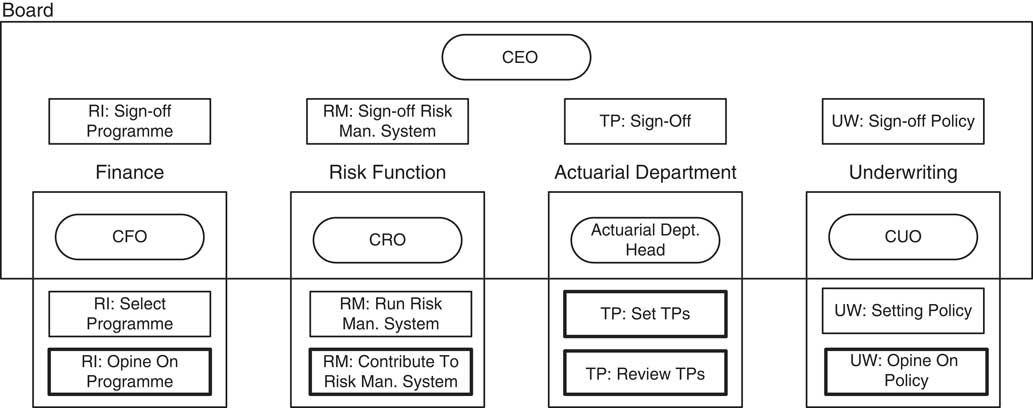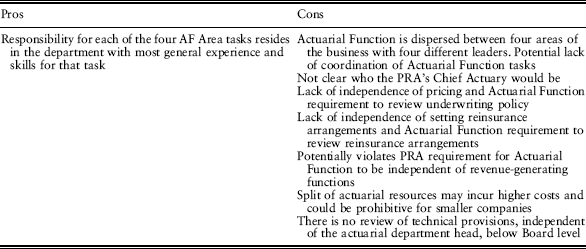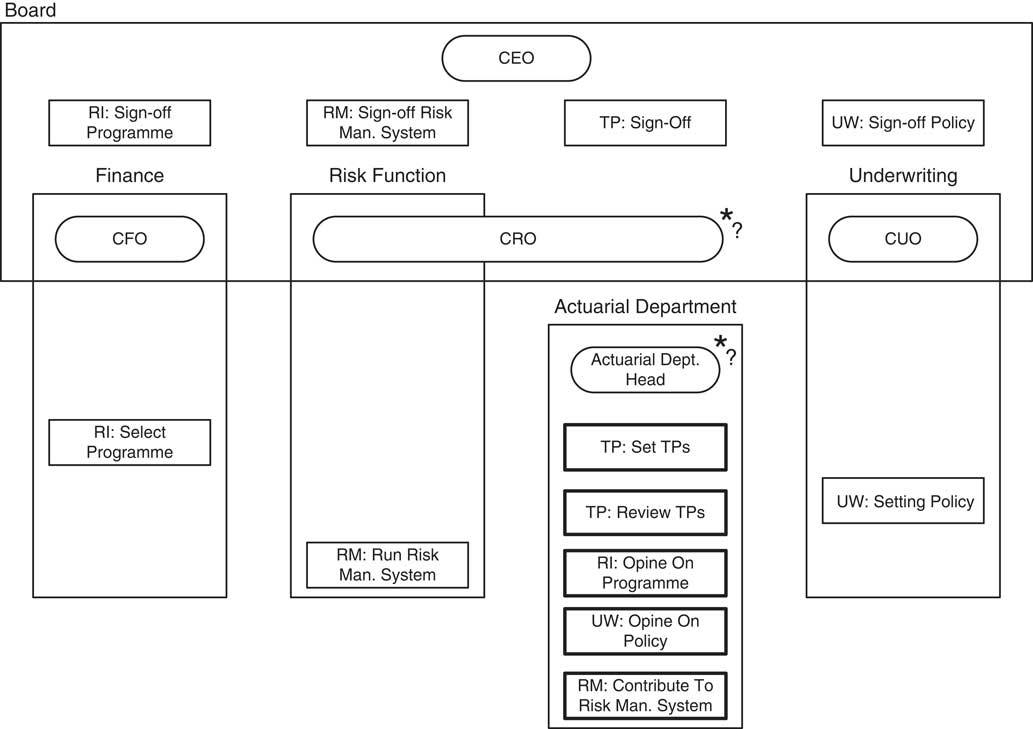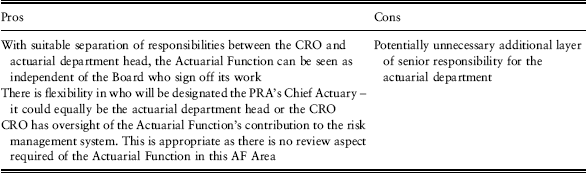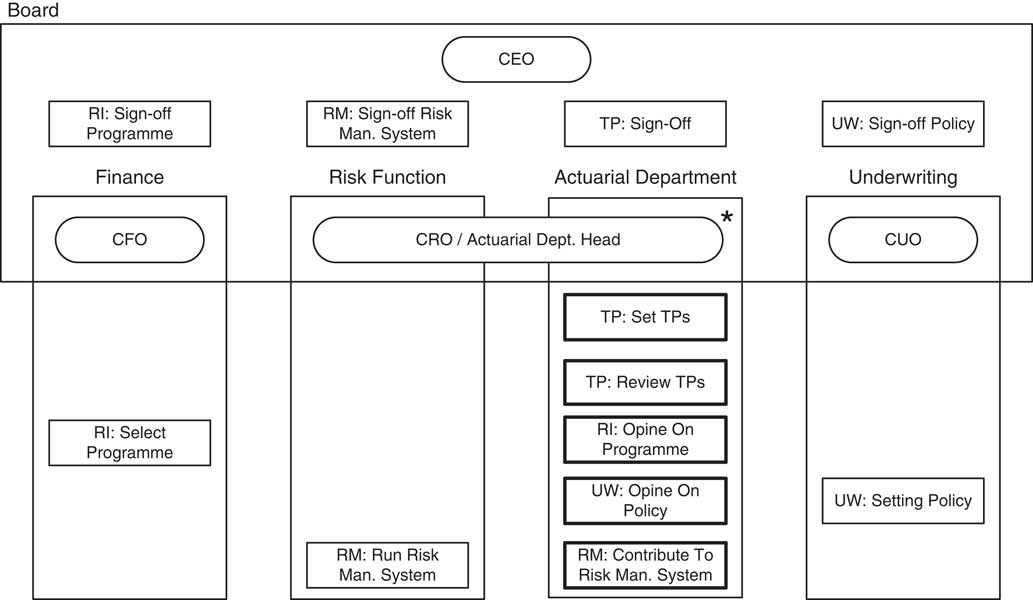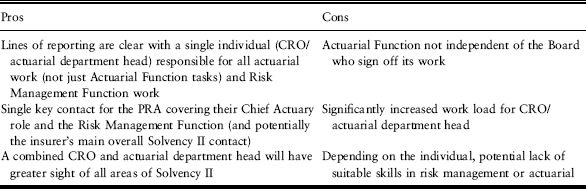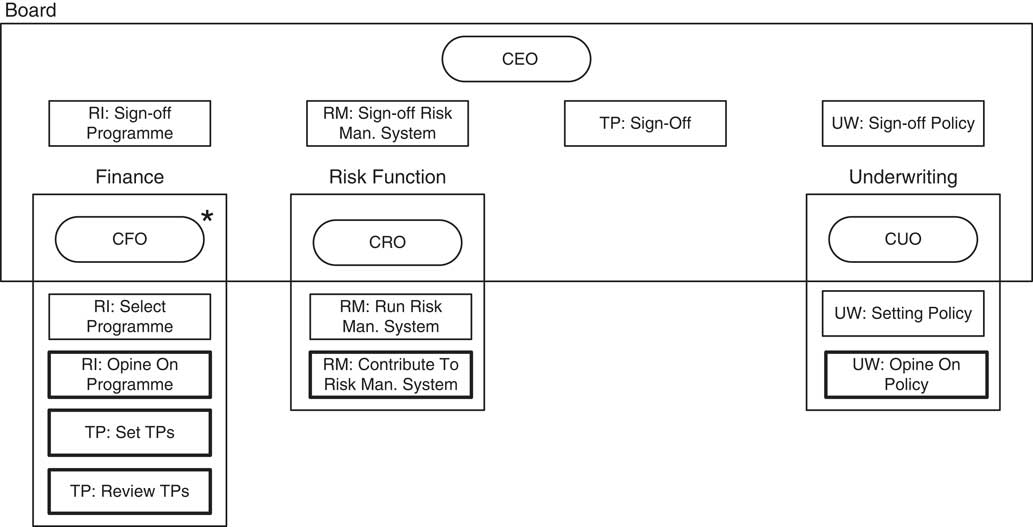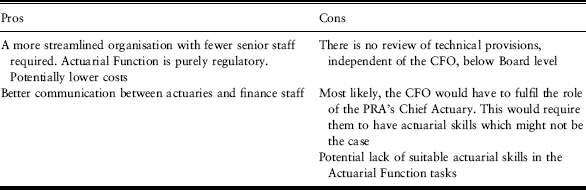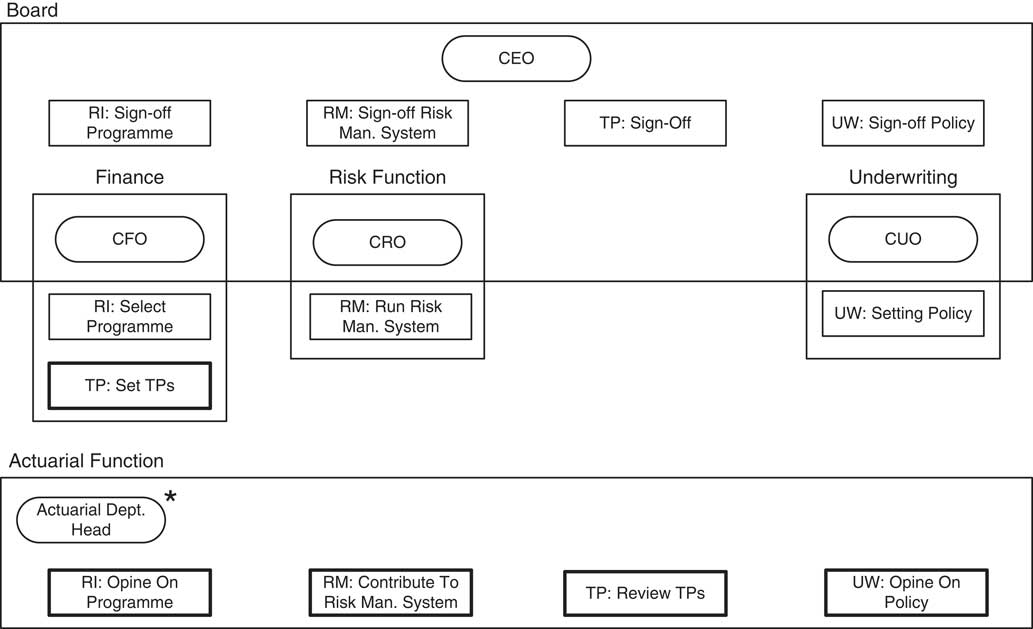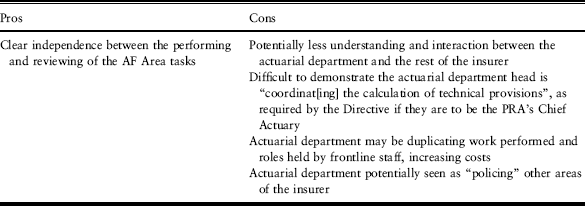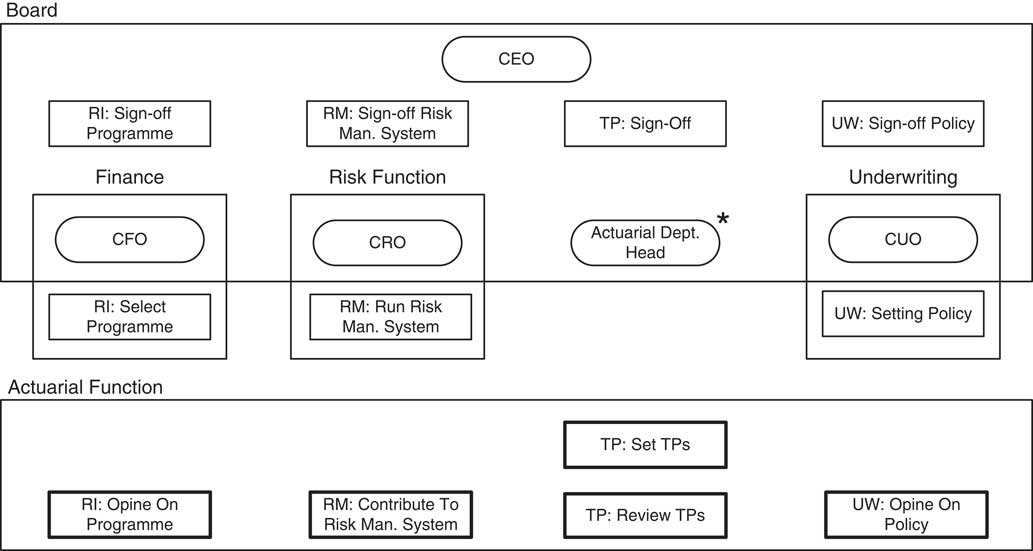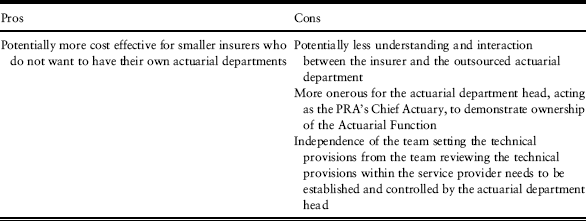


1. Introduction
The purpose of this paper is to provide the reader with some practical insights and suggestions around addressing the requirements of Article 48 of the Solvency II (SII) Directive. The Working Party’s terms of reference (ToR) are set out in the next section. It is not our intention to give advice, nor to be seen to give advice, but rather to make suggestions and observations that we hope the reader will find useful and interesting.
The Directive establishes a system of governance for insurers that includes the formalisation of four functions: the Risk Management Function, the Compliance Function, the Internal Audit Function and the Actuarial Function. This paper considers only the requirements of the Actuarial Function. Please see section 1.2 below for the limitations of this paper.
The tasks required of the Actuarial Function under SII are prescribed in the Regulations. Much of what the Regulations require will already be part of the day-to-day work of insurers. The Directive formalises the need to carry out certain tasks and may introduce additional requirements in some areas, for example, around reporting.
For the purpose of this paper, the requirements set out in the Regulations are considered the minimum tasks necessary to comply with SII. We may within this document discuss other potential tasks and items to include in the Actuarial Function Report where we consider them useful or informative. To this end, we define:
-
∙ “Regulatory Level” as that which we believe is necessary to meet the minimum requirements of the Regulations.
-
∙ “Best Practice Level” as that which goes beyond that required by the Regulations, but which (when appropriate) may add value to and hence improve the overall performance of the insurer.
Interestingly, in our survey (see section 3, Q13), roughly the same number of respondents agreed and disagreed that the Actuarial Function and Actuarial Function Report should concentrate on delivering the statutory minimum rather than go further and reflect industry best practice. A similar number again did not have an opinion.
1.1. Regulators
1.1.1. Prudential Regulation Authority (PRA) expectations
The PRA set out its approach to insurance supervision shortly after its formation. According to the approach, the PRA expects insurers to “have in place separate risk management and control functions – notably risk management, actuarial, finance and internal audit functions – to the extent warranted by the nature, scale and complexity of their business” (Bank of England, 2013, paragraph 117).
The PRA expects these functions “to be independent of an insurer’s revenue-generating functions, and to possess sufficient authority to offer robust challenge to the business. This requires these functions to be adequately resourced, to have a good understanding of the business, and to be headed by individuals at senior level who are willing and able to voice concerns effectively” (Bank of England, 2013, paragraph 118).
“The PRA expects insurers to have in place an operationally independent Actuarial Function commensurate with the nature, scale and complexity of the risks inherent in the firm’s business. The PRA considers the Actuarial Function to be integral to the effective implementation of a firm’s risk management framework and therefore expects the Actuarial Function to be engaged with all aspects of risk management” (Bank of England Prudential Regulation Authority, 2013a; paragraph 120).
In addition, at GIRO 2014, Mark Carney, Governor of the Bank of England, said the following: “Later this year we will consult on a regime that includes the most senior actuaries – alongside CEOs, Chairmen and Chief Financial and Risk Officers – in our senior managers regime, making them directly accountable for how a firm is run, for their decisions, and for their actions. These senior persons will be expected to prove their fitness to regulators before they take up a role, and the onus will be on them to ensure risks are understood, measured and properly considered” (Bank of England, 2014, page 7). This consultation “Senior insurance managers regime: a new regulatory framework for individuals – CP26/14” was released by the PRA on 26 November 2014 and closed on 2 February 2015 (see section 7).
1.1.2. PRA preparatory work
SII is expected to go live on 1 January 2016. Ahead of this, from 1 January 2014, the PRA is adopting European Insurance and Occupational Pensions Authority’s (EIOPA) guidance on how national regulators should prepare their supervision for this part of insurers’ structure of governance (Bank of England Prudential Regulation Authority, 2013c). Although the guidance is for supervisors, it can reasonably be assumed this “preparatory guidance” will form the basis of what the PRA expects insurers to adopt over the coming 2 years in advance of SII implementation.
The preparatory guidance focusses on some of the more difficult areas of the Actuarial Function, such as the Actuarial Function’s opinion on the underwriting policy and adequacy of reinsurance, as well as the coordination of the calculation of the technical provisions. As a result of previous quantitative impact studies, the actual calculation of technical provisions may be well understood compared with other areas of the Actuarial Function’s work, and is not a focus of the preparatory guidance.
1.1.3. The Institute and Faculty of Actuaries (IFoA)
On 4 December 2014, the IFoA published part 2 of its “Consultation on the Regulation of Chief Actuaries under the Solvency II regime”. In this, the regulation board state they “have decided that it is appropriate to introduce a compulsory Practising Certificate for our members who are approved as ‘Chief Actuary’ under the Prudential Regulation Authority’s Senior Insurance Managers Regime in both Life and non-Life undertakings” (IFoA, 2014, page 3).
1.2. Actuarial Function Working Party
Whilst the current Working Party members are listed on the front of this report, others have contributed to this publication at various times. We would like to thank everyone who has helped in producing this document.
Different sections of the paper have been written by different members of the Working Party. Individuals have in places given their own interpretation of the guidelines and how they should be applied. We do not necessarily agree on all of these views, but in order to reach a point whereby we can publish this paper, we have given plenty of latitude to individuals to present their own opinions. It is the responsibility of the individuals within an insurer to ensure they meet the SII requirements. Whilst we do not think it appropriate to rely on this paper for that purpose, we would be satisfied to know you have found it useful in informing your thinking in this area.
In addition, we note that with the implementation of SII fast approaching on 1 January 2016, regulatory requirements are constantly developing. Whilst we have tried to reflect the latest output from the PRA and IFoA, we cannot guarantee the Working Party’s interpretation of the guidance contained in this document will be in line with the regulator’s requirements. Any guidance or requirements published by the PRA or IFoA should always take precedence over material presented here.
2. Working Party ToR
The Actuarial Function Working Party, in conjunction with the General Insurance Practice Executive Committee of the IFoA have adopted the following ToR.
To prepare a discussion paper for GIRO (possibly to be followed by a sessional meeting paper) and a workshop which is to address at least the following issues in the context of firms underwriting general insurance business (in no particular order):
-
1. To provide more detail of the work which will need to be undertaken by the Actuarial Function to fulfil the requirements of Article 48 of the SII Directive.
-
2. To suggest content and structure of the Actuarial Function Report. (This may not necessarily take the form of a prescriptive set of wordings, titles or opinions, but should aim to offer potential consistency to our community. This could take the form of some examples.)
-
3. To discuss possible organisational structures for the Actuarial Function which may vary according to the scale, nature and complexity of the organisation. (This too could take the form of some examples.)
-
4. To consider who should perform the role of the Actuarial Function and any recommended qualifications. (Of interest, this might include a survey of approaches in other EU countries as some have mandated that an actuary hold the role.)
-
5. To consider the non-regulatory, internal users/clients/“customers” of the Actuarial Function and their requirements and expectations. In particular, to examine the value provided by the required opinions to the organisations and to consider how this may vary according to the ownership, scale, nature and complexity of the organisation
-
6. To discuss issues of independence, conflicts of interest and the appropriate segregation of responsibilities in the context of the Actuarial Function.
-
7. To consider the extent and nature of liaison with and reliance upon non-actuaries which may be required to fulfil some of the requirements of the SII Directive.
The paper should be both:
-
∙ Educational: helping general insurance actuaries to get up to speed with issues relating to the Actuarial Function.
-
∙ Developmental: helping general insurance actuaries to further develop their thinking in relation to the Actuarial Function.
3. Survey of IFoA Members
In order to gain an understanding of the progress made by insurers in establishing SII compliant Actuarial Functions, we carried out a short survey in February/March 2014. Results of this survey were presented at GIRO 2014. Work will have progressed since then, but its findings provide some insight into how developed the market is on this issue.
3.1. Survey Methodology
In all, 16questions on the subject of the SII Actuarial Function were uploaded onto the “survey monkey” website. The survey was advertised through the IFoA and members were given approximately a month to respond. No controls were put around who could respond (or potentially how many times they could respond).
3.2. Survey Results
We had 43 respondents, representing an equal distribution of large, medium and small companies (Q1). About a third wrote business through the Lloyd’s of London market (Q2) and around 80% considered themselves to be “senior actuaries” or chief actuaries (Q3). Detailed results are included in Appendix C. We have not included free-form text responses in this report.
Key points from the survey include:
-
∙ 93% of respondents felt that at the time of responding their insurer had either made some or good progress in preparing for the requirements of the SII Actuarial Function (Q4). However, 44% felt they had made no significant progress in producing what they believed would be a fully compliant actuarial report (Q8).
-
∙ 61% felt that while they were familiar with the requirements of the Directive and Level 2 Delegated Acts regarding providing an opinion on their insurer’s reinsurance arrangements, they were unsure on how to meet them (Q6). A similar percentage (63%) were unsure on how to meet the need to provide an opinion on underwriting policy (Q7).
4. Tasks and Report of the Actuarial Function
4.1. Introduction
The establishment of an Actuarial Function could begin with a ToR. At a Regulatory Level, the required ToR should reflect the regulatory requirements as laid out in Article 48 of the Directive. These are described further in this section.
4.2. SII Actuarial Function ToR
Whether the insurer is aiming for a Regulatory Level or Best Practice Level of sophistication (or somewhere in between) it is reasonable to assume that the role of the Actuarial Function should be defined by a ToR. Suggested contents for the ToR might include:
-
∙ The tasks expected of the Actuarial Function by the insurer and how it is expected to deliver these.
-
∙ The expectations for the Report of the Actuarial Function (e.g. timelines and content given the composition of the function).
-
∙ The composition of the Actuarial Function including suitability and qualification of staff, as well as identifying the head of the Actuarial Function (and compliance with any approved persons regulatory regime).
-
∙ The use of external parties in performing the Actuarial Function’s tasks and consideration of links to outsourcing requirements.
-
∙ The reporting lines and governance of the Actuarial Function including the expected operation of feedback loops between the function and overseers.
-
∙ How objectivity and independence of the Actuarial Function is ensured where necessary, including its expected interaction with other departments and functions, notably the risk function.
At a minimum, the ToR should allow for the necessary formally constituted committees (e.g. reserving committee) and there should be properly constituted processes for review and sign off of the Actuarial Function output, notably those specifically required by the Directive.
4.2.1. Governance
The ToR of the Actuarial Function should go through suitable but proportionate governance procedures. Governance will differ from undertaking to undertaking, depending on the existing governance structures in place. This may include having the ToR reviewed and signed off by the reserving committee or the Board. Governance is important as the ToR should be seen as the mandate given to the Actuarial Function to perform its duties by the Board and, where necessary, the ToR may be used to enforce that mandate so that the Actuarial Function can perform its tasks.
The ToR of the Actuarial Function should also bear in mind any ToR for other parts of the insurer; for example, the reserving committee. In such a situation where the Actuarial Function is expected to present its findings to the reserving committee, then the ToR of the reserving committee should ensure that it addresses the areas of responsibility of the Actuarial Function. The Actuarial Function’s ToR should be consistent with that of the reserving committee.
The ToR should be reviewed at least once a year, or more frequently if the undertaking feels that it is appropriate. The ToR should reflect any change in scope of the Actuarial Function, whether required from a regulatory standpoint or a more business-driven change in scope.
4.3. Relationship Between the Tasks and Report of the Actuarial Function
For a Regulatory Level of sophistication, the tasks of the SII Actuarial Function are defined by the Regulations. The specific requirement for a report of the Actuarial Function comes from the Delegated Acts text:
“The actuarial function shall produce a written report to be submitted to the administrative, management or supervisory body, at least annually. The report shall document all tasks that have been undertaken by the actuarial function and their results, and shall clearly identify any deficiencies and give recommendations as to how such deficiencies should be remedied” (Commission delegated regulation (unnumbered), 2014, Article 272, paragraph 8).
The tasks of the SII Actuarial Function and the contents of the report of the Actuarial Function are therefore closely linked, at least at a Regulatory Level of sophistication. The tasks of the Actuarial Function should be set out in the Actuarial Function ToR and the report of the Actuarial Function should report on the outcomes of those tasks performed.
4.4. Actuarial Function Report
4.4.1. Purpose of the Actuarial Function Report
The Actuarial Function Report is one or more documents addressed to the Board of an insurer, and has two primary functions:
-
∙ to enable informed decisions to be made about the administration of the insurer, based on reasoned analysis, evidence and justification; and
-
∙ to demonstrate compliance with the requirements of the Directive.
It should highlight deficiencies and limitations in the tasks performed and reviewed by the Actuarial Function and make recommendations on where these can be improved, where relevant. For members of the IFoA, the report would be subject to the relevant Technical Actuarial Standards (TASs).
4.4.2. Aggregate reports and timing
There is no reporting timescale for the Actuarial Function Report provided it is produced “at least annually” (Commission delegated regulation (unnumbered), 2014, Article 272, paragraph 8). In addition, there is no requirement for all the tasks of the Actuarial Function to be completed at the same time. As discussed in the section 7, the tasks of the Actuarial Function may be completed by different individuals/departments within the insurer. Who carries out a task and when it is performed will be determined by business need and other regulatory requirements. Efficiency and accuracy mean the best time to report on these tasks will be when the tasks are being performed.
TAS-R allows for actuarial reports to consist of an aggregate report made up of multiple component reports (Board of Actuarial Standards, 2009, section B.1.7). Consequently, depending on the segregation of responsibilities, firms may decide to produce multiple component reports throughout the year, covering the various tasks. For example:
-
∙ Reinsurance purchase at the annual renewal of cover.
-
∙ Technical provisions following year-end valuations.
-
∙ Underwriting/risk management at the time of business planning.
In our survey (see section 3, Q14), 44% of respondents believed their Actuarial Function Reports could largely be compiled from existing documentation.
Where component reports are produced at different times of the year, it may be necessary to have an over-arching component report referencing all the constituents of the aggregate report and potentially addressing some of the less-specific Actuarial Function requirements (such as ToR and TASs compliance).
There is a risk from this approach that presentation and clarity will be diminished. For example, through repetition. The aggregate report may contain much that is not relevant or apparently contradictory given the different timings of authoring and purposes of the separate component reports. Consideration as to how to mitigate this risk should be given, for example, by using a standard glossary.
Other firms may prefer a more simplistic approach where the Actuarial Function produces a single annual report to the Board covering all its ToR. This may be appropriate where an external party is used or at the Board’s request. However, the practicality of the use of the Actuarial Function Report in terms of its input into decision-making processes should be carefully considered.
The timing of Actuarial Function reporting should consider the other reporting timelines which are prescribed under other areas of SII such as Pillar 3 and the Solvency and Financial Condition Report. These will include some detail around the technical provisions.
4.4.3. Structure
For clarity, this section assumes a single report is being produced once a year, but as discussed in the previous section, this could easily be broken into smaller component reports with different timings if required.
One of the key considerations needs to be the intended audience. As the Actuarial Function Report is targeted at the Board (and relevant sub-groups delegated to by the Board, e.g. reserving committee), it should reflect a technical complexity expected to be understood by the recipients. The format should also be accessible, for example, avoiding too much reliance being placed on appendices or the report being too technical or long for Board review.
The Report also needs to demonstrate robust application of actuarial techniques and process in meeting the challenges of the tasks undertaken and demonstrate how the conclusions have been reached.
The structure suggested below can only be the starting point as the report will need to be tailored to the individual insurer. It is split under the following headings:
-
∙ Executive Summary;
-
∙ Introduction;
-
∙ Technical Provisions;
-
∙ Underwriting;
-
∙ Reinsurance;
-
∙ Risk Management; and
-
∙ Conclusions and Recommendations.
In the key areas above, the Actuarial Function should identify any limitations arising and make recommendations to address those limitations.
When going beyond the Regulatory Level of sophistication, the Actuarial Function may wish to include an additional section on tasks undertaken which do not fall under the key responsibilities required by SII.
The Actuarial Function may also, through its report, include cross references to the wider documentation of the firm where more detail can be found on the workings and analyses performed for its key roles.
The Actuarial Function Report may rely on other reports produced during the year which include an element of technical provisions (e.g. Statement of Actuarial Opinion reports for Lloyd’s syndicates). However, it should be noted that the Actuarial Function Report should support the provisions for solvency; reports written to support provisions not prepared on a SII basis would not necessarily consider all the material assumptions, methods and uncertainties introduced in moving to a SII basis which should be considered in the Actuarial Function Report. Amending the existing report to reflect these differences would be necessary.
Under APS X2, actuaries are required to consider whether a peer review is necessary or not. In making the decision, the actuary should consider the requirements detailed in APS X2.
4.4.4. Content
-
∙ The Executive Summary will bring together the main considerations and conclusions of the report. This will include the highlights from the Actuarial Function’s review or calculation of technical provisions and the statements required by the Actuarial Function under the Directive on the opinion on the underwriting policy and adequacy of reinsurance arrangements.
It will also highlight any identified deficiencies and suggested remedial action for the attention of the reader.
Following several iterations of the report it may be useful to cover previous review feedback and how this has been subsequently addressed.
-
∙ The report’s introduction will:
-
− State the Actuarial Function’s terms of reference (or refer to an Appendix where they may be found).
-
− Set out the scope of the report. This should be based on the Actuarial Function’s ToR. It should confirm compliance with the ToR and highlight any areas where these have not been adhered to. In addition, it may be considered appropriate to cross reference the ToR to the main body of the report.
-
− State compliance (or otherwise) with reporting requirements such as the Financial Reporting Council’s TASs, the IFoA’s Actuarial Professional Standards and the Actuaries’ Code, where relevant. While many of these are applicable only to IFoA members, the Directive does note that individuals carrying out Actuarial Function duties need to “demonstrate their relative experience with applicable professional and other actuarial standards” (Commission Directive 2009/138/EC, 2009, Article 48, paragraph 2). The Working Party would suggest this includes producing TAS-equivalent compliant work and reports.
-
∙ Content relating to technical provisions (see section 5).
-
∙ Content relating to underwriting policy (see section 6.2).
-
∙ Content relating to reinsurance adequacy (see section 6.3).
-
∙ The Risk Management section covers the Actuarial Function’s contribution to the risk management of the firm, specifically the implementation of the own risk and solvency assessment (ORSA) and risk modelling. While there is no explicit opinion required in this regard, the Actuarial Function should set out how the requirement is fulfilled.
The Directive says that the Actuarial Function should “contribute to the effective implementation of the risk-management system referred to in Article 44, in particular with respect to the risk modelling underlying the calculation of the capital requirements set out in Chapter VI, Sections 4 and 5, and to the assessment referred to in Article 45 [Own Risk and Solvency Assessment]” (Commission Directive 2009/138/EC, 2009, Article 48, paragraph 1(i)).
The requirement therefore primarily relates to a confirmation within the Actuarial Function Report around how this is achieved. It is expected that the Actuarial Function contributes extensively to the risk management system of the insurer. It is likely that these requirements will primarily focus on the integration of technical provisions with the above areas of the risk management framework and the wider remit of, for example, reviewing reserving risk modelling, providing cashflow patterns, monitoring emerging risks, etc.
A specific example of where the Actuarial Function is expected to be involved in the risk management system might be around undertaking specific parameters. The guidelines on USPs say “The role of the actuarial function is … very important in the assessment of the quality of data used in the calculation of undertaking-specific parameters” (EIOPA report BoS-14/178, 2014, annex, paragraph 1.6) and continues “some of the inputs used to calculate these parameters will be similar … to the inputs used to calculate technical provisions. It is expected that the actuarial function contributes to the assessment of these inputs within the risk-management system” (EIOPA report BoS-14/178, 2014, annex, paragraph 1.7).
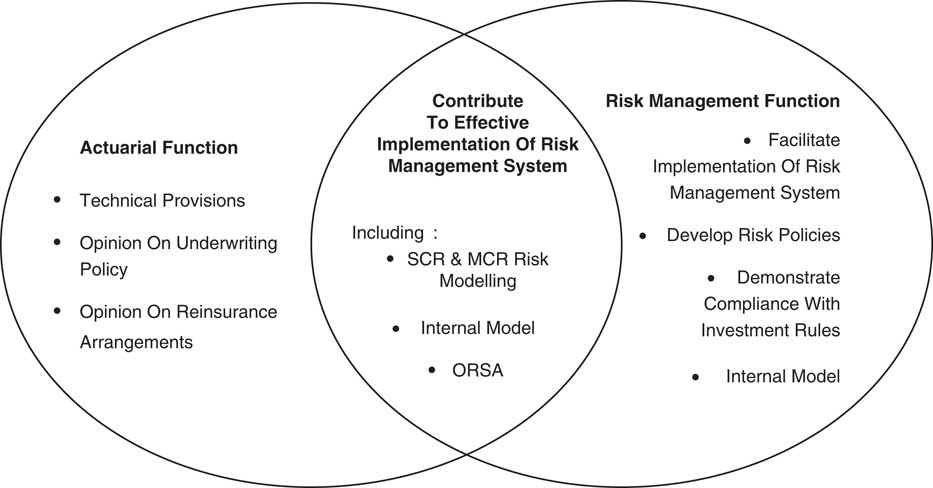
The Actuarial Function needs to carefully consider the requirements of independence here as both performing calculations and reviewing/validating the output may risk conflicts of interest. Conflicts of interest are covered in other sections of this report; however, it is acknowledged that overlap of the duties and responsibilities of Actuarial Function and Risk Management Function is likely.
-
∙ Many of the Conclusions and Recommendations are likely to have been made in the individual sections above. It may be useful however to bring these together such that (particularly for recommendations following limitations) they can be monitored as action points over time.
5. Technical Provisions
Given the number of requirements of the Actuarial Function which relate to technical provisions, this section is likely to make up the largest part of the report. The requirements are reasonably well understood and may not go much further than existing reserving actuary interaction and reporting with the Board. There are, however, additional considerations and assessments required under SII which may not have been addressed previously, such as reporting on the appropriateness of information technology systems (Commission delegated regulation (unnumbered), 2014, Article 272, paragraph 3). In addition, depending on the nature of the insurer’s business, there may be significant differences in the way in which each of the areas covered by the Directive are addressed.
It may be useful or necessary to include additional informative detail which goes beyond the Regulatory Level of sophistication. For example, this might include looking beyond the 1-year time horizon or details of staff changes.
Given their explicit inclusion in the Directive and Delegated Acts, the Actuarial Function Report should explain how the Actuarial Function has
-
∙ Coordinated the calculation of technical provisions. In particular, how it has
-
− “Appl[ied] methodologies and procedures to assess the sufficiency of technical provisions and to ensure that their calculation is consistent with the requirements set out in Articles 75 to 86 of the Directive” (Commission delegated regulation (unnumbered), 2014, Article 272, paragraph 1(a)).
Articles 75–86 of the Directive covers “Rules relating to the valuation of assets and liabilities, technical provisions, own funds, Solvency Capital Requirement, Minimum Capital Requirement and investment rules”.
The Working Party has taken the above to mean that the Actuarial Function Report should include a detailed description as to how the technical provisions are calculated. However, we note that such detail may not be of interest to the Board who may only require comfort that the calculation is fit for purpose and an understanding of what the sensitivities are.
The description may include specific references to compliance with the requirements as well as detail of the approach adopted to gain comfort on the sufficiency of the technical provisions. For example, describing the governance around reviewing technical provisions.
-
− “Assess[ed] the uncertainty associated with the estimates made in the calculation of technical provisions” (Commission delegated regulation (unnumbered), 2014, Article 272, paragraph 1(b)). Methods may include:
-
▪ Qualitatively describing the areas of greatest external uncertainty. For example, the most recent year, the future development of market events, the economic and underwriting cycle, etc.
-
▪ Further details could then be provided on how these areas of uncertainty would impact upon the data and assumptions used in projecting technical provisions.
-
▪ Estimating quantitative ranges based on benchmarks, stress and scenario testing, or stochastic techniques.
-
▪ Commenting on the reliability and adequacy of the technical provisions and circumstances which may lead to significant deviations from the derived best estimate, attempting to quantify these where appropriate. Ideally, this comment would cover limitations in the process, methods and assumptions as well as the derived amounts.
-
-
− “Ensur[ed] that any limitations of data used to calculate technical provisions are properly dealt with” (Commission delegated regulation (unnumbered), 2014, Article 272, paragraph 1(c)).
The Level 3 Guidance says “The undertaking should require the actuarial function to assess the consistency of the internal and external data used in the calculation of technical provisions against the data quality standards as set in Solvency II. Where relevant, the actuarial function provides recommendations on internal procedures to improve data quality so as to ensure that the undertaking is in a position to comply with Solvency II requirements” (EIOPA Consultation Paper 14/017, 2014, Guideline 51).
This may include descriptions of how data limitations have arisen and been identified including whether the deficiencies relate to data appropriateness, accuracy or completeness. Where assumptions or approximations are used to overcome limitations in the data then such assumptions will need to be documented clearly along with the rationale for the assumptions or approximations.
-
− “Ensur[ed] that the most appropriate approximations for the purposes of calculating the best estimate are used in cases referred to in Article 82 of Directive 2009/138/EC” (Commission delegated regulation (unnumbered), 2014, Article 272, paragraph 1(d)).
Article 82 covers “data quality and application of approximations, including case-by-case approaches, for technical provisions”.
It may be useful to set out the details of simplifications used in the valuation process and why these continue to be the most appropriate approach.
-
− “Ensur[ed] that homogeneous risk groups of insurance and reinsurance obligations are identified for an appropriate assessment of the underlying risks” (Commission delegated regulation (unnumbered), 2014, Article 272, paragraph 1(e)).
It might be appropriate to describe the basis on which classes of business have been set for reserving purposes. This would be particularly important where existing classes have been changed for the purpose of SII reporting. For example, the splitting of motor classes between liability and other claims.
There may also be a need to consider data credibility within each of these risk groups.
-
− “Consider[ed] relevant information provided by financial markets and generally available data on underwriting risks and ensure[d] that it is integrated into the assessment of technical provisions” (Commission delegated regulation (unnumbered), 2014, Article 272, paragraph 1(f)).
Given the wide range of potential information available and the wide range of applications for it within the technical provisions and risk management system, the onus is on the Actuarial Function to make the best use of the most appropriate information.
This “integration” could be through the valuation process itself (e.g. the use of benchmarks in the valuation) or to assist in the validation of the derived results (e.g. by comparing the insurer’s results with those in the market).
-
− “Compar[ed] and justified any material differences in the calculation of technical provisions from year to year” (Commission delegated regulation (unnumbered), 2014, Article 272, paragraph 1(g)).
The starting point for this may be to create “waterfall” charts which break down the movement from year to year into separate components. Such a split might include, inter alia, changes in the following:
-
▪ classes of business written;
-
▪ base data used for the projections;
-
▪ underlying projection assumptions;
-
▪ margins removed;
-
▪ events not in data;
-
▪ the profit in future premiums;
-
▪ expenses;
-
▪ the impact of discounting;
-
▪ the breakdown between the claims provision and premium provision;
-
▪ the breakdown between separate cash flows, for example, claims, premium and expenses; and
-
▪ risk margin.
Each change could then be explored in more detail, proportionate to its materiality.
An alternative approach would be to produce two waterfall charts of movements from GAAP/IFRS reserves to SII technical provisions for both the current year and previous year. Explaining the differences between the two charts would highlight the materiality of the changes in each item.
-
-
− “Ensur[ed] that an appropriate assessment is provided of options and guarantees included in insurance and reinsurance contracts” (Commission delegated regulation (unnumbered), 2014, Article 272, paragraph 1(h)).
This is less likely to be applicable to non-life insurers. Although a statement around their materiality and how this is confirmed would help confirm this to the reader.
-
-
∙ “Assess[ed] whether the methodologies and assumptions used in the calculation of the technical provisions are appropriate for the specific lines of business of the undertaking and for the way the business is managed, having regard to the available data” (Commission delegated regulation (unnumbered), 2014, Article 272, paragraph 2).
This may include:
-
− Overviews of the adopted assumptions and methodologies, consideration of possible alternatives, the materiality of each assumption, identified limitations, potential improvements, data required, rationale for use, the use of expert judgement and validation procedures.
-
− Reviewing whether the projection methodology, perhaps selected on the basis of IFRS/GAAP reserving classes of business, is still appropriate when mapped to SII classes of business.
-
− Considering whether a general approach to reserving works for individual classes of business.
-
-
∙ “Assess[ed] whether the information technology systems used in the calculation of technical provisions sufficiently support the actuarial and statistical procedures” (Commission delegated regulation (unnumbered), 2014, Article 272, paragraph 3).
Considerations here may include:
-
− The appropriateness and accuracy of the software packages used to produce the technical provisions.
-
− Staff understanding of how software is processing the information and what the output means. As reserving software becomes more complicated, there may be a temptation to plug data in, push the button and present the result, without fully understanding the process. This risks unintended results and inappropriate technical provisions.
-
− The robustness of systems which should be easy and quick to use, and reliably work whenever needed.
-
− The ability of software to produce the required outputs and its adaptability at short notice to new tasks.
This analysis may be linked to the data limitations noted above.
-
-
∙ “When comparing best estimates against experience, review[ed] the quality of past best estimates and use[d] the insights gained from this assessment to improve the quality of current calculations” (Commission delegated regulation (unnumbered), 2014, Article 272, paragraph 4).
The focus here is on the development of a feedback loop between the actual experience and the expected experience as a key technical provision validation tool, and linking this to the impact on the technical provisions (e.g. changes in cashflow patterns, ultimate premium or claims estimates and key assumptions).
-
∙ “The comparison of best estimates against experience shall include comparisons between observed values and the estimates underlying the calculation of the best estimate, in order to draw conclusions on the appropriateness, accuracy and completeness of the data and assumptions used as well as on the methodologies applied in their calculation” (Commission delegated regulation (unnumbered), 2014, Article 272, paragraph 4).
-
∙ Informed the Board of the reliability and adequacy of the calculation of technical provisions.
“Information submitted to the administrative, management or supervisory body on the calculation of the technical provisions should at least include a reasoned analysis on the reliability and adequacy of their calculation and on the sources and the degree of uncertainty of the estimate of the technical provisions” (Commission delegated regulation (unnumbered), 2014, Article 272, paragraph 5).
“That reasoned analysis should be supported by a sensitivity analysis that includes an investigation of the sensitivity of the technical provisions to each of the major risk underlying the obligations which are covered in the technical provisions. The Actuarial Function shall clearly state and explain any concerns it may have concerning the adequacy of technical provisions” (Commission delegated regulation (unnumbered), 2014, Article 272, paragraph 5).
6. Opinions
6.1. What Is An Opinion
What the Directive means when it refers to an “opinion” in Article 48, paragraphs 1(g) and 1(h) has concerned the market for some time. Based on the additional information provided in the Delegated Acts and Level 3 Guidance, it is this Working Party’s view that:
-
∙ There is considerable benefit, both for the insurer concerned and the regulators, in the Actuarial Function contributing its knowledge and experience to the sound running of the insurer. Underwriting policy and reinsurance adequacy have been singled out as areas most suited to this and where historically actuaries in many insurers may have had less involvement.
-
∙ An opinion in this sense is therefore not a formal signing-off of the underwriting policy or reinsurance arrangements in the style of, say, a Statement of Actuarial Opinion. It is more a view on the practices and outcomes in these areas from applying the actuarial skillset.
-
∙ Although the actuarial team within many insurers already provide such a contribution, SII will formalise the role and set a minimum level of contribution, bringing all insurers up to a common standard, whilst still giving sufficient flexibility to adapt to the specific circumstances of the insurer.
-
∙ For such opinion work to be effective and efficient, the Actuarial Function would need to embed its work in this area around the process and timetable of underwriting and reinsurance teams. A close working relationship and mutual cooperation would be essential.
-
∙ Whilst it is not envisaged that the Actuarial Function acts as a policeman to the underwriting and reinsurance teams, it is important that it positions itself so that it can still provide constructive criticism and informed debate and not simply rubber stamp the work of the other teams.
-
∙ Documentation of the Actuarial Function’s work in deriving its views will be essential in demonstrating its compliance in this area (as indeed it is elsewhere in its obligations under the Directive).
6.2. Opinion on Underwriting Policy
The Directive states that insurers should “provide for an effective Actuarial Function to … express an opinion on the overall underwriting policy” (Commission Directive 2009/138/EC, 2009, Article 48, paragraph 1(g)).
The Delegated Acts state:
“Regarding the underwriting policy, the opinion to be expressed by the Actuarial Function … shall at least include conclusions regarding the following considerations:
-
(a) sufficiency of the premiums to be earned to cover future claims and expenses, notably taking into consideration the underlying risks (including underwriting risks), and the impact of options and guarantees included in insurance and reinsurance contracts on the sufficiency of premiums;
-
(b) the effect of inflation, legal risk, change in the composition of the undertaking’s portfolio, and of systems which adjust the premiums policy-holders pay upwards or downwards depending on their claims history (bonus-malus systems) or similar systems, implemented in specific homogeneous risk groups;
-
(c) the progressive tendency of a portfolio of insurance contracts to attract or retain insured persons with a higher risk profile (anti-selection)” (Commission delegated regulation (unnumbered), 2014, Article 272, paragraph 6).
The opinion provided should be supported by reasoned analysis. This may include:
-
∙ Comparison of actual profitability and premium rate movements on each business segment compared with business planning expectations.
-
∙ Ability to make profit targets, for example, return on equity both at a best estimate and under stressed scenarios (e.g. inflationary claims environment, etc.) or via a loss distribution.
-
∙ Explanation on consideration of external and internal influences on premium rates.
The above should enable the Actuarial Function to assess the adequacy and sustainability of the business model of the undertaking and, through the reporting, provide the Board with informed and reasoned comments to this effect.
In arriving at the opinion, the actuary should have regard to the risk appetite of the insurer and whether this is being adhered to in practice.
There should be some regard to the impact of the underwriting policy on the technical provisions and vice versa.
6.2.1. Sufficiency of premium
Any opinion on the sufficiency of premiums to cover future losses needs to take into account factors such as inflation, anti-selection, legal risk, changes in the market environment and any other relevant internal or external issues. It is proposed that the Actuarial Function will also be required to suggest improvements to be made to the policy in future where deficiencies are identified.
It is anticipated that in determining the adequacy of technical provisions the Actuarial Function will consider the sufficiency of premiums in relation to expired periods of cover and also consider the likely appropriateness of premiums received and due to be received in relation to policies already sold for future exposure periods. The Actuarial Function would need to conduct additional work to consider the appropriateness of the combined pricing and underwriting strategy in the light of trends in the underlying experience of the business and the expected risk profile for future underwriting.
6.2.2. Potential conflict of interests
The requirement that the Actuarial Function provides an opinion on the underwriting policy does not mean that the Actuarial Function cannot be involved in any of the original decisions on this issue, but that the degree of documentation and justification will need to be higher in this situation.
6.2.3. Staff relationships
Currently, the degree of interaction between the underwriters and actuaries in relation to pricing and underwriting varies materially between different insurers. The level of actuarial input into pricing and underwriting will depend on the structure and nature of the insurer. An insurer may have actuaries working directly in the underwriting function, who are independent from the Actuarial Function responsible for giving the underwriting opinion or have outsourced different responsibilities to different actuarial service providers. The requirement to express an opinion will therefore present a different level of challenge to different undertakings. However, in many cases it should encourage greater communication between pricing teams, be they underwriters or actuaries, and the Actuarial Function.
In order to carry out the Actuarial Function tasks as proposed by SII, the actuaries will need to have an open, understanding and cooperative relationship with their underwriters, based on mutual respect and understanding of each other’s values. This may be a challenge in some undertakings where this relationship is not already in place. The role of the actuary may be seen as a policeman reporting any shortcomings to the Board. This will particularly be the case where there is disagreement between the two teams and the underwriters believe that the actuaries cannot add any value to the process. This significant challenge will need to be overcome as quickly as possible in order to effectively meet the proposed requirements of SII.
6.2.4. Forming an opinion
The process undertaken to form an opinion on the underwriting policy is likely to vary for different types of insurer. In the following paragraphs, we have explored some possible scenarios that can exist but the Working Party recognises that every insurer will have its own business model and underwriting processes and the way the Actuarial Function operates will need to be effective within the local business environment.
-
∙ In the case of a large personal lines insurer, where risks are typically relatively homogeneous, it is likely that the underwriting is carried out using rating models with little discretion applied. In this case the Actuarial Function may be responsible for regular review and ongoing monitoring of the rating model and its parameterisation. Where this is sufficiently sophisticated it may be the case that no further analysis is required and that the insights gained can be used to assist with the calculation of technical provisions and other tasks.
In some instances we would anticipate simple rating structures and in this case further analysis may be required. For example, analysis may be required to test for anti-selection, perhaps considering the change in business mix, where only a small number of rating factors are used.
-
∙ For commercial lines insurers, the technical pricing information available is likely to vary considerably from insurer to insurer. Where a technical pricing model is available, the actuary may review the model in a similar way to the personal lines provider. However, in general it would also be important to analyse the extent that the actual premium differs from the modelled premium either on an individual risk or a portfolio basis. Where no pricing model exists the analysis would possibly be on a case-by-case basis over a sample of risks. Reference could be made to the rate monitoring system to determine the adequacy of rates to cover future costs, although the actuary would need to be aware of its limitations. In all cases the actuary will need to form a view as to how the risks (such as anti-selection and inflation) will impact the exposure to claims and expenses.
-
∙ Underwriting specialist lines of business, particularly where the individual risks are large, sees some of the closest working practices between actuaries and underwriters. In these situations, underwriters often rely on tailor-made models developed by the actuaries to evaluate the expected outcomes and capital costs of each contract before reaching a conclusion on whether to write the risk, the line size and need for additional reinsurance or other risk mitigation strategies.
We believe that the requirement to express a view on underwriting policy was based on the fact that many firms have benefited from actuaries engaging more closely with underwriting and contributing opinions based on actuarial judgement to enhance underwriting strategy and decision making. The new requirement can present an opportunity for actuaries to become more closely engaged with underwriters, where this has not already been achieved to date.
6.2.5. Reporting
In terms of the Actuarial Function providing information relevant to the Board’s needs, we note that whilst the solvency capital requirement (SCR) valuation considers 1 year’s new business, proposals in relation to the ORSA have suggested that it should be including stresses to business plans over a longer time period, perhaps 3–5 years ahead. As the future expected profits is a component of both the SCR and the output of future balance sheet stress scenarios, the Actuarial Function may be expected to express an opinion over both these timeframes and should communicate clearly the key threats to future profitability associated with the planned underwriting strategy.
The requirements relating to the underwriting opinion should align with the Actuarial Function’s task of coordinating the calculation of the technical provisions. It is clear that insight is needed into the historical underwriting policy and its appropriateness in order to form a view on the adequacy of the technical provisions. Likewise, understanding the current technical provisions can provide insight into the current underwriting policy. These two requirements of the function should reinforce each other, with insight gained under each task assisting with the other.
In forming these views the Actuarial Function, notwithstanding the comments above with regard to independence of responsibilities for pricing and forming and opinion on underwriting, could be asked to deliver its SII responsibilities in different ways:
-
∙ The Actuarial Function may form its view of the underwriting strategy based solely on its analysis of the relevant data and market knowledge. This leaves the Board with responsibility to draw conclusions from the different recommendations of the Actuarial Function and the underwriting function.
-
∙ Alternatively, the Actuarial Function may work closely with the underwriting function, understanding the day-to-day operations and the underwriting perspective and providing an opinion containing the actuarial judgement of the whole operation.
Variations on both these approaches operate in different organisations in relation to setting technical provisions so it may be expected that similar divergence of approaches will continue under SII.
An important part of the underwriting process relates to the capture of information that can be used to estimate rate adequacy and the levels of exposure written. It may be appropriate to suggest improvements in the data capture or changes to the process that improve this information. This would then lead to enhanced robustness around the analyses carried out, such as technical provision calculation and business planning.
6.3. Opinion on Adequacy of Reinsurance
The Directive states that insurers should “provide for an effective Actuarial Function to … express an opinion on the adequacy of reinsurance arrangements” (Commission Directive 2009/138/EC, 2009, Article 48, paragraph 1(h)).
The Delegated Acts state:
“Regarding the overall reinsurance arrangements, the opinion to be expressed by the actuarial function … shall include analysis on the adequacy of the following:
-
(1) the undertaking’s risk profile and underwriting policy;
-
(2) reinsurance providers taking into account their credit standing;
-
(3) the expected cover under stress scenarios in relation to the underwriting policy;
-
(4) the calculation of the amounts recoverable from reinsurance contracts and special purpose vehicles” (Commission delegated regulation (unnumbered), 2014, Article 272, paragraph 7).
In order to support the opinion on the adequacy of reinsurance arrangements the Actuarial Function may wish to consider:
-
∙ Analysis of historical use and outcomes of the reinsurance programme.
-
∙ Forecast gross and net profit distributions.
-
∙ Identification of any perceived limitations in reinsurance.
-
∙ The process for deciding on the creditworthiness of reinsurers.
This analysis should allow the function to assess the adequacy and suitability of the reinsurance cover for the business model of the undertaking.
In arriving at the opinion the actuary should have regard to the goodness of fit for the stated risk appetite of the insurer, both in regard to the level of reinsurance cover in place and the resulting credit risk of the reinsurers used.
6.3.1. Adequacy of reinsurance arrangements
The Actuarial Function will need to review whether the reinsurance arrangements are well matched to the nature and extent of gross insurance risks faced by the undertaking, given their business plans, underwriting policy and resulting risk profile. The extent of reduction in insurance risk achieved should be considered in light of the stated risk appetite.
To test for adequacy, it may be necessary to carry out scenario tests including horizontal and vertical stresses to test for any gaps in cover, exhaustion scenarios, etc. It may also be helpful to describe the gross and net profit distributions at various percentiles.
Where alternative structures may be suitable (either giving a better fit to risk appetite, or to cover exhaustion scenarios or gaps in the programme) these should be explained, for example, by demonstrating their effect on the same scenarios used to test the existing programme.
6.3.2. Potential conflicts of interest
As discussed earlier in section 6.2, the requirement that the Actuarial Function provide an opinion on the reinsurance programme does not mean that the Actuarial Function cannot be involved in any of the original decisions on this issue, but the degree of documentation and justification must be sufficient to clarify where the actuarial team (or specific individuals) were acting in a first line or second line of defence capacity in each instance.
6.3.3. Forming an opinion
The process undertaken to form an opinion on the reinsurance programme may vary depending on the size of the undertaking, and the extent and type of reinsurance programme in place. Clearly, there may be extremes where an undertaking insures none or all of its business, and there will be a range of different types of risk transfer arrangements from traditional quota share or excess of loss to captives or catastrophe bonds.
In all cases however the following areas may be useful to consider in forming an opinion:
-
∙ A list of major contracts for the current year, and description of how this has changed from past years. This would typically incorporate some sort of diagram illustrating the programme. If this is not practical (e.g. Lloyd’s syndicates with large numbers of class-specific facultative contracts) then a suitable grouping of categories of contracts may be required.
-
∙ Discussion of how reinsurance is assessed. This would include clarification of the stated risk appetite of the undertaking, the stated reinsurance policy and how this integrates with the risk appetite. It may also include commentary on how reinsurance purchase decisions are made, and how these fit within the overall governance framework.
-
∙ A discussion of the extent to which the reinsurance programme is aligned with the business plan, in terms of exposures and programme limits, etc. A review of vertical cover through comparison to catastrophe scenarios or Lloyd’s Realistic Disaster Scenarios may be required, and could link to any reverse stress tests which have already been performed by the undertaking. A review of horizontal cover (through consideration of the implications of a series of events) may highlight other areas of potential exhaustion. Special attention may be required for any new products, risks or aggregations which may be foreseeable.
-
∙ Discussion of the approach to credit risk, and associated items including the security of recoveries (through reinsurer credit ratings, and collateralisation or parental guarantees); liquidity risk; exchange rate risk.
The Actuarial Function Report may also include an assessment of the cost of protection, through implied reinsurer loss ratios and previous performance of the programme. The report will need to highlight any deviations or exceptions to the stated risk appetite and reinsurance policy of the undertaking. It may also be worth commenting on the certainty of contractual obligations.
In documenting its opinion, the Actuarial Function may also wish to comment on the suitability of data available for the assessment and the appropriateness of the models used by the undertaking to assess their reinsurance needs.
7. Actuarial Function Deliverer
The Directive states:
“The Actuarial Function shall be carried out by persons who have knowledge of actuarial and financial mathematics, commensurate with the nature, scale and complexity of the risks inherent in the business of the insurance or reinsurance undertaking, and who are able to demonstrate their relevant experience with applicable professional and other standards” (Commission Directive 2009/138/EC, 2009, Article 48, paragraph 2).
Below, we use the term “Actuarial Function Deliverer” to refer to the person or persons defined in the section of the Directive given above. This is to avoid implying that the individual or individuals concerned should be qualified as actuaries or indeed be actuaries at all.
7.1. IFoA Membership
As can be seen from the Directive, the Actuarial Function need not necessarily be performed by actuaries. The regulator will although require the Actuarial Function Deliverer to have the relevant skills and experience to fulfil the role. The PRA has announced that “for all insurers, the [controlled functions] would also include the Chief Actuary” (Bank of England Prudential Regulation Authority, 2014b, section 2.8) meaning these individuals will be subject to pre-approval by the PRA which “seeks to ensure that the senior persons who are effectively running insurers, or who have responsibility for other key functions at those firms, will behave with integrity, honesty and skill” (Bank of England Prudential Regulation Authority, 2014b, section 2.4). The PRA defines the Chief Actuary here as “the function of having responsibility for the actuarial function specified in Conditions Governing Business 6” (Bank of England Prudential Regulation Authority, 2014b, appendix 1.1, section 6.1). Conditions Governing Business 6 appears to be Article 48 of the Directive (Bank of England Prudential Regulation Authority, 2014a, appendix 1.12, paragraph 6). The PRA do not appear to have required the “Chief Actuary” to be a qualified actuary or member of the IFoA.
Despite this, the qualification and required continual professional development given to IFoA members provides the skills required to fulfil the role of Actuarial Function Deliverer. While these skills are not unique to the actuarial profession it may be that a person or persons without the rigorous training that comes with an actuarial qualification will be looked on less favourably by national supervisors. It is equally the case that firms may resist attempts to mandate that roles that they currently have fulfilled by non-actuaries should in future require a more expensive qualified actuary.
In our survey (see section 3, Q10), only 61% of respondents felt non-actuaries with the required skillset internal to the insurer should be allowed to deliver some of the requirements of the Actuarial Function, which fell to 28% for non-actuaries with the required skillset external to the insurer. It was interesting that more respondents felt student actuaries with the required experience should be able to deliver the Actuarial Function than non-actuaries with the appropriate skills. While such a response might be expected from IFoA members, feelings outside the profession are likely to be more accepting towards non-actuaries. The group to which survey respondents were most comfortable delegating the work of the Actuarial Function was external consultants (Q11), with underwriting and reinsurance teams following some way behind.
7.1.1. Actuarial qualifications
If an insurer proceeds to adopt a requirement that the Actuarial Function Deliverer should be qualified as an actuary, then thought needs to be given to the source of qualification. Qualifications differ between countries and depending on the nature of business of the undertaking, qualification from specific countries may be more suitable. Care should also be given to any local requirements on the Actuarial Function Deliverer, for example, an ability to read/write in the local language that may limit the pool of candidates for the Actuarial Function Deliverer. Local requirements might include the requirement for a practicing certificate, or equivalent. The IFoA has announced that it will “introduce a compulsory Practising Certificate for [its] members who are approved as ‘Chief Actuary’ under the Prudential Regulation Authority’s Senior Insurance Managers Regime” (IFoA, 2014).
In addition, any member of the IFoA in the position of the Actuarial Function Deliverer will be subject to the IFoA’s regulation, and the Financial Reporting Council’s TAS.
Whilst the pros and cons of requiring a practicing certificate are discussed elsewhere (including in the IFoA’s own consultation), it is important to recognise the trade-off that comes with establishing an IFoA member as the Actuarial Function Deliverer. Although the staff cost may be higher, the insurer will gain a potentially better qualified, better-regulated individual with ongoing training.
In our survey (see section 3, Q12), there was no conclusive view as to the need for practicing certificates with 40% of respondents thinking them a good idea and 56% thinking them not. However, a requirement to be pre-authorised under “fit and proper” rules would only make 21% less likely to adopt an Actuarial Function role (Q14).
It is important to remember that the Directive does not require the person or persons to be a qualified actuary, merely one with the sufficient and necessary experience to undertake the role.
7.2. Splitting Responsibilities
It may be that in some circumstances, it is not possible for the Actuarial Function Deliverer to be one individual. It may be the case that one person does not have the required skills to perform all aspects of the role. For instance, one person may have the necessary skills to oversee the calculation of the technical provisions, but may not be able to opine on the reinsurance policy due to the complexity of the undertaking’s business. Where an undertaking is highly complex, the Actuarial Function Deliverer role may be broken up into several parts, each being undertaken by a different individual.
As stated previously, the Chief Actuary as defined by the PRA is a controlled function (CF) and performs the Actuarial Function Deliverer role. The PRA has stated that “In certain circumstances, including but not limited to job-share arrangements, a firm may be allowed to have more than one individual responsible for a single CF” (Bank of England Prudential Regulation Authority, 2014b, appendix 2, paragraph 2.8). In our survey (see section 3, Q9), 58% of respondents felt the responsibilities could be split by Article 48 task if permitted (e.g. underwriting policy, reinsurance policy, calculation of SII technical provisions, support for risk management).
The PRA continues “The PRA would expect to see a clear explanation and justification of how the relevant responsibilities are allocated or shared between the individuals responsible for the CF, along with the reporting lines and lines of responsibility for each individual” (Bank of England Prudential Regulation Authority, 2014b, appendix 2, paragraph 2.9). Although it does not explicitly state so, if the Chief Actuary role is shared, it is likely that each individual would need to meet the PRA’s senior managers’ regime and hold an IFoA practicing certificate (where a member of the IFoA).
The PRA then qualifies the above: “However, the PRA expects CFs to be shared between individuals only where appropriate and justified. The norm should be for every firm to have a single individual performing each of the PRA CFs which the firm is required to have. This individual should be the most senior employee or officer responsible for managing that area” (Bank of England Prudential Regulation Authority, 2014b, appendix 2, paragraph 2.10).
From a practical standpoint, the regulator may find it easier to deal with a single individual who would act as the point of contact for all items relating to the Actuarial Function. So although many, perhaps senior, actuaries may be involved in delivering the Actuarial Function’s duties, the overall responsibility to the Board and external parties would still reside with one person.
Discussions about the structure of the Actuarial Function is covered later in this report.
7.3. Outsourcing
It may be desirable and possible for an insurer to outsource the work underlying the responsibilities of the Actuarial Function Deliverer under Article 49 of the Directive. However, Article 49, paragraph 1 (Commission Directive 2009/138/EC, 2009) also states “… insurance and reinsurance undertakings remain fully responsible for discharging all of their obligations under this Directive when they outsource functions or any insurance or reinsurance activities”.
This implies that even when all the work to deliver the requirements of the Actuarial Function are outsourced, there still needs to be someone within the insurer capable of taking responsibility for that work. Therefore, it is difficult to see any arrangement where the Actuarial Function Deliverer role itself is outsourced.
In our survey (see section 3, Q10), while 95% of respondents felt internal qualified actuaries should be allowed to deliver some of the requirements of the Actuarial Function Deliverer, only 56% felt external qualified actuaries should.
7.4. Skillset
The Directive states:
“The Actuarial Function shall be carried out by persons who have knowledge of actuarial and financial mathematics, commensurate with the nature, scale and complexity of the risks inherent in the business of the insurance or reinsurance undertaking, and who are able to demonstrate their relevant experience with applicable professional and other standards” (Commission Directive 2009/138/EC, 2009, Article 48, paragraph 2).
In addition, there will be requirements both from the PRA’s Senior Manager Regime and the IFoA’s practicing certificate regime, proposals for which are both currently still in the consulting phase.
This Working Party also believe the Actuarial Function Deliverer must be someone who can communicate clearly and concisely. This will enable such individuals to articulate the conclusions of the Actuarial Function’s work in a manner suitable for the audience in question. Further, they may require some skill in diplomacy and negotiation. This will be particularly useful where the conclusions of the Actuarial Function may be difficult for others to accept.
8. Governance
8.1. Introduction
The typical evolution of actuarial departments in many non-life insurers (particularly smaller ones) has seen relatively small numbers of actuaries and students covering an ever wider range of activities. As the concept of a “risk function” has grown, there has tended to be considerable overlap, both in staff and responsibilities, between this and the Actuarial Function. The result has been that less attention than would be ideal has been paid to ensuring that those who “do” and those who “review” or “monitor” are kept separate.
SII creates a much greater duty of care on actuaries and actuarial management to address these issues. The principles of good governance demand that all actuarial work is properly managed, reviewed, reported and approved. Some practices, such as “back of the envelope” calculations, backdoor approvals and private meetings that are not minuted are no longer appropriate.
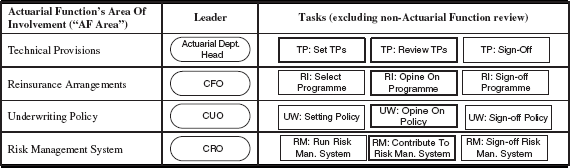
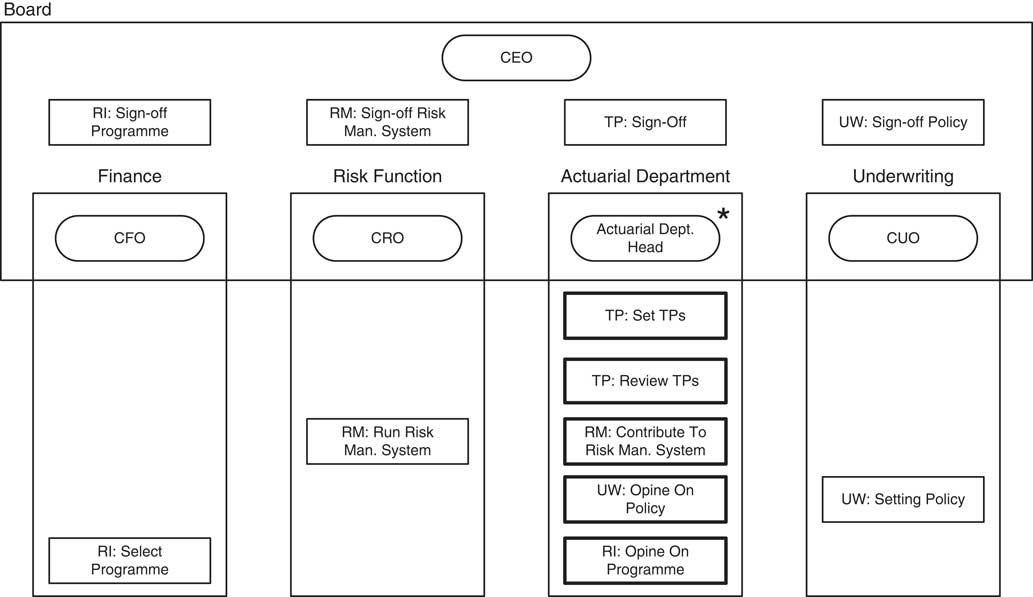
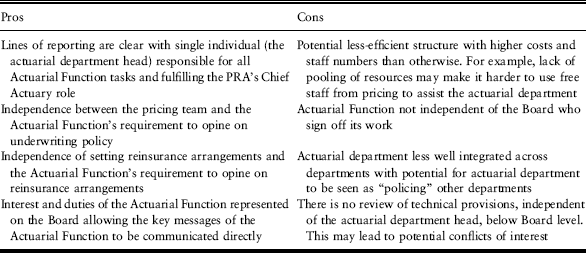
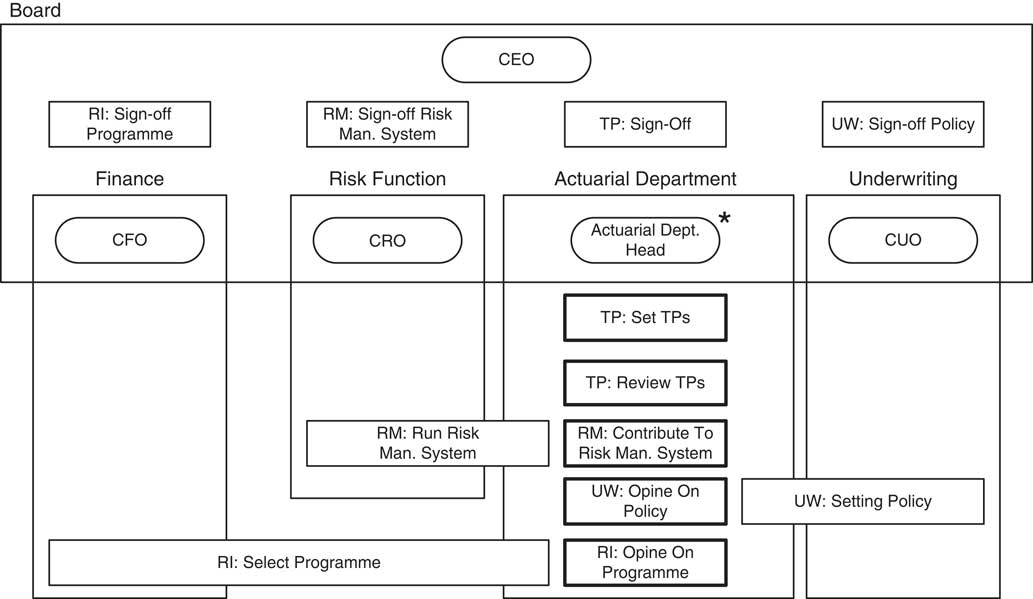
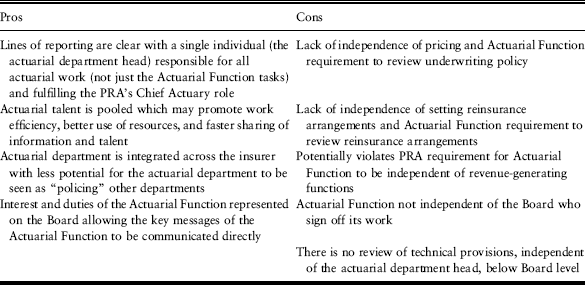
Section 10 of this Report discusses various structures for the Actuarial Function and how it fits into the wider organisation, but whatever formal structure is adopted, certain base principles will need to be met.
The classic “three lines of defence” model has been well documented and illustrated elsewhere, but to put it simply, from the perspective of insurance company governance, the requirements are as follows:
-
∙ First line of defence: processes and controls underpinning all Actuarial Function activity.
-
∙ Second line of defence: governance committees overseeing the first line of defence.
-
∙ Third line of defence: the audit functions (both internal and external) reporting directly to the Board.
The difficulty for a formally constituted Actuarial Function is the overlap between those who do the work and those who must provide the process and control around that work which underlines the first line of defence – the controllership functionality. If that overlap is not properly managed then the second line of defence, which relies on a functioning first line of defence, cannot work properly.
8.2. First Line of Defence
In an ideal world it would of course be simple to ensure proper segregation of all these matters: the Actuarial Function would employ sufficient staff to have separate management reporting lines. Such a department might have:
-
∙ “analysts”: those that do the work;
-
∙ “reviewers”: “second pair of eyes” checkers, or more formal peer reviewers where appropriate; and
-
∙ “controllers”: people more removed from the actual work whose task is to promote checking/reviewing policy (amongst other things) and ensure that such policies are adhered to.
This is often unrealistic as other considerations, such as cost and availability of suitably qualified and experienced people, will always take precedent.
However, a well-managed Actuarial Function will recognise that it is important (even imperative) to acknowledge the need for good governance and will ensure that there is controllership of that governance. While it may be possible to split the controller responsibilities up between various members of the Actuarial Function and ask them to take on the controller responsibilities in addition to their regular tasks, ultimately in order to avoid conflicts of interest it may well be best to accept that one person (not necessarily an actuary) be designated the controller and given the responsibility to act essentially as the guardian of the first line of defence.
The controller would have a number of roles, but their primary role would be to act as the conscience of the Actuarial Function. That is, to remind colleagues of their obligations under the governance policies and to ensure adherence.
8.3. Independence
The PRA have stated that “to the extent warranted by the nature, scale and complexity of the business, the PRA expects the [actuarial function] to be independent of an insurer’s revenue-generating functions, and to possess sufficient authority to offer robust challenge to the business” (Bank of England Prudential Regulation Authority, 2013a, paragraph 118).
As well as the need for its advice to be independent, perhaps just as importantly it needs to be seen to be independent. By “independent” we mean that the advice is demonstrably free of inappropriate influence by any other function in the business and as far as possible not coloured by business considerations where those conflict with unbiased actuarial advice. This can be difficult where there is heavy overlap between the Risk Management Function and Actuarial Function, with staff fulfilling common roles. Difficult, but not impossible. With proper imposition of governance, monitoring and the controllership acting as guardian or even gatekeeper of inputs, models and outputs the aim of demonstrable independence can be achieved. In our survey (see section 3, Q14), 63% of respondents felt the Risk Management Function and the Actuarial Function could be led by the same person without conflicts of interest becoming an issue.
One example with which we are all familiar would be reserving, where it is theoretically possible for pressure to be exerted by the finance function on the actuaries to reduce the reserves to maximise underwriting profit. With properly set out process guidelines for reserve setting (lodged with the controller) and a properly convened reserving governance committee (with ToR formally agreed through the insurer’s risk committee), the Actuarial Function may find it easier to resist pressure and insist that reserves be properly set at a best estimate.
There are obviously many such examples, but by requiring all decisions to be endorsed by a governance committee structure and duly recorded in the minutes, accusations of a lack of independence are much harder to substantiate. That the actuaries “lack commercial understanding” may be a common complaint, but those making it will have to justify their accusations.
Independence for smaller insurers may be a bigger issue due to a reduced ability to separate and segregate roles. The PRA do restrict their requirement above “to the extent warranted by the nature, scale and complexity of the business”; however, the PRA are likely to still expect some degree of demonstrable independence in the Actuarial Function’s work.
8.4. Conflicts of Interest
One of the consequences of a lack of independence is the potential for conflicts of interest. Within an insurer, the issue of a conflict of interest arises when the same person has more than one role and the needs of those roles can potentially be at odds with each other. For example, when an individual is both the author of a piece of work as well as the reviewer or ultimate user. Such circumstances may, inter alia, include between:
-
∙ The calculation and review of technical provisions.
-
∙ The Actuarial Function and general management, possibly because of remuneration arrangements based on profit.
-
∙ The Actuarial Function and underwriting team, given the need to provide an opinion on underwriting policy and differences between reserving and pricing.
-
∙ The Actuarial Function and reinsurance team, given the need to provide an opinion on reinsurance arrangements.
-
∙ Determination of the SCR and capital requirements, and the validation of the model.
-
∙ Group and subsidiaries.
When designing the Actuarial Function, identification of potential conflicts of interest must be a priority, followed by how such potential conflicts can be mitigated. As discussed earlier, where possible this should be by segregation of responsibilities. For example, technical provisions should have proper checking and peer review regimes in place, preferably in distinct reporting lines. Supervision of such regimes would once again be a controllership function.
Where this is not possible because of, for example, restrictions on skills or staff, insurers will have to think carefully how they can establish reporting lines that minimise potential conflicts of interest. This may include the use of external parties to produce the work which the Actuarial Function Deliverer then reviews.
8.5. Documentation
The key to demonstrating independence and avoidance of conflicts of interest is proper documentation. Example might be:
-
∙ Written and agreed policies.
-
∙ Keeping accurate process notes.
-
∙ Setting governance committee ToR.
-
∙ Taking minutes and other evidences of formal decision taking.
-
∙ Setting formal file structures, directories, etc.
-
∙ Logging of changes, issues, developments, etc.
All of the above are key and must be kept properly, ideally by a document librarian in a secure location.
8.6. Governance Summary
The contents of this section may seem bureaucratic and certainly for many will represent a sea change in working culture. But that is what SII is really about – changing habits and imposing or encouraging good behaviours.
The reality is that none of this is actually that arduous and can be achieved even in quite small Actuarial Functions. What it needs is commitment (from senior management to office juniors) and possibly one or two dedicated resources with the influence to make it work.
9. Stakeholders
9.1. Introduction
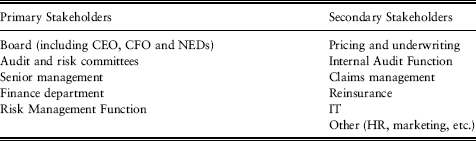
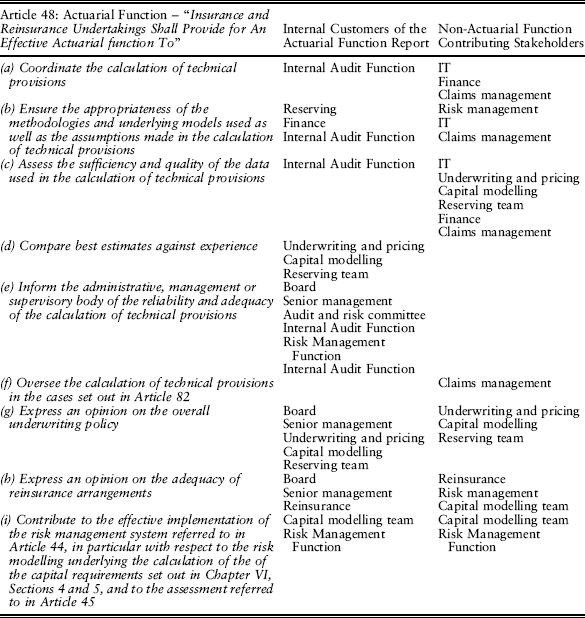
Beyond the requirements of the Directive, the Actuarial Function exists to fulfil the requirements of its various stakeholders. These stakeholders range from the owners of the company through the Board, all the way to the policyholders. Each will have different expectations of the Actuarial Function and therefore different requirements.
Equally, the Actuarial Function cannot work in isolation. SII requires that the Actuarial Function opines on the adequacy of the underwriting and reinsurance arrangements (Commission Directive 2009/138/EC, 2009, Article 48) and implicitly on various other elements within the insurer (as covered in other sections of this paper). In order for the Actuarial Function to be able to make these opinions, it will be required to interact with other departments in the insurer. These interactions may give rise to conflicts of interests. This section focusses on the extent of the interactions and reliance on various stakeholders that the Actuarial Function can place without compromising its ability to provide an independent opinion.
The nature of the interaction between the Actuarial Function and its stakeholders will be driven by the scale of existing actuarial involvement in areas of the firm including reserving, pricing, risk management and reinsurance. For a firm where actuarial involvement is currently limited, the Actuarial Function Report may afford an excellent opportunity, through unfiltered commentary to senior management, for them to demonstrate how they can add value to the firm’s operations through their greater involvement in business decisions. However, in larger firms with well-established actuarial teams already proactively assisting the business with advice and analysis to support decision making, the additional provision of the Actuarial Function Report may simply be a summary of the views expressed throughout the year and a formalisation of existing processes.
There will not be a “one-size-fits-all” approach, and it remains to be seen how much scope the final Regulations allow for variation in report length and content to reflect this situation. In addition, the way the Actuarial Function is structured may have a bearing on how they communicate with their stakeholders, and perhaps more importantly, how those comments are received.
9.2. Stakeholder Categories
We have identified two main categories of internal stakeholders; primary and secondary customers of the Actuarial Function, as given in Table 1.
Primary and Secondary Stakeholders

CEO, Chief Executive Officer; CFO, Chief Financial Officer; NED, Non-executive Director; HR, Human Resources.
Primary stakeholders. These represent groups who have a direct interest in the outputs of the Actuarial Function. They would rely on the Actuarial Function Report as either an indication of the insurer’s performance or in order to inform their own decision-making processes.
Secondary stakeholders. These represent groups who have an indirect interest in the outputs of the Actuarial Function. They may not even be aware of their interest in the outputs and it may be up to the Actuarial Function to make these stakeholders aware of the implications of the Actuarial Function’s output. It is important to note that over time and once the SII is live, some secondary stakeholders may become primary stakeholders.
It is important to note that the classification of stakeholders is also a function of the size of the insurer. For example, in a smaller organisation, individuals may have multiple overlapping responsibilities that may mean some secondary stakeholders, for example, underwriters, become primary stakeholders where they may value the outputs of the Actuarial Function as verification or guidance to their own activities.
It also goes without saying that the Actuarial Function will need to work within the existing culture of the insurer, allowing for any existing relationships the Actuarial Function has with other stakeholders.
How the Actuarial Function communicates with its stakeholders will be critically important. The level of technical detail and the way it is presented will need to be tailored to the recipients and reflect a balance between sufficient precision to be accurate but enough accessibility to be understood.
Table 2 provides an example of the areas where the different stakeholders may align in meeting the Directive’s requirements.
Stakeholders and Directive Requirements

9.3. Stakeholder Requirements
It is important to recognise from the outset the requirements of each key stakeholder of the Actuarial Function. We list key stakeholders below and discuss possible requirements from, and interactions with, the Actuarial Function.
9.3.1. Board of directors
Role. The Board is tasked by the owners of the insurer to run the company. They are therefore a primary customer of the Actuarial Function. Their primary interest is to ensure that they are informed of all key actions within the insurer and set the strategy and vision for the insurer. The Board is ultimately responsible for the setting of technical provisions within the insurer.
Requirements from Actuarial Function. The Board would need to know the following from the Actuarial Function:
-
∙ The contribution the required SII technical provisions make to the performance of the company.
-
∙ Any underlying analytics on performance, for example, profit or loss attribution.
-
∙ Areas of uncertainty or risk that the insurer faces in respect of the SII technical provisions.
Interaction with Actuarial Function. The Board would be expected to respond to the items raised by the Actuarial Function. The Board would set out an area for investigation, provide management actions where necessary or make a decision to be executed by the Actuarial Function or other departments in the insurer.
9.3.2. Chief Financial Officer (CFO)
Role. The CFO is responsible for the preparation of the accounts among other obligations. Their primary interest is the accuracy of the technical provisions which typically forms the bulk of an insurance company’s liabilities.
Requirements from Actuarial Function. The CFO will need to be one of the final reviewers of the Actuarial Function Report. The CFO may also be the only representative at Board meetings with responsibilities for the reserves. They will therefore need to be comfortable with what the Actuarial Function Report indicates and may even provide input to the report itself. In addition, the CFO will need to be familiar with the differences between the technical provisions for accounting purposes and for SII. For smaller companies, it is plausible that the CFO may be the owner of the Actuarial Function Report.
Interaction with Actuarial Function. The CFO is reliant on the Actuarial Function to complete its SII technical provision calculations accurately, which it then may peer review. The CFO may seek to influence the level of technical provisions set or the way the Actuarial Function Report is written in terms of both style and content. The Actuarial Function will therefore need to maintain its independence, and be aware of possible conflicts in its responsibilities to the Board and any undue influence that may be exerted by the CFO.
9.3.3. Audit and risk committee
Role. This committee is charged with oversight of the firm’s audit (including the auditors), risk management and internal controls, and annual financial statements. They may be separate functions in larger insurers.
Requirements from Actuarial Function. The committee would need to review the Actuarial Function Report and provide the Board with steer on any issues or trends arising.
Interaction with Actuarial Function. The committees may consist of non-actuaries and their challenge to the Actuarial Function will be important. The interaction will improve the level and type of communication used by actuaries. On the other hand, it will be a good way to educate the non-actuarial members on actuarial matters.
9.3.4. Risk Management Function
Role. SII is designed to be a risk-based prudential supervisory regime involving an enterprise-wide view of risks and a risk-based capital system. Recently, there has been a greater focus on risk management. The Risk Management Function is a formal requirement (Commission Directive 2009/138/EC, 2009, Article 44, paragraph 4) and together with the Actuarial Function it is seen as a key component of the risk management system. The Risk Management Function’s key tasks include:
-
∙ Defining risk policy and risk appetite.
-
∙ Capital management.
-
∙ Identifying conflict and conflict resolution.
-
∙ Maintaining a risk register.
-
∙ Measuring operational risk.
-
∙ Managing non-quantifiable risks.
-
∙ Identifying emerging risks.
Many firms now have a Chief Risk Officer (CRO) who will head this function. They will be responsible for managing the risks and opportunities facing the insurance company. They therefore need to be fully aware of all risks including emerging and latent risks, including reserve risk.
Requirements from Actuarial Function. The Actuarial Function may contribute (or take the lead) to the effective working of the Risk Management Function to meet regulatory obligations. It may also work together with the Risk Management Function to further the insurer’s commercial objectives. The CRO needs to be made aware of any new risks that the Actuarial Function identifies. This may include reserve risk, operational risk or underwriting risk. The CRO is also likely to own the internal model and would need to understand how the SII technical provisions impact on the capital modelling and vice versa (see 9.3.10 section).
Interaction with Actuarial Function. The Actuarial Function plays a role in the risk identification process of the Risk Management Framework. They may also continue to play a role in risk monitoring and these items may be covered in the Actuarial Function Report.
The potential for conflicts of interest may depend on the structure of the Risk Management Function and how independence is maintained. For example, for small firms risk management may be very much part of the Actuarial Function. For larger firms, there may be three lines of defence approach where the Risk Management Function may be used to validate the Actuarial Function Report.
The Society of Actuaries in Ireland (2013) has reviewed the interaction of the Actuarial Function and Risk Management Function and point out that a close working relationship is envisaged between the Risk Management Function’s responsibility to “facilitate the implementation of the risk-management system” (Commission Directive 2009/138/EC, 2009, Article 44, paragraph 4) and the Actuarial Function’s responsibility to “contribute to the effective implementation of the risk-management system” (Commission Directive 2009/138/EC, 2009, Article 48, paragraph 1(i)). This is summarised in Figure 1.
Interaction of actuarial function and risk management system (Murphy, Society of Actuaries in Ireland, 2013)

9.3.5. IT department
Role. IT has an integral part to play within the Actuarial Function in so far as systems are concerned. Without IT, it would be impossible to meet the Directive requirements. A Chief Information Officer (CIO) has responsibilities for the delivery and quality of data used in the reserving exercise. For larger insurers, the CIO’s responsibilities may not extend to the final system used by the Actuarial Function. This may be because the system is owned and controlled by the Actuarial Function itself.
Requirements from Actuarial Function. It is difficult to envisage the IT department to have an interest in the technical aspects of the Actuarial Function Report. However, there may be relevant sections on data, systems and processes that will be of interest. In particular, a CIO needs to be aware of any data delivery or quality issues that may affect the accuracy of the SII technical provisions estimation process.
Interaction with Actuarial Function. It is very likely that most of the IT department are technology specialists with little or no actuarial knowledge. Most interaction will be upfront. The involvement of IT may be heavy in setting up the processes initially, with intermittent involvement over time, for example, when new products are launched, during takeovers or when systems are changed, etc. The nature of involvement will depend on various factors; for example, type of systems, complexity of business, costs, expertise, etc.
An established player will have many legacy systems so it would be imperative to get IT involved during the planning stages and continued support is likely. The Delegated Acts says “The Actuarial Function shall assess whether the information technology systems used in the calculation of technical provisions sufficiently support the actuarial and statistical procedures” (Commission delegated regulation (unnumbered), 2014, Article 272, paragraph 3). This gives the Actuarial Function a level of responsibility over IT systems potentially managed by the IT department.
The Actuarial Function will need to identify all data issues to the CIO. Data quality maintenance is often an ongoing exercise. The Actuarial Function may therefore only want to catalogue data issues, either resolved or not, that are of high materiality. It should be noted that any resolutions to data issues must be weighed against the materiality of the data as well as the ability to deliver its obligations on time.
9.3.6. Internal Audit Function
Role. The role of Internal Audit Function is to provide independent assurance that an insurer’s risk management, governance and internal control processes are operating effectively. The structure and make up of Internal Audit Functions within insurers may vary depending on the size of the organisation and management. For example, small firms may outsource their Internal Audit Function; larger firms may have actuaries in their internal audit teams.
Requirements from Actuarial Function. The Internal Audit Function may use the output from the Actuarial Function to build independent risk-oriented audit plans (European Confederation of Institutes of Internal Auditing, n.d.). The Internal Audit Function should work proactively to enhance effective collaboration, clear responsibilities and peer acceptance with the Actuarial Function.
Interaction with Actuarial Function. Internal audits are typically carried out by non-actuaries and are historically focussed on the actuarial process rather than the actuarially technical content (although this may now be changing). Depending on the size and maturity of the insurer, a focus on the content may be driven by the Internal Audit Function. Lloyd’s guidance, for instance, suggests that data auditing is a task that should be performed not by the Actuarial Function but by the Internal Audit Function (Lloyd’s of London, 2012).
The level of oversight may be an area of disagreement between the Actuarial Function and the Internal Audit Function. For example, too many controls may be seen as “gold plating” and not be proportional to the risk.
Small insurers may outsource the Internal Audit Function, so it may be possible for audit teams to carry out some of the requirements of the Actuarial Function where these outsourcing firms have the appropriate mathematical or actuarial expertise. Clearly, there may be conflicts of interest considerations in this model as Internal Audit is responsible for independent reviews.
The Internal Audit Function of larger insurers may incorporate actuaries who can perhaps express an opinion on the overall underwriting policy or on the adequacy of reinsurance arrangements. In fact, actuaries within internal audit may be suitably placed to meet some of the requirements in these areas of the Directive (Commission delegated regulation (unnumbered), 2014, Article 272, paragraphs 3, 4, 6 and 7). This could cause unnecessary confusion and duplication of responsibilities, with negative impact on the efficiency and effectiveness of the internal control system. A good coordination between the governance functions is vital.
SII presents a challenge for the Internal Audit Function as there may still be a long way to go for many insurers to fully comply with the new Regulations and the existing Chartered Institute of Internal Auditors Standards. This applies in particular in the area of the independence of the Internal Audit Function. This is crucial, if the Internal Audit Function wants to act as the objective assurance function for the Board.
9.3.7. Reinsurance team
Role. The reinsurance team is responsible for the purchasing and structuring of the company’s reinsurance programme. They also have responsibilities for controlling the counter-party default risk posed when purchasing reinsurance.
Requirements from Actuarial Function. The reinsurance team may look to the Actuarial Function to validate the reinsurance structure. They would also be interested in any reinsurance profitability studies that the Actuarial Function performs.
Interaction with Actuarial Function. The Actuarial Function will provide their opinion of the reinsurance costs and structure, as required by the Directive. It is possible this input may be at odds with the reinsurance team’s views, so in turn the reinsurance team may seek to influence the Actuarial Function. The reinsurance team may provide information which would be necessary for the setting of the technical provisions, or other actuarial tasks.
The Actuarial Function may provide technical support to the reinsurance team but it is important to remember that reinsurance purchasing is also based on the relationships between the insurer and the reinsurers, and not purely on the technical calculations of the underlying reinsurance. Actuarial Function comments about the reinsurance programme should be constructive and bear this in mind.
9.3.8. Underwriting team
Role. Underwriting and pricing teams are responsible for selecting the risks and calculation of premiums.
Requirements from Actuarial Function. Reserving and pricing are deemed to be different sides of the same coin. Typically, they affect each other. For example, poorly priced risks may result in strengthening reserves in the future, or poor reserving may result in increasing prices, etc. The Actuarial Function Report may be useful for these teams to enhance pricing or underwriting practices, for example, by understanding experience versus pricing, comparing assumptions, expert judgements, etc.
Interaction with Actuarial Function. Underwriting and pricing teams generally have a mix of staff (including underwriters, statisticians, actuaries and programmers). These areas of expertise may be able to provide some input to the Actuarial Function Report. For example, an independent review of the underwriting policy may involve interviews with these teams.
The Actuarial Function will provide their opinion of the underwriting policy, as required by the Directive. It is possible this input may be at odds with the underwriting team’s views, so in turn the underwriting team may seek to influence the Actuarial Function.
Note that smaller firms may share personnel carrying out the pricing and reserving function so there may need to be some thought on how it may work going forward. There may also be traditional barriers of interaction that may need to be overcome to achieve this separation of functions.
It may be possible that some independence issues can be avoided by actuaries in the underwriting team reviewing the work of the Actuarial Function.
9.3.9. Claims team
Role. The claims team controls the level at which claims are settled. They often are the main face of the insurer as policyholders tend to remember an insurance company by their dealings with the claims team.
Requirements from Actuarial Function. The claims team would be interested in having an independent assessment of the level of claims leakage. They would also be interested in whether the Actuarial Function has identified any trends in the claims.
Interaction with Actuarial Function. The Actuarial Function should already have a close working relationship with the claims team through their ongoing reserving activities. It is important for a successful Actuarial Function to have a transparent relationship with the claims team. An honest and open relationship should ideally allow both the Actuarial Function and the claims team to give and accept any constructive criticism of each other’s processes. This is important as any criticism from the Actuarial Function of the claims team where the relationship is strained may only be detrimental.
Potentially, this close working relationship may give rise to conflicts as the Actuarial Function must be seen to be independent although working closely with the claims team. Possible ways of addressing this may be to establish ethical walls where one section of the Actuarial Function works closely with the claims team while another provides an opinion of its workings.
9.3.10. Capital modelling
Role. The capital modelling team has responsibilities to build the insurer’s capital model and in determining the capital requirements of the insurance company. These include all parts of the balance sheet including requirements on insurance risk. The capital modelling team may be under the leadership of the Risk Management Function.
Requirements from Actuarial Function. The capital modelling team depends on the Actuarial Function to calculate the technical provisions, including the risk margin. It would need both the results of the reserving exercise and the parameter calibrations for the insurance risk elements of the capital model. It would also need the associated documentation for the technical provisions as part of the internal model documentation. The Actuarial Function will also need to support the capital modelling team in their analysis of change of the internal model results by providing additional analysis or results on the technical provisions or on the insurance risk elements.
Interaction with Actuarial Function. There will be a high level of interaction between the Actuarial Function and the capital modelling team. The capital modelling team may act as a review point for the technical provisions or calibration as the capital modelling team have an obligation to assess all data going into the capital model. Conversely, the Actuarial Function may also need the capital calculation results from the capital modelling team to calculate the risk margin component of the technical provisions. This may mean that the Actuarial Function could act as a review point of the risk margin calculation.
9.3.11. Finance function
Role. The finance function will typically be responsible for raising capital, budgeting and managing cash flows, the P&L and balance sheet. There are many other duties, especially with smaller firms where the finance function may be also in charge of reserving.
Requirements from Actuarial Function. Undoubtedly, the finance function will be interested in the Actuarial Function Report. SII introduces requirements that differ from either IFRS or UK GAAP account requirements. It will be necessary for the finance function to understand the subtleties of SII and how this could affect decision making, for example, capital requirements, budgeting, strategy, etc.
Interaction with Actuarial Function. Finance teams in insurers historically consist mainly of non-actuaries although there is some evidence of this changing. Depending on how the finance function is structured and the method used to calculate the technical provisions, a significant amount of input will be required to understand the data quality, and processes and systems used. There may be interaction with the other areas of the firm, for example IT.
9.4. Raising Awareness of the Actuarial Function
As mentioned before, not all stakeholders of the Actuarial Function may be aware or interested in the output of the Actuarial Function. Increasingly, actuarial teams are finding themselves needing to be more transparent with their analysis and results to both the regulators and the business. The Actuarial Function can no longer be the back room actuaries who are never seen by the business.
Interaction between the Actuarial Function and the business will differ based on the size of the insurer and the culture within it. For larger insurers, it may make sense to have an individual within the Actuarial Function who interacts with a particular line of business. This ongoing interaction with the business then fosters a relationship that can be used to start sharing results of the Actuarial Function’s work with the other parts of the business. It is important to bear in mind that the commercial view of the business may differ to the technical or statistical view of the business, and therefore internal messaging may need to be different to that given to a typical technical audience.
10. Organisational Structure
10.1. Introduction
There are a number of high-level issues to consider in coming up with an operational structure which reflects the needs of the Actuarial Function and wider business. Many of these have been discussed in detail elsewhere in this report. In this section, we will bring them all together and discuss their practical implications. Key considerations are:
-
∙ The Regulations and other guidance: all organisations, at a bare minimum will need to comply at this level. It may include, inter alia, the PRA Senior Manager’s Regime, the IFoA’s practicing certificate regime, Regulations published by EIOPA, Lloyd’s regulation, etc. The firm should decide who is responsible for this and whether, for example, the Compliance Function oversees the adherence to all requirements or responsibility is given to individual owners (such as the Actuarial Function Deliverer) and technical teams to demonstrate compliance.
-
∙ Independence and conflicts of interest: the PRA requires that the Actuarial Function is free from influence from the revenue-generating functions of the firm (Bank of England Prudential Regulation Authority, 2013a, paragraph 118). Further, it is important that the Board receives advice, which is both independent from the revenue-generating functions of the firm and seen to be independent. This may be difficult to achieve where key function duties overlap. The firm should decide on the structure and governance which best meet its needs and demonstrate compliance here.
Note that the Directive states that “… save as regards the internal audit function, in smaller and less complex undertakings it should be possible for more than one function to be carried out by a single person or organisational unit” (Commission Directive 2009/138/EC, 2009, recital 32).
The Actuarial Function Deliverer may be on the Board. Where this is the case, as long as the individual can provide its opinion independently and free from influence from other Board members this should be acceptable.
-
∙ Deciding on a “Chief Actuary”: in this context, the Chief Actuary is the individual responsible for delivering the tasks of the Actuarial Function under Article 48 of the Directive, as defined by the PRA (see section 7). In the transitional phase, the PRA has stated that it “may approach those persons the firm or group identify as key function holders ahead of Solvency II to understand better how a firm’s preparations are proceeding” (Bank of England Prudential Regulation Authority, 2013b, paragraph 3.10).
-
∙ Availability of suitably qualified and experienced (fit and proper) resource: this is necessary in each insurer and in the market as a whole (as this drives the ability to recruit appropriate staff, if required). The needs of individual insurers will vary depending on the size and nature of the organisation.
In comparing example structures below, we have considered the above factors. Additional considerations will include:
-
∙ Non-SII requirements: the primary purpose of this document is to discuss the requirements of the Directive and how these may be implemented in insurers. There will however be other needs, often specific to individual insurers, which we have not considered.
-
∙ What is practical and already being done?: the Actuarial Function is a list of tasks which need performing by suitably qualified and experienced individuals, internal or external to the firm, not necessarily by the traditional “actuarial department”. Many of the duties are likely to be already taking place, so setting up a formal “function” in line with these existing roles is likely the most appropriate option. Firms will need to ensure that all the requirements are, however, being fully met and reported to the Board.
-
∙ Addressing complexity: for example, the relative complexity of using an internal model versus Standard formula; the complexity of business written including number of lines; length of claims’ tails; volatility in claims experience, etc.
-
∙ Setting and adhering to a risk appetite.
-
∙ The need (or not) for a Target Operating Model or equivalent incorporating the desires of the Board.
-
∙ Interaction with other departments and key functions of the firm: the Actuarial Function will both use data and information from the wider firm and supply data and information to other teams and functions. In determining how the Actuarial Function can carry out its duties, the wider teams’ responsibilities need to be well understood. For example, what checks are performed on data before it being supplied to the Actuarial Function? What additional checks does the Actuarial Function need to perform?
Interaction with other key SII functions is critical. For example, the link between the Risk Management Function owning the internal model and ORSA and the Actuarial Function’s contribution to this. While independence would ideally be maintained, these two functions need to operate closely.
See section 9.
-
∙ Outsourcing: the insurer may wish to consider if it is more suitable to externally resource the duties and role of the Actuarial Function, either partially or completely, subject to Article 49 of the Directive. Again, this will likely depend upon the size and nature of the insurer.
These issues should feed into the proposed structures of the insurer. There is no practical value in coming up with an “ideal” structure which is fundamentally unachievable for companies.
10.2. Example Structures
Actuaries may be involved in many parts of the business, but the Actuarial Function, as defined by Article 48 of the Directive, is required to be involved in only four (“Actuarial Functions (AF) Areas”):
-
∙ technical provisions;
-
∙ reinsurance arrangements;
-
∙ underwriting policy; and
-
∙ the risk management system.
For each of these areas, in most insurers there is likely to be an existing role which naturally takes the lead, but does not necessarily carry out all the tasks. For example, the CRO may lead risk management but will most likely rely on the actuarial department for some of the inputs to the internal model.
For simplicity, we can divide the work of each of the AF Area into:
-
∙ performing the work of the AF Area;
-
∙ reviewing the work of the AF Area; and
-
∙ sign off.
Again, for simplicity, we will ignore where “reviewing the work of the AF Area” is not carried out by the Actuarial Function, as we are only concerned here with how the Actuarial Function fits into the wider insurer.
By way of example, we could divide the reinsurance arrangements AF Area, into “selecting the reinsurance programme”, “non-actuarial function review of the reinsurance programme”, “actuarial function opinion on the reinsurance programme” (to meet its obligation under Article 48, paragraph 1(h)) and “sign off of the reinsurance programme”. We will not be concerned with the “non-actuarial function review of the reinsurance function”.
When determining the structure of an insurer to meet the requirements of the Directive, it is how these tasks are completed, by whom and how they interact with others that matters.
Table 3 sets out the tasks in which the Actuarial Function is interested.
Actuarial Function’s Areas of Involvement

In the following examples of insurer structures:
-
∙ The five boxes with a bold border (□) indicate tasks required by Article 48 of the Directive to be completed by the Actuarial Function.
-
∙ An asterisk (*) indicates the individual fulfilling the role of “Chief Actuary” as defined by the PRA.
-
∙ We use the term “actuarial department” to differentiate the group of actuaries within an insurer (usually led by a Chief Actuary or equivalent) from the Actuarial Function as defined by Article 48. These are not necessarily the same.
-
∙ Consistent with section 6.2, “UW: setting policy” includes pricing (which may already include actuarial input).
There will never be a single structure suitable for all insurers. In the following examples we have considered a sample of structures which could meet the four key considerations listed previously and have added discussions around the relative pros and cons of each. The list given is not exhaustive and the implementation in each insurer will be different.
10.2.1. Structure 1
The first example structure is one arranged around the requirements of the Directive, with the actuarial department only performing the tasks assigned to the Actuarial Function. Other potential actuarial tasks, most notably pricing (but potentially also contributing to the building of the internal model or developing the reinsurance programme) are the responsibility of other departments, where additional actuarial resources may sit. The actuarial department head is the PRA’s Chief Actuary who sits on the board and contributes to the sign off of all four AF Areas (Figure 2).
Example Structure 1

The main strength of this arrangement is the separation of the performing and the actuarial reviewing of the underwriting policy and reinsurance arrangements AF Areas. Its biggest potential weakness is the splitting of actuarial resources between different departments (e.g. a separate pricing team), potentially leading to higher staffing requirements and costs (Table 4).
Structure 1: Pros and Cons

PRA, Prudential Regulation Authority.
10.2.2. Structure 2
Under this structure, all actuarial tasks (not just Actuarial Function tasks) are contributed to by the actuarial department. This includes contributing to pricing, the internal model and developing the reinsurance programme. Again, the actuarial department head is the PRA’s Chief Actuary who sits on the board and contributes to the sign off of all four AF Areas (Figure 3).
Example Structure 2
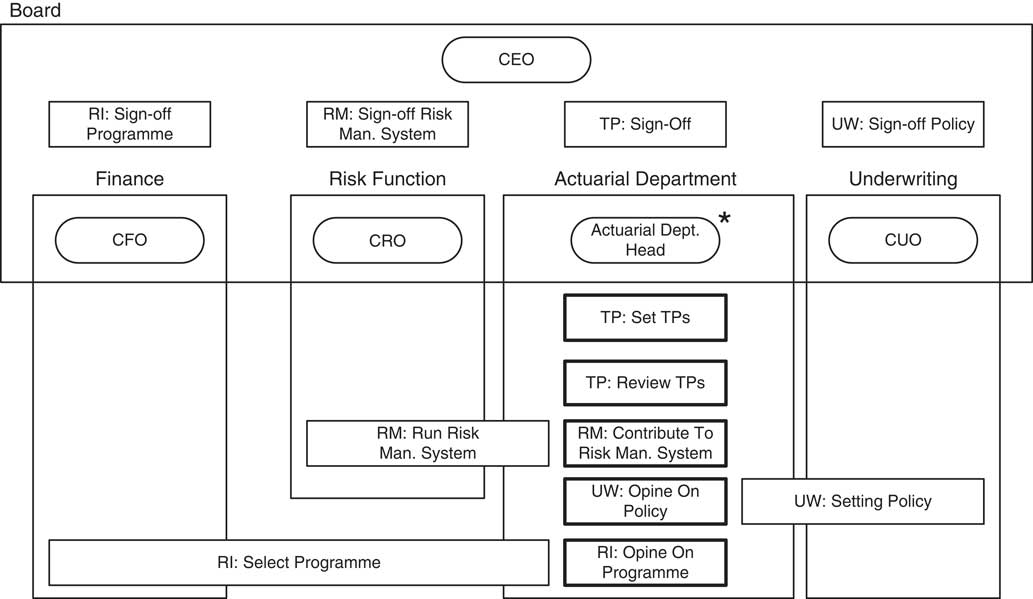
In a reverse to structure 1, the main strength of this arrangement is its potential staff efficiency with its biggest potential weakness being the lack of independence between performing and reviewing its work in the AF Areas (Table 5).
Structure 2: Pros and Cons

PRA, Prudential Regulation Authority.
10.2.3. Structure 3
In this structure, the actuarial department and its head are only responsible for the technical provisions AF Area. The actuarial contributions to the other three AF Areas are the responsibility of the lead in the relevant department. For example, the chief underwriting officer is responsible for the Actuarial Function review of the underwriting policy (Figure 4).
Example Structure 3
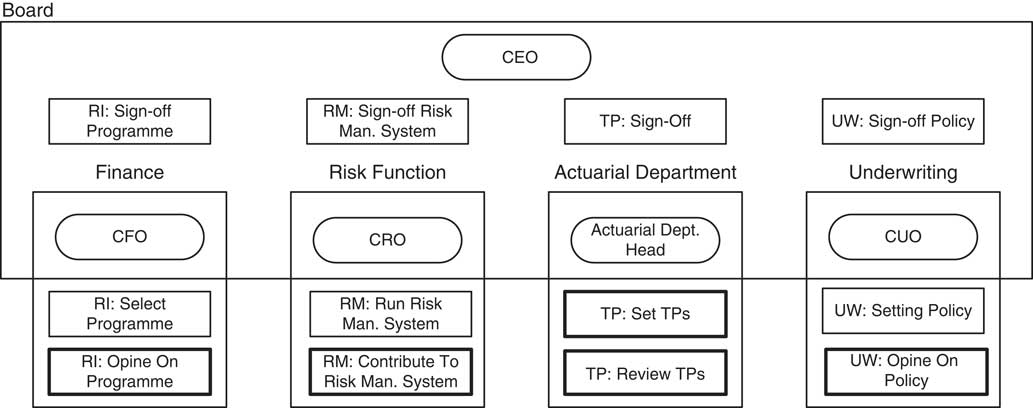
This structure has significant drawbacks with limited benefits. Not clear who the PRA’s Chief Actuary would be unless the role is shared, as collectively the department heads would need to take responsibility for the Actuarial Function tasks. The PRA do not appear keen on this sort of arrangement. They say the norm should be one person as Chief Actuary, although there is some flexibility (e.g. job sharing) (Bank of England Prudential Regulation Authority, 2014b, appendix 2, section 2.10) (Table 6).
Structure 3: Pros and Cons

10.2.4. Structure 4
This example structure is similar to structure 1 (but could equally be based on structures 2 or 3). The key difference is that the actuarial department head does not sit on the Board and instead reports to the CRO (Figure 5).
Example Structure 4
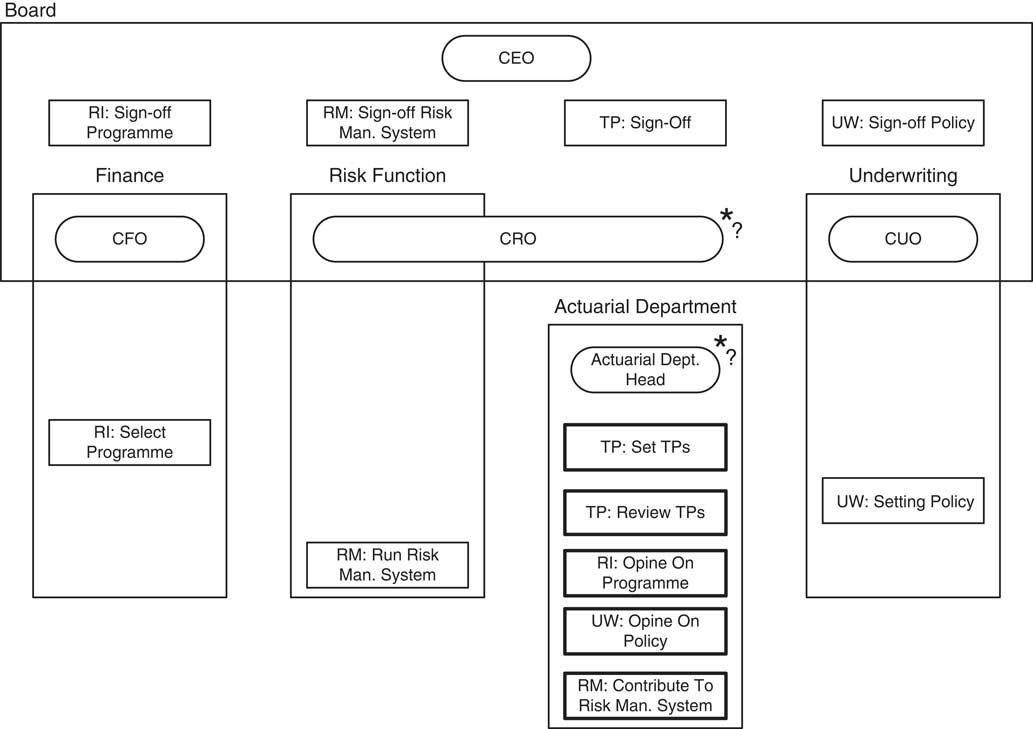
Whilst this potentially adds an extra layer of review of the technical provisions below the Board, this may lead to unnecessary duplication, particularly in smaller insurers. The key pros and cons of the removal of the actuarial department head from the Board (beyond those addressed in earlier example structures) are given in Table 7.
Structure 4: Pros and Cons

CRO, Chief Risk Officer; PRA, Prudential Regulation Authority.
10.2.5. Structure 5
In this structure, the CRO duties and responsibilities include those of the actuarial department head. This is similar to structure 4, but the CRO and actuarial department head are the same individual (Figure 6).
Example Structure 5

The key pros and cons from the merging of the CRO and actuarial department head roles (beyond those addressed in earlier example structures) are given in Table 8.
Structure 5: Pros and Cons

CRO, Chief Risk Officer; PRA, Prudential Regulation Authority.
10.2.6. Structure 6
Here we remove the actuarial department completely and reassign its work to other departments. It takes structure 3 one step further by allocating the technical provisions AF Area to the finance department. This may be more suitable for smaller insurers with limited resources, or where non-actuaries carry out the tasks of the Actuarial Function (Figure 7).
Example Structure 6
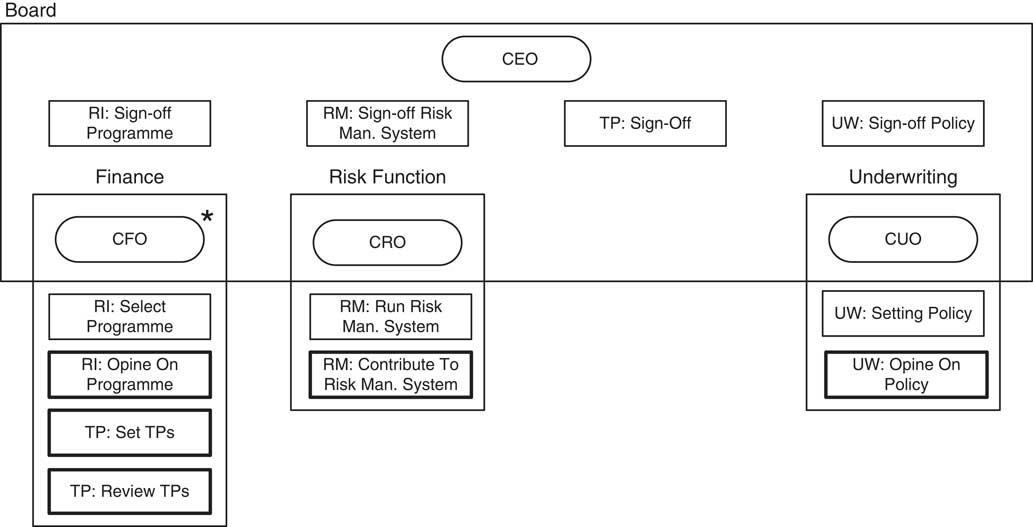
The key pros and cons of moving the technical provisions tasks to the finance department beyond those described in structure 3 are given in Table 9.
Structure 6: Pros and Cons

CFO, Chief Finance Officer; PRA, Prudential Regulation Authority.
10.2.7. Structure 7
Here, the actuarial department provides a review role, completely independent of the Board. The technical provisions are set by the finance department and the actuarial department head, the PRA’s Chief Actuary, does not sit on the Board (Figure 8).
Example Structure 7
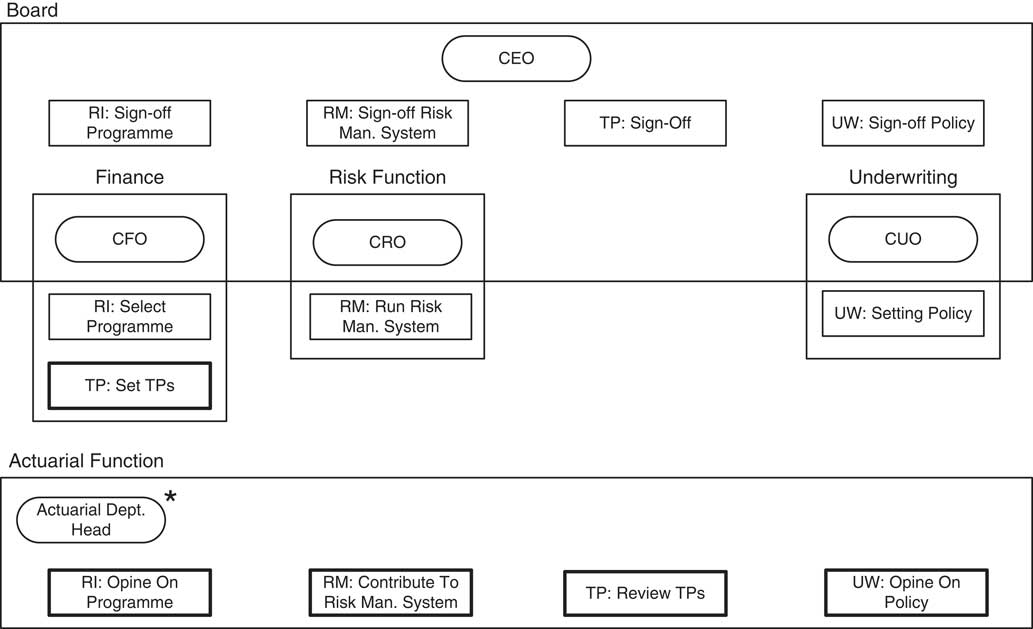
This approach maximises the independence between performing and reviewing the tasks of the AF Areas. The key advantages and disadvantages of this approach compared with the other structures are given in Table 10.
Structure 7: Pros and Cons

PRA, Prudential Regulation Authority.
10.2.8. Structure 8
The final example structure represents one where the whole actuarial department is outsourced. However, the “actuarial department head” is still an employee of the insurer, sits on the Board and acts as the PRA’s Chief Actuary. Note that the CFO could potentially fulfil this role (Figure 9).
Example Structure 8

This set-up may be useful for smaller insurers who do not have their own actuarial departments, but it may cede significant control and understanding to the external service provider. The key advantages and disadvantages of this approach compared with the other structures are given in Table 11.
Structure 8: Pros and Cons

PRA, Prudential Regulation Authority.
We note we can see nothing to say the actuarial department head role and hence PRA’s Chief Actuary role could not be ceded to the outsourced actuarial department.
Appendix A: Level 1 – Article 48 of the Solvency II Directive
(Commission Directive 2009/138/EC, 2009)
Article 48
Actuarial Function
-
1. Insurance and reinsurance undertakings shall provide for an effective Actuarial Function to:
-
a. coordinate the calculation of technical provisions;
-
b. ensure the appropriateness of the methodologies and underlying models used as well as the assumptions made in the calculation of technical provisions;
-
c. assess the sufficiency and quality of the data used in the calculation of technical provisions;
-
d. compare best estimates against experience;
-
e. inform the administrative, management or supervisory body of the reliability and adequacy of the calculation of technical provisions;
-
f. oversee the calculation of technical provisions in the cases set out in Article 82 (data quality and application of approximations, including case-by-case approaches, for technical provisions);
-
g. express an opinion on the overall underwriting policy;
-
h. express an opinion on the adequacy of reinsurance arrangements; and
-
i. contribute to the effective implementation of the risk-management system referred to in Article 44, in particular with respect to the risk modelling underlying the calculation of the capital requirements set out in Chapter VI, sections 4 and 5, and to the assessment referred to in Article 45.
-
-
2. The Actuarial Function shall be carried out by persons who have knowledge of actuarial and financial mathematics, commensurate with the nature, scale and complexity of the risks inherent in the business of the insurance or reinsurance undertaking, and who are able to demonstrate their relevant experience with applicable professional and other standards.
Appendix B: Level 2 – Delegated Acts
(Commission delegated regulation (unnumbered), 2014)
Article 272
Actuarial Function
-
1. In coordinating the calculation of the technical provisions, the Actuarial Function shall include all of the following tasks:
-
a. apply methodologies and procedures to assess the sufficiency of technical provisions and to ensure that their calculation is consistent with the requirements set out in Articles 75–86 of Directive 2009/138/EC;
-
b. assess the uncertainty associated with the estimates made in the calculation of technical provisions;
-
c. ensure that any limitations of data used to calculate technical provisions are properly dealt with;
-
d. ensure that the most appropriate approximations for the purposes of calculating the best estimate are used in cases referred to in Article 82 of Directive 2009/138/EC;
-
e. ensure that homogeneous risk groups of insurance and reinsurance obligations are identified for an appropriate assessment of the underlying risks;
-
f. consider relevant information provided by financial markets and generally available data on underwriting risks and ensure that it is integrated into the assessment of technical provisions;
-
g. compare and justify any material differences in the calculation of technical provisions from year to year;
-
h. ensure that an appropriate assessment is provided of options and guarantees included in insurance and reinsurance contracts.
-
-
2. The Actuarial Function shall assess whether the methodologies and assumptions used in the calculation of the technical provisions are appropriate for the specific lines of business of the undertaking and for the way the business is managed, having regard to the available data.
-
3. The Actuarial Function shall assess whether the information technology systems used in the calculation of technical provisions sufficiently support the actuarial and statistical procedures.
-
4. The Actuarial Function shall, when comparing best estimates against experience, review the quality of past best estimates and use the insights gained from this assessment to improve the quality of current calculations. The comparison of best estimates against experience shall include comparisons between observed values and the estimates underlying the calculation of the best estimate, in order to draw conclusions on the appropriateness, accuracy and completeness of the data and assumptions used as well as on the methodologies applied in their calculation.
-
5. Information submitted to the administrative, management or supervisory body on the calculation of the technical provisions shall include at least a reasoned analysis on the reliability and adequacy of their calculation and on the sources and the degree of uncertainty of the estimate of the technical provisions. That reasoned analysis shall be supported by a sensitivity analysis that includes an investigation of the sensitivity of the technical provisions to each of the major risks underlying the obligations which are covered in the technical provisions. The Actuarial Function shall clearly estate and explain any concerns it may have concerning the adequacy of technical provisions.
-
6. Regarding the underwriting policy, the opinion to be expressed by the Actuarial Function in accordance with Article 48(1)(g) of Directive 2009/138/EC shall at least include conclusions regarding the following considerations:
-
a. sufficiency of the premiums to be earned to cover future claims and expenses, notably taking into consideration the underlying risks (including underwriting risks), and the impact of options and guarantees included in insurance and reinsurance contracts on the sufficiency of premiums;
-
b. the effect of inflation, legal risk, change in the composition of the undertaking’s portfolio and of systems which adjust the premiums policy holders pay upwards or downwards depending on their claims history (bonus–malus systems) or similar systems, implemented in specific homogeneous risk groups;
-
c. the progressive tendency of a portfolio of insurance contracts to attract or retain insured persons with a higher risk profile (anti-selection).
-
-
7. Regarding the overall reinsurance arrangements, the opinion to be expressed by the Actuarial Function in accordance with Article 48(1)(h) of Directive 2009/138/EC shall include analysis on the adequacy of the following:
-
a. the undertaking’s risk profile and underwriting policy;
-
b. reinsurance providers taking into account their credit standing;
-
c. the expected cover under stress scenarios in relation to the underwriting policy;
-
d. the calculation of the amounts recoverable from reinsurance contracts and special purpose vehicles.
-
-
8. The Actuarial Function shall produce a written report to be submitted to the administrative, management or supervisory body, at least annually. The report shall document all tasks that have been undertaken by the Actuarial Function and their results, and shall clearly identify any deficiencies and give recommendations as to how such deficiencies should be remedied.
Appendix C: Full Survey Results
See section 3 for further details.
Question 1

Question 2

Question 3

Question 4

Question 5

Question 6

Question 7

Question 8

Question 9

Question 10

Question 11

Question 12

Question 13

Question 14

Question 15

Glossary