INTRODUCTION
Caregiving for cancer patients is a demanding task for healthcare providers.
A cancer diagnosis has a traumatic and overwhelming impact on patients' psychological and physical balance. In order to improve patients' quality of life and to provide them with the assistance and care required for the healing process, healthcare providers find that on a daily basis they are dealing with the same demands that patients themselves have to face. Often they are emotionally exhausted, as they do not possess the technical and theoretical tools that may help in gauging patients' reactions and psychological suffering, and thereby they run the risk of being overwhelmed by their own feelings and thoughts. From the literature, it emerges that nowadays burnout syndrome has become very frequent in healthcare professionals whether they be physicians or nurses (Kash et al., Reference Kash, Holland and Breitbart2000; Quattrin et al., Reference Quattrin, Zanini and Nascig2006; Whippen & Canellos, Reference Whippen and Canellos1991). Burnout may be defined as: “a mental or physical energy depletion after a period of chronic, unrelieved job-related stress” (Maslach & Jackson, Reference Maslach and Jackson1981).
Each individual type of cancer has its own specific consequences on the patient's well being (Zabora et al., Reference Zabora, Brintzenhofe Szoc and Curbow2001) and these require specific skills on the part of healthcare providers. Regarding gynecologic cancers, patients and providers, albeit from different perspectives, have to face issues such as mutilation following major surgeries, loss of childbearing ability and parenthood, induced menopause and hormonal changes, long and debilitating treatment sessions, impaired sexuality, and fear of death and loss (Sichel, Reference Sichel1990; Corney et al., Reference Corney, Crowther and Howells1993; Kornblith et al., Reference Kornblith, Thaler and Wong1995; Johnson et al., Reference Johnson, Gold and Wyche2010). The emotional cost of this is understandably very high.
The gynecologic oncology division of the European Institute of Oncology (IEO) is committed to following a process of care of women from the time of diagnosis, throughout the active treatment phases (surgery, chemotherapy, radiation therapy), and throughout the follow-up periods. This also therefore includes possible recurrent disease diagnosis, terminal phases, and death. This long-term relationship leads to the construction of strong rapports of reliance with patients and their families with the concomitant risk of this becoming emotionally demanding if attention is not continually paid to the health providers' psychological well-being.
We decided to create a training program for the nurses' group within a major project of support and patient-relationship skills development intended for the whole ward, and to create a model of intervention based on multiple learning styles, including theoretical issues, group activities, and well-known films as a means to work on the inner psychological dynamics characterizing daily practice in cancer care.
Our main purpose was that of having an impact on nurses' level of burnout. In fact, when the operators go into burnout they may use maladaptive defense mechanisms to deal with their suffering, and this usually produces an inadequate focus on cancer patients' physical symptoms, anger, blank denial of patients' distress, or detachment (Guex et al., Reference Guex, Stiefel and Rousselle2002). Such elements are often mentioned as affecting the patient's psychological adjustment (Ford et al., Reference Ford, Fallowfield and Lewis1996), information recall, and satisfaction with care (Loge et al., Reference Loge, Kaasa and Hytten1997). We decided to focus not only on communication skills training but also on general aspects related to the psychology of patients affected by gynecologic cancers, in keeping with the results of a work from Sivesind et al. (Reference Sivesind, Parker and Cohen2003), which focused on nurses' needs in communication with cancer patients. From this article, it emerged that many of the challenging areas identified by nurses go beyond simple communication skills and come under the purview of the psychological management of the cancer patient. Our second aim was to affirm a strong multidisciplinary concept of caregiving for cancer patients, reinforcing the collaboration between the ward and the Psycho-oncology Service in dealing with the psychosocial aspects related to gynecologic malignancies.
Works in the literature often refer to nurses' psychological training in terms of the lack of skills that needs to be addressed. We propose a perspective that emphasizes nurses' available skills and competence and aims to support them in developing and acknowledging a deeper sense of what happens between them and patients.
METHOD
In 2009, at the IEO, the Gynecologic Oncology Division took care of 490 women: 275 (56,1%) women had a diagnosis of ovarian cancer, 97 (19,8%) had a diagnosis of endometrial cancer, 92 (18,8%) had a diagnosis of cervical cancer, and 23 (4,7%) had a diagnosis of vulvar cancer. The mean age of patients was 54 years old ranging from 14 to 84.
Participants
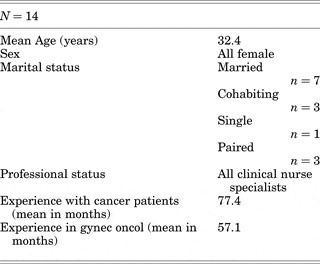
On the basis of the contents, emerged from a series of focus groups conducted in 2007 with gynecologic nurses to explore their need for psychological support, we proposed that the IEO gynecologic oncology nursing team participate in a multimodal training program based on the psychosocial aspects of gynecologic patients reactions' to the disease, treatment, and expectations of quality of life (QoL). The nursing team is composed of 14 female nurses whose sociodemographic characteristics are described in Table 1. Of the original sample, 10 nurses agreed to participate. The four who did not participate were nurses specialized in administering chemotherapy. We are planning to explore by means of anonymous written interviews whether there were specific motivations for having refused to participate in the training program in this group.
IEO Gynecologic Nursing Team characteristics

IEO, European Institute of Oncology
Methods
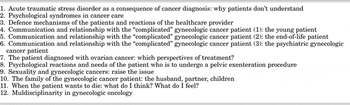
The training program we proposed lasted 48 hours, comprising 4 hour meetings every 2 weeks. Each meeting consisted of a 1.5 hour theoretical lesson on a specific aspect of gynecologic cancer patients' process of care, 20 minutes for the projection of a short film, which was the result of a collage of parts of well-known films dealing with the specific aspects on which each single lesson focused, and 1.75 hour of role-playing exercises and experiential exchanges. The program, in addition to a list of the films used, is described in a detailed manual that is available by writing to the authors (FNL AND PA). Aims, contents and techniques were standardized in order to allow module replication. The training covered topics ranging from specific psychological responses to a gynecologic cancer diagnosis, the psychosocial dimensions associated with gynecologic cancer and its treatment, detecting psychopathologic reactions to diagnosis and prognosis, and discussion of quality of life, death, and the meaning of nursing, as shown in Table 2. During each lesson, a case was discussed by a psychologist of the IEO Psycho-oncology Service either from the psychologist's or the nurse's point of view in order to build up a multidisciplinary sense of working. Nurses were encouraged to discuss clinical cases arising from their daily activity. The trainers were two experienced psychologists trained in psycho-oncology. Trainers were supervised regularly throughout the study.
Training program contents and theoretical topics

Assessment Procedure
Before the beginning of the training program (T0) and at the end of it (T1) we administered the Link Burnout Questionnaire (LBQ) (Santinello, Reference Santinello2007) to the participants in order to calculate the difference between pre- and post-intervention scores through t test statistic for paired data. This is a self-report questionnaire designed to measure burnout syndrome in healthcare professionals. It is composed of 24 items on a six-point Likert scale. Unlike the Maslach Burnout Inventory (MBI) formed by three scales, the LBQ is composed of four scales: relationship depersonalization, emotional exhaustion, professional inefficacy, and disillusionment.
Furlotti et al. (Reference Furlotti, Pedrabissi and Santinello1991) added disillusionment to the three main constructs proposed by Christina Maslach convinced of the high motivation that characterizes healthcare professionals in choosing their job. Difficulties related to organizational aspects of the institution, or to particularly complex patients, contribute to the deterioration of such motivation, causing disillusionment. Correlation between the LBQ and the MBI varies from 0.70 (p < 0.01) between psycho-physical exhaustion (LBQ) and emotional exhaustion (MBI) and −0.49 (p < 0.01) between professional inefficacy (LBQ) and personal accomplishment (MBI) being higher for similar contructs. At T0 we also administered a sociodemographic questionnaire. In the light of the high evocative and emotional power of video-imaging, at the end of each film presentation we also administered a single open-ended questionnaire asking participants to write down in the more sympathetic way (words, pictures, colors) the emotional response caused in them by what they saw. The results of this survey will be reported elsewhere by the authors.
RESULTS
Ten out of 14 nurses attended the course. They completed the LBQ before the beginning of the training and immediately after its completion.
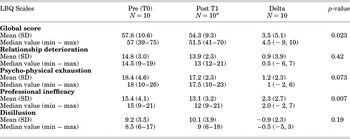
Two subjects did not complete the follow-up questionnaire. With the last observation carried forward (LOCF) approach missing data were replaced with the T0 questionnaire results. Expecting a reduction in time of burnout levels, the LOCF approach seems to be substantially conservative. In addition to the final global score, the four principal scales were also evaluated: relationship deterioration, psycho-physical exhaustion, professional inefficacy, and disillusionment.
For each subject and each dimension, we calculated the difference between pre- and post-intervention scores. t test statistic for paired data was used. p values < 0.05 were considered statistically significant. As shown in Table 3, the general level of burnout statistically diminished by 3.5 points (p = 0.02). The subscale with a significant positive change is “professional inefficacy.” Other differences were not statistically significant.
Burnout – global and by scales – Link Burnout Questionnaire (LBQ) (2007)

a Two nurses did not complete T1 follow up; values were substituted with basal values on the basis of last observation carried forward (LOCF) approach.
Regarding the second aim of the present study that consisted in the improvement of the collaboration between the gynecologic ward and the Psycho-oncology Service in a multidisciplinary perspective, the number of gynecologic cancer patients referred to the psycho-oncology service for psychosocial care in the 6 months following the program increased by 50% (from 32 to 48 patients referred).
DISCUSSION
To the best of our knowledge, this is the first study that proposes a model of training that strongly stresses the importance of the specificity of the cancer site in influencing patient–provider relationship: cancer patients' concerns and psychological distress are influenced by the type of malignancies that they have, and this consequently influences the relationship with the oncology nurses and the skills required in detecting and caring for such distress (Zebora et al., Reference Zabora, Brintzenhofe Szoc and Curbow2001).
Our training program answers to the need for support coming from an organizational level, as expressed by nurses in a study of Barnard et al. (Reference Barnard, Street and Love2006).
A multimodal training program was adopted to comprehend and respond to different learning styles – activist, reflector, theorist, and pragmatist – as described by Astin et al. (Reference Astin, Closs and Hughes2006). Because it was demonstrated that each nurse displayed one or two dominant learning styles, we utilized different learning techniques (theoretical, film projection and reflection, role playing and pragmatist, case study and activist) to respond to the learning needs of every nurse, so as to have an impact on the level of burn out experienced. As demonstrated in a work of Delvaux et al. (Reference Delvaux, Razavi and Marchal2004) a 105 hour psychological training program combining theoretical and experiential exchanges was efficacious in reducing stress levels as measured by the Nursing Stress Scale (Gray-Toft & Anderson, Reference Gray-Toft and Anderson1980). Although they did not measure burnout, we may safely assume that the two constructs are correlated.
The decrease in the general level of burnout and in the professional inefficacy scale is an important goal. The impact of the intervention on the perceived professional efficacy experienced by nurses is very significant: offering a psychological perspective on what occurs in a woman's emotional world when faced with a gynecologic cancer diagnosis probably helped nurses to distance their emotional world from that of the patient, not in a defensive way, but developing confidence in the professional role of the psychologist who can help in caring for psychological suffering. This contrasted with the feeling of powerlessness often experienced in caring for oncology patients.
Some study limitations should be considered: we did not have a control group that could exclude the influence of other variables, such as time, on our encouraging results. As a future step, we could introduce a randomization process in selecting participants to the training program as Delvaux et al. did in their study (Reference Delvaux, Razavi and Marchal2004).
We nonetheless believe in the accuracy of our training model, as its concrete efficacy is supported also by the establishment of a stronger collaboration between the gynecology ward and the Psycho-oncology Service, in terms of patients being reasonably referred to a psychological support program. Nurses felt better prepared to meet the patients' and relatives' needs for emotional support.
Further research, focusing on training efficacy in terms of patient benefits and cost utility, is also warranted. For example, it would be of great interest to study the effect of the training program on the patients' satisfaction with the perceived quality of care.
ACKNOWLEDGMENTS
This study has been supported by grants from the European Institute of Oncology Foundation. We thank William Russell-Edu for his kind assistance in reviewing the English text.