Lichenized fungi are a major component of coastal marine ecosystems. Their distributions transition through a range of distinct environmental pressures that span from daily immersion in sea water to fully terrestrial ecosystems, sometimes within the space of only a few metres (Hawksworth Reference Hawksworth2000). Natural environmental gradients such as these are important for investigating ecological and evolutionary mechanisms due to their ability to drive shifts in species assemblage, niche differentiation, and local adaptation (Prieto et al. Reference Prieto, Martínez, Aragón and Verdú2017). On rocky shores a variety of interacting factors across this gradient (e.g. salinity (Grube & Blaha Reference Grube, Blaha, Gunde-Cimerman, Oren and Plemenitaš2005; Delmail et al. Reference Delmail, Grube, Parrot, Cook-Moreau, Boustie, Labrousse, Tomasi, Ahmad, Azooz and Prasad2013), light (Sonina Reference Sonina2012), grazing (Higgins et al. Reference Higgins, Connan and Stengel2015) and water availability (Kranner et al. Reference Kranner, Beckett, Hochman and Nash2008)) have led to the formation of lichen ‘zones’. These zones correspond to distinctive coloured bands that begin at the top of the regularly submerged intertidal (black) and pass through parts of the shore exposed to regular sea spray/splashing (orange), to the upper zone that is influenced only by sea spray/splashing during storms (grey), before extending to fully terrestrial (i.e. not marine influenced) habitats. First delineated according to colour alone by Knowles (Reference Knowles1913), lichen zones were investigated extensively by Fletcher (Reference Fletcher1973a, Reference Fletcherb), who categorized the rocky shore into littoral, littoral fringe, mesic-supralittoral, submesic-supralittoral, xeric-supralittoral and xeric-terrestrial based upon the extent of lichen species distribution. Lichen zonation has since been observed to occur on rocky shores worldwide (Sheard & Ferry Reference Sheard and Ferry1967; Sheard Reference Sheard1968; Smith & Simpson Reference Smith and Simpson1985; Søchting & Gjelstrup Reference Søchting and Gjelstrup1985; Pentecost Reference Pentecost1987; Ryan Reference Ryan1988; Wolseley et al. Reference Wolseley, James, Coppins and Purvis1996; Chu et al. Reference Chu, Seaward and Hodgkiss2000; Boaventura et al. Reference Boaventura, Ré, da Fonseca L and Hawkins2002; Brodo & Sloan Reference Brodo and Sloan2004; Chappuis et al. Reference Chappuis, Terradas, Cefalì, Mariani and Ballesteros2014; Vail & Walker Reference Vail and Walker2021).
Despite this established understanding of lichen zonation, with its clear relevance to coastal ecology, remarkably little is known about the adaptations of marine and maritime lichens that contribute to this distinct niche differentiation (Sonina & Androsova Reference Sonina, Androsova and Grigore2020). In recent years, the use of lichen functional traits has emerged as a powerful tool to investigate the response of species and species assemblages to environmental variables (Ellis et al. Reference Ellis, Asplund, Benesperi, Branquinho, Di Nuzzo, Hurtado, Martínez, Matos, Nascimbene and Pinho2021). Here, we apply a qualitative trait-based approach to littoral and supralittoral lichens on UK coastlines to examine the distribution of morphological characteristics between zones and discuss the ecological implications of these traits.
Method
A list of lichens from intertidal and supralittoral zones was generated using the British Lichen Society database (www.britishlichensociety.org.uk: accessed 15 May 2022). First, a subset of the database was created based upon the records containing the ‘Ma’ (Maritime) scale habitat. A total of 7359 records were explicitly stated as being from maritime environments, including a total of 699 species. Species with < 5 records were discarded, leaving 296 species. Distribution maps of each of these were examined by eye and any species with extensive non-coastal records were excluded from further analysis, retaining key species with occasional inland records (e.g. Ramalina siliquosa (Huds.) A. L. Sm., Anaptychia runcinata (With.) J. R. Laundon), leaving a final list of 54 accepted species of maritime and marine lichens (see Supplementary Material Fig. S1, available online).
The boundaries between zones based on species distributions as delineated by Fletcher may vary depending on multiple factors (e.g. exposure and aspect), and in some cases certain species and corresponding zones may appear absent altogether. To address this, we used a simplified scheme based upon tide and wave action alone, assigning lichens to one of three primary zones. Lichens that are found predominantly within the range of high and low tide (including those that are infrequently found above the high-water mark such as Collemopsidium halodytes (Nyl.) Grube & B. D. Ryan) are classified as eulittoral (equivalent to Fletcher's littoral). Lichens that are frequently found above the upper limit of the high-water mark (including some that can occasionally occur below the high-water mark such as Hydropunctaria maura (Wahlenb.) C. Keller et al.) are classified as mesic-supralittoral (equivalent to Fletcher's littoral fringe, mesic- and submesic-supralittoral zones). Lichens that are found only above regular influence of wave action are classified as xeric-supralittoral (equivalent to Fletcher's xeric-supralittoral zone). Zones were determined using species descriptions in The Lichens of Great Britain and Ireland (Smith et al. Reference Smith, Aptroot, Coppins, Fletcher, Gilbert, James and Wolseley2009) and in Orange (Reference Orange2012).
For each lichen, the following traits were considered: primary photobiont (chlorococcoid, trentepohlioid or cyanobacteria); thallus (black/brown-black, orange/yellow, white/grey/yellow-grey, green/olive/brown, immersed/superficial); growth form (crustose, foliose, fruticose or squamulose); ascoma type (lecanorine, lecideine, lirelliform, zeorine, aspicilioid, arthonioid or perithecioid); vegetative reproductive strategy (soredia or isidia). These traits were chosen for analysis based upon existing literature (Matos et al. Reference Matos, Pinho, Aragón, Martínez, Nunes, Soares and Branquinho2015; Koch et al. Reference Koch, Matos, Branquinho, Pinho, Lucheta, de Azevedo Martins and Vargas2019; Nimis et al. Reference Nimis, Martellos, Chiarucci, Ongaro, Peplis, Pittao and Nascimbene2020; Käffer et al. Reference Käffer, Port, Brito and Schmitt2021) and to cover a broad range of functionality within lichen ecology and life cycle. Pycnidia were not included as a trait owing to insufficient information pertaining to conidiomata for many of the species within the dataset.
All statistical analysis was conducted in R v. 4.0.3 (R Core Team 2020). Non-metric multidimensional scaling (NMDS) was carried out on a Jaccard distance matrix calculated from a presence/absence matrix of species traits using the ‘metaMDS’ function in vegan (Oksanen et al. Reference Oksanen, Blanchet, Friendly, Kindt, Legendre, McGlinn, Minchin, O'Hara, Simpson and Solymos2018) and plotted in ggplot2 (Wickham Reference Wickham2016). Overall trait composition was compared between zones by permutational multivariate analysis of variance (PERMANOVA) using the ‘pairwise.adonis’ function (Martinez Arbizu Reference Martinez2020). Distribution of specific traits between zones was tested by counting the number of species displaying each trait and performing a Fisher's exact test with subsequent pairwise posthoc comparisons on specific characters using the ‘fisher.multcomp’ function from the RVAideMemoire package (Hervé Reference Hervé2021).
Results and Discussion
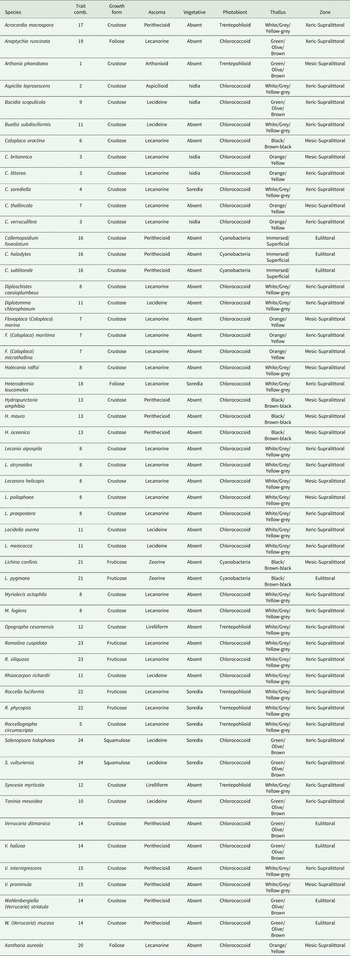
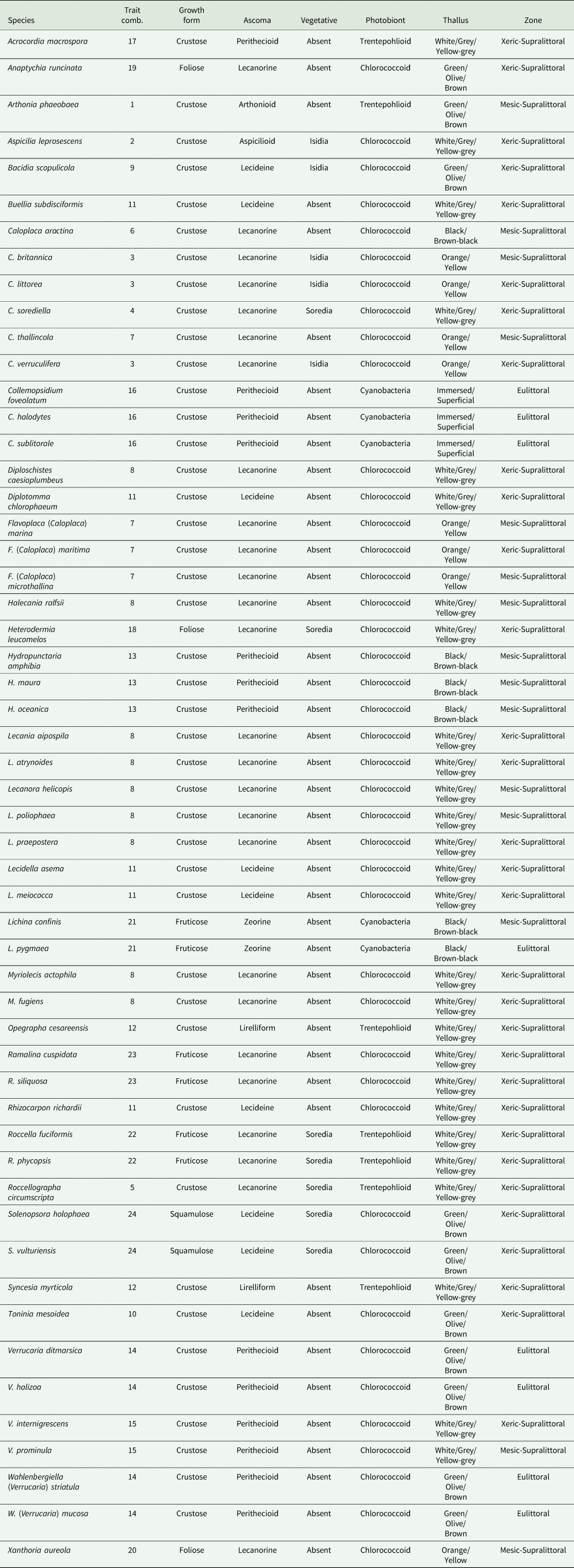
A total of 54 lichen species were included in the dataset from the eulittoral (8 species), mesic-supralittoral (15 species) and xeric-supralittoral (31 species) zones. After determining functional traits presented by each species, 24 unique trait combinations were identified (Table 1).
Species included within the dataset of littoral and supralittoral lichens on UK coastlines, indicating all assigned traits and zones. A simplified scheme of species distributions, as delineated by Fletcher (Reference Fletcher1973a, Reference Fletcherb), based on tide and wave action alone is used to assign lichens to three primary zones. Currently accepted synonyms of recently revised taxa in the BLS database (accessed 15 May 2022) are indicated in parentheses.
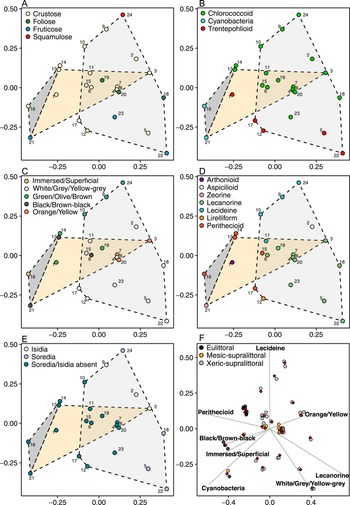
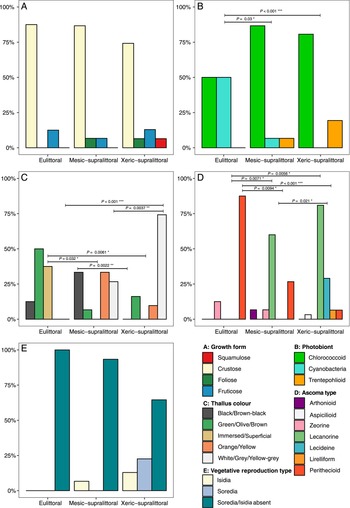
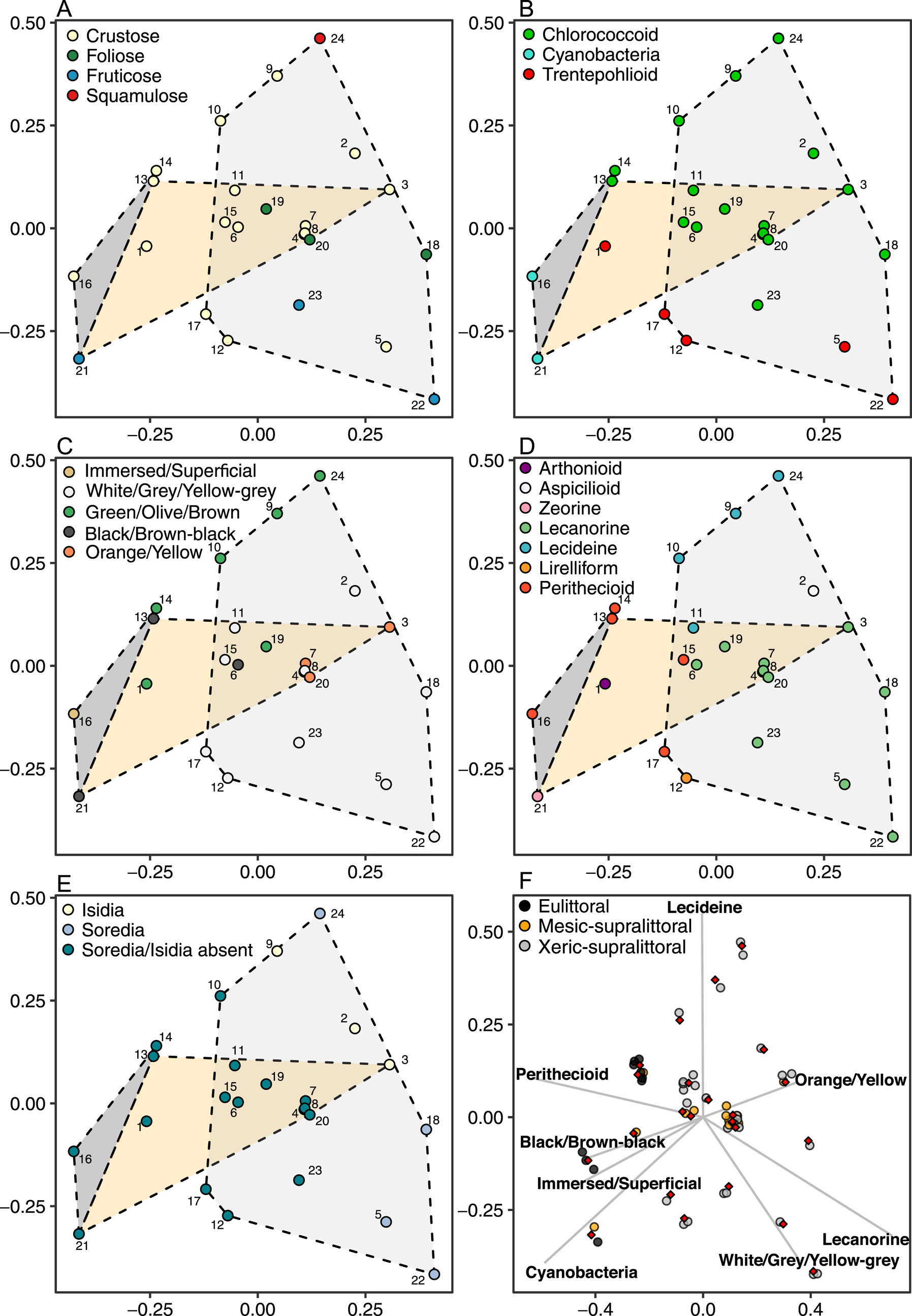
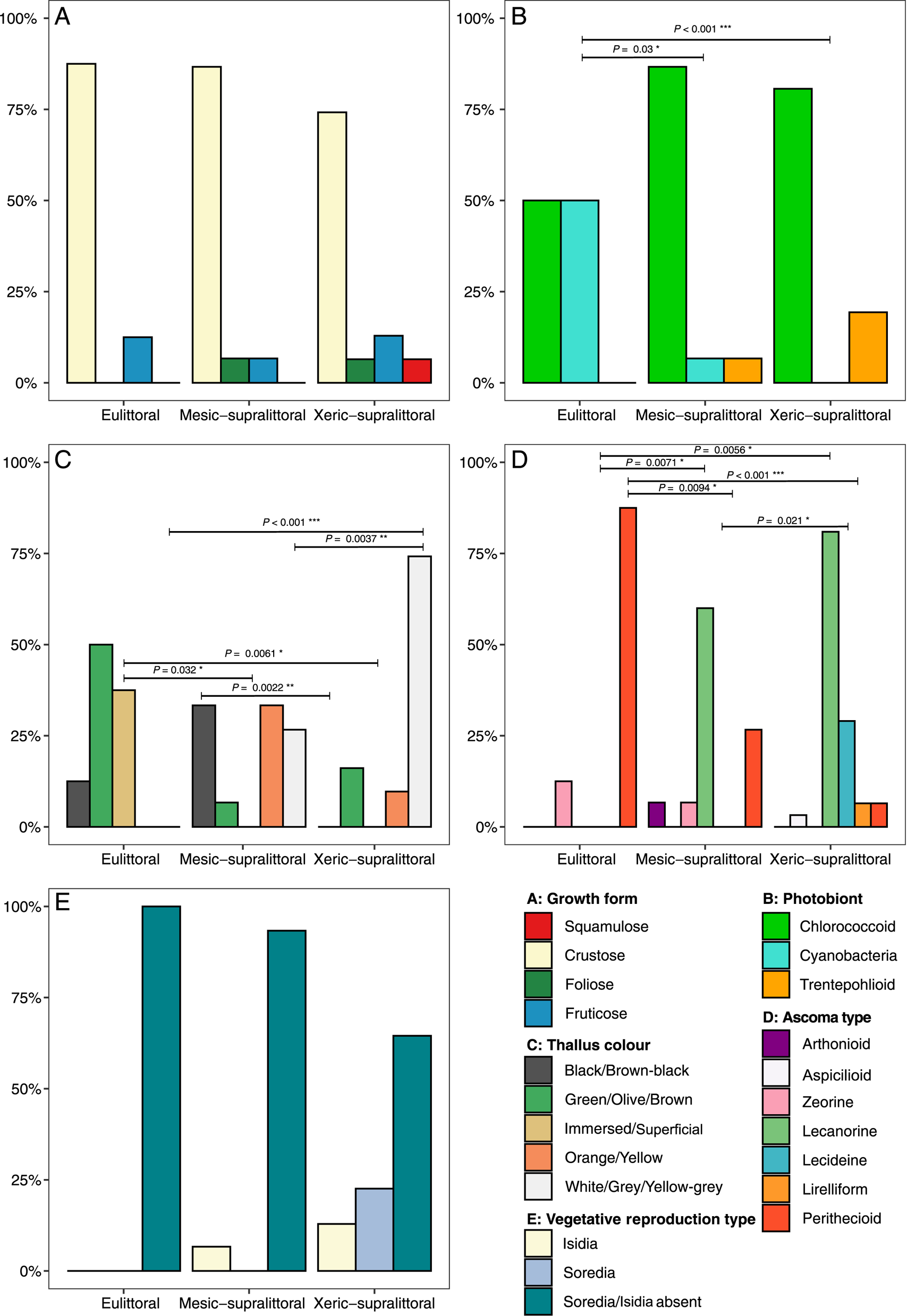
The trait combinations were unevenly spread across the three zones (Fig. 1), with overall trait distributions significantly different between the eulittoral and mesic-supralittoral (pairwise PERMANOVA: F = 4.8, R 2 = 0.19, P (adjusted) = 0.009*), eulittoral and xeric-supralittoral (pairwise PERMANOVA: F = 7.96, R 2 = 0.18, P (adjusted) = 0.003**), and the mesic-supralittoral and xeric-supralittoral zones (pairwise PERMANOVA: F = 3.64, R 2 = 0.076, P (adjusted) = 0.009*). These findings roughly correspond to recognized patterns of lichen zonation based on species composition, suggesting that conditions along the coastal environmental gradient are driving both community assemblage and adaptive traits. Of all the traits included in the analysis, three were found to show significant differences between zones: primary photobiont (Fisher's exact: P = 0.0023**) (Fig. 2B), thallus pigmentation (Fisher's exact: P < 0.001***) (Fig. 2C) and ascoma type (Fisher's exact: P < 0.001***) (Fig. 2D).
Non-metric multidimensional scaling (NMDS) plots of lichen functional traits on rocky shores in the UK. Points represent unique combinations of traits. Convex hulls outline combinations of traits found in the eulittoral (black), mesic-supralittoral (orange) and xeric-supralittoral (white) zones. Plots are faceted to highlight the following trait categories: A = growth form, B = photobiont, C = thallus, D = ascoma type, and E = vegetative reproduction type. F = NMDS biplot showing vectors for traits found to be significantly different as determined by pairwise Fisher's exact tests (red diamonds are trait combinations as in A–E, clustered points indicate individual species).
Relative abundance of functional traits in lichens of the eulittoral (n = 8), mesic-supralittoral (n = 15) and xeric-supralittoral (n = 31) zones in the UK. Trait categories shown are as follows: A = growth form, B = photobiont, C = thallus colour, D = ascoma type, and E = vegetative reproduction type. Significantly different comparisons as determined by pairwise Fisher's exact tests on presence/absence counts for each trait are indicated. * = P < 0.05, ** = P < 0.005, *** = P < 0.001. In colour online.
Primary photobiont
Lichens with cyanobacterial photobionts were significantly more frequent in the eulittoral zone compared to the mesic-supralittoral and xeric-supralittoral zones (Fig. 2B). Cyanobacteria have a requirement for liquid water (Lange et al. Reference Lange, Büdel, Meyer and Kilian1993, Reference Lange, Green, Reichenberger and Meyer1996) that is readily available as sea water in the intertidal zone, and they can make use of carbon concentrating mechanisms to account for reduced rates of diffusion of CO2 when saturated (Raven et al. Reference Raven, Johnston, Handley and McInroy1990; Palmqvist Reference Palmqvist1993; Máguas et al. Reference Máguas, Griffiths and Broadmeadow1995), which may be advantageous during tidal inundation.
It is important to consider that the absence of cyanolichens from the xeric-supralittoral zone here accounts only for lichens with a strictly maritime distribution. Several cyanolichens that are non-maritime specific can be found in the xeric-supralittoral (e.g. Lathagrium auriforme (With.) Otálora et al., Placynthium nigrum (Huds.) Gray). The acquisition of a photobiont adapted to survival in sea water could be an important factor in allowing marine cyanolichens such as Lichina pygmaea (Lightf.) C. Agardh to survive with regular sea water coverage (Ortiz-Álvarez et al. Reference Ortiz-Álvarez, de los Ríos, Fernández-Mendoza, Torralba-Burrial and Pérez-Ortega2015; Chrismas et al. Reference Chrismas, Allen, Hollingsworth, Taylor and Cunliffe2021). In the xeric-supralittoral, where freshwater inputs dominate, this requirement is unnecessary and non-marine specialized cyanolichen communities with typical terrestrial Nostoc photobionts may be favoured.
While there was no significant difference in overall frequency of lichens with chlorococcoid photobionts between zones, further species differentiation exists within chlorococcoid photobionts that has not been examined here. For example, whereas terrestrial green-algal photobionts such as Trebouxia may be favoured in the xeric-supralittoral due to their ability to resist desiccation and use water vapour (e.g. sea mist and fog) in photosynthesis (Matos et al. Reference Matos, Pinho, Aragón, Martínez, Nunes, Soares and Branquinho2015), marine lineages such as Paulbroadya and Pseudendoclonium dominate in crustose lichens of the eulittoral and lower mesic-supralittoral, such as Wahlenbergiella mucosa (Wahlenb.) Gueidan & Thüs and Hydropunctaria maura (Thüs et al. Reference Thüs, Muggia, Pérez-Ortega, Favero-Longo, Joneson, O'Brien, Nelsen, Duque-Thüs, Grube and Friedl2011; Darienko & Pröschold Reference Darienko and Pröschold2017; Černajová et al. Reference Černajová, Schiefelbein and Škaloud2022). Furthermore, differential response of photobionts to salt concentrations (Gasulla et al. Reference Gasulla, Guéra, de los Ríos and Pérez-Ortega2019) indicates that photobiont halotolerance is an important factor in determining marine lichen distributions and could be a further ‘sub-trait’ to be explored.
Thallus pigmentation
Characteristics of lichen thalli roughly follow the established black-orange-grey model of marine-maritime lichen zonation (Fig. 2). The xeric-supralittoral contained a significantly higher proportion of grey/yellow-grey lichens compared to both the mesic-supralittoral and the eulittoral zones, at least in part due to a higher frequency of lichens containing usnic acid (e.g. Ramalina spp.). Usnic acid has UV protective and antioxidant properties (McEvoy et al. Reference McEvoy, Nybakken, Solhaug and Gauslaa2006; Kosanić & Ranković Reference Kosanić, Ranković and Ranković2019) and may play a role in alleviating oxidative stress in maritime lichens (Françoise et al. Reference Françoise, Holger, Marie-Laurence, David, Joël and Bourgougnon2014). The orange pigment parietin has similar properties (Kosanić & Ranković Reference Kosanić, Ranković and Ranković2019), yet despite the dominance of parietin-rich lichens in the mesic-supralittoral, a significant difference in the number of true maritime lichens with orange pigmentation was not detected. In this case, the abundance of key species (e.g. Caloplaca thallincola (Wedd.) Du Rietz) should be considered in addition to absolute species count, while also taking into account the fact that other broadly distributed species not included in this study (e.g. Xanthoria parietina (L.) Th. Fr.) also contribute to the mesic-supralittoral and xeric-supralittoral communities.
Black lichens were significantly more abundant in the mesic-supralittoral compared to the xeric-supralittoral. Black pigmentation is usually attributed to melanin (Mafole et al. Reference Mafole, Solhaug, Minibayeva and Beckett2019) and is probably an adaptation in polyextreme environments (Gostinčar et al. Reference Gostinčar, Muggia and Grube2012; Muggia et al. Reference Muggia, Gueidan, Knudsen, Perlmutter and Grube2013, Reference Muggia, Quan, Gueidan, Al-Hatmi, Grube and de Hoog2021). The specific adaptive significance of melanin in marine lichens is yet to be established, but it probably increases resilience to osmotic pressure (Money et al. Reference Money, Caesar-TonThat, Frederick and Henson1998; Cordero & Casadevall Reference Cordero and Casadevall2017) and aids retention of osmolytes (Kogej et al. Reference Kogej, Stein, Volkmann, Gorbushina, Galinski and Gunde-Cimerman2007), thereby contributing to salinity tolerance (Ravishankar et al. Reference Ravishankar, Muruganandam and Suryanarayanan1995; Lud et al. Reference Lud, Huiskes and Ott2001; Grube & Blaha Reference Grube, Blaha, Gunde-Cimerman, Oren and Plemenitaš2005) as well as offering anti-herbivory (Higgins et al. Reference Higgins, Connan and Stengel2015) and photoprotective properties (Grube & Blaha Reference Grube, Blaha, Gunde-Cimerman, Oren and Plemenitaš2005). Extension of highly melanized thalli into the xeric-supralittoral may be suppressed by the tendency of melanin to cause overheating and subsequent damage to the photosynthetic apparatus (McEvoy et al. Reference McEvoy, Gauslaa and Solhaug2007), and in the mesic-supralittoral there is a likely trade-off between the advantages and disadvantages of melanized thalli.
Lichens with immersed or superficial thalli were significantly more frequent in the eulittoral compared to the mesic- and xeric-supralittoral. Lichens with thalli fully immersed in the substratum (i.e. Collemopsidium foveolatum (A. L. Sm.) F. Mohr and C. sublitorale (Leight.) Grube & B. D. Ryan) often grow on shells of barnacles, limpets and oysters, and are frequent in the eulittoral zone where suitable biogenic substrata are present, although these species may also be saxicolous on shores comprised of calcareous rock. Interestingly, where C. halodytes appears on rock, a superficial thallus is present, indicating a possible relationship between substratum preference and thallus development in this poorly understood genus (Mohr et al. Reference Mohr, Ekman and Heegaard2004).
Ascoma type
Ascoma type is a key trait defining the boundary between the eulittoral and the two supralittoral zones, shown by a significant switch from lecanorine apothecia in the xeric- and mesic-supralittoral to perithecioid apothecia in the eulittoral (Fig. 2D). These findings mirror observations in non-marine aquatic lichens, where enclosed perithecioid apothecia are frequent and more common than lecanorine apothecia (Nascimbene & Nimis Reference Nascimbene and Nimis2006). It is worth noting that the zeorine apothecia of the two Lichina species are similarly enclosed within a thalline exciple. This characteristic may have adaptive significance in marine environments, since developing ascospores within enclosed fruiting bodies have less chance of encountering surrounding water during tidal cycles and splashing, leading to a higher chance of survival relative to those of more open ascomata such as lecanorine apothecia (Aptroot & Seaward Reference Aptroot and Seaward2003; Sonina & Androsova Reference Sonina, Androsova and Grigore2020). This implies a sub-aerial rather than sub-aquatic mode of dispersal in marine lichens and further research into the timing of ascospore discharge and the viability of ascospores will be important in establishing the influence of sea water on reproduction in lichenized fungi.
Conclusions
Our results indicate that while there are differences between lichen traits found in the eulittoral, mesic- and xeric-supralittoral zones, absolute boundaries between the zones are not clear. Many features of eulittoral lichens can be found in lichens of the mesic-supralittoral, where traits common to the xeric-supralittoral can also be found. The mesic-supralittoral may then be interpreted as an ecological boundary zone or ecotone, supporting an increased diversity of traits that accommodate the wide variety of ecological pressures that lichens within this zone are exposed to.
The qualitative traits used here provide an overview of traits contributing to lichen zonation on rocky seashores and may be used as a basis for more quantitative studies. In the intertidal zone, low lichen diversity means that absolute species counts as used here may not represent the most robust way of interpreting lichen ecology, and by incorporating species abundance into our understanding of trait distributions we might better understand the processes driving variation in lichen community assemblage in this complex and dynamic environment. Furthermore, some marine species (e.g. Hydropunctaria orae Orange) are poorly represented in the BLS database and more extensive surveys of coastal habitats are essential to establish their true distributions.
Finally, more research is necessary to investigate the effect of dispersal mode, secondary metabolite production, and photobiont specificity on marine and maritime lichen fitness and physiology to better understand lichen adaptations to this unique environment.
Acknowledgements
NC wishes to thank Maxine Putnam, John Skinner and Nicola Bacciu for helpful initial discussions on coastal lichens, Janet Simkin for providing access to the BLS database, and the two referees whose comments and suggestions greatly improved the quality of the manuscript.
Author Contribution
NC and MC devised the study. BT-J and NC collected and analyzed the data. NC and BT-J wrote the manuscript with additional contributions from MC. All authors agreed on the final version of the manuscript.
Author ORCIDs
Beth Tindall-Jones, 0000-0002-2898-0536; Michael Cunliffe, 0000-0002-6716-3555; Nathan Chrismas, 0000-0002-2165-3102.
Competing Interests
The authors declare no competing interests.
Supplementary Material
To view Supplementary Material for this article, please visit https://doi.org/10.1017/S0024282923000038.