


I. Introduction
In May 1958, the North Korean youth magazine Sae sedae published an essay by O Chŏngsam (Reference Chŏngsam1958) describing a recent encounter with an unnamed South Korean short story. For O, a seasoned playwright with family in the South, this encounter was a personal affair. Faced with the violence and injustice that the story's “shoeshine boy” protagonist had to endure, he could not help but think that his nephew, a boy of about the same age living in Seoul, would likely be struggling with the same challenges. This realization, according to O's account, sent “shudders” of rage through his body. It also elicited a more unusual mode of intervention: inserting himself into the text alongside the protagonist's interlocutor, the boy's teacher. “I plunge into the short story,” O (Reference Yŏngsu1958, 25) thus narrated, “and question the shoeshine boy with the same set of feelings as . . . his young teacher.”
By taking this “plunge,” O's essay transitioned from an account of cross-border reading to an attempt at cross-border writing: an attempt, that is, to intervene in—and transform—the South Korean text. Although not named, the story under discussion was O Yŏngsu's “Migratory Bird” (Hujo, Reference Yŏngsu1958), which had appeared three months earlier in the South Korean literary journal Hyŏndae munhak. O Chŏngsam's essay was faithful enough to the original text to make this clear, yet it also pushed the story in new directions by rewriting elements of it. Questioning the narrative's protagonist, O transposed the story's critique of the corruption and inequality of postwar South Korean society into an indictment of the violence of the American military. He also turned the boy into a figure of retribution rather than passivity, setting the stage for one final moment of transformation. By the end of the essay, O's rage no longer sent silent shudders through his body. Instead, it produced audible calls for resistance, with the implication that O's own transformation mirrored the one that he had produced in the story's protagonist. As cross-border reading became cross-border writing, what was refashioned was not only the text from the other side of the peninsula but also the contours and possibilities of the self in Pyongyang.
In the literature on twentieth-century Korea, the division of the peninsula in 1945 and the establishment of two separate states in 1948 are generally described in terms of the formation of two diametrically opposed zones of power, production, and imagination. This is a narrative not only of division but also of mutual exclusivity: a narrative in which the two halves of the Korean peninsula are severed from each other as they are incorporated into their respective Cold War blocs. There are compelling reasons for framing the contours of modern Korean history in this way: national division separated families; it interrupted long-standing social, economic, and environmental networks; and it gave rise to both a catastrophically destructive war and a Military Demarcation Line that is often described as the most heavily militarized border on earth. And yet, this is not the entire story, for the so-called division system—while largely effective at preventing people and resources from crossing the thirty-eighth parallel—never completely blocked the flow of media. In reality, media continued to cross the border throughout this period, and its consumption epitomized the counterintuitive and often contradictory nature of the Cold War order in Korea: the fact that national division, insofar as it demanded a rigid differentiation between the two Koreas, also demanded an unending process of interaction between them.
This article explores such interaction, focusing on the practices of cross-border writing developed by North Korean cultural producers in the 1960s. As I demonstrate in section two, despite being physically separated from their colleagues in the South, North Korean writers continued to read the literature that they produced. They also came to engage with it creatively: first, as I show in section three, by borrowing and refashioning the literary trope of the volcano that had emerged in the South amid the April Revolution of 1960, and second, as I turn to in section four, by rewriting specific South Korean texts such as An Tongnim's short story “Hope” (Hŭimang, Reference Tongnim1963), one of the many works of fiction from the South that had been republished in the North.
As I demonstrate, the North Korean playwright Kim Myŏngsu rewrote An's story in his 1965 work Mother of the South (Namnyŏk ŭi ŏmŏni), and his adaptation was significant not only for the way in which it transformed An's passive figure of the mother into a revolutionary one but also for the influence that it had on North Korea's practices of self-reflection. Kim's adaptation, as I note in section five, not only brought An's vision into contact with contemporary North Korean representations of the role of mothers in the 1920s–1930s “revolutionary heritage” but also subtly reshaped them, demonstrating the two-way process of coproduction that emerged in North-South literary interactions of this era. Far from being isolated from each other, I argue, North and South Korean literature of the 1960s engaged in a dynamic, multidimensional dialogue—a form of dialogue that wove them together rather than tore them apart.
II. Cross-Border Reading
In recent years, research on North Korean literature has gained significant momentum. Grounded in the pioneering scholarship produced in South Korea in the years after 1988 (Hong Reference Hong2008; Kim Chaeyong Reference Kim1994; Kwŏn Reference Kwŏn1989; Sin and O Reference Sin and Sŏngho2000), when the Republic of Korea (ROK) lifted its ban on works by those who went to the North after 1945, such work includes research that stakes out connections between cultural production in the North and in the larger socialist world (Gabroussenko Reference Gabroussenko2010; Mironenko Reference Mironenko2014; Zur Reference Zur2014). Meanwhile, a complementary stream of inquiry makes connections across the thirty-eighth parallel by comparing how writers in the two Koreas have represented each other (de Wit Reference De Wit2015; Elfving-Hwang Reference Elfving-Hwang and Hammond2012), as well as how writers in the two Koreas have engaged with global literary trends shared in common, such as science fiction (Berthelier Reference Berthelier2018; Kim Minsŏn Reference Kim2020; Zur Reference Zur2017).
In contrast, this article makes connections across the thirty-eighth parallel by highlighting direct engagements between North and South Korean texts. In particular, it adapts methods from scholarship on transnational textual flows to argue that North and South Korean literature have to be understood in direct dialogue with each other and not just in comparison to each other, something that Kang Chuyŏng (Reference Chuyŏng2015) and Kim Sŏngsu (Reference Kim2018) have suggested in relation to different eras. In doing so, it also engages with the robust scholarship on women and gender in North Korea, which has noted, in particular, the complexity of North Korean culture's vision of motherhood (Cho Reference Cho2020; Immanuel Kim Reference Kim2018; Suk-Young Kim Reference Kim2010; Suzy Kim Reference Kim2013, Reference Kim2014; Ryang Reference Ryang2000). Building upon these works, I nevertheless argue that the emergence of the figure of the militant mother in the North, most famously canonized in the protagonist of Sea of Blood (Hyŏrhae/P'ibada), has to be understood in relation to visions of the South. The existing scholarship links this figure to visions of revolutionary motherhood developed outside the literary sphere in the immediate post-Liberation period (Suzy Kim Reference Kim2014) and to the North Korean state's attempt to socialize women's labor while subjecting it to the power of the state patriarch (Suk-Young Kim Reference Kim2010). However, I argue that the militant mother solidified her position as an expansive model for revolutionary action within the context of mid-1960s engagements with South Korean literature and the character that these engagements produced: in particular, that of the partisan mother who replaces her children at the front lines of struggle.
To do this, it is necessary to rethink our understanding of the permeability of the thirty-eighth parallel. The early years of the North Korean literary world were defined by three successive waves of writers who moved to the North: a first wave around the time of Liberation; a second wave in late 1947 and early 1948; and a third wave in 1950, after the outbreak of the Korean War. In contrast, after the stabilization of the battle front in 1951 and the first set of purges and offensives against transplants from the South in 1952, this movement more or less ceased. It has long been assumed that this dual interruption of writers’ movement and political pushback against those who had already moved entailed a progressive severing of relations between the North and South Korean mediascapes. However, this is not the case. Although the routes that such texts took across the thirty-eighth parallel and the mechanisms through which they circulated among trusted actors in the North both remain unclear, what is certain is that North Korean writers continued to have—and make robust use of—access to South Korean texts long after regular human transit across the border ceased. This occurred in both the journalistic domain, as I have shown elsewhere (Kief Reference Kief2021), and the literary domain, the focus of this article.
This is evident in one of the critical texts that played a canonical role in the first round of purges mentioned earlier: Han Hyo's (Reference Hyo1953) four-part “Korean Literature in the Struggle against Naturalism.” Because of its role in these events, the broad outlines of Han's article are relatively well-known. Yet the article does not simply critique Han's enemies for their reactionary tendencies across the decades; it also links them to the “bourgeois” literary sphere that emerged in the South. This entails an analysis of post-Liberation works produced in the South by those who did not go to the North. Such works include texts published after the stabilization of the battlefront in 1951, in particular, Yŏm Sangsŏp's short story “The Coveted Shack” (T'amnaenŭn hakkobang) and Kim Chinsu's play The Flower That Bloomed on the Roadside (Kilka e p'in kkot), both of which were published in Sinjo, one of the non-military-linked journals published during the war in the South (Han Reference Hyo1953 [3], 133).
Such references to South Korean works and publications increased steadily over the course of the postwar period. For example, in a speech to writers, editors, and publishers in Pyongyang, Han Sŏrya (Reference Sŏrya1956) continued the critique of “Coveted Shack,” extending it to Hwang Sunwŏn's The Descendents of Cain (K'ain ŭi huye) and Ch'oe T'aeŭng's “The Sorrow of Aebaebae” (Aebaebae ŭi piae). Likewise, in an article outlining the debased and debasing influence of existentialism, pragmatism, and other “reactionary” literary and intellectual movements, the critic Ch’ŏng Am (Reference Am1957) discussed work by Yŏm alongside fiction and criticism by a range of other writers working in the South: Son Usŏng, Mo Yunsuk, Kim Kwangju, Pak Inhwan, Yi Muyŏng, Hwang Sunwŏn, Ch'oe Inuk, An Pyŏnguk, Kim Tongni, Ch’ŏn Sangbyŏn, Yi Pongnae, and Kwak Chongwŏn. In fact, such articles appeared regularly in North Korean publications, and their practices of citation and critique made one thing abundantly clear: that writers in the North had access to an extensive array of publications from the South that ranged from specialist-oriented literary and intellectual publications to popular magazines and journalistic outlets.
As the scope of these references changed, so, too, did their character. Throughout the late 1940s and most of the 1950s, South Korean culture was seen as wholly “bourgeois” and “reactionary.” Beginning in the late 1950s, however, this shifted, and South Korean literature came to be seen as internally divided between what the critic Ch’ŏng Am (Reference Am1958) called the “literature of the slave” (noye ŭi munhak) and the “literature of resistance” (panhang ŭi munhak). In 1958, as North Korea declared the cooperativization of all agriculture complete and turned toward the mass-line Ch’ŏllima Movement, it also initiated a shift toward a strategy of co-optation in its policy toward the South (Szalontai Reference Szalontai2005, 141). This new strategy diverged dramatically from contemporary South Korean policies toward the North, which saw virtually all interactions across the thirty-eighth parallel as threats to be interrupted; it also ushered in a new era of cross-border literary engagements in the North. Beginning in 1958, North Korean literary critics began supplementing their critiques of South Korean literature's “reactionary” and “bourgeois” tendencies with praise for its “progressive” ones, which were seen as targets for engagement and cultivation. An article by O Chŏngsam (Reference Chŏngsam1959, 3), the writer mentioned earlier, thus extended its critique of “reactionary” fiction by pointing toward the “progressive literature that, in opposition to South Korean reactionary literature, had recently emerged in a notable way.” In particular, he singled out three recent stories by Chŏn Kwangyong—“Stratum” (Chich’ŭng), “Thunder” (Pyŏngnyŏk), and “G.M.C”—as representative of this new “undeniable” trend that “struggles to seek out the new and carries robust critical depth in relation to the pitiful state of its society” (O 1959, 3).
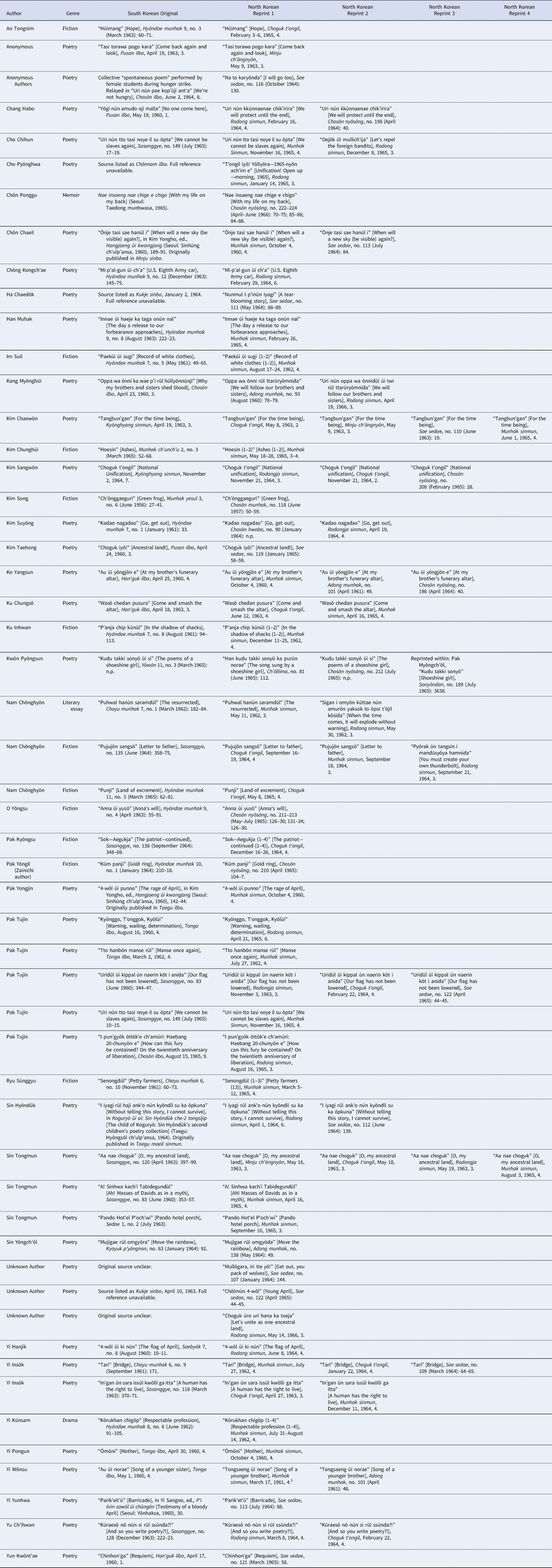
Such presentations—impossible at the time in South Korean visions of the North—continued in subsequent years, with a widening group of works identified as “progressive.” In tandem, moreover, a selection of such works began appearing in the pages of North Korean publications. Reprints of current-events-related comics from the South began appearing in the North as early as 1954, and in June 1957, the literary journal Chosŏn munhak reprinted the entirety of the South Korean novelist and playwright Kim Song's Reference Song1956 short story “Green Frog” (Ch’ŏnggaeguri). Yet it was not until the 1960s that such reprints became a common feature of North Korean publications. Jumping between specialized publications, popular magazines, and the journalistic press, these reprints significantly expanded the bounds of cross-border reading in the North, allowing those without direct access to South Korean publications to engage with an eclectic array of South Korean poetry, fiction, and drama (see table 1 in the appendix.).Footnote 1 Indeed, although it is well-known that the North republished work by the South Korean novelist Nam Chŏnghyŏn, who was later prosecuted under the ROK's National Security Law (Hughes Reference Hughes2012, 129–64), the range of writers whose words were recirculated in the North was quite diverse.
To be sure, this was a carefully selected ensemble, and texts were frequently edited, as discussed elsewhere (Kief Reference Kief2021; Kim Sŏngsu Reference Kim2018). Ku Inhwan's (Reference Ku1961) “In the Shadow of Shacks” (P'anja chip kŭnŭl), for example, was abridged by excising the part of the text dealing with the Korean War. In the original text, which deals with slum demolition projects in Seoul, the critique of South Korean state and society that emerges through the hardships of the poor protagonist who loses his home is paired quite explicitly with a parallel invocation of the threat of the North Korean state from the wartime-era past. In the North Korean reprint, however, this middle section is edited out, and the text thus becomes a unidimensional critique of South Korean state and society (Ku Reference Ku1962).
Similarly, Kim Suyŏng's (Reference Kim1961) poem “Go, Get Out” (Kadao nagadao), republished in the North Korean magazine Chosŏn hwabo and then again in the Rodongja sinmun newspaper, was edited to voice its demand to “get out” solely to Americans rather than to both Americans and Soviets (Kim Suyŏng Reference Kim1964a, Reference Kim1964b). Such texts signaled accelerating practices of cross-border engagement, and they signaled, in particular, the imbrication of two separate yet interrelated processes: the cross-border reading practices described earlier and the cross-border writing practices that I turn to next.
III. Explosive Words
Between February and April 1960, a series of student-led protests across South Korea succeeded in driving the ROK's first president, Syngman Rhee, and his Liberal Party from power in what came to be known as the April Revolution. This was a transformational moment in the South, and it was also a time when those in the North looked southward with a seemingly unparalleled sense of urgency and expectation. The result, as previous scholarship has noted, was an outpouring of North Korean literature about the South: texts framed with the goal of producing a participatory aesthetic of cross-border solidarity (Kim Chonghoe Reference Kim2007; Kim Sŏngsu Reference Kim2001, Reference Kim2014; Yi Reference Yi2006, Reference Yi2011). What has not been discussed, however, is the extent to which North Korean writers, looking to the South after the April Revolution, engaged creatively with literary texts being produced there. The April Revolution, that is, propelled North Korean literature toward practices of cross-border writing: literary coproduction that brought North and South Korean writing together in new—albeit asymmetrical—ways.
On the evening of April 20, 1960, writers gathered in a Pyongyang theater for a “Poets’ Evening,” at which Pak Seyŏng offered a reading of a new poem that included the following words (Kim Ullyong Reference Kim1960, 4):
Shaken by resentment, building up and building up, the southern land
Has erupted like a ridge of volcanoes! Following the flames in Masan
In Seoul, Pusan, Taegu, and Kwangju,
Students and civilians, the blood they inherited from their righteous ancestors boiling
Have issued a fiery decree against Syngman Rhee's rule of fascist terror!
. . .
Seoul, you were no longer like my hometown! [But] you have risen again!
In Kwanghwamun, where I walked so often, and on all streets,
Ranks surge, spouting flames of rage, and
Resentment, building up like Samgak Mountain, explodes!
(Pak Seyŏng Reference Pak1960, 3)
Published in the following morning's Rodong sinmun newspaper, Pak's poem historicized the event in dual temporalities: first, it placed it within a longer historical trajectory; second, and more importantly, it described it as the outcome of rage and resentment built up over years, deploying the trope of volcanic eruption.
In picking up this trope of the volcano, Pak's poem anchored its vision not only in temporal depth but also in a broader spatial domain: in particular, that of South Korean representations. In South Korea, literary responses to the April Revolution varied noticeably according to age. While many older writers reacted in awe, their young colleagues noted that the April Revolution did not appear out of nowhere. For such writers, the uprising of April 1960 had to be seen as the product of a series of latent transformations, and this was most canonically represented with reference to the image of a volcano. Dormancy, this image implied, was not the same as passivity; it was, instead, the invisible, subterranean gathering of an even larger reaction.
The image of the volcano appeared in South Korean reporting on student protests as early as March 18, when the Han'guk ilbo (1960a, 2) likened the emergence of the March 15 uprising in Masan to the opening of a “volcanic crater” (punhwagu). This image, moreover, was subsequently taken up by poets the following month. Yi Hanjik's (Reference Yi1960) portion of a jointly authored poem published in Saebyŏk in mid-April was likely the first to do so. In Yi's prose poem, the speaker recalls an unusual dream in which he is aboard an American “Apache” airplane searching for underground natural resources. What surprises the American pilot the most, the speaker relates, is “the fact that actively living volcanic ranges were spread deeply across the land like a spider's web” (32). “This is trouble; these are volcanoes that could erupt at any moment,” the pilot then says, to which the narrator responds, “Trouble? Aren't those irreplaceably precious underground resources? . . . They are irreplaceably precious treasures for the attainment of democracy” (32).
For Yi, then, the silent surface of the Korean landscape—like the sleeping mind—hides an active subterranean world out of which the explosive demand for democracy emerges. It does not come from above—or from economic power—but rather from below, and this was a conviction that many other poets echoed. Kim Yongho's (Reference Kim1960, 4) “Each Year When April Comes” (Haemada 4-wŏl i omyŏn), published on April 28, 1960, thus proclaimed,
A volcano erupted. Flames blasted into the sky.
The suppressed subterranean heat of rage exploded
At once. March 15! The alert rang out
In my hometown.
The angry waves of the southern sea were the signals.
As in Yi Hanjik's poem, pent-up range produced an explosion in the name of democracy—an explosion that, after emerging in Masan, spread across the country. Indeed, the image of the volcano soon became tethered to the broader set of events culminating on April 19, as Hwang Kŭmch'an's (Reference Kŭmch'an1960, 4) “Young Mountain Ridges” (Chŏlmŭn sanmaekdŭl), for example, makes clear:
In the April 19 collision with the heavens, when a generation erupted like a volcano,
I saw the movements of life.
They are exploding, young mountain ridges, flag-bearers of justice,
The last fortresses of democracy,
Symbols of life.
Spewing rage and resentment, this eruption, Hwang implied, was also life giving. This meant that April, as Pak Hwamok (Reference Pak1960, 4) put it, was a “month of resurrection” when “living things that had seemed to exist in silence / almost as if dead / shot up fiercely, fiercely like an eruption.”
The power and prevalence of this symbol of the volcano in South Korean representations of the April Revolution made it a prime focus for North Korean writers. In search of a means for literary engagement with their colleagues across the border, they took it up with zeal, deploying it as a means of participating in the ongoing literary dialogue on revolutionary possibilities then occurring in the South. At the same time, however, they also provided it with new nuances and dimensions. On April 14, the Rodong sinmun carried a poem by Yun Ch'angju (Reference Yun1960, 5) underneath a photo of Masan citizens heading for a police station with clubs in hand. Titled “Masan Has Raised the Signal Fire” (Masan ŭn ponghwa rŭl ch'uk’yŏ tŭrŏtta), Yun's poem began with the following words:
People! Masan has raised the signal fire.
Enraged, Taegu and Pusan bolt up.
In Seoul, too, flames of rage burn and spread—
Fifteen years of fraud, day and night
The southern land, having shed blood innocently on the penal rack,
Is now spewing fire like an erupting volcano.
For Yun, as for others, the flames engulfing the South were flames of rage, of resentment, and of revenge: those hidden deep underground until ready to explode. Yet he also described them as “signal fires” (ponghwa), an invocation of the Chosŏn (1392–1910) dynasty's military communication system, which relied upon mountaintop signal fires to relay messages across the peninsula. In Yun's imagination, therefore, revolution was not merely a conjuring forth of latent possibilities; it was also an act of communication, an attempt to signal the North and articulate solidarity.
Yun's poem thus constructed cross-border reciprocity. Engaging with texts from the South, it rewrote them to include attempts at communication with the North. This was drawn out further in the work of the veteran novelist and playwright Song Yŏng (Reference Song1960), who published the play The Volcano of Rage Has Erupted (Punno ŭi hwasan ŭn t’ŏjyŏtta) in the June 1960 issue of Chosŏn munhak. Performed for the first time at the National Drama Theater on June 3 (Rodong sinmun 1960, 5), Volcano begins with the stage set as follows:
The curtain opens with the grand sound of a chorus . . . An active volcano is visible with smoke rising from its peak. As the sound of the chorus gets louder, the volcano erupts with the sound of an explosion. The fierce flames continue to grow. (Song Reference Song1960, 22)
The play then travels to the city of Masan to tell a fictionalized account of the family of Kim Chuyŏl, a student killed by the police during the protests of March 1960, and its transformation in the wake of his death: not only its eye-opening effect on his aunt and uncle but also its mobilization of his cousin, a student in Seoul, who realizes that the necessary task is creating a “new way of life, a new politics, a new system” (Song Reference Song1960, 49).
For the cousin, Sŭngwŏn, this task ultimately means leading a group of armed youth in a fatal confrontation with the ROK military—a confrontation that is energized, at a crucial moment, by a message of solidarity broadcast via radio from North. What happens here, however, is not one-way co-optation. Already in the second-to-last scene, protestors themselves have become forces of communication, as the scene's staging makes clear:
A map of the darkness of southern Korea (in a color that expresses darkness) appears. Above it, signal fires flare up here and there. As the signal fires pervade southern Korea, the flames grow larger. Masan, Chinhae, Chinju, Pusan, Ulsan, P'ohang, Kimhae, Seoul, Inch’ŏn, Suwŏn, Taegu, Taejŏn, Kimch’ŏn, Kwangju, Chŏnju, Kunsan, Mokp'o, Ch’ŏngju, Ch'unch’ŏn, etc.
As the flames continue to grow, southern Korea in its entirety becomes a signal fire.
(Song Reference Song1960, 46)
At this moment, the volcanic eruption that began the play becomes a “signal fire,” and this turns the North Korean broadcast in the subsequent scene into a dialogic response.
Of course, the April Revolution in the South did not proceed as many in the North might have hoped. Although Syngman Rhee and his Liberal Party were pushed out of power, the events of April 1960 neither overthrew the ROK state nor led to widespread expressions of solidarity with the North. Nevertheless, writers in the North did not abandon the visions of eruptive possibilities that they had developed during this period. Although Kim Chuyŏl's cousin, Sŭngwŏn, dies at the end of Song's play, the final scene concludes with Sŭngwŏn's young comrades marching on, led by his mother and a woman with a handkerchief around her head.
These were figures and images that soon took center stage in North Korean engagements with South Korean literature, and at first, they remained tethered to the trope of the volcano. This was evident, for example, in Chŏn Tongu's (Reference Tongu1963) “Go Forward Carrying that Rage!,” which addresses the mother of one of the martyrs of April 1960: Chin Yŏngsuk, a middle school student who left a famous parting message to her mother as she set out to join her peers in the streets. Referencing this message directly, the poem speaks to Chin's mother as follows:
In this poem, the call for the mother to take up the revolutionary task unfinished by her child is imagined, once again, in terms of volcanic eruption. Yet this call would soon become independent from the volcanic trope, allowing it both to push engagements with South Korean texts in new directions and to bring them back, in complex ways, to North Korean literature.
IV. Mother of the South and the Spectacle of the Familiar
In mid-1967, the actress Ra Sŭngim (Reference Ra1967) submitted a “directing proposal” (yŏnch'ul an) for the five-act play Mother of the South (Namnyŏk ŭi ŏmŏni) to the North Korean magazine Chosŏn yesul. First performed two years earlier, Kim Myŏngsu's Mother of the South was, like many of the texts mentioned earlier, a play focused on the April Revolution in the South. Yet it was also written with a keen awareness of subsequent events across the border in the ROK, and its fourth and fifth acts thus deal with post-1960 developments: in particular, the role of a martyred student's mother, Sunnyŏ, in the second round of large-scale student-led protests that emerged in 1964 and 1965 in opposition to the Park Chung Hee regime's pursuit of diplomatic ties with Japan.
For Ra, Sunnyŏ was a “true mother of Korea” (58). She was a figure who, “like all Korean mothers,” Ra said, possessed “a firm and resolute spirit, a high humanity, and a noble character and way of life” (58). This made her firm and determined, but it also made her eminently relatable; it made her an everywoman whose movements and presence were “soft and familiar” (59). Where did this sense of familiarity originate? Despite Ra's attempt to explain it by invoking a gendered image of Korean national character, its basis was significantly more concrete. After all, in articulating its vision of Sunnyŏ, Kim's play drew upon an array of textual precedents that had passed through the pages of North Korean publications: not only the South Korean novelist An Tongnim's (Reference Tongnim1963) short story “Hope” (Hŭimang), which had recently been republished in the North, but also a range of texts, again originating in the South and picked up in the North, related to the activities of Yi Kyedan, the mother of one of the South Korean martyrs of 1960 who had subsequently banded together with student demonstrators.
In addition to focusing on the revolution itself, South Korean literature in the wake of April 1960 also came to place emphasis on the effect of martyred students’ sacrifices on their surviving family members. In particular, as Han Sunmi (Reference Sunmi2011, 471–74) has discussed, the image of the widowed mother now left alone after the death of her child in the April Revolution protests became a recurring trope. It was first popularized in works by students: for example, in Yi Pongun's (Reference Yi1960a) “Mother” (Ŏmŏni), later republished in the North (Yi Pongun Reference Yi1960b), which, like Chin Yŏngsuk's parting message, urged its speaker's mother to stand proud of her child's sacrifice rather than mourn it.
This figure also became a staple of fictional representations by professional writers. For example, An's “Hope” tells the story of an April 1960 student's internal conflict in relation to the effects of his actions on his mother. The two protagonists of the story, Yŏngsŏp and Hun, are students involved in the planning of demonstrations against the Rhee regime. Hun lives alone, having come South alone during the Korean War, but Yŏngsŏp lives with his mother, a widow whose world centers around him. Although he is dedicated to the cause, Yŏngsŏp thus finds himself questioning his ability to follow through in joining the demonstrations—a hesitation he eventually overcomes.
Like “Mother,” An's “Hope” was subsequently republished in the North and discussed as evidence of “progressive literature” in the South. More importantly, it also sparked creative action, inspiring North Korean writers to take up their pens toward the goal of literary coproduction. This is most evident in Mother of the South. Kim Myŏngsu's (Reference Kim1966) play begins with the immediate post-Liberation period and the process of waiting for Sunnyŏ's husband to return home from Japan. Although initially hopeful, Sunnyŏ and her son, Inho, soon learn from a neighbor that her husband died in a mine accident just before Liberation. The play then jumps to 1960. Now a university student, Inho has been involved in the planning of protests against the Rhee regime, and this has attracted scrutiny from the university administration, from sinister ROK officials, and from their American backers, who offer scholarships to the families of poor students in exchange for information.
Dedicated to her son's education, Sunnyŏ is initially attracted to the offer, and this produces an internal conflict for Inho. He does not consider providing information, but he does think twice about what effect his participation in the April 1960 demonstrations will have on his mother. “What would you do,” Inho asks his close friend, Yŏngman, “if your mother were by your side, relying solely upon you?” (Kim Myŏngsu Reference Kim1966, 40). Yŏngman's response is pointed and direct. “You idiot!” he exclaims, saying, “It's not just you. There are countless mothers who have sons. Every night, I mean, they lie awake anxiously. But who is the one keeping those mothers awake? You or me? No. It is the old ghost [Syngman Rhee] lurking at Kyŏngmudae who made them that way.” Yŏngman's plea, in other words, is for Inho to join him in ending this state of affairs. After all, as he puts it, “ . . . we cannot live like our mothers, can we?” (40).
In staging Inho's hesitation and Yŏngman's response in this way, Mother draws directly upon An Tongnim's “Hope.” As noted earlier, “Hope” tells the story of Hun and his friend Yŏngsŏp, whose concern for his mother leads him to question whether he can take part in the upcoming demonstrations he has been helping to plan. Speaking with Hun outside his school after one of the group's secret meetings, he uses the exact same words as Inho, asking, “What would you do if your mother were by your side, relying solely upon you?” (An Reference Tongnim1963, 63). Yŏngsŏp, in other words, is torn between filial duty to a mother for whom his life and future are everything, and a duty to nation, justice, and friendship—values that, to Hun, seem clearly paramount. And the response he receives, therefore, again echoes the one that Yŏngman provides in Mother of the South: “You are not the only one who is a son. Even tonight, there must be a mother lying awake anxiously, thinking of her son. But no son wants to live like his mother, does he?” (63). Like Inho, therefore, Yŏngsŏp ultimately chooses not to hold back from taking part in the protests despite his worries and concerns. Surprising Hun by showing up on the front lines, he ends up sacrificing his life to the cause of the April Revolution, staining the ROK flag that he carries with him red with his blood.
Implicit in the conclusion to An's story is the assumption that Yŏngsŏp is correct in his understanding of his mother. “My mother,” he says to Hun at one point, “does not love humanity . . . She loves her son, only her son” (An Reference Tongnim1963, 63). In Kim's play, however, Sunnyŏ is present rather than absent, and the voicing of a posthumous message that Inho has left in a notebook spurs a transformation in her character. After Inho's death, Sunnyŏ spends the next three years taking care of his comrades as her new “sons and daughters.” Yet she also goes beyond this. As conflicts over the ROK-Japan normalization treaty heat up and the figures responsible for her son's death reappear, Sunnyŏ returns to her son's notebook to articulate a belated reply: one that transforms her into an active subject whose origins, once again, are located in South Korean texts.
In April 1965, North Korea's Rodong sinmun newspaper published a half-page spread devoted to Yi Kyedan, who it described as “the mother of Ri [Yi] Kŭnhyŏng, who, on the day that all of southern Korea was engulfed in the flames of resistance, was sacrificed while fighting heroically at the front lines of the struggle for a new politics, a new system, and a new way of life” (Rodong sinmun 1965a, 3). Moreover, noting that amid the student protests against the ROK-Japan normalization “[Yi] had been arrested . . . while taking the place of her sacrificed son in the struggle against corruption and evil” (3), it went on to present an ensemble of excerpts of South Korean articles about her, accompanied by photos.
This was not the first time that the newspaper had reported on Yi. Just two days earlier, it had carried a four-column article by Ri Sŏngbok (Reference Ri1965a) that demanded her release. Yi, the article noted, had quite famously declared, at the time of her son's death in 1960, “Why would I cry? My son died so gloriously . . . Since my son, Kŭnhyŏng, died so gloriously, this mother will not cry” (3). Considering the death of her son, who had died fighting for justice, an “honor,” she had more recently taken action to fill the space he had left behind. Fasting together with hunger striking students, she had pledged “to fulfill [her] son's portion of the fight” (3), and she had joined them in the streets, taking up a position on the front lines. Yi, the article thus demanded, “must be released” (3), and a subsequent version of the same piece published the following month articulated a similar position (Ri Reference Ri1965b).
Recirculated in the North Korean press, Yi's words and actions became tools for appropriation. In April 1960, the South Korean newspaper Han'guk ilbo published a note that Yi had written to her son immediately following his death. Republished in the North's Rodong sinmun in 1965, the note read, in part, as follows:
“The twenty-four years I spent devoting myself to my son were not spent in vain.”
My virtuous child! I'm telling you now that you are departing forever. At the time of the demonstrations, I spent three or four days wandering around looking for you. Then I finally found you, but you could not reply! . . .
I wanted to depart forever with you, but what could I do as the unfilial youngest child with sick parents? Your mother has no way of expelling the grudge buried in her heart. But since you have a strong spirit, I will rid you of your grudge so that you can rest in peace. Come to me in my dreams and reveal the grudge in your heart. (Han'guk ilbo 1960b, 3; Rodong sinmun 1965b, 3)
Drawing upon this note, Kim's play refashioned it in the words that Sunnyŏ's offers to her son after returning to his notebook:
My virtuous child! With you departing first for the benefit of the nation, the thirty years I spent devoting myself to you alone as my only family in the world were not spent in vain. I pledged not to cry in front of the spirit of one who died so gloriously, but today I teared up once again, so forgive me. But, Inho! You must know that these tears are not tears but the thirty million flames buried in your mother's heart that cannot be extinguished. With my whole body now made of flames, I will seek vengeance on your enemies. Come to me in my dreams and reveal the grudge in your heart. (Kim Myŏngsu Reference Kim1966, 36–37)
Sunnyŏ here pivots from suppressing her emotions and standing on the sidelines of the struggle to expressing them and calling for justice, and she does so using words borrowed directly from Yi Kyedan.
Moreover, Sunnyŏ also mirrors her actions. Ignoring the pleas of the students to stay out of harm's way, Sunnyŏ realizes that she can no longer be content with her existing role of providing food and support. Instead, she replaces her buckets of food with buckets of rocks, marching arm in arm with the students who, once again, make their final advance in response to a message of support broadcast via radio from the North. She also dons the cotton handkerchief that her husband had worn during his labor activism and her son had worn in April 1960, telling the students that it is “her turn” to take up the banner of struggle (Kim Myŏngsu Reference Kim1966, 41). In this way, Kim's play rewrites “Hope” in light of Yi Kyedan's emergence as an alternative model of motherhood. Crossing the thirty-eighth parallel divide, it brings together disparate elements of South Korean texts, creating a revolutionary coproduction: a coproduction that, while clearly unidirectional in its power relations, nevertheless attempts to speak together with South Korean literature in a creative and transformative way.
V. Mother of the South, Mother of Korea
In fact, there was another dimension to the sense of familiarity that Ra located in Sunnyŏ. As noted earlier, Kim rewrote An's “Hope” by transforming its mother figure: in particular, by refashioning her in the image of Yi Kyedan. The outcome of this refashioning, however, was not a wholly new character who had not been seen in North Korean literature before. Of course, there is a long history of imaginations of the mother figure in revolutionary literature stretching from Maxim Gorky (Kim Suk-Young Reference Kim2010, 223) to Ding LingFootnote 2 and beyond, and wartime North Korean literature had included a number of narratives of militant mothers (de Wit Reference De Wit2015, 219–22). Yet the 1960s witnessed a particularly pointed emphasis on such figures, forming the essential backdrop for Mother of the South's vision.
Amid the events of the April Revolution, audiences in North Korea were enjoying a musical adaptation of Mother of Korea (Chosŏn ŭi ŏmŏni), a drama by the playwright Pak Hyŏk. First performed in 1959 and then published in text form the following year, Mother of Korea takes place near the Manchurian border in the 1930s and follows its widowed protagonist, Han, a strong and resolute character who prioritizes revolution over personal concerns in an act of what Immanuel Kim (Reference Kim2018, 36) calls, in relation to another work, “the sublation of the nuclear family.” In words that echo those later associated with Kim Il Sung's mother, Kang Pansŏk, Han thus castigates her son for the tears he sheds, saying, “Don't worry about home. Just focus on one thing [i.e., revolution]” (Pak Hyŏk Reference Pak1960, 92). She also rejects the violent extortion of the Japanese authorities. When the authorities take Han's youngest son hostage, threatening to kill him if she does not follow their orders to speak out publicly against the partisans, she resists. This is a pivotal moment that she eventually turns toward her advantage; pretending to follow the authorities’ demands, she ends up offering a full-throated call to support the partisans. Yet it is also a pivotal moment in which the play makes a clear and direct reference to another work: the canonical Sea of Blood.
In 1953, as Suzy Kim (Reference Kim2014, 262–63) has noted, Kim Il Sung sent an investigative team to Manchuria to recover the historical remnants of the colonial-era partisan struggle. Sea of Blood was one such remnant identified during this trip. It was introduced to the North Korean public, as Chŏng Chonghyŏn (Reference Chonghyŏn2002) and others have discussed in detail, in multiple variants by the writers Song Yŏng (Reference Song1956) and An Hamgwang (Reference Hamgwang[1956] 1999). Although these variants’ depictions of the work's main character—a mother eventually dubbed Sunnyŏ—ranged from sacrificial martyr to militant fighter, the bare bones of their narratives remained constant.Footnote 3 Set in 1930s Manchuria, the story comes to its narrative climax when she resists the Japanese authorities’ attempt to extort information about the partisans out of her using the method discussed above: taking her youngest son hostage. Sea of Blood's Sunnyŏ thus provided the model for Pak's protagonist in Mother of Korea, and her influence in fact spread widely, especially after the former partisan Kim Myŏnghwa (Reference Kim1960, 131)—another model of revolutionary motherhood—and An Hamgwang (Reference Hamgwang1961, 105) identified Sea of Blood as the work of Kim Il Sung himself (Chŏng Reference Chonghyŏn2002, 369).
Kim Myŏngsu's Sunnyŏ was thus not an aberration transplanted from the South Korean literary world but rather a point of interconnection linking North and South Korean textual domains. She was also an agent of change binding them together in transformational ways. In 1966, the year after Mother of the South was first performed, the Hyesan Theater Troupe performed a new seven-scene play by Pak Hyŏk, the author of Mother of Korea (Ri Reference Ri1966, 4). Titled North Star (Pukkŭksŏng), the play was said, once again, to portray the “lofty internal world of a mother” (An Reference Chinsŏng1966, 23), and it focused, like previous narratives, on a widow from the 1930s who sends her children, one after the other, to join the partisans, taking pride in the prospect of sacrificing their lives for the nation (Kim and Ri Reference Kim and Kwiyŏng1967, 41–42). Nevertheless, it did not end with this gesture alone. In the play's final scene, Hwang, the mother-protagonist, having decided to end her life out of grief over her son's death, finds out that her daughter and daughter-in-law, also partisans, have died in battle and cannot avenge her son's murder. She thus realizes that she, herself, must rise up, and when a messenger from Kim Il Sung appears summoning her, she responds in turn, pledging, as the actress who played the part of Hwang put it, to “inherit the task that her . . . children could not complete,” to “take up the will of the General and fight in her children's place” (Ryu Reference Ryu1967, 55).
Hwang here takes up the task of resistance from her fallen children, joining the partisans in their stead. She thus goes beyond the model found in plays like Mother of Korea, mirroring, instead, that of Sunnyŏ in Mother of the South, who also replaces her child on the front lines. Moreover, similar transformations in representations of the 1930s revolutionary past emerged at this time in fiction. This can be seen, for example, in Kim Subŏm's (Reference Kim1966) short story “Embrace” (P'oong), based upon the life of another “mother of Korea,” Chang Kilbu, the widowed mother of the colonial-era revolutionary Ma Tonghŭi, here referred to as Wangjun, Ma's childhood nickname (Cho Reference Kŭnwŏn1965, 2). In the story, Chang sees the Japanese arrest her son as he tries to infiltrate the village, but when she visits him in prison, she finds that he carries a misguided sense of guilt; he sees himself, once again, as an “unfilial child” who has caused her unnecessary suffering (56). Like the mothers described earlier, however, Chang dismisses this self-critique, seeing his dedication to the nation as a value superseding individual notions of filiality.
Moreover, she sees this dedication as something that must be carried forward after his death. “Couldn't I do the work that he had done, crossing the river, in his place?,” she thus asks, at which point she “feels a new strength throughout her body” (Cho Reference Kŭnwŏn1965, 57). Chang's newfound activism, taken up in place of her son, thus mirrors Sunnyŏ's declaration that it is finally “her turn” to take up the cloth handkerchief of struggle. Once again, this suggests that the cross-border encounters staged in Mother of the South did not remain fixed within representations of the South but rather fed back into visions of the North's own past in transformative ways.
It also suggests that interactions with South Korean literature helped shape the direction in which some of North Korea's most canonical figures developed. As noted earlier, when it was introduced to the North in 1956, the story of Sea of Blood existed in multiple variants, which portrayed the figure of the mother in significantly different ways ranging from sacrificial to militant. Soon, however, descriptions of Sunnyŏ as a martial figure who took up arms against the Japanese faded away. Instead, discussions of the play came to describe her engagement in the struggle as ending either with the resistance to divulging information noted above (Kim Chaeha Reference Kim1960; Ri Reference Ri1962) or with her subsequent seeking out of the partisans in order to be reunited with her eldest son (Kim Ojun Reference Kim1964; Yŏn Reference Yŏn1963). This soon changed. In 1967 and 1968, a militant vision of the mother-protagonist reappeared, with the work's conclusion now summarized as “the mother and daughter join the partisans to fight” (Ri Reference Ri1967–68 [3], 6) and “the mother and Kapsun [the daughter] join the partisans and fight the Japanese Empire” (Chosŏn yesul 1968 [3], 59).
Of course, this was not exactly the version of Sunnyŏ canonized in the film of 1969–70 and subsequent operatic (1971) and novelistic adaptations (1973); in the canonized version, she engages in combat with the Japanese, avenging her son's murder, but does not join the partisans herself. Nevertheless, the canonized version of her clearly bears the imprint of this swing toward the militant variant of Sunnyŏ's character—a swing that occurred in the immediate aftermath of the emergence of a partisan mother in works like North Star and “Embrace.” Therefore, if the canonized Sunnyŏ, as Suzy Kim (Reference Kim2014) suggests, played a pivotal role in the emergence of revolutionary motherhood as a model for all citizens—not just women—then this gendering of political commitment in the North also bears the mark of engagements with South Korean literature and with the vision of the mother as social and political actor that emerged out of them.
VI. Conclusion
Uncovering this history of cross-border writing and performance is important because it allows us to trace the complex and dynamic ways in which North Korean cultural producers contested the thirty-eighth parallel divide. North and South Korean literature never existed in completely separate worlds. On the contrary, writers in the North continuously read work from the South—and so did the North's general readership, albeit in a highly curated way. Moreover, in the years following the April Revolution, North Korean cultural production became increasingly engaged in practices of cross-border writing. Such practices came into their own with the reimagination of the South Korean trope of the volcano, yet they soon expanded in new directions. In particular, they came to focus on the image of the activist mother, and the contours of her influence then reflected back into North Korean narratives like “Embrace,” North Star, and even Sea of Blood.
What this suggests, however, is not that North Korean literature was remade in the image of the South. Instead, what it suggests is that acts of outward-facing co-optation and inward-looking self-fashioning became linked in North Korean literature of the mid-1960s. This period—so closely linked to the mythologization of the Manchurian struggle, the construction of the Kim family cult, and the institutionalization of Juche ideology—is often seen as a pivotal moment in North Korea's “deviation” from the international socialist line. However, given the robust interactions with South Korean literature discussed earlier, this period should not be seen as a time of insularity; instead, it should be seen as a time of shifting strategies of cross-border engagement.
These interactions, moreover, did not occur in a vacuum. When North Korean writers thought critically about division during these years, they looked toward other divided nations like Vietnam, where the type of insurgency that North Korean writers hoped to foment in the ROK did in fact take shape. In 1967, the poet and critic Hoài Thanh, who visited North Korea while serving as general secretary of the Alliance of Arts and Literature Associations of Vietnam, wrote the following in a contribution to Chosŏn munhak:
When we talk about Vietnamese literature, we cannot do so separate from southern Vietnamese literature. Vietnam is one, and so too is Vietnamese literature . . . Southern Vietnam is an ideal location for writers and poets to strengthen themselves in struggle. For this reason, southern Vietnamese literature currently occupies an important place in Vietnamese literature. (Hoài Reference Hoài1967, 140)
What this told North Korean writers was that their interactions with South Korean literature also formed new points of dialogue with international partners. And what it tells us is that the reconsideration of North Korean literature's engagements with South Korean texts also offers new avenues for thinking about transnational comparisons and connections.
Acknowledgments
I am grateful to the many colleagues who offered feedback on earlier versions of this article and to the anonymous reviewers from the JAS for their insightful comments and critiques. This research was supported by the Korea Foundation and by the Academy of Korean Studies (53-4816-0003).
Author Bio
I Jonathan Kief is Assistant Professor of Korean Studies in the Department of Asian and Middle Eastern Studies at the University of North Carolina at Chapel Hill.
Appendix
South Korean Literature Reprinted in North Korean Publications, Mid-1950s to Mid-1960s