


Why do poor people in poor countries often support parties that do not champion their programmatic interests? How do parties that represent elite policy interests win mass support? Conventional explanations to these questions have emphasized one of three expansionary strategies: programmatic shifts, patronage, or “distracting” appeals to a voter's moral values or social identity. Yet each of these arguments is limited in its ability to explain elite party success among poor voters, especially outside the universe of wealthy Western democracies. First, the powerful and privileged bases of these parties often constrain them from pursuing redistributive programmatic shifts that would undermine the elite interests. Second, most elite actors in the global south have primarily operated as opposition parties. Consequently, unlike the longtime incumbent parties common to these regions (notably catch-all parties of independence), elite parties have never enjoyed the sustained incumbency needed to develop extensive patronage networks among the poor. Indeed, winning office requires the prior support of these vote-rich electorates, creating a chicken-and-egg dilemma for elite parties in opposition. Third, for reasons I describe later, poor voters in poor countries are especially unlikely to be distracted by identity-based appeals. How then do elite parties recruit the poor while retaining the rich?
In this article, I present a novel strategy through which such a balance can be struck: Elite parties deploy an organizational division of labor, in which they outsource the task of mobilizing poor voters to their nonelectoral organizational affiliates. The latter recruit the poor through the private provision of local public goods—mostly basic health and educational services. Such outsourcing provides a material mechanism for appealing to poor voters (contra identity-based appeals), circumvents the need for prior incumbency (contra a patronage-based strategy), and permits the party to maintain economic and cultural policies favored by its elite supporters (contra programmatic shifts). If successful, such a strategy implies that rich and poor voters will support elite parties for very different reasons. Rich voters will support elite parties because of their programmatic affiliation with those parties’ economic and ideological commitments. By contrast, poor voters will support elite parties because of material benefits they receive from those parties’ nonelectoral organizational affiliates.
I test the observable implications of this strategy with evidence from India, home to the world's largest poor electorate. I specifically examine how the Hindu nationalist Bharatiya Janata Party (BJP) has used such an approach to retain its traditional upper caste core, while winning unexpected support from poor Dalits (the former “untouchable” castes) and Adivasis (indigenous tribals) in several Indian states. I build on earlier research on the local welfare activities of Hindu nationalists (Froerer Reference Froerer2007; Thachil Reference Thachil2009; Reference Thachil2011), providing a broader explanation of how these activities fit within the overall strategic efforts of an elite party. I also draw on new quantitative and qualitative data to test the implications of my division-of-labor theory. First, I use a national sample of more than 9,000 Indian voters to examine the determinants of BJP support among elite and non-elite voters. Next, I draw on 15 months of fieldwork, conducted between 2007–11, to substantiate the mechanism through which poor voters were recruited. This unique data include elite and household interviews; the private, previously inaccessible records of Hindu nationalists; and a panel dataset of major Indian states. I conclude by considering the broader implications of the BJP's experience beyond South Asia, including an illustrative discussion of support for Islamist politics in Yemen.
ELITE PARTIES AND POOR VOTERS
Disadvantaged voters routinely cast their ballots in favor of parties that represent the policy interests of wealthier citizens. They do so across a variety of political contexts—in rich and poor countries, in plurality and proportional electoral systems, and in parliamentary and presidential regimes. The prevalence of this paradox in advanced industrial democracies has been extensively documented (De La O and Rodden Reference De La O and Rodden2008; Gelman et al. Reference Gelman, Park, Shor and Cortina2008; Huber and Stanig Reference Huber and Stanig2009; Roemer Reference Roemer1998; Walsh Reference Walsh2012) and perhaps most compellingly framed by Frank's (Reference Frank2004) well-known question—“What's the matter with Kansas?”—prompted by the robust support he observed for Republicans among poorer residents of his native state.
Instances of poor citizens voting against their policy interests are seen as paradoxical because they cut against the expectations of both sociological and instrumental theories of party politics. In sociological accounts of European party formation, the organization of politics around deep social cleavages was understood to produce enduring class-based partisan divides (Bartolini and Mair Reference Bartolini and Mair1990; Lipset and Rokkan Reference Lipset, Rokkan, Lipset and Rokkan1967). By contrast, instrumental frameworks anticipate that self-interested poor citizens will support progressive, redistributive parties, because the former's individual preferences closely align with the latter's policy positions in any given election (Downs Reference Downs1957; Meltzer and Richard Reference Meltzer and Richard1981). The frequency with which this shared expectation is contradicted has therefore understandably attracted a great deal of scholarly and popular attention.
To date, the “poor voter paradox” has been exclusively studied within wealthy Western democracies. The possibility of similar puzzles existing outside these regions has gone largely unacknowledged, far less explored. Principally, this neglect stems from conventional views of how politics in the global south is organized. Countries in these parts of the world are home to mostly poor and poorly educated electorates, limited technologies of communication and information, and weak party organizations (Hagiopan Reference Hagiopan, Boix and Stokes2007). It has been argued that such contexts facilitate a politics centered on personalist or ethnic group-based appeals that are heavily reliant on discretionary flows of patronage to win support. The Western left–right ideological spectrum, premised on programmatic differences in policies of redistribution and regulation, is therefore not seen to order political life for most of the world (Linzer Reference Linzer2010).
Yet the reduced salience of left–right distinctions should not blind us to the emergence of broadly similar electoral puzzles among poor voters in the global south. These regions are scarcely devoid of low-income electorates or of elite parties, which are defined here as those whose core constituencies—the groups most influential in providing them financial resources and shaping their policy profile—come from the upper strata of a national electorate (see Gibson Reference Gibson1996).Footnote 1 Historically, elite parties have emerged in developing countries to defend the concerns of relatively wealthy citizens, including large landowners resisting the redistribution or nationalization of landholdings (the PAN in Mexico in the 1940s or ARENA in El Salvador in the 1970s) or middle class and business communities advocating market reforms (the FIS in Algeria, UCEDE in Argentina, Partido Liberal in Brazil, or Movimiento Libertad in Peru).Footnote 2
The specific poor voter paradox motivating this article is arguably even more dramatic in India than its better known analogs within wealthy Western democracies, because the antipathy of Dalits and Adivasis toward the upper caste BJP is not simply a function of class-based divides. The party emerged in the 1920s as the electoral arm of a Hindu nationalist social movement founded by upper castes, which sought to entrench a set of standardized Hindu traditions as the basis for Indian citizenship (Golwalkar Reference Golwalkar1966; Savarkar Reference Savarkar1923). Yet despite its pan-Hindu aspirations, the movement's elitist interpretation of Hindu praxis (including its defense of caste hierarchies) primarily appealed to the privileged co-ethnics of its founders.Footnote 3
By contrast, non-elite communities were separated from the BJP's upper casteFootnote 4 core by economic inequities and social hierarchies. Although cultural and economic cleavages often crosscut in Western polities, India's “ranked” ethnic system of caste ensured that the two overlapped.Footnote 5 Accordingly, Dalits and Adivasis—a quarter of all Indians—were seen as especially unlikely supporters of Hindu nationalism (Brass Reference Brass1993; Rudolph and Rudolph Reference Rudolph and Rudolph1987; Yadav Reference Yadav2004).
Indeed, the Indian paradox can be simultaneously seen as an instance of poor voters supporting an elite party, of low-ranked ethnic communities backing high-ranked politicians, and of an ideological party winning over voters who dislike its core doctrine. Thus, non-elite support for the BJP is puzzling through either the lens of class, caste, or religion. Each of the perspectives also suggests a possible explanation for this puzzle. A class-based perspective suggests the BJP may have increased its appeal among poor voters through redistributive programmatic shifts. An emphasis on ethnicity indicates the party may have won over lower castes by increasing their representation within its ranks. A religion-based perspective suggests Hindu nationalists may have used communal appeals to distract poor Hindus from their material concerns.
However, this section outlines why none of these strategies has been able to balance elite voter retention and poor voter recruitment. First, because upper castes dominated the BJP's leadership ranks, activist cadre, and core partisan support base, they ensured that the party's economic platform consistently reflected elite interests: from support for market reforms (Chhibber Reference Chhibber1997), to opposition to ethnic quotas for non-elite castes (Jaffrelot Reference Jaffrelot1993), to a reduced commitment to pro-poor public spending (Teitelbaum and Thachil Reference Teitelbaum and Thachil2012). The party was unable to sufficiently modify its programmatic orientation to overcome its upper crust “partisan image” (Green, Palmquist, and Schickler Reference Green, Palmquist and Schickler2002). This reputation is reflected in the BJP's lingering colloquial label as a “Brahmin-Bania party” (two upper caste communities) and in the continuing preponderance of upper castes within its partisan base.Footnote 6
Skeptics will counter that few parties of any kind establish programmatic linkages with low-income voters in developing country settings. Instead, political actors in such arenas rely on patronage networks to incorporate poor voters whose precarious livelihoods render even small payoffs highly valuable. Yet, most accounts of successful machines—the PRI in Mexico (Magaloni Reference Magaloni2006), Christian Democrats in Italy (Chubb Reference Chubb1981), NDP in Egypt (Blaydes Reference Blaydes2010), or the Congress in India (Chhibber Reference Chhibber1999; Kothari Reference Kothari1964)—have focused on successful incumbents. By contrast, elite parties have rarely won office in non-Western arenas, let alone enjoyed the sustained victories required to compete against dominant patronage machines. To acquire the ability to use patronage, elite parties must first find a way to win over poor voters without it.
Of course, even opposition parties can signal their intentions regarding the distribution of patronage should they come to power. Chandra (Reference Chandra2004) argues that ethnic parties such as the lower caste-led Bahujan Samaj Party (BSP) sent positive signals to poor voters by including candidates from non-elite ethnic backgrounds in their party lists. Yet the Indian case, where Chandra's argument was developed, itself illustrates why elite parties cannot mimic their ethnic competitors. When the BJP considered replicating the BSP's approach in the early 1990s, it faced a virulent backlash from the upper castes whom this strategy would necessarily displace. BJP insiders confessed that upper castes warned against being “stifled” within the party,Footnote 7 that “such efforts to disturb the party's upper caste character were not worth it,”Footnote 8 and that this approach “risked losing our loyal base.”Footnote 9 One BJP operative explained his party's disadvantage this way: “When these smaller caste-based parties first mobilize lower castes they are only looking to that section to build a base. . .we can't do what they do as we already have our base.”Footnote 10
Electoral evidence confirms the BJP's failure to mimic non-elite ethnic parties: Hindu nationalists rarely field lower caste or tribal candidates outside of constituencies where they are required to do so by India's ethnic quota laws.Footnote 11 In the next section, I present survey data confirming that such an approach does not underpin the BJP's success among poor voters.
Given the difficulties of pursuing policy- and patronage-based approaches, one obvious alternative for elite parties is to distract the poor through faith-based appeals to their moral preferences. However, Hindu nationalists confessed that upper caste calls to “defend” Hinduism held little appeal for lower castes marginalized by the faith's internal divisions.Footnote 12 One influential reframing of the distraction argument posits that overcoming extreme divisions requires equally extreme distractions, namely religious violence. Wilkinson's (2004, 165–67) study provides the clearest articulation of the electoral incentives driving communal conflict in India. He notes that Hindu nationalists planned preelection violence against Muslims, hoping to polarize electorates along religious lines and thereby uniting Hindu voters across caste divisions.
Did conflict sufficiently distract marginalized voters into supporting the elite party they had traditionally shunned? Data from two different sources suggest not. First, Hindu nationalist leaders confirmed the failure of ideological agitations in personal interviews, such as the following:
In 1991, I mentioned during the Ram Mandir agitations [the signature Hindu nationalist ideological campaign] that lower caste participation in the movement was largely ceremonial. . .no one could ignore it [emphasis added]. We needed a new mechanism to succeed with lower caste populations.Footnote 13
Second, the number of Hindu–Muslim riots in a state between 1950 and 1995, taken from the Varshney-Wilkinson dataset, does not positively correlate with the BJP's state-level vote share among marginalized lower caste and tribal voters in any of the national elections held in 1996, 1999, or 2004 (Figure S.7A). Further, data from the Indian government show that the pattern of improvements in the BJP's performance in these communities between 1996 and 2004 is negatively correlated with the number of communal incidents in a state (Figure S.7B).Footnote 14 Finally, in the next section, I test and find no support for the voter-level implications of distraction arguments within electoral survey data.
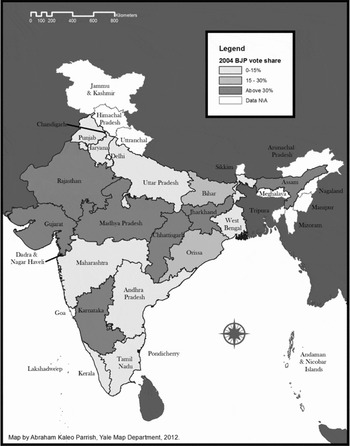
Thus, existing explanations cannot satisfactorily account for how elite parties such as the BJP can recruit the poor. Yet elite parties must achieve some modicum of success among the poor, especially in low and middle income settings where they are especially rich in votes. And despite its strategic limitations, electoral evidence suggests the BJP has recently increased its following among its least likely supporters. In the 1996 national elections, the BJP garnered only 14.89% of the combined vote share from Dalits and Adivasis across India's 17 largest states and exceeded 30% in only a single state. By 2004, this percentage increased to 21.54% (nearly a 50% increase), and it exceeded the 30% threshold in seven states (see Figure 1). Across these seven states—mostly in central India—the party doubled its average vote share among these electorates from 17 to 34% (see Table S.33). How was this unlikely and uneven success achieved? To paraphrase Frank (Reference Frank2004), what's the matter with central India?
BJP Performance with Dalit and Adivasi Voters (2004)

I demonstrate that such unlikely success was won through an electoral division of labor in which the BJP's movement affiliates won over poor voters by privately providing them basic social services. Dalits and Adivasis were specifically targeted under this strategy, because Hindu nationalists believed their recruitment efforts were less likely to succeed among better organized “intermediate” caste groups.Footnote 15 Outsourcing recruitment allowed the BJP itself to continue representing elite interests in its policies and leadership positions.
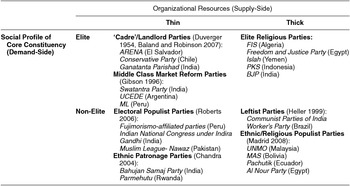
Before empirically substantiating this argument, it is worth asking whether such a strategy is idiosyncratic to India or is likely to be observed elsewhere. To answer this question, it is helpful to focus on two criteria common to most party typologies: the social profile of a party's core constituencies and the depth of its organizational resources (see Table 1). The first criterion influences the demand that a party has for a division-of-labor approach. Parties with less privileged cores—most obviously leftist, populist, and low-rank ethnic parties—can craft redistributive platforms without the risk of alienating their loyal supporters. The approach discussed here thus only holds appeal for parties whose elite core constituencies prevent them from courting disadvantaged communities through such programmatic appeals (Figure 1's top row). However, not all elite parties are equipped to bear the supply-side costs of providing basic services. Parties that arose as agglomerations of local notables (“cadre” parties) or as champions of liberal economic policies (such as UCEDE in Argentina, Movimiento Liberal in Peru, or Swatantrata Party in India) often lack the organizational heft to privately provide welfare.
Which Parties Are Most Likely To Divide Electoral Labor?

Thus, only those parties that combine an elite social base with “thick” organizational assets are likely to mimic the BJP's approach (Gunther and Diamond Reference Gunther and Diamond2003). Yet such organizationally thick elite parties (Figure 1's top right quadrant) may seem like an empirical oddity, especially to conventional typologies based on Western European experience. Do such parties actually exist? The BJP's own roots point us to an important “family” of organizationally thick elite parties across Asia and Africa: those emerging out of religious social movements (Mair and Mudde Reference Mair and Mudde1998). Although not all faith-based formations are elite, many of the most influential examples enjoy their strongest support from relatively privileged urban voters. These include Egypt's Freedom and Justice Party (a Muslim Brotherhood affiliate), Front Islamique du Salut (FIS) in Algeria, Jordanian Islamic Action Front (IAF), Islah in Yemen, and Prosperous Justice Party (PKS) in Indonesia, (Chhibber Reference Chhibber1996; Clark Reference Clark2004; Masoud Reference Masoud2010; Robinson Reference Robinson2004).
The relatively privileged profiles of these parties reflect the social contexts from which they emerged. The Egyptian Muslim Brotherhood was made up of culturally elite urbanites during its early years under founder Hassan al-Banna (Mitchell Reference Mitchell1969). The “most dynamic motors” (Wickham Reference Wickham2002, 115–116) of growth for both the Brotherhood and Indonesian PKS operate on college campuses: the gama’at (Islamic student associations) and tarbiya dakwah (“missionary” Islamic education) movements, respectively (Machimudi Reference Machimudi2008; Wickham Reference Wickham2002, 115–16). The Jama’at-e-Islami in Pakistan similarly built its base among the mu’assir tabqa (influential class), disproportionately drawn from elite ashrafiya migrants from India who left after the subcontinent's partition in 1947 (Iqtidar Reference Iqtidar2011). Islamists networks in Yemen are also strongest among urban middle classes, and the Islah party is stocked with university-educated professionals (Clark Reference Clark2004, 17).
Like the BJP, these elite parties with religious roots are constrained in their ability to win over poor voters through policies or patronage. The Egyptian Brotherhood has been described as “a movement of the middle classes” (Masoud Reference Masoud2010, 180) whose policy platforms consistently represent the interests of relatively privileged voters (Wickham Reference Wickham2002, 2, 209). Chhibber (Reference Chhibber1996) reveals a similar commitment to middle class preferences in the policies advocated by the Algerian FIS. Wedeen's (2008, 189–91) study of Yemen notes that even the visions of social justice offered by Islamists are elite-friendly, “avoid[ing] the radical land reform language of old while lending approval to private property and entrepreneurial profit.” Further, few of these parties have enjoyed any time in office and primarily compete against longtime incumbent regimes with far deeper pockets of patronage.
Finally, these parties are also unlikely to be able to distract the poor through symbolic appeals. Empirical evidence of religion's strength as a political opiate has been mixed at best, even within advanced industrial democracies (Bartels Reference Bartels2008; Gelman et al. Reference Gelman, Park, Shor and Cortina2008). There are three reasons to be even more skeptical of religion's capacity to drive the electoral decisions of poor voters in non-Western settings. First, recent data from the World Values Survey indicate that whereas poor respondents from Western countries are systematically more religious than the nonpoor, the inverse is true of respondents from Asian and African countries.Footnote 16 Second, the especially harsh poverty experienced by poor voters in low and middle income countries makes them even less likely to be able to afford values voting than their counterparts in wealthier contexts.Footnote 17 Third, even if disadvantaged voters in the Global South did politically prioritize “social values,” it is unlikely that doing so would drive them to support elite parties, even those with ties to religious movements. Numerous studies have found that the poor have largely been neglected or even excluded from the “social and political vision” of these actors (Clark Reference Clark2004, 39).Footnote 18
Given these highly similar constraints and capabilities of elite parties with religious orientations, an explanation of how the BJP constructed a diverse social coalition should prove especially helpful in advancing our understanding of these increasingly important actors.
TESTING A DIVISION-OF-LABOR ARGUMENT
This section empirically tests my explanation for how Hindu nationalists recruited the poor through their movement affiliates, thereby remaining free to maintain programmatic linkages with their core elite supporters. In the first part of this empirical section, I test individual-level implications of my division-of-labor argument, drawing on data from an all-India citizen survey. My model predicts that poor voters support elite parties because of material benefits they receive from the their organizational affiliates, not because of their ideological or economic affinity for the party's platform. Conversely, among elites the relative salience of these determinants should be exactly reversed. These expectations yield the following two voter-level hypotheses:
H1: Receiving basic goods and services from organizations affiliated with elite parties increases (does not affect) the likelihood of marginalized (elite) voters supporting these parties.
H2: Programmatic preferences for an elite party's policy platform do not affect (increase) the likelihood of marginalized (elite) voters supporting these parties.
Concepts and Measures
To test H1 and H2 at the broadest level possible, I drew on data from the 2004 National Election Study (NES) conducted by the Center for the Study of Developing Society (CSDS). CSDS has regularly conducted surveys of voter opinion since 1996, and the 2004 NES was the largest survey of Indian voters available at the time this study was conducted.Footnote 19 The non-elite sample used here includes roughly 5,500 marginalized Dalit (lower caste) and Adivasi (tribal) respondents. The elite sample includes 3,200 upper caste Hindus. Both samples are drawn from respondents across 17 major Indian states, which are home to 95% of the country's population.
To test these hypotheses, I estimated logistic regression models where the binary dependent variable identified supporters of the BJP in the 2004 national elections. Each model included three key explanatory variables associated with H1 and H2:
1. Associational Membership: Within the non-elite sample, the key explanatory variable (Associational Member) is a binary measure identifying respondents affiliated with nonparty associations. The survey classified respondents based on their membership in such associations, which included the religious associations and welfare organizations that typify Hindu nationalist organizations.Footnote 20 If such associations did in fact build a comparative organizational advantage responsible for driving the BJP's success among poor voters, we would expect non-elite members to be more likely to vote for the BJP than non-members.Footnote 21 However, we anticipate no such differences among elite voters.
2. Ideological Orientation: I argue that ideological support for Hindu nationalism is a key predictor of elite support for the BJP, but not of non-elite support. However, even among non-elites, ideological views might confound the key relationship between nonparty associations and support for the BJP. After all, respondents who are more supportive of communal political agendas might be more likely to join nonparty affiliates of the party. Equally, non-elites who view such agendas more favorably might reasonably be expected to support the BJP itself at higher rates than their less sympathetic counterparts (Hansen Reference Hansen1999; Jaffrelot Reference Jaffrelot1993; Rajagopal Reference Rajagopal2001). The variable Communalism measures support for Hindu nationalism, notably the movement's signature (and controversial) demand for a Hindu temple to exclusively replace a mosque demolished by Hindu mobs in the northern town of Ayodhya.
3. Economic Policies: I argue that the BJP's elite backers, but not its non-elite supporters, are driven by programmatic preferences for the party's economic platform. Yet such preferences must be accounted for within analyses of the non-elite sample as well. In India, one major axis of disagreement between the BJP and its nonparty affiliates concerns support for economic liberalization. Movement ideologues remain wedded to economic nationalism and see deregulation measures as enabling Western infiltration. However, the BJP broke dramatically with its movement partners as it became clear that many upper caste voters benefited from and supported market reforms (Chhibber Reference Chhibber1997; Lakha Reference Lakha2007). Consequently, it is possible that a non-elite respondent favoring liberalization measures would be more likely to support the BJP electorally but less likely to join one of its partner organizations. Not accounting for this influence may therefore result in an underestimation of membership's impact on Dalit and Adivasi voters. My measure of support for market reforms (Liberalization) is an index based on opinions regarding four broad reforms aimed at shrinking the public sector and broadening private sector activities.Footnote 22
The models also include a number of carefully selected control variables, each of which is not simply an important potential determinant of BJP support but also a plausible confounder of the key relationship between membership and BJP support (Achen Reference Achen2005; Ray Reference Ray2003).
1. Religiosity: I distinguish here between a commitment to a religious political ideology (measured by communalism) and spiritual devotion: To be a devout Muslim or Hindu is not equivalent to being an Islamist or Hindu nationalist. Disadvantaged voters might support an elite party if their religiosity shifts the determinants of their vote choice away from material concerns and toward social issues (Manza and Brooks Reference Manza and Brooks1997; Scheve and Stasavage Reference Scheve and Stasavage2006). Yet higher levels of religiosity might also plausibly lead poor citizens to join the organizational affiliates of an elite party such as the BJP. To control for this dual influence of piety, I construct an index variable, Religiosity, using component analysis based on how often voters pray, how many times they go to temple, how frequently they keep religious fasts, and how often they attend religious services.Footnote 23
2. Ethnic Leader Influence: Although the upper caste BJP might benefit from politically activated religious identities, it is conceivable that the party will do less well with non-elite voters for whom caste identities are especially electorally salient. At the same time poor voters who are strongly politicized along caste will plausibly be less likely to join Hindu nationalist organizations, which often subsume intra-faith caste distinctions within their flock. To account for this possibility, I include a measure (Ethnic Influence) identifying voters who cited co-ethnic (caste) community leaders as the most important influence on their vote choice.Footnote 24
3. Income: One possible explanation of non-elite support for the BJP is that the party primarily recruits the economically elite strata within largely non-elite caste communities. In India, mandated ethnic quotas in legislative and public administrative institutions have enabled a small number of lower caste and tribal citizens to attain relative prosperity (Chaudhury Reference Chaudhury2004). As they ascend the class hierarchy, members of this “creamy layer” might see the BJP's elite-friendly platform as increasingly programmatically appealing (Shah Reference Shah1994). Sociologists have noted that upwardly mobile non-elites often also seek greater social status through assimilative mimicry of elite practices (in India, this process was dubbed “Sanskritization”; see Srinivas Reference Srinivas1956). Such a process might include efforts to join organizations historically associated with elitist traditions of cultural practice, such as those run by Hindu nationalists. I therefore include a categorical variable Income, measuring the household monthly income of the respondent.
The general specification of the models tested in this section can be written as
 \begin{eqnarray*}
{\it logit}(\pi )&\hspace*{-1pt} = \hspace*{-1pt}& \alpha \hspace*{-1pt}+\hspace*{-1pt} {\it Associational\,Member \hspace*{-1pt}+\hspace*{-1pt} \beta 2Liberalization}\\
&& +\, \beta 3{\it Communalism} + \beta 4{\it Income}\\
&& +\, \beta 5{\it Ethnic}\,{\it Influence} + \beta 6 {\it Religiosity} + \varepsilon , \\
\end{eqnarray*}
where logit(π) is the logit function of probability that a voter supports the BJP.Footnote 25 The models are estimated with heteroskedasticity-robust standard errors clustered by state. Because the analysis is interested in assessing the determinants of individual voter choices, all four models also include state fixed effects to account for unobserved, stable, state-level differences that influence patterns of BJP support. The coefficients for each explanatory variable therefore indicate its impact on distinguishing supporters of the BJP from nonsupporters within the same state.Footnote 26
Determinants of Non-Elite Support
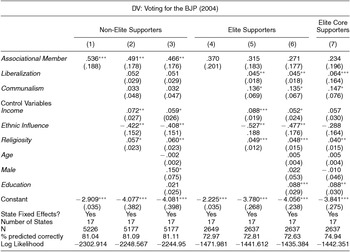
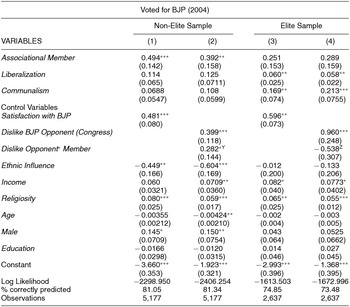
Columns 1–3 of Table 2 report the results of testing the general model specified earlier within the sample of non-elite respondents. Model 1 reports a bivariate model with only associational membership included as an explanatory variable. Model 2 adds the two policy-related measures, as well as the three major control variables. Model 3 then adds standard demographic controls measuring a respondent's age, gender, and level of education. The results indicate strong support for H1 among marginalized voters, because affiliating with nonparty associations significantly increases the likelihood of supporting the BJP in each specification.Footnote 27
Determinants of Support For an Elite Party in India

*** = p < .001 ** = p < .01 * = p < .05 Note: Logistic regression models with robust standard errors corrected for clustering by state.
Associational membership also exerts a strong substantive impact on electoral preferences. The simulated probability of a member voting for the BJP ranged between 30 and 32%, more than double that of a nonmember supporting the party (14%).Footnote 28 The impact of membership was also more than 50% greater than that of the next most influential factor (religiosity).Footnote 29 Further, these effects were not restricted to a small number of voters, because 3 in 10 poor BJP supporters were incorporated within nonparty networks (30%). This was nearly twice the average proportion of members within all other parties (16%).
The results also find support for H2 among marginalized voters, as Models 2 and 3 find weak evidence of a programmatic linkage between non-elite voters and the BJP. Neither support for the BJP's economic policies (liberalization) nor cultural agenda (communalism) emerges as significant in distinguishing supporters of the party among non-elite voters.Footnote 30 This latter result may especially strike many readers as surprising, but the impact of communal values was consistently low (2 to 3 percentage points). All three major control variables—ethnic influence, income, and religiosity—were statistically significant and returned coefficients in the theoretically anticipated direction.
Determinants of Elite Support
To assess H1 and H2 among elite voters, I replicated the models reported in Columns 1–3 within the upper caste sample of the same 2004 NES.Footnote 31 The results, reported in Columns 4–6 of Table 2, reveal several striking differences between the two constituencies. First, in accordance with H1, nonparty membership did not significantly distinguish elite backers of the BJP in any of the specifications. Second, the results fail to reject H2, because variables measuring programmatic attachments to the BJP's platform were influential in determining elite support. Liberalization, which did not distinguish Dalit and Adivasi supporters of the BJP, proved to be a highly significant predictor of upper caste backers of the party. Moving from strongly opposing to strongly supporting market reforms increased the simulated probability of an upper caste voter supporting the BJP by nearly 40%, from 35 to 49 percentage points. Support for Hindu nationalist ideology also emerged as a comparably significant predictor of elite support for the BJP, increasing the likelihood of voting for the party from 35 to 45 percentage points.
Finally, I argued that the BJP's cultural and economic platform enabled it to retain core elite supporters. To identify elite loyalists, Model 7 used a dependent variable coded 1 only for upper caste respondents who supported the BJP in both the 1999 and 2004 national elections. The results indicate that, in accordance with my argument's expectation, liberalization and communalism significantly distinguished these ardent elite supporters of the party.
Comparing Elite and Non-Elite Support
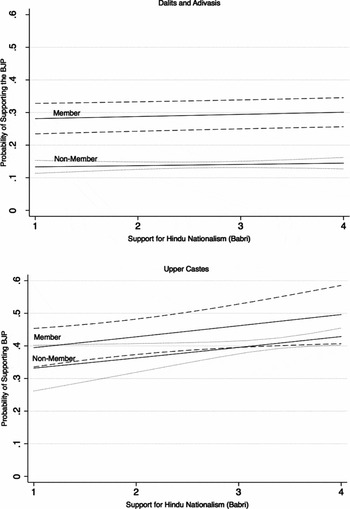
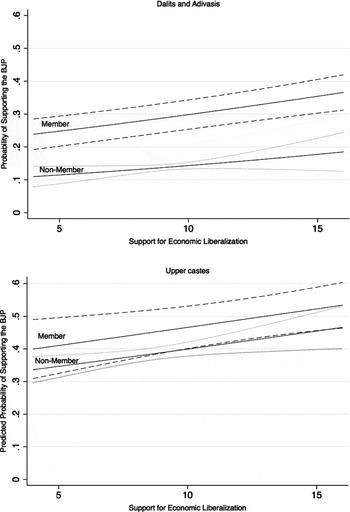
A direct comparison of results for upper and lower caste samples helps sharpen the division-of-labor argument put forward in this article. Figure 2 highlights the striking contrast in how organizational and ideological factors affect Dalits and Adivasis (the top panel) and the upper castes (bottom panel). Within the former sample, membership increased the likelihood of BJP support by roughly 15 percentage points regardless of a respondent's ideological position (the gap between the two solid lines). Meanwhile moving from extreme opposition to support for Hindu nationalism (the slope of these lines) increased the likelihood of BJP support by less than 3 percentage points irrespective of membership status. In fact, the simulated probability of a strongly secular member supporting the BJP (point A) was roughly twice that of a strongly communal nonmember (point B).
Organization Vs. Ideology

By contrast, among upper castes the weight of these influences was completely reversed (Figure 2's bottom panel). Highly communal upper castes (members and nonmembers) were 10 percentage points more likely to support the BJP than secular co-ethnics, whereas the impact of membership was less than half that. Figure 3 depicts a similar picture when comparing the substantive effects of nonparty membership and support for economic liberalization. Membership effects are substantively larger and statistically significant only among non-elites, whereas support for liberalization is more impactful and statistically significant only among upper castes.
Organization versus Economic Preferences

These striking divergences are consistent with a strategy in which an elite party recruits poor voters through nonparty networks, enabling it to continue direct programmatic linkages with rich voters. At the same time, evidence from India also suggests hard limits beyond which this strategy cannot win over poor voters. Replicating the tests used in Table 2 on the survey's sample of poor Muslims and Christians finds that nonparty membership does not exert the same positive effect on support for the BJP among poor respondents of either faith.Footnote 32 Further, relatively few poor Muslims or Christians are incorporated within nonparty associations in the first place. The data cannot discern whether these low numbers stem from Hindu nationalist aversion to incorporating religious minorities or from poor minorities remaining wary of affiliating with a movement whose ideological mandate they distrust. Adjudicating between these two options remains an important question for further inquiry.
ROBUSTNESS CHECKS
The preceding section provides evidence of a strong correlation linking nonparty associations to non-elite voter support for Hindu nationalists. Before substantiating the mechanism behind this core result, I subject it to several robustness checks designed to address four separate issues: imbalances between “treatment” (member) and “control” (nonmember) populations, reverse causation, whether membership effects were confounded by voter attachments to parties and party organizations, and whether these membership effects specifically benefited an elite religious party.
Are Membership Effects Driven by Underlying Imbalances in the Data?
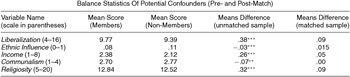
One concern raised by this analysis is that the “treatment” of associational membership was not randomly assigned, a common problem with observational data. The top panel of Table 3 indicates there were in fact statistically significant differences between members and nonmembers across the other major explanatory variables included within the analysis. Given these differences, the analysis needs to work toward fulfilling what Sekhon (Reference Sekhon, Collier, Brady and Box-Steffensmeir2008, 7) has termed a “strong ignorability of assignment.” An increasingly popular way to do so is through nearest neighbor propensity score matching, which first assesses each observation's “propensity” for being treated, based on observed covariates (in this case the five listed variables plus age, education, and gender). Each treated case is then matched to the untreated case with the closest propensity score. As the top panel of Table 3 shows, this matching procedure does improve the balance between members and nonmembers, eliminating significant differences across these major confounders.Footnote
33
The average treatment effect of nonparty membership was robust to this matching. The middle panel of Table 3 shows that members remained 10.5 percentage points more likely to support the BJP than matched nonmembers, an impact that was statistically significant.
Propensity Matching And Sensitivity Analysis * p<.05 **p<.01 *** p<.001


Matching on observed covariates is, of course, no panacea. One crucial concern is that the results cannot account for the possibility of unobserved confounders that increase the ex-ante likelihood of members supporting the BJP relative to nonmembers. Although estimating the magnitude of this potential bias with observational data is impossible, we can use the protocol developed by Rosenbaum (Reference Rosenbaum2002) to estimate how strong such a confounding effect would have to be to undermine the results of the matching analysis.Footnote 34 This sensitivity analysis finds that an omitted variable would have to make members 70% more likely to support the BJP than matched nonmembers to confound the impact of membership at the p <. 05 threshold. Although we cannot definitively preclude this possibility, it is difficult to think of an omitted variable that would make members so much more likely than nonmembers to support the BJP, given that the two groups have already been matched on so many theoretically important potential confounders.
Does Support for the BJP Induce Membership?
Could nonparty organizations be targeting voters who were already supporting the BJP? If so, the direction of association between membership and voting might be the reverse of what my argument implies. Unfortunately, panel data, experimental manipulations, and instrumental variables—three major techniques for addressing endogeneity—are unavailable for use in this instance. Given the difficulties of tracking individuals, particularly in rural India, the NES surveys do not include panels. Experimentally compelling some citizens to join particular religious organizations is neither practically feasible nor ethically permissible. Finally, the survey questionnaire does not provide an instrument capable of fulfilling the especially tricky exclusion restriction when analyzing the impact of one kind of political participation (membership) on another (voting).Footnote 35
However, two types of information can help us better address concerns of causal sequencing. The first is qualitative evidence from Hindu nationalists corroborating the role of nonparty networks in recruiting poor voters to the BJP rather than the other way around. Before discussing such evidence, the survey itself provides us some additional empirical leverage. The 2004 NES asked respondents whom they voted for in the prior national election held in 1999. If organizational inclusion preceded a change in electoral preferences, we would expect members to be more likely to have recently shifted to voting for the party. To examine if this held true, I retested Model 3 of Table 1 on a sample that excluded respondents who had supported the BJP in 1999. In effect the dependent variable now measured if a respondent switched from a different party to the BJP in 2004. The results (reported in Column 1 of Table S.21) indicate a statistically robust influence (p < .05) of nonparty membership on vote switches to the BJP. The impact of membership was also substantial: Members were 9.27 percentage points more likely than nonmembers to shift to supporting the BJP.Footnote 36
Of course, this specification does not preclude a voter from first deciding to switch over to the BJP at some point between 1999 and 2004 and only then joining a nonparty association. However, membership also increases the likelihood of BJP support among respondents who reported making their 2004 voting decision within a few days of the election (Column 3 of Table S.21). Further, membership increases the likelihood of such “late deciders” switching to vote for the BJP (Column 4). In this last specification, membership necessarily precedes the decision to begin supporting Hindu nationalists, unless the respondent decided to join a nonparty association on election day or just before. Although not irrefutable, these tests provide substantial evidence that poor voter shifts toward the BJP followed their organizational incorporation.Footnote 37
Are Membership Effects Confounded by Ties to Political Parties?
My argument emphasizes the importance of the BJP's nonelectoral affiliates in recruiting poor voters. In line with this theory, the party does enjoy an advantage among poor voters who are incorporated within nonparty networks. But what if the BJP enjoyed a similar advantage among poor voters who were members of political parties? Such evidence would point to the importance of the general organizational strength of the party, rather than the specific division of labor that I emphasize. I therefore examine if the results hold if we substitute a measure of individual membership within political parties (Party Member) for the nonparty membership variable. Among non-elite voters, party membership had a slightly negative and statistically insignificant impact on support for the BJP. Among upper castes however, this variable positively and significantly distinguishes BJP supporters, with party members emerging as 36 percentage points more likely to support the BJP than nonmembers.Footnote 38 Rather than trouble my argument, these divergent findings reconfirm the contours of the division of labor I specify.
A related concern is whether a voter's satisfaction with the BJP party confounds the effects of membership. Given their conceptual proximity to vote choice, such preferences are notoriously tricky to include as explanatory variables within analyses of electoral decisions. Yet if membership effects remain robust even after including such a strong predictor, our confidence in the autonomous impact of nonparty associations will be concomitantly improved. Model 1 in Table 4 shows that membership's impact is statistically (p <. 001) and substantively (15 percentage points) robust to controlling for a respondent's satisfaction with the BJP as a party.Footnote 39
Accounting for Party Preferences

*** = p<.001 ** = p<.01 * = p<.05 Note: Logistic regression models with robust standard errors corrected for clustering by state.
Y The mean coefficient of individual interaction effects calculated separately for each observation (using the protocol developed by Norton et. al 2004) is positive (.144) and significant (p<.01). Figure S2C (in supplement) plots the distribution of the z-statistics for individual interaction effects (most are significant at the 95% confidence level).
Z The mean coefficient of individual interaction effects calculated separately for each observation is negative (-.120) and statistically insignificant. Figure S2D (supplement) plots the distribution of the z-statistics for these individual interaction effects (none are significant at the 95% confidence level).
A slightly different concern is whether voter displeasure with the BJP's major national rival (the Indian National Congress) confounds the impact of membership. Models 2 and 4 in Table 4 include a binary measure of such displeasure. Not surprisingly, this variable registers a significant positive impact on the likelihood of BJP support among both elite and non-elite samples. The inclusion of this measure does not, however, confound the autonomous impact of membership among non-elite voters. Interestingly, an interaction term between nonparty membership and Congress disaffection exerts a positive average marginal impact on BJP support among Dalits and Adivasis. Membership's impact was more than twice as high among poor voters displeased with the Congress (25.38 percentage points) than among those less critical of the BJP's rival (11.65 percentage points).Footnote 40 The interaction was also statistically significant for most observations in the non-elite sample.Footnote 41 However, a similar interaction between membership and a voter's active preference for the BJP was not significant for any observation in the elite sample.Footnote 42 In line with my argument, these results show that the BJP's non-party affiliates are most effective at recruiting poor voters who are disaffected with other parties, rather than those who are already predisposed to vote for Hindu nationalists.
Do Membership Effects Extend to Other Types of Parties?
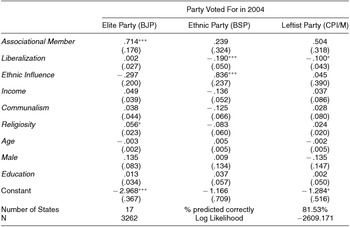
Finally, a theory of elite parties deploying a unique division of labor would be weakened by evidence showing that other political formations also use a similar approach. To assess this possibility, I compared poor supporters of the BJP to those backing three other types of parties common across the global south: a catch-all party of independence (in this case, the Indian National Congress), a nonreligious ethnic party (the Bahujan Samaj Party, India's most prominent lower caste party), and a leftist party (a coalition of two communist parties).Footnote 43 These formations were both conceptually important and electorally influential, comprising the four largest recipients of Dalit and Adivasi votes in 2004. To compare support for these parties, I estimated a multinomial logit model using the Congress as a base category, a decision informed by the party's “centrist” positioning and earlier national dominance among non-elite voters. The coefficients in this specification indicate the impact of a given variable on the likelihood of a voter supporting a given party relative to the likelihood of his or her supporting the Congress.
In this analysis, reported in Table 5, associational membership was the single biggest factor distinguishing the BJP's supporters from those backing the Congress. Yet this variable was insignificant in identifying non-elite supporters of any other party. For the lower caste-led BSP, the strongest determinant of support was the influence of ethnic leaders, in line with conventional wisdom. Meanwhile, communist supporters were most strongly identified by their support for the left's vocal opposition to economic liberalization, also in line with the view that leftist parties establish programmatic linkages with their poorer core constituencies (Heller Reference Heller1999).
Comparing Non-Elite Support Across Major Party Types (multinomial logit model, Congress Base Party)

*** = p<.001 ** = p<.01 * = p<.05 Note: Multinomial Logit model with state fixed effects and robust standard errors corrected for clustering by state.
SPECIFYING CAUSAL MECHANISMS: QUALITATIVE AND QUANTITATIVE EVIDENCE ON RELIGIOUS WELFARE
Although survey data provided robust evidence of a broad division of labor between movement and party, it cannot specify what kinds of nonparty associations succeeded in recruiting the poor. In this section, I substantiate the causal mechanisms behind my argument by demonstrating how the BJP specifically used affiliates providing local public goods (mostly in health and education) to attract low-income voters. To do so, I collected state-level evidence from a range of primary sources. First, I draw data from the internal records of Hindu nationalist organizations, obtained through personal contacts made during fieldwork in India, to statistically test a third hypothesis:
H3: Poor voter support for elite parties is higher in areas where the parties’ private welfare networks are more strongly developed.
Second, I use qualitative data from interviews to discuss why this strategy is simultaneously attractive to the BJP and to poor voters and to provide additional confirmation of the sequencing implied by my argument.
Testing the Electoral Gains from Service
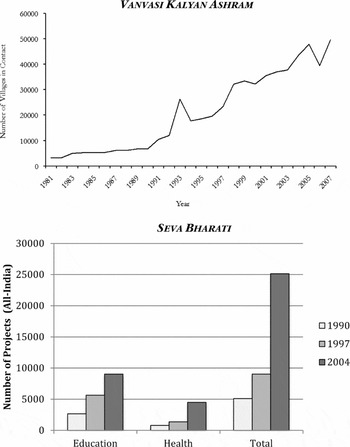
Data from the internal records of Hindu nationalists reveal a proliferation of service chapters over the past two decades. The movement's two major wings devoted to service provision are Seva Bharati (Service to India) and Vanvasi Kalyan Ashram (Association for the Welfare of Tribals; VKA). Both provide a variety of different services ranging from schools (including one-teacher schools in remote areas) to blood banks, medical dispensaries, and vocational training centers (for learning typing, sewing, etc.). Despite their long presence within the movement, these affiliates have massively proliferated over the past two decades (Figure 4).Footnote 44
Recent Growth in Religious Welfare across India Sources:

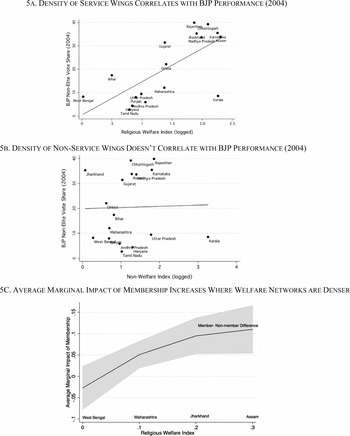
Did this growth correspond to the BJP's pattern of success among marginalized voters? To answer this question, I constructed an index of the per capita density of social service affiliates across the 17 largest Indian states.Footnote 45 If the BJP does indeed benefit electorally from the work of its service wings, it stands to reason that its aggregate performance with disadvantaged constituencies should be stronger where these affiliates have a denser presence. Figure 5a shows that the vast majority of India's major states conform quite remarkably to this hypothesized pattern.
Religious Welfare and BJP Performance

A second observable implication of my argument is that there should be no particular correlation between the BJP's performance and the aggregate presence of Hindu nationalist nonservice chapters. Figure 5b confirms this implication, showing that variations in an identical index for nonservice affiliates do not correspond to patterns in the BJP's performance with non-elite voters. Finally, service networks were not simply being built in states where the BJP was already doing well among marginalized electorates. Instead, states where service networks expanded most rapidly between 1996 and 2004 were also those in which the BJP made the most dramatic gains with poor voters during this same period.Footnote 46
To further assess the centrality of service networks among the poor, I examined if the strong associations between service density and the BJP's performance were reduced or removed by accounting for certain state-level potential confounders. The dependent variable for this analysis is the BJP's vote share among a state's combined Dalit and Adivasi electorate in the 1996, 1999, and 2004 elections (each taken from the relevant National Election Study). The key independent variable for this specification (Religious Welfare) is the per capita welfare index described earlier, calculated from nationwide internal reviews conducted by Hindu nationalist organizations in 1995, 1997, and 2004.
The control variables were once again carefully selected as factors that are plausibly associated with both the dependent and key independent variables. I included a measure of party fragmentation (the effective number of parties, ENPV) within a state.Footnote 47 Elite parties such as the BJP stand to perform better with non-elites when they face fewer salient electoral competitors. Less politically fragmented states might also have less crowded organizational arenas and hence less competition for religious welfare organizations looking to recruit the poor.
Second, upper caste Hindu nationalist service activists may find it especially difficult to appeal to non-elite citizens where caste-based divisions are sharply politically polarized. At the same time, the elite BJP is itself less likely to attract non-elite voters in such environments. To measure ethnic political polarization, I adapt Huber's (Reference Huber2012) index of ethnic voting using NES data.Footnote 48 Higher values of the index indicate sharper partisan differences between members of different ethnic groups. Third, I include a measure of upper caste support for the BJP (Elite Support). Service organizations may be built where elite parties enjoy a greater following among their core constituencies, because these communities often fund and support welfare activities. Yet elite parties might independently do better among the poor in areas of high core support, where their own mobilizing capacities are likely to be stronger.
Fourth, demographic factors might jointly influence religious welfare and elite party performance. Past scholarship has argued that sectarian parties are more effective when the populations they mobilize against (Muslims and Christians in the BJP's case) are larger. Equally, religious movements might concentrate their welfare efforts in these areas because they view them as posing greater social threats to their faith (such as organized conversion). I therefore control for the proportion of a state's population that is Muslim or Christian. Further, elite parties might also expand welfare networks where the non-elite populations they target are larger. However, India's plurality system may incentivize groups to self-mobilize where they are more numerous (e.g., Posner Reference Posner2006). Non-elite ethnic communities may therefore be less likely to support elite parties as their size approaches a winning plurality. Not accounting for group size might therefore dampen any association between service chapters and elite party performance.
Finally, economic development (Development, measured as the per capita state domestic product) may exert similar inverse effects on welfare chapter placement and BJP support.Footnote 49 Service activists may concentrate their efforts in relatively underdeveloped states where their offerings will be especially valued. However, class-based voting is often stronger in poorer regions (Gelman et al. Reference Gelman, Park, Shor and Cortina2008; Huber and Stanig Reference Huber and Stanig2009), reducing the chances of disadvantaged voters crossing class lines to support the BJP.
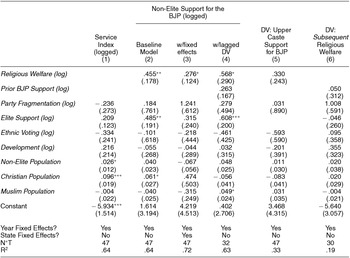
Table 6 reports how these various factors affected the BJP's performance across 17 Indian states from 1996 to 2004.Footnote 50 The models used were generalized least squares panel regressions with robust clustered standard errors.Footnote 51 All models also included year fixed effects to remove any idiosyncratic effects of a particular election year. Given the limited sample size (N = 47 for most models), the results should be interpreted with caution, but are nevertheless instructive. Model 1 first assesses where Hindu nationalist service networks were built by regressing the service index on the other explanatory factors. Only the size of Christian and that of non-elite populations were found to significantly affect welfare network density, both in the expected positive direction.Footnote 52
Religious Welfare and Elite Party Support Across Indian States (1996–2004)

Notes: *p<.05 **p<.01 ***p<.001. The panel is slightly imbalanced (47 instead of 51) due to missing data on some explanatory variables for Chhattisgarh and Jharkhand for 1996 and 1999, as these states were only formed in 2000.
Model 2 shifts to regressing BJP performance with Dalits and Adivasis on the service index and other state-level explanatory variables. The results reveal that the density of welfare chapters significantly and positively correlates with the BJP's performance, even when accounting for these theoretically important potential confounders. Because both the key predictor and outcome variables are log transformed, the results indicate that a 10% increase in the service index results in an average increase of about 4.5% in the BJP's vote share. Among the control variables included, the BJP's upper caste vote share also exerted a positive impact on its performance among subaltern groups, but this result was not consistent across all specifications and did not confound the autonomous impact of service networks. Although the proportion of Christians did significantly affect BJP vote share, its impact was in the opposite direction to its impact on welfare network density. Given these inverse effects, this variable cannot be driving the positive association observed between welfare and BJP performance.
Models 3–6 subject the observed association between welfare networks and BJP performance to additional robustness checks. Model 3 shows that the impact of welfare is robust to controlling for unobserved stable differences between states by including fixed effects.Footnote 53 Model 4 shows this result also holds when including a lagged measure of non-elite support for the BJP.Footnote 54 This gauge of past performance helps control more directly for the distinctive trajectory of Hindu nationalism with disadvantaged voters in each state (Angrist and Pischke Reference Angrist and Pischke2008). The consistently robust impact of service on BJP performance across these different specifications increases confidence that the results are not the artifact of a particular modeling strategy.Footnote 55
Finally, Models 5 and 6 present “placebo tests” for which my central theory predicts no effect. Finding an effect in either instance would therefore cast doubt on the support this analysis provides for my argument. First, my theory anticipates welfare network density to have no impact on elite support for the BJP, because service chapters explicitly do not “treat” upper caste populations. Model 5 regresses upper caste support on religious welfare and finds no impact. Second, Model 6 finds no effect of earlier BJP performance (measured in 1996 and 1999) on subsequent levels of Hindu nationalist service provision (measured in 1997 and 2004). A significant coefficient on the welfare index in this specification would have indicated a violation of the causal logic implied by my argument.Footnote 56
We can also combine state and survey data to address concerns of measurement validity with the membership variable used in the voter-level analysis. The broad wording of the survey question used to construct this measure raises the possibility that participation in non-Hindu nationalist organizations drives membership's impact. To address this concern, we can leverage the reasonable assumption that membership is more likely to reflect participation in Hindu nationalist welfare associations where these organizations actually have local chapters for voters to join. Consequently, my argument anticipates membership to correlate with BJP vote choice more strongly in states with dense aggregate welfare networks. Conversely, my theory would be troubled if we find this correlation is stronger in states with weak service networks (i.e., where membership is less likely to reflect inclusion in Hindu nationalist networks).
Accordingly, I test whether membership's impact on BJP support is conditioned by the state-level welfare index. I do so by including an interaction term within the full specification used among non-elite voters. This term interacts the welfare index value resides with his or her individual membership status (Service*Member).Footnote 57 I follow Long (Reference Long2009) in using simulated probabilities to interpret the interaction effect within a nonlinear framework. Figure 5c charts the average marginal impact of membership on BJP support across a range of welfare index values. This effect is actually negative (and statistically insignificant) for low values of the welfare index, but steadily increases for higher index values. The impact becomes positive for values greater than .05 and is statistically significant for values greater than 0.1 (roughly the index value for Maharashtra).Footnote 58
Thus, in line with my argument, the marginal impact of membership on BJP support becomes more pronounced where Hindu nationalist welfare networks are denser. Of course, these tests must be read with caution, because the interaction term still does not specifically identify members of Hindu nationalist associations. That said, these findings—triangulated with the other layers of evidence provided here—do strengthen confidence in the validity of my analysis.Footnote 59
Why Service? The Views of Providers and Recipients
A final question that the prior analyses cannot satisfactorily answer is why parties such as the BJP might turn to this particular division of labor.Footnote 60 In 1989, Hindu nationalists launched a new “service division” (seva vibhag) to expand their welfare activities. Interviewees admitted that this new division was created to be a tool for political recruitment, noting that “we knew that our presence was mostly with upper castes, so we decided to make a separate service division to help us work among our backward brothers.”Footnote 61 Other informants corroborated this shift, noting that “it was in 1990 that we really decided to enter society in a full way using service. Before that we did not always do this constant service work” [emphasis added].Footnote 62 In this section, I draw on extensive fieldwork in three Indian states between 2007 and 2010 to argue that the provision of quotidian private welfare proved particularly attractive because it allowed the BJP to balance the needs of poor voters, wealthy core constituencies, and movement ideologues.Footnote 63
For poor voters, welfare-based outreach provided modest but tangible material benefits and was therefore preferable to strategies primarily based on ideological appeals. In interviews, poor beneficiaries repeatedly voiced their appreciation of these services. One telling instance came from the village of Kikar, where the local public schoolteacher confessed he had enrolled his son in a Hindu nationalist school, which he regarded as superior to his own.Footnote 64 Another example came from two Adivasi residents of Bael village, who said they especially valued the local Hindu nationalist welfare wing for its afterschool programs.Footnote 65 Absent this service, their children had often been left unsupervised and invariably found ways to get in trouble. A particularly striking illustration came from the village of Anola, where an interviewee said he enrolled his son in a Hindu nationalist school, despite initially opposing the BJP, because he believed it offered a better education.Footnote 66 He now openly claims to vote for the BJP.
This appreciation was enhanced by the inadequacy of local public services. Dalit residents of a slum in the northern city of Agra complained about the irregular presence of government schoolteachers, noting that “out of three teachers, only one actually shows up. There is no atmosphere for learning.” They noted that “compared to the [local] Seva Bharati school, the work in government schools is third rate—it is just a salary collection business.”Footnote 67 Villagers in central India voiced similar complaints about their local primary health center, saying they preferred to receive medicines for common illnesses (colds, coughs, diarrhea) from Hindu nationalists because “they will always see you, whereas with the government center we never know whether we will even see a doctor that day.”Footnote 68 These conversations underscore the fact that it was dissatisfaction with existing service infrastructure that drew the poor to religious welfare chapters, not their preexisting attachments to the BJP.
For elite party providers, welfare offers an efficient method of outreach that does not encroach on the programmatic agenda of their core supporters. First, offering local public goods allowed individual providers to establish contact with a relatively large number of poor voters. Second, the physical expenses of welfare could be kept relatively low. They relied on committed ideologues to provide low-cost services, while the inadequacy of public services ensured these basic offerings were still appreciated. Third, the patronizing terms of “uplift” associated with welfare proved far less threatening to the BJP's elite core than the redistributive language needed to justify pro-poor shifts in policies or party personnel.Footnote 69
Additionally, welfare provided the basis for upper castes to gain access to poor communities that have been previously hostile to Hindu nationalism's elitist ideological vision: “There is distrust at first, and will continue until you actually go to them and work amongst them,”Footnote 70 but “through our little pieces of work we gain their trust.”Footnote 71 Welfare providers discussed how the goodwill and high local standing that welfare generates can be deployed to help the BJP electorally: “Our teachers are not respected at first, because people are not sure about what they are trying to do in the village. But over time they gain high status in the village. . . even today teachers in tribal society command much respect, which is helpful for us politically.”Footnote 72
Some activists were even more forthcoming, detailing their specific contributions toward mobilizing communities within their sphere of influence. Two activists discussed how they “first sit with those villagers with whom we have a good relationship and make clear which candidate we want to win the election.”Footnote 73 Having done so,
We tell our friends to go and talk to their neighbors and try and convince them to support our preferred candidate. We also tell them how to explain their support, to make sure villagers understand the choice is best for the development of their community.Footnote 74
Another activist, who runs a boarding school for tribal students notes:
See in the beginning, people were suspicious, but the best proof of the turn [in their opinions] has been that we have managed to recruit 15 students from our school alone in the last few years to work as full time party workers for hamara bhajapa [our BJP].Footnote 75
Such sensitive confessions, which required sustained engagement with particular activists to elicit, provide invaluable confirmation of the causal sequencing implied by my argument. These interviews all converged in describing a pattern of initial hostility among non-elite citizens toward Hindu nationalism and the BJP, which is overcome by the goodwill earned by service workers, leading to a shift in political preferences.
Qualitative fieldwork also confirmed that this “goodwill” is not simply window dressing for clientelism. As part of my research, I interviewed 80 randomly selected households in five central Indian villages with active Hindu nationalist service chapters. Contra the discretionary logic of clientelism, no interviewee reported being turned away from a Hindu nationalist welfare chapter. Second, villagers framed their reciprocity in terms of voluntary gratitude, not as a compulsory quid pro quo. Each household was asked if it “had to” (dena parhta hai) give something back to Hindu nationalists in return for using their services. The vast majority (87%) said they did not. However, when asked if they felt they “should” (dena chahiye) give something back, 53% responded in the affirmative. Interestingly, such reciprocity often included attending regular meetings and festivals organized by the providing organization.Footnote 76
Finally, service activists noted that monitoring voters—a key feature of clientelism (see Stokes Reference Stokes2005)—imposes prohibitive logistical costs, especially within populous Indian constituencies. Assuming such responsibilities would curtail the service work each activist could perform, reducing the number of poor voters within his or her sphere of influence.Footnote 77 Further, service activists believe they are more socially respected (and hence electorally effective) if they do not explicitly make partisan demands.Footnote 78 These claims appear to resonate with survey evidence, because measures of monitoring efforts did not correlate with the BJP's success among associational members. Neither preelection contact with party activists nor attendance at campaign rallies increased the likelihood of members voting for the party (Table S.28).
CONCLUDING DISCUSSION: THE ARGUMENT BEYOND INDIA
This article has argued for the need to extend the study of the poor voter paradox to the non-Western world. Such paradoxes emerge routinely across the global south, but have been ignored because these arenas are not organized in accordance with Western convention. Through an in-depth examination of how this puzzle manifested within the world's biggest democracy, I have illustrated the inadequacy of existing explanations based on conventional material strategies or values voting. Instead, I outline a unique strategy through which elite parties can recruit the poor while retaining the rich. Specifically, the BJP exemplifies how elite parties can outsource recruitment to organizational affiliates providing basic social services, allowing their party arm to maintain programmatic linkages with elite core supporters. In delineating this strategy, I more broadly highlight the importance of privately furnished electoral strategies that (outside of direct vote buying) continue to be significantly understudied.
I develop and test this argument with evidence from the intrinsically important case of India. One of the advantages of my subnational design is its ability to control for institutional effects while analyzing variations in elite party performance. However, India's institutional context does highlight some important conditions that enabled the BJP's approach. Most fundamental were the demand-side incentives provided by electoral competition and the civic freedoms the BJP's affiliates enjoyed. Absent these conditions, elite parties are more likely to remain focused on organizational survival (and hence on core voter retention), instead of on electoral expansion.Footnote 79 Second, India's plurality system compelled the BJP to expand beyond its elite base, because upper castes do not constitute a plurality in practically any Indian constituency. Finally, India's populous constituencies raised the monitoring costs of individualized clientelist pacts, thereby incentivizing Hindu nationalists to focus on providing local public goods.
Some of these facilitative conditions may not exist in polities in which other elite actors, especially those with religious roots, operate. Yet insights from India are still useful for the broader study of such parties. For example, my argument has illustrated the widely varying reasons for which citizens might support the BJP, an elite party with religious roots, and the importance of intra-faith class distinctions in structuring such variation. Second, the BJP's approach also reverses conventional portrayals of these actors, which assume movement radicals whip up the core base, while party pragmatists focus on reaching out to noncore supporters.
An interesting illustration of the comparative potential of both insights comes from contemporary Yemen. Although clearly not a fully democratic state, Yemen also defies many stereotypes of political life in nondemocratic settings. The country has had a vibrant history of associational life, and “Yemenis from a variety of regional and class backgrounds routinely criticize the regime without the fear of repercussions” (Wedeen Reference Wedeen2008, 76). The country is also home to an elite party affiliated to a religious movement: the Yemeni Congregation for Reform (commonly known as Islah). Islah has a staunchly urban, middle-class core, and its platform accordingly emphasized “everyday social practices” (Weeden 2008, 189–91) and avoided redistributive economic policies favoring the poor.Footnote 80 Yet the party has faced increasing electoral incentives to reach out to poor voters in post-unification parliamentary elections, because tribal leaders it had relied on for this task were inconsistent in their commitment to Islamist values and susceptible to the poaching efforts of the dominant General People's Congress (GPC). Welfare provision, led by the Islah Charitable Society (ICS), appears to have become an important part of the party's outreach, especially among the urban poor.Footnote 81 Even Clark's (2004, 124) skeptical account, which depicts Islamic welfare networks in Egypt and Jordan as being run “by and for middle classes,” calls the ICS “the most successful humanitarian nongovernmental organization helping the poor in Yemen.”
It is beyond the scope of this article to provide equivalently extensive tests of my argument within Yemen. However, the recent Arab Barometer survey does provide evidence of some intriguing parallels. Although it did not report the specific electoral preferences of respondents, it did ask whether they thought it “suitable to have a parliamentary system in which only Islamic political parties and factions compete.”Footnote 82 A replication of the tests conducted in Table 2 revealed that among poorer Yemeni, associational members were significantly more likely to support Islamist politics (a simulated probability of 30%) than nonmembers (14%).Footnote 83 Conversely, a respondent's religiosity (measured as the frequency of reading the Quran) yielded no significant impact.Footnote 84 Yet these effects were inverted among relatively privileged Yemeni respondents: Organizational inclusion had no effect on support for Islamist politics, but piety increased such support by 30 percentage points.
I do not wish to overstate the significance of these findings nor conclude with unfounded assertions that all elite parties, even those with religious orientations, will necessarily replicate the BJP's approach. Instead, this brief discussion helps highlight how a study from South Asia can help structure our analysis of similar phenomena outside the region. In this instance, insights from the BJP's experience helped uncover strikingly resonant divergences in how organizational inclusion and cultural values affect support for a similar elite party outside the subcontinent. The momentous changes sweeping across much of Africa and Asia have ensured that a growing number of such parties will simultaneously face decreased restrictions on their activities and increased electoral incentives to appeal to the poor. Given this shifting terrain, an explanation of how Hindu nationalists forged a coalition of rich and poor within India's more mature democratic setting should prove particularly instructive.
Supplementary materials
To view supplementary material for this article, please visit http://dx.doi.org/10.1017/S0003055414000069






Comments
No Comments have been published for this article.