INTRODUCTION
Balancing the needs of biodiversity conservation with those of social and economic development is one of the key challenges faced by societies in areas of high biological diversity. Over the last few decades, alongside the rise of the global discourse of sustainable development, a range of people-centred approaches to conservation (including ‘community based conservation’, ‘integrated conservation and development projects’ and ‘community based natural resource management’), have become ever more prominent features in the conservation landscape (Roe Reference Roe2008). These approaches aim to achieve both development/poverty reduction and biodiversity conservation. However, just as the global discourse of sustainable development has been subject to critical analysis (Sachs Reference Sachs, Hajer and Fischer1999; Thompson Reference Thompson, Fischer and Hajer1999; Adams Reference Adams2009), a backlash has emerged against simplistic but persistent discourses that paint conservation and development in terms whereby both win. Some have argued that people-centred approaches to conservation have demonstrably failed to protect nature (Oates Reference Oates1999; Terborgh Reference Terborgh1999), while others have argued that these approaches often fail to deliver promised benefits to local populations (Schmidt-Soltau Reference Schmidt-Soltau2004; West Reference West2006), or that, although often participatory in name, many apparently participatory conservation projects are as vulnerable to the influence of dominant power interests as non-participatory approaches (Peterson et al. Reference Peterson, Peterson and Peterson2005). International conservation experience over the last 20 years indicates that ‘initiatives that produce win-win outcomes appear to be the exception as opposed to the rule’ (Mcshane et al. Reference Mcshane, Hirsch, Chi, Songorwa, Kinzig, Monteferri, Mutekanga, Thang, Luis, Pulgar-vidal, Welch-Devine, Brosius, Coppolillo and Connor2011, p. 968).
The ideal of outcomes that benefit both conservation and society (‘win–win’ outcomes) resonates with decision makers, project funders and the public alike, and, as such, these discourses are highly marketable and resilient. However, as well as being largely inaccurate descriptors of the outcomes of many conservation and development projects (Sunderland et al. Reference Sunderland, Ehringhaus and Campbell2008), these ‘win-win’ discourses and the rhetoric of consensus that often accompanies them, might themselves be considered a political strategy which reifies the status quo, acting to maintain existing hierarchies rather than change them, thus reinforcing bureaucratic state power (see also Ferguson Reference Ferguson1994; Buscher Reference Buscher2010). Others have argued that the emphasis on consensus in conservation is fundamentally undemocratic: it implies that reducing the plurality of discourses and opinions around conservation is both possible and desirable, but in fact the appearance of consensus is only achieved by masking conflict between participating groups and individuals, and hence is an illusion that is ‘fatal to democracy because a healthy democratic process requires recognition of differing interests, and the recognition that open conflict about differing interests is legitimate’ (Peterson et al. Reference Peterson, Peterson and Peterson2005, p. 764). Jasanoff (Reference Jasanoff, Dryzek, Norgaard and Schlosberg2011, p. 130) has termed this push to build consensus as ‘false universalism’, arguing that it represents an attempt to deny or denigrate ‘differences that should be respected and that legitimately matter to others’. In reality, the social contexts in which conservation and development take place are very rarely characterized by consensus and outcomes that benefit all parties; rather a range of different interests and perspectives exist, all of which understand and define the situation differently. Work in the social and political sciences has pointed out that the very nature and meaning of ‘the problem’ is itself constantly being negotiated between actors in complex discursive struggles (Hajer Reference Hajer1997), and that different perceptions of what constitutes a problem are ‘implicitly rooted in divergent inculturated beliefs about the appropriate state of the world and appropriate outcomes of management’ (Mattson et al. Reference Mattson, Byrd, Rutherford, Brown and Clark2006, p. 401).
There have been a number of calls for conservationists to move away from discourses based on idealized outcomes that benefit both conservation and society and the search for consensus, towards more open acknowledgment of trade-offs in conservation and development (Faith & Walker Reference Faith and Walker2002; Sunderland et al. Reference Sunderland, Ehringhaus and Campbell2008; Mcshane et al. Reference Mcshane, Hirsch, Chi, Songorwa, Kinzig, Monteferri, Mutekanga, Thang, Luis, Pulgar-vidal, Welch-Devine, Brosius, Coppolillo and Connor2011). An important dimension of trade-off thinking is that choices need to be made between often incommensurable interests, perspectives and goals. Crucially these are not easy choices and in most cases involve significant losses. To understand what is at stake in decision making, different perspectives and framings of an issue need to be taken into account, and, in order for this to happen, these diverse views need first to be made explicit. This thinking finds parallels in calls from policy studies for the need for research to focus on ‘opening up’ policy processes to the full range of discourses and framings around a given issue (Stirling Reference Stirling2008), in order to ‘reveal the hidden social and cultural assumptions underlying apparently incommensurable world views’ (Leach & Mearns Reference Leach, Mearns, Leach and Mearns1996, p. 33).
In this paper, consensus-based approaches to conservation and development on the Galápagos Islands are critically examined. A high profile conservation area and the site of significant conservation anxiety, the Galápagos Islands provide an interesting case study in which to explore these dynamics.
The Galápagos Islands are a volcanic archipelago comprising around 18 islands situated in the Pacific straddling the equator, 928 km from Ecuador by whom they are governed. Despite a resilient narrative that depicts the islands as an uninhabited and pristine wilderness (Grenier Reference Grenier2007; Hennessy & McCleary Reference Hennessy and McCleary2011), the islands have been populated since the mid-19th century (Larson Reference Larson2001; Quiroga Reference Quiroga, Tapia, Ospina, Quiroga, González and Montes2009), and a population of c. 25 000–27 000 people currently inhabit five of the islands (INEC [Instituto Nacional de Estadistica y Censo] 2010). Although officially 95% of the terrestrial surface of the islands and the surrounding areas within 40 nautical miles of the islands are protected as a national park and marine reserve, in recent years, the conservation of the archipelago has been the subject of a great deal of concern, as evidenced by their temporary addition to UNESCO's list of World Heritage in Danger in 2007 (UNESCO [United Nations Educational, Scientific and Cultural Organization] 2007), and the issuing of an emergency decree by the Ecuadorian president Rafael Correa, stating that the islands were in a state of risk (Presidential decree No. 270, 10 April 2007, Government of Ecuador). The islands have been experiencing consistently high economic growth, largely as a result of a successful tourism industry (Taylor et al. Reference Taylor, Hardner and Stewart2006; Epler Reference Epler2007). In 2011, > 180 000 people visited the Galápagos National Park (PNG [Parque Nacional Galápagos] 2011), and although exact figures are unavailable, some estimates suggest that tourism is (directly and indirectly) responsible for 78 % of all employment on the islands (Epler Reference Epler2007, p. 21). However, conservationists and others have raised fears that the current development trends are unsustainable, increasing pressure on natural resources through the growing demand for goods and services (González et al. Reference González, Montes, Rodríguez and Tapia2008), and threatening the endemic species through increasing the risk of introduction of non-native species or diseases (Causton et al. Reference Causton, Peck, Sinclair, Roque-Albelo, Hodgson and Landry2006; Bataille et al. Reference Bataille, Cunningham, Cedeño, Patiño, Constantinou, Kramer and Goodman2009).
The ‘conservation imperative’ (Wilshusen et al. Reference Wilshusen, Brechin, Fortwangler, West, Brechin, Wilshusen, Fortwangler and West2003) of preventing further species extinctions on the islands is rarely in dispute in public debate on the islands, and, indeed, the anthropological work of Ospina (Reference Ospina2004) illustrated the way in which conservationist language has become an important source of cultural legitimacy for a broad range of social actors in Galápagos, many of whom strive to present themselves as defenders of nature while seeking to cast aspersions on the motives and actions of other groups and individuals. Despite this, one of the key issues raised by the UNESCO mission was the lack of a ‘common vision for Galápagos’ among the local population (UNESCO 2007, p. 9), a situation which was felt to be hampering concerted conservation efforts. This sentiment was also expressed in the management plan of the Galápagos National Park, which called for the islands to unite around a shared vision of Galápagos as the ‘road map to a sustainable future’ (PNG 2005, p. 37, translated from Spanish), and was reiterated in a number of other influential documents in subsequent years (Tapia et al. Reference Tapia, Ospina, Quiroga, Gonzalez and Montes2009a ; CDF [Charles Darwin Foundation] 2010). A diversity of perspectives towards conservation is thus widely recognized, but most frequently cast as a barrier to effective conservation. What is required, it has been argued, is the fostering of a shared ‘cultural identity based on respect for natural capital’ (CDF 2010, p. 180), to be achieved in part through increasing amounts of science, better tied to the needs of conservation and sustainable development (Tapia et al. Reference Tapia, Ospina, Quiroga, Gonzalez, Montes, Tapia, Ospina, Quiroga, González and Montes2009b ); or more ‘solid information’ (Watkins & Cruz Reference Watkins and Cruz2007), along with improved education of local people in order to change attitudes (Merlen Reference Merlen and Stewart2007; Watkins & Cruz Reference Watkins and Cruz2007). This paper will critically examine some of these calls to consensus in conservation by using Q methodology to reveal the diversity of perspectives towards conservation on the islands, asking how and why these differ, and what their existence means for the creation of a shared vision or consensus around conservation.
METHODS
Q method
We used Q method, a quali-quantitative technique that can be used to explore viewpoints or discourses about any topic that can be socially contested or debated. A Q study is typically divided into five distinct phases. (1) A number of opinion statements are collected from a wide range of sources. This process is known as building a concourse, which can be defined as bringing together the ‘volume of discussion’ (Brown Reference Brown, Berry and Lewis-Beck1986, p. 58) on the topic of interest. (2) The concourse of statements is examined for themes, and a sub-set of the statements selected in order to be presented to participants for rank ordering. This sub-set of statements is known as the ‘Q sample’ and ideally contains all the diversity of the broader concourse. (3) A diverse range of purposively-selected participants is asked to rank the statements in the Q sample along a scale of ‘most like my point of view’ to ‘least like my point of view’. This process is known as carrying out a Q sort. Q method is an intensive, ‘small n’ methodology, and the number of participants in a typical Q study is 20–40 people (Brown Reference Brown1980). (4) The results are statistically analysed in order to allow the extraction of a number of ‘factors’ representing generalized opinions or discourses present in the population. (5) The factors or discourses are interpreted using additional comments made by the participants and recorded at the time of carrying out the Q sorts.
In this study, the concourse was defined as ‘opinion related to Galápagos conservation’. Statements were collected from a wide range of documents and websites, as well as informal interviews. Sources included academic and popular literature about Galápagos, grey literature (such as the Galápagos Park Management Plan [PNG 2005], and the Galápagos Regional Plan [Instituto Nacional de Galápagos 2002]), the websites of various local institutions (for example local and regional councils, non-governmental organizations [NGOs], tour operators and fishing cooperatives), and comments made by speakers at an event organized by the Galápagos Conservation Trust (attended on 15 September 2009). In addition, approximately 20 informal interviews were carried out with local people in Puerto Ayora, Santa Cruz Island, Galápagos, during October 2009, with interviewees being selected based on the researchers’ appraisal of voices that appeared to be missing from the published literature on Galápagos (for example local farmers and fisherfolk, women and younger people). In order to guide the selection of a broad range of different types of statements, a sampling strategy was adapted from Dayton (Reference Dayton, Addams and Proops2000) whereby statements were sought under the following thematic categories: environmental ethics/beliefs and ‘visions’ of Galápagos; causes and definitions of existing problems; social actors; policy prescriptions/solutions; and the role of scientific knowledge. A total of 200 opinion statements, written in both English and Spanish, comprised the original concourse.
The concourse was then narrowed down to a manageable number of statements (the Q sample) to be sorted by participants. In order to capture the diversity of the concourse, approximately equal numbers of statements were selected from each of the thematic categories. While a structured approach to selecting the statements for the Q sample is considered good practice, the meanings of the statements are not fixed, and thus not to be found solely in the categorizations of the researcher, but ‘more importantly in the reflections of the individual as he or she sorts the statements’ (Brown Reference Brown1993, p. 101). Statements were translated into both Spanish and English by a professional translator, and checked by a bilingual Galápagos resident to ensure the vocabulary was appropriate to the context. A pilot study was carried out with four participants in order to ensure the clarity of the statements and the sorting instruction. Fifty-two statements made up the final Q sample.
Participant selection aimed to incorporate as diverse a group of people as possible. The stakeholder analysis of Oviedo (Reference Oviedo and Buckles1999) was helpful in outlining some of the main stakeholder groups within Galápagos society (conservation/research, fishing/farming and public administration) and in guiding selection of an initial group of participants from these different sectors. It is common practice in Q method to seek the participation of a number of ‘decision-makers and opinion leaders’ (Webler et al. Reference Webler, Danielson, Tuler, Kalof and Shockey2009, p. 21), as these people are likely to have an important role in the production of different discourses. A conscious effort was therefore made to seek out participants that were influential in some way (for example, we surveyed the heads of various local and international NGOs, local government and National Park decision makers, heads of fishing cooperatives, a teacher and other influential local figures). In order to ensure that local knowledge of the social landscape was appropriately incorporated into the selection of participants, once the Q process had started, we adopted a snowball approach whereby participants were asked to identify other potential recruits with opinions different from their own. A total of 33 individuals completed Q sorts on the main inhabited islands of Santa Cruz (14 individuals), San Cristobal (13 individuals) and Isabela (six individuals) between November and December 2009. Twenty-four of the participants were Ecuadorian nationals, of whom nine were born on Galápagos. The remaining nine participants were international visitors or long-term residents of the islands. We opted to incorporate international visitors in the participant group because international visitors (for example visiting researchers or journalists, short-term staff and volunteers working for international NGOs) are often some of the more prominent voices in conservation debates about the islands at the international level, and thus we recognized that a description of the discourses on the islands would be incomplete without the inclusion of their views.
Participants were asked to sort the cards onto a pre-prepared chart according to how like or unlike their point of view they were, with +4 being most like their point of view and –4 being least like their point of view. The way in which each participant ranks the statements is referred to as that person's Q sort. In some Q studies, participants are asked to sort the statements into a forced quasi-normal distribution, however as this is unnecessary for the technique to work (Brown Reference Brown1971; Burt Reference Burt, Brown and Brenner1972; Barry & Proops Reference Barry and Proops1999; Watts & Stenner Reference Watts and Stenner2005), pragmatic considerations (regarding the familiarity or otherwise of participants with taking part in research, and their levels of formal education) meant that a quasi-normal distribution was not used in this case. Participants were encouraged to respond to the statements and explain their sorting during the exercise. With participant consent, these comments were recorded and transcribed to aid interpretation of the factors.
Analysis
The 33 Q sorts were analysed using the freely-available PQ method software (Schmolck Reference Schmolck2002). The software generates a correlation matrix comparing each of the 33 sorts with every other, and illustrating the level of correlation between these. Principal components analysis was then carried out on the correlation matrix, with the aim of identifying which participants’ Q sorts clustered together. In order to explain this clustering, a number of factors were generated. A factor is ‘a dimension or construct which is a condensed statement of the relationship between variables’(Kline Reference Kline1993, p.5). In order to find the simplest structure in the data and to explain the greatest amount of variance, the original factors were then rotated using a varimax rotation such that each individual tended to be associated with just one factor (McKeown & Thomas Reference McKeown and Thomas1988).
There is not necessarily one objectively correct or ‘mathematically superior’ final solution regarding the number of factors that emerge from a Q study (Watts & Stenner, 2005a, p. 80), and the final solution needs to consider simplicity, clarity, distinctness and stability (Webler et al. Reference Webler, Danielson, Tuler, Kalof and Shockey2009, p.31). In this study, the outputs obtained when different numbers of factors were rotated were compared, and we sought a solution that maximized the variance explained and the number of participants loading significantly on just one factor, minimized the number of confounders (participants loading on more than one factor) or non-loaders (participants not loading on any factor), and ensured that each factor contained at least two sorts that loaded on that factor alone (Watts & Stenner Reference Watts and Stenner2005, p. 81). Based on these criteria, a three-factor solution was selected as the optimum.
Individuals whose sorts correlate significantly with a given factor are called loaders. Sorts loading at > ±0.36 on a given factor were considered significant at the p < 0.01 level. This was based on the equation: 2.58 (
 ), where n = the number of statements in the Q sample: 2.58 (
 ) = 0.36 (see Brown Reference Brown1980, p. 283). The weighted average of the loaders’ sort patterns for a factor were used to calculate an idealized sorting pattern for that factor along the original response scale (–4 to +4).
RESULTS
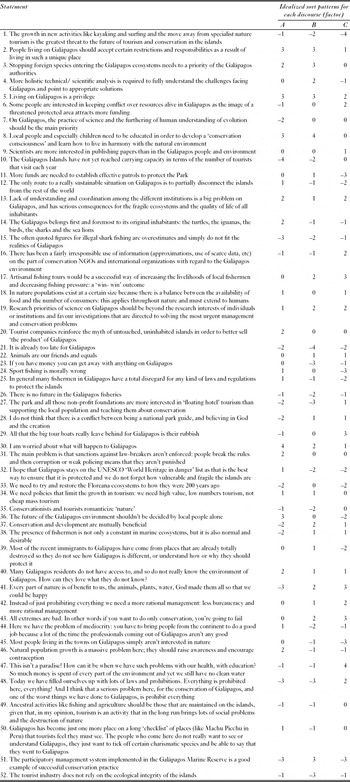
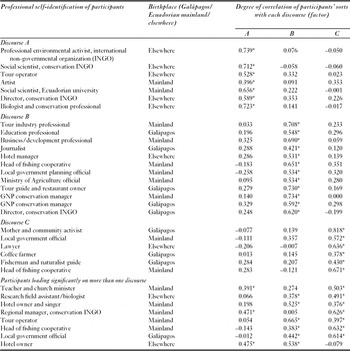
The three factors that emerged from the analysis represent discourses about conservation, and for the sake of clarity will be referred to as such for the remainder of this paper. Labels were given to each discourse, intended to act as an abbreviated storyline (see Hajer Reference Hajer1997) capturing some essence of the larger narrative. We labelled these discourses as Discourse A: ‘Conservation of Galápagos as an international/global concern’; Discourse B: ‘Conservation with sustainable development’; and Discourse C: ‘Social welfare and equitable development’ (see Table 1 for idealized sorting patterns for each discourse). We assessed the degree to which each participant's sort correlated with each of the discourses (Table 2). We assessed the degree of correlation between the discourses, the percentage variance explained by each discourse and the number of sorts loading on each individual discourse at p < 0.01 (Table 3).
Statements that made up the Q sample with idealized sort patterns for each discourse (factor). Letters A, B and C represent the three different discourses that emerged from the analysis; sort patterns represent the way in which a hypothetical individual loading 100% on a given discourse would have sorted the statements along the original scale (where –4 means ‘least like my point of view’ and +4 means ‘most like my point of view’).

Participant list and the degree of correlation of each participant's Q sort with each discourse (factor). *Indicates that a sort loads significantly at the p < 0.01 level.

Discourse (factor) correlations, % variance explained by each discourse and the number of sorts loading on each discourse alone at p < 0.01.

It is important to note that these discourses represent hypothetical constructs, and that actual participants will often share elements of all three discourses, as evidenced by the correlations of their Q sorts with each discourse (Table 2). In addition, although the discourses are described as separate narratives, they are all correlated to a degree (Table 3). In the descriptions that follow, numbers in square brackets refer to the number of the statement on which the analysis is based (Table 1), the quotes are explanatory comments made by individuals whose sorts correlated significantly with the discourse being described, and quotes marked with an asterisk have been translated from Spanish.
Discourse A: ‘Conservation of Galápagos as an international/global concern’
For proponents of this view, the needs of the native and endemic flora and fauna of the Galápagos were the primary concern [14]. As one participant commented, ‘their right to exist and to reproduce as species should be paramount’ and maintaining the native and endemic biodiversity should be ‘absolutely primary’. In addition, respondents felt the current human population of Galápagos should consider it a ‘privilege’ to live in such a unique place [5], with one participant expressing the view that if people did not like what they had in Galápagos they should ‘go move to the continent’. Viewed through this lens there was serious cause for concern in Galápagos [30], as ‘all trends are going in the wrong direction’, largely as a result of the perceived incompatibility of economic development and conservation [37], with immigration a key concern; as one participant put it ‘more people caused by more development creates more problems’. One of the drivers of what was considered an unsustainable level of development on Galápagos, was understood to be the ongoing growth in tourism beyond the ‘carrying capacity’ of the islands [10]. The outright number of tourists, the changing nature of tourism and the types of tourists visiting Galápagos were all of concern, hence the relatively higher score awarded to statement 50 (Table 1). Anxiety about population growth was a common feature of this discourse [46]. One participant felt that Galápagos had a ‘very worrisome demographic profile in terms of a very young population, having children’.
In terms of solutions to the problems facing Galápagos, this discourse reflects some pessimism about the success of conservation initiatives such as the participatory management system implemented in the marine reserve [51]. To a degree, the attitudes of the local fisherfolk in particular were felt to be a barrier to effective conservation [25]. Education, strong regulation, and control of the population, were seen as the keys to effective conservation of the islands (views that are for the most part shared with discourse B proponents) [8, 2, 48], and there was a sense that this control is inadequate due to ineffective/inconsistent policing and/or corruption [31]. Given the global importance of Galápagos wildlife, the involvement of the international community in the protection of Galápagos was seen as absolutely crucial [36]. As one participant put it, local people should ‘have a significant say, but obviously they need assistance’. To this end, the use of conceptually powerful international tools such as UNESCO's World Heritage in Danger category was considered necessary to raise awareness and funds for conservation [32]. Compounding the need for international involvement on Galápagos was the perception of a degree of ‘mediocrity’ of the professionals from Galápagos [44]. While on the one hand international links and involvement are seen as crucial, on the other hand, the increasing number of international linkages and the decreasing geographical isolation of Galápagos were understood to be ecologically unsustainable, and hence this discourse reflects a degree of agreement that a partial ‘disconnection’ of the islands from the rest of the world was necessary [12]. As one participant put it: ‘there needs to be improved controls and quarantine systems and a reduction of all kinds of transport flows into the archipelago. . . basically a reduction in tourism’*.
With regard to the role of science on Galápagos, although on the surface there appeared to be a broad consensus between the three discourses that science is important to conservation and should be steered by management needs, discourse A exhibited a lesser degree of agreement with statement 19 than the other two discourses, and participants’ comments pointed to a possible tension beneath this apparent consensus. As one participant put it: ‘to be perfectly honest I think there's a role for science beyond the immediate management and conservation problems. . . I think there's a role for science to look beyond the horizon’. Another commented: ‘I think that we should allow pure science, pure science is good for humanity, I believe in pure science, and pure science in the end will help us with conservation’. Also, in relation to the role of science on Galápagos, discourse A illustrated a degree of disagreement with the idea that the practice of science should be the ‘main priority’ [7], and indeed was neither positive nor negative regarding the need for more science to address conservation challenges [4]. As one participant put it: ‘they [the scientists/conservationists] know what the problems are, they know more or less what the solutions are, it's just a matter of doing it, that's the problem’. There was, however, evidence that an acceptance of the findings of science, especially with regard to the theory of evolution, should be a prerequisite for working as a guide in the National Park, and thus that holding creationist beliefs is incompatible with this role [28]. As one participant put it: ‘You should be able to answer the questions that people ask you about evolution and if you do not believe in evolution then it makes it very difficult’.
Discourse B: ‘Conservation with sustainable development’
One of the key differences between discourses A and B was the agreement that the latter appeared to reflect concerning the idea that ‘development’ (left deliberately undefined in the concourse) and conservation could be mutually beneficial [37]. Supporting statements underlined that what was required was ‘sustainable development’ or as one participant put it: ‘development in terms of an improvement in people's quality of life, not just in terms of growth’, but in principle at least, this type of development was believed to be both possible, and compatible with conservation's aims. From this point of view, the primary route to sustainability was through the development of a sustainable tourism industry, which itself relied on the ‘ecological integrity’ of the islands [52]. As one participant said: ‘either you manage tourism properly and allow the economy to move, or you evict the population. The second option isn't possible, you have to manage tourism. . . [it's] the only non-extractive activity that, properly managed could become sustainable’*. Given the centrality of tourism to sustainability amongst participants with this point of view, ‘partially disconnecting’ Galápagos through limiting travel to the islands [12], was not appropriate. As one participant said: ‘transforming Galápagos into a ‘ghetto’ isn't going to solve anything’*.
Within this discourse the conservation of Galápagos was framed in terms of a management challenge, in which both practical/technical conservation measures, and education were considered to be crucial [8, 3]. Similarly, science had a key role to play: more science was required to point to sustainable solutions on Galápagos [4], and research priorities should be tightly linked to conservation management needs [19]. Despite the key role of science for proponents of this view, there was considered to be no conflict between holding creationist beliefs and being a Park guide [28]. In fact, within this discourse, there was space for the possibility that creation of all nature was by God for the benefit of humanity [41].
In line with discourse A, restrictions and regulation were understood to be necessary and reasonable to ensure effective conservation [2,48], but unlike discourse A, it was not felt that local fishers disregarded legislation [25]. This discourse appeared to reflect a higher degree of optimism about participatory conservation management actions undertaken in the marine reserve [51], and of the prospects for Galápagos conservation in general [21]. In agreement with the other discourses, it was felt that living on Galápagos was a privilege [5], however, where discourse A highlights the ‘extraordinary’ nature of the place, participant comments on statement 5 highlighted more practical considerations: ‘the peace, the security’*, compared with continental Ecuador. The ability of local professionals [44] and the integrity and independence of local institutions was maintained, and there was disagreement with the idea of widespread corruption on the islands [23], or of close links between conservation organizations and the tour industry [27]. There was evidence of a degree of ambivalence about international involvement in Galápagos as evidenced by the zero score awarded to statement [36]. As one participant explained, conservation required a degree of international input from ‘scientists and other experts’, but he voiced frustration with the stream of outsiders giving views on Galápagos conservation: ‘people from outside always think they are right, that they know how to manage Galápagos’*. Within this discourse, local professionals were not perceived as any less able than internationals [44]. There was discomfort with the idea of maintaining an international image of ‘threatened Galápagos’ in order to raise awareness and funds [32].
Discourse C: ‘Social welfare and equitable development’
Within this discourse Galápagos conservation was framed less in terms of concepts such as biodiversity or endemism, and more in terms of personal ties to Galápagos. As one participant put it: ‘we understand what conservation is, we know because we love the place where we grew up, where we are, and we want our children to enjoy this’*. The statements awarded the highest and lowest scores concerned the issues of social welfare [47] and changes in tourism [1]. Participant comments highlighted the notion of inequity when describing the relative benefits gained from different types of tourism. Non-traditional forms of tourism such as kayaking and surfing holidays [1] or artisanal fishing tours [17] could provide much needed redistribution of benefits. As one participant put it, ‘these small activities have helped lots of families: this is tourism with a local base’*. From this point of view continued growth in tourism could potentially be a positive thing, as the more neutral scores for statements [10] and [34] seem to suggest. There was a perception that it was the big tour operators and cruise ships (the so-called ‘floating hotel’ model) that were supported by the science and conservation sectors [27], which were doing little social or environmental good [29]. As one participant commented: ‘some of them have some small projects to give back to the community, but it pretty much comes down to building an information centre here or there every three years, or giving a few local students a week on board their ships. But in reality all they do is come here drop tourists off and leave the rubbish behind, and all the money goes back to the continent. . .’
This discourse therefore appeared to be broadly in line with discourse A in terms of reflecting a belief that conservation and development were not mutually beneficial [37], but participant comments suggested that this was because conservation was felt not to provide benefits for development not vice versa. As one participant commented: ‘conservation is not beneficial’*.
Within discourse C, there was a sense that local people should be deciding on the development direction taken by Galápagos [36]. In line with discourse B, there is evidence for disagreement with the pragmatic use of the UNESCO World Heritage in Danger category for international awareness and fundraising purposes [32]. One participant commented: ‘someone who doesn't know Galápagos, who just reads what they publish on the internet, that person's going to say ‘what is going on in Galápagos? Those people are destroying everything!’*. From this perspective the motives and actions of some conservation organizations and individual scientists were somewhat suspect [6, 16, 9], neither more science to steer conservation strategies [4], nor more money for conservation management [11] were felt to be necessary. One participant commented: ‘nobody's doing any meaningful work that furthers the quality of our existence. . . I've had enough of scientists coming here to study the turtles, study the marine iguanas. . .’. The same participant continued: ‘there's plenty of money available, they're just doing the wrong thing with it’. Perhaps linked to the suspicion about international organizations, there was also ambivalence toward the idea and project of environmental education to generate a ‘conservation consciousness’ as evidenced by the zero score awarded to statement [8]. As one participant commented: ‘nobody can come here to give me consciousness’*.
In general, within this discourse there was evidence for a level of agreement with the other two discourses that living on Galápagos was a privilege [5] and that certain restrictions and responsibilities were necessary to a degree [2]. However, the relatively lower scores awarded to these statements by this discourse illustrate that this agreement was less pronounced than for the other two. Indeed many of the prohibitions and restrictions were felt to be excessive and to a degree irrational [42, 48]. As one participant commented: ‘they restrict you but they do not give you opportunities, they do not offer you anything’*. Where legislation existed (for example in the case of fishing regulations) it was not felt that many people disregarded these laws [25], and there was strong disagreement with the idea that people living on Galápagos were not interested in nature [45], with some of those loading on this discourse maintaining that nature was created to be of benefit to humankind [41]. As one participant put it: ‘God gave us the authority to administer his creation. . . we also have to look after it, but look after it for everybody. And also look after his people’*.
DISCUSSION
The three discourses revealed by this study point to fundamentally different ways of thinking about Galápagos conservation and largely support the claims that there is no shared vision of Galápagos conservation. However, rather than downplaying or obscuring the political nature of these debates through recourse to the ‘anti-political’ language of shared visions and consensus, it is argued that a more deliberative (Dryzek & Niemeyer Reference Dryzek and Niemeyer2008) or argumentative (Hoppe Reference Hoppe1999) approach to policy making, which shifts the focus away from the search for consensus and is based instead on ‘acknowledgment of conflicting views and interests. . . [in order to] facilitate deliberation and concerted negotiation’ (Hirsch et al. Reference Hirsch, Adams, Brosius, Zia, Bariola and Dammert2011, p. 260), is both more democratic and realistic. It may lead to better environmental outcomes than if individuals and institutions attempt to carry out conservation interventions built on false assumptions of consensus, as these are likely to be much less able to ‘effectively mediate the complex political dynamics they encounter during implementation’ (Buscher Reference Buscher2010, p. 29).
Although the three discourses cannot claim to be the only discourses about Galápagos conservation on the islands (and it is not possible from the data gathered to indicate what proportion of the population subscribes to a given discourse), they can at least be said to be influential given the inclusion of a number of decision makers and other prominent local figures in the participant group. The participation of additional participants might have revealed additional alternative discourses, but this would simply add another layer of complexity to the picture, without challenging the existence and structure of those discourses already revealed (Brown Reference Brown1980).
The necessarily small sample sizes in a Q study mean that apparent patterns regarding the characteristics of the participants that loaded on each discourse must be treated with caution, and if certain characteristics appear to correlate with a particular discourse these can only be treated as ‘working hypotheses’ (Ockwell Reference Ockwell2008, p. 278), indicating possible avenues for future research. In this case, one such hypothesis might be that the birthplace of participants influences which discourse they load on, hence participants loading on discourse A were predominantly born outside Ecuador, while those loading on discourses B and C were predominantly born on Galápagos or in mainland Ecuador. That this should be so is perhaps unsurprising, because the views that people hold about the relationship between people and nature are ‘strongly influenced by where they are raised, how they are educated, their life experiences and the survival conditions and options they have faced’ (Mcshane et al. Reference Mcshane, Hirsch, Chi, Songorwa, Kinzig, Monteferri, Mutekanga, Thang, Luis, Pulgar-vidal, Welch-Devine, Brosius, Coppolillo and Connor2011, p. 969), and previous work has shown a significant link between variables such as amount of formal education and perceptions of conservation (King & Peralvo Reference King and Peralvo2010). An additional observation is that to an extent the divisions between discourses can be seen to map different sectorial divisions in Galápagos: for example nearly half the participants loading on discourse A are associated with international NGOs, while the majority of those loading on discourse B are associated with the National Park, local government and local businesses, and half of those loading on discourse C are associated with fishing and agriculture. However, it is perhaps more interesting to note that these divisions are not absolute, hence the appearance of a fishing cooperative leader and an international NGO leader both associated with discourse B, local government officials associated with both B and C, and tour guides spread between the three discourses. This highlights the importance of a discursive approach such as that adopted here that looks beyond an analysis of the views of different sectors or interest groups, in order to understand the discourses which ‘help constitute identities and their associated interests’ (Dryzek & Niemeyer Reference Dryzek and Niemeyer2008, p. 5).
While the existence of diverse views on Galápagos has been widely recognized over a number of years (Watkins & Cruz Reference Watkins and Cruz2007; Tapia et al. Reference Tapia, Ospina, Quiroga, Gonzalez and Montes2009a ), this diversity has tended to be framed as a problem to be overcome. It has been argued that disagreements ‘result more from differences in perspectives rather than from real differences’ (Watkins & Cruz Reference Watkins and Cruz2007, p. 4), and that what is required is an increase in solid information and education. Implicit in these calls is the idea that perspective differences are in some senses not real, and would likely be reduced or disappear in the light of more scientific data. However this idea, although widespread in diverse policy domains, has been thoroughly critiqued (see Collingridge & Reeve Reference Collingridge and Reeve1986; Collins & Yearley Reference Collins, Yearley and Pickering1992; Pielke Reference Pielke2007). Despite the creation of bodies of scientific knowledge specifically aimed at resolving political dispute, in areas as diverse as climate change, nuclear waste disposal and biodiversity conservation, rather than resulting in increasing consensus around appropriate policy, this process has often been accompanied instead by growing political controversy and gridlock (Sarewitz Reference Sarewitz2004). The results of this study suggest that increasing the amount of information available, is unlikely to lead to societal consensus around conservation, as the problem is not an information deficit, but genuinely divergent perspectives about subjective topics such as the nature of Galápagos, the role of people on the islands, and the desired pathway of development.
The view that more science is necessary on Galápagos (statement 4) and that science should be tightly tied to conservation management needs (statement 19) are features of discourse B, and are widely expressed in publications about Galápagos (Tapia et al. Reference Tapia, Rodriguez, Reck, Ospina, Quiroga, Gonzalez, Montes, Tapia, Ospina, Quiroga, González and Montes2009c ). However, in addition to the fact that science cannot overcome value disputes, calls by scientists for more science can be seen to have political implications, leading to a generally more conservative stance. As Bocking (2004, p. 39) explained: ‘When societal problems are defined as technical, the view of science as objective and free of particular political values rules out political change as an option, thereby disallowing alternative political visions. . . . [and] rejecting all but minor adjustments in the social order’.
However, for discourse C it is changes in the social order that are called for, in particular a redistribution of benefits from tourism (for example see statements 1, 17, 27, 29 and 34). Although discourse C appears to be the most overtly political discourse in its expression of resistance to some of the ideas and practices of conservation, an examination of the values and assumptions underlying the other two discourses reveals that these are no less value laden. For example, discourse A's framing of the issue of Galápagos’ conservation in terms of the global importance of the islands, acts to legitimize the absconding of power and control over resources to the so-called ‘international community’, a tendency underscored by its emphasis on the role of global institutions such as UNESCO. Similarly this discourse's vision of the islands as uninhabited and its related preoccupation with population growth (statement 46) reveals a particular vision of the islands in which centralized control of the population is key. Indeed, at one extreme, it is possible to find people working in the conservation sector in Galápagos who express the view that the human population should be forcibly controlled: for example, one discourse A participant joked that: ‘we have a spay and neuter programme for the cats and dogs, I think we need to implement it for the human population’. These views can be traced back to conservationist discourses that define the ideal state of Galápagos as the ecological state that existed prior to human discovery of the islands. For example, a report published by the Charles Darwin Foundation in 2002 outlines a ‘Biodiversity Vision’ for Galápagos which states that: ‘ [t]he baseline (what was Galápagos like prior to 1535). . . provides both a benchmark and the basis for the ultimate long-term aspiration for biodiversity conservation’ (Bensted-Smith Reference Bensted-Smith2002, p. 8; parentheses in original). As Hennessy and McCleary (Reference Hennessy and McCleary2011, p.151) pointed out, these efforts to return the islands to their pre-human past are ‘the epitome of a closed politics. . . [in which there is no space]. . .for people or political debate’. Discourse C rejects this view of the human population as the problem on Galápagos, reframing the conservation debate around the question of ‘conserve for whom’ as the following quote from a discourse C participant illustrates: ‘They told me to conserve for future generations, I am the future generation, my parents already worked. . . and my daughter, she's 21, now they're going to tell her that she has to conserve for future generations; and in the meantime what?’
For proponents of discourse C, there is a sense that rather than population growth on the islands, it is ‘outsiders’ of various types (international tour operators, industrial fishing fleets from the mainland, international NGOs or continental bureaucrats) that are the real problem. As one participant associated with discourse C put it: ‘Galápagos’ problem isn't here, Galápagos problem is outside, in the big companies, the big decisions, the big ministries. . .Is the fact that my neighbour has three kids a problem for Galápagos? No!’ This view resonates with academic literature that has highlighted the necessity of understanding the broader political and economic drivers of change in Galápagos (Grenier Reference Grenier2007), rather than focusing narrowly on the local population. However there may also be a degree of what has been called ‘ideological amplification’(Sunstein Reference Sunstein2007) that takes place on all sides, and a danger of self-stereotyping of the local population as helpless victims fighting distant but powerful outsider interests, including conservationists ‘in their comfortable offices, in their mansions on the continent. . . [telling the people] do not touch this, do not touch that’ (discourse C participant).
The ideal development pathway for Galápagos is another divisive issue on the islands. While discourse A appears to consider conservation and development as essentially incompatible, Discourse B frames the challenge as one of achieving ‘sustainable development’ through the appropriate application of science to conservation management challenges, and in particular the appropriate management of tourism. This focus on tourism is not new and has been the subject of discussion since the industry's beginnings on Galápagos in the 1960s (Snow & Grimwood Reference Snow and Grimwood1966). However, the tension between Galápagos’ current economic reliance on tourism and ecological need for isolation means that many observers suggest that the Galápagos is living a fundamental contradiction (see Ospina Reference Ospina2004), caught between two apparently opposing currents, a state which presents a serious challenge to appropriate management. Discourse B does not consider the basic model of an economy built on tourism to be inherently unsustainable but rather considers the challenge to be one of formulating and implementing policies that control tourism and limit numbers of tourists, maintaining ‘high value, low numbers tourism, not cheap mass tourism’ (statement 34), and focusing efforts on the control and eradication of non-native species (statement 3). In this sense, discourse B appears to be a fairly typical example of the policy discourse that has been labelled ecological modernization, which maintains ‘that environmental problems can be solved in accordance with the workings of the main institutional arrangements of society’ (Hajer Reference Hajer1997, p. 3), a view that while popular with policymakers worldwide, has been broadly critiqued by various authors (see Torgerson Reference Torgerson, Paehlke and Torgerson1990) who suggest that this way of thinking cannot conceive of the more radical changes potentially required in order to address current social and environmental problems. However, others might counter that this was simply a pragmatic approach to an intractable problem, and that without the sort of approach offered by the discourse of ecological modernization we are simply ‘reduced to wishful thinking about how things might be different’(Dryzek Reference Dryzek1997, p. 232).
CONCLUSION
In revealing the different societal discourses around conservation on Galápagos, and subjecting the range of values and assumptions upon which these are built to critical scrutiny, the goal here is to contribute to a deliberative process whereby conflicts can be ‘addressed more openly, rather than remain concealed in hegemonic environmental readings and policy’ (Leach & Mearns Reference Leach, Mearns, Leach and Mearns1996, p. 467), or masked in the ‘discursive blur’ (Buscher Reference Buscher2008, p. 230) of calls for consensus and a shared vision. There are various ethical and substantive reasons why the opening up of policy process to multiple discourses should be preferable to the unquestioned dominance of a given discourse or narrative. It may be normatively undesirable from the perspective of accountability within a democracy to allow a network to be dominated by a single discourse (Dryzek & Niemeyer Reference Dryzek and Niemeyer2008). Others highlight the partiality of all knowledge claims and point out that ‘a single and final understanding of a sufficiently complex issue is inherently over simplistic’ (Hirsch et al. Reference Hirsch, Adams, Brosius, Zia, Bariola and Dammert2011, p. 263), and that therefore other understandings or discourses could always claim relevance. Others stress the fact that there are times when transformation or more radical social change may be desirable, and argue that this is not facilitated by a focus on consensus which ‘further legitimizes continuity or stability’ (Peterson et al. Reference Peterson, Peterson and Peterson2005, p. 766). This study has highlighted the irreducible plurality of discourses around conservation on Galapagos. By revealing these different discourses it is hoped that work in this vein may facilitate a more open and honest communication between proponents of the various views, and ultimately a more appropriate approach to conservation.
ACKNOWLEDGEMENTS
Rose Cairns thanks all of the anonymous participants who shared their perspectives on Galápagos conservation with her so openly. We are grateful for the support of the Galápagos National Park, and in particular to Marilyn Cruz at the Laboratorio de Epidemiologia, Patología y Genética de Galápagos (LEFG-G) and Washington Tapia of the Galápagos National Park. Thanks also for the logistical support provided by Virna Cedeño of Concepto Azul, Guayaquil. Many people at the Charles Darwin Foundation shared their views about Galápagos conservation, in particular Christophe Grenier. Sincere thanks to Mette Termansen and Joseph Murphy (Leeds University), and Andrew Cunningham (Institute of Zoology, London) for support. This project was completed with funding from an ESRC/NERC interdisciplinary studentship (ref: ES/FO12519/1). Additional support was provided by a DEFRA Darwin Initiative grant (ref: EIDPO15).