1. Introduction
Of the five orders of trilobites that are present during the Frasnian Stage at the beginning of the Late Devonian, only two, the Proetida and the Phacopida, survived into the Famennian. The presence of a conformable sequence of trilobite-bearing fore-reef limestones, the Virgin Hills Formation, that form part of the Late Devonian reef system in the northern part of the Canning Basin in Western Australia, allows the patterns of evolution and extinction of the late Frasnian and early Famennian trilobites to be assessed. In these deposits the three orders that became extinct during the Frasnian–Famennian biocrises were the Corynexochida (McNamara & Feist, Reference McNamara and Feist2006), the Lichida (Feist & McNamara, Reference Feist and McNamara2007) and the Harpetida (McNamara, Feist & Ebach, in press). Here we focus on one of the groups that survived this event, the Phacopida.
Although, with a single exception, they are rare elements of the trilobite fauna in the Canning Basin, the phacopids are generically the most diverse of the trilobite orders in the Virgin Hills Formation. Feist & Becker (Reference Feist and Becker1997) described two species, Babinops planiventer and Trimerocephalus tardispinosus, from the Famennian part of the Virgin Hills Formation at Virgin Hills. Here we describe four species in two genera from the lower, Frasnian part of the succession, and a further six species in three genera in the Famennian in the South Lawford Range.
The Frasnian–Famennian boundary marks a major global biocrisis that is particularly apparent in low-latitude, shallow marine, reef-building communities and their associated biota. Although phacopids were one of only two orders of trilobites to survive this biocrisis, none of the genera described here is known to have crossed the Frasnian–Famennian boundary. In addition to documenting the changing biodiversity levels of the phacopids at this time, we also examine patterns of evolution prior to and following the event, in order to assess the role that environmental changes might have been having on the phacopids, both in terms of the trilobites' reaction to changing environmental stress levels before this biocrisis, and patterns of recovery of survivors after the event. We examine the role of developmental change in reflecting responses to changing environmental conditions experienced by the faunas, particularly with regard to changes in the morphology of the eye. Some of the species we describe are blind, while others show evolutionary trends of varying numbers of lenses, both before and after the mass extinction. We examine these trends in the light of fluctuating environmental conditions as reflected in sedimentary changes both here and in the other parts of the Prototethys Ocean in which these trilobites were living.
2. Geological setting and biostratigraphy
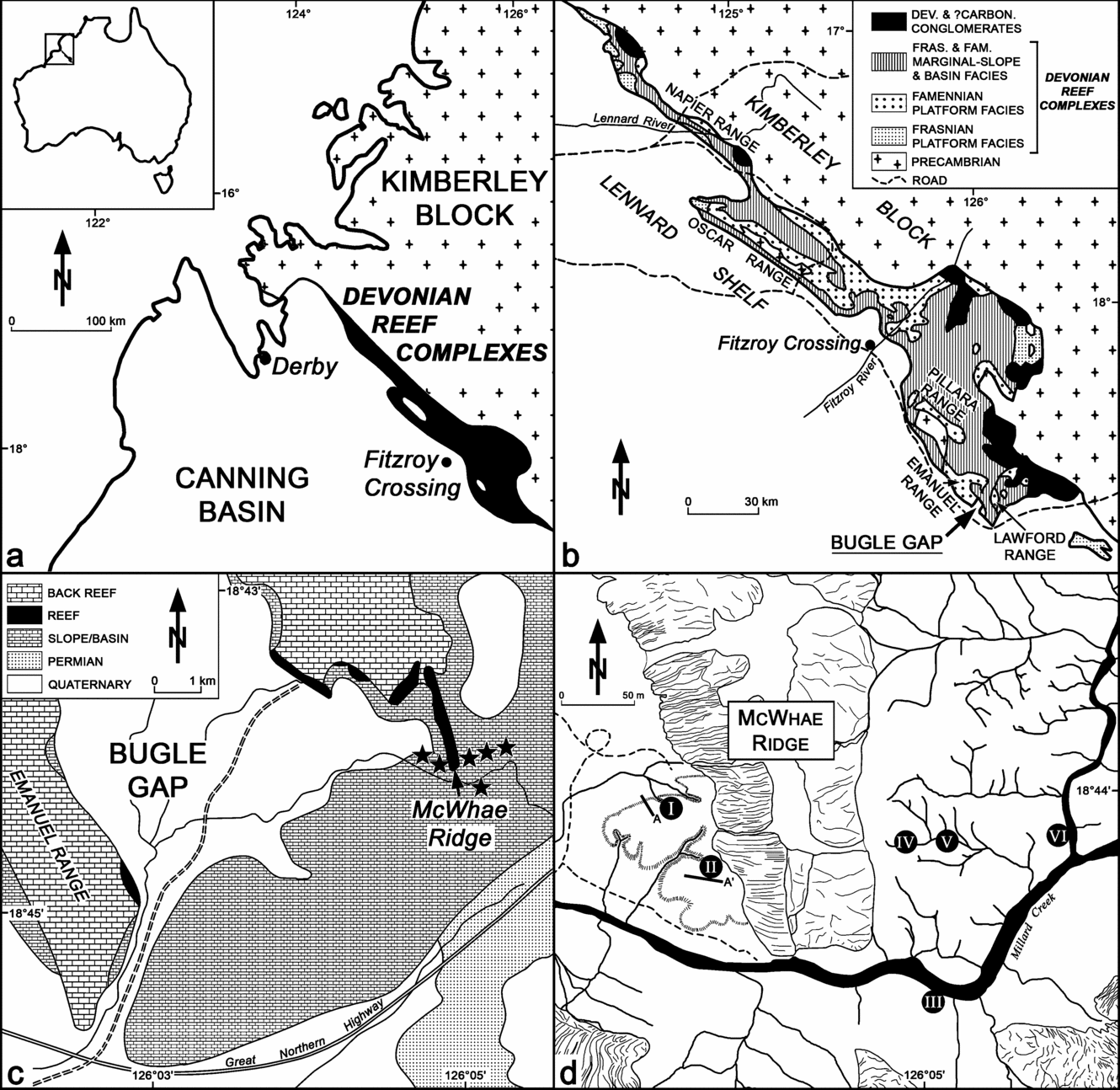
Late Devonian sedimentary rocks extend along the southern margin of the Kimberley Block in northern Western Australia for about 350 km, from the Napier Range in the northwest to the Lawford Range in the southeast (Fig. 1). They form part of a major reef complex that became established on the Lennard Shelf on the northern side of the Canning Basin during the latest Givetian to Famennian (Playford, Reference Playford1980, Reference Playford1981, Reference Playford and Purcell1984; Playford & Lowry, Reference Playford and Lowry1966; Becker et al. Reference Becker, House, Kirchgasser and Playford1991; George & Chow, Reference George and Chow2002). The reef complex was dominated by stromatoporoids in the Givetian and Frasnian, being replaced in the Famennian by cyanobacterial reefs (Playford, Reference Playford1980; George & Chow, Reference George and Chow2002; Wood, Reference Wood2004). Trilobites have only been collected from the marginal slope facies, the Virgin Hills Formation, that may have been deposited at depths of several tens to at least 200 m (Becker et al. Reference Becker, House, Kirchgasser and Playford1991). Apart from the Famennian material described by Feist & Becker (Reference Feist and Becker1997), the rest of the trilobite faunas collected from the Virgin Hills Formation have come from the South Lawford Range. It is on the basis of this material that the phacopid trilobites in this paper are described.
Maps showing late Frasnian and early Famennian Virgin Hills Formation localities that have yielded phacopids at McWhae Ridge, South Lawford Range, W. A. Localities I and II (sections A and A′) on the west side of McWhae Ridge comprise predominantly Frasnian, and entirely Famennian strata, respectively. Localities III to VI on the eastern side of McWhae Ridge are all Frasnian. IV and V are the Phacopid Gully localities; VI is Calyx Corner.

The material was collected at the southern end of the South Lawford Range on the western and eastern flanks of McWhae Ridge (1:100000, Bohemia Sheet 4160, Grid Reference 920260, and 9 km to the north, on the eastern side of the South Lawford Range, east of the northern end of the Laidlow Range Ridge (1:100000, Bohemia Sheet 4160, Grid Reference 906357) (Fig. 1). The Virgin Hills Formation at McWhae Ridge comprises a sequence of thinly bedded and gently dipping, very fine-grained calcarenites and calcilutites. The sediments, many of which are haematite-rich (Becker et al. Reference Becker, House, Kirchgasser and Playford1991), are often gritty on account of detrital admixture of quartz grains and mica coming from the uplifted Kimberley hinterland.
Most of the the Frasnian specimens used in this study were collected from a 36 m thick sequence on the east side of McWhae Ridge (1:100000, Bohemia Sheet 4160, Grid Reference 924258–924263). The Frasnian–Famennian boundary occurs at a height of about 30.5 m above the base. Fossiliferous beds containing trilobites within the Frasnian section are restricted to five discrete sequences (see McNamara & Feist, Reference McNamara and Feist2006, fig. 2). Phacopids were only found in the upper two trilobite-bearing units in the Frasnian part of the section (localities IV to VI in Fig. 1d), named Phacopid Gully (19.5–27 m) and Calyx Corner (28–29 m). The fossiliferous limestones in Phacopid Gully (localities IV and V) consist of grey, micaceous calcarenites; the Calyx Corner beds (locality VI) consist of predominantly dark red and grey calcarenites. Both are rich in goniatites and crinoids and are similar in many respects to coeval beds from late Frasnian localities in Europe (Feist & Schindler, Reference Feist and Schindler1994).
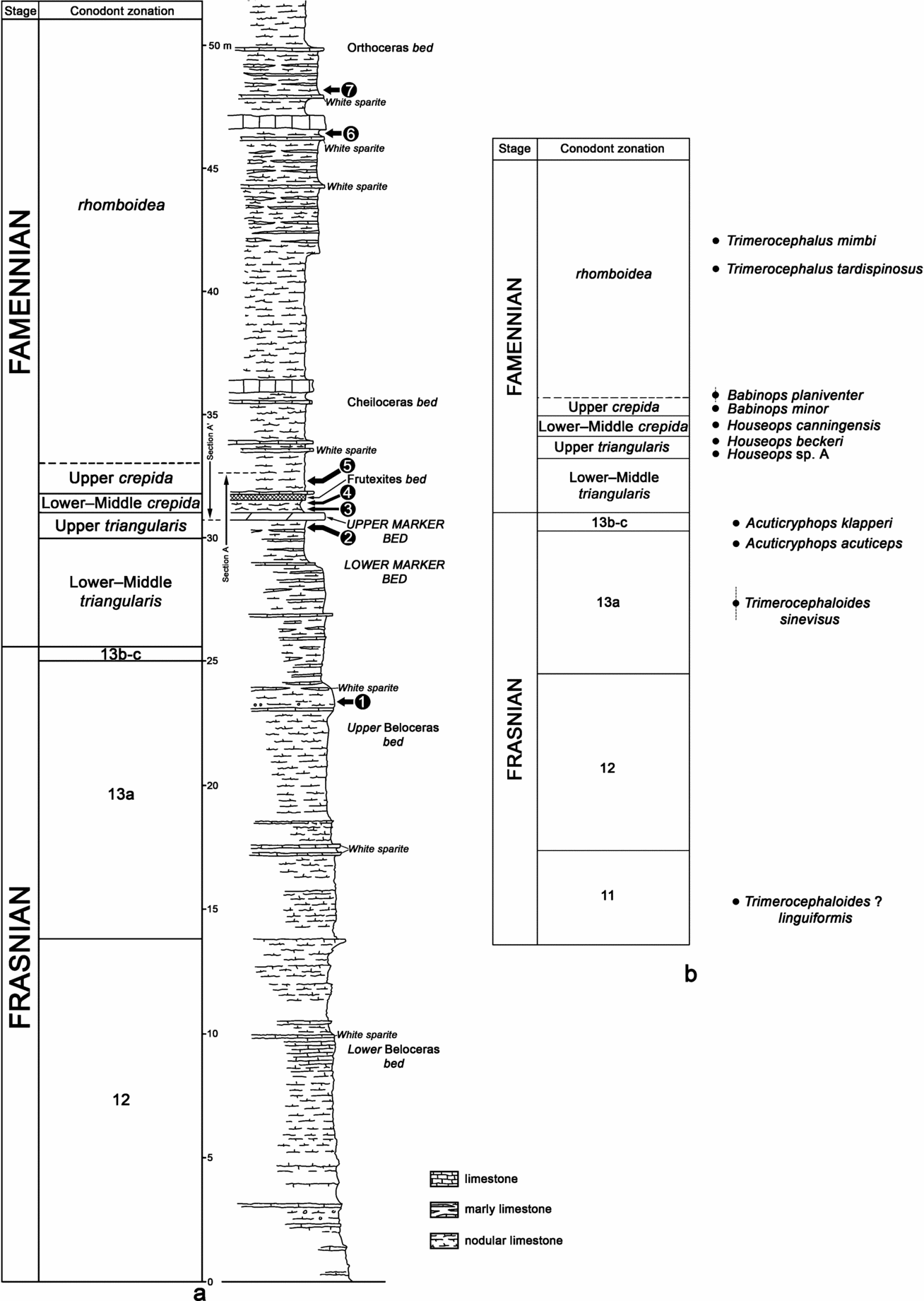
The western side of McWhae Ridge (1:100000, Bohemia Sheet 4160, Grid Reference 918260), from where the Famennian phacopids were collected, has received much more attention from palaeontologists than the section on the east side of the ridge, and is discussed in detail by Becker et al. (Reference Becker, House, Kirchgasser and Playford1991). Attention, however, has focused mainly on the Frasnian section and the lowermost beds of the Famennian. Apart from a single specimen of the Frasnian Acuticryphops acuticeps from horizon 1 in section A (Fig. 2a), all the other specimens were derived from the Famennian (horizons 2–7; Fig. 2a). Horizons 2–5 occur in the uppermost part of section A (locality I; Fig. 1d), all within 1 m of the stromatolitic Frutexites bed. Lithologically the sediments are essentially the same as on the eastern side of McWhae Ridge, although dolomitic beds (e.g. the so-called ‘Upper Marker bed’ of Becker et al. Reference Becker, House, Kirchgasser and Playford1991) are not uncommon. A stratigraphically higher section (section A′) that at its base overlaps with the top of Section A, occurs about 500 m southeast of section A (locality II; Fig. 1d) and has yielded phacopids at two horizons in the upper part of the section (horizons 6 and 7; Fig. 2a).
(a) Stratigraphic section, with conodont zones, on the west side of McWhae Ridge showing the horizons (1 to 7) from where phacopid trilobites were collected. (b) Stratigraphic distribution of the phacopid trilobites that occur in the Virgin Hills Formation.

The oldest part of the Virgin Hills Formation to yield phacopids is the outcrop known as ‘Windy Knolls’, situated 9 km north of McWhae Ridge, where the basal part of the section is conodont Zone 11 (Klapper, Reference Klapper2007). At McWhae Ridge the Frasnian section ranges from Zone 12 to Zone 13c. The overlying Famennian that has yielded phacopids extends to the rhomboidea Zone, the earliest phacopids occurring in the Upper triangularis Zone. To date, phacopids have not been found in the earliest part of the Famennian, the Lower and Middle triangularis zones, in the Canning Basin.
3. Material and terminology
The material used in this paper is housed in the collections of the Western Australian Museum (WAM). The cephalic nomenclature used herein follows that of Chlupáč (Reference Chlupáč1977). Two new morphological terms are introduced. The ‘lateral preoccipital furrow’ is the exsagittal branch of the glabellar lobe L1 that demarcates the lateral preoccipital lobe adaxially. Campbell (Reference Campbell1975, p. 170) has argued that this forms a significant part of the appendage muscle attachment site in this furrow and corresponds to his ‘appendage posterior auxiliary scar’. The ‘postvincular area’ is that part of the anterior cephalic doublure which is located between the vincular furrow and the hypostomal suture.
4. Systematic palaeontology
Order PHACOPIDA Salter, Reference Salter1864
Suborder PHACOPINA Struve, Reference Struve1959
Superfamily PHACOPACEA Hawle & Corda, Reference Hawle and Corda1847
Family PHACOPIDAE Hawle & Corda, Reference Hawle and Corda1847
Subfamily PHACOPINAE Hawle & Corda, Reference Hawle and Corda1847
Genus Houseops gen. nov.
Type species. Houseops canningensis sp. nov.
Assigned species. H. canningensis sp. nov.; H. beckeri sp. nov.; H. sp. A; Phacops (Trimerocephalus) miserrimus Drevermann, Reference Drevermann1901; Nephranops miserrimus wiedensis Lütke, Reference Lütke1968. Tentatively assigned: Phacops cryphoides Richter & Richter, Reference Richter and Richter1926; Phacops pronini Maksimova, Reference Maksimova1955; Phacops nalivkini Maksimova, Reference Maksimova1955; Trimerocephalus ocellatus Perna, Reference Perna1915.
Etymology. For the late Professor Michael House, in honour of his pioneering work on the biostratigraphy of the Virgin Hills Formation.
Diagnosis. Phacopine with subdued transverse cephalic profile and protruding anterior border; preoccipital glabella retracted anteriorly and evenly curved with recurved anterolateral corners, narrow at base, S2 and S3 glabellar furrows not impressed; preoccipital ring entire with flat, poorly defined lateral lobes; occipital ring long with median occipital tubercle; eyes low, distant from posterior margin; cephalic doublure with moderately deep vincular furrow, flat and short postvincular area; hypostome low and wide posteriorly; pygidium with posteriorly narrow axis remaining distant from posterior margin, few axial rings, adaxially horizontal pleural fields; prosopon thin, with sparse tubercles.
Remarks. Famennian phacopines with a protruding anterior border and advanced eyes with reduced visual surfaces have hitherto been assigned to Nephranops Richter & Richter, Reference Richter and Richter1926, whose type-species, N. incisus (Roemer, Reference Roemer1866) from the lowermost Famennian of Rübeland, Harz Mountains, Germany, is characterized by the general absence of lenses on the otherwise normally formed visual surface, with the single exception of one specimen where two lenses remain on one side of the cephalon (Richter, Reference Richter1922, p. 344). This configuration of the Nephranops eye is considered one of the most remarkable examples of an evolutionary trend in eye-reduction among trilobites (Fortey & Owens, Reference Fortey, Owens and McNamara1990, fig. 5.2). The general configuration of the visual complex developed in N. incisus is shared by two contemporaneous, closely related taxa, N. dillanus Richter & Richter, Reference Richter and Richter1926 and N. franconicus Alberti, Reference Alberti1970, the latter originally considered early Frasnian but now dated as earliest Famennian (G. Alberti, pers. comm.). Among other taxa assigned to Nephranops by Richter & Richter (Reference Richter and Richter1926) and Lütke (Reference Lütke1968), Trimerocephalus ocellatus Perner, 1915, Phacops (Trimerocephalus) miserrimus Drevermann, Reference Drevermann1901 and N. miserrimus wiedensis Lütke, Reference Lütke1968 exhibit functional visual surfaces and, being much younger than the typical Nephranops dillanus and allies, cannot reasonably be considered their direct descendants. Besides their multilenticular eyes they differ by many other traits, such as the evenly rounded anterior outline and narrow base of the preoccipital glabella, their low transverse profile, the absence of impressed S2 and S3 glabellar furrows and the relatively narrow postvincular area. All these characters are diagnostic of the new genus Houseops to which we consequently assign these species, rather than to Nephranops, which should be restricted to the type species and the above mentioned allies. In this sense, Nephranops differs from Houseops mainly in the obsolescence of lenses on the visual field, the higher transverse vault of the cephalon and glabella, the large and deeply impressed glabellar furrows, and the wider, dorsalward concave postvincular area. Nevertheless, both Nephranops s.s. and the new genus share certain features, such as a thin prosopon and the presence of a median occipital tubercle, both of which are unusual in phacopids. Whereas the latter constitutes a real occipital organ with five pits discernible on the internal mould in Houseops, this is not ascertained in Nephranops. However, the presence of spiny protuberances extending from the occipital node in meraspids of N. incisus (Crônier, Reference Crônier2007, fig. 2) might represent an homologous structure.
A number of general traits of Houseops, such as the relatively flat glabella, the strongly vaulted posterior genae with weak palpebral furrows and flat palpebral lobes, poorly differentiated lateral occipital lobes, long postocular area, narrow pygidial axis, shallow pleural furrows, and sparse tuberculation are developed in mid-Devonian representatives of Chotecops Chlupáč, Reference Chlupáč1971, as best exemplified by its type species C. auspex Chlupáč, Reference Chlupáč1971 from the early Eifelian in Bohemia. Among them, the mid-Givetian C. koeneni (Holzapfel, Reference Holzapfel1895) from the northern Rhenish Slate Mountains, Germany, is closest to Houseops and Nephranops in the far advanced visual complex and the largely smooth prosopon. However, all taxa assigned to Chotecops exhibit a more advanced frontal outline of the glabella entirely covering the anterior border, such that the latter disappears opposite to the anterolateral glabellar corners in dorsal view. The base of the preoccipital glabella in Chotecops is consistently wider than in Houseops. In frontal view the cephalon and the glabella are appreciably more vaulted transversely with more steeply sloping outer genae. Representatives of this genus exhibit wide (sag.) dorsalward concave postvincular areas like Nephranops s.s. but unlike Houseops, in which this area is much narrower and flat. The pygidium of Chotecops has significantly more axial rings than in either Houseops or Nephranops and the pleural ribs remain much lower with rather shallow, very weak pleural furrows.
In conclusion, despite diagnostic traits which clearly differentiate Nephranops s.s. and Houseops on one hand and Chotecops on the other, all three taxa are more closely related to each other than to any other phacopine. According to Chlupáč (Reference Chlupáč1977), the older Chotecops might thus constitute the ancestral clade of the two others. Currently, evidence of possible direct phylogenetic relationships are obscured by the poor knowledge of phacopines in the Frasnian, in particular in the crucial period prior to the Kellwasser biocrises. Only two species which might tentatively be assigned to Houseops have been described from this period, as they exhibit anteriorly positioned small eyes, a relatively low glabella of evenly curved anterior outline, and an anterior border visible adaxially to the anterolateral corners of the glabella. Whereas the first, ‘Phacops’ cryphoides Richter & Richter, Reference Richter and Richter1926 from the mid-Frasnian of Sessacker, Germany, is only known from its cephalon, the other one, ‘Phacops’ pronini Maksimova, Reference Maksimova1955 from Mugodjar, southeastern Urals, assigned by Chlupáč (Reference Chlupáč1977) to Chotecops, is particular in its extremely long axial furrows, such that the anterolateral glabellar corners are almost angular and very close to the anterolateral cephalic margin. It has an unusually long pygidium with a rather high number of segments, in contrast to the much shorter pygidium, particularly in Houseops and Nephranops but also in Chotecops. ‘Phacops’ nalivkini Maksimova, Reference Maksimova1955, from the early mid-Famennian of the Southern Urals, regarded by Chlupáč (Reference Chlupáč1977) as the youngest representative of Chotecops, is tentatively reassigned here to Houseops, mainly on account of the retracted anterior outline of its low glabella and the narrow, posteriorly pointed pygidial axis. It differs, however, from the typical Houseops by the shorter, abaxially inflated postocular area and the less recurved anterolateral corners of the glabella. Another late lower Famennian taxon from the Southern Urals, ‘Trimerocephalus’ ocellatus Perna, Reference Perna1915, is more distinct from Houseops, sharing only the small, forwardly positioned eyes, and the anteriorly evenly curved and narrow-based glabella without impressed S2 and S3 furrows. It is distinguished by its frontally overhanging glabella and the sharply down-flexed posterior margin of the pygidium. It can questioningly be assigned to Houseops.
Houseops canningensis sp. nov
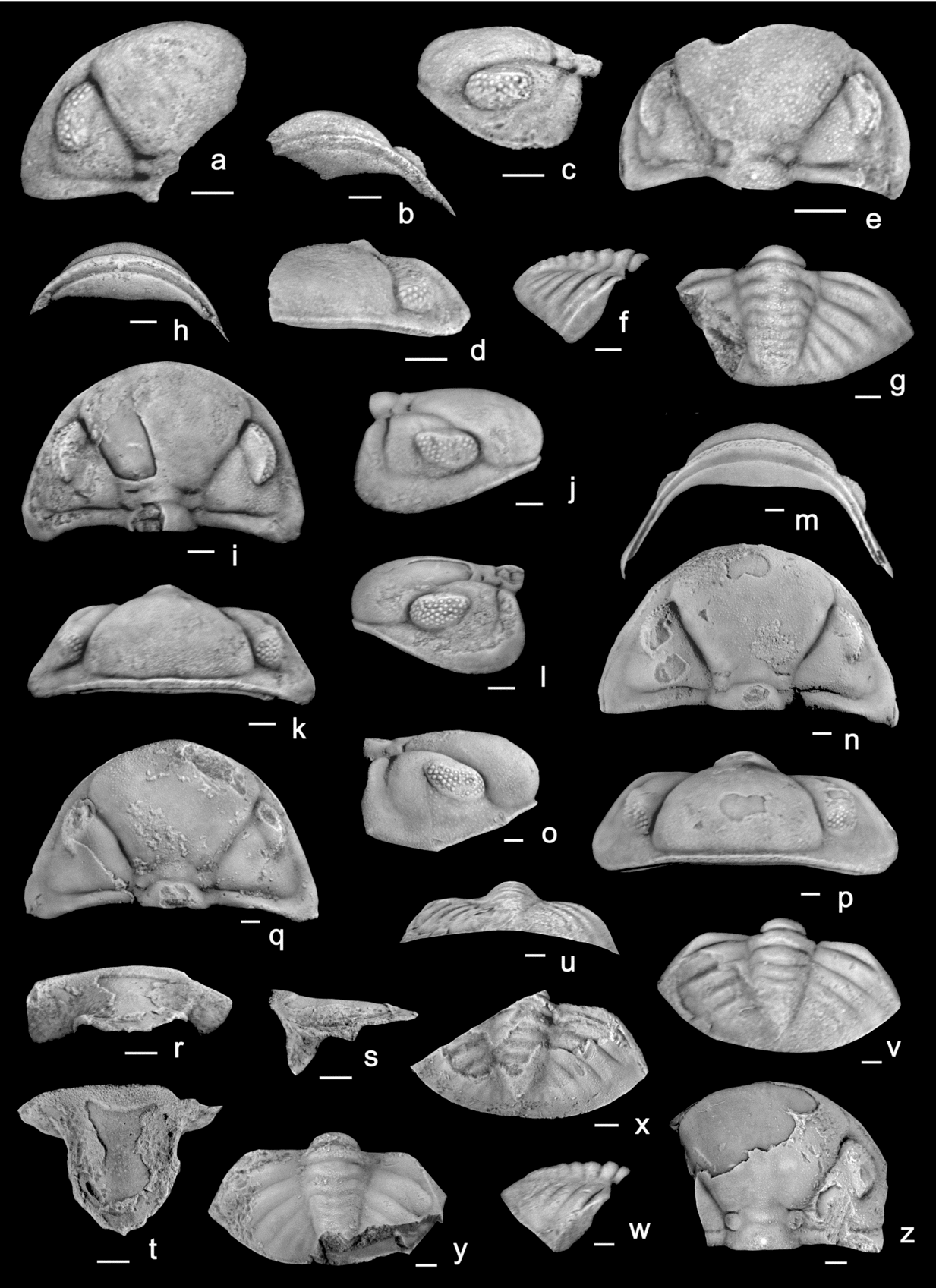
Figure 3m–z
Scale bar = 1 mm. (a–g) Houseops sp. A, Famennian, Upper triangularis Zone, McWhae Ridge west, section A, Canning Basin, NW Western Australia; (a–d) WAM 07.262, cephalon, dorsal, ventral, lateral and frontal views; (e) WAM 07.263, cephalon, dorsal view, showing occipital tubercle; (f, g) WAM 07.264, pygidium, lateral and dorsal views. (h–l) Houseops beckeri sp. nov., Famennian, Upper triangularis Zone, McWhae Ridge west, section A, Canning Basin, NW Western Australia; WAM 07.265, holotype cephalon, ventral, dorsal, lateral right, frontal and lateral left views. (m–z) Houseops canningensis sp. nov., Famennian, Lower? to Middle crepida Zone, McWhae Ridge west, section A, Canning Basin, NW Western Australia; (m–p) WAM 07.266, holotype cephalon, ventral, dorsal, lateral and frontal views; (q) WAM 07.267, cephalon, dorsal view; (r–t) WAM 07.269, hypostome, posterior, lateral and dorsal views; (u–w) WAM 07.270, pygidium, posterior, dorsal and lateral views; (x) WAM 07.271, fragmentary pygidium, dorsal view; (y) WAM 07.272, fragmentary pygidium, dorsal view showing part of doublure; (z) WAM 07.268, fragmentary cephalon, dorsal view showing occipital tubercle.

Material, locality and horizon. Holotype, cephalon WAM 07.266 (Fig. 3m–p). Paratypes, cephalon WAM 07.267 (Fig. 3q), cephalon WAM 07.268 (Fig. 3z), hypostome WAM 07.269 (Fig. 3r–t), pygidium WAM 07.270 (Fig. 3u–w), pygidium WAM 07.271 (Fig. 3x), pygidium WAM 07.272 (Fig. 3y). Two other cephala from same locality and horizon. McWhae Ridge, South Lawford Range, west side, horizon 4 section A (locality I, Fig. 1d); 0.2 m below Frutexites bed; lower Famennian, Lower? to Middle crepida Zone.
Etymology. From Canning Basin, south of the Kimberley Block, NW Australia.
Diagnosis. Cephalon broad with wide posterior genae moderately sloping at genal angle; eye in high position, distant from posterior and anterolateral borders, anteriorly inclined; anterior genae flat, steeply inclined, without border furrow. Anterior border sharp-edged, ventral side of median border flat. Pygidium transverse with posteriorly pointed axis widely separated from border.
Description. Cephalon broad, length to breadth ratio 1:1.7, semicircular, glabella remaining inside overall external outline; low, trapezoidal in frontal view, with subdued upper profile and wide genal areas; moderately high in lateral view with nearly horizontal upper profile. Glabella low in front of preoccipital ring, almost flat-topped, steeply declined anteriorly in anterior third to become vertical above anterior border furrow without encroaching upon border medially, remaining behind anterolateral border until a third of transverse width inside anterolateral corners; evenly arched in anterior outline with recurved anterolateral corners, sharply delimited laterally by rectilinear, anteriorly deep and posteriorly shallowing axial furrows that diverge at 60–63° between S1 and anterolateral corners. Base of preoccipital glabella narrow (tr.), not exceeding 46–49% of maximum breadth. Occipital region depressed, remaining as low as preoccipital glabella, the preoccipital lobe slightly lower than occipital lobe. Glabellar furrow S1 rectilinear, slit-like, deep abaxially; not continuous with axial furrow; adaxially prolonged into a very shallow and thin, forwardly directed branch that dies out after a third of transverse extension of preoccipital lobe. S2 and S3 not impressed on external surface, perceptible on internal mould where the former and the posterior branch of the latter form small crescents in relief, whereas the anterior branch of S3 forms a narrow ridge running parallel to the axial furrow. Preoccipital ring entire, of even length abaxially (exsag.), broadening medially where it curves forward to merge with median lobe of glabella; slightly swollen in medio-posterior part. Lateral preoccipital lobes depressed, flat, poorly defined against medial part of preoccipital ring, abaxially delimited by very shallow axial furrows. Occipital furrow sigmoidal, abaxially deeply incised and slightly curved behind lateral preoccipital lobes, shallowing and widening adaxially when arched forward to become transverse behind medial preoccipital ring. Occipital ring as wide (tr.), and abaxially as long (exsag.) as preoccipital ring, strongly protruding medially to become less than twice length of medial preoccipital ring (sag.); strongly and evenly arched transversely, slightly curved longitudinally, carrying a flat, low protuberance on its medio-posterior half, which exhibits five pits visible only on internal mould. Palpebral area of moderate width (tr.) and strongly vaulted. Palpebral furrow indistinct. Palpebral lobe slightly convex (tr.), steeply inclined anteriorly; postocular distance between palpebral lobe and posterior border furrow 60% of palpebral length (exsag.). Eye low, set far behind anterolateral corners of glabella, in high position on genal field, distant from lateral border furrow, 1.5 times its own height above lateral border. Eye surface low, kidney-shaped, higher in front than behind, sloping at 45°; lenses arranged in 14–16 dorso-ventral files, with a maximum of five lenses in one file. Lens formula in right eye of holotype from rear to front: 23344445444433. Genal field wide posterolaterally, gently convex, with moderate declivity. Posterior border furrow sharply incised adaxially when slightly forward flexed, becoming very shallow abaxially where it curves gently forward to merge with wide lateral border furrow which smoothes out opposite the eye. Posterior border as long as abaxial occipital lobe (exsag.), flat adaxially, widening and becoming gently convex when merging with lateral border at genal angle. Anterior half of lateral border flat, edged with prominent rim, posterior two-thirds increasingly convex to become swollen at angle. Preglabellar furrow narrow, continuously deep, sharply separating glabellar frontal lobe from narrow protruding, sharp-edged border. On ventral surface, border steeply inclined rearward, flat medially, progressively becoming narrow and crest-like abaxially. Vincular furrow broad, moderately deep, with anterior and posterior border at same level in life position. Postvincular area twice as long as vincular furrow (sag.), flat, almost horizontal medially. Sculpture of tiny, sparsely distributed granules on glabella and posterolateral genal areas; on slope of frontal glabella and anterolaterally beneath eye coarser and more dense. Very fine, dense scaly, anteriorly orientated granulation on medial postvincular area; fine terrace ridges developed laterally.
Hypostome length to breadth ratio 1:1.45; relatively broad at posterior third, with wide borders and shallow border furrows; almost horizontal longitudinal profile besides slightly upturned anterior border; middle body depressed, gently arched transversely; prosopon densely covered with tubercles that become coarser on posterior middle body.
Pygidium length to breadth ratio 1:1.83. Anterolateral outline sharply angled at fulcrum; posterior outline wide parabolic; axis slender, narrower than pleural field (tr.), of moderate height, gently arched longitudinally, 1/3 height of pleural field in lateral view; narrow and strongly arched in posterior view; short, remaining distant from posterior border for 1/5–1/6 of its length; pointed posteriorly, prolonged onto border by faint postrachial ridge; axial furrows faint; six axial rings discernible besides end piece, first axial ring higher and more convex than the others of subdued convexity; remains of faint preannulus in second ring; ring furrows shallow, sigmoidal, swinging backward medially when becoming very faint, deeper laterally, curving backward abaxially to join axial furrows. Internal half of pleural field horizontal, strongly flexed downward at fulcral line; six pleural ribs besides half-rib discernible; pleural furrows thin, sharply incised, adaxially, almost rectilinear, disappearing a short distance from lateral border. Sculpture of tiny tubercles on anterior axial rings and pleural ribs; lateral and posterior border edged with tiny rim.
Discussion. The type species of Houseops differs from the slightly younger Houseops miserrimus (Drevermann, Reference Drevermann1901), from the late early Famennian of Langenaubach, Rhenish Slate Mountains, which has a medially pointed frontal glabella and very faint S1 and S2 impressions. H. miserrimus wiedensis (Lütke, Reference Lütke1968) from the Late crepida Zone of Wieda, Harz Mountains, is very similar to H. canningensis in cephalic features, except that it has a continuously deep S1 furrow and smaller eyes. The pygidium is more differentiated by the presence of both pleural and interpleural furrows, and it has a broader and more parabolic outline of the termination of the axis.
Houseops beckeri sp. nov
Figure 3h–l
Material, locality and horizon. Holotype cephalon WAM 07.265 (Fig. 3h–l). McWhae Ridge, South Lawford Range, west side, horizon 3, section A (locality I, Figs 1d, 2), 0.5 m below Frutexites bed; Famennian, Upper triangularis Zone.
Etymology. Named in honour of R. Thomas Becker for his outstanding research on ammonoid biostratigraphy in the Canning Basin.
Diagnosis. Cephalon moderately broad with narrow, flat, strongly downward-flexed outer genae, well-defined palpebral furrows, wide horizontal palpebral lobes; eye approaching anterolateral border, in contact with well-marked border furrow; edge of anterior border blunt, medially inflated on ventral side.
Description. Similar to Houseops canningensis, but with the following distinct features: cephalon of moderate breadth, length to breadth ratio 1:1.6, anterior outline conspicuously flexed backward opposite to anterolateral axial furrows, trapezoidal in frontal view with slightly vaulted glabella and relatively narrow genal areas. Glabellar furrow S1 without adaxial prolongations. Preoccipital ring remaining of same length (sag. and exsag.) transversely, slightly bowed forward medially where it is merely differentiated from median lobe of glabella by very shallow transverse depression or change in slope. Lateral occipital lobes undifferentiated, being flush with median lobe. Occipital lobe moderately enlarged medially to attain twice length of preoccipital lobe (sag.). Palpebral area narrow (tr.), moderately vaulted; palpebral lobe horizontal, clearly separated from genal field by shallow but continuously distinct palpebral furrow; postocular distance between palpebral lobe and posterior border furrow 45% of palpebral length (exsag.). Eye moderately high, in low anterolateral position on genal field in contact with anterolateral border furrow. Visual surface relatively high, slightly higher posteriorly than anteriorly; lenses arranged in 13 irregular dorso-ventral rows with a maximum of four lenses in one row, from rear to front: 2334344444432. Outer genal field narrow posterolaterally, flat, of strong declivity. Lateral border furrow shallow but continuously distinct, merging with base of anterior eye socle. Lateral border moderately convex anteriorly, enlarging posteriorly, with distinct circular inflation shortly in front of genal angle. Anterior border blunt, ventrally inflated medially; postvincular area two and a half times longer than vincular furrow (sag.).
Houseops sp. A
Figure 3a–g
Material, locality and horizon. Cephala WAM 07.262 and WAM 07.263; pygidium WAM 07.264; McWhae Ridge, South Lawford Range, west side, horizon 2, section A (locality I, Fig. 1d); 0.9 m below Frutexites bed; Famennian, Upper triangularis Zone.
Description. Cephalon broad, length to breadth ratio 1:1.8; relatively gently vaulted. Glabella slightly convex (sag.) posteriorly, declining anteriorly to slightly recurve at glabellar furrow; transversely gently convex; anterolateral corner gently rounded; relatively narrow posteriorly, posterior width just under half maximum anterior width. Glabellar furrow S1 deep, short abaxially, continuous with axial furrow; medially very shallow. Lateral preoccipital lobes well-defined abaxially, less so adaxially. Median part of L1 gently convex, lateral lobes slightly inflated. S2 short, shallow close to axial furrow. Posterior ramus of S3 very faint and set more adaxially than S2; anterior ramus of S3 short, slightly deeper. Occipital ring long, more than twice length (sag.) of preoccipital lobe; gently convex with prominent medial occipital tubercle; attenuates rapidly abaxially. Occipital furrow relatively deep and wide (sag. and exsag.). Axial furrows deep and narrow, diverging at about 65°. Palpebral area narrow (tr.) and gently convex. Palpebral furrow distinct, but shallow. Palpebral lobe horizontal, slightly convex (tr.); postocular distance to posterior border furrow 45% of exsagittal length of the eye. Eye surface with 25 lenses. Preglabellar furrow very narrow and shallow. Vincular furrow narrow and shallow; postvincular area flat and relatively large (sag.). Posterior border furrow relatively deep and broad. Posterior border narrow (exsag.) adaxially, widening and flattening abaxially to wide gently convex posterolateral border. Lateral border furrow broad and shallow. Anterior border very narrow (sag. and exsag.), blunt, convex on ventral side. Sculpture of relatively coarse, dense granulation on glabella and genal areas; more sparse on palpebral lobe and posterior and lateral borders.
Pygidium broad, length to width ratio 1:2.1; gently vaulted; segments relatively well incised. Axis long and robust, gently convex sagitally; posteriorly rounded, ill-defined close to posterior border. Axis with up to eight rings, posterior ones ill-defined. Anterior two rings narrowing medially in front of fused remains of preannulus of succeeding ring. Ring furrows well-defined laterally, shallow and broader sagitally; anterior three arched forward abaxially before recurving strongly distally. Axial furrows relatively well-incised, weakly convergent before becoming very shallow behind axis. Six pleural furrows, anterior ones deepest; anterior short extending as far as fulcrum, about half anterior pleural width; second pleural furrow two-thirds pleural width in length; posterior pleural furrows more shallow and extend closer to posterolateral border. Interpleural furrows weakly developed anteriorly, absent posteriorly. Coarse granulation on medial axial rings becoming finer on anterior pleural bands.
Discussion. Two incomplete small cephala and a fragmentary large pygidium were recovered from an interval of 0.5 to 1 m below the Frutexites bed, which belongs in the Upper triangularis Zone. The cephala compare with H. beckeri in having a transversely low vault in frontal view and the narrow steep outer genae, the postocular distance to the posterior border, the continuously vaulted lateral border and the blunt, inflated anterior border. However, this form differs in having fewer ocular lenses, S1 continuous with the axial furrow, weakly incised S2–3 glabellar furrows and significantly lower eye. Until more material is collected, it is not possible to determine to what degree these characteristics are a function of its smaller size. Although the reduced number of lenses may be thought of as an ontogenetic trait, it is interesting to note that in similar size specimens of the closely related Chotecops, Chlupáč (Reference Chlupáč1977, p. 56) observed that small C. glabrens cephala had the same number of lenses as a cephalon twice the size. This suggests that the smaller number of lenses in H. sp. A may be of specific, not ontogenetic distinction.
The single pygidium of H. sp. A differs considerably from that of H. canningensis in the larger and deeper pleural furrows, and the broader and rather robust axis that reaches further backward to approach closer to the posterior border. The width of the axis diminishes to the rear less abruptly and regularly, such that the posterior end remains relatively broad and well-rounded, unlike the somewhat pointed termination in H. canningensis.
Genus Babinops Feist & Becker, Reference Feist and Becker1997
Type species. Babinops planiventer Feist & Becker, Reference Feist and Becker1997.
Assigned species. Babinops planiventer Feist & Becker, Reference Feist and Becker1997; B. minor sp. nov.
Emended diagnosis. Cephalon with genal spine sometimes reducing to pointed genal angle in larger holaspids; low convex glabella not overhanging anterior border; doublure without vincular furrow; palpebral and lateral border furrows faint; pygidium transverse with narrow axis distant from border, pleural and axial ring furrows shallow and wide; sculpture of fine tuberculation.
Remarks. The discovery of a second species of Babinops confirms that the persistence of a genal spine into the holaspid stage is a generic character. Even in larger holaspids a small point is still present at the genal angle. Such genal spines are usually only present in meraspids, such as in the other Famennian phacopine Nephranops (Crônier, Reference Crônier2007). The other typical feature of this genus is the obsolescence of the vincular furrow, such as occurs in the contemporaneous phacopidelline taxa Ductina Richter & Richter, Reference Richter and Richter1931 and Dienstina Richter & Richter, Reference Richter and Richter1931, and generally in all phacopidellines since their Silurian origin (Richter & Richter, Reference Richter and Richter1923). However, an assignment of Babinops to the Phacopidellinae is excluded because of the typical phacopine features of its pygidium. The reduction and ultimate disappearance of the vincular furrow in Babinops might therefore be regarded a case of homeomorphy, as Chlupáč (Reference Chlupáč1977), following Richter & Richter (Reference Richter and Richter1923), recorded for similar examples in the early Devonian Reedops Richter & Richter, Reference Richter and Richter1925.
Babinops minor sp. nov.
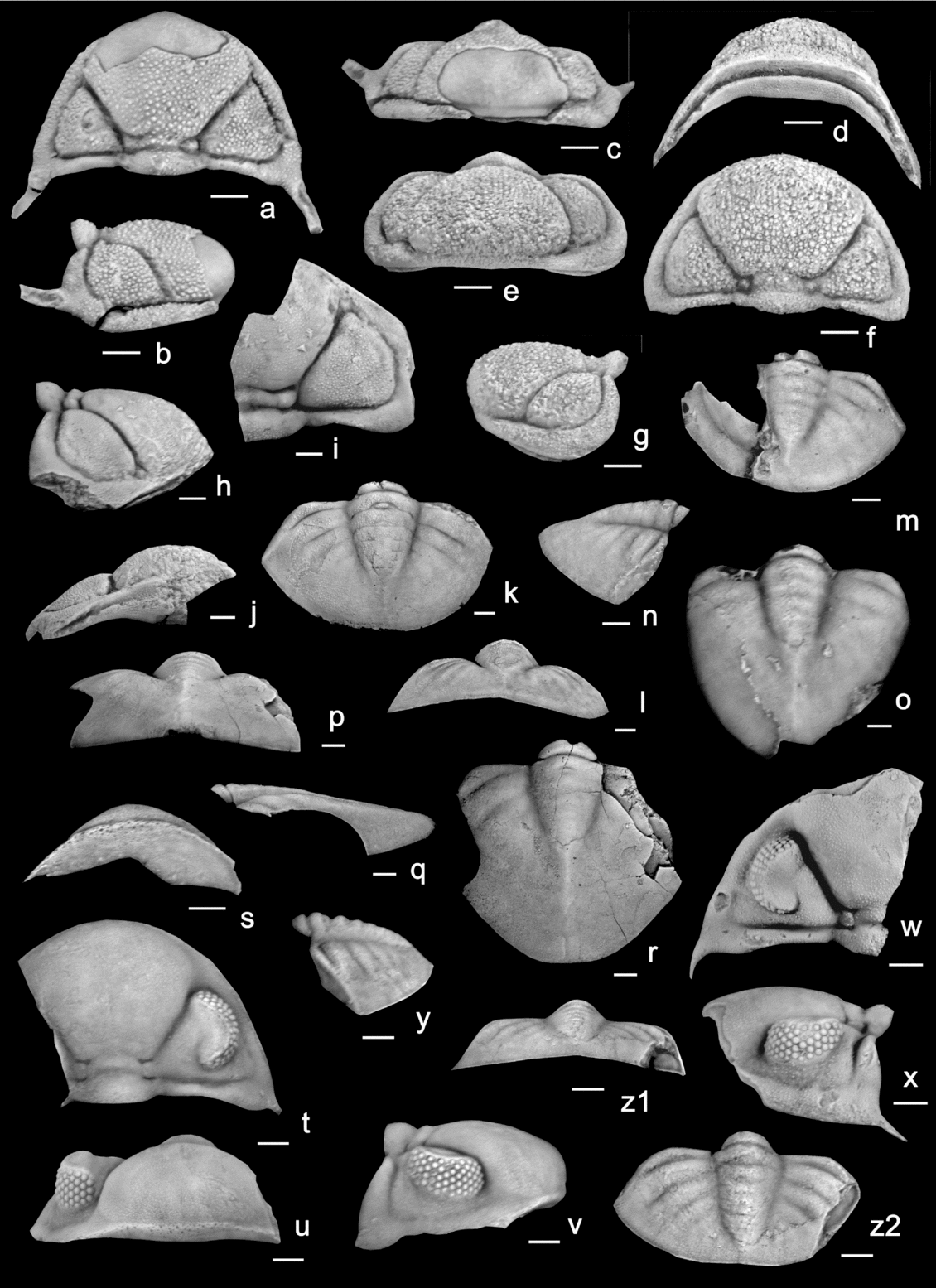
Figure 4s–z
Scale bar = 1 mm. (a–c) Trimerocephalus tardispinosus Feist & Becker, Reference Feist and Becker1997, Famennian, rhomboidea Zone, McWhae Ridge west, section A′, Canning Basin, NW Western Australia; WAM 07.285, cephalon, dorsal, lateral and frontal views. (d–g) Trimerocephalus mimbi sp. nov., Famennian, rhomboidea Zone, McWhae Ridge west, section A′, Canning Basin, NW Western Australia; WAM 07.284, holotype cephalon, ventral, frontal, dorsal and lateral views. (h–n) Trimerocephaloides sinevisus gen. et sp. nov., Frasnian, Zone 13a, ‘Windy Knolls’, Bugle Gap, 1 km south of Waggon Pass, 9 km NNW of McWhae Ridge, South Lawford Range, Western Australia, Virgin Hills Formation; (h–j) WAM 07.277, holotype fragmentary cephalon, lateral, dorsal and ventral views; (k, l) WAM 07.278, pygidium, dorsal and posterior views; (m, n) WAM 07.279, fragmentary pygidium, dorsal view showing doublure, and lateral view. (o–r) Trimerocephaloides? linguiformis sp. nov., Frasnian, Zone 11, ‘Windy Knolls’, Bugle Gap, 1 km south of Waggon Pass, 9 km NNW of McWhae Ridge, South Lawford Range, Western Australia; Virgin Hills Formation; (o) WAM 07.282, pygidium, dorsal view, latex cast of external mould; (p–r) WAM 07.281, holotype fragmentary pygidium, posterior, lateral and dorsal views. (s–z) Babinops minor sp. nov., (s–v) WAM 07.273, holotype fragmentary cephalon, ventral, dorsal, frontal and lateral views, McWhae Ridge west, section A, Canning Basin, NW Western Australia, Upper crepida Zone; (w, x) WAM 07.274, fragmentary cephalon, dorsal and lateral views, McWhae Ridge, South Lawford Range, east side at Casey Falls section, rhomboidea Zone; (y, z) WAM 07.275, pygidium, lateral, posterior and dorsal views, McWhae Ridge, South Lawford Range, east side at Casey Falls section, rhomboidea Zone.

Material, locality and horizon. Holotype cephalon WAM 07.273, McWhae Ridge, South Lawford Range, west side; Virgin Hills Formation, 20 cm above Frutexites bed, horizon 5, section A, locality I, Fig. 1d; Famennian, Upper crepida Zone. Paratype cephalon WAM 07.274 and paratype pygidia WAM 07.275, 07.276; external mould of right genal area with eye; McWhae Ridge, South Lawford Range, east side at Casey Falls section (locality III, Fig. 1d) (Bed 8c in Becker et al. Reference Becker, House, Kirchgasser and Playford1991, fig. 1a); Famennian, rhomboidea Zone.
Etymology. From minor (Latin), because of the reduced number of eye lenses.
Diagnosis. Frontal glabella evenly curved with blunt anterior corners; doublure medially slightly bulged, slightly upturned anteriorly; preoccipital ring not inflated; visual surface low, with relatively reduced lens number; pygidium transverse with shallow but clearly perceptible pleural and axial ring furrows, axis distant from posterior border, faint postaxial ridge.
Description. Cephalon relatively broad, length to breadth ratio 1:2; gently vaulted. Glabella almost flat (sag.) posteriorly, declining anteriorly to anterior border that is not recurved; transversely moderately convex; anteriorly well-rounded, not protruding beyond line of anterolateral border, gently curved at anterolateral corners. Glabellar furrow S1, short, deep, tranverse slit-like abaxially, notched at preoccipital furrow; continuous with axial furrow; medially shallow and curving anteriorly. Lateral preoccipital lobes well-defined, slightly elongated (exsag.), convex, separated from median part of preoccipital ring by incised lateral preoccipital furrows. Median part of L1 not inflated, gently convex (sag. and tr.). S2 and S3 very faint, short. Occipital ring moderately long, about twice length (sag.) of preoccipital lobe; moderately convex, attenuating slightly abaxially. Occipital furrow shallow and narrow (sag. and exsag.). Axial furrows deep, diverging anteriorly at about 65°. Palpebral area moderate width (tr.) and slightly vaulted; more than half width of preoccipital lobe. Palpebral furrow indistinct. Palpebral lobe closer to midline anteriorly than posteriorly; postocular distance short. Eye surface with 16 dorsoventral rows of lenses, with a maximum of five lenses in each file; maximum total number of lenses in each eye 61. Lens formula of right eye in holotype from rear to front: 2323444545454543. Preglabellar furrow indistinct. Eye socle flat, short and steeply sloping to lateral border. Anterolateral margin with prominent, narrow rim that diminishes adaxially. Anteromedial part of cephalic doublure without traces of vincular furrow, slightly bulged and curved upward. Posterior border furrow deep and relatively broad and narrow. Posterior border narrow (exsag.) adaxially, widening appreciably to genal angle that in small paratype (length 5.4 mm) bears prominent, short genal spine, but in larger (length 6.1 mm) holotype is just a sharp, pointed genal angle. Lateral border gently convex and broad. Lateral border furrow broad and shallow. Sculpture on cephalon of relatively fine, even granulation; sparse on genal areas. Very fine, dense granulation on anterior doublure; fine terrace ridges developed laterally.
Pygidium of low convexity; width twice length; fulcrum at less than half distance from axial furrow to widest part of pygidium. Axis narrow, almost horizontal sagitally, declining to sharply rounded end piece. Axis low with seven to eight perceptible rings besides end piece. Ring furrows broad (sag.), shallowing laterally into broad axial furrow. Pleural area flat adaxially, with five to six moderately shallow, large pleural furrows that extend no more than half way to border; distally pleural area steeply declined to border, which is broad, almost flat and gently inclined. Very weak interpleural furrows perceptible on first two segments. Border with dense covering of fine granular ornamentation.
Discussion. Feist & Becker (Reference Feist and Becker1997) described Babinops planiventer on the basis of six cephala and two pygidia from the latest crepida to rhomboidea zones in Virgin Hills, about 14 km northwest of McWhae Ridge. They erected the genus Babinops for this very distinctive Late Devonian phacopid that lacks any trace of a vincular furrow; it possesses a relatively weakly inflated glabella; large palpebral lobe, and faint cephalic and pygidial furrows. The cephalon of B. minor is very similar to that of the type species. The holotype (WAM 07.269, cephalic length 6.1 mm) possesses a sharp genal angle, and in this regard is comparable with the holotype of B. planiventer of cephalic length 8 mm figured by Feist & Becker (Reference Feist and Becker1997, pl. 1, fig. 8). The paratype cephalon of B. minor (WAM 07.270, cephalic length 5.4 mm) possesses a distinct, short genal spine. In B. planiventer this is also present on a specimen of 5 mm cephalic length (Feist & Becker Reference Feist and Becker1997, pl. 1, fig. 6). This confirms that the genal spine, usually a meraspid phacopid feature, is retained in Babinops into early holaspids.
B. minor can be distinguished from B. planiventer by its eyes. Feist & Becker (Reference Feist and Becker1997) record B. planiventer as possessing up to 81 lenses in each eye, arranged in up to 18 dorsoventral files, with up to six lenses in each file. The maximum number of lenses in B. minor is 61, arranged in up to 16 dorsoventral files, with up to five lenses in each file. The glabella of B. minor is transversely more convex, and anteriorly more rounded and less pointed than in B. planiventer; neither does it project anterior of the anterolateral line of the cephalon. The preglabellar furrow, while shallow, is distinct in B. planiventer. In B. minor it is much less distinct. The two species can most readily be distinguished by their pygidium. The new species has a higher width/length index and the fulcrum is set closer to the axis than in B. planiventer. The pleural and axial furrows in B. minor are more well-defined and greater in number. Moreover, it has a wider border, especially posteriorly where the well-defined end piece of the axis is set further from the posterior border of the pygidium than in B. planiventer; and the fulcrum is set closer to the axis in B. minor.
Genus Trimerocephaloides gen. nov.
Type species. Trimerocephaloides sinevisus sp. nov.
Assigned species. Trimerocephaloides sinevisus sp. nov, and, tentatively, T. linguiformis sp. nov.
Etymology. Resembling Trimerocephalus M'Coy, Reference M'Coy1849.
Diagnosis. Phacopine with moderately vaulted cephalon, non-protruding glabella, entire preoccipital lobe, eye-less genae continuously surrounded by deep border furrows, large shallow vincular furrow with convex postvincular area; pygidium long with semicircular posterior outline, short axis with few rings and pronounced postaxial ridge, shallow pleurae with weak, posteriorly effaced pleural furrows.
Discussion. This blind phacopid is represented by a solitary, incomplete cephalon, a fragment of the medial anterior cephalic border and ventral doublure, and two pygidia. Although incomplete, the cephalon has a combination of features that do not allow its emplacement in any known genus. It is included here with the Phacopinae rather than with the Phacopidellinae on account of the presence of its weak vincular furrow and the rather short pygidial axis with few rings, prolonged into a long postaxial ridge. Dorsal traits such as the absence of eyes, the deep continuous border furrows and the configuration of the preoccipital lobe resemble Trimerocephalus M'Coy, Reference M'Coy1849 from the late Early and Middle Famennian, but the anteriorly not protruding glabella and the shallow vincular furrow with a convex and wide postvincular area are different. The long pygidium with the relatively short axis contrasts immediately with the rather short, transverse pygidium of Trimerocephalus where the pleural bands are markedly differentiated. The new genus shares with the phacopidelline Ductina Richter & Richter, Reference Richter and Richter1931 from the early Famennian the evenly curved glabella that medially does not protrude and the vaulted genae without eyes surrounded by continuous border furrows. Ductina, however, is distinguished by the complete obsolescence of the vincular furrow, the presence of functional facial sutures, and a shorter pygidium with a longer axis and more differentiated pleurae. Contemporaneous material from the Montagne Noire, currently under study by R. Feist, probably belongs to the new genus, and will add more to our understanding of this taxon.
Trimerocephaloides sinevisus sp. nov.
Figure 4h–n
Material, locality and horizon. Holotype cephalon WAM 07.277 (Fig. 4h–j). Paratypes: pygidium WAM 07.278 (Fig. 4k, l), pygidium WAM 07.279 (Fig. 4m, n); additional material: fragment of antero-median cephalic doublure WAM 07.280; from Windy Knolls, Bugle Gap, 1 km south of Waggon Pass, 9 km NNW of McWhae Ridge, South Lawford Range, Western Australia; Virgin Hills Formation; associated with Homoctenus, Palpebralia and Crickites lindneri (det. R. T. Becker), late Frasnian, Zone 13a.
Etymology. From sine (Latin: without) and visus (Latin: sight).
Diagnosis. See diagnosis of genus.
Description. Cephalon weakly vaulted. Glabella gently convex (sag. and tr.), not recurved at anterior border; relatively wide posteriorly; anteriorly does not project beyond line of anterior border. Glabellar furrow S1, relatively well-defined medially, curving slightly posteriorly abaxially before deepening and recurving anteriorly close to axial furrow where it abruptly terminates without confluence with axial furrow. L1 convex (sag. and tr.); abaxially swells into elevated lateral preoccipital lobe that bears a prominent tubercle; lateral preoccipital furrow weak. S2 and S3 very faint, short. Occipital ring long, nearly twice length (sag.) of L1; moderately convex, attenuating strongly abaxially. Occipital furrow wide (sag.) adaxially, deepening and narrowing (exsag.) abaxially. Axial furrow rather deep and narrow, diverging at about 60° initially, becoming less divergent anteriorly at two-thirds glabellar length. Preglabellar furrow well-defined; anterior border prominent, narrow, slightly vaulted dorsally, with sharp angle against large, very shallow vincular furrow (sag.). Vincular furrow deepening and narrowing abaxially where it is deeply notched below protruding anterolateral border. Posterior border of vincular furrow defined abaxially, diminishing adaxially as it merges with strongly convex anterior part of large postvincular area. Genal area broad, moderately vaulted, slightly inflated in anterior adaxial angle, representing ovoid remnant of palpebral lobe without ocular lenses. Posterior border furrow straight, narrow, deeply incised adaxially, only moderately shallower abaxially, flexed forward in genal angle to merge with lateral border furrow. Lateral border furrow deep and a little wider than posterior border furrow; straight, running exsagittally then forming an obtuse angle with anterolateral border furrow opposite mid-length of preoccipital glabella. Anterolateral border furrow straight, running obliquely toward anterior glabellar corner, irregularly defined against anterolateral genal field, where it is intermittently provided with small ovoid swellings that increase in size adaxially, the most important located at confluence of axial furrow. Facial suture crosses the border furrow abaxially to the most external swelling, running on to the outer slope of the genal field, where it demarcates a very tiny crescentic field before redescending to the border furrow adjacent to the innermost swelling. Posterior border very narrow (exsag.) and convex adaxially, widening and flattening abaxially; continues into gently convex lateral border that flattens adaxially to pass into very narrow anterior border, visible in dorsal view inside glabellar corners up to a quarter of anterior glabellar width. Sculpture on glabella and borders of fine, relatively sparse tuberculation; coarser and denser on genal areas. Fine granular ornamentation on vincular area; postvincular area with dense covering of terrace ridges.
Pygidium large, of low convexity, with well-rounded posterior margin, relatively narrow, width one-and-half-times length. Fulcrum at about half distance from axial furrow to widest part of pygidium which is located opposite to fourth axial ring at about half length of axis. Axis broad, a little less than one-third pygidial width; short, slightly more than half pygidial length; sagitally gently declining; posteriorly ill-defined, passing into pronounced postaxial ridge which declines at steeper angle than axis. Axis with up to six discernible rings in front of triangular end-piece. Ring furrows shallow and narrow (sag.); only anterior two continuous across axis, both of which bifurcate medially. Axial furrow moderately deep and broad, disappearing along postaxial ridge. Pleural area gently convex, domed adaxially. Pleural ridges very low and slightly convex, with five to six shallow pleural furrows that broaden and become more ill-defined posteriorly and extend no more than half way to border; interpleural furrows absent. Distally pleural area steeply declined to broad, gently convex border, poorly defined against pleural field by slight break in slope. Doublure extremely large, posterior half flat, horizontal, interior portion upraised, convex (sag. and exsag.), reaching forward medially up to opposite sixth axial ring well before end of axis. Ornamentation of fine granulation; dense on axis, less dense on pleural areas, absent on border. Flat lying outer portion of doublure densely covered with tiny, irregular terrace wrinkles; inner part bare.
Discussion. Some specific features of Trimerocephaloides sinevisus, such as the inflated adaxial anterior angles of the genal field, were also observed by Richter & Richter (Reference Richter and Richter1926, p. 175) in some individuals of Trimerocephalus mastophthalmus (Richter, Reference Richter1856). Such ‘ocular protuberances’ (Osmólska, Reference Osmólska1963) also occur in Trimerocephalus dianopsoides Osmólska, Reference Osmólska1963 and in species of Trifoliops Crônier, Reference Crônier2003. The particular course of the straight lateral border furrow occurs in Trimerocephalus shotoriensis Feist, 2003 (in Feist, Yasdi & Becker, Reference Feist, Yasdi and Becker2003) but is much longer there. Sharp postaxial ridges that characterize the new species are only developed in early phacopidellines, such as the Silurian type species Phacopidella glockeri (Barrande, Reference Barrande1846), but they lose this feature in derived Early Devonian forms. Conversely, they all exhibit a rather narrow and long, multisegmented axis which largely contrasts with the new species.
Trimerocephaloides sinevisus might constitute the final stage of an evolutionary lineage that derived from hitherto undiscovered oculated ancestors. It is characterized by the complete obsolescence of functional visual organs on an almost entirely reduced palpebral area. This is an additional example of eye-reduction that affects many taxa independently in the latest Frasnian shortly before the end-Frasnian Kellwasser extinction event.
Trimerocephaloides ? linguiformis sp. nov.
Figure 4o–r
Material, locality and horizon. Holotype pygidium WAM 07.281 (Fig. 4p–r), paratype pygidium WAM 07.282 (Fig. 4o), paratype pygidium WAM 07.283, from Windy Knolls, Bugle Gap, 1 km south of Waggon Pass, 9 km NNW of McWhae Ridge, South Lawford Range, Western Australia; Virgin Hills Formation, ‘Harpetid bed’ above basal conglomerate upon Gogo Formation, Frasnian, Zone 11.
Etymology. linguiformis (Latin): tongue-shaped.
Diagnosis. Pygidium as long as broad, of narrow parabolic posterior outline; axis narrow, subdued, very short, posteriorly prolonged into rather long, prominent postaxial ridge; few, very low axial rings and pleurae of which anterior three defined by axial and pleural furrows, posterolateral border recurved.
Description. Pygidium tongue-shaped, as long as broad. Axis narrow, a little less than width of pleural field, of moderate transverse vault, low in lateral view, with gently declining straight profile; strongly subdued between high pleural fields; of narrow conical outline, pointed behind, following which, without break in slope, is a narrow, crest-like, prominent, very long postaxial ridge that almost reaches posterior border. Five to six axial rings of very low profile discernible, the anterior two gently curved forward medially, the second and third with fused anterior half-rings; ring furrows faint, the anterior two reaching axial furrow. Axial furrow wide, shallow, straight, disappearing when close to postaxial ridge. Pleural field strongly vaulted anteriorly and adaxially opposite to axis, almost as high as posterior axis in lateral view, becoming flat behind; gently arched transversely. Pleural ridges ill-defined, three or four discernible in anterior half of pleural field; anterior three pleural furrows weekly impressed, disappearing before halfway to border. Posterolateral border without border furrow, strongly recurved downward. Border and anterior axial rings of first four segments sculptured with tiny nodules; the remainder of prosopon bare.
Discussion. The taxon is only known from its pygidium. However, its particular features such as the long tongue-like outline, the very short axis deeply sunk in between the vaulted anterior pleural fields and the extremely long postaxial ridge are unique in phacopids. Whereas there is no doubt about the assignment of this pygidium to a new species, it is very difficult at this stage to decide definitively to which genus it might belong. It shares with Trimerocephaloides sinevisus the relatively large size (though being considerably more elongated), the short axis with few segments, the laterally low and posteriorly effaced pleural ridges, and the presence of a long, thin postaxial ridge, although it is much longer than in T. sinevisus. Though these features are sufficiently different in definition and dimensions to allow the pygidia of these two taxa to be readily distinguished, such features do not occur in any other taxa. We therefore assign linguiformis questioningly to Trimerocephaloides. We are aware that should further material, particularly a cephalon, be found, it could well be assigned to a different, new genus.
Genus Trimerocephalus McCoy, 1849
Type species. Phacops mastophthalmus Richter, Reference Richter1856.
Trimerocephalus mimbi sp. nov.
Figure 4d–g
Material, locality and horizon. Holotype cephalon WAM 07.284; McWhae Ridge, South Lawford Range, west side. Virgin Hills Formation, section A′ (locality II, Fig. 1d, horizon 7, Fig. 2), at about 17 m above Frutexites bed; Famennian, rhomboidea Zone.
Etymology. In recognition of the Mimbi Community, who facilitated the collection of the material upon which this species is based.
Diagnosis. Cephalon with broad, slightly protruding glabella, covering anterior margin medially; straight, medially flattened L1 with demarcated prominent lateral lobes preglabellar furrow ill-defined medially, facial suture not cutting genal lobe, posterolateral border very large, without genal spine.
Description. Cephalon broad, length to breadth ratio 1:1.65; strongly vaulted; genal angles well rounded. Glabella strongly convex (sag. and tr.), declining anteriorly to recurve at anterior border; relatively wide posteriorly, posterior width half anterior width; frontal lobe of wide parabolic outline, slightly projecting medially beyond line of anterolateral border. Glabellar furrows S1, ill-defined medially, deepen appreciably abaxially where they are slightly anteriorly curved around basal glabellar lobe to join axial furrow. L1 long sagittally, transverse and almost flat; bears a pair of prominent tubercles; sunken below level of occipital ring and posterior part of glabella; abaxially preoccipital lateral lobes well-defined, circular and convex, adaxially defined by deep preoccipital furrows. S2 and S3 very faint, short. Median part of occipital ring almost same length (sag.) as L1; moderately convex, slightly narrowing abaxially. Occipital furrow straight, shallow medially, very deep behind lateral posterior lobe. Axial furrows very deep, diverging at about 80° initially, reducing to 65° at mid-glabellar length. Genal area strongly vaulted, thickened anteriorly but without discernible swellings. Preglabellar furrow very shallow and narrow. Anterior border prominent, almost flat, steeply inclined posteriorly, slightly wider sagittally, sharply delimited against vincular furrow. Vincular furrow broad and very deep, narrowing slightly abaxially where it becomes notched. Postvincular area as wide as vincular furrow (sag.), flat and horizontal medially, rearward declined and narrowing slightly abaxially. Posterior and lateral border furrows deep and relatively broad. Posterior border narrow (exsag.) and convex adaxially, widening and flattening to rounded genal angle; continues into flat, increasingly narrower anterolateral border which forms an obtuse angle with anterior border opposite frontal glabellar corners, remaining visible along external quarter of frontal glabella in dorsal view. Facial suture runs along base of anterior cheeks. Sculpture on glabella and genal areas of relatively coarse tuberculation; finer, although still dense, tuberculation on borders. Even finer, dense granular ornamentation on anterior doublure; granules becoming aligned parallel laterally.
Discussion. This is the second species of Trimerocephalus to be described from the Famennian of the Virgin Hills Formation. Besides the absence of genal spines, T. mimbi can further be distinguished from the other species, T. tardispinosus Feist & Becker, Reference Feist and Becker1997 by its relatively wider cephalon; glabella that is relatively wider and less pointed anteriorly; more well-defined lateral preoccipital lobes and deeper lateral preoccipital furrows; flatter glabellar lobe L1, and weaker preglabellar furrow. Among other contemporaneous species of Trimerocephalus, T. mimbi differs from T. mastophthalmus (Richter, Reference Richter1856) in having a broader glabella, transversely straight preoccipital lobe, weaker preglabellar furrow, and a facial suture that does not cut the anterior cheek. The course of the facial suture is much the same as in T. caecus (Gürich, 1896) but this species has narrower lateral borders that disappear anteriorly at frontal glabellar corners in dorsal view. T. mimbi differs from T. lelievrei Crônier & Feist, Reference Crônier and Feist1997 in possessing a relatively narrower cephalon, more anteriorly sinuous axial furrow, more well-defined lateral preoccipital lobes, weaker preglabellar furrow, and deeper vincular furrow. Compared with T. shotoriensis Feist in Feist, Yasdi & Becker, Reference Feist, Yasdi and Becker2003, T. mimbi has a finer tuberculation, broader cephalon, a less convex and less anteriorly protuberant glabella, longer (sag. and exsag.) L1, shorter (sag. and exsag.) occipital ring, and evenly curved lateral border furrow. The new species is easily distinguished from T. dianopsoides Osmólska, Reference Osmólska1963, which has prominent swellings (‘ocular protuberances’) on the adaxial anterior cheeks and has a much finer granulation.
Trimerocephalus tardispinosus Feist & Becker, Reference Feist and Becker1997
Figure 4a–c
1997 Trimerocephalus tardispinosus sp. nov. Feist & Becker, p. 236, pl. 1, fig. 9, pl. 2, figs 1–7.
Material, locality and horizon. Cephalon WAM 07.285 (Fig. 4a–c) from McWhae Ridge, South Lawford Range, west side. Virgin Hills Formation, section A′ (locality II, Fig. 1d, horizon 6, Fig. 2), at about 15 m above Frutexites bed; Famennian, rhomboidea Zone.
Discussion. The cephalon from the new locality at McWhae Ridge, some 14 km southeast of the Virgin Hills from where T. tardispinosus was first described by Feist & Becker (Reference Feist and Becker1997), allows complementary observations to be made. At a cephalic length of 4.4 mm, the genal spine measures 2.4 mm in length. The occipital node is well-developed, the preoccipital lobe bears numerous randomly distributed nodules of various sizes among which the pair of prominent nodes, typical of young holaspids, is still discernible. In contrast, the cephalic prosopon is densely covered with nodules of equal size, unlike smaller cephala that bear nodules of different sizes (see Feist & Becker, Reference Feist and Becker1997, pl. 2, figs 1, 7). On the internal mould the protruding frontal glabella appears clearly pointed medially (Fig. 4a). In frontal view the glabella is only moderately vaulted, a little higher than the genal areas.
As its name implies, T. tardispinosus, unusually for phacopids, retains a genal spine into the holaspid stage. Normally in Trimerocephalus the spine is only present in meraspids, but is lost in the holaspids. For instance, in the type species, T. mastophthalmus Richter, Reference Richter1856 from the Harz Mountains in Germany, specimens figured by Richter & Richter (Reference Richter and Richter1926, pl. 9, figs 68–71), Maximova (1955, pl. 14, figs 1, 2), Lütke (Reference Lütke1968, pl. 8, figs 3, 4) and Becker & Schreiber (Reference Becker and Schreiber1994, pl. 1, figs 2, 14, 15) show that the genal spine has been lost by the time the cephala are between 4.3 and 7 mm long. In T. lelievrei Crônier & Feist, Reference Crônier and Feist1997 the spine has disappeared at a cephalic length of 4 mm. The holotype of T. mimbi is 4.4 mm long and also lacks a genal spine However in T. tardispinosus the genal spine is still present when the cephalon is 6 mm in length. Indeed, between cephalic lengths of 2.7 and 6 mm the genal spine doubles in length in T. tardispinosus (Feist & Becker, Reference Feist and Becker1997, p. 240) and may thus have been maintained into the late holaspid stage.
Genus Acuticryphops Crônier & Feist, Reference Crônier and Feist2000
Type species. Acuticryphops acuticeps (Kayser, Reference Kayser1889).
Assigned species. Acuticryphops acuticeps (Kayser, Reference Kayser1889), A. klapperi sp. nov.
Diagnosis. See Feist & Schindler, Reference Feist and Schindler1994, p. 212.
Acuticryphops acuticeps (Kayser, Reference Kayser1889)
Figure 5a–q
1889 Phacops (Trimerocephalus) acuticeps Kayser, p. 288, pl. 13, fig. 6–6d.
1926 Phacops (Cryphops) acuticeps Kayser; Richter & Richter, p. 162, pl. 9, figs 57–60.
1966 Cryphops acuticeps (Kayser); Chlupáč, pp. 107–8, pl. 22, figs 1–3.
1975 Cryphops acuticeps (Kayser); Hahn & Hahn, p. 24, pl. 2, fig. 17.
1977 Cryphops acuticeps (Kayser); Chlupáč, p. 122, pl. 32, figs 1–2.
1991 Cryphops acuticeps (Kayser); Feist, p. 208, text-fig. 7.
1994 Cryphops acuticeps (Kayser); Feist & Schindler, p. 212, pl. 5, figs 1–11.
1995 Cryphops acuticeps (Kayser); Feist, p. 235, text-fig 11.6.
1999 Cryphops acuticeps (Kayser); Crônier, p. 189, text-fig. 2 (8).
2000 Acuticryphops acuticeps (Kayser); Crônier & Feist, pp. 505–6, text-fig. 3, pl. 1, fig. 9.
2002 Acuticryphops acuticeps (Kayser); Feist, p. 208, fig. 3A–I.
2003 Acuticryphops acuticeps (Kayser); Weyer, Girard & Feist, p. 74, pl. 1, figs 4, 5, 9, 10.
2004 Acuticryphops acuticeps (Kayser); Crônier, Feist & Auffray, pp. 472–9.
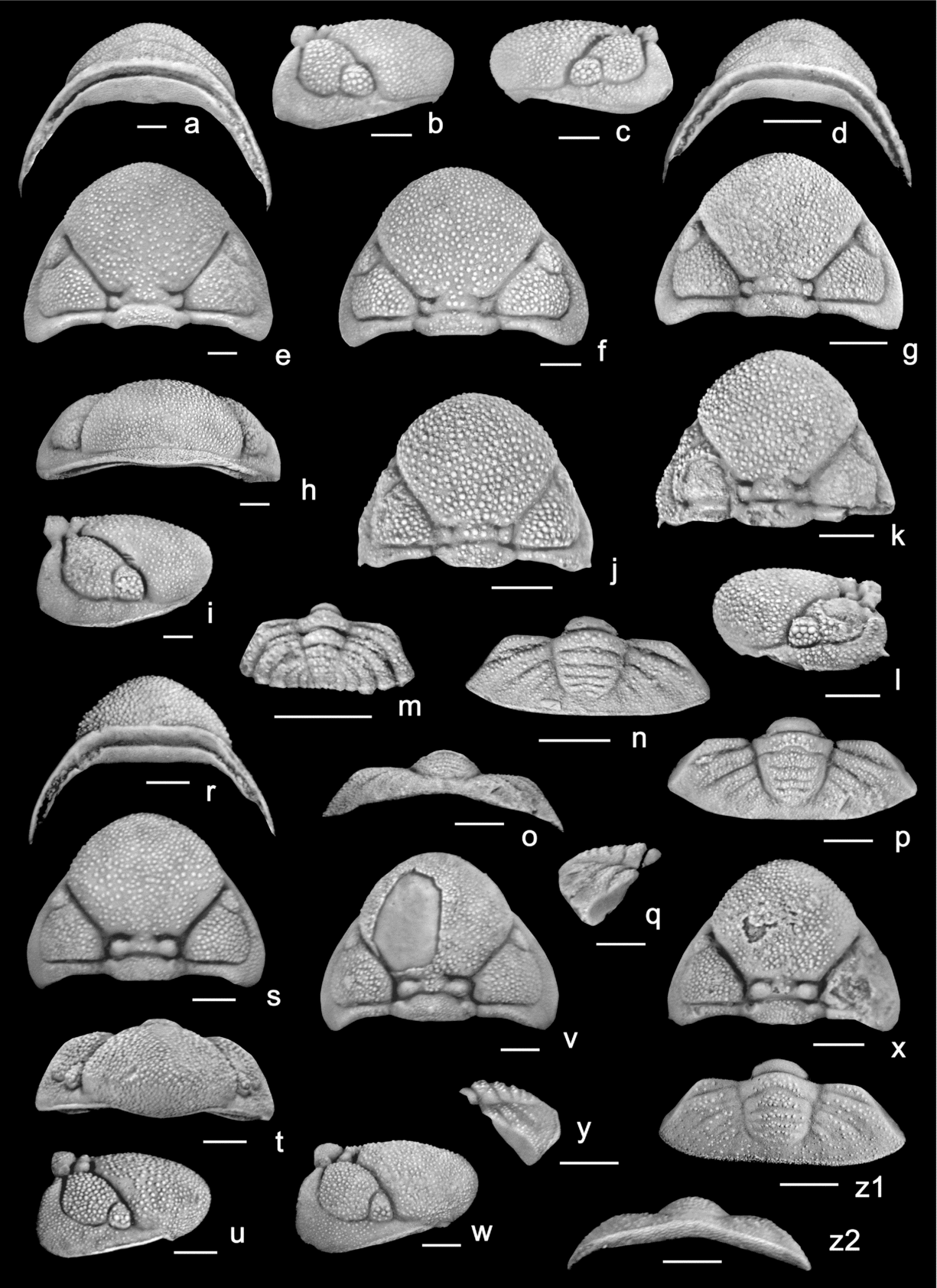
Scale bar = 1 mm. (a–q) Acuticryphops acuticeps (Kayser, Reference Kayser1889), from eastern Phacopid Gully, McWhae Ridge east, South Lawford Range, Virgin Hills Formation; Frasnian, Zone 13a; (a, e, h, i) WAM 07.286, cephalon, ventral, dorsal, frontal and lateral views, morph with 12 lenses; (b, f) WAM 07.301, cephalon, lateral and dorsal views, morph with 11 lenses; (c, d, g) WAM 07.287, cephalon, lateral, ventral and dorsal views, morph with 10 lenses; (j) WAM 07.288, young holaspid cephalon, dorsal view; (k, l) WAM 07.289, young holaspid cephalon, dorsal and lateral views, morph with 5 lenses; (m) WAM 07.292, meraspid transitory pygidium, dorsal view; (n, o) WAM 07.290, pygidium, dorsal and posterior views; (p, q) WAM 07.291, pygidium, WAM 07.291, dorsal and lateral views. (r–z) Acuticryphops klapperi sp. nov., Frasnian, Zone 13b, from Calyx Corner (r–x) and western Phacopid Gully (y, z), McWhae Ridge east, South Lawford Range, Virgin Hills Formation, Western Australia; (r–u) WAM 07.294, holotype cephalon, ventral, dorsal, frontal and lateral views; (v, w) WAM 07.296, cephalon, dorsal and lateral views; (x) WAM 07.295, cephalon, dorsal view; (y, z) WAM 07.299, pygidium, lateral, dorsal and posterior views.

Material, horizon and locality. South Lawford Range, east McWhae Ridge, Virgin Hills Formation; Frasnian, Zone 13a. Cephala WAM 07.286 (Fig. 5a, e, h, i), 07.301 (Fig. 5b, f), 07.287 (Fig. 5c, d, g), 07.288 (Fig. 5j), 07.289 (Fig. 5k, l); pygidia WAM 07.290 (Fig. 5n), 07.291 (Fig. 5p, q), meraspid, transitory pygidium WAM 07.292 (Fig. 5m), from eastern Phacopid Gully, between 26 and 28 m above base of section (Fig. 1d, locality V). Cephalon WAM 07.293, from McWhae Ridge, western side, section A, below Upper Beloceras bed, (Fig. 1d, locality I; Fig. 2). Additional material: 65 cephala, 10 thoracic segments, 10 pygidia from Phacopid Gully.
Emended diagnosis. Anteriorly large glabella, maximum width anterior to midlength of preoccipital glabella; S1 straight and short; L1 with small lateral lobes of half width of median lobe, anterior facial suture impressed below glabella; anterior border flush with overturned part of glabella; vincular furrow gently curved medially, postvincular area longer (sag.) than vincular furrow; pygidium moderately arched transversely with high, vaulted axis. Axial rings and pleurae well-defined.
Ontogeny. The single transitory pygidium (Fig. 5m) is trapezoidal in outline and has a sagittal length of 0.92 mm and 1.92 mm maximum width at posterior border. The anterior margin is straight and relatively short; the posterior margin is widely parabolic to nearly straight with seven pairs of blunted border spines; the lateral margin is relatively long. The angle of the anterolateral margin is about 120°. The axis is well-defined, delimited by well-impressed axial furrows and relatively wide (tr.) with a ratio about 1.60. Axis and pleural fields are clearly differentiated: 6 + 1 axial rings and 7 pleurae are discernible. Among the latter, the four anterior ones are separated by deep, continuous interpleural furrows, and shorter anterior pleural bands are distinct from posterior ones by deeply incised pleural furrows. The remaining adaxial pleurae are still differentiated by continuous interpleural furrows, whereas pleural furrows are no longer discernible. The distal ends of the posterior pleural bands are abaxially strongly curved backward before terminating into bluntly rounded tips; anterior three protrude slightly beyond the posterolateral margin. Pleural bands and axial rings are sculptured with coarse tubercles. Pleurae possess tubercles merging into granules at the flexion.
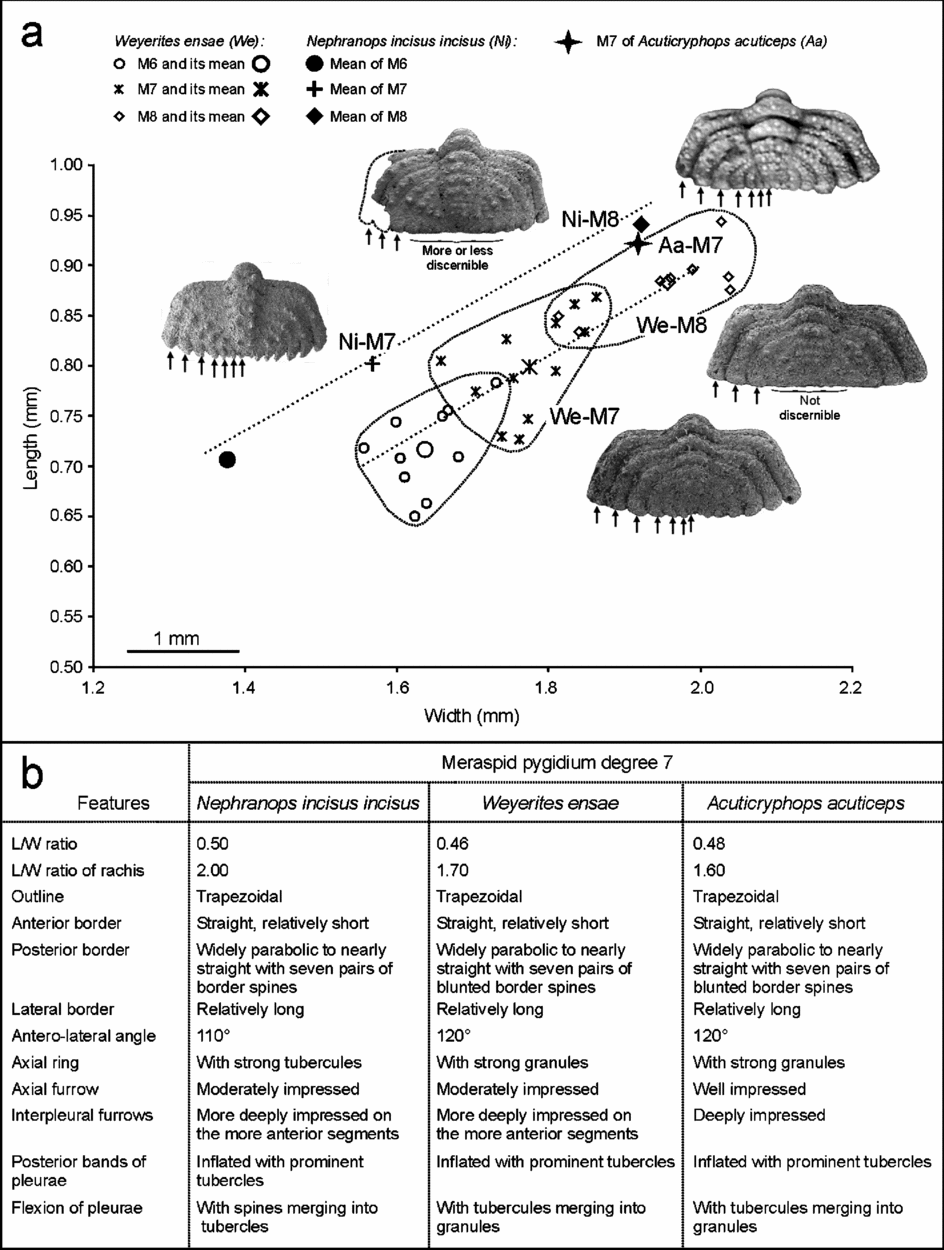
After comparing the size of the transitory pygidium and the relative length of the pleural spines (border spines) with known transitory pygidia of other Late Devonian phacopines, it is possible to determine that the meraspid stage of the Acuticryphops acuticeps pygidium was probably degree 7 (Fig. 6). In comparison with described degree 7 transitory pygidia of other Late Devonian phacopines, by far the closest is Weyerites ensae (Richter & Richter, Reference Richter and Richter1926), which is of similar shape (Crônier et al. Reference Crônier, Bartzsch, Weyer and Feist1999, figs 4–11). Nevertheless, this latter species has a pygidial axis a little narrower (tr.) and pleurae less well-defined posteriorly. Acuticryphops also differs from Nephranops incisus incisus (Roemer, Reference Roemer1866) in a number of ways. This latter species has a narrower (tr.) and elongated (sag.) rachis, seven pairs of well-differentiated border spines that are not blunt, and interpleural furrows more poorly defined but nevertheless more deeply impressed on the more anterior segments (Crônier, Reference Crônier2007, figs 2–11). Comparisons of dimensions and primary ontogenetic features are given in Figure 6 for transitory pygidia degree 7 of Nephranops incisus incisus, Weyerites ensae and Acuticryphops acuticeps.
(a) Size-frequency diagram obtained from measurements of the width as a function of the length of transitory pygidia exhibiting dimensional classes for (1) instar means degree 6 to 8 of Nephranops incisus incisus (data from Crônier, Reference Crônier2007), (2) instars and instar means degree 6 to 8 of Weyerites ensae (data from Crônier et al. Reference Crônier, Bartzsch, Weyer and Feist1999), and (3) instar degree 7 of Acuticryphops acuticeps. (b) Dimensions and main ontogenetic features of transitory pygidium degree 7 of Nephranops incisus incisus (modified from Crônier, Reference Crônier2007), Weyerites ensae (modified from Crônier et al. Reference Crônier, Bartzsch, Weyer and Feist1999) and Acuticryphops acuticeps.

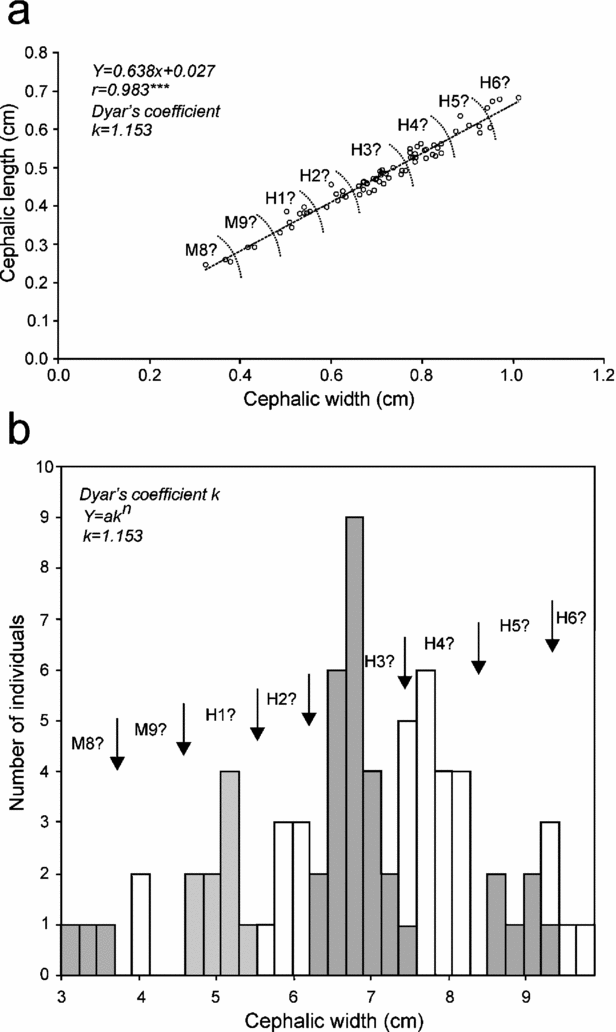
A plot of cephalic length against width shows a clustering possibly corresponding to presumed instars (Fig. 7). Assessment of meraspid versus holaspid periods is based on the presence of genal spines and the presence of coarser tuberculation on small cephala (Fig. 5j–l) that may represent meraspids.
(a) Size–frequency diagram obtained from measurements of the cephalic width (cm) as a function of the cephalic length (cm). (b) Size–frequency histogram obtained from width measurement, exhibiting probable height dimensional classes for cephala of Acuticryphops acuticeps from the Virgin Hills Formation. The numbers above the clusters correspond to the assumed instars defined after extrapolation from meraspid exoskeleton with genal spines and Dyar's coefficient.

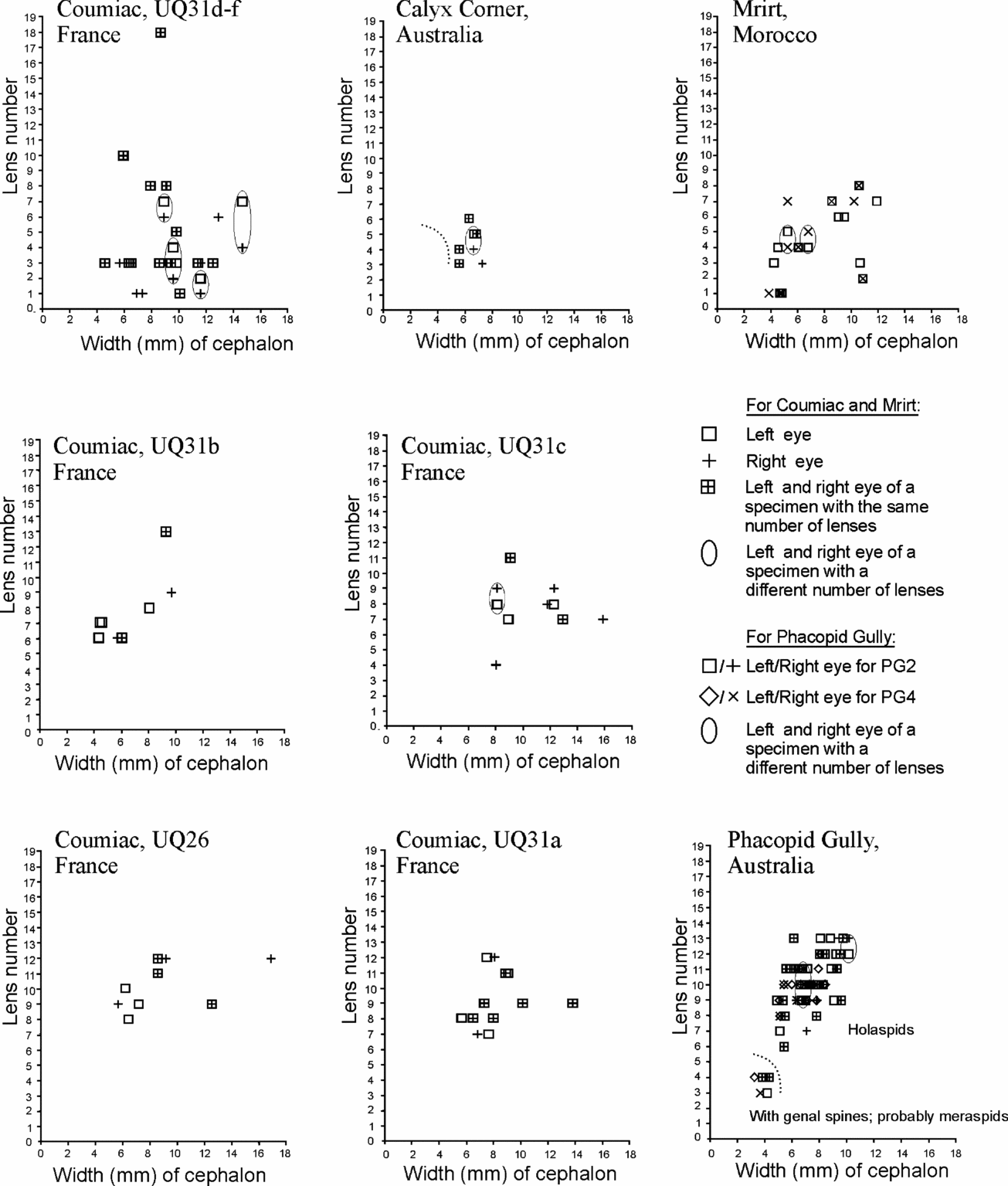
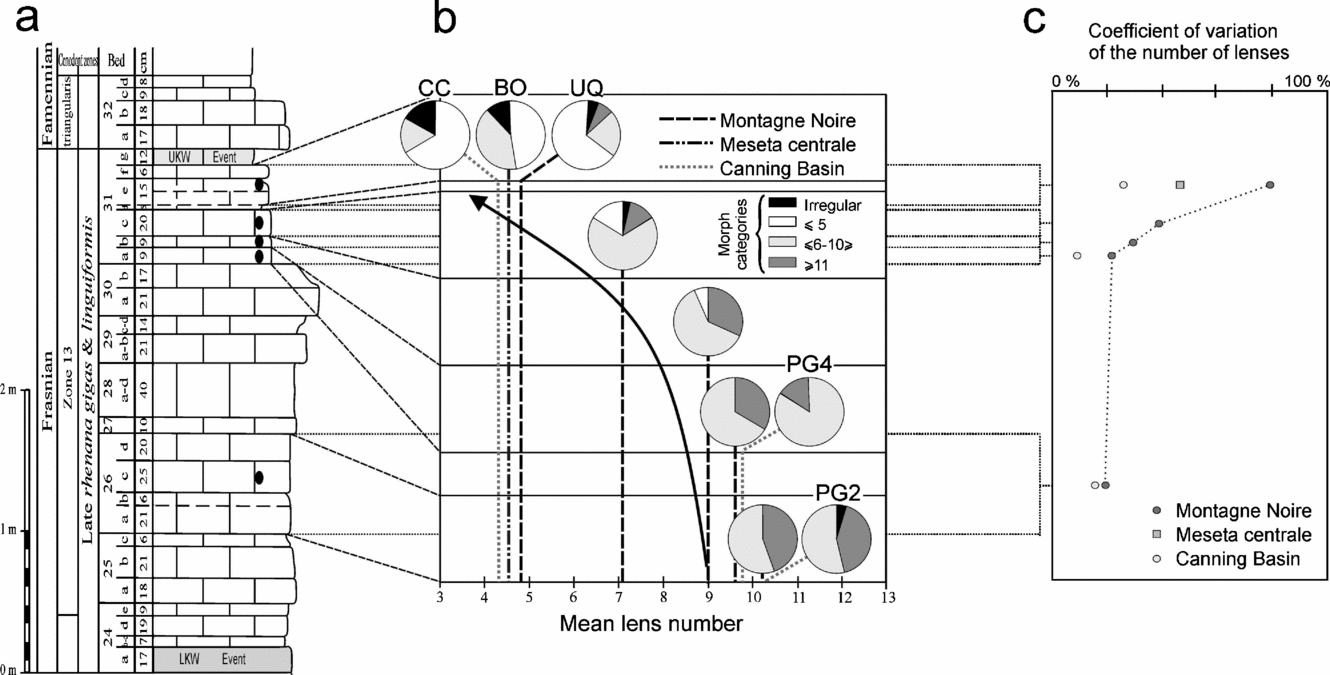
Discussion. Acuticryphops acuticeps is a widely distributed late Frasnian species, having long been known from the Rhenish Slate and Harz Mountains, and Thuringia in Germany (Richter & Richter, Reference Richter and Richter1926), and more recently from Moravia (Chlupáč, Reference Chlupáč1977), Montagne Noire in France (Becker et al. Reference Becker, Feist, Flajs, House and Klapper1989), and Morocco (Feist, Reference Feist2002). Material from the late Frasnian of the Canning Basin shows no significant morphological difference from specimens from the type region (Sauerland, NE Rhenish Slate Mountains, Germany). Specimens attributed to this species from Coumiac in the Montagne Noire are known to show appreciable variation in lens number, both stratigraphically and between penecontemporaneous forms (Feist, Reference Feist1991, Reference Feist and McNamara1995; Crônier, Feist & Auffray, Reference Crônier, Feist and Auffray2004) (see Sections 5, 5.a). The variation that we document from the Canning Basin material falls within the range documented from the Montagne Noire populations at an equivalent stratigraphical level. However, the Montagne Noire and Canning Basin forms show some difference in the extent of variation in glabellar convexity, documented between specimens in both regions. The French forms show greater variation, with more low convex forms. Given the wide overlap between most of the Canning Basin forms and the more convex French forms, we regard the difference as reflecting intraspecific variation. The Montagne Noire form has a longer biostratigraphical range, from conodont Zone 12 to 13b (Feist & Schindler, Reference Feist and Schindler1994; Girard, Klapper & Feist, Reference Girard, Klapper, Feist, Over, Morrow and Wignall2005). The Canning Basin specimens of A. acuticeps are confined to Zone 13a. A form that occurs in Zone 13b in the Canning Basin sequence is regarded as being specifically distinct.
Compared with the Canning Basin form, specimens from Mrirt in Morocco assigned to A. acuticeps by Feist (Reference Feist2002) have a slightly more anteriorly projecting, less rounded glabella; eye with fewer lenses (1 to 8, compared with 6 to 13 in holaspids of the Canning Basin form); a wider pygidium with fulcrum set further from the axis and more ill-defined pleural furrows. As Feist (Reference Feist2002, p. 208) suggests, more material might show that the Moroccan form is specifically distinct from A. acuticeps. In contrast to the Mrirt specimens, A. acuticeps populations from Schleiz in Thuringia (Germany) have the same mean lens number as those from Canning populations (5–14, Weyer, Girard & Feist, Reference Weyer, Girard and Feist2003).
Acuticryphops klapperi sp. nov.
Figure 5r–z
Material, locality and horizon. Holotype cephalon WAM 07.294 (Fig. 5r–u); paratypes cephala WAM 07.295, Fig. 5x), WAM 07.296 (Fig. 5v, w), WAM 07.297, 96.480, 07.298, from Calyx Corner (Fig. 1d, locality VI); paratype pygidium WAM 07.299 (Fig. 5y–z1, z2) from western Phacopid Gully, pygidium WAM 07.300, from Calyx Corner; McWhae Ridge, South Lawford Range, east side. Virgin Hills Formation, Calyx Corner about 30 m above base of section; Upper Phacopid Gully, 50–100 cm above ‘Upper Beloceras bed’ (Fig. 1d, locality IV); Frasnian, conodont Zone 13b.
Derivation of name. For Professor Gil Klapper, in honour of his fundamental work on the conodont biostratigraphy of the Virgin Hills Formation.
Diagnosis Glabella of narrow parabolic anterior outline, projecting strongly anteriorly; maximum width at mid-length of preoccipital glabella; S1 with anteriorly convex curvature; lateral preoccipital lobes prominent, ovoidal, larger than median lobe (tr.); anterior facial suture effaced below glabella; anterior border protruding; vincular furrow transverse medially, post-vincular area as large as vincular furrow (sag.); pygidium low, with vertical posterior marginal rim, axis of broadly parabolic posterior outline, pleural furrows weak.
Description. Cephalon narrow, with length to breadth ratio 1:1.40–1.45; strongly vaulted transversely. Glabella anteriorly projects strongly forward of line of anterolateral border, with anterior lobe of medially not pointed; narrow parabolic outline. Preoccipital glabellar lobe gently convex (sag. and tr.), declining anteriorly to recurve strongly at anterior border; maximum glabellar width far advanced to midlength of preoccipital glabellar lobe, posterior width about half anterior width; glabellar furrow S1 abaxially short, very deep, slightly curved with convexity toward anterior; interrupted adaxially, continuous with axial furrow. S2 and S3 not developed. L1 high, medially connected with preoccipital glabella. Lateral preoccipital furrow moderately incised, demarcating well-defined, largely ovoidal (tr.), convex preoccipital lobes, almost one-third posterior glabellar width in diameter. Median part of L1 relatively wide (sag. and exsag.), gently convex, narrower than lateral lobes (tr.). Occipital ring relatively wide (sag. and exsag), of gently convex posterior outline, longest medially attaining nearly twice length of preoccipital lobe (sag.); medially moderately convex (tr.), abaxially inflated to discernible occipital lobes. Occipital furrow deep and narrow (sag. and exsag.); slightly anteriorly curved medially, abaxially increasing in depth when slightly notched posteriorly and curving around lateral preoccipital lobes. Axial furrows very deep, slightly divergent from posterior to opposite S1; then anteriorly divergent at 80° initially, becoming slightly more divergent anteriorly. Palpebral area strongly vaulted. Palpebral lobe very small, located anteriorly, in contact with axial furrow adaxially; palpebral furrow narrow and deep, curved from axial to anterolateral furrow. Visual surface ovoid with horizontal long axis, slightly steeper inclined anterolaterally than palpebral lobe, carrying three to six lenses in middle of eye-lobe; base of eye anterolaterally well-defined by slightly curved furrow that terminates abaxially at point of conjunction with palpebral and anterolateral border furrows; it recurves adaxially before merging with axial furrow. Facial suture not impressed below frontal glabellar lobe. Preglabellar furrow distinct, very narrow. Anterior border forms a continuous, slightly protruding, tiny rim. Vincular furrow deep and moderately wide, with medially flat, long anterior area that declines posteriorly from anterior border rim; transverse in front of glabella, declining steeply and becoming notched laterally. Postvincular area almost flat, not wider than vincular furrow medially (sag.), narrowing (exsag.). Posterior border furrow straight, deep and narrow, anteriorly curved opposite genal angle to merge with lateral border furrow of equivalent depth that terminates at junction with palpebral furrow and base of protruding eye-lobe. Posterior border convex, widening slightly and flattening at genal angle, continuing into gently convex posterolateral border that narrows anterolaterally. Sculpture of dense drop-like tubercles on glabella and genal areas; no tuberculation on preoccipital or occipital lobes; sparse, finer tuberculation on median part of S1; fine but denser tuberculation on occipital ring and borders. On postvincular area ornamentation of fine, dense granular terrace ridges.
Pygidium broad, almost two and a half times wider than long, of low convexity; posterior border almost straight (tr.). Fulcrum set relatively close to axis; facet much longer than anterior pleural width. Axis broad, one-third pygidial width, gently convex; poorly-defined broadly rounded posterior end, terminating one-fifth pygidial length from posterior border. Axis with five flat rings besides end-piece. Ring furrows weakly defined, narrow (sag.) and, except for first one, not continuous with narrow, well-incised axial furrow; anterior two arched forward; posterior two transverse. Pleural ridges of weak convexity. Four weakly incised pleural furrows, extending to about halfway to border; posterior two pairs very weak. Very faint interpleural furrows present. Edge of posterior border blunt, descending exteriorly to a vertically orientated doublure medially equal in length to first axial ring (sag.). Sculpture of moderately dense granular tuberculation, especially on axial rings and pleurae; becoming finer and more dense toward border. Vertical doublure densely covered with small tubercles that tend to align to tiny terraces.
Discussion. Acuticryphops klapperi can be distinguished from the slightly older A. acuticeps by its relatively narrower, more vaulted cephalon; more anteriorly projecting glabella; curved S1, pronounced tripartite L1 with prominent lateral lobes, smaller palpebral lobe with fewer lenses; more transverse vincular furrow; narrower (sag.) postvincular area, ill-defined anterior facial suture. The pygidium differs in its coarser tuberculation, fainter pleural furrows, more ill-defined and larger posterior of the axis, and more transverse posterior border with large vertical doublure which is shorter and more convex in A. acuticeps.
5. Evolutionary trends and their functional significance in the eye of Acuticryphops
The discovery of numerous Acuticryphops in the Canning Basin with well-preserved eyes allows changing patterns of eye-lens development to be analysed (Fig. 8). When compared with the small population of Acuticryphops klapperi from Zone 13b, the two populations of Acuticryphops acuticeps from beds PG2 and PG4 (26 m and 28 m above base of section, McNamara & Feist, Reference McNamara and Feist2006, fig. 2) at Phacopid Gully are characterized by a high mean lens number (means 10.29 and 9.79 respectively) and exhibit a low degree of variability in the number of eye lenses (Fig. 9b, c). The six specimens of Acuticryphops klapperi collected from immediately below the Upper Kellwasser extinction level at Calyx Corner, are characterized by a significantly lower mean lens number (mean of 4.33).
Plot of lens number versus cephalic width of Acuticryphops species from different beds from the Upper Quarry at Coumiac (southern France), Mrirt (Morocco) and Canning Basin (Australia).

(a) Stratigraphic succession of the terminal Frasnian of the Upper Quarry section at Coumiac, Montagne Noire, southern France. (b) Mean of actual number of lenses of succeeding populations of Acuticryphops, and distribution (%) of their four morphs depending on the number of lenses. (c) Coefficient of variation of the number of lenses of succeeding population of Acuticryphops. For equivalent levels from Coumiac (UQ), Phacopid Gully (PG) and Morocco (BO), populations are characterized by nearly the same pattern. Sample sizes for each assemblage: UQ26 = 14; UQ31a = 35; UQ31b = 28; UQ31c = 30; UQ31d-f = 62; PG2 = 29, PG4 = 19; CC = 6; BO = 23. Morph categories: (1) five lenses or fewer, (2) six to ten lenses, (3) more than 11 lenses, and (4) asymmetric forms with a different lens number for each eye (modified and completed after Crônier, Feist & Auffray, Reference Crônier, Feist and Auffray2004).

Equivalent contemporaneous populations from Coumiac in the Montagne Noire show very nearly the same pattern. On the basis of 14 and 35 individuals, respectively, the oldest populations, from beds UQ26 and UQ31a, possess lens numbers ranging from seven to 17 (respective means: 10.21 and 9.6) (Fig. 8) and, like A. acuticeps from the Canning Basin, exhibit a low degree of variability in the number of eye lenses (Crônier, Feist & Auffray, Reference Crônier, Feist and Auffray2004) (Fig. 9b, c). On the contrary, in the youngest population below the Upper Kellwasser horizon at Coumiac (bed UQ31e-f), based on 62 specimens, the lens number is much smaller, ranging from one to 18 (mean: 4.79) (Fig. 8), close to that seen in A. klapperi. Furthermore, they are characterized by a much higher degree of variability in the number of eye lenses among individuals. Specimens with more than ten lenses are found together with individuals of the same growth stage that have fewer than six lenses, and four individuals have only one lens (see Crônier, Feist & Auffray, Reference Crônier, Feist and Auffray2004).
The coefficient of variation in the number of eye lenses increases during the considered time interval, reaching a maximum just before the extinction event (Fig. 9c). Comparison of the coefficient of variation by a F-max test indicates a significant heterogeneity of variance among assemblages from Coumiac (F vmax/vmin = 4.04; ddl1 = 61; ddl2 =13; p = 0.004). No real significant heterogeneity of variance can be observed among assemblages from Australia (from Phacopid Gully: F vmax/vmin = 1.72; ddl1 = 48; ddl2 =18; p = 0.104 NS; from Phacopid Gully and Calyx Corner: F vmax/vmin = 2.80; ddl1 = 5; ddl2 =18; p = 0.048). However, the bed at Calyx Corner in Zone 13b is situated immediately below the Upper Kellwasser extinction level, contains only six individuals and so is probably too small to show a pronounced significant heterogeneity of variance.
Specimens attributed to Acuticryphops acuticeps by Feist (Reference Feist2002) from the late Frasnian of the Moroccan Meseta at Mrirt are restricted to a single level (BO) immediately below the Upper Kellwasser horizon (conodont Zone 13b), corresponding to the Calyx Corner level in the Canning Basin. Like the specimens from this horizon at Coumiac, the Moroccan forms are also characterized by a low number of eye lenses and high degree of variability. In a sample of 23 recovered holaspid specimens with preserved visual surfaces, the lens number ranges from 1 to 8 and a mean of 4.52 lenses (see Crônier, Feist & Auffray, Reference Crônier, Feist and Auffray2004).
The evolutionary reduction in lens number between the Phacopid Gully and Calyx Corner populations is independent of body size. During phacopid ontogenetic eye development the lenses are progressively added and always placed below existing ones at the base of the visual surface (Clarkson, Reference Clarkson1975). Although it could be argued that, owing to environmental factors, the mean age of individuals might decrease along the lineage, thus accounting for the observed reduction in the number of lenses, the homogeneity in size in the compared populations does not support this interpretation. MANOVA testing performed on cephalic width and length of holaspid instars of Acuticryphops acuticeps from Phacopid Gully indicates that cephalon size does not affect lens number, as it does not differ among morph categories (Table 1).
Results of MANOVA testing the differences among morph categories regarding cephalic size (width and length) of 68 individuals from Phacopid Gully (excluding five meraspid individuals). Morph categories: five or fewer lenses, six to ten lenses, more than 11 lenses, and asymmetric forms with a different lens number for each eye.

5.a. Discussion
As previously noted by Crônier, Feist & Auffray (Reference Crônier, Feist and Auffray2004) on the basis of the material from the Montagne Noire, the pattern of morphological cephalic changes of successive populations of Acuticryphops shows that reduction in mean lens number occurred in parallel with eustatic deepening. In particular, it has been suggested that the terminal Frasnian Upper Kellwasser Event, which reflects a eustatic sea-level rise of anoxic water, played an important role in eye reduction. Deepening water would have resulted in reduction in light levels, and consequent reduction in selection pressure for large eyes. McNamara & Feist (Reference McNamara and Feist2006) have noted how eye size reduced in the Canning Basin between zones 12 and 13b in the scutelluine Telopeltis by paedomorphosis. Similarly, paedomorphic eye reduction occurred in the late Frasnian in some tropidocoryphids, proetids (Feist, Reference Feist1991), and the first blind new phacopine Trimerocephaloides in Zone 13a from the Bugle Gap area. The convergent evolution in eye reduction in a number of unrelated trilobite taxa suggests very strong selection pressure targeting this trait. One explanation is that these forms may have been adapting to inhabiting darker environments, either below the photic zone as sea level rose, or perhaps by adopting infaunal life styles. Alternatively, George & Chow (Reference George and Chow2002) have suggested that during late Frasnian times in the Canning Basin there were periods of high levels of influx of siliciclastic material that would have resulted in high levels of turbidity causing reduced light levels. Such conditions might also have played a role in favouring forms with reduced eyes.
Although the Kellwasser events are considered to have been global in their extent, it has been noted (Becker & House, Reference Becker and House1997; George & Chow, Reference George and Chow2002) that there is no sedimentological signal for the Kellwasser events in the Canning Basin sediments, suggesting that aerobic conditions persisted up to the Frasnian–Famennian boundary, even in relatively deep water. Becker et al. (Reference Becker, House, Kirchgasser and Playford1991) suggested that the Frasnian part of the Virgin Hills Formation at McWhae Ridge represents ‘toe-of-slope’ deposition, at depths in the vicinity of 200 m. The upper Frasnian (zones 12 and above) of the Canning Basin appears not to have been a period solely dominated by these transgressions, but was marked by a series of both transgressions and regressions. Indeed, George & Chow (Reference George and Chow2002) have suggested that the latest Frasnian was characterized by a period of rapid fluctuations in sea level, caused by both global eustatic events, like the Kellwasser events, and more local, tectonically driven factors.
However, although the Kellwasser events did not leave a direct sedimentological signature in the Canning Basin, there is ample evidence that the major Frasnian extinction events during the Frasnian coincided with the two Kellwasser events (e.g. Feist & McNamara, Reference Feist and McNamara2007; McNamara, Feist & Ebach, in press). As the phenomenon of eye reduction appears not to have been constrained by local conditions in the Montagne Noire, but occurred contemporaneously in Morocco (NW Gondwana) and Australia (NE Gondwana), it suggests that in this trait, trilobites were responding more to the global eustatic deepening that occurred in the late Frasnian just before the global extinction event, than to regional effects. Moreover, this close correspondence in trends of eye reduction in the disparate regions demonstrates the potential of using mean lens numbers in phacopid trilobites for fine-scaled intrazonal inter-regional correlations.
The other significant phenomenon displayed by the Montagne Noire and Moroccan populations is the high coefficient of variation in lens number in Zone 13b, just prior to the terminal Frasnian–Famennian event. The population numbers for Acuticryphops klapperi from Zone 13b in the Canning Basin are relatively low to assess whether levels of intraspecific variation in eye-lens number were correspondingly high. This high coefficient of variation can be explained in different ways.
George & Chow (Reference George and Chow2002) have suggested that in the Canning Basin this was a period of environmental stress arising from significant fluctuations in sea level. Such unstable environmental conditions may have played a significant role in the high levels of extinction experienced, particularly by low-latitude invertebrate faunas at this time. The high coefficient of variation in the number of lenses in Acuticryphops acuticeps just prior to the terminal Frasnian/Famennian event in the Montagne Noire population may be a reflection of increased developmental instability. It is well known from a range of living organisms that there is a strong causal link between severe environmental stress and elevated levels of phenotypic plasticity (Parsons, Reference Parsons1987, Reference Parsons1989, Reference Parsons1992, Reference Parsons1993a, Reference Parsonsb; Holloway, Sibley & Povey, Reference Holloway, Sibley and Povey1990; Hoffman & Parsons, Reference Hoffman and Parsons1991). It could be argued that this pronounced increase in the coefficient of variation in eye-lens number in the Montagne Noire and Moroccan populations is similarly a reflection of severe environmental stress associated with rapidly fluctuating sea levels at this time.
Alteratively, the high coefficient of variation just prior to the Frasnian–Famennian boundary may have been a consequence of relaxation of selection pressure for eye-lens development, arising from ecological shifts due to the extension of habitats during the rise in sea level (Crônier, Feist & Auffray, Reference Crônier, Feist and Auffray2004, p. 479). This could have resulted in increased variability in lens number generated by developmental instability due to lower selection pressure for the maintenance of a visual system in deep water.
It is particularly interesting that the strong selection for reduction in the number of eye lenses in Acuticryphops occurred in two different ways in the Montagne Noire and the Canning Basin. Feist (Reference Feist and McNamara1995) and Crônier, Feist & Auffray (Reference Crônier, Feist and Auffray2004) have demonstrated how the reduction in eye-lens number in the material from the Montagne Noire occurred by a unidirectional, gradual intraspecific change in this single trait over the duration of this species in that region, during conodont zones 13a and 13b. However, in the case of Acuticryphops in the Canning Basin it was a cladogenetic event, the populations that existed over the same time period being distinguished as two species: A. acuticeps in Zone 13a and A. klapperi in Zone 13b. This suggests that selection pressure was not the same in the two regions, targeting only the eyes in the Montagne Noire populations, but targeting many other traits in the Canning Basin population.
6. Post-event recovery
Neither of the two phacopid genera that occur in the latest Frasnian, the blind Trimerocephaloides and the strongly reduced oculated form Acuticryphops, survived the Upper Kellwasser event. Until the discovery of these early Famennian phacopids in the Canning Basin, the only other phacopids known from the earliest stages of the Famennian were species of the blind Nephranops, found in Germany (Richter & Richter, Reference Richter and Richter1926) and France (Becker et al. Reference Becker, Feist, Flajs, House and Klapper1989). Nephranops s.s. is the earliest Famennian phacopid known, occurring as early as the Middle triangularis Zone. Given that later Famennian phacopids are known that were fully sighted, it has been difficult to reconcile these forms as having evolved from blind taxa. However, despite occurring in slightly younger strata in the Canning Basin, namely the Upper triangularis Zone, the discovery of the new genus Houseops provides evidence that oculated forms were present not long after the Upper Kellwasser event, and therefore must have survived the biocrisis of the Frasnian/Famennian event.
In those sites where Nephranops occurs in Europe, the Kellwasser extinction event is marked by the presence of black shales that formed under anoxic conditions. However, as we have noted above, there is no sedimentological signal for either of the Kellwasswer events in the Canning Basin. Despite the strong selection on reduced or no eyes that occurred in the late Frasnian, the first phacopids in the early Famennian in the Canning Basin were oculated forms of Houseops that occur in the Upper triangularis to Middle crepida zones. This raises the possibility that Houseops might have descended from an oculated lineage that originated in shallow water refugia in peri-reefal environments that remained beyond the influence of the Kellwasser anoxic episodes. Although the eye is not especially large in Houseops when compared with other oculated phacopids, it is far larger than occurs in species of the Frasnian Acuticryphops. Babinops, which occurs in the Upper crepida to rhomboidea zones, has an even larger eye. Despite the continued presence of blind taxa, such as Ductina and Trimerocephalus, the early Famennian was a time for the re-establishment of oculated phacopids.
Acknowledgements
We thank G. Klapper (Glencoe, IL) for determining the conodont-based biozonations of our trilobite samples and R. T. Becker (Münster) and the late M. House for help with biostratigraphy and provision of unpublished field notes, respectively. We are grateful to G. Rockylle (Augusta), the late E. Routasuo and P. Playford (Perth) for expert guidance and logistic support in the field, and to J. Long (Melbourne), D. Friend (Cambridge), C. McGeachie (Perth), D. Haig (Perth) and Tim McNamara (Perth) for assistance during field work in the Canning Basin. D. Bruton (Oslo) and E. Clarkson (Edinburgh) are thanked for reviewing the manuscript and offering suggestions for its improvement. We gratefully acknowledge funding support from the Australian Research Council. This is a contribution of UMR 5554, CNRS, Montpellier (ISEM 2008-034) and UMR 8157, CNRS, Lille.