1. Introduction
One and a half decades after Kim Cascone articulated his concerns regarding the lack of exchange between academic and independent sides of electronic and computer music (Cascone Reference Cascone2000), this issue does not seem to have been resolved. The recurring presence of ‘beat’ in the work of independent practitioners and its implicit association with popular music cultures are cited by both Cascone (Reference Cascone2000) and Ben Neil (Reference Neill2002) as prominent reasons for this gap. Around the same time, Joel Chadabe predicted the emergence of a ‘new cultural landscape, [one] not based on aristocratic and popular traditions’ (Chadabe Reference Chadabe2000: 11). However, more than a decade later, the dismissive attitudes towards the independent approach that was ‘yet to be taken seriously by research-based computer music institutions’ (Thomson Reference Thomson2004: 211) are still in place. As Tony Myatt points out, ‘most research and academic writing about electronic and electroacoustic music is focused on music produced within academic communities’ (Myatt Reference Myatt2008: 1), leaving the body of work from independent artists and musicians largely unscrutinised, at least in terms of their musical and aesthetic features. The impact of this is seen, for example, in the rather equivocal terminology and classifications for works and genres: glitch, microsound, noise music, electronica, post-digital and even sonic art and sound art, are overlapping terms often used interchangeably in writings about independent sound-based artworks.Footnote 1 Such lack of consistency is perhaps partly due to the fact that even the limited amount of academic attention paid to these works, as Landy points out, is primarily targeted at their technical and technological characteristics, rather than aesthetic and theoretical ones (Landy Reference Landy2007).
Shortly after Landy made this remark, Tony Myatt, in his editorial note to the Organised Sound issue titled New Aesthetics and Practice in Experimental Electronic Music, called for a discussion of contemporary independent electronic music that ‘can provide accurate and factual descriptions of sounds and music in the context of contemporary cultures, economies and philosophies, particularly in relation to the function of music and of musical research within the societies and communities who support it’ (Myatt Reference Myatt2008: 3). In parallel to this, he and three fellow researchers at the University of York instigated the New Aesthetics in Computer Music project in 2008 (New Aesthetics in Computer Music 2008) in an effort to explore the aesthetic principles evident in the works of a number of prominent independent electronic musicians, most of whom are yet to receive significant attention from scholars. New Aesthetics in Computer Music features a series of interviews with these artists, among whom is Olaf Bender (aka Byetone), a co-founder of Raster-Noton, one of the most influential and aesthetically coherent record labels of the twenty-first century’s experimental electronic music scene. Regardless of their substantial contribution to the field in the past decade or so, works of only a few Raster-Noton artists receive only occasional mention in a limited number of academic writings. Excluding a few instances such as Adam Collis’s article in the New Aesthetics issue (Collis Reference Collis2008), these mentions usually do not move beyond broad survey discussions as part of a more general discourse on glitch, microsound, noise and sound art. For instance, Hegarty, Voegelin and Demers briefly touch on the contributions of Carsten Nicolai (aka Alva Noto, the other co-founder of Raster-Noton), Ryoji Ikeda and Pan Sonic to microsound and glitch (Hegarty Reference Hegarty2007; Demers Reference Demers2010; Voegelin Reference Voegelin2010). Caleb Kelly’s rather comprehensive encyclopedia of glitch completely (and surprisingly) overlooks these artists, to the extent that Nicolai – who according to Demers ‘rivals Kim Cascone for the position of the world’s most prominent microsound musician’ (Demers Reference Demers2010: 87) – is cited only once and amongst several other names, in the introduction of Kelly’s book (Kelly Reference Kelly2009: 8).
Even when discussed, works of these artists are often referred to individually (sometimes in separate chapters and subsections), with a more comprehensive investigation of their aesthetic interconnections remaining to be undertaken. In this respect, Torben Sangild’s analysis – despite its brevity – stands out, as he groups Ryoji Ikeda, Alva Noto and Pan Sonic together in a genre he refers to as ‘minimal click’, suggesting dryness, repetition, use of sonic technological byproducts and lack of melodic material as some of their common aesthetic features (Sangild Reference Sangild2004: 260–1).
It is the aim of this article to expand and build upon this feature of Sangild’s writing, in finding a common ground between various strands of contemporary sound-based artworks, strands which have been overlooked in the academic literature of recent years. In doing so, this article ignores the specific technical and technological discussions that have led to the rather ambiguous terminologies outlined above, and instead suggests a cross-genre and multidisciplinary investigation that is concerned with neither the medium nor the technology, but the interrelating aesthetic principles of these works.
2. Rethinking An Aesthetic Trend
From the final years of the twentieth century onwards, there has been an emergent aesthetic phenomenon evident across a growing number of independent sound-based artworks, regardless of their genre, cultural context, or medium. This includes works by the co-founders of Raster-Noton (Nicolai, Bender and Frank Bretschneider) and several artists on their roster, such as Ryoji Ikeda, Aoki Takamasa and Mika Vainio (one of the Pan Sonic duo), audiovisual projects by Martin Messier, Nicolas Bernier and Ryoichi Kurokawa, and large-scale kinetic sculptures by Zimoun and Pe Lang. Ranging across laptop-produced compositions, audiovisual performances, installations and sound-sculptures, these works share certain characteristics. Although approached very differently in terms of tools, techniques and media, they are connected through common aesthetic elements. These elements include avoidance of melodic and harmonic material to a complete or substantial degree through the use of sounds that are conventionally perceived as ‘extra-musical’, harsh, mundane and unwanted (digital or mechanical noises, extremely high and low frequencies, or sonic glitches, byproducts and artefacts). Alongside this, they are also linked through the extensive use of iterative sonic and visual materials presented in clearly defined and rigidly gridded structures, comprising highly repetitive macro- or micro-building blocks (multiple iterations of an identical sound source, sound-object, or image, as well as pulse-based rhythms, static timbres, repeated patterns, and recurring images and stroboscopic visuals). Many of these elements are reminiscent of the ‘minimalist skeletalism’, which Sherburne identifies in early Chicago house and Detroit Techno as a means to rid the music of everything inessential to the pulse requisite for the dance floor (Sherburne Reference Sherburne2004: 324). According to Sherburne, the same minimalist skeletalism is used by glitch and microsound ‘to approximate the form of dance music by substitution and implication, swapping out traditional drum samples for equivalent sounds sourced from pared-down white noise: click, glitch, and crackle’ (Sherburne Reference Sherburne2004: 324).
It might be convenient to paint the works mentioned above with the same broad minimalist brush, given that there are certain attributes supporting this assumption: repetition and the reduction of the sound material to basic elements (sinetones, burst of white noise, clicks, or basic sound-generating objects) being the pivotal ones. For example, in his Mille Plateaux manifesto, Achim Szepanski refers to ‘click’, one of the signature sounds of microsound and glitch, as ‘the introduction to the minimalism of the twenty-first century’ (Szepanski Reference Szepanski2001: 225). The association with minimalism is also made by Taylor Deupree, the founder of 12k (another influential contemporary record label for independent electronic and computer music), as Sherburne quotes him saying that the central aesthetic of 12k is minimalism (Sherburne Reference Sherburne2002: 176). A minimalist aesthetic is also used by Raster-Noton co-founder Carsten Nicolai, as the foundational concept underlying the label’s aesthetic, which he described as an attempt to ‘release the music without anything except the music and what is necessary to carry it out’ (Borthwick Reference Borthwick2003: 44). However, as the other Raster-Noton co-founder, Olaf Bender, states in interview with Myatt, while reduction of structure to its essential elements makes their music ‘in a way minimal’, they do not actually follow the traditions of Minimalist music (Bender Reference Bender2008). Sonya Hofer argues that ‘while [microsound is] described as “minimalist” by many, this minimalism […] did not necessarily adhere to the formal tenets of Minimalism, capital “M”’ (Hofer Reference Hofer2014: 299).Footnote 2 This can be extended to the mechanically produced audiovisual works and sound installations mentioned above. For instance, Zimoun explains in an interview that his interest in simplicity, repetitive and reductive principles, and raw material gives ‘some kind of minimal aesthetic’ to his work (Zimoun 2011). Similarly, Nicolas Bernier’s Frequencies (a) (Bernier Reference Bernier2012) is described as a ‘not-quite-minimal’ sound and light composition on his website.
In his ‘Thankless Attempts at a Definition of Minimalism’, Kyle Gann (Reference Gann2004) lists a series of features shared by early Minimalist music, a number of which are also widely used in the works discussed here (e.g. repetition, steady pulse, linear transformation, clarity of structure). Yet the artists mentioned above are hesitant in closely identifying their works with Minimalism, which can be perhaps explained by the historical gap between the two, the very different cultural contexts in which they operate, and the differences in their musical materials especially in terms of pitch use. In discussing the works released on Mille Plateaux on the Clicks+Cuts (2000) compilation, William Ashline writes that ‘the “minimalism” invoked here is hardly adequate for defining the distinctive character of a rapidly evolving genre of electronic music’, as it is not ‘comparable to the experiments of Steve Reich and others in the milieu of the 1960s and 1970s avant-classical tradition’ (Ashline Reference Ashline2002). Here then, minimalism is used with the lower case ‘m’.
In an interview with Ashline, Ian Andrews argues that the minimalism of glitch and microsound is a ‘return to purity’ of modernism and a ‘rejection of postmodernism’, a phenomenon he claims lacks theoretical investigation (Ashline Reference Ashline2002). Expanding the discussion to the cross-medium works mentioned earlier, the line taken in this article is that although these works utilise structural or stylistic audiovisual features that are aesthetically minimal (again: repetition, reduction, formal clarity, etc.), solely identifying them with the term ‘minimalist’ does not suffice in terms of the aesthetic assessment that is the purpose of this article. To make this point clear, there exist a large number of sound-based artworks that although sharing minimal aesthetics, do not necessarily belong to the focus group of this article. This includes numerous works of Taylor Deupree, William Basinski, Scott Morgan (aka Loscil), or Trimpin, whose works are respectively associated with microsound, ambient, ambient electronica and kinetic sound sculpture. The noticeable use of either melodic phrases, harmonic layers, or conventional musical instruments, in addition to developmental and open forms in these works, even if minimal features are incorporated through use of repetition or limited set of materials, excludes them from the more focused aesthetic group that this article is concerned with.
By contrast, what unifies many works of those artists under discussion here is something more than their minimalistic approach to form and materials. It is a recapitulation and recycling of key modernist tendencies – not limited to minimalism – that is presented in an uncompromising or even confrontational manner. Beyond the aesthetic of reduction, there is a form of sensory provocativeness, conveyed through insistent use of contemporary technological noise that links them historically to Futurism. Noise is key here, whether acoustic (digitally or mechanically produced irregular vibrations) or contextual (‘non-musical’ sounds or sound-generating objects, high frequencies, or extreme dynamics). Whatever the source of noise, it is presented in a highly ordered and organised manner: temporally (the binary pulsating beats of Pan Sonic’s Kesto (234.48:4) (2004), or Alva Noto’s unitxt (2008)), spatially (Zimoun’s painstakingly arranged prepared motors, or Kurokawa’s perfectly arched HD displays sequencing through video snippets of waterfalls in Octfalls (2011)), or both (the perfect geometry of monochromic lines, rectangles and grids in Ikeda’s visuals accompanying his pulsating noises in Transfinite (2011), or Daito Manabe’s accurately arrayed spinning metal sheets producing techno-like patterns in Motor Music Test 55 (2013)).
The lack or extreme limitation of pitch material, discreteness of timbre, and the simple pulse-based and clear-cut on/off envelopes in these works aligns them tightly with Wishart’s concept of ‘the lattice’ on which conventional musical structure is constructed (1996). Here, however, the sonic material never develops across the underlying lattice, as the works are not organised into developmental or teleological forms. This is the case not only in installation pieces, but also in fixed-media audio works, for in both there are no dramatic build-ups, climaxes, or significant dynamic shifts. One can enter the gallery, or click the play button at any point in a piece, and the audible structure reveals itself within the next few pulses, beats or bars. Due to this block-like temporality, the discourse of these works is largely defined by the grid itself, which unlike Wishart’s lattice, is not used as a conceptual framework to build sonic architecture upon, but is emphasised as a dominant aspect of the work. Additionally, and regardless of the mode and medium of expression, a visual grid often accompanies the sonic one: tightly concurrent arrays of moving objects, stroboscopic bursts of light, and highly synchronous visuals constructed from basic abstract geometries are ubiquitous. Both sonically and visually, what make these works aesthetically consistent and enthralling is their direct and radically reductionist use of material, and the structural clarity of their grid-based forms: fluorescent lights, monochromic pixels and basic noise-producing (physical or digital) objects that are meticulously formalised through iterated (temporally, spatially, or both) grids made of identical or tightly similar units.
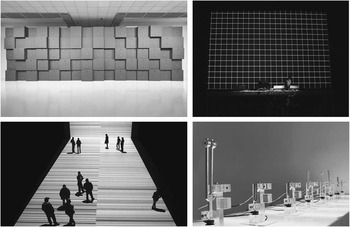
These works may be highly elaborate in their patterning of a reduced material and formal palette, but they also avoid over-complexity. In Nicolai’s Prototypes (2001), for example, ‘while the sound world is extreme in its register and exaggerated thinness of texture, the familiar language of the beat is never far from the surface, playing a critical role in structuring the compositions throughout’ (Knowles Reference Knowles2006: 18). Whether produced digitally (Ikeda’s Test Patterns, 2008), or physically (Messier’s Sewing Machine Orchestra, 2011), they feel cold, stark, mechanical and binary; this is what Sangild calls ‘an almost inhuman gesture’, which he contrasts to ‘Oval’s quasi-organic syntheses’ (Sangild Reference Sangild2004: 265). The lack of sentiment that these works convey is further reinforced through their rejection of melodic and harmonic material, and projected through their inorganic feel. Revealing his interest in ‘dark sounds’ and ‘very basic harmonic systems’, Bender, for example, describes his compositional process as a mechanical structure in which all the elements function just to bring the rhythm forward (Bender Reference Bender2008). Even when using sophisticated technologies, the conventionally non-musical sonic material used in these works are conveyed in a raw and basic form: Bernier’s Frequencies (a) (2012), regardless of its use of mechatronics and microcontroller programming, is composed for a number of sinetones and tuning forks, confirming his fascination with basic sound-generating units (Bernier Reference Bernier2014). Aurally, visually, or audiovisually, these works reveal the materiality of their materials. In Cyclo, Nicolai and Ikeda’s sound waves are visually expressed through oscilloscopes, whereas Zimoun’s installation works are even titled after their materials, such as 80 prepared dc-motors, cotton balls, cardboard boxes 71×71×71 cm (2011) (Figure 1). Accordingly, the direct and upfront nature of these works hides nothing: sinewaves are presented as sinewaves, filtered white-noise as filtered white-noise, DC motors as DC motors, and sewing machines as sewing machines. In this way, there is no subsumption of the material used within a representational or developmental ‘language’, as materials are employed for their own inherent qualities and functions, and not articulated by a governing musical ‘discourse’. By expressing raw materials in these bare and reductionist forms, these works create a sensory experience out of audiovisual elements normally understood as unpleasant, uninteresting, and ignored or extraneous, which are now contextualised and regulated as macro- and micro-units, contained by arrays, grids and repetition. Regardless of the medium or mode of presentation, such works can be described as radically reductionist systems that are stripped down to a set of raw quantised sonic or visual elements, which although perhaps uninteresting in isolation, are compelling as a grouped and organised phenomenon.
Top-left: 80 prepared dc-motors, cotton balls, cardboard boxes 71×71×7 cm (2011) by Zimoun. Photo courtesy of Zimoun. Top-right: Olaf Bender aka Byetone performing live (2008). Photo by Alvaro Fárfan/CC BY-NC 2.0. Bottom-left: test pattern [nº3] (2010) by Ryoji Ikeda. Photo courtesy of Ryoji Ikeda. Bottom-right: Frequencies (a) (2012) by Nicolas Bernier. Photo courtesy of Nicolas Bernier.

The rigorous minimalistic approach evident in these works, in addition to their emphasis on the visual appearance and physical existence of their material, equips them with something to hold onto: Landy’s term for certain factors that make sound-based artworks accessible to their audience (Landy Reference Landy2007).Footnote 3 Through reduction, repetition and clarity of sonic and visual texture and form, these works are readily accessible at one level, even if at other levels their materials are not conventionally musical or ‘beautiful’. This juxtaposition grants such works their unique affectivity and aesthetic, which could also be considered as a balanced tension, a frisson, or an aestheticisation of the ‘ugly’. With these points in mind, here we begin to broach another contextual and historical link between these works, to which the first author of this article deeply relates: their relationship to Brutalism.
3. Brutalism
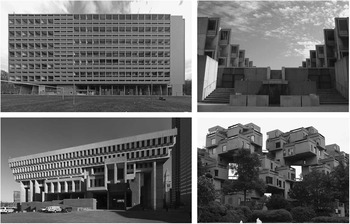
A post-war movement in architecture, Brutalism (originally known as New Brutalism) emerged in the 1950s (Figure 2). Reyner Banham coined the term ‘The New Brutalism’ as ‘a deliberate attempt to construe [Alison and Peter] Smithsons’ aesthetics as a new movement that would overcome the soft modernism of The Architectural Review’s “New Humanism,” or “new Empiricism”’ (Vidler Reference Vidler2013: 17). The origin of the term, however, was used equivocally by Banham, as it had multiple references: Le Corbusier’s béton brut (raw concrete), neo-brutalist as an inside joke used by Hans Asplund in reference to the work of some of his Swedish colleagues, or Peter Smithson’s nickname ‘Brutus’ (Banham Reference Banham1966). Nevertheless, when first theorising the movement in 1955, Banham clearly defines Brutalism’s chief principles as ‘memorability as an image, clear exhibition of structure, and valuation of materials “as found”’ (Banham Reference Banham2011/1955). In explaining Brutalism’s mission, Banham argues that it is an amalgam of sets of stylistic features (as are found in Cubism) and ideological principles (typified by Futurism) (Banham Reference Banham2011/1955). The relevance of this to the preceding discussion should be clear, but before turning to these links, a little more historical and aesthetic information is first required.
Top-left: Unité d’habitation (1952) by Le Corbusier. Photo by Sébastien Pérez-Duarte/CC BY-SA 2.0. Top-right: Salk Institute (1965) by Louis Kahn. Photo by Jim Harper/CC SA 1.0. Bottom-left: Boston City Hall (1968) by Gerhard Kallmann and Michael McKinnell. Photo by Daniel Schwen/CC BY-SA 4.0. Bottom-right: Habitat 67 (1967) by Moshe Safdie. Photo by Wladyslaw Sojka/GFDL.

Among the first architects to associate themselves with the term Brutalist were Alison and Peter Smithson. They describe Brutalism as a movement that ‘tries to face up to a mass-production society, and drag a rough poetry out of the confused and powerful forces which are at work [in it]’, claiming that Brutalism’s essence is ethical rather than stylistic (Smithson and Smithson Reference Smithson and Smithson2011/1957). Michael J. Lewis describes early Brutalism as the late appearance of modernism in British architecture, which ‘had been delayed by the Depression, world war, and England’s incorrigible provincialism’ (Lewis Reference Lewis2014). The use of unpolished, unsanded, and unpainted wood and metal in the Smithsons’s work, he argues, was inspired by Le Corbusier’s rough-cast concrete in his Unité d’habitation: a monumental emblem of modernist architecture. By associating their work with the brut of Le Corbusier, as Lewis states, early Brutalists wanted to express their Brutalism as having an ‘impeccable modernist pedigree’ (Lewis Reference Lewis2014). He argues that the radical transformations of modernist painting and sculpture from 1930s to 1950s had not yet left any appreciable mark on modern architecture, which was still in alignment with the ‘laconic, Platonic, and coolly functionalist’ modernism of the 1920s. Therefore, as a late but radical leap in modern architecture, ‘the rise of the New Brutalism was an expression of this discrepancy in sensibilities, and the new appetite for coarse textures and raw materials’ (Lewis Reference Lewis2014). As Banham importantly points out, ‘what characterises the New Brutalism in architecture […] is precisely its brutality, its je-m’en-fourtisme, its bloody-mindedness’ (Banham Reference Banham2011/1955: 23).
John MacArthur argues that Banham’s goal in 1955 was ‘defining Brutalism as a movement […] in the expectation that it could then become an observable style’ (MacArthur Reference MacArthur2005: 105). Whatever the intentions of Banham and the Smithsons, and their ideological motivations, Brutalism today is understood not for its ethical dimension, but aesthetically as an architectural style whose appearance can be described as austere, stark, cold and monolithic, with these primary features created through strict geometries, repetitive modules and undisguised use of materials. Certainly, ‘anti-beauty’ ‘is the one characteristic of Brutalism that has by no means been lost on the public’ (Reidel Reference Reidel2013: 127). This refers to Banham’s definition, ‘anti-beauty in the classical aesthetic sense of the word’, that was a reflection of the broader ‘anti-Academic aesthetics’ movement at the time (Banham Reference Banham2011/1955: 25), one that was ‘emerging in the era of “angry young men”, in literature, theatre, film and “musique concrete”’ (Glancey Reference Glancey2014). In this way, Banham’s Brutalism ‘sought to provoke rather than to please the senses’ (Shapiro Reference Shapiro2013: 101). This is perhaps why ‘Brutalism never caught on with the public, who could not be made to see that the problem with modern architecture was that it was insufficiently surly’ (Lewis Reference Lewis2014).
The utilisation of raw materials as they are found (i.e. unprocessed, unrefined and undecorated) is evidence of the minimalistic aspect of the Brutalist aesthetic. For example, Fabrizio Gallanti refers to works of Sigurd Lewerentz as ‘construction stripped to the bone, reduced to its minimal functional terms, where elements of architecture are understood for what they make’ (Gallanti Reference Gallanti2013: 83). Likewise, Smithsons’ Hunstanton School ‘appears to be made of glass, brick, steel and concrete, and is in fact made of glass, brick, steel, and concrete’ (Banham Reference Banham2011/1955: 22). However, even if we regard Banham’s ethical Brutalism as historical and not extendable to a popular understanding of Brutalism, at a stylistic level Brutalism is still very much defined by a predominance of material and formal features which are minimalistic: extensive use of right angles, cubes, abstract geometric patterns with forms created through use of repeated units, a monochromatic or very reduced colour palette, a thorough eschewing of decorativeness, and exposed use of raw (i.e. found) materials.
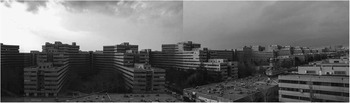
Such an architectural aesthetic formed a strong personal context for first author Mo H. Zareei’s later reception of the sound-based artworks discussed in this article. Born and raised in Ekbatan, a Brutalist residential building complex in west Tehran, built in the 1970s, Zareei developed a sense of attachment to the ‘anti-beauty’ aesthetics of the cold and austere blocks of concrete, stacked in perfectly aligned geometric arrays, that were the site of his upbringing (Figure 3).Footnote 4 Such deep-rooted topophilic affinity for the rigidly structured harshness only recently became apparent to Zareei, while investigating the intersecting aesthetic features that held strong appeal for him. Further investigation into Brutalism made the connection between these sound-based works and Brutalist architecture clear: reductionist, minimalist and functional qualities which provide form for the provocative ‘anti-beauty’ aesthetic wherein noise replaces the concrete and other physical materials of Brutalism, and its spatial grid is expanded to the temporal domain. Building upon these aesthetic links, and in order to realise the idea in an explicit manner, an ensemble of sound-sculptures was designed and developed by Zareei, with a mind to realising Brutalist principles in a series of sound-based works (Zareei Reference Zareei2015b).
Ekbatan residential complex, Tehran. Photo courtesy of Hoda Zareei.

4. The Brutalist Noise Ensemble
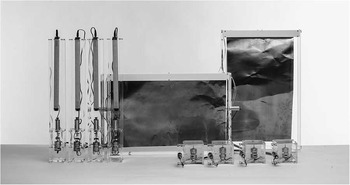
The Brutalist Noise Ensemble is an audiovisual project based on a series of sound-sculptures designed and developed by the first author in 2013–14, in an attempt to take ‘glitch music outside computers, and into a domain where glitch is created mechanically, physically, and visibly’ (Zareei Reference Zareei2015a). The ensemble comprises ten sound-sculptures grouped into three instrument types: Mutor (Zareei et al. Reference Zareei, Carnegie, McKinnon and Kapur2014b), Rippler (Zareei et al. Reference Zareei, Carnegie, McKinnon and Kapur2015) and Rasper (Zareei et al. Reference Zareei, Carnegie and Kapur2014a) (Figure 4). Rasper’s sound-generating mechanism is based on surface friction between a sharp piece of spring steel and a plastic disk rotated by a DC motor, while the contact between the two is made using a linear actuator. In Rippler, the actuation noise of the linear actuator is amplified and transduced using a thin sheet of steel, whereas in Mutor, the sonic output is the noise of a DC motor, modulated in terms of timbre and amplitude. Although each instrument uses a different sound-generating apparatus and has its own sonic and visual characteristics, they all share aesthetic aspects that pay conscious homage to Brutalism.
The Brutalist Noise Ensemble (2014) by Mo H. Zareei (left to right: Rasper×4, Rippler×2, Mutor×4). Photo © Mo H. Zareei.

All three instruments employ non-musical objects whose sonic aspects are conventionally perceived as ‘non-beautiful’: the buzzes, whirs, and clicks and clacks of electromechanical objects, the sounding of bits and pieces of metal. By presenting these objects in sculpture forms, the ensemble takes them through an aesthetic transformation, in which the ‘ugly’ sonic byproduct of everyday technological life is turned into a medium for artistic expression. This transformation is completed with the help of mechatronic techniques and microcontroller programming, which equips the instruments with the ability to create exactly controlled and repetitive patterns and motions. By expressing but regulating the sound of the instruments’ raw material in terms of rhythm and timbre, and structuring them through strictly metric rhythmic patterns, the aggregation of these sound-sculptures as an ensemble affords the composition of a temporal grid of noise constructed from various timbral units and rhythmic layers. In doing so, what is normally hidden inside the black box of a machine is brought back to the foreground in a fully visible and audible form, and expressed as found, i.e. undecorated and unmodified. Enclosed in entirely transparent structures, the materiality and corporeal being of all the components are clearly exhibited, exposing their usually covert (but always potential) aesthetic essence. Limited to right angles, cubes, squares and rectangles, the enclosures are designed for function alone, leaving no room for ornamental features in the sculptures’ reductionist, minimalist and strikingly bare appearance. This austere visual quality is further highlighted through bursts of fluorescent lights, which in negotiating a fine line between mesmerising and uncomfortable, intensify the sensory experience of the works in a bold audiovisual manner. Using identical mechatronic components across all three instrument-types (i.e. the same types of DC motors and linear actuators) creates further homogeneity when they are collected as an ensemble, in keeping with the rigour of the Brutalist ethos. In doing so, the work simultaneously undertakes a sonic transcoding of these principles that is expressed through the use of the intrinsic noise of its materials, and the clear and immediate comprehensibility of its sonic structure. A sonic equivalent of the visual memorability of Brutalist architecture, this audible structure is established through the use of a steady-state sonic palette and purely grid-based rhythms. Repetition is incorporated as a key formal element, which eliminates organic formal development from the work, while the utilisation of mechanical noise as the only sound material functions as a sonic equivalent to the ‘anti-beauty’ qualities of Brutalism.Footnote 5
5. Sound-Based Brutalism
Can we now take the proposed connection a step further and expand the realm of sound-based brutalism to the broader context in which The Brutalist Noise Ensemble has been situated, one that includes the various contemporary works discussed in this article? To make the claim that certain contemporary aesthetic trends in sonic arts are influenced by or directly correlated to a – primarily architectural – movement that started 60 years ago and was deemed to have failed within a few decades, is at first glance rather challenging. The original (New) Brutalism arrived in 1950s and is supposedly well past its prime. For a number of decades now, the movement has been regarded as failure by many, harshly criticised by critics and widely disdained by the public, to the extent that a substantial number of Brutalist buildings have been demolished over the past few decades (Berger Reference Berger2013; Hicks and Newmeyer Reference Hicks and Newmeyer2013; Villacorta and Marsollier Reference Villacorta and Marsollier2013). The rejection of Brutalist architecture has several roots, including its starkly alien visual presence with regard to its surroundings (Stark Reference Stark2013). But it is most importantly the ‘anti-beauty’ aesthetic of Brutalism that fails to appeal to the public (Reidel Reference Reidel2013), and which gives rise to derisive names for Brutalist buildings, such as ‘concrete monstrosity’ (Glancey Reference Glancey2014).
However, it should be made clear that it is not the intention of this article to argue for the direct translation of certain architectural principles as a set of criteria for creating sound-based artworks, as for example in Xenakis’s adaptation of architectural models in the composition of his early music (Sterken Reference Sterken2007). Nor is the goal of this discussion to declare the birth of an entirely new practice in sound-based arts. The goal here is to establish a frame of reference, built upon a shared set of aesthetic features that are most cogently expressed in an architectural form – Brutalism – and which can be used to draw together and draw attention to a set of sound-based artworks across genres and media. Having encountered incoherent neologisms such as ‘Raster-Noton-y’ or ‘Zimoun-ish’ in a colleague’s or an audience member’s reference to works with similar aesthetic qualities, the authors argue that this particular sense of aesthetics has become a broad aesthetic movement which, once defined as such, becomes more amenable to further investigation, definition and clarification. With this in mind, and based on the arguments made above, the authors suggest the term brutalist as an appropriate focal term. In doing so, and to re-iterate, this is not an argument for this set of sound-based works having direct connections to Brutalist architecture. Rather, we suggest ‘brutalism’ as an apt descriptor for their shared aesthetic principles, as well as providing an historical point of reference which is decoupled from the normative, and historically more removed, association of noise-based practices with Futurism. In this way, Brutalism’s revival can be extended to the realm of sound, as an extreme manifestation of modernist aesthetics expressed in the works discussed here: uncompromising in their use of the brut of post-digital noise, modern technological objects and artefacts, and the presentation of these through stripped-back forms and grid-based structures.
In an effort to ‘delineate one genre that highlights a conceptualisation of sonic matter’, Sonya Hofer points to the insistence on materiality through the ‘conception of sound as particles’ in microsound (Hofer Reference Hofer2014). More broadly, Hegarty describes noise music as ‘an attempt to reassert the material over the musical’ (Hegarty Reference Hegarty2008: 18). With these points in mind, sound-based brutalism encompasses sound-based works which focus on the materiality of their ‘anti-beautiful’ materials in sonic – and often also visual – forms, through a highly ordered, organised and often quantised mode of expression. Indeed, it could be argued that sound-based brutalism embraces Pierre Schaeffer’s objet sonore through its focus on basic sound-objects, but rejects his concept of reduced listening through emphasis on the material thingness of the object itself.Footnote 6 If the Brutalism of Banham tried to ‘confound [Cubism and Futurism] and belong to both at once’ (Banham Reference Banham2011/1955: 19), sound-based brutalism feeds on the noise of the Futurism and the reductionist rigour of minimalism – a child of Cubism – at the same time, taking its raw material from the former and sculpting it through the latter.
Beyond this, and as stated in a recent BBC documentary on Brutalism, ‘half a century after its heyday, a wholesale rehabilitation of Brutalism is on the way’ (Meades Reference Meades2014). In the concluding section of his thorough examination of British Brutalism, Alexander Clement claims that ‘in spite of the debates about the aesthetic qualities of many period Brutalist buildings, the style has been revived in more recent years’ (Clement Reference Clement2011: 156), and according to Michael J. Lewis, ‘it seems safe to say that there is no topic in architecture at present that is of greater interest and curiosity than Brutalism’ (Lewis Reference Lewis2014).Footnote 7 Indeed, the BBC documentary on Brutalism concludes with the announcement that ‘we are witnessing the emergence of Neo-Brutalist architecture’, and introduces a number of visual artists who are integrating Brutalism into their work (Meade 2014). As has been argued here, the shared aesthetic features of the work of a broad range of artists and musicians, warrants the inclusion of sound-based practices in this neo-brutalism.