

The French intervention in Mexico from 1862 to 1867 has spawned a large literature, but curiously little of it considers the expedition's consequences for France or Europe. Though historians have situated the wars of German unification in a global context,Footnote 1 the Mexican expedition barely features in standard accounts of the origins of the Franco-Prussian War.Footnote 2 Moreover, while historians have long noted the unpopularity of the Mexican expedition,Footnote 3 they have generally underplayed its importance in explaining the political and constitutional reform of the French Second Empire in the late 1860s.Footnote 4 Instead of considering the ramifications for French domestic politics, historians of the expedition have been principally concerned to explain how the French came to expend so much blood and treasure in a region in which they had prima facie so few strategic or economic interests. Thus, much of the scholarship addresses questions of diplomatic, intellectual, and cultural history, reconstructing Franco-Mexican relations from the 1820s onwards, explaining Napoleon III's objectives in Mexico and analysing the regime that the French created there.Footnote 5 While some of this work discusses the expedition's consequences for France – particularly regarding its relationship with contemporaneous French imperialism in Algeria, Indochina, and elsewhere – the impact in Europe has been comparatively neglected.Footnote 6 Indeed, the conquest of Algeria aside, historians have largely overlooked the effects of French extra-European policy on France, reflecting a broader disregard for French imperial history from 1814 to 1870.Footnote 7
As we shall see, however, the Mexican expedition had a severe impact on French politics, stimulating the liberalization of the Second Empire in the 1860s and reducing the regime's capacity to cope with a deteriorating international situation in Europe. These consequences are apparent in the finances of the Mexican expedition, which have received relatively little attention despite historians’ focus on explaining why the French expended such resources in Mexico in the first place. While scholars have given some attention to the economic motivations for the Mexican expedition and its financial history,Footnote 8 they have largely overlooked the question of how the costs of the intervention affected the French public – a crucial issue, since the latter's willingness to bear the burdens of the fiscal-military system, that is the taxes and conscription which underwrote French great power, directly affected France's ability to face the Prussian threat. As Edward Shawcross has observed, the limited popularity of the Mexican expedition pushed the French government to seek to minimize the costs by installing the Archduke Maximilian, brother of the Austrian Emperor Franz Josef, as emperor of Mexico in 1864. Upon accepting the throne, Maximilian agreed the Miramar Convention with France, stipulating that his government would reimburse the French 270 million francs for the costs of the expedition hitherto and would finance the presence of French troops in Mexico thereafter. Shawcross argues that the use of Maximilian's regime as a vehicle for informal empire contributed to the expedition's failure; had the French sought to occupy Mexico the way they had Algeria after 1830, he suggests, the intervention's chances of success might have increased. However, the enormous expense of conquering Algeria made the latter unattractive as a model for French imperialism elsewhere.Footnote 9 Indeed, the costs of the expedition were the reason that the French gave Maximilian's government for their withdrawal.Footnote 10 Moreover, even if the French had been willing to bear the costs of direct rule in Mexico, they would still have had to contend with the hostility of the United States. Not only did the Americans, particularly after the end of their Civil War in 1865, contribute materially to the republican guerrilla war against Maximilian's Empire, but pressure from Washington pushed the French to accelerate their withdrawal in 1867.Footnote 11
Though aggravated by republican guerrillas and the French desire to intervene in Mexico on the cheap, the financial problem was incipient from the outset. While the expedition was partly motivated by the desire to nurture the strength of the ‘Latin’ race and so check the power of the ‘Anglo-Saxon’ United States, to secure better access to Mexican resources such as silver and cotton, and to extend French commerce, the pretext for the expedition in 1862 was Mexico's default on foreign debt. Mexico, thus, faced severe fiscal difficulties before the French arrived. In the final years of Spanish rule, the colony slipped into deficit as Madrid sought to offload mounting budgetary problems at home onto the colonies, initiating a period of fiscal instability that lasted into independence.Footnote 12 Protracted political volatility thereafter, not least disagreements over federalism and centralization, hindered the construction of a stable and effective fiscal system.Footnote 13 Most recently, a civil war of 1857–60 – the Reform War – that followed the promulgation of a liberal constitution in 1857 had interrupted tax collection, stimulating banditry and resistance to taxation. The French intervention did little to alleviate Mexico's socio-economic problems. On the contrary, banditry and unrest increased, encouraged by opponents of the French intervention who fought a guerrilla war, aggravating problems of taxation and adding to the costs of the expedition by increasing France's military difficulties. Benito Juárez, the Mexican president before the intervention, did everything he could to make life as hard as possible for the French, maintaining a diverse coalition of radicals, moderates and liberals while cultivating support in Washington.
Concerns about the expense of the Mexican expedition reflected the French public's general wariness of Napoleon's aggressive foreign policy, which entailed military interventions in the Crimea, Italy, Syria, China, and Indochina in addition to Mexico – all of which cost money and men.Footnote 14 Throughout the Second Empire, the government's seeming willingness to spend money provoked criticism of fiscal irresponsibility.Footnote 15 To appease the critics, Napoleon appointed Achille Fould as finance minister in 1861 to pursue fiscal equilibrium. Given the series of military actions abroad, Fould raised taxes. Naturally, the ensuing fiscal burden was unpopular. Despite increasing taxes, though, Fould ultimately aimed to reduce them and streamline the state, thus enhancing the legitimacy of the fiscal system. Indeed, the desire to cut taxes was one reason for the conclusion of the Franco-British commercial treaty in 1860. While the 1850s had been boom years, the 1860s were more turbulent economically, given the disruption arising from poor harvests, cholera, wars, and financial crises. Spending on public works such as railways, slashed after 1848 to accommodate pressure for retrenchment, rose alongside military expenditure as the government sought to counteract economic malaise. While public works had been largely delegated to the private sector in the 1850s, investor confidence was more volatile in the 1860s, necessitating greater government action.Footnote 16 The expense both of the latter and of an aggressive foreign policy impeded the tax cuts that might have bolstered the legitimacy of the regime.
Napoleon's foreign policy had further domestic political costs. His sponsoring Italian unification, and thus the absorption of the Papal State into Italy in 1860, eroded Catholic support for the Empire, while the regime also lost support in industrial areas that suffered from the lowering of tariffs that followed the Franco-British commercial treaty of 1860. Still, the government's position was sufficiently solid that the initial moves towards political liberalization, intended to recalibrate support for the Empire, in November 1860 were not forced on Napoleon but rather reflected his choice.Footnote 17 Likewise, the regime proved willing to countenance greater decentralization in the 1860s, stimulating greater vibrancy in local politics and ultimately the emergence of the ‘republican’ notion of citizenship that characterized the Third Republic.Footnote 18 However, with opposition progress in the elections of 1863 and 1869 and growing popular discontent in the late 1860s, the government was pushed to further concessions, hastening the liberalization of the Empire. As we shall see, the legacy of the Mexican debacle contributed to these problems, weakening the regime and reducing France's chance of victory over Prussia in 1870.
I
Soon after the French arrived in Mexico, it became clear that the expedition would not be quick, easy, or cheap. ‘I do not know how we will get out’, Fould wrote in September 1862, ‘and what advantage we can get from it [the expedition]. The news which reaches me from Mexico makes me tremble for the finances.’Footnote 19 Considering Mexico as a potentially wealthy country, the French did not anticipate the expense of the expedition. Instead, Napoleon expected it, and the settlement of Mexican finances, to be quick and easy: ‘one of the first questions will be the re-establishment of order in the finances, because that will permit us, without overburdening the country, to pay ourselves our indemnities’. To his knowledge, the Mexican government's ordinary revenues would suffice for this purpose.Footnote 20 In other words, the French were drawn into Mexico partly by casual racial and cultural assumptions that they could tap the country's wealth more effectively than the Mexicans themselves. Such assumptions of superiority probably contributed to the French reluctance to leave Mexico once these rosy expectations were disappointed. The notion of Mexican inferiority both increased the reluctance to concede defeat and made victory appear more achievable.
The French faced numerous difficulties when they landed, most of which had financial ramifications. Shortly after arriving in Veracruz, the French commander Charles de Lorencez noted the ‘excessive price of everything in Mexico’;Footnote 21 the French, wrote a finance ministry official the following year, had to make their purchases in piastres ‘at an excessive rate’.Footnote 22 While Mexico had land of ‘extraordinary fertility’ alongside extensive mineral wealth, the French could not just exploit this at will. Indeed, despite Mexico's reputed wealth in gold and silver, the French faced shortages of specie, and thus prohibited its export while having to import it to allow the army to purchase supplies.Footnote 23 Such difficulties, exacerbated by Juárez's partisans, arose from social turbulence and the limited capacity of the Mexican state, and therefore may have increased the French sense of superiority over the Mexicans. As Lorencez wrote, ‘We have such a superiority over the Mexicans of race, of organization, of discipline, of morality and of elevation of sentiments that I pray your Excellency to please inform the Emperor that from now, at the head of these 6,000 soldiers, I am the master of Mexico.’Footnote 24 Despite his defeat at Puebla by a smaller force a few days later, which retarded the French advance and boosted the morale of Juárez's forces, the French generally continued to consider the Mexicans inferior. Indeed, considering his Mexican auxiliaries, Lorencez wrote that they ‘avail us almost nothing, ravage the country and increase our unpopularity’.Footnote 25 Given the perceived inadequacies of France's Mexican allies – which had some justification – and the defeat at Puebla, the French sent reinforcements under the command of General Forey, adding to the cost of the expedition. Already, Lorencez had logistical difficulties with his 6,000 men; the proposed increase to 25,000 would obviously exacerbate these problems. Ultimately, the French army in Mexico grew to 30,000 men.
The reinforcement of the army after Puebla reflected the new reality of the Mexican expedition. Rather than the relatively rapid operation the French may have had in mind at the outset, they had to reconcile themselves with the possibility of a protracted intervention. In June 1862, Lorencez wrote that ‘After several years of monarchy this country would obtain an amazing degree of prosperity. But nobody here wants monarchy, not even the reactionaries. The Mexicans are all infatuated with liberal ideas.’Footnote 26 A month later, he reiterated that he ‘had not seen a single partisan of monarchy in Mexico’, but hoped that a French occupation of ‘several years’ would rectify this deficiency.Footnote 27 As his remarks about Mexico's potential prosperity indicated, the intervention would have to be accompanied by a process of state-formation, which would serve as an instrument for informal empire in Mexico and allow the French to extract the means required to reimburse themselves the cost of the expedition. Thus, in November 1862, Fould sent a former receiver general, Budin, ‘to constitute in Mexico, as soon as possible, a good financial administration’.Footnote 28 In 1863, he was reinforced by twelve agents drawn from the different branches of the finance ministry to assist him in imposing order and regularity on Mexico's finances.Footnote 29 Simultaneously with Budin's appointment, Fould opened negotiations with bankers to reduce the costs of procuring credit in Mexico to cover the army's needs.Footnote 30
While Budin's mission extended to raising money from any taxes available, the French directed most of their attention towards customs. In part, they did so because customs revenues were hypothecated to cover the payments Mexico owed the French, British, and Spanish. Other taxes were problematic, given the difficulties the French had in imposing authority across Mexico, particularly on rural areas. While Maximilian's regime raised direct taxes, these seem to have yielded little; in 1866, General Bazaine, who replaced Forey as commander of the expedition in 1863, noted that landed estates did not produce enough to pay the taxes imposed on them.Footnote 31 Controlling major ports, customs were a relatively easy tax for the French exploit, even if the violence that accompanied their expedition impeded the commerce that underlay customs revenues. Consequently, customs were the main source of tax revenue during the intervention.
While the French installed agents to oversee the collection of customs duties, revenue remained inadequate.Footnote 32 Throughout the intervention, customs provoked complaints from taxpayers over the uneven collection of the duties and their seeming arbitrariness.Footnote 33 Pending the creation of a more productive tax system, Forey decided to emit for the new Mexican government treasury bills of up to 200,000 piastres per month, guaranteed by France.Footnote 34 While the Miramar Convention specified that the Mexican army would cease to be financed by the French on 1 July 1864, this proved impossible to implement, given the Mexican government's lack of means. Thus, Bazaine stipulated that the costs of the Mexican army would continue to be paid by the French, who were ultimately to be reimbursed.Footnote 35 ‘The financial situation will improve, I hope’, he wrote shortly afterwards, ‘but it progresses slowly up to now. It is necessary, above all, to create an administration and to find some politicians. It is necessary to create resources and there exist no others besides the old taxes which are totally insufficient and barely established.’Footnote 36
The problems with taxation weakened Mexican government credit, which simultaneously assumed greater importance as a source of revenue. Indeed, as he contemplated accepting the Mexican crown, Maximilian sought to ensure a loan for his prospective government.Footnote 37 Upon taking the throne, he opened negotiations in Paris and London, creating the Commission des finances du Mexique in Paris under the count de Germiny, a former French finance minister and ex-governor of the Banque de France. French financiers, though, inclined to follow the lead of the City, which had hitherto provided most of Mexico's foreign credit. If the bondholders who had suffered from the default of 1861 were not compensated, wrote the Paris banker Salomon de Rothschild, the British market would be closed to the loan, rendering it unfeasible.Footnote 38 In any case, Maximilian hoped to minimize his dependence on the French. Thus, he concluded a contract with the London firm of Glyn Mills for 305 million francs. The loan, however, was poorly received by investors,Footnote 39 leaving the French with a considerable problem: if Mexico could not procure funds on the market, the French government would have to provide more money. Fould, wrote the Paris banker Hottinguer, regarded the loan ‘as a resource for his treasury’.Footnote 40 Of the nominal 534 million francs that Mexico borrowed in two loans in 1864 and 1865, only 34 million went to Maximilian's government.Footnote 41 The rest went to service existing foreign debts and to the French treasury. The costs of the expedition were still large enough to keep Fould's 1864 budget in deficit,Footnote 42 but French expenditure in Mexico was overall relatively small (Table 1). Excluding 31,713,000 francs that the navy ministry spent on foreign interventions without being able to disaggregate the costs for each mission, the Mexican expedition cost approximately 363,165,000 francs from 1861 to 1867 and produced revenues of around 61,975,000, comprising reimbursements from the Mexican government, the sale of Mexican bonds, and income from Mexican customs.Footnote 43 Even without these revenues, Mexico never cost more than 5 per cent of the French government's budget in any given year from 1861 to 1867. Though the expense of informal empire in Mexico was easily sustainable, it was still significant enough to impede tax cuts and thus impress public opinion with the costs of the expedition, as we shall see.
French government expenditure in Mexico, 1861–7
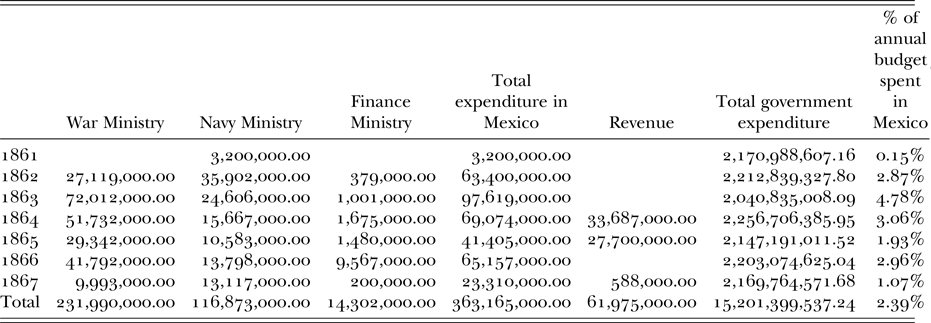
Sources: Moniteur universel, 25 June 1867; Projet de loi portant règlement définitif du budget de l'exercice [1861–1867] (Paris, 1863–72).
Given their desire to minimize expenditure in Mexico, the French acted to rescue the 1864 loan. Already in 1862, Fould had expressed his willingness to assist the Mexican government in obtaining credit.Footnote 44 While the British had been Mexico's principal overseas creditors before 1861, the tripling of Mexico's foreign debt during the intervention was largely financed by the French.Footnote 45 Faced with lacklustre results in London, the Commission des finances du Mexique replaced the conventional 6 per cent bonds issued by Glyn Mills with lottery bonds.Footnote 46 The use of the latter reflected a shift in the market for Mexican securities. Whereas Glyn Mills had moved to issue the loan in the usual fashion, relying on bankers and their lists of subscribers, lottery bonds were designed with a more demotic appeal: their offer, in this instance, of a biannual cash prize targeted French small investors instead of high financiers. ‘Prizes, premiums and all sorts of combinations of games’, wrote the Paris banker Alphonse de Rothschild, would ensure that the loan ‘would be taken by the country itself, which greatly likes games and lotteries’.Footnote 47 Another loan of 250 million francs in 1865 was issued by the same means, and Fould expressed his ‘delight’ that 70,000 people had invested.Footnote 48 Government officials publicly endorsed the loans, projecting an economic bonanza in Mexico and helping to raise the number of investors in Mexican bonds, ultimately, to 300,000.Footnote 49 Though the loans were raised successfully, they came with significant risk premiums: 14.43 per cent interest in 1864 and 15.6–16.49 per cent in 1865. While elite bankers still took a significant portion of these loans,Footnote 50 which they then sold, the recourse to French small investors presented a severe political difficulty when it came to withdrawing from Mexico a few months later. Fould's ‘delight’ was thus short-lived.
Besides rescuing the Mexican loan, Fould also sought to ease Mexican government credit and stimulate the Mexican economy through the creation of a Banco de México, modelled on the Banque de France. Whereas substantial parts of the loans could be raised from relatively low-information small investors, the bank would rely on high financiers, some of whom had agents or contacts in Mexico. Already in 1863, Fould was discussing proposals to this end with several bankers. Pitching the idea to Hottinguer, who then enlisted other bankers in support, Fould suggested that the state-formation – chiefly the creation of a functioning fiscal system and army – on which the French had embarked in Mexico would prevent their withdrawal for at least three years. Thus, Hottinguer, despite his unwillingness to partake in issuing Mexican bonds,Footnote 51 concluded that ‘in these conditions it seems to me that this proposal of a bank can be usefully pursued’;Footnote 52 ‘if France maintains its administration in that country [Mexico], the privilege that we obtain can only be an excellent affair’.Footnote 53 Hottinguer had few illusions about the situation in Mexico. It was a ‘shattered country’, whose ‘credit is to be completely reconstructed’.Footnote 54 While Maximilian stalled approving the bank's statutes, perhaps hoping for a counteroffer, these and an advance of 10 million francs were finally agreed in February 1865 with distinguished members of the Paris haute banque, including Hottinguer, Pillet Will, Mallet, Fould (the firm of Achille Fould's family), Seillière, and Marcuard André alongside the City firm Finlay Hodgson.Footnote 55 Hottinguer's colleagues, though, were generally warier of the proposal than he was. Considering it an ‘extravagant idea’, Marcuard, for example, only acquiesced because ‘I do not want to separate myself from our friends…who probably have good reasons’ for endorsing the proposal.Footnote 56 Baring, Hottinguer's principal correspondent in London, declined to participate, on the basis that the bank could risk the firm's reputation – though he was confident that ‘you will make money by your shares…in the Paris hotbed of speculation’.Footnote 57 Such lukewarm sentiments contributed to the collapse of the syndicate in September, due to concerns about the mismanagement of Mexican finances. While the Comptoir d'escompte de Paris took over the contract, the project ultimately failed.Footnote 58
The abandonment of the Banco de México perhaps reflected a decline in French support for Maximilian's regime. Seeking to establish a basis for his rule that did not rest exclusively on the French army, the emperor sought to conciliate different factions in Mexican politics under an enlightened, moderate liberalism; at the same time, he used ceremony and urban renovations in Mexico City to try to impress his new subjects with the mystique of monarchy – at considerable expense.Footnote 59 The French were generally underwhelmed by these efforts. Within a few months of Maximilian's arrival, Bazaine was complaining that the ‘torpor which paralyses the members of the Mexican government could not be relieved by my efforts’, while his agents were finding it ‘impossible to complete their mission, lacking support from the Mexican authorities’.Footnote 60 Maximilian's government, he wrote, sought to ‘leave to us all the odious exceptional and rigorous measures’. In fiscal matters, meanwhile, Mexican officials showed a ‘passive resistance’ to supervision.Footnote 61 While tax revenues, particularly from customs, seem to have increased during the intervention, these remained far from adequate to cover the costs of the army.Footnote 62 The ensuing ‘penury’ of the Mexican treasury inhibited the government from functioning effectively, and denuded Maximilian of resources that he might use for the sake of developing his support among the Mexican population.Footnote 63 Encouraged by Juárez's agents, banditry remained rife, and French efforts to raise tax revenues by expediting Mexican economic development, for instance through railway construction, made slow progress. Were it to succeed, therefore, the process of state-formation would take longer than the French had anticipated – a prospect for which they had little enthusiasm.
With the continuing inadequacy of the Mexican tax system and the loans of 1864 and 1865 having been largely spent, the Mexican government's financial dependence on France increased. Despite the difficulties evinced since the beginning of the expedition, Fould maintained, with growing impatience, that Mexico was ‘rich and it must pay if it wants us to give it security’.Footnote 64 In April 1866, wearying of the expense and faced with growing hostility to the expedition from the French public, mounting pressure from the United States following the end of the Civil War and the consequently resurgent Mexican republicans, the French government announced its intention to evacuate Mexico between November 1866 and November 1867, which had ‘an adverse influence on Mexican resources in paralysing business and in estranging capital’.Footnote 65 Mexican credit, already frail, collapsed (Figure 1). In May, following persistent requests from Maximilian for advances, Bazaine conceded 500,000 piastres per month, to be secured against customs revenue.Footnote 66 The decision to withdraw, paradoxically, increased the cost of the expedition until the evacuation was actually realized. ‘The ever-growing embarrassments of the [Mexican] Treasury’, wrote Bazaine, ‘are a cause of malaise that paralyses everything.’Footnote 67 The French government, though, resolved to provide no further advances to Maximilian's government, despite the commitment of the ‘men on the spot’ to the intervention and their claims that fiscal equilibrium could be attained in Mexico.Footnote 68 Instead, a new agreement concluded in July gave the French half of all Mexican customs revenue.Footnote 69 By this point, though, all Mexico's debts, both those privately contracted and those owed to the French government, were secured against ‘the mirage of brilliant customs revenue’, as Fould sardonically put it. With no credit forthcoming from the non-existent Banco de México,Footnote 70 at the end of 1865 Maximilian had proposed to raise 500 million francs in London using customs as collateral. While Fould was more than happy for the Mexicans to raise money in London, he was wary of imposing another burden on customs revenue and doubted that investors would buy.Footnote 71 Financially, Maximilian's Mexico offered no hope of return – though as late as March 1867, for example, one French provincial newspaper perhaps somewhat disingenuously described Mexican bonds as ‘always in high demand’ on the Paris bourse (Figure 1).Footnote 72
Weekly closing prices of Mexican 6% bonds, as quoted in Paris, May 1864–August 1867

The French hoped to leave Maximilian with the means to survive, but even before their evacuation the outlook was bleak. ‘Property produces nothing’, wrote Bazaine; ‘the civil, political, financial, military and judicial administrations do not function’.Footnote 73 Unpaid, Mexican troops were deserting and defecting.Footnote 74 The French government's termination of the subsidies granted by Bazaine was, one officer wrote, ‘a death sentence’ for Maximilian's regime.Footnote 75 The latter's collapse, though, would imperil the repayment of the money the French had put into Mexico since 1861. For the French government, and certainly for Fould, preserving the investment of French nationals was a high priority, which became significantly more important as the loans of 1864 and 1865 drew more French capital into Mexico.Footnote 76 The problem was all the more acute, given the probability that Maximilian's regime would collapse following the French withdrawal. While Fould at least talked as though he expected a new government to honour Mexico's debts to France, his colleagues harboured no such delusions.Footnote 77 Thus, upon resuming power in 1867, the Republican government denied that it owed French creditors, exacerbating the problems of legitimacy that the Mexican expedition created for Napoleon III's regime.
II
The Mexican expedition may have ended in 1867, but it remained a fixture in criticism of the Bonapartist regime until the latter's collapse. The withdrawal coincided with an intensification of the difficulties confronting the Second Empire in the late 1860s. In part, these arose from the liberalization of the Empire that began in 1860. In 1864, the Le Chapelier law, which had prohibited workers’ unionization, was repealed in a forlorn bid to cultivate the urban working class.Footnote 78 The ensuing wave of strikes intensified towards the end of the decade as the economy proved sluggish,Footnote 79 following poor harvests, outbreaks of cholera, and financial crises, all of which fuelled what the opposition called ‘la grève du milliard’. Referring to the ‘milliard’ in the vaults of the Banque de France which permitted interest rates to fall, the opposition lambasted government policy as creating an atmosphere of uncertainty, unconducive to investment despite the surplus of capital and thus causing economic malaise.Footnote 80 Meanwhile, restrictions on the press were relaxed, providing the regime's critics with new fora in which to attack the government. The latter came under particularly heavy fire after the Prussian army's unexpectedly rapid victory over Austria in 1866 presented a challenge to French primacy in Europe, precipitating a foreign policy crisis. Though Napoleon had made a pre-war bargain with Bismarck to ensure the transfer of Venetia to Italy, France itself made no tangible gain, which left the impression of acquiescence in Prussian aggrandisement for nothing in return. Seeking compensation, the government attempted to orchestrate the acquisition of Belgium and Luxembourg, but without success.Footnote 81 These inept machinations to recoup prestige in Europe, wrote the duc de Persigny, a former minister and staunch Bonapartist, reinforced the impression that the government was ‘completely corrupt’; ‘today everybody believes the Empire is going to ruin’.Footnote 82 Withdrawal from Mexico, in effect defeat, was a further blow. All these setbacks aggravated the problems confronting the French fiscal-military system.
Given continuing pressure for retrenchment, the weight of expenditure in Mexico, which showed no sign of yielding imminent success, became increasingly difficult to justify. In 1866, Fould noted the ‘strong reluctance of the [legislative] chamber with respect to the Mexican expedition’.Footnote 83 Persuading deputies to vote money for Mexico was becoming harder. Already in 1862, the prefect of the Meurthe had noted the ‘unanimous approbation’ that greeted a reduction in the size of the army and thus of military spending, given the peace in Europe and the unpopularity of recent tax increases, particularly on salt.Footnote 84 In 1864–5, before the withdrawal, Fould forced further cuts to the army budget. According to the prefect of the Aube, these were ‘received by public opinion in the most favourable manner’, and there was a general desire for the cuts to have been greater.Footnote 85 Under pressure to minimize expenditure in Mexico, Bazaine wrote that he had ‘ceaselessly made every effort to arrive at notable economies’.Footnote 86 As Marshal Randon, the war minister, rather caustically recalled, ‘Everybody wanted reductions in the army, a lowering of the expenditure of the war ministry, at the same time as they were pretending that the Mexican expedition was ruining our arsenals and was exhausting our army.’Footnote 87 The Mexican expedition may not have exhausted the army, but it certainly produced war-weariness. ‘France's task is complete: the enemy we had to fight is defeated’, wrote one observer in La Presse in 1866. ‘The task of Mexico is to be continued and achieved; but, we repeat, it is a Mexican interest that does not bind in any way the policy or action of France.’Footnote 88 While military leaders such as Forey wished to remain in Mexico, adamant, as they had been for years, that final victory was imminent,Footnote 89 they were in a clear minority by 1866. Procureurs généraux, charged with evaluating public opinion in the regions over which they exercised jurisdiction, emphasized the widespread satisfaction at the withdrawal from Mexico.Footnote 90
The Mexican expedition was generally unpopular, but public opinion was multifaceted. The satisfaction at the end of the expedition, wrote the procureur in Dijon,
is mixed with a feeling of humiliation. It is felt that our efforts in this faraway country have failed; it is supposed that American pressure, as much as the difficulties inherent in the enterprise, determined our retreat & national pride suffers from both of these thoughts. One calculates that the sacrifice in men & in money that we have uselessly made & all the investors in Mexican loans who, for the most part, belong to the class of small capitalists that the promise of high interest [rates] calls more than others towards hazardous placements, reproach the Government for having pushed them towards this disastrous speculation. All these sentiments, inspired by the national or private interests, are sourly displayed.Footnote 91
The Mexican expedition, in other words, offered plenty of causes for grievance among the French public, particularly with respect to the fiscal-military system on which French great power depended. Discontent at the waste of blood and treasure was blamed on the government, weakening the legitimacy of the regime. Investors in Mexican bonds, generally described by procureurs as ‘middle class’, worried that their investments would be lost in the withdrawal. While few of these bondholders seem to have expressed a desire for the French to remain in Mexico, they nevertheless hoped that the government would save them from their predicament. The appeal to small capital, encouraged by the government in 1864–5, came at a political price. Moreover, rescuing French bondholders – at least initially – depended heavily on the Mexican government, since the idea that the French government would guarantee Mexican bonds was politically difficult. While some supported the idea, the procureur in Caen, for example, noted that much of the wider public saw it as ‘excessive and unjust’.Footnote 92 Indeed, the concern for Mexican bondholders was not universal. As the procureur in the industrial town of Douai observed, ‘the working classes of the towns and the countryside remain completely indifferent’.Footnote 93
The government's problem was that the bondholders, though a minority, had prominent advocates in the press and the Corps législatif. ‘I am very worried about the question of the investors in the Mexican loan’, wrote Napoleon, because the regime's opponents ‘want to exploit their discontent.’Footnote 94 In July 1867, Pierre-Antoine Berryer, a legitimist deputy and frequent critic of the management of the public finances and of the Mexican expedition,Footnote 95 denounced the government for having allowed the bankers to swindle small investors, lambasting in particular the director of the Comptoir d'escompte, Alphonse Pinard, whose firm had played a leading role in issuing the Mexican loans.Footnote 96 As one of the self-described ‘fools’ who invested in Mexican bonds wrote, Pinard and his associates ‘know so well how to profit from our ignorance’.Footnote 97 The bankers responded by seeking to deflect criticism of themselves onto the regime. In November, Pinard chastised the government for having ‘proclaimed almost officially that the Mexican empire had exceptional resources and that French capitalists could entrust it with their money with complete confidence’.Footnote 98 Turbulence on the bourse in 1867 probably reinforced the willingness to castigate bankers over the Mexican loans and, like the latter, was easily linked to the government, further eroding investors’ confidence in the regime. In September 1867, a crisis at the Crédit mobilier, a joint-stock finance company established in 1852 with the government's support, reached its climax in a widely reported scandal. Run by the Pereire brothers, the Crédit mobilier and its management maintained close links with the regime. Indeed, the government had attempted to rescue the Pereires, most notably by allowing the Crédit mobilier to double its share capital in 1866.Footnote 99 ‘The misfortune of the Crédit mobilier coincides with failures abroad’, wrote the republican Jules Ferry; ‘and while affairs in Mexico and Germany provide a big lesson in foreign policy, the losses, scattered across all classes by this great financial deception, complete the economic education of the French people.’Footnote 100 In 1868, Ferry delivered another financial cause célèbre, this one less well founded, by denouncing the mismanagement of the municipal Parisian finances.Footnote 101 Despite these blows to the regime's reputation for economic competence, the financial turbulence had one positive outcome: it increased the attractiveness of government rentes as a safe haven, a sense reinforced by the difficulties of other foreign companies, particularly those associated with the Crédit mobilier.Footnote 102 As a result of these failures abroad, which Hottinguer described as ‘a cause of ruin for everyone’, ‘small investors buy rentes and French securities’.Footnote 103 Thus, when in August 1868 the government opened a public subscription for a loan of 429 million francs, issued partly to convert short-term securities used to finance the Mexican expedition, it received subscriptions worth 15,000 million francs from a total of 781,292 people.Footnote 104 While the procureur in Besançon noted the ‘immense enthusiasm’ for the loan, he also observed that ‘ceaselessly repeated rumours of war disturb and alarm people, who retain their capital and break off negotiations. Business hesitates and deals only in the short term.’Footnote 105 The loan was one of the few good, long-term investments available. At the same time, the ‘rumours of war’ kept attention on the government's foreign policy – with its less than glorious record.
In line with the democratization of French politics during the Second Empire, the number of investors in the 1868 loan reflected a transformation of the French financial system, which risked being undermined by the financial travails of the late 1860s, not least those arising from Mexico. The investing public had grown substantially in the 1850s, which was demonstrated most dramatically in the borrowing of 1,580 million francs by public subscription to finance the Crimean War, as the government had promoted ‘the universal suffrage of capital’, aspiring to create the property-owning democracy of the nineteenth century. The liberalization of the Empire in the 1860s was part of this project, intended as it was to broaden the regime's appeal, in part to the ‘middle class’ – precisely those people whose savings vanished in Mexican bonds. These investors, noted the prefect of the Loiret, had ‘confidence in the wisdom of the Emperor's government and count on the support of the deputies of the Loiret to defend their interests in the event that they could be threatened’.Footnote 106 The failure to protect investors in Mexican bonds probably stimulated dissatisfaction with the regime among the ‘middle class’, forcing the continued liberalization of the Empire, both to restore the government's standing among such people where possible and to cultivate greater support among the lower classes. The latter, more indifferent to the issue of Mexican bonds, could buttress the regime in the face of middle-class discontent. To an extent, therefore, the politics of the ‘Liberal Empire’ mirrored those of Disraeli's One-Nation Conservatism in Britain: appealing to the lower classes to facilitate democratization on conservative terms. In Britain, this appeal relied on social and electoral reforms, while in France it depended on public works and social reforms such as the permission to unionize and, in both countries, it entailed invocations of jingoistic nationalism, even if the Bonapartist appeal to nationalism was complicated by the regime's foreign policy failures.
The furore over the Mexican bonds coincided with a debate over military reform. Indeed, historians have overlooked the Mexican expedition's consequences for army reform in 1867, focusing instead on the impact of Prussia's victory over Austria. Certainly, though Napoleon had favoured military reform in the aftermath of the Wars of Italian Unification of 1859–60, the outcome of the Austro-Prussian War created a renewed urgency. Since 1818, the French army had relied on long-term conscription – seven years’ service in 1866 – for which men were chosen by lot, in contrast to the Prussian system of shorter, more universal service after which soldiers passed into the reserve. In 1866, seeking the benefits of a larger reserve, Napoleon backed proposals for shorter, universal military service. The opposition was widespread. Randon, favouring an army of professional soldiers, resigned; Niel, his successor, was better disposed towards Napoleon's ideas, though he too had reservations. Thus, before a reform bill was even drafted, Napoleon was pushed to dilute his initial design. In December, the government proposed that men would spend six years each in the army and the reserve, after which they would become part of a new garde mobile. In unveiling the proposal, the government showed its sensitivity to discontent with the fiscal-military system, promising that reform would not ‘encumber the finances of the state, nor impose too heavy a burden on the population’; the state did not want ‘to divert in peacetime the vocations of young men aspiring to the liberal professions’.Footnote 107 Despite such reassurances, officials noted the resounding unpopularity of the proposal, which was so badly castigated in the Corps législatif that the government was forced to dilute it further before it eventually passed in January 1868.Footnote 108
The disaster in Mexico goes some way towards explaining the opposition to the government's proposal. True, most arguments against the bill did not revolve around Mexico. Liberals criticized an expansion of the army as facilitating a more oppressive state, conservatives feared the consequences of arming the masses, while republicans supported more universal conscription than the government proposed. The possible consequences of drawing labour away from agriculture and industry were a further concern, particularly given the regime's receding reputation for economic competence.Footnote 109 However, the army law debate also offered a means of airing more general grievances against the regime, not least because the issue of conscription affected both domestic and foreign policy. Thus, days before the law passed, a candidate for a by-election decried the ‘system of official candidates’ – that is deputies nominated for election by the government – which had ‘directed us into Mexico; it is the same system that, tomorrow, in full peacetime, will give us a military law the application of which agricultural and industrial France cannot long sustain’.Footnote 110 As the criticism of official candidatures indicates, the Mexican expedition was invoked during the army law debate to support further liberalization of the Empire. Already in 1866 as the debacle in Mexico became apparent, opposition politicians such as Adolphe Thiers, a former minister and among the most distinguished of the opposition deputies in the Corps législatif, had used the opportunity to demand a more consultative political process. The existing political system, Thiers and others argued, had allowed the expedition despite the French public's indifference. As a result, France, committed in Mexico, had lacked the means for action in Europe in 1866.Footnote 111 While the regime made some minor concessions to such pressures, allowing the Corps législatif to question ministers from January 1867, agitation for liberalization remained unabated and was exacerbated by the debate over the army law.Footnote 112 In sapping the regime's prestige, the failures in Mexico and in Europe in 1866–7 did nothing to endow the government with the kind of political capital necessary to impose greater sacrifices on the French population for the sake of foreign policy.
The pressure for political liberalization compounded the war-weariness arising from the Mexican expedition, none of which made larger-scale conscription, generally unpopular at the best of times, more palatable. The expedition had made lightening the fiscal-military burden more difficult earlier in the decade, when France faced little geopolitical threat, and made raising the burden correspondingly harder later in the decade, when such a threat materialized. Indeed, some ministers feared the electoral consequences of extending conscription.Footnote 113 While the Mexican expedition and other military actions abroad fed an existing republican pacifism,Footnote 114 anti-war sentiment pervaded large sections of society. The procureur in Chambéry, for example, noted in 1868 that given the ‘angry memories’ left by the military interventions in Italy and Mexico, a war at the emperor's behest, without popular support, would endanger the dynasty; thus, the liberalization of the Empire was essential.Footnote 115 Not only could liberalization reduce the regime's aggressiveness abroad, but the Mexican legacy emphasized the potentially unwelcome geopolitical implications of the army law. Thus, the liberal deputy Maurice Richard argued that extending conscription risked encouraging the aggressive foreign policy evinced in Mexico.Footnote 116 Similarly, the republican Jules Favre claimed that the Mexican expedition had aroused other powers’ fears of French aggression, which an expansion of the army would only reinforce; consequently, the law would diminish France's influence abroad.Footnote 117 Such invocations of the Mexican debacle during the debates on the army law exacerbated the problems of legitimacy facing the regime and the fiscal-military system.
The legitimacy crisis and the legacy of the Mexican expedition were clearly reflected in the legislative elections of May 1869. Indeed, during the final months of the Empire, suggests Roger Price, ‘a substantial amount of support for violent revolution was building up’, though, as he observes, revolutionary socialism had very limited appeal outside major industrial centres.Footnote 118 Still, the 1869 elections showed notable gains for opposition liberals and republicans, the latter receiving a substantial increase in working-class support despite the regime's charm offensive, while the government retained a clear majority of seats.Footnote 119 In some rural areas such as the Morvan nivernais, the republicans were the chief beneficiaries of increased voter turnout, though the official candidate was still elected.Footnote 120 The army law provided a principal theme of the campaign,Footnote 121 with election literature reiterating the malaise of the fiscal-military system and invoking the Mexican expedition. The regime, Favre charged, ‘has spent our millions, it has sacrificed our children to enterprises which the country would have stopped had it been consulted freely’. Mexico, as the most recent, one of the longest-lasting, and most expensive albeit not the costliest in French lives, was foremost among these ‘enterprises’. Though French troops remained in Rome until 1870, the Italian wars ended in 1860, as did the intervention in China, while the expedition to Syria ended the following year; and whereas the French had a more protracted presence in Cochinchina, establishing a colony there in 1863, this required only a small fraction of the men and money lost in Mexico. Though Cochinchina consumed 60 million francs in 1860, an expense partly inflated by the intervention in China, costs there fell from 57 million in 1862 to 22 million in 1863, stabilizing at around 19–20 million annually thereafter. Even with a revenue of 1,630,000 francs from Cochinchina in 1863, its deficit was markedly smaller than Mexico's, which that year peaked at 97,619,000 francs (Table 1).Footnote 122 The regime, Favre continued,
has maintained, aggravated a system of compression which weighs on all minds. It has doubled the debt, increased its burdens, it has asked the Corps législatif for and obtained upon proclaiming it necessary an army of eight hundred thousand which removes for nine years our children from work, family and marriage.Footnote 123
Other candidates referenced Mexico more explicitly. Denouncing the growth of public expenditure, one wrote that ‘other powers have grown in Europe, while in Mexico a useless and unfortunate expedition cost precious blood of our valiant armies’.Footnote 124 With the passage of the army law, another told voters, ‘all your sons are soldiers’, which exacerbated the risks of the adventurous policy apparent in the ‘faraway expedition’ of Mexico.Footnote 125 ‘You were told one day: the Empire means peace’, wrote the republican Taxile Delord, citing Napoleon's famous speech of 1852, ‘and the Empire has been until now one long war. In the Crimea, in Italy, in China, in Mexico the blood of our children has been spilled.’Footnote 126
Meanwhile, the problem of the bondholders remained. Seeking to douse continuing public anger, in 1868 the government had offered a partial refund of Mexican bonds in the 1869 budget proposing to convert them into 3 million francs of 3 per cent rentes, worth around 68 million francs.Footnote 127 The government's proposal did little to satisfy the bondholders; Germiny did ‘not hesitate’ to denounce it as ‘incomplete, insufficient’.Footnote 128 Many bondholders sent letters and petitions to the Corps législatif, while the holders of over 6,000 bonds formed a committee to lobby the deputies.Footnote 129 Ministers consequently agreed to increase the compensation to 4 million francs of rentes, then worth just over 93 million francs, which were to be used alongside 5,675,068.20 francs deposited at the Caisse des dépôts et consignations. The latter, charged with managing a wide range of private assets for the French state, had taken custody of some of the money raised from the Mexican loans. Nevertheless, the holders of some 40,000 Mexican bonds still declined the refund, preferring not to compromise their claim on the Mexican government.Footnote 130 As the number of refusals suggests, many investors remained dissatisfied. Thus, during the election campaign, one journalist, for example, condemned the Corps législatif for having approved men and money for the expedition and for having acquiesced in the government's swindle of small investors in Mexican bonds.Footnote 131 The legacy of the Mexican expedition therefore provided ready fodder for the campaign against the government, with the fiscal-military system facing particularly intense criticism.
Despite the discontent, a plebiscite in May 1870 endorsed a new, more liberal constitution for the Empire, suggesting at least an acceptance of the regime. However, the dissatisfaction prompted by the Mexican expedition and expressed in the elections of 1869 had certainly not vanished. Noting the general desire for peace, the procureur in Riom wrote in April 1870 that a ‘war would stop the reforms that we [the people] cannot wait to see’, which included ‘tax cuts [and] economies’ in public spending.Footnote 132 Indeed, Bonapartism retained firm support in parts of rural France, benefiting from an association with lower taxation, while Republicanism remained tainted by the memory of tax increases imposed by the Second Republic in 1848.Footnote 133 Despite the Prussian threat, and Napoleon's reluctance, the army budget therefore faced further reductions in 1870.Footnote 134 Meanwhile, the unpopularity of military expenditure and the conscription it implied was an important factor in pushing the French to propose, unsuccessfully, Franco-Prussian disarmament in early 1870.Footnote 135 As with the debate over army reform, the regime's precariousness inhibited the preparations that might have better enabled France to counter the Prussian threat.
The remarkably rapid collapse of the regime partly reflected its continuing problems of legitimacy. With war against Prussia, wrote the finance minister shortly after the outbreak of hostilities in July 1870, ‘we risk the dynasty and at the same time the destinies of our country’.Footnote 136 Like Napoleon III's other wars, that of 1870 aroused limited popular enthusiasm.Footnote 137 While the outbreak of hostilities produced a patriotic élan, this quickly became antipathy following the defeats of early August, which effectively destroyed Napoleon's authority – in contrast to 1914 when the Germans reached the Marne without imperilling the Republic's legitimacy. The emperor, defeatist before the war began, remarked that ‘all [was] lost’. Returning hurriedly to Paris from Saint-Cloud, the Empress Eugénie pronounced the dynasty as finished.Footnote 138 Though she too was generally rather fatalistic, having in August 1866 described the state of affairs after the Prussian victory in the Austro-Prussian War as ‘the beginning of the end of the dynasty’,Footnote 139 other well-informed observers agreed: ‘even with a victory we [the French people] have accounts that are too big to settle’, wrote Alphonse de Rothschild; the dynasty was doomed as ‘irritation against the present government is pushed to its final limits’.Footnote 140 In Paris and elsewhere, demonstrations against the regime multiplied, encouraged by rumours of treason.Footnote 141 A former opposition deputy, and thus albeit a rather jaundiced observer, travelling between Tulle and Brides-les-Bains in mid-August noted the widespread unpopularity of the government, ‘a ministry of treason’ that was neglecting the defence of France and represented ‘the last expression of personal power’.Footnote 142 The Empire was defunct before Sedan. Public hostility, arising from socio-economic difficulties and political missteps such as the Mexican expedition, left the regime with limited stamina by 1870. Given this fragility, withdrawal towards Paris, which would have made sense militarily by mid-August, became politically impossible. Instead, needing a victory, Napoleon and the army were pushed into a disastrous march to Sedan, where he surrendered on 2 September. The paralysis of the army command that allowed strategy to be almost totally dictated by domestic politics also reflected more directly the toxic legacy of Mexico. In his attempt to deflect responsibility for the Mexican debacle, Napoleon had used the press to insinuate that Bazaine had mishandled the expedition. The consequently tense relations between Napoleon and one of his most distinguished commanders, already problematic at the start of the war, became more so when he was forced to give Bazaine command of the main French army after the reversals of early August.Footnote 143 While the French command structure during the war was in any case inadequate, here, as in other respects, the outcome of the Mexican expedition contributed to the defeat at Sedan and thus to the eclipse of French primacy in Europe.
III
The Mexican expedition contributed significantly to the erosion of the Bonapartist regime in the late 1860s. The cost of the intervention, though sustainable, inhibited Fould's hopes of streamlining the state to strengthen the regime and perpetuated an image of the government as wasteful of public funds. The maintenance of high taxes and the limits to reductions in military spending in the early 1860s weakened the Empire's legitimacy, sapping political capital which might have been used more effectively in resisting the rise of Prussia. The protracted intervention in Mexico enhanced the regime's alleged partiality to armed conflict, which was unpopular among the French public and did nothing to strengthen the case for more extensive conscription in 1867. Moreover, in seeking to alleviate the burden of Mexico on the French treasury, the government created a further problem of dissatisfied bondholders after 1867. Like the regime's reputation for war, the issue of the bondholders presented a challenge to its legitimacy.
The crisis of executive power that the Mexican expedition helped to provoke lasted until the late 1870s. In this respect, 1870–1 was less of a caesura in French history than historians have suggested. By the time the crisis ended in the late 1870s, monarchy was rapidly losing credibility in French politics, and with it went support for a strong one-man executive. While Thiers, president of the Republic from 1871 until his removal by the National Assembly in 1873, exercised considerable executive power, the presidency diminished thereafter. In 1877, his successor, the royalist Patrice MacMahon, replaced his republican président du conseil Jules Simon, precipitating a constitutional crisis as the republican majority in the Assembly immediately passed a motion of no confidence in the new government. In the ensuing elections, the republicans retained their majority, effectively marking the triumph of the legislature over the executive. The weakening of the executive, though, reflected the legacy of the Liberal Empire; indeed, as historians such as Philip Nord and Sudhir Hazareesingh have shown, the political culture of the Third Republic owed much to the Second Empire.Footnote 144 In the 1860s, as we have seen, the opposition lamented the lack of oversight of the executive, citing a long catalogue of the government's failures – not least that in Mexico. With the Third Republic, the plebiscite, touted by Émile Ollivier as the distinction between the Liberal Empire and a parliamentary regime,Footnote 145 was shelved, as was direct election to the presidency. Instead, the president of the Republic was chosen by the National Assembly, curbing the executive's capacity to claim to legitimacy independent of the legislature.
If the end of the Second Empire did not resolve the crisis of the executive, Sedan came closer to settling the problem of the fiscal-military system. The army was overhauled in the aftermath of defeat, and universal conscription was introduced. Meanwhile, despite the opposition rhetoric of streamlining the state in the 1860s, the Third Republic presided over the accelerated growth of government expenditure, not least through public works, as the state continued to expand.Footnote 146 The opposition critique of executive power in the 1860s entailed lambasting the government for disposing of the nation's blood and treasure without sufficient accountability to the people. Indeed, Fould, who opposed political liberalization in the 1860s, saw reductions in government expenditure as a means of reinforcing the more authoritarian Empire established in the 1850s by mitigating discontent with the fiscal system. Instead, the growth of public expenditure encouraged the liberalization of the Empire and, ultimately, the creation of a parliamentary regime. In this respect, the Mexican expedition, in impeding Fould's programme of retrenchment in the 1860s, played a role in forcing the liberalization of the regime – all the more so, since the ‘Liberal Empire’ of 1870 was largely a consequence of the legitimacy crisis that the failure in Mexico helped to create. Thus, the Mexican expedition not only reduced the Second Empire's capacity to respond to the rise of Prussia; it also expedited the creation of a parliamentary democracy in France.



