Introduction
Prevalence of aggressive and violent behaviour within acute psychiatric services is estimated at about 10% (Huf et al. Reference Huf, Alexander, Allen and Raveeendran2009). Conclusions from the literature suggest that diagnoses of schizophrenia and substance abuse (Angermeyer, Reference Angermeyer2000; Noble & Rodger, Reference Noble and Rodger1989), as well as a history of involuntary admission, are predictors of aggressive behaviour (Nijman et al. Reference Nijman, Merckelbach, Evers, Palmstierna and à Campo2002). Medications used within this context are required to have a rapid onset of effect, low frequency of administration and low levels of side effects (Allen et al. Reference Allen, Currier, Carpenter, Ross and Docherty2005).
The term ‘rapid tranquillisation’ (RT) is commonly used in modern psychiatry. However, it appears that this expression was first used by Polak & Laycob (Reference Polak and Laycob1971) to describe a method of treating acute schizophrenia through the administration of chlorpromazine at a dose of 50 mg to 200 mg orally every one or two hours so that the patient would be ‘tranquillised’ within six hours. Donlon & Tupin (Reference Donlon and Tupin1974) used the term ‘rapid digitalization’ instead of RT, advocating the administration of ‘high dosages of the more potent, less sedating antipsychotic drugs to schizophrenic patients to promote the patients’ rapid improvement’. ‘The concept of chemical restraint’ (Fann & Linton, Reference Fann and Linton1972) is another expression describing the mechanism by which antipsychotics can control excited and violent behaviour. Ellison et al. (Reference Ellison, Blum and Barsky1989) defined RT as ‘the use of psychotropic medication to control agitation, threatening or destructive psychotic behaviour’.
The National Institute for Health and Clinical Excellence (NICE) defined RT, or pharmacological management of aggression and violent behaviour, as ‘the use of medication to calm/lightly sedate the patient, reduce the risk to self and/or others and achieve an optimal reduction in agitation and aggression, thereby allowing a thorough psychiatric evaluation to take place allowing comprehension and response to spoken messages throughout the intervention’ (NICE, 2005).
NICE guidelines (2005), currently under review, emphasise that RT, physical intervention and seclusion should only be considered once de-escalation and other strategies have been unsuccessful. However, such interventions are preventative, and are not regarded as primary treatment techniques. It is important to consider clinical need, safety of the patient and others on the ward and, where possible, advance statements when determining the most appropriate intervention for a patient. The intervention selected must be both reasonable and proportionate to the risk posed by the patient.
Aim
The aim of this study was to identify the pharmacological management of acutely disturbed behaviour and to identify clinical and sociodemographic characteristics of persons who required RT.
Method and Objectives
This is a retrospective cohort examination. Data for the study were collected from patients’ medical records and the Trust’s incident reporting system.
The local PICU is a mixed gender 10-bed unit, which allocates beds flexibly by patient need rather than gender. It has a dedicated PICU Consultant Psychiatrist, Nursing Team, and attached Occupational Therapist, Clinical Psychologist and a Pharmacist, as well as having access to a Physical Health Care Practitioner. The physical layout is a central dining area and lounge with adjoining courtyard allowing 24-hour access to fresh air. Running parallel to these areas is a corridor with 10 en-suite bedrooms and a disabled access bathroom. Directly opposite is a purpose built seclusion room with 24 hour CCTV access.
Inclusion criteria for the study were based on the NICE (2005) definition of RT as ‘the administration of medication to calm or sedate an agitated, violent or aggressive patient as quickly and safely as possible’. The study included all patients admitted to the PICU in 2011. Following an initial screening of all patients admitted to the PICU within the given year, 74 were identified as having received RT. However, on further review of medical records it was identified that 24 patients received RT based on the NICE (2005) definition. The authors included only patients whose records clearly demonstrated evidence of actual aggressive and violent behaviour associated with medication administered to manage such behaviour. Patients receiving medication to treat an underlying condition or on a ‘when required’ or pro re nata (PRN) medication to prevent violence or aggression were excluded from the study.
After obtaining the required information, all data were calculated and analysed using MS Excel.
Results
On review of all patient records, 24 (24.7%) of the 97 patients admitted to PICU during 2011 had received RT as defined by NICE (2005). Overall, there was a total of 28 episodes of RT, with 20 patients receiving RT once and 4 patients (2 male and 2 female) receiving RT twice.
Patient demographics
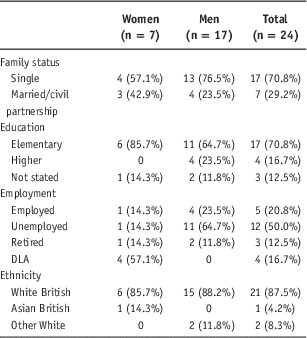
Twenty-four patients with an average age of 38.8 years were identified as meeting the criteria for inclusion in the study. This sample was comprised of seven females (mean age=40.1 years; age range: 20–65 years) and seventeen males (mean age=38.2; age range: 18–79 years).
Patient clinical characteristics
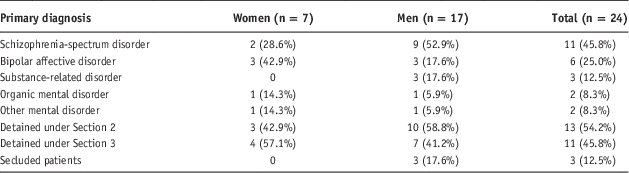
With regards to primary clinical diagnoses according to ICD-10 (World Health Organization, 1994), eleven patients (45.8%) had a diagnosis of schizophrenia-spectrum disorder; six (25.0%) a manic episode of bipolar affective disorder; three (12.5%) a substance-related mental health disorders, two (8.3%) had a diagnosis of Asperger’s syndrome and two (8.3%) had an organic mental disorder (see Table 1).
Patient clinical characteristics
Twenty-three (95.8%) of those identified were detained under the Mental Health Act (MHA) 1983.
In relation to factors precipitating the decision to utilise RT, verbal aggression and threatening behaviour accounted for 14 (58.3%) instances, physical aggression towards others for seven (29.3%); and risk of fire in one (4.2%). In two cases (8.3%), it was not possible to identify the factors precipitating the use of RT, due to the lack of rationale found in their records. However, their medical notes clearly demonstrated that they received RT as a result of disturbed behaviour. Moreover, they were reported in the incident reporting system and had all observations and care post RT, as per trust policy. One might presume that it was aggressive behaviour that had led to the RT; nevertheless, as it was not documented in their records, the authors felt that it was not appropriate to add such information.
Three (12.5%) of the 24 patients required an average of 5 hours and 45 minutes in seclusion. Duration of seclusion varied between patients, ranging from 90 minutes to 12 hours. All seclusion incidents occurred immediately following RT.
Pharmacological management
All patients received intramuscular medication as RT, within the British National Formulary maximum dosages. In terms of individual medications used for RT, 14 patients (58.3%) were medicated with a combination of haloperidol plus lorazepam; 9 individuals (37.5%) with zuclopenthixol acetate only; and one (4.2%) with a combination of zuclopenthixol acetate plus promethazine (see Table 2).
Medication used for RT

No second-generation antipsychotics, neither oral nor intramuscular, were used.
Gender differences
The majority of females (71.4%) were administered haloperidol plus lorazepam. However, in male patients zuclopenthixol acetate alone, or combined with other drugs (47.1%) was used nearly as frequently as the combination of haloperidol and lorazepam (52.9%) (Table 2).
Socio-demographic findings
In terms of socio-demographic findings, the majority of individuals were single males (54.2%) of White British origin (87.5%); and basic education (70.8%). Whilst 57.1% of females were on disability living allowance (DLA), no male patients were receiving DLA but 64.7% of them were unemployed (see Table 3).
Socio-demographic variables

Discussion
In line with previous studies (Brown et al. Reference Brown, Chhina and Dye2010; Kasmi, Reference Kasmi2007) the majority of patients were young males who were single, unemployed, detained under the MHA (1983) and of White British origin.
In contrast to findings reported by Kasmi (Reference Kasmi2007) and Feinstein & Holloway (Reference Feinstein and Holloway2002), people from ethnic minorities were not over-represented in the PICU sample with 4% being from an ethnic minority background. Brown et al. (Reference Brown, Chhina and Dye2010) also reported higher representation (23%) of people from Black and Ethnic Minority backgrounds in their review of seven PICUs across England. One study of 17 NHS PICUs in London (Pereira et al. Reference Pereira, Sarsam, Bhui and Paton2005) reported that 50% of patients were from a Black background. However, the proportion of people from such backgrounds in Middlesbrough and the North East is lower than in the London area. According to the Office for National Statistics (2011) the current population of people from the Black and Ethnic Minority communities in Middlesbrough is estimated to be 11.7% compared to the regional average of 8.2% in the North East; London had above average proportions for most minority ethnic groups including African (7.0 %), Indian (6.6 %), and Caribbean (4.2 %). This may explain the lower representation of patients from Black and Ethnic Minority backgrounds in the patient sample.
The major diagnostic groups found in this study were schizophrenia spectrum disorders (46%), and bipolar affective disorder (25%). This is consistent with other UK studies (Brown et al. Reference Brown, Chhina and Dye2010; Brown & Bass Reference Brown and Bass2004), showing a remarkable regularity, with the principal group being schizophrenia (50% of patients) followed by mania (20% of patients)
In agreement with previous studies (Nijman et al. Reference Nijman, Allertz, Merckelbach, à Campo and Ravelli1997), we found that aggressive behaviour is a regular occurrence on PICUs. Verbal aggression occurred in 58.3% of patients, who consequently received RT. This is consistent with previous studies, showing that verbal aggression is common, although not indicative of physical aggression (Foley et al. Reference Foley, Kelly, Clarke, McTique, Gervin, Kamali, Larkin, O'Callaghan and Browne2005). Contrary to previous studies (El-Badri & Mellsop, Reference El-Badri and Mellsop2006) a relatively low proportion (12.5%) of patients in this study required seclusion. Furthermore, physical aggression appeared to occur less frequently in the present study (29% of instances) than in other studies (45% reported by Cohen et al. Reference Cohen, Akhtar, Siddiqui, Shelley, Larkin, Kinsella and O’Callaghan2008, and 60% in El-Badri & Mellsop, Reference El-Badri and Mellsop2006).
In terms of medications used for the RT, fourteen patients (58.3%) were medicated by the combination of haloperidol plus lorazepam. This is fairly consistent with previous studies (MacDonald et al. Reference MacDonald, Wilson, Minassian, Vilke, Perez, Cobb, Tallian, Becker and Feifel2010; Battaglia, Reference Battaglia2005). Reasons for this may be that as a highly potent and selective antagonist of the dopamine-2 receptor, haloperidol has a long track record of effective use for RT. Haloperidol reaches peak plasma levels about 20 minutes after intramuscular administration. Haloperidol alone reduces agitation and aggression; although in combination with other medications such as lorazepam or promethazine produces superior results (Battaglia et al. Reference Battaglia, Moss, Rush, Kang, Mendoza, Leedom, Dubin, McGlynn and Goodman1997). There is a good evidence base for the efficacy of haloperidol and until recently it was considered to have a good safety profile. Its current use is controversial following the review of cardiovascular safety of antipsychotic medications carried out by the UK’s Committee on Safety of Medicines. The 2004 report concluded that there was sufficient evidence to demonstrate that haloperidol prolonged QTc. This led to changes in the summary of product characteristics for haloperidol requiring that it should not be prescribed with other antipsychotics and an ECG should be done as a baseline before starting it. Moreover, its maximum daily dose for oral use has been reduced to 20 mg and for intramuscular use to 12 mg a day (Janssen-Cilag Ltd, 2014).
The second most common medication utilised for the purpose of RT was parenteral zuclopenthixol acetate which was used in ten (41.7%) patients. Furthermore, zuclopenthixol acetate was more frequently prescribed for men than women; eight of whom were prescribed this drug compared to only two women. This may depend upon the patients’ clinical presentation, and may suggest that men display more aggressive behaviour than women.
When comparing these findings with previous studies, the proportion of patients receiving zuclopenthixol acetate in our sample appears higher than in the study of Brown et al. (Reference Brown, Chhina and Dye2010), where the use of zuclopenthixol acetate for the purpose of RT was found to be 32%. Although not recommended for RT, due to its long onset and duration of action, zuclopenthixol acetate may be considered for administration in some instances. Such instances include patients who are expected to be disturbed over an extended period of time, have a history of good response to the medication, have a history of repeated parenteral administration, or who cited it in an advance statement (NICE, 2005). Zuclopenthixol acetate is not quick acting as its sedative effects usually begin within two hours after injection and peak at around 36 hours. These effects typically last up to 72 hours although full elimination of the drug may not be complete for seven days. Over-sedation and extrapyramidal side effects are amongst the most common side effects of this drug (Taylor et al. Reference Taylor, Paton and Kapur2012).
The Cochrane reviews of zuclopenthixol acetate for RT do not report any evidence that this medication is more or less effective in controlling aggressive behaviour, or in preventing adverse effects compared to intramuscular haloperidol, and neither appear to have a rapid onset of action (Gibson et al. Reference Gibson, Fenton, Coutinho and Campbell2004). Use of zuclopenthixol acetate may also be linked with nursing staff individual perceptions of the drug and its perceived benefits, which may lead to a request for zuclopenthixol to be prescribed. There is evidence to suggest that PICU nurses seek to persuade medical staff to prescribe higher doses of medication when they are frightened of patients or unconsciously angry towards them (O’Connor Reference O'Connor1998). Bimenyimana et al. (Reference Bimenyimana, Poggenpoel, Myburgh and van Niekerk2009) investigated the experience of nursing staff exposed to frequent violence and aggression from patients. Possible contributing factors to aggression and violence from patients included staff shortages, lack of support from management, staff negative feelings towards patients and ineffective coping strategies. Similarly, in a self-reported survey of staff working on a PICU, O’Brien et al. (Reference O'Brien, Tariq, Ashraph and Howe2014) found that 65% of staff reported having being assaulted over the course of the year. However, they felt ambivalent about prosecuting patients, and indicated that they would value further training to assist them with prediction of assaults, and about the criminal justice interface. Following on from the present study it may be of benefit to explore staff perceptions of how violence and aggression is managed on the ward, both by nursing staff and the wider multidisciplinary team, and whether difficult feelings aroused by violence on the ward influence decisions to request or utilise RT.
Despite national (NICE, 2005) and international (Falkai et al. Reference Falkai, Wobrock, Lieberman, Glenthoj, Gattaz and Möller2005; Wilson et al. Reference Wilson, Pepper, Currier, Holloman and Feifel2012) guidelines, there is no current consensus as to the first line pharmacological agent in RT (Parker & Khwaja, Reference Parker and Khwaja2011). Moreover, there seems to be a discrepancy in treatment across different PICUs (Innes & Sethi, Reference Innes and Sethi2013). The evidence demonstrates that there is a need to rationalise RT and develop consensus guidelines that allow for evidence based decision-making tools, it is expected that these will be incorporated into the eagerly anticipated NICE guidelines of RT that are to be published in 2015.
Research indicates that second-generation antipsychotics have been recently gaining popularity as first line treatment alternatives of short-term management of agitation because of their more favourable side effects (Wilson et al. Reference Wilson, Pepper, Currier, Holloman and Feifel2012; Allen et al. Reference Allen, Currier, Carpenter, Ross and Docherty2005). Evidence suggests that oral risperidone plus lorazepam is as effective as haloperidol plus lorazepam, and oral risperidone alone is as efficacious as intramuscular haloperidol alone (Currier et al. Reference Currier, Chou, Feifel, Bossie, Turkoz, Mahmoud and Gharabawi2004; Hsu et al. Reference Hsu, Huang, Lee and Chiu2010).
Moreover, intramuscular formulations of olanzapine and ziprasidone provide similar efficacy to those of conventional antipsychotics, albeit without the associated high incidence of extrapyramidal side effects (Damsa et al. Reference Damsa, Adam, Lazignac, De Gregorio, Mihai, Lejeune, Sarasin and Allen2008; Brook, Reference Brook2003). Studies comparing olanzapine with haloperidol have indicated that olanzapine, and haloperidol plus promethazine were effective for the management of violent patients. However, the combination of haloperidol plus promethazine resulted in fewer additional medication interventions within four hours following RT (Raveendran et al. Reference Raveendran, Tharyan, Alexander and Adams2007). In addition, haloperidol and promethazine cost almost a third less than olanzapine injection (Baldaçara et al. Reference Baldaçara, Sanches, Cordeiro and Jackoswski2011). Intramuscular olanzapine is not directly available in the UK, and intramuscular ziprasidone has never been available. Moreover, intramuscular olanzapine should not be administered concurrently with intramuscular benzodiazepines for at least one hour after the olanzapine dose is administered (Bushe et al. Reference Bushe, Taylor and Mathew2007) due to potential adverse effects of sedation and cardiorespiratory depression (Zacher & Roche-Desilets, Reference Zacher and Roche-Desilets2005).
Recent guidelines from the American Association for Emergency Psychiatry project BETA (Wilson et al. Reference Wilson, Pepper, Currier, Holloman and Feifel2012) recommended the use of antipsychotic medication for the treatment of psychosis-driven agitation in patients with a known psychiatric disorder. Second generation antipsychotics are preferred over haloperidol, either alone or with an adjunctive medication. If the patient is willing to accept oral medication, oral risperidone is recommended. If the patient cannot cooperate with oral medications, intramuscular ziprasidone or intramuscular olanzapine is favoured for RT. If an initial dose of antipsychotic medication is insufficient to control agitation, the addition of a benzodiazepine such as lorazepam is preferred to additional doses of the same antipsychotic or to a second antipsychotic.
Rigorous governance is needed to ensure that positive and proactive care is the main approach within services to reduce excessive reliance on restrictive interventions and to ensure that if they are used, it is only ever as a last resort, and they are undertaken in a proportionate and least restrictive way (Department of Health, 2014). The use of RT should only be applied under the auspices of legal and ethical frameworks such as the MHA (1983), or as an urgent necessity within Common Law. Common law provision may apply in order to save life, relieve serious suffering, prevent deterioration in an urgent setting, or if it represents the minimum interference necessary, in order to prevent a patient from behaving violently or from posing a risk to themselves.
The Mental Capacity Act (2005) provides lawful authority for the treatment of a patient who is incapable of giving a valid consent. Patients may be treated under Section 5 of this act if they lack capacity to consent and it is considered that the treatment is necessary, proportionate to the risks of harm they may otherwise suffer and is in their best interests. What is proportionate may include restraint, defined as the use or threat to use force to secure the doing of an act to which the patient resists and restrictions on the patient’s liberty of movement, whether or not the patient resists (Section 6).
In an emergency situation treatment may be given, under the MHA (1983) Section 62 Urgent Treatment, to a non-consenting detained patient if it is not possible to comply with the requirements of Section 58. Because of the urgency with which treatment (i.e. RT) needs to be given, medication may be given to a refusing or non-consenting or incapable patient without the Section 58 safeguards: (a) if it is immediately necessary to save the patient’s life; (b) to prevent a serious deterioration of his/her condition; (c) to alleviate serious suffering by the patient; or (d) to prevent the patient from behaving violently or being a danger to himself/herself or others (Department of Health, 2008).
It is worth noting that patients held under MHA sections 5(4), 5(2), 4, 35, 135 and 136 cannot be treated without their consent except in an emergency under the Common Law Doctrine of Necessity (Department of Health, 2008).
Strengths and Limitations of this Study
The study findings are consistent with the results of earlier UK studies. The sample size used in the study is small when compared to admissions during the study period. This may have been due to the application of strict criteria for RT. It does not include all episodes of RT, but only the number of patients who had RT.
Furthermore, the authors acknowledge that the exact number of patients requiring RT could potentially be higher, due to inconsistent record keeping in an extremely stressful environment. Secondly, although RT and PRN use have been clearly defined in the local trust policy there may have been instances of staff recording the use of RT as PRN medication.
Despite these limitations, this study is pragmatic as it focuses on real-life psychiatric emergencies requiring immediate attention and interventions.
Conclusions
This study has examined the pharmacological management of acutely disturbed and violent patients in the PICU and has demonstrated that haloperidol in combination with lorazepam was the most common medication utilised for the purpose of RT. Nevertheless, zuclopenthixol acetate alone, or combined with other drugs, was used in over 40% of the cases. This finding is in considerable variation with the recommended guidelines. Use of zuclopenthixol acetate should be limited to specific circumstances when prolonged agitation or violent behaviour is expected, or where there is a past history of good response to this medication. Careful review of current RT practice should be considered, as well as the broadening of the spectrum of medication used for RT, such as second-generation antipsychotics. It may also be of benefit to explore the factors influencing choice of medication for and the decision to administer RT. Further training in the prevention of violence and aggression may also be considered.
Acknowledgements
Financial support
This research received no specific grant from any funding agency, commercial or not-for-profit sectors.