Introduction
Anaemia has been a significant contributor in diseases of the women in reproductive age, pregnant women, and adolescent girls, which, in turn, significantly contributes to maternal deaths and morbidity (Gautam et al., Reference Gautam, Min, Kim and Jeong2019; Toteja et al., Reference Toteja, Singh, Dhillon, Saxena, Ahmed, Singh, Prakash, Vijayaraghavan, Singh, Rauf, Sarma, Gandhi, Behl, Mukherjee, Swami, Meru, Chandra and Chandrawati Mohan2006). Maternal anaemia is also associated with complicated childbirth including the risk of preterm birth, stillbirth, perinatal morbidity, and low birth weight (Alene and Mohamed Dohe, Reference Alene and Mohamed Dohe2015).
Globally, 1620 million people were affected by anaemia during 1993 to 2005 (World Health Organization and Centers for Disease Control and Prevention Atlanta, 2005). About 30.2% (∼468 million) of non-pregnant women and 41.8% (∼56 million) of pregnant women had anaemia.
The widespread presence of anaemia during pregnancy and post-partum is higher in low and middle-income countries. A study from Bangladesh reported 43.4% of women, those who were less educated and undernourished, were found to be anaemic (Kamruzzaman et al., Reference Kamruzzaman, Rabbani, Saw, Sayem and Hossain2015). Such imbalances are mainly caused by the differences in the dietary pattern, deficiencies in intake of micronutrient, and prevalence of infections such as malaria and hookworm in the developing countries (Daru et al., Reference Daru, Zamora, Fernández-Félix, Vogel, Oladapo, Morisaki, Tunçalp, Torloni, Mittal, Jayaratne, Lumbiganon, Togoobaatar, Thangaratinam and Khan2018). In types of anaemia, Iron deficiency anaemia has been most prevalent in developing countries (Bekele et al., Reference Bekele, Tilahun and Mekuria2016; Indriastuti Kurniawan et al., Reference Indriastuti Kurniawan, Muslimatun, Achadi and Sastroamidjojo2006; Jamnok et al., Reference Jamnok, Sanchaisuriya, Sanchaisuriya, Fucharoen, Fucharoen and Ahmed2020; Ogundipe et al., Reference Ogundipe, Hoyo, Stbye, Oneko, Manongi, Lie and Daltveit2012).
Anaemia in women is influenced by multiple factors like age of women, place of residence, smoking habits (Gebre and Mulugeta, Reference Gebre and Mulugeta2015; Toteja et al., Reference Toteja, Singh, Dhillon, Saxena, Ahmed, Singh, Prakash, Vijayaraghavan, Singh, Rauf, Sarma, Gandhi, Behl, Mukherjee, Swami, Meru, Chandra and Chandrawati Mohan2006), education and BMI status (Durrani, Reference Durrani2018). Apart from these, other risk factors for anaemia are: low dietary intake of iron, past records of illness due to chronic disease, excessive menstrual bleeding, and history of malaria, history of abortion, genetic disorder, diarrhoea, food fortification, and blood loss during labour, close-spaced of pregnancies (Ahmad et al., Reference Ahmad, Kalakoti, Bano and Aarif2010; Berhe et al., Reference Berhe, Mardu, Legese, Gebrewahd, Gebremariam, Tesfay, Kahsu, Negash and Adhanom2019; Bharati et al., Reference Bharati, Shome, Chakrabarty, Bharati and Pal2009; Haas and Brownlie, Reference Haas and Brownlie2001; Kaur and Arya, Reference Kaur and Arya2014; Zekarias et al., Reference Zekarias, Meleko, Hayder, Nigatu and Yetagessu2017).
In India, the National Family Health Survey (NFHS) 2015-2016 reported that the prevalence of anaemia was 53% among women of reproductive age group (National Family Health Survey (NFHS-4), 2017). Another study in 16 districts of the India reported anaemia ranging from 30% to 89% among pregnant women in the country (Toteja et al., Reference Toteja, Singh, Dhillon, Saxena, Ahmed, Singh, Prakash, Vijayaraghavan, Singh, Rauf, Sarma, Gandhi, Behl, Mukherjee, Swami, Meru, Chandra and Chandrawati Mohan2006).
Evidence on anaemia in northeast India (a group of eight states: Arunachal Pradesh, Assam, Manipur, Meghalaya, Mizoram, Nagaland, Sikkim, Tripura in north eastern part of country bordering Bhutan, Bangladesh, Myanmar, Nepal, China) has been limited and majorly concentrated on pregnant, non-pregnant, and adolescents (Bora et al., Reference Bora, Barman and Barman2015; Gogoi and Kumar, Reference Gogoi and Kumar2013; Malakar and Malakar, Reference Malakar and Malakar2014). Studies have focused on small-scale and extreme region-specific data (Biswas and Baruah, Reference Biswas and Baruah2014; Dey et al., Reference Dey, Goswami and Goswami2010; Mahanta et al., Reference Mahanta, Mahanta, Gogoi, Dixit, Joshi and Ghosh2015). Northeast India has a distinctive culture and socio-political identity, where a large number of indigenous, ethnic groups have been living for a long time (Ali and Das, Reference Ali and Das2003; Dey et al., Reference Dey, Goswami and Goswami2010). The diversified cultural behaviours regarding healthcare, women’s autonomy in deciding preferences are crucial for determining the status of anaemia and associated factors.
Thus, to bridge the evidence gap, this study aimed to examine the prevalence and determinants of anaemia in married women of reproductive age group in all the eight states of northeast India, which have not been investigated yet as per our knowledge, using large scale data sources. The National Family Health Survey of India (2015-2016) provides the national data on various characteristics related to the health of women who belong to the reproductive-age (National Family Health Survey (NFHS-4), 2017), including anaemia, child health, maternal health, and nutrition among women of reproductive age. Hence, this study was designed to examine the prevalence and risk factors of developing anaemia among married women of childbearing age groups (15-49 years) in northeast India.
Methods
Study design
The study used a 65,941 sample of eligible women data (aged 15-49 years; married; northeast India) from the India NFHS 2015-2016, a cross-sectional nationally representative survey, conducted as a part of DHS (Demographic and Health Survey) under the Ministry of Health and Family Welfare (Government of India) (National Family Health Survey (NFHS-4), 2017). The sampling design of NFHS is a multi-stage sampling set-up and the data provides national and state weights for generalizability, which have been used in the analysis that adjust the survey design.
National Family Health Survey (NFHS-4, 2015-2016)
The survey was conducted by Ministry of Health and Family Welfare- India, to provide useful information about the basic demographic and health indicators related to men, women, and children. The NFHS 2015-2016 India was conducted through a multi-state stratification sampling technique. For selecting the sampling process, this survey uses Primary Sampling Units (PSUs) for rural areas and the Census Enumeration Blocks (CEBs) for urban areas. In the NFHS 2015-2016 India, villages were selected using a sampling frame with Probability Proportional to Size (PPS) method. PSUs were sorted based on the educational level of women, whose age is above six years. From selected PSU, a complete household listing and mapping operation was conducted prior to the primary survey. In each PSU, approximately three hundred households were selected. After the selection of households, two segments were selected randomly for surveys using a systematic sampling technique with probability proportional to segment size. Hence, NFHS 2015-2016 India, the cluster is either a PSU or segment of a PSU (National Family Health Survey (NFHS-4), 2017).
The NFHS 2015-2016 India has used the following four survey questionnaires to collect data: women’s questionnaire, men’s questionnaire, household questionnaire, and biomarker questionnaire using Computer Assisted Personal Interviewing (CAPI) method with 17 local languages. The Household Questionnaire collected information about the demographic characteristics of the household. The Women’s Questionnaire collected data (including demographic, reproductive, family planning use) from eligible currently married women age 15-49 years. The Men’s Questionnaire was administered only in the subsample of households selected for the state module. The Biomarker Questionnaire covered measurements of height, weight, haemoglobin (Hb) for children, and measurements of height, weight, haemoglobin (Hb) blood pressure, and random blood glucose for women of 15 to 49 years and men of 15 to 54 years (National Family Health Survey (NFHS-4), 2017).
In NFHS 2015-2016, for anaemia, the blood test was conducted randomly in the finger-trick method on the eligible women who have consented or voluntarily allowed for blood sample collection. Otherwise, “no additional testing” was done. The Haemoglobin (Hb) count was measured on-site using the HemoCue Hb 201+ analyser. The Haemoglobin (Hb) level for the anaemia in non-pregnant women, pregnant women and men of age 15-49 years was <11 g/dl, <12 g/dl and <13 g/dl respectively (National Family Health Survey (NFHS-4), 2017). The Haemoglobin (Hb) levels were adjusted for cigarette smoking and for altitude above 1000 meters of sea level.
Measurement of Variables
The outcome variable: Anaemia
For the study, a dichotomous variable was formed: “1” for ‘any anaemia’ included all women of reproductive age group (15-49 years) with either severe, mild, and moderate anaemia and “0” for ‘no anaemia’ that did not have anaemia. Further, the study also classified Anaemia as mild, moderate and severe based on the World Health Organization classification for anaemia (g/dl): blood level severe with <7.0 g/dl; moderate with 7.0-9.9g/dl; and mild with 10.0-11.9g/dl (World Health Organization and Centers for Disease Control and Prevention Atlanta, 2005).
Independent variables: predictors of anaemia
The predictor variables were based on literature obtained on anaemia related issues and the risks factors for anaemia from developing countries, including India (Gautam et al., Reference Gautam, Min, Kim and Jeong2019; Toteja et al., Reference Toteja, Singh, Dhillon, Saxena, Ahmed, Singh, Prakash, Vijayaraghavan, Singh, Rauf, Sarma, Gandhi, Behl, Mukherjee, Swami, Meru, Chandra and Chandrawati Mohan2006).
The study included socio-demographic factors (age group, social groups, women residence, religion, educational attainment, working status, household’s health status, and source of drinking water); women’s reproductive factors (age at first birth, the total number of living children, contraception use during survey and iron supplementation intake in last five years); biosocial and behaviour factors, cigarette smoking/tobacco consumption); women’s autonomy in making healthcare decisions as predictor variables.
The self-reported information of continuous variables are categorized into the following age groups of women: 15-25 years; 25-34 years and 35-44 years; 44-49 years (Bharati et al., Reference Bharati, Shome, Chakrabarty, Bharati and Pal2009). Social groups were categorized into Scheduled Castes (SCs), Scheduled Tribes (STs), and Other Backward Class (OBC), none of the above. Religion (Hindu, Muslim, Christian, Others), women’s residence (rural and urban), educational attainment (no education, primary, secondary, higher secondary), women’s occupation/employment (not working, agricultural, manual, non-manual worker) were also considered. The study used pre-categorised quintiles of the wealth status of women (Poorest, Poorer, Middle, Richer, and Richest) (National Family Health Survey (NFHS-4), 2017; Rammohan et al., Reference Rammohan, Awofeso and Robitaille2012). In the NFHS 2015-2016, weight and height were recorded as continuous variables. Body Mass Index is a ratio of weight and square of height of a person. High BMI always has adverse impact on health. For the study, BMI was calculated and categorized as underweight (< 18.5 kg/m2), normal (18.5-24.9 kg/m2), overweight (25.0-29.9 kg/m2), obese (>30.0 kg/m2). The study also grouped the source of drinking water into four categories: tap water (Standpipe and dwelling tap), surface water (springs, streams, river, dams, canals), well (tube well including protected or unprotected well), and others.
For contraception use, three groups were categorized on the basis of the methods used. The first group consisted of those not using any method (which include non-use any modern or traditional methods); the second group were women making use of the traditional method (Withdrawal, abstinence, other traditional methods); the third group consisted of women who use modern methods (including pills, IUD, emergency contraception, male or female condom, female or male sterilization, injections, implants).
The NFHS 2015-2016 collected information regarding women empowerment, and their decision making power regarding their own healthcare (National Family Health Survey (NFHS-4), 2017). This study calculated three categories of autonomy that women exercise: high autonomy (decision taken by herself), medium autonomy (household decision taken by both partners), low autonomy (she is not involved in decision making) regarding her healthcare.
Statistical Analysis
The data were exported to STATA 14 software (StataCorp LP, College Station, Texas) for analysis. Descriptive analysis was performed for all variables. A bivariate analysis was performed to determine the association between anaemia and selected correlates. Further, a binary logistic regression was used to determine the effects of each predictor on anaemia. Additionally, a multivariable regression analysis (odds ratio with 95% Confidence Interval) was performed to determine the association of women’s autonomy with anaemia status. For each predictor variable, multicollinearity was assessed using the variance inflation factor, prior to the multivariate regression analysis.
Results
Prevalence of Anaemia
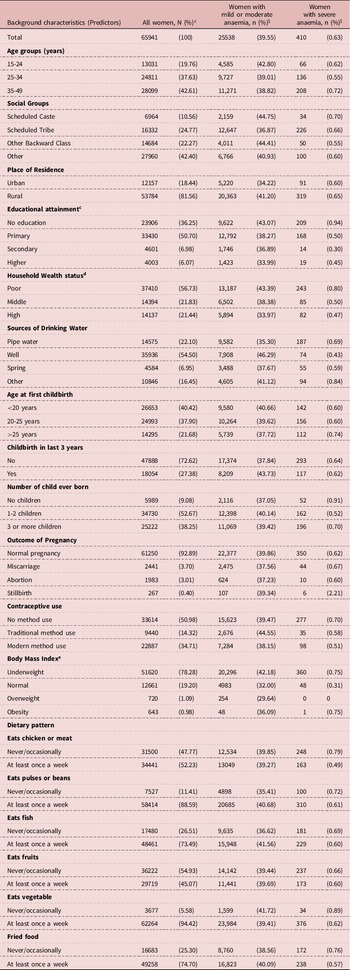
A total of 65941 women of reproductive age group, aged 15-49 years from northeast India were included. Of these 65941 participants, about 25993 (40%) had anaemia (include mild, moderate and severe) (Table 1). About 25,583 (39.55%) had mild or moderate anaemia while 410 (0.63%) had severe anaemia. Nearly 19.76% of the participants were adolescents and young adults (aged 15-24 years). About 4585 (42.80%) women had mild or moderate anaemia who were in the 15-24 age group and 66 (0.62%) women were severely anaemic. However, 208 (0.72%) women of 35-49 years were severely anaemic. About 44.75% of the women of Scheduled caste, followed by women from Other Backward Classes (44.41 %) had mild or moderate anaemia.
Prevalence of and factors associated with anaemia in married women of reproductive age group (15-49 years) in northeast India, 2015-2016

N: number; %: Percentage; c: Column percentage; $: the percentage and the number are adjusted for sample weight and multistage sampling, Row percentages; c: no education include no school attained/incomplete primary education, primary (completed primary), secondary (incomplete secondary/completed secondary), high (completed higher education); d: household was determined by given categories in data as low (poorest/poorer), medium (middle), high (richer/richest); e: Body mass Index was categories into four groups (<18.49kg/m2), normal (<18.49-24.9kg/m2), overweight (<25.0-29.9kg/m2), obese (≥30.0kg/m2)
High prevalence of mild or moderate anaemia was found among women with following socio-demographic characteristics: residing in the rural area (41.20%), having no education (43.07%), belonging to the low-income family (43.39%), having well as a source of drinking water (46.29%), had given birth in the past three years (43.73%), using the traditional method of contraception (44.55%), underweight (42.18%) and those who had first child before age of 20 years (40.66%). As per dietary patterns, higher proportion of women who never or occasionally ate vegetable (41.72%) had anaemia.
Factors associated with developing anaemia among married women
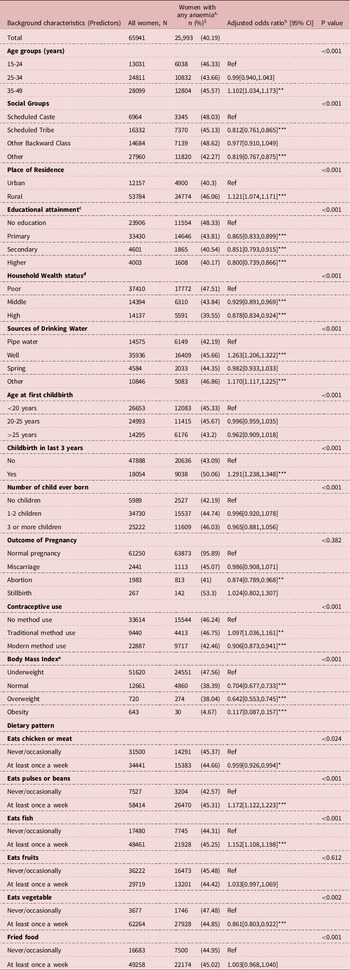
The bivariate logistic regression analysis examined the factors associated with anaemia (Table 2). The women in the age group 35-49 years (aOR: 1.10, 95% CI: 1.03-1.17), women residing in rural areas (aOR: 1.12, 95% CI: 1.07-1.17), women having well for drinking water (aOR: 1.26, 95% CI: 1.20-1.32) were more likely to develop anaemia. Further, childbirth in the past three years (aOR: 1.29, 95% CI: 1.23-1.34) and traditional method of contraception (aOR: 1.09, 95% CI: 1.03-1.16) and were also identified as factors associated with anaemia. Women with education [primary (aOR: 0.86, 95% CI: 0.83-0.89), secondary (aOR: 0.85. 95% CI: 0.79-0.91) and higher education (aOR: 0.80, 95% CI: 0.73-0.86)]; those belonging to the middle (aOR: 0.92, 95% CI: 0.89-0.96) or high (aOR: 0.87, 95% CI: 0.83-0.92) wealth status and women with healthy body weight (aOR: 0.70, 95% CI: 0.67-0.73) were less likely to develop anaemia. In addition, overweight and (especially) obese women were much less likely to be anaemic.
Factors associated with anaemia in married women of reproductive age group (15-49 years) in northeast India, 2015-2016

N: number; %: Percentage; a: (include mild, moderate, and severe anaemia), $: the percentage and the number are adjusted for sample weight and multistage sampling, Row percentages; b: Exponentiated coefficients; * p<0.05, ** p<0.01, *** p<0.001; c: no education include no school attained/incomplete primary education, primary (completed primary), secondary (incomplete secondary/completed secondary), high (completed higher education); d: household was determined by given categories in data as low (poorest/poorer), medium (middle), high (richer/richest); e: Body mass Index was categories into four groups (<18.49kg/m2), normal (<18.49-24.9kg/m2), overweight (<25.0-29.9kg/m2), obese (≥30.0kg/m2)
According to dietary pattern of women, the women who ate pulses or beans (aOR: 1.17, 95% CI: 1.12-1.22), and fish (aOR: 1.15, 95% CI: 1.10-1.19) at least once a week were more likely to suffer from anaemia while the women who ate chicken or meat (aOR: 0.95, 95% CI: 0.92-0.99); or vegetables (aOR: 0.86, 95% CI: 0.80-0.92) once a week were less likely to develop anaemia.
Discussion
The present study, based on India NFHS-4 data, showed two out of every five women in north-eastern part of India were anaemic. The alarming high prevalence of anaemia in these vulnerable communities needs attention. Residence in rural areas; availability of well for drinking water; using traditional method of contraception; eating pulses, beans or fish at least once a week were identified as factors associated with anaemia. Further, this study investigated the role of women’s autonomy regarding her healthcare on the risk of developing anaemia.
About 40% of women in the northeast regions (Arunachal Pradesh, Assam, Manipur, Meghalaya, Mizoram, Nagaland, Sikkim, and Tripura) have been found anaemic, in line with previous studies (Bora et al., Reference Bora, Barman and Barman2015; Mahanta et al., Reference Mahanta, Mahanta, Gogoi, Dixit, Joshi and Ghosh2015). The NFHS 2016 report showed the prevalence of anaemia in northeast states lower than national average (53%) except Tripura (54.4%) and Meghalaya (56.2%) (IIPS, 2017). Thus, the degree of prevalence of anaemia is varied across states within the northeast region, similar to variation in other states of India (Bharati et al., Reference Bharati, Som, Chakrabarty, Bharati and Pal2008).
The prevalence of anaemia was reported higher in the younger age-group (15-24 years, 43%) but after controlling for other factors older women (35-49 years) were more likely to be anaemic. These findings are consistent with the previous studies where adolescent girls were found to be anaemic (Biradar et al., Reference Biradar, Biradar, Alatagi, Wantamutte and Malur2012; Chaturvedi et al., Reference Chaturvedi and Chaudhuri2017). A study from Meghalaya described 49.6% young adults women at high risk of being anaemic (Dey et al., Reference Dey, Goswami and Goswami2010). The food pattern also determine in shaping the health of the state population (Biswas & Baruah, Reference Biswas and Baruah2014; Monsang and Singh, Reference Monsang and Namita Singh2018) and under-nutrition contributes in determining anaemia.
Young women in the age group less than 25 years are more likely to suffer from anaemia however this changes for pregnant women (Bharati et al., Reference Bharati, Som, Chakrabarty, Bharati and Pal2008), as they receive more care. On contrary, few community based studies have shown prevalence of anaemia was relatively low among adolescent and late adolescent women in India, however the study area were urban and non-endemic region of malaria and infestation (Biradar et al., Reference Biradar, Biradar, Alatagi, Wantamutte and Malur2012; Dudeja et al., Reference Dudeja, Tewari, Singh and Roy2016). India may include awareness of anaemia in north-eastern region communities through Integrated Child Development Schemes and Information Communication and Technology.
The risk of developing anaemia increased in women who had not attended education, in line with study from Ethiopia, which suggested education helps to imparting knowledge regarding nutrition and health consciousness (Asres et al., Reference Asres, Yemane and Gedefaw2014). However, another study from southern Ethiopia did not find association between education and anemia (Getahun et al., Reference Getahun, Belachew and Wolide2017).
The poor and rural women were found comparatively more susceptible to anaemia in the north-eastern region of India in line with studies from other states like Maharashtra, Manipur and Nagaland (Sharma et al., Reference Sharma, Singh and Srivastava2018; Rokade et al., Reference Rokade, Mog and Mondal2020; Gopinath et al., Reference Gopinath, Ashok, Kulkarni and Manjunath2016). Women economical background affects the women’s nutritional status (Dey et al., Reference Dey, Goswami and Goswami2010), and studies have shown an association of women’s wealth and anaemia (Agarwal and Sethi, Reference Agarwal and Sethi2013; Biswas and Baruah, Reference Biswas and Baruah2014).
The source of drinking water was associated with developing anaemia in the study. Previous studies in Bangladesh and Romania reported three folds increase in anaemia in women due to levels of arsenic in drinking water (Kile et al., Reference Kile, Faraj, Ronnenberg, Quamruzzaman, Rahman, Mostofa, Afroz and Christiani2016; Surdu et al., Reference Surdu, Bloom, Neamtiu, Pop, Anastasiu, Fitzgerald and Gurzau2015). The north-eastern region, rural areas in particular, have challenges for access to quality drinking water.
In the study, women who had child at early age were found more likely to be anaemic. The major risk of developing anaemia during pregnancy at early age is due to the loss of iron and other nutrients during and repeated pregnancy. The study findings are consistent with studies from Saudi Arabia and India, which showed the increased the number of pregnancy and mother’s age were significantly associated with developing anaemia (Ahmad et al., Reference Ahmad, Kalakoti, Bano and Aarif2010; Bharati et al., Reference Bharati, Som, Chakrabarty, Bharati and Pal2008). Pregnancy has been identified as a risk factor for anaemia in previous studies (Haidar, Reference Haidar2010; Makhoul et al., Reference Makhoul, Taren, Duncan, Pandey, Thomson, Winzerling and Shrestha2012). Repeated pregnancy in short intervals alone with a prolonged period of lactation leads to strain on the iron reserves (Upadhyay et al., Reference Upadhyay, Palanivel and Kulkarni2012). Iron supplementation must be considered for this vulnerable population and expansion of fortification cereal flour with iron must be implemented. Adolescent programmes and maternal and child health programmes must include awareness sessions for women about need of iron in routine food intake.
The prevalence of anaemia was high in women who had given birth in past three years. These finding were consistent with other studies in India (Bora et al., Reference Bora, Barman and Barman2015; Gogoi and Kumar, Reference Gogoi and Kumar2013) and also in Pakistan and Myanmar (Mawani and Aziz Ali, Reference Mawani and Aziz Ali2016; Win and Ko, Reference Win and Ko2018).
The study showed that traditional family planning methods were associated with developing anaemia than modern contraceptive method. This finding is consistent with study from eastern Africa where use of modern contraceptive methods is associated with lower prevalence of anaemia (Teshale et al., Reference Teshale, Tesema, Worku, Yeshaw and Tessema2020).
The nutritional status (Body mass index) was associated with anaemia in women. Similar results were found in study from rural Mysuru, where the women having poor nutrition (lower BMI) were found more likely to be anaemic (Gopinath et al., Reference Gopinath, Ashok, Kulkarni and Manjunath2016). Other studies from India revealed that obese /overweight women had higher consumption of nutrient food as compared with underweight women (Khan et al., Reference Khan, Khan, Bhardwaj, Aziz and Sharma2018; Singal et al., Reference Singal, Setia, Taneja and Singal2018). Therefore, among factors nutritional deficiencies contribute to the onset of anaemia which may leads to iron deficiency anaemia.
Women from middle and low income countries lives with geographic and cultural restrictions and gender discrimination. They live in a narrow autonomy environment which may have adverse effects on women health and survival of their children. Further, women have low control over health and autonomy and further reduced access to key determinants of health (access to preventive and curative health services including reproductive health, education, food and nutrition). Consequently, these limited accesses to health may lead to malnutrition, health risk from greater number of pregnancies against women.
Study limitations
The study had few limitations. The study was based on women who are in the reproductive age which may give insignificant result if the study population is separated as pregnant and non-pregnant women. The sample of women in the survey (for eight states of northeast India) was not evenly distributed across states of studied regions. The northeast region have dissimilar food habit, socio-culture and ethnic diversity among women compare to rest of India, therefore, it may be difficult to generalize the findings of the study with all women in India.
Conclusion
Two out of every five married women of reproductive age in north-east India were found to be anaemic. Women with low education, poor wealth, low nutritional status and without access to safe drinking water were more likely to be anaemic than were other women.
Disclosure Statements
Ethics
This research work was performed based on secondary data (NFHS-4), which is freely available in the public domain; thus, the authors do not require any ethical clearance and consent to participate. The NFHS-4 (2015-16) received ethics approval from the ethics review board of International Institute of Population Sciences, Mumbai, India. The authors assert that all procedures contributing to this work comply with the ethical standards of the relevant national and institutional committees on human experimentation and with the Helsinki Declaration of 1975, as revised in 2008. For more information about data: https://dhsprogram.com/data/dataset_admin/index.cfm.
Funding
The study did not receive any external funding.
Conflict of Interest
The authors declare no conflicts of interest with respect to the research, authorship, and/or publication of this article.