Implications
The pig meat is the major consuming meat in China. Native pig breed exhibited excessive body fat deposition, which was one of the main problems in the pig industry. High content of fat is not only to decrease the market value of pig meat, but also to increase the raise costs. We try to find genetic markers that cause to whole body fat deposition. Apolipoprotein A5 gene is a major candidate gene for our targets. This study is potential for improving the pig meat quality.
Introduction
In China, a long-term goal was to decrease body fat in pig production, because most of native pig breeds had excessive body fat deposition, which can decrease feed conversion rate and the whole quality of pig meat. Recently, studies had shown many genes are associated with the adipose traits in pig, such as FTO, CMYA1 or leptin gene (Silveira et al., Reference Silveira, Antunes, Almeida, Braga, Freitas, César and Guimarães2008; Fontanesi et al., Reference Fontanesi, Scotti, Buttazzoni, Davoli and Russo2009; Xu et al., Reference Xu, Xu, Pan, Li, Jiang, Yu, Rothschild and Liu2009). The apolipoprotein A5 (APOA5) gene, a new member of the apolipoprotein gene family, is rapidly being recognized as a key regulator of serum triglyceride concentration (van Dijk et al., Reference van Dijk, Rensen, Voshol and Havekes2004; Elosua et al., Reference Elosua, Ordovas, Cupples, Lai, Demissie, Fox, Polak, Wolf, D’Agostino and O’Donnell2006). APOA5 can enhance lipoprotein lipase (LPL) activity to accelerate the rate of LPL-mediated triglyceride hydrolysis to regulate triglyceride metabolism (Schaap et al., 2004; Rensen et al., Reference Rensen, van Dijk and Havekes2005). It had been found that several haplotypes of APOA5 gene were related with the significant changes in triglyceride level (Grallert et al., Reference Grallert, Sedlmeier, Huth, Kolz, Heid, Meisinger, Herder, Strassburger, Gehringer, Haak, Giani, Kronenberg, Wichmann, Adamski, Paulweber, Illig and Rathmann2007; Nelbach et al., Reference Nelbach, Shu, Konrad, Ryan and Forte2008). In rat, the percentage of body fat was significantly correlated with serum triglyceride (Paik and Yearick, Reference Paik and Yearick1978), and in the young females and male pigs, the triglyceride level was positively correlated with backfat thickness (Mersmann and MacNeil, Reference Mersmann and MacNeil1985). Martin et al. (Reference Martin, Ramsay, Campion and Hausman1985) also noted that the high backfat Ossabaw sows had higher serum triglyceride levels. In healthy men, high fat content was associated with elevated total serum triglyceride (Walton et al., Reference Walton, Lees, Crook, Worthington, Godsland and Stevenson1995), and visceral abdominal fat was also positively associated with serum triglyceride level in Japanese (Taniguchi et al., Reference Taniguchi, Nakai, Sakai, Yoshii, Hamanaka, Hatae, Kawata, Yamanouchi, Okumura, Doi, Tokuyama, Nagasaka and Fukushima2002). The above studies indicated that fat deposition can be influenced by the concentration of circulating triglyceride and APOA5 may play an important role in fat deposition. To date, several mammalian APOA5 cDNA sequences, such as human, cattle, rat and mouse have already been cloned, but porcine APOA5 is still unknown.
At present, tagging single nucleotide polymorphisms (tagSNPs) are selected in genes to represent other co-related SNPs in linkage disequilibrium (LD) with the tagSNPs because of its high efficiency. This method has widely used to analyze the association in family study between genotype and traits in human disease or animal quantitative traits (Jiang et al., Reference Jiang, Michal, Williams, Daniels and Kunej2006; Tang et al., Reference Tang, Pharoah, Ma and Easton2006; Hivert et al., Reference Hivert, Manning, McAteer, Dupuis, Fox, Cupples, Meigs and Florez2009). Based on the important role in the triglyceride homeostasis, APOA5 is considered as a potential candidate gene for fat deposition in our study. In order to identify the porcine APOA5 gene and the associations between APOA5 and fat deposition, we had firstly cloned and sequenced the whole gene, then detected the SNPs of APOA5, and investigated the effects of tag SNPs of APOA5 with fat deposition in the Jinhua × Pietrain F2 reference population lastly.
Material and methods
Animal and tissue collection, RNA extraction and cDNA synthesis
The tissue samples of kidney, hypophysis, heart, hypothalamus, spleen, small intestine, muscle, adipose and liver were derived from crossbred of Landrace sire × Yorkshire of 210-day old. Total RNA from the tissues was extracted using the Trizol reagent (Invitrogen, Carlsbad, CA, USA) according to the manufacturer’s protocol. The concentration of total RNA was measured at 260 nm using the NanoDrop ND-100 spectrophotometer (NanoDrop Technologies, Wilmington, DE, USA). Aliquots of total RNA were reverse transcribed using random primers and the Improm-II reverse transcriptase (Promega, Madison, WI, USA), and finally the product was stored at −20°C.
RT-PCR
The porcine expressed sequence tag (EST) databases were searched by Basic Local Alignment Search Tool (BLAST; http://www.ncbi.nlm.nih.gov/blast/) based on the sequences of cDNAs of human and rat APOA5 gene (accession numbers: NM_052968 and NM_080576), then 9 porcine ESTs (accession numbers: BP443998, BP446485, DY418089, CJ000488, BP446061, BP446847, DB808886, CJ000039 and BP442824) were selected, which assembled into a contig, with which a set of primers was designed for PCR amplification and sequencing. The cycling conditions comprised denaturation at 94°C for 3 min, 40 cycles at 94°C for 30 s, annealing at 57°C for 30 s and extension at 72°C for 1 min, and last extension at 72°C for 10 min.
Rapid amplification of cDNA 3′ end
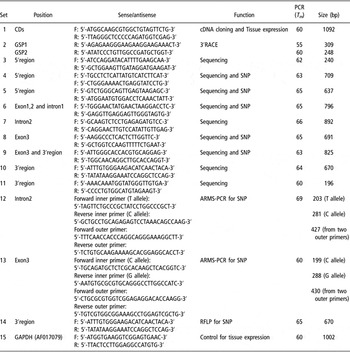
The 3′ end of cDNA was amplified with the 3′ Takara full RACE Kit (Otsu, Shiga, Japan) according to the manufacture’s protocol. First-stand cDNA was synthesized using the adaptor primer, then two rounds of 3′ RACE-PCRs were performed using the amplification primer, 3′ RACE outer primer and gene specific outer primer for first round; 3′ RACE inner primer and gene specific inner primer for the nested PCR (Table 1). The PCR was performed using the following conditions: 32 cycles of (94°C for 30 s, annealing at 55°C for 30 s and extension at 72°C for 1 min) for first PCR; and 32 cycles of (94°C for 30 s, 60°C for 30 s and extension at 72°C for 1 min) for nested PCR.
Primer sets designed for porcine APOA5 gene

CD = coding sequence; GSP1 = gene specific primer1; F = forward; R = reverse; SNP = single nucleotide polymorphism; ARMS-PCR = amplification refractory mutation system; RFLP = restriction fragment length polymorphism; GAPDH = glyceraldehyde-3-phosphate dehydrogenase.
Amplification and sequencing of genomic region
Genomic BLAST programs at National Center for Biotechnology Information (http://www.ncbi.nlm.nih.gov/blast/) and Sanger institute (http://www.sanger.ac.uk/DataSearch/blast.shtml/) were used for homology searches. Genomic DNA was extracted from blood using standard phenol protocol. All PCRs were performed by 36 cycles of 94°C for 30 s, annealing at 55°C to 68°C for 30 s and extension at 72°C for 1 min, and last extension at 72°C for 10 min. All products were ligated into the pGEM-T easy vector system (Takara, Japan) and then transformed into competent E. coli DH5α cells. Plasmid DNA was purified and sequenced on ABI 3730 sequencer (ABI, Foster City, CA, USA).
Sequence analysis
The open reading frame (ORF) was found using the DNAStar software, and the nucleotide sequences were translated to the amino acids by the DNAMAN program. The amino acid sequences of APOA5 were downloaded from Genbank (Homo sapiens: NP_443200; Bos Taurus: NP_001076961), and then the BLAST analysis was made by the DNAMAN program.
Reference population and phenotypic traits
Jinhua × Pietrain resource population was developed from purebred Pietrain sires and Jinhua dams, including 4 F1 boars and 24 F1 sows and ∼250 F2 progeny. The Jinhua pig has high backfat thickness, while the Pietrain has a heavy muscle, which leads to low backfat thickness. The average backfat thickness (ABF) was measured on the left carcass at four locations (shoulder, sixth and seventh rib, last rib and gluteus medius). The leaf fat (LF) weight on the left side of each carcass was weighted by electronic scale. On the day before slaughter, the animals were weighed, with an average weight of 85 kg (70 to 100 kg). The average values of ABF and LF in Jinhua pig are 3.82 cm and 1.21 kg, respectively, and Pietrain pig had 1.83 cm of ABF and 0.35 kg of LF.
Polymorphism detection and genotyping assay development
All primers were listed in Table 1. Approximately 50 ng of genomic DNA were amplified in a final volume of 20 μl that contained 12.5 ng of each primer, 2.5 mM dNTPs, 1.5 mM MgCl2 and 0.5 U of Taq polymerases. The PCR conditions were carried out as follows: 94°C for 3 min, 36 cycles at 94°C for 30 s, annealing at 60°C for 30 s and extension at 72°C for 50 s, and last extension at 72°C for 10 min. Then the PCR products of primers 3 to11 were sequenced for SNP discovery using ABI 3730 sequencer (ABI, USA) with a standard protocol. The direct sequencing approach with the products of primers 4 to 6 and 8 to 9 were also used to detect the polymorphisms on all animals. Additionally, genotyping was performed with the products of primers 12 to 13 by ARMS-PCR (amplification refractory mutation system) (Ye et al., Reference Ye, Dhillon, Ke, Collins and Day2001), while a BsrBI site for restriction fragment length polymorphism in the products of primer 14.
Statistical analysis
The Hardy–Weinberg equilibrium of each mutation and LD among mutations in porcine APOA5 gene was estimated using the HAPLOVIEW program (Barrett et al., Reference Barrett, Fry, Maller and Daly2005). Association analysis of the SNPs with the traits in reference population was performed using the MIXED model procedure of SAS v9.0 (SAS institute Inc., Cary, NC, USA) with the following model: Yijklmno = μ + bWi + Bj + Sk + Dl + Gm + Lin + eijklmno, where Yijklmno is the dependent variable (traits); μ is the general mean; Wi is live weight (kg) as a covariate; Bj the birth year; Sk the sex; Dl the age (days); Gm the genotype of SNPs; Lin the random effect of litter and eijklmno the random error. P-value < 0.05 or < 0.01 was considered statistically significant or highly statistically significant after Bonferroni correction.
Results
Cloning of porcine APOA5 gene
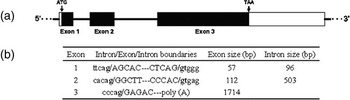
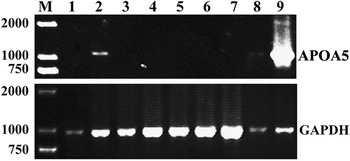
On the basis of sequences of APOA5 cDNA from other species, conserved regions of porcine APOA5 gene were identified. Further analysis revealed that the cDNA of the porcine APOA5 gene was composed of 1883 bp and were then submitted to the Genbank database (Accession numbers: FJ810861). The ORF was 1092 bp, with a predicted protein composed of 363 amino acid residues, which is 80.43% and 78.47% homologous to bovine and human APOA5, respectively. The information of genomic sequence released by the Porcine Genome Project, and the gene located in chromosome 9, CH242-243D19, CU582845. Genomic sequence of porcine APOA5 was obtained by PCR. The exon-intron boundaries were further identified by the cDNA and genomic DNA alignment by DNAMAN software. The gene is distributed among three exons spanning of 2.482 kb of genome. All the exon-intron boundaries are consistent with the GT-AG splicing rule (Figure 1). Using the house-keeping gene GAPDH as internal control, RT-PCR analysis showed that the porcine APOA5 gene was expressed in hypophysis, adipose and liver (Figure 2).
(a) Schematic representation of the genomic structure of the porcine APOA5 gene. Translated regions are given in black. (b) Exon/intron boundaries of the porcine APOA5 gene. Intron sequences are shown in lowercase, and exon sequences are in uppercase. Both exon and intron sizes are indicated. The ag/gt consensus splice sequences are in boldface.

Tissue expression distribution of porcine APOA5 gene. M, DL2000 markers; 1, kidney; 2, hypophysis; 3, heart; 4, hypothalamus; 5, spleen; 6, small intestine; 7, muscle; 8, adipose; 9, liver. APOA5 = Apolipoprotein A5; GAPDH = glyceraldehyde-3-phosphate dehydrogenase.

Single and multiple nucleotide polymorphisms
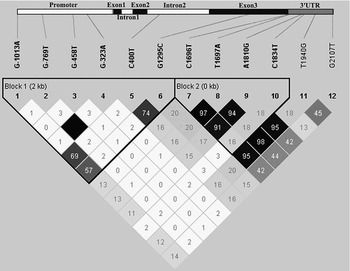
In the porcine APOA5 gene, twelve SNPs were detected (Figure 3). The promoter region (spaning −1200 to +8 bp) harbors four SNPs, while the exons and introns contain two SNPs (G1295C and C400T). The remaining six SNPs are in the 3′ end region. No missense mutation occurs in the coding region. All mutations belonged to porcine genomic DNA contig (CU582845).
Genomic and haplotype analysis in the porcine APOA5 gene. Pairwise linkage disquilibrium relationship for 12 mutations is noted based on r 2 measurements.

Haplotype analysis
The analysis of genotype data of all F2 progeny indicated that two SNPs in the promoter region: G-769T and G-323A form two haplotypes GG and TA. No historical recombination status between these two SNPs was confirmed by HAPLOVIEW. In the 3′ end region, HAPLOVIEW also indicated that C1696T, T1697A, A1810G and T1940G have no historical recombination by forming two haplotypes of CTAT and TAGG. Therefore eight tagging SNPs, G-1013A, G-769T, G-458T, C400T, G1295C, A1810G, C1834T and G2107T, were used in the association analysis.
Association analysis of APOA5 gene with ABF and LF
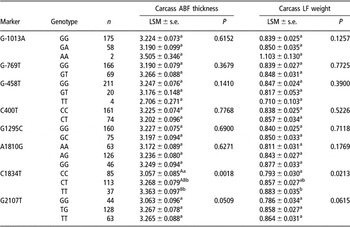
The results of MIXED procedure revealed that the SNP of C1834T was significantly associated with ABF and LF in the population (P = 0.0018 and P = 0.0213, respectively) (Table 2). The CC animals had 0.306 cm of ABF less than the TT animals and 0.211 cm less than the CT heterozygote. Animal with GG genotypes had 0.09 kg of LF less than animals with TT. No any significance level was found to associate the other tag SNPs with ABF or LF.
Associations of APOA5 gene polymorphism with ABF and LF

ABF = average backfat; LF = leaf fat; LSM = least significant mean; s.e. = standard error; n = number of animals genotyped.
Different superscript letters are significant differences (capital letters: P < 0.01; lowercase letters: P < 0.05).
Discussion
In this study, we described the identification and characterization of the full length of porcine APOA5 cDNA and APOA5 gene. The ortholog of porcine APOA5 is related to its human and bovine counterparts based on cDNA and amino acid sequence comparisons. In human and rat, the expression of APOA5 is mainly restricted to liver (van der Vliet et al., Reference van der Vliet, Sammels, Leegwater, Levels, Reitsma, Boers and Chamuleau2001). The porcine APOA5 is weakly expressed in adipose and over expressed in liver.
A total of 12 mutations were detected in porcine APOA5 gene region including a multiple nucleotide polymorphism in the promoter region. No any polymorphism association with ABF and LF were detected in the region of promoter, intron or coding regions. In the 3′ end region, the SNP of C1834T yielded strong association with ABF and LF (P < 0.01 and P < 0.05, respectively) (Table 2). In human, several SNPs within the APOA5 locus (−1131T > C, −3A > G, S19W, IVS3 + 476G > A, 1259T > C and 1764C > T) have been identified, and their alleles are associated with triglyceride homeostasis in different populations (Nabika et al., Reference Nabika, Nasreen, Kobayashi and Masuda2002; Lai et al., Reference Lai, Demissie, Cupples, Zhu, Adiconis, Parnell, Corella and Ordovas2004; Klos et al., Reference Klos, Hamon, Clark, Boerwinkle, Liu and Sing2005; Moreno-Luna et al., Reference Moreno-Luna, Perez-Jimenez, Marin, Perez-Martinez, Gomez, Jimenez-Gomez, Delgado-Lista, Moreno, Tanaka, Ordovas and Lopez-Miranda2007). At the same time, two major haplotypes (−1131T > C and c.56C > G) associated with higher triglyceride levels had tagged (Pennacchio et al., Reference Pennacchio, Olivier, Hubacek, Cohen, Cox, Fruchart, Krauss and Rubin2001; Lai et al., Reference Lai, Arnett, Corella, Straka, Tsai, Peacock, Adiconis, Parnell, Hixson, Province and Ordovas2007). Yao et al. (Reference Yao, Zhang, Wu, Zheng, Deng and Yang2008) also detected 7 mutations (C-169T, C600T, T635C, C841G, C914T, C1142G and C1394T) in chicken APOA5 gene. In our study, SNPs were detected in porcine are different from the results of other species. This was not surprising because we reported for the first time the SNPs of porcine association with adipose traits.
APOA5 is located in the ApoA1/C3/A4 gene cluster (van der Vliet et al., Reference van der Vliet, Sammels, Leegwater, Levels, Reitsma, Boers and Chamuleau2001). Polymorphisms in this cluster have been linked to the human diseases in lipid metabolism (Mar et al., Reference Mar, Pajukanta, Allayee, Groenendijk, Dallinga-Thie, Krauss, Sinsheimer, Cantor, de Bruin and Lusis2004; Olivier et al., Reference Olivier, Wang, Cole, Gau, Kim, Rubin and Pennacchio2004; Shanker et al., Reference Shanker, Perumal, Rao, Khadrinarasimhiah, John, Hebbagodi, Mukherjee and Kakkar2008). Obviously the APOA5 gene should be a strong candidate gene for the triglyceride metabolism. In APOA5-knockout mice, the triglycerides concentration increased fourfold (van der Vliet et al., Reference van der Vliet, Sammels, Leegwater, Levels, Reitsma, Boers and Chamuleau2001), while the serum triglyceride concentrations decreased by 50% to 70% in transgenic mice with the human APOA5 (Baroukh et al., Reference Baroukh, Bauge, Akiyama, Chang, Afzal, Fruchart, Rubin, Fruchart-Najib and Pennacchio2004). APOA5 may enhance LPL-mediated triglyceride hydrolysis in vitro and modulate hepatic very low density lipoprotein-triglyceride synthesis to affect triglyceride levels (Fruchart-Najib et al., Reference Fruchart-Najib, Baugé, Niculescu, Pham, Thomas, Rommens, Majd, Brewer, Pennacchio and Fruchart2004; Schaap et al., Reference Schaap, Rensen, Voshol, Vrins, van der Vliet, Chamuleau, Havekes, Groen and van Dijk2004; Merkel et al., Reference Merkel, Loeffler, Kluger, Fabig, Geppert, Pennacchio, Laatsch and Heeren2005). Additionally, APOA5 has a unique association with cellular lipid droplets, which it may be involved in the storage or mobilization of intracellular lipids (Shu et al., Reference Shu, Chan, Ryan and Forte2007 and Reference Shu, Ryan and Forte2008). In chicken, the significant association between SNPs in T635C and abdominal fat weight in F2 cross of White Plymouth Rock × Silkies were found (Yao et al., Reference Yao, Zhang, Wu, Zheng, Deng and Yang2008). Our results confirmed the significant relationship of SNPs in APOA5 gene and body fat deposition in porcine. Although the exact reasons for these finding are not clear, it speculated that APOA5 gene may be a functional factor in fat deposition. Our research also provided a foundation for further investigation on function of APOA5 gene.
In conclusion, we cloned the porcine APOA5 gene using a comparative bioinformatics approach and developed a total of 12 genetic markers in this gene. Genotyping these markers on ∼250 Jinhua × Pietrain F2 reference population indicated that porcine APOA5 gene is significantly associated with ABF and LF weight. We propose APOA5 as a candidate gene for fat deposition, and further studies are needed to evaluate the effects of this gene in other pig breeds and investigate the regulating mechanism of APOA5 in triglyceride metabolism.
Acknowledgments
The research was supported by the National Major Basic Research Program of China (973 Program, no. 2006CB102100), and the National High Technology Research and Development Program of China (863 program, no. 2007AA10Z158).