Introduction
Legumes are important crops in Southeast Asia. Crops such as yard-long bean (Vigna unguiculata subsp. sesquipedalis), cowpea (Vigna unguiculata) and green bean (Phaseolus vulgaris) account for a significant share of the total area for the cultivation of vegetables, and are important sources of plant proteins and micronutrients in the human diet. Since they are capable of fixing atmospheric nitrogen, these leguminous crops also play an important role in managing soil fertility. Legumes, in particular vegetable legumes, are highly susceptible to a wide range of arthropod pests and diseases. Among the documented pests, the legume pod borer (Maruca vitrata) is considered one of the most serious pests in tropical Asia and sub-Saharan Africa (Sharma, Reference Sharma1998). Yield losses up to 80% caused by pod borer have been reported for various vegetable and grain legumes (Singh et al., Reference Singh, Jackai, Dos Santos, Adalla and Singh1990; Afun et al., Reference Afun, Jackai and Hodgson1991; Dreyer et al., Reference Dreyer, Baumgärtner and Tamò1994; Ulrichs and Mewis, Reference Ulrichs and Mewis2004).
At present, farmers in Southeast Asia, as elsewhere, rely almost exclusively on the application of synthetic pesticides to manage pod borers and other arthropod pests and diseases. Previous studies have reported that Cambodian farmers sprayed major vegetables including yard-long bean up to 20 times/season with five different pesticides/tank mixed together (Sodavy et al., Reference Sodavy, Sitha, Nugent and Murphy2000). Bean growers in Bangladesh have been reported to spray weekly or twice weekly to control pod borers (Hoque et al., Reference Hoque, Mollik, Nazimuddin, Alam, Khorsheduzzaman, Jasmine, Sultana, Rahman, Ahmed, Rajotte and Luther2002). Pod borer moths and larvae are nocturnal. The larvae feed on floral buds, flowers and pods. Since they are exposed to leaves for just a short time after hatching, there is only a brief window of opportunity for the effective use of insecticides. Much of the spray, therefore, does not reach its target. We observed that farmers tend to respond by increasing their spraying frequency or resorting to more toxic products.
The intensive and rapidly increasing use of pesticides is creating serious problems as it exposes farm workers, consumers and ecological systems to the risk of pesticide residue accumulation. In developing countries, such risks are difficult to manage because of a lack of public and policy awareness (Schreinemachers and Tipraqsa, Reference Schreinemachers and Tipraqsa2012). Chronic problems related to the overuse and misuse of agricultural pesticides have been reported in many parts of South and Southeast Asia and China (e.g. Mazlan and Mumford, Reference Mazlan and Mumford2005; Xu et al., Reference Xu, Kuang, Pay, Dou and de Snoo2008; Schreinemachers et al., Reference Schreinemachers, Sringarm and Sirijinda2011).
In Vietnam, rapid growth in the use of pesticides started with economic liberalization in the mid-1980s when the private sector was allowed to import and distribute pesticides and when farmers were given rights for pesticide use over their agricultural land, allowing them to make independent farm management decisions (Lamers et al., Reference Lamers, Schreinemachers, Ingwersen, Sangchan, Grovermann, Berger, Fröhlich, Schreinemachers, Stahr and Clemens2013). From 1991 to 2007, the volume of agricultural pesticides as formulated products (i.e. active ingredients as well as inert ingredients such as solvents, emulsifiers and adjuvants) increased from 20,000 to 77,000 tons. This suggested an average annual growth rate of 8.5% over a 16-year period (Lamers et al., Reference Lamers, Schreinemachers, Ingwersen, Sangchan, Grovermann, Berger, Fröhlich, Schreinemachers, Stahr and Clemens2013). As a result, there have been very significant problems with the contamination of vegetables and ecosystems with pesticide residues, particularly in the Red River Delta (Van Hoi et al., Reference Van Hoi, Mol, Oosterveer and van den Brink2009; Nishina et al., Reference Nishina, Kien, Noi, Ngoc, Kim, Tanaka and Iwasaki2010; Hoai et al., Reference Hoai, Sebesvari, Minh, Viet and Renaud2011) and also in mountainous areas (Lamers et al., Reference Lamers, Anyusheva, La, Nguyen and Streck2011).
The contamination of food with pesticide residues also poses a serious problem in Thailand (e.g., Posri et al., Reference Posri, Shankar and Chadbunchachai2006; Athisook et al., Reference Athisook, Sungwaranon, Lertreungdej, Jongmeevasana, Payanant, Chaipol-ngam and Kunstadter2007). From 1987 to 2010, Thailand experienced a sixfold increase in the quantity of formulated pesticide products applied to each hectare of agricultural land (Praneetvatakul et al., Reference Praneetvatakul, Schreinemachers, Pananurak and Tipraqsa2013). The government had been promoting the use of pesticides for decades to stimulate agricultural productivity, and has tried to promote more sustainable methods of pest management only since the late 1990s (Praneetvatakul et al., Reference Praneetvatakul, Schreinemachers, Pananurak and Tipraqsa2013). However, public investment in integrated pest management (IPM) is very limited (Schreinemachers et al., Reference Schreinemachers, Schad, Tipraqsa, Williams, Neef, Riwthong, Sangchan and Grovermann2012).
Previous studies have shown that the legume pod borer can be managed using sex pheromones to capture male moths (Downham et al., Reference Downham, Tamo, Hall, Datinon, Adetonah and Farman2004) and by using biopesticides such as various commercial formulations of Bacillus thuringiensis (Srinivasan, Reference Srinivasan2008, Reference Srinivasan2012). The pod borer also has a wide range of natural enemies and can be managed through biological control (Waterhouse and Norris, Reference Waterhouse and Norris1987; Sharma, Reference Sharma1998; Ulrichs et al., Reference Ulrichs, Mewis, Schnitzler and Burleigh2001; Huang et al., Reference Huang, Peng and Talekar2003; Arodokoun et al., Reference Arodokoun, Tamò, Cloutier and Brodeur2006), but this method is incompatible with current spraying practices that rely on broad-spectrum synthetic insecticides. The pod borer is prone to developing resistance against such insecticides, as has been reported in several countries of Southeast Asia (Ulrichs et al., Reference Ulrichs, Mewis, Schnitzler and Burleigh2001) and sub-Saharan Africa (Okeyo-Owuor et al., Reference Okeyo-Owuor, Agwaro and Simbi1983; Atachi and Sourokou, Reference Atachi and Sourokou1989; Ekesi, Reference Ekesi1999).
This study was carried out as part of a research and development project aimed at improving the livelihoods and capacity for income generation of small-scale vegetable legume farmers in Southeast Asia (Thailand and Vietnam) and sub-Saharan Africa (Bénin and Kenya) by developing a simple, economical and environmentally sound IPM strategy for the control of pod borers. The project seeks to accomplish this goal through refining existing IPM technologies based on sex pheromones, entomopathogens and botanicals, and combining these agents with species-specific natural enemies of the pod borer for introduction and release throughout Southeast Asia and sub-Saharan Africa.
Against this backdrop, the objective of the present study was to describe how farmers in Thailand and Vietnam presently manage their pest problems in vegetable legumes in order to identify suitable entry points for the introduction of IPM. This study uses the case of yard-long bean; it is one of the most important vegetable legumes in Southeast Asia, and consumed as a green vegetable, eaten raw or cooked in a variety of dishes.
This paper is structured as follows. The Materials and methods section first explains the site selection and data collection methods applied in this study. The Results section describes the general characteristics of yard-long bean production systems in Thailand and Vietnam before focusing on pest problems and their management. The Discussion section relates these findings to the potential and challenges for rolling-out an IPM programme for pod borer control.
Materials and methods
Farm-level survey data were collected from the main yard-long bean production areas in Thailand and Vietnam, as identified by local experts. In Thailand, data were collected in the central region; this region is suitable for the growth of various vegetable crops as it has a hot and humid climate and good access to water for irrigation and to markets for the sale of the produce. Apart from yard-long bean, commonly cultivated vegetables in this region are kangkong (Ipomoea aquatica), Chinese chive (Allium tuberosum), Chinese kale (Brassica oleracea var. alboglabra) and pak choi (Brassica rapa var. chinensis). Within the central region, the provinces of Ratchaburi, Pathum Thani and Kanchanaburi were selected for the survey, as these provinces have relatively large areas for growing this crop. In 2009, yard-long bean was planted on nearly 3786 ha in these three provinces, and Pathum Thani accounted for 60% of this area (Department of Agricultural Extension, 2010).
In Vietnam, the study was conducted in the northern districts of Gia Lam, Dong Anh and Hoai Duc, as these are the three most important districts for yard-long bean production in the Hanoi area. Farms are generally small. In Dong Anh, the average area of an agricultural land/farm worker is only 0.051 ha. Farmers produce vegetables of various types as well as rice. Villages were selected based on information from local experts (district agricultural officers in Thailand and local scientists from the Vietnam Academy of Agricultural Sciences).
Data were collected using a combination of qualitative and quantitative survey methods. The qualitative part used the tools and techniques of the Participatory Rural Appraisal, including focus group interviews and problem ranking. This approach was used to develop a general understanding of the situation, including the technologies used in cultivation, monthly price changes, area trends and marketing constraints.
This method was followed by face-to-face interviews with growers of the crop to get more quantitative data on cultivation, pest and disease problems and other production constraints. In each selected village, all growers were selected for an interview. In Thailand, 20 villages were chosen and 120 farmers were interviewed. In Vietnam, the survey was made in seven villages and 120 farm managers were interviewed. The personal interviews used a structured questionnaire and were carried out from November 2010 to January 2011 in Thailand and from January to April 2011 in Vietnam.
The questionnaire recorded general information about farms, arthropod pest problems and plant diseases, pest management methods, pesticide-handling practices and costs and returns in producing this crop. Problems of arthropod pests and diseases were recorded by asking farm managers to list their problems, five major pests and five major diseases. They were then asked to rank these separately for pests and diseases. From these data, we calculated the percentage of farm managers who had listed a particular pest or disease problem and the average rank given. The most important pest and plant disease were given a rank of 5, the least important a rank of 1. Pests and diseases not mentioned by a respondent were given a rank of zero for calculating the average.
Results
Production systems
In both survey locations, the focus group discussions revealed that farming has gradually shifted from the cultivation of paddy rice to vegetables and other high-value crops over the last three decades. In Vietnam, many farmers in the study sites still grow rice in the dry and wet seasons, with 85% being used for home consumption. Farmers grow a variety of different vegetables, the main types being cabbage, yard-long bean, mustard green, cauliflower and Chinese cabbage. Although most of the produce is sold, 38% of the households also consumed some of their own production of yard-long bean.
In both countries, yard-long bean is produced by small-scale operations.
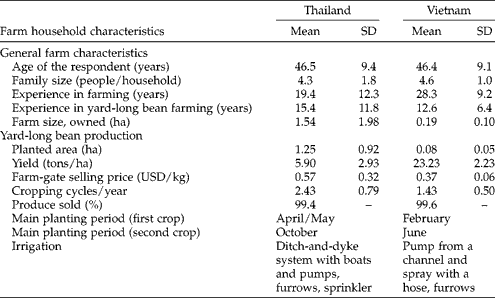
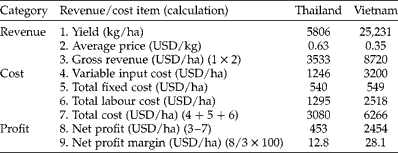
In Thailand, the average household planted this crop 2.4 times/year on a total area of 1.25 ha; in comparison, the average farm size was 1.54 ha (Table 1). Other cultivated crops included cucumber, chili, rice, sugarcane, mustard green, asparagus, cauliflower and sponge gourd. Producers in Vietnam planted an average 1.43 cycles/year on a total area of only 0.08 ha; this is in comparison to an average farm size of 0.19 ha. The average pod yield/cropping cycle was 5.9 tons/ha in Thailand and 23.2 tons/ha in Vietnam. The average yield in Thailand was relatively low, but comparable to the national average yield of 6.15 tons/ha as reported by Benchasri and Bairaman (Reference Benchasri and Bairaman2010). The large difference in average pod yield can be explained by differences in production systems and especially the intensity of cultivation, as follows.
Average household characteristics of yard-long bean producers in Thailand and Vietnam, 2010

There are two distinct systems of yard-long bean production in Thailand. In Kanchanaburi Province, it is cultivated as an upland crop requiring sprinkler or furrow irrigation; in Pathum Thani Province, most farmers use the rong nam cropping system. This is a kind of dike-and-ditch system in which crops are grown on raised beds surrounded by channels. Boats are used by the farmers to navigate through the field, irrigate the crop and transport the harvest. Creating and maintaining the beds is labour-intensive, but this system helps to protect crops from seasonal floods and eases some farm operations. Production of yard-long bean in Vietnam is very intensive. Farmers plant the crop at a high density, using virtually every square meter of the plot, and tend their plants individually. As in Kanchanaburi Province, farmers in Vietnam irrigate their plants with furrows, but sometimes also use a hose to water individual plants.
The three main commercial cultivars in Vietnam are ‘Xanh dai’, ‘Hat trang’ and ‘Hat tim’. Many more cultivars were available in Thailand; the survey recorded 17 different names, yet 58% of the growers used just two, ‘Sorn Dang’ and ‘Lamnanche’. Thai farmers like to try different cultivars, as 65% had switched cultivars in the last three cropping seasons. Their main reason for this was the better characteristics of the bean pods, such as a bigger size, greater firmness, better shape, taste or colour.
The average farm-gate selling price, converted to the US dollar (USD), was 0.37 USD/kg in Vietnam and 0.57 USD/kg in Thailand. However, average prices varied widely within the year. In Vietnam, prices were low in April and May when the market supply was high, and gradually increased towards the end of the year; in Thailand, there was no such trend in 2010.
Arthropod pests and plant diseases
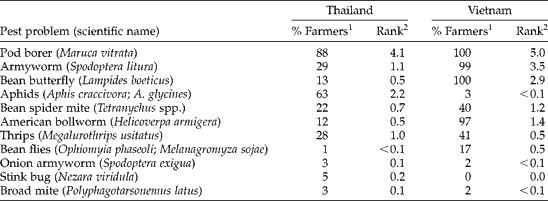
Table 2 lists the major arthropod pests on yard-long bean as reported and ranked by the farmers during the survey. Pod borers were reported by 88% of the respondents in Thailand and 100% in Vietnam and given the highest rank in both countries. In Thailand, aphids were the second most important arthropod pest problem, mentioned by 63% of the respondents. In Vietnam, armyworm (Spodoptera litura and S. exigua), bean butterfly (Lampides boeticus) and bollworm (Helicoverpa armigera) were all considered major pest problems and were mentioned by nearly all growers.
Arthropod pest problems in yard-long bean cultivation in Thailand and Vietnam, 2010
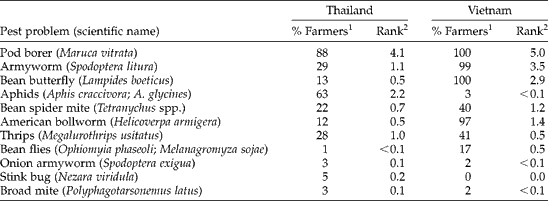
1 Percentage of farmers who mentioned the pest among their five most important arthropod pest problems.
2 Rank (0–5) quantifies the importance of the problem; a higher rank means more importance. Rows are sorted in descending order of the average rank of both countries.
This finding confirms those of Loan (Reference Loan2012), who identified the pod borer as a major pest during the period from flowering to pod forming in Vietnam, and those of Poramarcom (Reference Poramarcom2010), who identified pod borers as a major pest and aphids as the most important pest of yard-long bean in Thailand. Aphid adults and nymphs not only cause direct damage by feeding, but can also transmit aphid-borne mosaic virus, resulting in severe yield losses (Benchasri et al., Reference Benchasri, Bairaman and Nualsri2011). Although the information is scarce on secondary pests of yard-long bean in Vietnam, armyworm, bollworm, bean fly (Ophiomyia phaseoli) and aphid (Aphis craccivora) were reported to be the key pests besides M. vitrata in Thailand (Poramarcom, Reference Poramarcom2010).
In Thailand, surveyed farmers reported yield losses from pod borers as follows: 36% (zero or low), 32% (from 10 to 25%), 29% (from 26 to 50%) and 4% (above 50%). In field trials conducted in Kamphaeng Saen, Thailand, from March to May 2012, it was found that the borers could lead to at least 28% pod damage if the crop was left unprotected. Therefore, the perceived yield losses by most of the respondents in Thailand matched the results from our field trials.
Farmers in Vietnam felt that the available insecticides provided an effective means of control, and 95% of the respondents perceived that harvest losses due to pod borers were below 10%. However, it was found from the field trials at Gia Lam district in Hanoi, Vietnam, that the borers could lead to 30% pod damage resulting in only 0.45 tons/ha of marketable pods, if the crop was left unprotected from April to May 2012. Therefore, it is possible that the pod borers could cause about one-third of marketable yield losses in the unprotected crop.
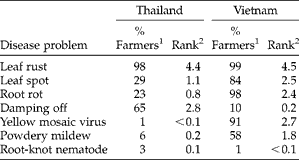
In terms of plant diseases, leaf rust caused by Uromyces vignae was identified as a serious problem with virtually all farmers reporting the disease in both countries (Table 3). Yellow mosaic virus, leaf spot caused by Mycosphaerella cruenta and root rot caused by Fusarium solani and Rhizoctonia solani were other major problems in Vietnam. Thai bean growers had more problems with damping off (a fungal disease affecting seedlings) caused by Pythium spp. Although plant diseases are prevalent, a large number of farmers in Thailand (48%) did not report significant crop yield losses from them. For all plant diseases combined, the average crop yield reduction as perceived by the Thai farmers was about 15%.
Plant disease problems in yard-long bean cultivation in Thailand and Vietnam, 2010
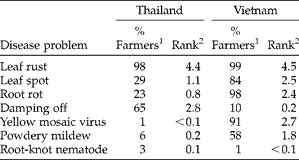
1 Percentage of farmers who mentioned the pest among their five most important arthropod pest problems.
2 Rank (0–5) quantifies the importance of the problem; a higher rank means more importance. Rows are sorted in descending order of the average rank of both countries.
Pest management
Synthetic pesticides are the main method of pest management used by 92% of Thai and 100% of Vietnamese growers of yard-long bean. This confirms the findings of several previous studies showing the farmers' reliance on chemical pesticides as a primary mode of pest control in Thailand (e.g. Plianbangchang et al., Reference Plianbangchang, Jetiyanon and Wittaya-areekul2009) and Vietnam (e.g. Van Hoi et al., Reference Van Hoi, Mol, Oosterveer and van den Brink2009). Nine farmers (8%) in Pathum Thani Province in Thailand produced pesticide-free yard-long bean for a niche market; this shows that it is economically and technically possible to produce the crop without pesticides as long as there is a market for this.
Non-synthetic methods of pest management included mostly biopesticides and were used by 55% of Thai farmers and reportedly by 100% of the Vietnamese. However, further inspection and consultation with local experts in Vietnam showed that none of these were actually biopesticides. According to local experts, pesticide traders sometimes give incorrect information to the farmers, telling them that the pesticides purchased are not harmful to their health because they are biopesticides. Very few farmers tried to control pests by removing infected plants from their field or through intercropping. In Thailand, only one farmer had heard of trap crops and one other had heard of the use of pheromones to manage arthropod pests.
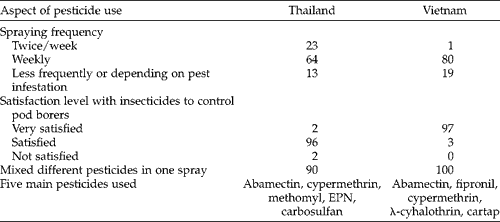
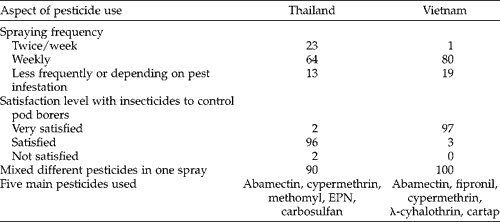
The average Thai growers of yard-long bean used 16.3 kg/ha of formulated pesticide products/cropping cycle. The most common pesticides used were abamectin, cypermethrin, methomyl, carbosulfan and EPN (Table 4). The latter three are highly hazardous chemicals and leave residues if the pre-harvest interval (the period between the last application of the pesticide and the safe harvesting of the crop) is not observed. Hence, it is not uncommon to have exceedingly high levels of pesticide residues. For example, an earlier report had confirmed the presence of several toxic pesticides, including methomyl, triazophos, chlorpyrifos, methamidophos, omethoate, dicofol and dimethoate, to a maximum of 15-fold higher than the maximum residue limits (MRLs) in yard-long bean from Thailand (PAN UK, 2006). In Vietnam, abamectin, fipronil, cypermethrin, λ-cyhalothrin and cartap were the pesticides mostly commonly applied. The latter three belong to the synthetic pyrethroids and carbamate groups. It has already been reported that more than 75% of the pesticide products used in Vietnam against arthropod pests are organophosphates, pyrethroids and carbamates (Thang, Reference Thang, Lim, Soetikno and Loke1999; Johansen et al., Reference Johansen, Tuan, Oanh and Nordhus2003). Thus, the current survey also confirmed the high prevalence of carbamates and synthetic pyrethroids. Since yard-long bean is grown in smaller plots, growers usually buy smaller packs of pesticides. An earlier study has documented the discrepancy in the label information for large packages (intended for official inspection) and for small packages (intended for farmers) (Van Hoi et al., Reference Van Hoi, Mol, Oosterveer and van den Brink2009) leading to pesticide misuse. For instance, the pre-harvest interval for abamectin was 7 days according to the information on the large packages, but the label on the small packages mentioned only 3 days, a reduction which makes this product more attractive for farmers. Similarly, the pre-harvest interval for permethrin recommended on the large package was 12 days, but on the small package only 7 days. Other pesticides such as fipronil did not even have any pre-harvest interval information on the small packages, though on the large packages a period of 14 days (for rice and beans) was indicated. Hence, it is apparent that pesticide use on yard-long bean in Vietnam may not be safe, since the harvest is done at least twice a week, and this may not leave sufficient time for residues to fall to levels below the MRL. In addition, pesticide use is currently higher on vegetables than on other crops in Vietnam. For instance, the pesticide use/ha in the Red River Delta is 5.52 kg/cropping season for vegetables compared with 3.34 kg/ha for rice and 0.88 kg/ha for other food crops (Van Hoi et al., Reference Van Hoi, Mol, Oosterveer and van den Brink2009).
Aspects of pesticide use in yard-long bean in Thailand and Vietnam, in percentage of farmers using pesticides, 2010
Virtually all farmers in both countries felt that pesticides provided an effective means of pest and disease control, and were satisfied with their effectiveness to control pod borers. According to the farmers, the use of pesticides made their crops look healthier and more marketable, and helped them to get a better price for their produce. When asked whether their intensity of pesticide use had changed in the past 5 years, 23% of Thai farmers thought it had increased and 6% thought it had decreased. Perceived reasons for the increase included a greater extent of pest damage and more difficulties in managing pests. These observations might point to the development of resistance against commonly used pesticides. Although resistance of legume pod borers to commonly used pesticides has not yet been documented for Thailand or Vietnam, resistance has been reported in other Southeast Asian countries (Ulrichs et al., Reference Ulrichs, Mewis, Schnitzler and Burleigh2001). Hence, it becomes imperative to assess the resistance of pod borers to commonly used pesticides in both countries.
Of the Thai respondents, 41% indicated a willingness to try alternative methods of pest management if these were provided, but 59% responded that they were not interested as they thought these methods would not be effective. Some farmers mentioned that alternatives can be useful only if all farmers adopt them, as they were concerned that pests would otherwise concentrate in their fields.
Spraying practices
Weekly spraying was the most common practice used by 64% of the Thai growers of yard-long bean who used pesticides; another 23% sprayed twice a week (Table 4). Of those growers using pesticides, 87% indicated that they did preventive (prophylactic) spraying; 37% indicated an increased frequency of spraying if they detected an increase in pest problems in their field (i.e. curative spraying). This is in line with earlier findings that also reported application as a prophylactic measure in Thailand (Plianbangchang et al., Reference Plianbangchang, Jetiyanon and Wittaya-areekul2009). In Vietnam, 80% of the respondents indicated that they sprayed once a week; only one farmer sprayed twice a week. An earlier survey among the vegetable farmers in the same study sites in Vietnam also showed that about 50% of the respondents sprayed fewer than 11 times with 8–10 day intervals in one season (3–4 months) on average (Johansen et al., Reference Johansen, Tuan, Oanh and Nordhus2003).
In Thailand, spraying was typically done using a power sprayer (54% of the respondents) or a mechanized pump sprayer (about 40% of the respondents). Manual pump sprayers are no longer commonly used. However in Vietnam, most farmers used either a portable manual pump sprayer or a mechanized pump sprayer (backpack type), which was also confirmed by Toan et al. (Reference Toan, Sebesvari, Bläsing, Rosendahl and Renaud2013).
All growers of yard-long bean in Vietnam and 90% in Thailand mixed two or three pesticides together. Toan (2011) previously reported the use of pesticide ‘cocktails’ (mixtures of three to five pesticides) in Vietnam. The use of such mixtures is a common practice to manage pests on vegetables in South and Southeast Asia; for instance, Kabir et al. (Reference Kabir, Baksh, Rouf, Karim and Ahmed1996) reported that growers of country bean (Lablab purpureus) in Jessore, Bangladesh, sprayed such a mixture daily or every alternate day to manage M. vitrata. Respondents of our survey felt that this practice made the spraying more effective and also saved time and labour. The mixing of different pesticide compounds is not recommended because the compounds might interact to modify the toxicity of the chemicals to humans (Crop Protection Association, 2007). Changes in absorption, translocation or metabolism of mixed pesticides can also reduce the effectiveness of the mixture in controlling pests and so damage the crop.
In Thailand, most of the spraying was done by the farm manager. Respondents explained that they would like to hire labour for spraying, but it was difficult to find people willing to work on the farm. Nearly all farmers said they used some types of protective gear, such as plastic boots (83%), hats/caps (77%) and masks (70%), but only 26% used gloves despite the fact that the hands are usually the area most exposed to pesticide residues. All respondents were aware that when they spray pesticides they should avoid eating, drinking and smoking in the field. Nearly all respondents said they normally wash themselves after spraying, though 42% did not usually change their clothes after washing.
Costs and returns of yard-long bean production
Detailed input and output data were collected from each respondent for the main field for growing yard-long bean. Consistent quantitative data on the monetary costs of all inputs could not be provided by every respondent, and we therefore used data for only 70 growers in Thailand and 18 growers in Vietnam. Inferences from the data for Vietnam should be made with caution because of the small sample size.
In Thailand, the average cost of variable inputs was 3080 USD/ha (Table 5); pesticides accounted for 13% of these. Growers of yard-long bean mostly relied on own family labour, but some farmers also used hired labour. The average labour use/ha was 231 person-days. Family labour accounted for 66% of the labour use; the rest was hired locally. Farm managers hired both male and female workers, depending on the work to be performed. More male labourers were hired for ploughing, operating tractors, irrigating and pesticide spraying; more female labourers were hired for harvesting, sorting, grading and packaging. Cleaning, sorting, grading and packing are notably labour-intensive activities, as bean pods are sorted one by one according to length, size, maturity and blemishes. Pods are weighed and packed into plastic bags at 10 kg/pack. Sorting and grading 50 kg of yard-long bean takes about 30 min. Labour costs were converted to value terms using the price of hired labour. The average labour cost, including the opportunity cost of own family labour, was 1295 USD/ha. Pesticide spraying accounted for about 4% of the total labour use.
Net returns and profits in yard-long bean cultivation in Thailand and Vietnam, 2010
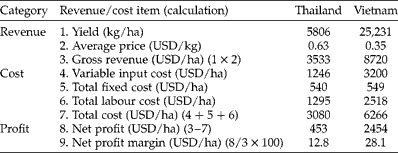
In Vietnam, the substantially higher average cost (6266 USD/ha) reflects the greater intensity of land use related to the small average farm size. Although yields are significantly higher than in Thailand, the average selling price was much lower, and the difference in gross revenues was therefore less significant than that in crop yields. The profit/ha was USD 2454 in Vietnam compared with USD 453 in Thailand. The profit margin – defined as the ratio of net profit and net revenue – was 12.8% in Thailand and 28.1% in Vietnam.
Discussion
In Thailand, farmers have only a limited interest in adopting IPM because they know very little about these methods and feel that pesticides provide an effective means of control. For an IPM strategy to succeed, it will be important that these methods do not increase on-farm costs and preferably increase profits. If it is possible to completely eliminate the use of synthetic pesticides, the cost of an IPM strategy, including the cost of own family labour, should not be more than USD 223/ha per cropping cycle (the amount currently spent on pesticides). Any additional costs need to be offset by short-term yield gains.
These monetary incentives are essential because farmers do not see their use of synthetic pesticides as a problem that needs to be solved. Creating a greater awareness about the risks to which farmers are exposed could benefit the adoption of IPM, but only in the long term. Small improvements in current pesticide handling methods, such as the use of protective gear and correct practices in the mixing of pesticides, could make a relatively large contribution to human health. An IPM training programme can build on the fact that farmers are literate, have a long experience in growing yard-long bean (18 years on average), like to experiment on their farms (as indicated by frequent changes in cultivar selection) and have a broad willingness to try IPM methods if these are provided.
In Vietnam, yard-long bean is grown on extremely small plots (750 m2 on average). This poses a challenge to the introduction of IPM methods based on biocontrol because the continued use of broad-spectrum insecticides on other crops in neighbouring plots would reduce the population of natural enemies. The use of pheromone traps as a monitoring or mass-trapping tool is also not effective unless it is practised at a community level. A further challenge lies in the fact that most growers appear to be very satisfied with the synthetic pesticides that they currently use.
An IPM training programme in Vietnam can build on the fact that farmers have a long experience in growing yard-long bean and show great interest in trying IPM methods on their farm. Most farmers have contacts with the government extension system, though private shopkeepers and pesticide traders are also influential in the farmers' pest management decision-making. There is a distinct gender pattern in activities connected with yard-long bean cultivation, with men doing most of the spraying and women doing most of the daily management; both men and women will, therefore, need to be involved in an IPM training programme.
Conclusion
A wide range of arthropod pests and plant diseases affect the production of yard-long bean in Thailand and Vietnam, but the legume pod borer (M. vitrata) is by far the most significant problem. Farmers rely almost entirely on the use of synthetic pesticides in managing pests and have only a limited knowledge of alternative methods. Most growers are satisfied with the level of control offered by synthetic pesticides, and feel that their use improves the marketability of their crop and the price they receive. Together with the very small scale of production systems, these factors pose serious challenges to the introduction of IPM methods. An IPM strategy needs to allow farmers to experiment with the methods on their farms while raising their awareness about the risk of pesticide exposure on the health of their families, consumers and the environment.
Acknowledgements
Financial support from the Federal Ministry for Economic Cooperation and Development, Germany, is gratefully acknowledged. The authors thank Dr Nguyen Van Van, Dr Nguyen Khac Quynh and Dr To Thi Thu Ha for their support. The authors also thank Dyno Keatinge, Jacqueline Hughes and two anonymous reviewers of this journal for their helpful comments, and Maureen Mecozzi for an English language check.