Disclaimer
This article is not intended to endorse or criticise specific products or suppliers. This case study looks at what worked for Baker Tilly. Each organisation's needs are different, so what worked in one scenario may not work in a different setting.
Background
Baker Tilly is a mid-tier professional services firm with over 1,000 fee earners. The client base is broad-ranging from owner managed businesses and high net-worth individuals, to charities and AIM listed companies. I joined the Firm in June 2008 and part of my role is to go around to some of the 28 offices to let them know about National Information Services (NIS) which offers research, library and intranet services, could do for them. I also went to hear about what resources they wanted. The NIS team consists of 10 people including myself. One of the needs identified was an e-mailed news service that was consistent, more widely available and had a better collection of sources.
The pre-existing service
The news service that was in place was cobbled together from a variety of sources. The service tracked key clients and targets. Our best collection of news was from a paid-for source that had two major barriers stopping us from broadening the service: firstly it had a cap on usage and secondly alerts had to be run manually due to additional costs being levied for automated searches. The manual running of the alerts prevented us from expanding the service, due to limited staff capacity and the cap on usage above a certain volume also prevented its best use.
Another tranche of the service used the UK news of a legal database. This tended to work well for major companies or widely reported events. It came in the form of a word attachment containing the full text of the article which made browsing impossible. For small organisations or charities it did not work so well. Users reported that Google news was good but too wide-ranging. They would like to know if their charity was mentioned in any major newspaper, but did not require details of every single charitable event or fun run associated with it.
For listed companies tracking the official announcements was desirable, so another service entailed setting up alerts on the London Stock Exchange RNS service and then forwarding them. We also had a digital licence to the FT and some people used this service to set up alerts on major companies.
The message that we could send out about what service we offered was therefore confused and unclear. We had to use the resources most relevant to the entity being tracked and they were not always fit for purpose. We even found that some fee earners had Google news alerts, FT.com alerts, our alerts, were tracking the company or organisation's own website and getting RNS alerts if it was listed.
The beginning
We did not have a detailed specification of what we wanted. We had a broad goal of improving the news service for end users at minimal cost. We started with our subscription content and looked at what else we could get in the market-place. Major providers of subscription based news content include:
• Factiva
• Nexis
• Newsroom from ThomsonReuters with Westlaw Watch
• OneSource
We spoke to our existing provider and explained our dilemma and the reasons for having to look at competitor products. They had a 90 day termination clause so we also notified them of our intention to cancel, but with no firm certainty that that would be the case. They were confident that their content would win the day and no better offer was forthcoming at the early stages of the negotiation. We were able to dismiss quickly some providers due to issues with the content, price or search options. That left us with one alternative to our current provider, Newsroom. Newsroom from ThomsonReuters had the attraction of being over half the price of our current news provider and it came with a bolt-on current awareness service called Westlaw Watch.
We also wanted to solve some of the other issues that users experienced with our news service offering. Trying to find a path forward into the unknown is very exciting, it relies on experience, contacts and determination to see the potential. The success of any project can also be about luck and good fortune.
• Experience had shown me an excellent software package in my time at Baker & McKenzie to deliver news content, but it was tied to just one content provider which we could not do. I wanted something similar but more flexible and cheaper.
• Contacts involved recalling what vendors had shown me, what I may have heard about in seminars and meetings and talking to colleagues. I had spoken to Alacra in the past and they were able to do some amazing things, but the content had to be in their data warehouse and both of the sets we were trying to compare were not available. I had been to an SLA event where one organisation talked about a business information portal they had developed for every desktop, but our licences would not work with that model and converting them or buying in new ones would be too costly. A message on the legal bulletin board lis-law asking about feedback on specific services and talking to fellow librarians about my plans and whether they had done anything similar, resulted in more “be sure to let me know” messages than anything else.
• Determination was then needed to find a solution where one did not currently appear to exist. Linex had demonstrated their product to me some months previously and the focus then had been on legal issues current awareness. What they offered appeared to be unsuitable, but I could see that with a few tweaks and some willingness to experiment it could offer what we wanted.
We set up a trial to Newsroom and their related product Westlaw Watch and undertook comparable searches on them and our existing provider. Due to the vast difference in price we were not expecting the same level of results from each service and were looking more at key tipping points that would rule out one service. They were:
• Distinct lack of a coverage in content in one compared to the other. We did not specify a source, as it may be that a news story was replicated in three sources and it was only necessary that we saw one of them
• Failure of the technology
• Contract terms that would not allow us to achieve our goals, particularly dissemination rights, the right to have a take down clause for key content and usage levels
The decision
This was actually easier than we had initially thought. We found subscription content sets that matched our needs combined with a software product that delivered both subscription and free content at less than the price of our existing provider. The searching on Newsroom and Westlaw Watch was clunky, but would only be seen by the research librarians so was not such a big issue. Set up time and migration of alerts was a key concern but, once this was achieved, the service had far more flexibility. Due to aggregated subscription content being subject to the vagaries of the content providers, we did not want to tie ourselves to a contract only to find out that a key source was no longer delivered via them.
At the eleventh and a half hour, despite our current provider being fully aware of why we were testing other applications, they came to us with a very good offer, which included some software that they owned which part of what we were hoping to achieve with Linex. Had they come to us at the start, we may not have invested the significant time and effort in trying to find an alternative. The timing though was not good. We had trialled the combined Newsroom and Linex option and knew it worked, whereas we did not know whether the other service would and also it did not offer quite as much as we were hoping to achieve eventually.
The new service
The new service could not have been achieved without the dedication of some key individuals in each of the organisations involved. Johanna Helmlinger, Research Librarian at Baker Tilly helped me to get the service working. Santiago Alonso at Thomson Reuters got the quirks sorted out and Matthew Dickinson at Linex responding speedily to questions, enhancement requests and dealing with technological gremlins.
It is probably easiest to explain the new service by going through the steps needed to set up an alert. We are currently using it to track companies and charities. Industries may follow in the future, but not yet.
Choosing the content
Linex allows us to mash content from a variety of sources. It is vital to check the terms and conditions of use of the product to ensure that your intended deployment does not contravene these terms. As Linex does not store the full content, but only a link and a summary, most freely accessible websites can be used with the service. Below are just a few examples of feeds and websites can be mashed within Linex:
• Pre-defined RSS feeds from free websites
○ Legal Week
○ Twitter
○ Blogs (most will have an RSS option)
• User-defined RSS feeds from free websites
○ Google news
○ BBC news
○ Twitter search
• User-defined RSS feeds from subscription content
○ Westlaw Watch with Newsroom
• Pre-defined RSS feeds from subscription content
○ Practicallaw.com
○ Lexis
• Web pages which do not have feeds but do have separate and unique pages for new content
This list is not exhaustive. I will give an example where we use Westlaw Watch, Google News and the Company's own website. Westlaw Watch includes content that you may elect to use or access elsewhere, for example London Stock Exchange Regulatory News Service announcements, Hoovers company profiles etc. With Westlaw Watch you can choose to include or exclude individual sources.
Getting started
The first step in setting up any alert is to think about the nature of the entity or combination of entities you are tracking, as Linex may already be tracking it. For example a major accountancy or law firm will already be covered by their service. Then think about where the best news will be, is it international or local, large or small? This will affect the range of sources you want or need to track.
Westlaw Watch stage
Once in Westlaw Watch you select the option to create a new clip and go through the search wizard. There are five steps.
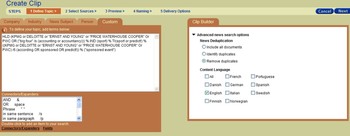
The Figure 1 shows the first stage in Westlaw Watch. The percentage sign (%) means exclude. The search is an “or” search for the Big Four accountancy firms.
First step of creating a Clip in Westlaw Watch

The remainder of the Wizard steps include selecting which combination of sources you want and at what time(s) the content is published to your chosen delivery method. From the summary view (see Figure 2) you can select the method of delivery that works with Linex and copy the link for that feed. Westlaw Watch is a news alerting service so does not have an archive beyond 90 days, but the combined subscription we have to sister product Newsroom covers the full archive. Our licence to Westlaw Watch is for up to five users, but allows for dissemination in the manner in which we are using it via Linex and allows for direct access to the full text of the articles by recipients of the alerts who are all internal Baker Tilly people.
Summary view of alerts on Westlaw Watch

Google news or twittersphere content
If deemed relevant you can then run a search in Google News, be careful though as much content can be duplicated between subscription and free content. I have checked with the NLA about using Google in this way and they said there were no additional charges on top of our existing licence, but remember that terms could change in the future.Footnote 1
Once you have run a news search in Google news, there is an RSS option at the bottom of the page and this link can be copied for later insertion into Linex. The latter does currently have a key web content search within it, but it cannot be combined with other sources, although this may be possible in the future.
An alternative to Google might be to either find a specific corporate entity on Twitter that you want to follow and get the feed from there, or do a search to get a feed more personalised to your needs and where the entity you are tracking is mentioned, not just tweeting.
Website stage
Tracking company news issued by the compnay itself may be something you want to do. Linex can track websites even if there is no RSS. Note the URL of the page, or the RSS link.
Linex stage
Linex does have search facilities within it:
• The previously mentioned key web content search (media watch)
• Deal search
• Legal current awareness
Linex indexes a huge variety of content including some other major subscription providers like PLC, together with free sources such as key government websites. In this example I am discussing Linex as a company news alerting service. We are importing some links into the content into Linex, but it may be that you found at your first step that some of the content is already tracked by Linex. There are two key areas on Linex, one for feeds and one called the Linex Directory for website tracked content.
In our example we need to add the Westlaw Watch and Google news examples to the feeds area of Linex and create a folder for those feeds to go into. Now all of the sources that you have can be pulled together into one location on Linex.
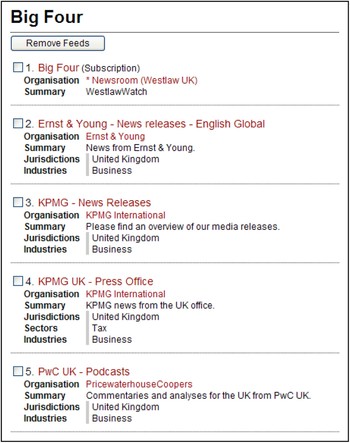
Figure 3 below shows that we have added the search from Westlaw Watch, we are tracking some key accountancy firms and also being alerted to new podcasts from PwC. (PriceWaterhouseCoopers). We can choose the edit options on the screen to add new content such as our Google feed and submit it. Linex will then send through confirmation that it is being tracked.
Linex feeds folder

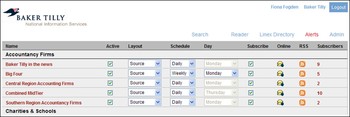
Linex is customisable and we have created folders for specific types of alerts. We have one for accountancy firms, one for charities and schools, companies etc. From the Alerts admin area, see Figure 4, you can view the list of alerts that you have set up and set the frequency. Our IT people were nervous about people being able to get an RSS link direct so only the admin people are able to view that. For end users that functionality is switched off. Being able to please internal IT people and manage their concerns has been a major boon in working with Linex. It is possible to click through to the subscriber area for each alert and add or delete recipients.
Linex admin area

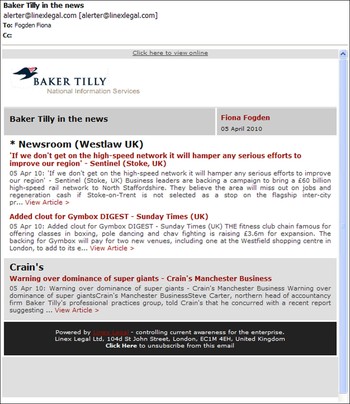
The primary function of the service for Baker Tilly is to send e-mails with summaries of new stories in them, with links to the full text, see Figure 5 over the page. However users can also login to the Linex area and view alerts, view the full archive of stories online and it would even be possible to put links from other services such as the Customer Relationship Management system (CRM) to the archive of stories.
An example of an alert with Westlaw Watch news and website news

There is an authentication option in Westlaw Watch which means that links from the e-mails will work for all recipients whilst in a Baker Tilly office, or logged on via the virtual network.
A single company alert with a Westlaw Watch alert and maybe one other website or feed will take about 20 minutes to set up. The majority of the time is spent on refining the search in Westlaw Watch. This reduces future need to tweak the results of the alert and means time is saved in the long run. If the search strategy is changed in Westlaw Watch, the feed address does not change, so nothing needs to change in Linex.
Next steps
We are gradually stopping the complementary services such as separate RNS alerts and moving users over to the combined service. We know there are improvements possible in both the Newsroom and Linex offerings and need to consolidate feedback to both providers. End users have been positive about the service and in particular marketing have been very keen users.
There are imperfections and there are irrelevant stories, but users are happy to browse a list of five results and accepting that one or two stories will not be relevant. This matches their use of RSS feeds, Google search results etc. A perfect match of stories would require returning to human intervention, but there is no money for this. To ensure quality we add one of the librarians to the e-mail distribution list so that tweaks can be made to search strategies, but the ultimate aim is that the alerts, once set up, will run themselves.
Conclusion
For the future we also need to resolve areas of concern with the IT department so that we can make wider use of the content in our CRM system and on our intranet. We have a survey going out to the entire firm about Information Services and this may also give us action points about our news service.
The entire experience of researching a suitable product, liaising with the suppliers, speaking to the users, working with fantastic team members and ultimately rolling out the service has been a hugely rewarding episode. Librarianship truly is a fantastic career.
Note
Both Westlaw and Linex have given the author permission to use the screen dumps appearing in this article.