Introduction
The development of critical thinking skills is one of the aims of the English National Curriculum for music at Key Stage 3 (ages 11–14) (DfEE, 1999); children are expected to engage in ‘responding and reviewing’, so as to ‘communicate ideas and feelings about music using expressive language and musical vocabulary to justify their own opinions’(DfEE, 1999: programme of study). Flynn and Pratt (Reference Flynn and Pratt1995) investigated the meaning and implications of the term ‘appraising’, and explored how it could be observed in music lessons. Their study of non-specialist primary school teachers enabled them to identify nine different ways in which children could be said to appraise. One of these ways was through talking about music; and so talk can be seen as an important aspect of communicating ideas and feelings about music. When children work in groups on composing projects in secondary school classrooms they develop their musical ideas collaboratively through talk, and when demonstrating children's work in progress to the rest of the class, teachers usually talk with them about the music composed. Talking about composition can thus be seen as an important part of the development of appraising skills, and of critical thinking in music.
A number of other writers have considered children and their thinking about music. Mellor (Reference Mellor2000) studied children's appraisals of each others’ compositions, analysing their responses in relation to their use of the music elements to judge the extent to which these revealed qualitative shifts in their conceptual understanding. Her results led her to conclude that by introducing too much terminology, teachers may be stifling creative and emotional ways of thinking: ‘Syntactical listening leads to analytical responses which diminish the richness of the listening experience’ (Mellor, Reference Mellor1999). Mellor values the untrained, intuitive approach to listening and criticises secondary music teachers for encouraging analytical, terminology-laden outcomes which emphasise critical responses related to the musical elements. Mellor lays emphasis on the power of music to stimulate emotional and other responses in pupils, rather than on the potential benefits of developing a musical vocabulary.
Glover (Reference Glover2000) stresses the value of helping children to become more aware of the processes they use to compose, and suggests that talk might help children to reflect in this respect. She sees the role of the teacher as providing examples of musical terminology to support children's thinking through talk about composition. Similarly, Burnard (2000a, Reference Burnard2000b) sees talk as aiding children's understanding of what they are doing in composing or improvising tasks by encouraging them to be more reflective: ‘Sharing understanding will help children to recognise why they are doing a certain activity and what they are doing, leading to an awareness of how they are doing it. Thus, by giving children the opportunity to articulate their understandings we enhance learning’(Burnard Reference Burnard2000a: 22). Campbell (Reference Campbell1998) found that children use colourful and unusual phrases to describe music, and that when they do not possess musical terminology, they often make up their own. ‘Such descriptions are valuable . . . yet they are not usually sufficient for communicating precisely what children musically perceive and know’ (Campbell, Reference Campbell1998: 216). For this an established mutually understood use of terminology is necessary.
The role of talk in the development of children's thinking, and the importance of social sharing and dialogue, have received a great deal of theoretical and empirical attention. Vygotsky (Reference Vygotsky1978) suggested that shared social behaviour gives rise to children making connections between ideas, thereby promoting greater understanding, and that talk and dialogue are essential parts of this process. New understandings emerge through Vygotsky's ‘zone of proximal development’ (Britton, Reference Britton, Murphy and Moon1989), in which learners are able to reach higher levels of understanding through interaction with the teacher. Mercer (Reference Mercer2000) has developed these ideas, proposing an ‘intermental development zone’ in which collective understandings are constantly reconstituted, as dialogue continues in relation to the activity taking place. His research with children revealed that when children are taught to discuss, their level of critical thinking and constructive language increases, and their rational, problem-solving abilities improve.
The teacher's role is also important in providing question and answer sequences to develop children's understandings, and in providing strategies for problem solving, and for making sense of their experiences. The teacher is not only a facilitator, but also has a role to play in developing children's thinking and talking. In music, the development of critical thinking skills can demonstrably be achieved via question and answer sessions involving pupils and the teacher. Although classroom talk almost always involves the use of musical terminology, it is nevertheless important not to lose sight of the intuitive response to music. When undertaking in-depth analyses of set works with advanced secondary pupils, I have often asked them to listen to a section of the music and simply to describe what they hear, and what they feel emotionally and affectively. The emerging talk can be simultaneously cognitive and analytical, involving the development of musical vocabulary, and also intuitive and affective, involving emotional responses to the music.
Swanwick (Reference Swanwick1994) has discussed this issue in terms of what he calls ‘intuitive knowledge’. His epistemological approach to educational issues rejects intuition as valuable in teaching and learning, but proposes that it has a dialectic relationship with analysis. For Swanwick, understanding how something is composed allows us to listen with a new level of meaning: he identifies a state of wordless (intuitive) thinking about music, and proposes that reflective discourse about the music will lead to new insights. His claim that thinking about and reflecting on music lies at the heart of music education is reflected in the importance of appraising in the National Curriculum in England in recent years.
The present study (Major, Reference Major2001) uses data collected from video observations of children while talking about their compositions. Different types of talk are analysed into categories, which may be related to developmental issues, and which raise the question of the existence of ‘stages’ of talk in the process of evaluating compositions. The study observes children talking in whole class lessons, in groups when working on composition tasks, and also when talking together in evaluation of their own and each others’ work. The four main issues under investigation are
(a) the nature of children's responses when talking about composing work in music lessons;
(b) the role of musical vocabulary and conceptual learning as manifest through their talk;
(c) the role of the teacher in nurturing a better quality of talk;
(d) whether children's thinking about and understanding of the music is more complex than their talk about it, as shown by their musical products.
Methodology
An action research methodology was adopted, using interpretive methods of analysis. This approach can take account of feelings and emotions, which is an important aspect of this research (Shipman, Reference Shipman1997: 37). Interpretive research lends itself ideally to the ‘progressive focusing’ necessary in action research. Theory is derived from what is observed, and is therefore derived inductively. One particular feature of action research is that the change of action that is decided upon will be unique to each situation. The changes in teaching strategies during the course of the research process are those which appear appropriate for particular contexts. The physical spaces in which children engage in musical tasks, and the relationships between the children and teachers, are unique to a particular situation and time. One purpose of the present study is to reflect on and explore the ways in which children talk about their composing. Different teaching strategies lead to new groupings and organisations of learning, and their analysis enables the teacher to formulate the next course of action for improving the contexts for children to talk when creating music.
Action research for teachers represents a form of professional development, curriculum development and evaluation. Theory is generated in order to illuminate practical aspects of the findings; but theoretical understanding has a subordinate role to the empirical research and to the project as a whole. Change or innovation is sought as a pre-condition of the research (Elliott, Reference Elliott1991). Curriculum ideas are tested through action, as the continually developing product of invention and reflection (Stenhouse, Reference Stenhouse and Hammersley1993). Action research enables the teacher to restructure the teaching strategies as a result of findings in each previous stage or cycle, such that research is classroom based, producing changes which are beneficial to teaching and learning. Often action research is undertaken by groups of participants in order to effect collective understanding and change (Kemmis, Reference Kemmis and Hammersley1993). The present study follows Stenhouse's (1993) principle of the ‘teacher as researcher’, in which the teacher develops his or her ‘capacity for autonomous professional self-development’ through systematic self-study, through the work of other teachers, and through the testing of ideas by classroom research procedures (Stenhouse, Reference Stenhouse and Hammersley1993: 32).
The present study also adopts Elliott's (Reference Elliott1991) approach in which classroom practice is linked to a realisation of values which relate to its ends or objectives. These are continually defined or redefined in the process of reflection on the practice. One main purpose in this study is to reflect on and explore the ways in which talk is used by teachers and children to further their composing work, and thereby to improve practice and to inform professional judgement. Elliott's revised version of Lewin's model of action research sees the researcher identifying the initial idea and ‘fact finding’, which in turn leads to a plan of action steps (as seen in the different stages of each cycle in the plan below). These plans are then put into practice in the classroom, and their implementation and effects are monitored and analysed: any failures or unexpected outcomes give rise to new, revised plans for the next cycle of the research.
In the present study, data were collected in real lessons: when small groups were working and being video recorded, the rest of the class were also present in the lesson. The video camera was the only unnatural part of the lesson. The fieldwork was divided into three cycles. The first cycle involved the collection of data from two whole class lessons in which the teacher was interacting with the pupils, as follows:
(1) Video-recording and analysis of transcripts from a year 8 (aged 12–13 years) music lesson in the teacher/researcher's classroom.
(2) Video-recording and observation together with analysis of transcripts from a year 7 (aged 11–12 years) music lesson taught by a colleague in the same school.
The analysis of the transcripts resulted in outcomes which determined the second cycle of the research. Here three new forms of data were collected:
(1) Video-recordings of two groups from year 7 (aged 11–12) and one group from year 9 (aged 13–14) engaged in talking together while working on a group composition without the teacher present.
(2) Teacher interviews with members from two of the sub-groups while watching the video-recordings of their composing work and dialogue.
(3) Audio recordings of five one-to-one interviews with pupils from year 11 (aged 15–16) talking with the teacher about their folios of GCSE compositions.
Following this stage of the study, a ‘typology of talk’ was derived from the data. The third cycle of the research evolved as a result of the typology, and set out to test whether younger children were able to engage with the music in such a way that they made more mature evaluative comments about musical composing work. The third cycle therefore, sought to challenge the hierarchical nature of the typology so as to discover whether a task could be designed which allowed younger children to make evaluative types of talk. This cycle involved a single strategy; four year 7 sub-groups (two groups working together at any one time) were asked to demonstrate their music to each other and to talk to each other about their musical compositions without the teacher's direct intervention.
Overview of results
Cycle 1 – whole class talk
In the first cycle of the study the dialogue appeared to be musically productive in that discussion by the teacher clearly allowed pupils to use musical terminology and also allowed pupils to move their work forward. Advice given was taken up by pupils in their musical compositions. The teacher's reinforcement of conceptual ideas and the modelling of vocabulary was strong. The teacher gave praise and adopted a positive role in accepting answers or opinions, sometimes probing for further clarification of a pupil's response. Progress was measured against shared criteria of what represents a successful outcome of the task.
In contrast, pupil talk was not extensive. Responses tended to be short, or interspersed with pauses. It was clear that in order to articulate ideas about composing work, pupils needed to feel very confident to speak out in a whole class situation. The talk was dominated by the teacher, and the quality of the pupils’ talk was poor. Talk was likely to reflect the ideas of only a small number of the children in the class. The first cycle of the study demonstrates the limitations of this environment in getting pupils to talk about their work. The musical changes and improvements to pupils’ work suggest that there is some kind of internal ‘conversation’ occurring, or that there is more productive talk occurring within small groups as they compose and make decisions about their music.
Cycle 2 – Talking individually and in small groups about composing
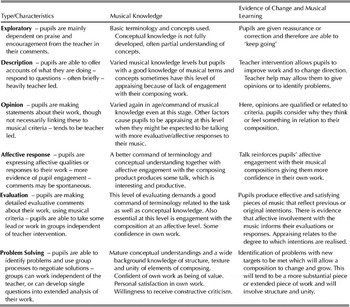
Cycle 1 revealed the need to vary the ways in which talk is ‘heard’ through the research. The variety of age groups taking part, and the different methods of observing talk, allowed a rich collection of data in this second cycle of the study. These findings are described by the formulation of a ‘typology of pupil talk about composing’, consisting of six main types, which were observed during this cycle of the research. Table 1 shows the characteristics of each of these types, along with a brief description of the musical knowledge and terminology demonstrated in each case, as well as pupils’ response in either musical outcomes or in the quality of the talk in each case.
A typology of pupil talk about composing

Development of a typology of talk
Exploratory
The most basic type of talk was observed in both the youngest and oldest pupils taking part. One of the General Certificate of Secondary Education (GCSE) pupils who was interviewed required considerable reassurance. This appeared to be a result of his lack of confidence in what he had produced. His comments were exploratory in nature. His responses to questions from the teacher were mono-syllabic and he failed to provide any analytical or evaluative responses:
Teacher Do you like it?
Pupil A Yes
Teacher You know, as a piece of music, do you like the tune?
Pupil A Yes
Teacher There is a problem with the tune?
Pupil A It's too high to sing.
Teacher Yes. What made you write this?
Pupil A You said we had to compose something for a group of instruments.
Teacher But what gave you the idea?
Pupil A I used a chord pattern that you had suggested as an example.
Pupil A was academically able, and excelled in languages, but lacked confidence in his ability as a composer. This appeared to influence his ability to discuss his own work. Another pupil in one of the year 7 groups demonstrated similar characteristics also because of her shyness and lack of confidence in talking with others.
Description
The commonest type of talk involved description. Most pupils, when asked to write about what they are doing, describe the activity. It was surprising to find that another intelligent GCSE pupil also failed to move beyond descriptive comments when talking about her work. She tended to give brief answers and where her answers were longer, they were largely descriptive. A year 7 pupil's prolonged description of what her group was doing in their performance of their composition provides a useful example of this type of talk:
We all chanted the last line quietly and then everyone chanted the last line quietly again except for Roger who said the first line. Then, while Nick was saying the second line, we all said quietly the first line then Emily said the third line and we all did the second one quietly and then everyone chanted the last line quietly again except for Roger who said the first line . . .
It was found that pupils who talk in a descriptive manner still tend to rely on the teacher to guide their musical progress. Their level of talk does not appear to relate to their overall musical ability, but may derive to some extent from their aptitude for composing.
Opinions
A third type of talk sees children giving opinions without really knowing why, or without relating ideas to conceptual learning or outcomes. For example, in cycle 1, pupils tended to say it sounded ‘good’ without offering a reason. ‘It was a good idea for Sarah to have a rest there in the music’. This may well be a valid point, but the pupil does not articulate the reasoning behind it. A qualified opinion on the same lesson was that ‘they played very well because they played like the notes were exactly in tune’. Even with 15–16-year-old GCSE pupils, who have been producing individual and extended pieces of work, some comments give opinions without reasons:
Teacher Shall we have a look at . . . I think there are a few issues here.
Pupil A Yes, I'm not happy with this one.
Teacher What are you not sure about?
Pupil A The accompaniment.
Teacher Yes, what about the accompaniment?
Pupil A It doesn't relate at all to the piece. It's all right in the second part . . . but in the first part it just doesn't seem to have the structural. . .
This extract illustrates the lack of clarity of opinion demonstrated in talk by the pupil. It is largely teacher-led, but goes further than description, and involves some explanation of the thinking behind the composition. The data showed that children of all ages are willing to provide opinions which are qualified by reasons. This was considered to be a higher level of talk than ‘exploratory’ or ‘opinion’ because pupils had to consider and evaluate their work to find a reason for their statement.
Affective
The fourth, affective type of talk stage appears to mark a more mature engagement with the music, in that pupils seem to form some kind of bond with their piece of work. Affective responses seem to occur when pupils have almost finished their work. This stage of discussion can be exciting because the pupil and teacher discuss the product on equal terms, in shared evaluations. Here the teacher talks to a GCSE pupil about his setting of Wordsworth's poem ‘The Daffodils’:
Teacher It looks as if you have used the music to illustrate the words.
Pupil B That's what I tried to do, yes.
Teacher Very good, yes – dancing in the breeze.
Pupil B Especially with the cloud – that's why I went up rather than – you know to give it a feeling of height.
Teacher The only other consideration is whether it is too high for the singer.
Pupil B I suppose I don't want to spoil the imagery that I've tried to create.
The pupil's imagery here, and his affective engagement with his music, demonstrates the important feature of interaction with the music. Talk at this level was found to demonstrate a confidence in a pupil's own composing.
Evaluative
The fifth type of talk, evaluative comments, are what teachers strive for when asking questions such as ‘What were the problems you encountered?’ or ‘Explain why that works well’. The data revealed that some year 9 and GCSE pupils were able to engage in evaluative talk. Evaluative talk often occurred when pupils produced music which reflected prior intentions and which could then be evaluated in relation to the degree to which intentions were realised. This might occur, for example, if pupils were composing a piece of music in the style of blues and then comparing it with the characteristics of a recording of a blues piece. The 13–14-year-old group, in viewing the video of their composing with the teacher, voiced some ideas which are both descriptive and evaluative:
Teacher What were the problems?
Pupil C Well, the blues bass line is restrictive but we tried to make the melody more interesting by adding two melodies going in opposite directions.
Teacher Could you have improved it?
Pupil D I think we could have added another variation or verse if we had another week to work on it.
These comments see pupils attempting to look at their work in a critical and evaluative way. Most of their comments are still largely descriptive but the indication here is that if the teacher probed further, these girls are capable of deeper evaluative comments in their appraising. Their musical responses are without doubt also affective and intuitive responses.
The data suggest that evaluative comments require an affective engagement with the music. A GCSE pupil's dialogue with the teacher demonstrates this more clearly. He is talking about a piece of music he has called ‘Question Mark’ and which uses tone-rows, a twentieth century musical technique:
Well basically I wanted to try something that was a bit more abstract. It doesn't really symbolise anything. I suppose being confused and puzzled . . . This is emphasised I think by the triplets which presumably . . . offsets it slightly. You lose the feeling of a direct rhythm a bit.
This pupil links the music to ideas. It is another example of imagery, as in the earlier extract about his work. This affective engagement with the music helps him to be evaluative and constructive in his comments.
Problem solving
The sixth and final type of talk was problem solving. Problem-solving responses were only observed in the GCSE pupils’ discussions with the teacher. Pupils at this level appear to set themselves a challenge, and set about solving it. The talk of the GCSE pupil quoted above about his work shows evidence of problem solving, in that he set himself a challenge and set about solving it in his tone row piece:
I don't know if that's going to work because sometimes the bottom tone row doesn't have enough tune.
I tried to speed it up and then slow it down – the original (tone row), sort of bring it to a height.
I tried to use syncopation but. . .
All these comments suggest problem solving is occurring. By the time they can make such reflections, pupils seem to demonstrate mature skills of musical criticism.
Cycle 3 – evaluative responses: a new approach
The third cycle of the research arose from the findings of the earlier cycles. Younger children described and readily gave opinions about their work and about the work of others, but did not demonstrate evaluation or affective engagement with it. For this reason, in cycle 3, pupils were given a task which was designed to provide some engagement with the composition, as well as to elicit more evaluative responses. The topic was imaginative – to depict a ‘spookey house’ in sound. The method of talk and discussion in this cycle was for two composition groups to work together to demonstrate their work to each other and to ask each other questions about it. This could be described as a kind of ‘peer appraising’. A number of different types of question began to emerge. These included questions about technique, such as ‘Why did you use the triangle for the chimes?’ or ‘Did you actually know what notes you were going to play on that keyboard?’. There were also representational questions about the way the music represented the story. For example, one pupil described what was happening in the story merely from listening to the music. His representation of the music was as follows:
That's the window smashing
They're walking across the floor and the tap is dripping
That's the door opening and it creaks
And that's a bang ‘cos he's dropped something.
These representations of the music were a form of ‘annotated presentation’. These were largely descriptive, with affective engagement with the story resulting in imaginative relationships between the music and what it represents. One of the reasons that this task was chosen was to enable pupils to relate symbolically to the story and the sounds. Affective engagement with the story and how it was represented in the music was strong, but talk about the music itself produced less emotional engagement. One group, however, turned their session into a kind of ‘game’, and asked their paired group to guess what their story was about as they performed it. Because of this, their resulting talk became evaluative. Close engagement with the music as audience members was evident as they were forced to analyse what was going on. Their talk demonstrated problem solving, and became much more analytical as they sought to explain what was happening in the music.
Pupil E In the music, I think there was someone walking along . . .
Pupil F Yes, (she sings the bassline).
Pupil E Something happened at the end . . . It was sort of like there's someone walking along and then all of a sudden someone grabs them, or something like that . . .
Pupil F What made you think that?
Pupil E The music became loud and fast and sounded annoyed.
Pupil F What could we have improved?
Pupil G I think the chimes could have been a lot slower.
Pupil F Do you think we should have more instruments?
Pupil E The chimes should be slower to make it eerie . . . It was low for a chime.
Using an imaginative task to allow pupils to guess what is happening allowed pupils to engage more affectively with the subject and the music, and to be more analytical in their responses. Evaluative responses were typically provided by children in the 11–12 years group.
Discussion of the findings and their implications for classroom teaching
An interesting but maybe not surprising outcome of this study is the suggestion that children's capacity to talk about what they understand is far more limited than the understandings which are demonstrated in their music. One of the problems of researching talk is that it has a ‘thinking’ element which can only be evaluated by the evidence of spoken or written word, through musical demonstration or through other art forms, such as drawings or poems. When pupils talk about their own or others’ work in a whole class setting, there are many factors which might affect what they say. Whole class talk, for the purposes of monitoring and feedback, is extensively used in current good practice. However, talk for the purposes of developing critical appraisal skills needs a sensitive context, and the lack of ability to articulate in whole class settings cannot be used as the sole indicator of the level of maturity of thinking or conceptual understanding. It has been suggested in this study that classroom dialogue can contribute to the development of conceptual understanding when pupils are engaged in practical tasks, and helps them to make sense of what they are doing. The results confirm the idea that children's understanding is greater than their talk may suggest.
Talk can clearly promote the collective progress of the work and the teacher, and in Vygotskian terms can bridge the ‘zone of proximal development’ (Vygotsky, Reference Vygotsky1978) in bringing about significant learning experiences through discussion with a pupil. Clearly the value of this kind of talk is useful in helping pupils to develop conceptual understandings through practical exploration and clarification of that understanding through discussion. In this sense, talk is viewed as an explicit form of thinking. The results of this study suggest that talk can be progressive in quality if nurtured and focused upon in composing lessons. Teachers can encourage the development of appraising skills through written self evaluations or through questions posed in collective peer evaluations.
The typology of talk in Table 1 implicitly suggests that children develop in their thinking and talk by moving from descriptive evaluations to providing opinions, although it may be that these modes of thinking occur simultaneously. The higher level skills involve pupil ownership and engagement with their work, where opinions are given with reasons and justification, and where evaluative comments are backed with a good command of musical vocabulary and conceptual understanding. It is this affective and evaluative progress that teachers might try to develop in pupils in order to develop their skills of musical thinking further. Cycle 3 in this study suggested that one way of encouraging higher level evaluative appraising skills is to involve pupils in peer evaluation by using an imaginative task. Further research might explore written evaluations of work: joint appraisal of finished compositions, and of the talk between a teacher and a pupil, might also be usefully explored to assess the use of terminology and evaluative appraising skills. The ‘typology of talk’ is not intended to be hierarchical but rather that children build on previous skills to reach more mature ways of thinking and talking.
Since talk is one of the means by which critical thinking is outwardly expressed, the development of talk is important. While this can be developed in responses to recorded music, it would seem appropriate, with younger pupils, that appraising could be developed most usefully through their own work, in which relevance and ownership is likely to be found. The idea of evaluating pupils’ own work has recently been adopted by examination boards, requiring candidates to appraise performances of their own compositions as part of their assessment (AQA, 2005).
This study has considered the talk surrounding composing tasks, but has not dealt with the compositions themselves. Further research might explore the relationship between the dialogue and musical progress in a composing task. This would involve looking more closely at the musical changes and not just the verbal development. Dialogue can link together the performing, composing, and listening components of the curriculum when children are encouraged to make sense of what they learn. Further research might also explore the links between talk about pupils’ own composing work, and that about the recorded music of established composers, and thereby throw some light on the extent to which appraising skills can be developed through critical, reflective thinking. The typology of talk presented in this paper represents a first attempt, and deserves further testing and development on larger and more varied samples, engaged in a wider variety of activities.