Introduction
This article focuses on the support of childless older Europeans and the links between informal support by the social network and formal support from social service providers in times of demographic change. Up to now, a plethora of comparative European studies have studied older parents and shown that most informal support is exchanged with their adult children (e.g. Attias-Donfut, Ogg and Wolff Reference Attias-Donfut, Ogg and Wolff2005; Brandt and Deindl Reference Brandt and Deindl2013; Deindl and Brandt Reference Deindl and Brandt2011; Hank Reference Hank2007; Igel and Szydlik Reference Igel and Szydlik2011). In the light of recent developments such as low fertility, rising childlessness (Hayford Reference Hayford2013; Rowland Reference Rowland2007) and longer lifespans (Oeppen and Vaupel Reference Oeppen and Vaupel2002), we however still know surprisingly little about childlessness (Herlofson and Hagestad Reference Herlofson and Hagestad2011), not least what it entails for support networks in older age.
Even though childless people may be a diverse group, they surely have one thing in common: they cannot rely on children when in need of support. Our research questions are: (How) is the lack of children in the support network compensated in older age? Who provides support across Europe? What role does social policy play, and how is informal and formal support for childless older people linked? Adding to the literature on the interplay between formal and informal support in Europe (e.g. Bolin, Lindgren and Lundborg Reference Bolin, Lindgren and Lundborg2008; Bonsang Reference Bonsang2009; Litwin and Attias-Donfut Reference Litwin and Attias-Donfut2009; Suanet, Broese van Groenou and van Tilburg Reference Suanet, Broese van Groenou and van Tilburg2012), we thus focus on the support mix for childless older people specifically.
We assess the support networks of older people in different European welfare states based on the Survey of Health, Ageing and Retirement in Europe (SHARE, www.share-project.org). We compare childless elders to parents in regard to informal support from social network members and assess the links between private support and the availability and usage of formal support – and thus focus on the influences of different European contexts on the support mix childless older people receive. The remainder of the article is structured as follows: we give an overview of recent research and empirical results to derive our hypotheses before introducing the data. Our analyses focus on the links between informal and formal support of older Europeans with and without children. The article then concludes with a discussion and future research prospects.
Background
Lack of support for childless older people?
In Western societies people today do not only live longer but also healthier – at least depending on the health indicators selected (Crimmins and Beltrán-Sanchez Reference Crimmins and Beltrán-Sanchez2010). However, independent of the fact that frailty might not rise as much as mortality declines and people can spend more healthy life years, getting older often links to higher needs for support with (instrumental) activities of daily living ((I)ADLs). Especially support with intimate needs such as care in older age is usually taken over by the close ‘support convoy’ (Antonucci and Akiyama Reference Antonucci and Akiyama1987; Kahn and Antonucci Reference Kahn, Antonucci, Baltes and Brim1980) – in most cases the spouse or children (e.g. Haberkern and Szydlik Reference Haberkern and Szydlik2010). Childless older people might not only lack informal support due to the absence of children, but also because childlessness is often associated with being single (e.g. Keizer, Dykstra and Poortman Reference Keizer, Dykstra and Poortman2010). Two things may compensate for this: one is more informal support from the extended social network, which childless people appear to be more engaged in (Dykstra Reference Dykstra2006), and the other is more formal support from health care and social services (Larsson and Silverstein Reference Larsson and Silverstein2004).
Reasons for childlessness and differences to parents
Studies about childless people up to now mainly deal with three different aspects: reasons for childlessness, wellbeing of childless people and consequences of childlessness for individual networks (Albertini and Mencarini Reference Albertini and Mencarini2014: 332). ‘There are different “kinds” of childlessness and … the heterogeneity among the childless reflects a variety of pathways into this state’ (Hagestad and Call Reference Hagestad and Call2007: 1339). Childlessness may, for example, result from a free decision or it might be the involuntary consequence of not having a partner or of biological problems. Abma and Martinez (Reference Abma and Martinez2006) found that in the age group between 35 and 45 in the United States of America (USA), people without children represented a minority of only seven per cent and voluntary childlessness was more prevalent than involuntary childlessness. They also found that childless women had more work experience and that higher-educated women delayed childbearing. For more religious women, childlessness was less of a voluntary decision. Other studies concluded that ‘pathways of the childless were more often characterized by late starts in independent living, education, and marriage’ (Hagestad and Call Reference Hagestad and Call2007: 1358), and childlessness sometimes resulted from a priority given to work (DeOllos and Kapinus Reference DeOllos and Kapinus2002). People who were voluntarily and involuntarily childless accordingly also differed in their later-life wellbeing (McQuillan et al. Reference McQuillan, Greil, Shreffler, Wonch-Hill, Gentzler and Hathcoat2012).
Research has provided mixed results regarding differences in individual characteristics of parents and childless people partly depending on the cultural background and the specific samples (cohort, age, gender). Differences in social and personal resources were often very small (e.g. Keith Reference Keith1983a ), and partly due to other factors related to childlessness such as partnership histories (e.g. Keizer, Dykstra and Poortman Reference Keizer, Dykstra and Poortman2010). According to data from the Netherlands, fathers between 40 and 59 had higher incomes than childless men, but their higher wellbeing was based on their partnerships (Dykstra and Keizer Reference Dykstra and Keizer2009). Both childless women and men in the Midwestern USA were not disadvantaged in terms of the availability of social support in very old age (Keith Reference Keith1983b ). Overall, we thus see relatively little differences between parents and childless people in regards to their economic, psychological or social wellbeing (e.g. Hank and Wagner Reference Hank and Wagner2013). But, in any case, social networks are composed differently, as will be seen in the next paragraph.
Support networks of parents and childless people
The existing literature focuses on three aspects of childlessness and later-life social networks: general differences in the structure of social networks (such as size, composition, etc.), and childless people as support givers and as receivers of support. Albertini and Kohli (Reference Albertini and Kohli2009) found that networks of childless elders in Europe were more complex and consisted of more non-kin and extended family members than parental networks. Even though lifetime childless people seemed to be more engaged in peer networks, they were ‘at a greater risk for social isolation in late life than parents’ (Dykstra Reference Dykstra2006: 762–3), with smaller networks on average (due to missing children or the death of peers in older age).
Although monetary transfers of childless people to their social network were less likely and less generous in Europe, they still gave substantial private financial support (Albertini and Kohli Reference Albertini and Kohli2009). In the USA, childless people gave more money to parents, relatives, friends and charities (Hurd Reference Hurd2009: 1224). In addition, there are indications that childless older people are more involved in voluntary and charity work (Albertini and Kohli Reference Albertini and Kohli2009) – however, this does not seem to hold everywhere (e.g. childless men in the Netherlands; Dykstra and Keitzer Reference Dykstra and Keizer2009).
Some studies find that childless older people are at higher risk of unmet support needs (for Britain: Gray Reference Gray2009; for Sweden: Larsson and Silverstein Reference Larsson and Silverstein2004), not only because of lower and faster declining availability of informal support, but also because of ‘substantial qualitative differences’ (Johnson and Catalano Reference Johnson and Catalano1981: 617) of support and care even if missing kin is compensated within the network. For example, childless women in England ‘were more likely than mothers to receive help from friends but even so had lower odds of receiving help from any informal source’ (Grundy and Read Reference Grundy and Read2012: 742). Childless people seemed to subjectively lack support in times of illness more than parents, however, they were not more likely to use social services than their counterparts when controlling for other important predictors such as availability of information about informal support (Choi Reference Choi1994). Support deficits were not even compensated by formal public services in a developed welfare state like Sweden (Larsson and Silverstein Reference Larsson and Silverstein2004).
Links between formal and informal support?
Based on recent research, we expect that support networks of childless elders entail significantly more friends and extended family members than the support networks of parents. However, it can be doubted that these social ties are able (and willing) to compensate for all necessary support tasks, and especially the more intense ones. It is first and foremost the close ties such as partners and children who help with regular and intense tasks. Moreover, when support involves medically demanding care or the regular provision of meals and so forth, professional providers are likely to come into play.
Most comparative research on the links between formal and informal support up to now focuses older parents and their adult children. The interplay between such types of support should, however, also be considered concerning the broader social networks of older people with and without children. Generally, formal support by professionals might substitute for informal network support and thus is expected to crowd out private support in developed welfare states where more support is provided – and covered – by public or publicly sponsored agencies (e.g. Reil-Held Reference Reil-Held2006). Others object that ‘there is more to receiving than needing’ (Künemund and Rein Reference Künemund and Rein1999) and private support is crowded in due to reciprocal, emotional and altruistic reasons when more (public) resources are available for redistribution – and empirical evidence accordingly suggests that more formal support is linked to more informal support (e.g. Deindl and Brandt Reference Deindl and Brandt2011). In the case of parents, it was shown that they rely on their offspring in terms of support, and public spending in developed welfare states enables parents and children to support each other financially and with hands-on-help (Kohli Reference Kohli1999). Overall, state and family seem to work together, taking over different, complementary tasks for people in need of assistance (e.g. Attias-Donfut and Wolff Reference Attias-Donfut, Wolff, Arber and Attias-Donfut2000). The two contradicting hypotheses – crowding in and crowing out – could thus be unified by applying the ‘complementarity’, ‘mixed responsibility’ or ‘specialisation’ theses (e.g. Brandt Reference Brandt2013; Daatland and Herlofson Reference Daatland, Herlofson, Lowenstein and Ogg2003; Litwak Reference Litwak1985; Motel-Klingebiel, Tesch-Römer and von Kondratowitz Reference Motel-Klingebiel, Tesch-Römer and von Kondratowitz2005). Studies which considered different support tasks or looked at the likelihood and the intensity of intergenerational support separately found that professional providers typically took over the more demanding, intensive, regular support, while children took over more sporadic, less-intensive support – and thus, at least across Europe, sporadic informal support for older parents was crowded in, but intense informal support was crowded out (Brandt and Deindl Reference Brandt and Deindl2013). Formal service providers often took over regular, demanding tasks such as, for example, daily care. Children then provided sporadic additional help such as gardening, errands and so on; especially when there was no spouse who typically takes over the more regular and intense support tasks (e.g. Brandt, Haberkern and Szydlik Reference Brandt, Haberkern and Szydlik2009).
This complementarity between formal (state and market) and informal support is also expected when focusing on the social networks of childless elders in comparison to parents: (single) childless elders are then likely to use formal services more than parents to compensate for the lack of close network relations. Moreover, support intensities are expected to be lower in terms of informal support for childless older people whereas formal and combined support is expected to encompass more hours than in the case of parents. The hypothesis on the micro-level is: childless elders receive less intense informal and more (intense) formal support than parents and therefore compensate for the lack of children by (a) receiving more sporadic informal support by less-close relations such as the extended family, neighbours and friends, and (b) using more intense formal support than parents who receive intense support more likely by their children (and partners). Moreover, we expect informal support to be more likely but less intense in countries with higher service provision, where the individual uptake of formal support is expected to be higher. We will assess these hypotheses comparatively for representative samples of Europeans aged 50 and over, focusing on individual use of formal (paid or publicly provided) support and the availability of social services in different countries. We will thus use the comparative nature of the data to see whether individual-level differences partly arise due to different social policies. We will, in a first empirical step, describe informal support networks and the use of formal household help, meals-on-wheels and care before focusing on the mix of formal and informal support of older childless people and parents in Europe. In the multivariate multi-level models we will introduce a well-established context indicator for social service supply (see e.g. Brandt and Deindl Reference Brandt and Deindl2013) to measure the availability of formal alternatives to informal support on the country level in a comparable way and predict the support mix received on the individual level.
Method
Data
Our research is based on SHARE, a cross-national data-set of the population aged 50 and over from 12 European countries (for details, see Börsch-Supan et al. Reference Börsch-Supan, Brandt, Hunkler, Kneip, Korbmacher, Malter, Schaan, Stuck and Zuber2013), including two Scandinavian (Sweden and Denmark), six Continental European (the Netherlands, Belgium, France, Germany, Austria and Switzerland), three Mediterranean (Spain, Italy and Greece) and one post-socialist country (Czech Republic). We use baseline interviews of a pooled sample of the first two waves of SHARE because our dependent variables were only asked in these rounds. In the case of Greece and Switzerland, we only use information of the second wave because the dependent variables were only available for the second round of SHARE. Ireland and Poland did not provide all necessary information for our analyses and were therefore dropped (Ireland did not provide information about income and wealth and Poland did not provide information about formal care). Sample statistics can be found in Table 1.
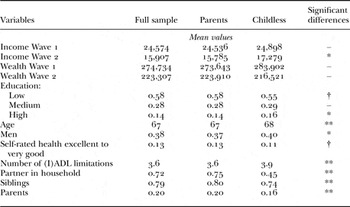
Characteristics of parents and childless elders

Note : N = 14,394 respondents (12,964 parents, 1,430 childless).
Source : SHARE Waves 1 and 2, only (instrumental) activities of daily living-limited.
Significance levels : † p < 0.10, * p < 0.05, ** p < 0.01.
Dependent variables and samples
Informal support
The first part of our dependent variable is the occurrence of help from outside the household: ‘Thinking about the last 12 months, has any family member from outside the household, any friend or neighbour given you or your husband/wife/partner any kind of help listed on this card?’ Help listed consisted of three different types: personal care, practical household help and help with paperwork. All three were here considered informal support (for a differentiation of different support types, see e.g. Brandt, Haberkern and Szydlik Reference Brandt, Haberkern and Szydlik2009). The support questions were answered by a ‘family respondent’ providing answers about him- or herself and the partner. In the case of couples, the values were transferred to both partners.
Formal support
The second part of our dependent variable indicated whether respondents had received any formal care: ‘During the last 12 months, did you receive in your own home any of the kinds of care mentioned on this card?’ The list included professional, paid nursing or personal care, professional or paid home help for domestic tasks that one could not perform due to health problems, and meals-on-wheels. Every individual was asked separately. We restricted our sample to respondents who reported at least one difficulty with (I)ADL (1: Dressing, including putting on shoes and socks; 2: Walking across a room; 3: Bathing or showering; 4: Eating, such as cutting up your food; 5: Getting in or out of bed; 6: Using the toilet; including getting up or down; 7: Using a map to figure out how to get around in a strange place; 8: Preparing a hot meal; 9: Shopping for groceries; 10: Making telephone calls; 11: Taking medications; 12: Doing work around the house or garden; 13: Managing money, such as paying bills and keeping track of expenses) since the use of formal support is necessarily linked to a need. Drawing on the information concerning informal and formal support, we distinguished between respondents who received no support, only informal support, only formal support, or combined formal and informal support.
In a second step, we considered the intensity of these different support types by recording the hours per week respondents received informal support, formal support and combined informal–formal support. In the case of informal support, respondents were asked how many hours they had received help on a typical day, in a typical week, in a typical month or in the last 12 months. For formal care arrangements, respondents were asked how many hours they had received nursing care or help by (paid) professionals. Meals-on-wheels were dropped for this analysis due to missing information on hours. From this information, we calculated the average logarithmised hours per week of the specific support type received by a respondent.
Independent variables
In our analyses respondents were defined as childless if they had no living children, without distinguishing further between respondents who never had children and respondents who outlived their children (roughly 3% of childless elderly in the SHARE sample) as in this study we are not concerned with the reasons for (not) having children but with the availability of children in the network in older age.
Controls
In order to adjust for the differences between parents and childless older people and to capture the independent effects of childlessness, several controls were introduced in our models. Socio-economic resources might be important factors for the usage of informal and formal care. Not only might it be easier to arrange for formal care if you are able to pay for it but also if you know how to apply for services. Moreover, private social contacts might support you because they can expect (financial) rewards later on. These factors are captured in our models by income, wealth and education. We used indicators of country-specific purchasing power-adjusted equivalent income and wealth 5 per cent quantiles based on the mean of five imputed values in euros in order to be able to compare the values across countries and waves (the income measures changed between waves from gross to net as can also be seen in the descriptive statistics in Table 1). Education was categorised into three International Standard Classification of Education (ISCED) groups: low (ISCED 0, 1, 2), medium (ISCED 3, 4) and high (ISCED 5, 6).
In addition, age and gender are important demographic variables, not least because social network composition as well as health problems vary over the lifecourse and between men and women. Moreover, older men often receive care by their spouses while their female partners have to rely on formal care later on because of their longer life expectancy. Health was measured via self-rated health ranging from excellent to poor (1–5) and the number of limitations with (I)ADLs. Self-rated health is often used to measure the general health status of respondents (Simon et al. Reference Simon, De Boer, Joung, Bosma and Mackenbach2005), while the (logarithmised) number of (I)ADL limitations is best suited to capture the intensity of care needs in the generally (I)ADL-restricted sample.
The existence of available social network resources in terms of family ties was introduced by separate indicator variables. Siblings are important because they often help each other, and parents might also still help their offspring – even in very old age. The most important support network, however, is the partner, whereby being married is not as crucial as living together. We thus distinguish between partners living together and respondents not living with a partner.
The countries in our study can be categorised in three ‘support regimes’ in terms of assistance for citizens in need (Brandt Reference Brandt2013): Southern and Eastern Europe with comparably low services and investments, Continental Europe with medium social expenditure and service supply, and the Scandinavian countries offering the most comprehensive public support for people in need. Social service provision was operationalised as the percentage of employees in health and social services in 2004 according to the third revision of the International Standard Industrial Classification sector N (United Nations 2012), retrieved from the Organisation for Economic Co-operation and Development (OECD 2007) to be comparable between countries. This measure is the best contextual complement of informal support as measured in SHARE which is available for all countries under study (also see e.g. Brandt and Deindl Reference Brandt and Deindl2013).
Following a descriptive overview of family sizes in Europe and the links between childlessness and patterns of support receipt, our multivariate analyses assessing the links between informal and formal support adjust for non-independence of observations on the country level by using multi-level estimations (for methodological details, see e.g. Hox Reference Hox2002; Snijders and Bosker Reference Snijders and Bosker1999). The analyses presented are multinomial and linear two-level regressions (level 1: individual; level 2: country) predicting the receipt of different support types as well as their intensities in terms of hours compared to not receiving support at all within different social service contexts; the effects of independent variables are displayed by coefficients.
Results
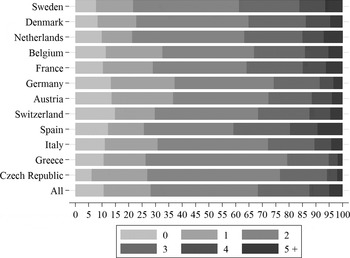
Every tenth person in the SHARE sample of people aged 50 and over had no children, as can be seen in Figure 1. This ranged from 6 per cent (in the Czech Republic) to 15 per cent (in Switzerland). Childlessness was lower in the Northern countries whereas the rest of Europe was close to the 10 per cent mean.
Percentage of respondents with zero to five or more children by European country.

Table 1 displays the differences between (I)ADL-limited parents and childless older people across Europe regarding the socio-economic characteristics discussed above. At first glance it might be astonishing that we found no wealth and only small income differences (in Wave 2; and thus the net values) between the two groups, especially since many studies report changes in wages after parenthood (e.g. Kmec Reference Kmec2011; Koslowski Reference Koslowski2011; Kühhirt and Ludwig Reference Kühhirt and Ludwig2012). In terms of equivalent household incomes, however, different income trajectories of men and women equal out at least in the second half of life: while fathers tend to work and earn more than their childless counterparts, mothers tend to earn less than non-mothers. The (however small) educational bias can be explained by the fact that better career chances and higher labour market attachment of the better educated are linked to lower investments in family life in terms of becoming a parent (at least for females) as other studies discussed above have shown. We thus find only little differences between parents and childless older people in terms of socio-economic status. Significant differences however existed for age, gender, self-rated health, the number of (I)ADL limitations, and not least for social networks (existence of a partner, siblings, parents alive). As previous research showed, social networks of childless people differ considerably from parental networks. The most important difference is a lower likelihood of having a partner living in the household when being childless.
Informal support
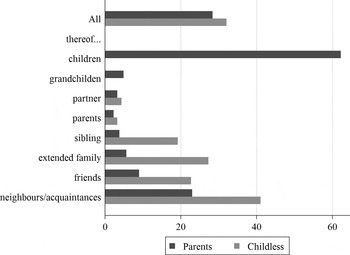
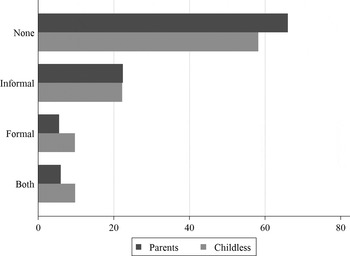
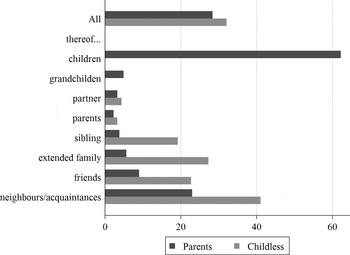
It is not only important if social contacts are available but also what support they provide. Thus, Figure 2 displays the support received from different network partners outside the householdFootnote 1 during the last year across all countries. Roughly 30 per cent of the SHARE respondents received some kind of informal help. Childless elders received (any kind and intensity of) informal support from outside the household more than parents. When looking at the composition of the support network, we found that children were the main external source of support for their parents, with over 60 per cent of the help received from children. For childless elders, siblings, the extended family (aunts, uncles, etc.), friends and neighbours compensated for the absence of the closer support network and took over support. We do not know, however, if this support met requirements and if the more challenging tasks, like body care for example, were also taken over by those more distant contacts. Moreover, it has to be noted that people living without a partner might need more support from outside the household than their counterparts and this is often linked to childlessness as we saw in the descriptive statistics (Table 1) – these issues will be disentangled in the multivariate analyses below.
Informal support received (%).
Formal support
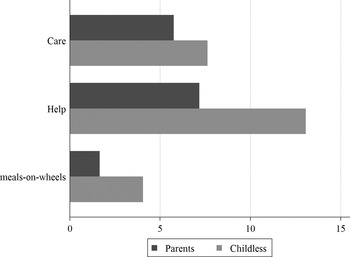
The use of professional services included three different aspects: care, help with household tasks and meals-on-wheels. Figure 3 provides two basic insights: professional (public and paid) services were not commonly used across Europe (between 2 and 13% depending on task and group) and childless elders used them more often than parents. The differences were greatest for help and meals-on-wheels, where the usage of formal support was about twice as likely for childless older people; but we also found significant differences for care, even though such services were also relatively often used by older parents.
Formal support received (%).

Links between informal and formal support
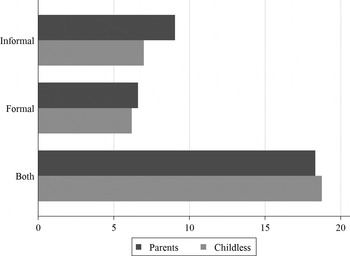
Figure 4 displays the different support mixes received (informal, formal, or combined formal and informal support). Childless older people were more likely to receive support than parents, and this is because they used formal support and a combination of informal and formal support more often than parents. Considering the mix, we also see almost no differences regarding (only) informal support between parents and childless elders due to more combined support used by childless elders. Moreover, according to Figure 5, informal support for parents entailed significantly more hours per week – supporting the assumption that children take over more support hours than other contacts outside the household.
Informal and formal support received (%).

Intensity of informal and formal support (average weekly hours).

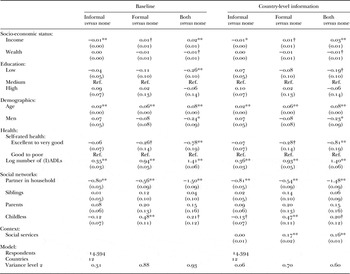
In the next step we predicted the probabilities of receiving informal support, formal support or a combination of both compared to not receiving support at all in a multivariate setting. The multinomial multi-level model presented in Table 2 shows that while wealth played only a minor role, household income mattered: the higher the income, the less likely informal, and the more likely formal or combined support. Accordingly, respondents with lower education were less likely to receive combined support.
Formal and informal support received (likelihood; multinomial multi-level models, logit)

Notes: Ref.: reference category. (I)ADL: (instrumental) activities of daily living. Standard errors in parentheses.
Source: SHARE Waves 1 and 2, Organisation for Economic Co-operation and Development, only (I)ADL-limited.
Significance levels: † p < 0.10, * p < 0.05, ** p < 0.01.
Not surprisingly, with higher age all forms of support but especially formal and combined support became more likely. Men tended to be less likely to receive combined support than women. Moreover, a better self-assessed health was linked to a lower likelihood of formal and combined support. The need in terms of the number of (I)ADLs is one of the most decisive factors for support receipt, and especially for the uptake of formal and combined formal and informal support.
Respondents living with a partner were not surprisingly much less likely to receive any support from outside the household. To the contrary, having siblings or parents alive had no significant influence on support received.
Controlling for and independent of all these socio-economic, demographic, need and network factors, childless older people were more prone to use formal support and a combination of formal and informal support – thus, formal services seem to play a significant role compensating for the lack of children. Not least, a higher social service supply on the country level was linked to a higher take-up of formal but also combined support within the household.
Support intensities
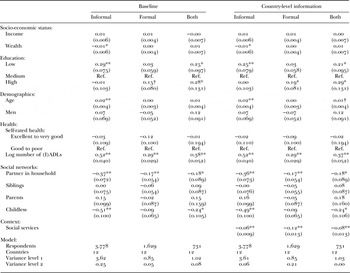
According to the linear multi-level models displayed in Table 3, income had no influence on the intensity of support measured in terms of weekly hours of support received, and wealth was linked to fewer hours of informal support. Accordingly, the lower-educated received more informal and combined support hours, whereas the higher-educated seemed to rely more on time-intense formal and combined support. Being older not only meant people were more likely to receive all support types but also significantly more hours of informal support. No differences could be found for gender – once support was received the hours for men and women did not differ. In terms of physical needs, self-perceived health was not as important as a higher number of limitations which meant significantly more hours of all support types.
Intensity of formal and informal support (weekly hours; linear multi-level models, regression coefficient)

Notes: Ref.: reference category. (I)ADL: (instrumental) activities of daily living. Standard errors in parentheses.
Source: SHARE Waves 1 and 2, Organisation for Economic Co-operation and Development, only (I)ADL-limited.
Significance levels: † p < 0.10, * p < 0.05, ** p < 0.01.
Living with a partner was naturally also linked to fewer hours of any kind of support from outside the household; the existence of family members outside the household, however, had no influence on the intensity of support. Not least, childless older people received fewer hours of informal and fewer hours of combined support – hinting that their informal network does not compensate for time-consuming support tasks. On the macro-level, we found a crowding out of social support hours on the micro-level by public social services. In more generous welfare states, the different support types encompassed fewer hours on average.
Discussion
Even though older people today exhibit relatively low levels of childlessness (Dykstra Reference Dykstra and Whitbourne2015), the number of childless older people in Europe is a relevant group amounting to around a tenth of the population and is expected to grow considerably in the future (e.g. Rowland Reference Rowland2007). Moreover, frailty levels are expected to be growing due to ageing populations.Footnote 2 We thus wanted to find out if there is compensation for the lack of children as well as complementarity of formal support by professional providers and informal support by family and other contacts in the case of childless elders – and not least how social policies matter in meeting the (growing) support needs of (rising numbers of) frail childless older people.
Older parents receive most informal support (from outside the household) from adult children as a plethora of studies has shown before (most recently, e.g. Brandt Reference Brandt2013), underlining the function of children as a safety net in older age in Europe. Childless elders compensate for the lack of close ties with children (and often also partners) with their extended family, friends and neighbours across all European countries – thus, compensatory mechanisms seem to work, at least in regard to the likelihood of receiving sporadic help from outside the household. However, when becoming frail and dependent on support, these extended network ties cannot compensate intensifying support needs. This is when formal support – and the social service context – comes into play. Overall, childless older people use more formal and a mix of formal and informal support than parents. There are no significant differences in the likelihood of (exclusively) informal support received between childless people and parents, but parents receive more hours of informal support. Thus, although childless older people generally seem to have a functioning support network, they are more likely to experience a care gap when becoming frail and depending on intense (time-consuming) support – especially when there is no formal support available to compensate for the lack of children as, for example, in Southern European countries.
These support differences between parents and childless elders remain robust in multivariate multi-level models. Even when controlling for a variety of important covariates on the individual and country level and considering the presence or absence of a partner in the household, childless older people take up more formal support. Moreover, in countries where social service provisions are higher, such as in Northern Europe, professional and combined support is generally more likely. However, when more (formal and informal) providers share the support needed, each single provider has to invest fewer hours.
So far much has been written about crowding in and crowding out and the complementarity between the family and the state – but almost exclusively only based on intergenerational solidarity and transfers between older parents and their adult children.Footnote 3 Based on our results, the discussion can be extended to the complementarity between informal support for childless older people and formal support by public providers: within the social network, the lack of children is compensated via sporadic less-intense support taken over by the extended family, neighbours and friends. Formal services typically come into play when support needs are higher, presumably taking over the more challenging tasks for frail older persons. Thus, generally, informal and formal support seem to work hand in hand – and this might even be beneficial for public spending: a generous welfare state goes along with more combined support, and less-intense public support is needed because responsibilities are shared between formal providers and informal social networks. So even though trends in terms of childlessness and support needs are not completely clear, future challenges are likely to be met best by generous welfare states.
Still, more evidence is needed when it comes to the specific tasks different providers take over – unfortunately, the low number of observations (childless people depending on help and receiving different forms of support as assessed in SHARE) did not allow for reliable analyses here. We were also not able not assess developments over a longer period of time, and causalities cannot easily be determined, especially when it comes to the macro–micro-links: how do social networks react to changes in service provision and how did service provision evolve based on the underlying support culture? Moreover, and even though we did assess individual formal service uptake directly, we could only provide contextual evidence based on a very broad indicator of the general provision of services and we could not distinguish between public (state) and paid (market) support. As soon as more comprehensive indicators become available for a larger set of countries, more detailed characteristics of social service regimes and care legislations can be assessed – maybe even for a larger set of SHARE countries if the survey continues to add countries. Last but not least, we would like to assess further whether support needs were (un-)met by a specific arrangement in order to qualify our conclusions better, but unfortunately the SHARE data do not provide information about support sufficiency (yet).
These issues provide no argument, however, to generally doubt our main conclusion: it is necessary to develop formal (public and paid) services to compensate for the expected future lack of informal support by a diminishing number of younger people who are willing and able to take over support for an absolutely and relatively higher number of frail elders, especially when they are single and childless.
Acknowledgements
This paper uses data from SHARE Waves 1, 2, 3 (SHARELIFE), 4 and 5 (DOIs: 10.6103/SHARE.w1.260, 10.6103/SHARE.w2.260, 10.6103/SHARE.w3.100, 10.6103/SHARE.w4.111, 10.6103/SHARE.w5.100), see Börsch-Supan et al. (2013) for methodological details.* The SHARE data collection has been primarily funded by the European Commission through FP5 (QLK6-CT-2001-00360), FP6 (SHARE-I3: RII-CT-2006-062193, COMPARE: CIT5-CT-2005-028857, SHARELIFE: CIT4-CT-2006-028812) and FP7 (SHARE-PREP: N°211909, SHARE-LEAP: N°227822, SHARE M4: N°261982). Additional funding from the German Ministry of Education and Research, the U.S. National Institute on Aging (U01_AG09740-13S2, P01_AG005842, P01_AG08291, P30_AG12815, R21_AG025169, Y1-AG-4553-01, IAG_BSR06-11, OGHA_04-064) and from various national funding sources is gratefully acknowledged (see www.share-project.org).