I. INTRODUCTION
Aluminum nitride (AlN) is an attractive ceramic material for packaging and microelectrical substrates due to its high thermal conductivity [200–320 W/(m K)], low dielectric constant (9), high volume resistivity (1011 Ω m), low thermal expansion coefficient (2.6–5.5 × 10⁻⁶ K−1), good mechanical strength, non-toxicity, and wide band gap (6.2 eV). Reference Kim1,Reference Paul, Song, Lee and Lee2
AlN powders have been produced using techniques such as a solid–solid reaction via a carbothermal reduction method that reduces Al2O3 or Al2SiO5 with carbon in a N2 environment at 1650–1800 °C, Reference Selvaduray and Sheet3,Reference Fu, Zhou, Chen and Wu4 liquid–liquid reaction via organometallic precursors (such as [(CH3)2AlNH2]3) reacting with liquid NH3 at 1000 °C, Reference Selvaduray and Sheet3 chemical vapor deposition reaction of gaseous AlCl3 and gaseous N2/NH3 at 1200–1400 °C, Reference Selvaduray and Sheet3,Reference Wang, Tsai and Wu5 liquid–gas reaction of metal Al powder via direct thermal nitridation with N2 gas at 1000–1400 °C, Reference Selvaduray and Sheet3,Reference Radwan and Bahgat6 and self-propagating high-temperature synthesis (or combustion synthesis) via ignition of Al and NH4X (X = F, Cl, Br) compact in N2 at 1000–1200 °C and at high pressure. Reference Chung, Yu and Liu7,Reference Lin, Hsieh, Chung, Cheng and Agrawal8
The aluminum metal thermal nitridation method is most often used for producing AlN powders. The Al powders are melted at temperatures above the melting point of Al metal (660 °C), causing the aggregation of Al powders, which hinders nitridation. Although adding an additive such as NH4Cl powders to Al powders can reduce agglomeration, Reference Chung, Yu and Liu7,Reference Shahien, Yamada, Yasui and Fukumoto9 traditional thermal synthesis methods for producing AlN powders usually require a long reaction time (3–6 h) and a high temperature (1000–1500 °C) or post-calcination treatment due to high N2 diffusion resistance, which results in a slow nitridation rate. A lower reaction temperature and a shorter synthesis time can be achieved via plasma processing.
Plasma technology has some advantages, such as short reaction time, high conversion rate, and high energy efficiency, for the production of AlN powders. In the discharge environment, highly active and energetic species such as excited nitrogen molecules or atoms and nitrogen ions can rapidly react with the Al atoms to form AlN. Various plasma processes have been proposed for the production of AlN powders, such as direct-current (DC) arc plasma, Reference Kim1,Reference Yu, Li, Sun, Li, Yang and Zou10–Reference Zheng, Ren, Li and Wang12 transferred arc plasma, Reference Chazels, Coudert, Jarrige and Fauchais13,Reference Iwata, Adachi, Furukawa and Amakawa14 radio-frequency plasma, Reference Cheng, Sun and Hing15–Reference Park, Rhee and Lee17 DC pulsed wire discharge, Reference Kinemuchi, Murai, Sangurai, Cho, Suematsu, Jiang and Yatsui18,Reference Ishihara, Suematsu, Nakayama, Suzuki and Niihara19 and microwave plasma. Reference Sangurai, Kinemuchi, Suzuki, Jiang and Yatsui20 In addition, nanosized AlN powders were successfully produced by plasma-chemical techniques via the solid material evaporation, gas-phase reaction, and condensation from supersaturated vapor processes to form AlN nanopowders. Reference Kinemuchi, Murai, Sangurai, Cho, Suematsu, Jiang and Yatsui18–Reference Sangurai, Kinemuchi, Suzuki, Jiang and Yatsui20
The production of AlN powders can be rapidly achieved through a highly energetic reaction, such as (excited N2, N, N2 +, N+, …) + Al → AlN. However, due to the high-temperature operation, the problems caused by the aggregation of Al powders need to be overcome. The use of a plasma-chemical reaction operated at a temperature lower than the melting point of Al metal to form an AlN hard film or shell on the surface of Al powders would not only prevent the aggregation of Al powders, but also lead to the facile operation of a sequential thermal synthesis at a high temperature. Hence, this study proposes a two-stage plasma process for rapidly synthesizing well-dispersed AlN powders.
II. EXPERIMENTAL WORK
An atmospheric-pressure microwave plasma system used in this study and was similar to the previous study. Reference Li, Kao, Chen, Wang and Tsai21 The main apparatus was assembled in a commercially available magnetron (National Electronics YJ-1600, 2.45 GHz; Richardson Electronics, La Fox, Illinois) with a maximum stationary power of 5 kW. A quartz tube intersected the waveguide (ASTeX WR340, ASTeX, Richardson, Texas), and a resonator was placed perpendicular to it. Microwaves were emitted in continuous-wave mode and passed through a circulator and a waveguide with a three stub tuners before reaching the cavity. At the cavity, an arc ignited the plasma when nitrogen was introduced.
In this study, a two-stage low-temperature synthesis process for fabricating AlN powders was carried out. In the first stage, an Al/NH4Cl (0–50%) ingot was prepared at 2000 psi by a tablet machine and was placed in the discharge effluents (N2 plasma) at a low temperature (400–600 °C) to form an AlN shell layer for 5–60 min with an applied power of 1200 W. In the second stage, a relatively high temperature (700–800 °C) was used for rapidly synthesizing AlN powders in 0.5–5 min at 1200 W with a total N2 flow rate of 12 standard liters per minute (slm). The temperature was the effluent gas temperature at the powder holder in the discharge zone and was measured by a thermocouple.
Prior to the synthesis, the chamber was flushed with high-purity N2 to remove residual oxygen and steam. The flow rate of gas was regulated by a mass flow controller. The axial gas and swirl gas were both N2 with flow rates of 3 and 9 slm, respectively. In addition, NH4Cl (particles sizes: 1–4 μm) at various content levels (0–50%) was added to the Al powders and pressed into ingots to be used as the feedstock in the first stage. The effects of effluent temperature (400–600 °C), NH4Cl content (0–50%), and discharge time (5–60 min) on the characteristics of synthesized AlN shell/Al core powders were examined. In the second stage, the pre-synthesized partially nitrided AlN powders were the feedstock. The effects of temperature (700–800 °C) and discharge time (0.5–5 min) on the characteristics of synthesized AlN powders were examined.
The thermal characteristics of raw Al powders (purity: > 99.5%; particle size: 2–8 μm), as well as the content of AlN in the prepared powders, were determined using thermogravimetric analysis (TGA; SDTQ600, TA Instruments, New Castle, Delaware) by heating the powders from room temperature to 1200 °C at a heating rate of 10 °C/min in nitrogen gas with a flow rate of 100 mL/min. The crystal structure of the synthesized AlN powders was determined using X-ray diffraction (XRD; Rigaku RINT-2000, Rigaku Corporation, Tokyo, Japan) with Cu Kα radiation in the scan range of 15°–85° (2θ). The powders were examined using scanning electron microscopy (SEM; Hitachi S3000N, Hitachi Corporation, Tokyo, Japan) to determine their particle sizes and morphologies. The specific surface area of the raw Al powders and the synthesized AlN powders is determined by a Brunauer–Emmett–Teller (BET) surface area analyzer (Micromeritics ASAP2020N, Micromeritics, Norcross, Georgia). The dielectric property of as-prepared AlN powders and commercial AlN powders (purity: >98.5%; particle size: 8–12 μm) was measured using an LCR (inductance, capacitance, resistance) meter (Agilent 4294A, Agilent, Hyogo, Japan). Optical emission spectroscopy (OES; HR 4000CG, Ocean Optics, Dunedin, Florida) was used to measure the active species involved in the synthesis of AlN in the discharge zone.
III. RESULTS AND DISCUSSION
A. Effect of ammonium chloride and reaction temperature on particle size
The thermal nitridation of Al particles to AlN powders is usually carried out at a high temperature of 1150–1500 °C. Reference Radwan and Bahgat6,Reference Axelbaum, Lottes, Huertas and Rosen22 In a previous study, AlN powders were synthesized from Al particles via a one-stage microwave plasma approach at a relatively low temperature (850 °C) with the addition of NH4Cl powders. Reference Li, Kao, Chen, Wang and Tsai21 However, the particle size of synthesized AlN powders increased due to the aggregation of some molten Al metal, resulting in the need of a longer plasma-chemical reaction time.
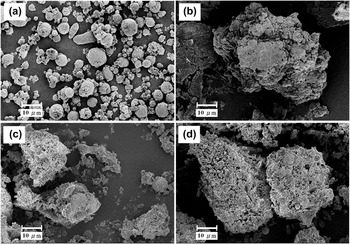
Figure 1(a) shows that the morphology and shape of the original Al powders are nearly spherical, with particle sizes in the range of 2–8 μm. Without NH4Cl addition, significantly agglomerated powders with particle sizes of several μm to 40 μm were produced at 800 °C in N2 plasma for 5 min [Fig. 1(b)]. The Al powders melted at above 660 °C, resulting in liquid Al forming large clusters and the agglomeration of AlN/Al particles. Furthermore, once an AlN shell or film formed, the diffusion rate of N-containing species passing through the hard AlN layer and the initial oxide film decreased, resulting in a slower nitridation rate. Reference Rosenband and Gany23
SEM micrographs (3000×) (a) original Al powders, (b) AlN powders produced at 800 °C for 5 min without NH4Cl addition, (c) AlN produced at 800 °C for 5 min with NH4Cl = 50%, and (d) produced at 800 °C for 15 min with NH4Cl = 50%, in N2 plasma.

To prevent molten Al powders from agglomerating into large clusters, NH4Cl powders were dispersed into the Al powders and compressed as ingots at 2000 psi. When 50% NH4Cl was added into the Al powders, the particle size of the produced AlN decreased to several μm to 20 μm at 800 °C in N2 plasma for 5 min [Fig. 1(c)]. Because the temperature was still above the melting point of Al metal (660 °C), Al melted and the initial oxide film on the surface of the powders was broken by the significant tensile stress arising due to an increased volume of particles. The liquid Al then agglomerated into larger particles. The clustered particles required a longer reaction time (15–45 min) to convert Al into AlN completely. Reference Li, Kao, Chen, Wang and Tsai21 Although the required reaction time of the plasma nitridation approach is much lower than those of gas-phase synthesis, Reference Park, Rhee and Lee17 carbothermal reduction, Reference Kuang, Zang, Zhou and Wang24 and direct nitridation, Reference Kameshima, Irie, Yasumori and Okada25 the particle size of the as-prepared AlN powders must still be reduced by improving the operating conditions.
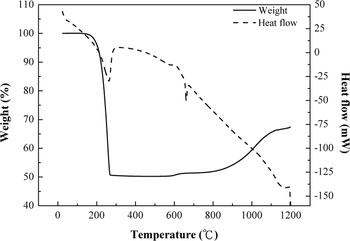
With the addition of NH4Cl, a part of the as-prepared particles with irregular shape, numerous porous structures and a pore size similar to the size of NH4Cl powders was produced [Fig. 1(d)] due to the rapidly sublimating and decomposing NH4Cl within the ingot. Reference Li, Kao, Chen, Wang and Tsai21 The thermal decomposition of NH4Cl into HCl and NH3 occurs at around 262 °C (Fig. 2). HCl can further react with Al to produce intermediate gaseous AlCl3 and H2. Reference Radwan and Bahgat6,Reference Shi, Radwan, Kirihara, Miyamoto and Jin26 The pores can trigger a vapor reaction between AlCl3 and N2, which causes the AlN crystals to deposit on the surface of the pores to form AlN fine particles and AlN nanowires or nanorods via the following reactions Reference Paul, Song, Lee and Lee2 :
 $${\rm{N}}{{\rm{H}}_4}{\rm{C}}{{\rm{l}}_{({\rm{s}})}} = {\rm{N}}{{\rm{H}}_{3({\rm{g}})}} + {\rm{HC}}{{\rm{l}}_{({\rm{g}})}}$$
 $${\rm{A}}{{\rm{l}}_{({\rm{s,l}})}} + 3{\rm{HC}}{{\rm{l}}_{(g)}} = {\rm{AlC}}{{\rm{l}}_{3({\rm{g}})}} + {3 \mathord{\left/ {\vphantom {3 2}} \right. \kern-\nulldelimiterspace} 2}{{\rm{H}}_{2({\rm{g}})}}$$
 $${\rm{AlC}}{{\rm{l}}_{3({\rm{g}})}} + {1 \mathord{\left/ {\vphantom {1 2}} \right. \kern-\nulldelimiterspace} 2}{{\rm{N}}_{2({\rm{g}})}} + {3 \mathord{\left/ {\vphantom {3 2}} \right. \kern-\nulldelimiterspace} 2}{{\rm{H}}_{2({\rm{g}})}} = {\rm{Al}}{{\rm{N}}_{({\rm{s}})}} + 3{\rm{HC}}{{\rm{l}}_{({\rm{g}})}}$$
TGA of Al powders (50%)/NH4Cl (50%) ingots (N2 flow rate of 100 cm3/min, from room temperature to 1200 °C, held for 1 h).

Figure 2 also shows that the nitridation is insignificant below the melting point of Al metal (660 °C) but noticeably increases at temperatures above 900 °C when the reaction Al(l) + 1/2N2(g) → AlN(s) proceeds. Moreover, the Al particle surface is usually coated by an initial protective oxide film, which inhibits the permeation of nitrogen gas and thus nitridation. Reference Rosenband and Gany23 Above the melting point, the initial protective oxide film is broken as a result of a tensile stress caused by an increase in the volume of the Al melt, and nitrogen reacts intensely with liquid Al particles.
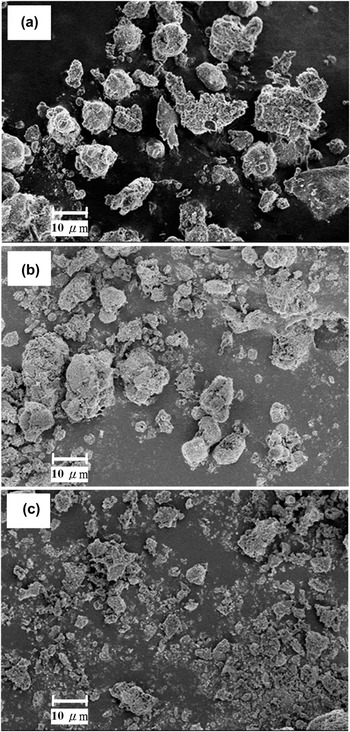
The addition of NH4Cl reduces the agglomeration of melted Al powders into large clusters; however, operation at below 660 °C could prevent the melting of Al and inhibit the aggregation of particles. Hence, with 50% NH4Cl and temperatures 500 °C [Fig. 3(a)] and 600 °C [Fig. 3(b)] in N2 plasma for 5 min, the particle size of partially nitrided Al powders was similar to that of the original Al powders.
SEM micrographs (3000×) of as-prepared powders with NH4Cl = 50% and (a) 500 °C for 5 min, (b) 600 °C for 5 min, and (c) 600 °C for 5 min followed by 700 °C for 5 min, in N2 plasma.

To examine the effect of operation at a higher temperature in the second stage after low-temperature synthesis in the first stage on the agglomeration of particles, AlN powders were synthesized via a two-stage plasma nitridation process (600 °C for 5 min followed by 700 °C for 5 min). The results show that the particle size is usually smaller than that of the raw Al powders [Fig. 3(c)]. Moreover, more fine particles with few large particles are produced by the two-stage synthesis process. The as-prepared AlN powders are well dispersed, and thus less reaction time is required to convert Al into AlN completely. In addition, the specific surface area of the raw Al powders is only 0.66 m2/g, as well as that of the synthesized AlN powders can reach 3.84 m2/g.
B. Effect of reaction temperature and time in first stage
Although NH4Cl can reduce the agglomeration of molten Al powders into large clusters, the best approach for preventing the aggregation of the molten Al is to use a low temperature below the melting point of Al metal (660 °C). However, this would lead to a low nitridation rate and make it difficult for N2 gas to diffuse into the unreacted Al core during the nitridation process. The thermal nitridation reaction proceeds at a high temperature (>900 °C) through a liquid–gas mechanism according to the reaction Al(l) + 1/2N2(g) → AlN(s). Reference Axelbaum, Lottes, Huertas and Rosen22,Reference Qiu and Gao27
To conduct the nitridation of Al below the melting point of Al metal, low-temperature microwave plasma is applied. In the discharge environment, active and energetic N-containing species, such as atomic N, excited N2, and N or N2 ions, are produced from nitrogen gas or NH4Cl. Reference Timmermans, Jonkers, Rodero, Quintero, Sola, Gamero, Schram and Mullen van der28–Reference Deng, Shi and Kong31 These energetic N-containing species thermodynamically react with Al or AlCl3 to form AlN via the following reaction Reference Ageorges, Megy, Chang, Baronnet, Williams and Chapman32 :
 $$\;\;\;{\rm{Active\ N - containing\ species\ }}\;\;\;\;\;\;\;\;\;\;\;\;\;\;\;\;\;\;\left( {{\rm{excited\ }}{{\rm{N}}_2},{\rm{N}},{{\rm{N}}_2}^ + ,{{\rm{N}}^ + } \ldots } \right) \;\;\;\;\;\;\;\;\;\;\;\;\;\;\;\;\;+ {\rm{Al}}\left( {{\rm{or\ A}}{{\rm{l}}^{3 + }}} \right) \to {\rm{AlN}} + \ldots$$
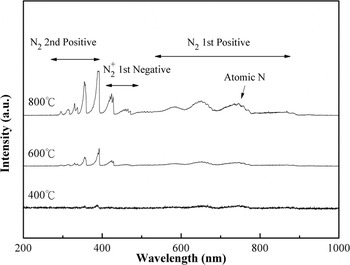
Figure 4 shows the OES spectra of the microwave nitrogen plasma measured at various positions. Large amounts of intermediate species were detected in the discharge zone at 1200 W. Moreover, the concentration of active species was higher at 800 °C than at 400 or 600 °C, resulting in a shorter AlN synthesis time. The main plasma processes, such as dissociative ionization, ionization, and excitation reactions, are carried out through electron-impact reactions and the Penning ionization reaction. For nitrogen plasma, the emission lines of N2 from the first positive band (B3Πg → A3Σu + transition, at 550–900 nm) and the second positive band (C3Πu → B3Πg transition, at 300–400 nm), and the emission lines of nitrogen molecular ions from the first negative band (B2Σu + → X2Σg + transition, at 381–470 nm) were also measured. Reference Timmermans, Jonkers, Rodero, Quintero, Sola, Gamero, Schram and Mullen van der28,Reference Hsueh, McGrath, Ji, Felker, Langan and Karwacki29,Reference Jeong and Kim33
OES spectra for nitrogen MW plasma at 400, 600, and 800 °C.

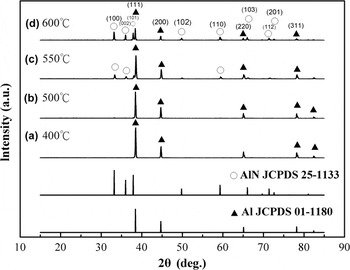
Figure 5 shows the XRD patterns of as-prepared AlN powders synthesized at low temperatures (400–600 °C for 15 min) in the first stage. Almost no AlN was synthesized at 400 and 500 °C. However, when the reaction temperature was 600 °C, AlN formation was more significant. The ratios of the characteristic peak at AlN (2θ = 33.2°)/Al (2θ = 44.8°) were only 0.02 and 0.06 at 400 and 500 °C, respectively, and reached 0.44 and 2.03 at 550 and 600 °C, respectively.
XRD patterns of AlN powders synthesized for 15 min in first stage at (a) 400 °C, (b) 500 °C, (c) 550 °C, and (d) 600 °C (NH4Cl = 50%).

SEM micrographs show that the particle sizes of the AlN powders synthesized at 400 °C [Fig. 6(a)] and 500 °C [Fig. 6(b)] were almost the same as those of the original Al powders (4–8 μm), which resulted from the very low concentration of active N-containing species that could react with the Al powders. When the reaction temperature was 550 and 600 °C, the particle size slightly increased to 4–12 μm [Fig. 6(c)] and 4–14 μm [Fig. 6(d)], respectively. Some larger and irregularly shaped particles formed due to local hot spots in the discharge zone, resulting in agglomeration, especially at temperatures close to the melting temperature of Al metal.
SEM micrographs of AlN powders synthesized for 15 min in first stage at (a) 400 °C, (b) 500 °C, (c) 550 °C, and (d) 600 °C (NH4Cl = 50%).

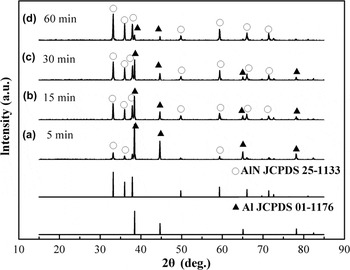
The XRD patterns of AlN powders synthesized at 400 °C in the first stage show that no AlN crystal phase was detected, even when the reaction time was increased from 15 to 60 min (Fig. 7). This is due to the very low amounts of active species produced (see OES spectra). When the temperature was 600 °C, AlN was synthesized via the plasma-chemical nitridation reaction. The characteristic peak ratios of AlN (2θ = 33.2°)/Al (2θ = 44.8°) increased from 0.38 (reaction time: 5 min) and 2.03 (reaction time: 10 min) to 2.7 and 6.55 for nitriding for 30 and 60 min, respectively (Fig. 8).
XRD patterns of AlN powders synthesized in first stage at 400 °C for (a) 15 min, (b) 30 min, and (c) 60 min (NH4Cl = 50%).

XRD patterns of AlN powders synthesized in first stage at 600 °C for (a) 5 min, (b) 15 min, (c) 30 min, and (d) 60 min (NH4Cl = 50%).

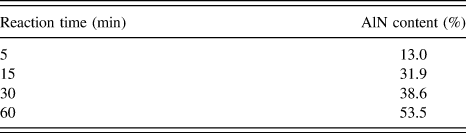
Table I shows the content of AlN in the as-prepared AlN/Al powders obtained at 600 °C from TGA using the following equation:
 $$X = {{\left( {151.85 - Y} \right)} \mathord{\left/ {\vphantom {{\left( {151.85 - Y} \right)} {\left( {151.85 - 100} \right)}}} \right. \kern-\nulldelimiterspace} {\left( {151.85 - 100} \right)}} \times 100\% \quad ,$$
where X is the content of AlN in the composite (%), Y is the final weight percentage obtained from TGA, and 151.85 is the theoretical final weight percentage obtained from a TGA pattern for Al conversion to AlN.
Calculated content of AlN in AlN/Al composite obtained at 600 °C for various reaction times from TGA.

The results show that the content of AlN increased from 13.0% to 53.5% when the reaction time was increased from 5 to 60 min, indicating that even at reaction temperatures lower than the thermal nitridation temperature and the melting point of Al metal, the complete conversion of Al to AlN can be achieved with sufficient nitriding time.
C. Effect of reaction temperature and time in second stage
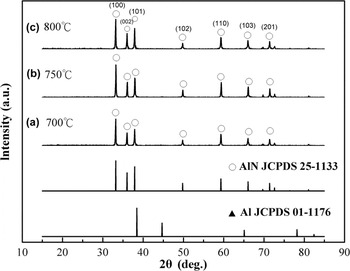
The pre-synthesized AlN/Al powders obtained at 600 °C for 5 min in N2 plasma were sequentially reacted in the second stage. Figure 9 shows that when the temperature was increased from 700 to 800 °C for nitriding for 5 min, the characteristic peak ratios of AlN (2θ = 33.2°)/Al (2θ = 44.8°) increased from 40.0 (for 700 °C) to 54.1 (for 800 °C). Moreover, no Al peaks were found in the XRD patterns for the powders reacted in the second stage. Because the melting Al was surrounded by hard shell or flowed into porous structure of the pre-synthesized particles, preventing the aggregation of AlN particles at temperatures higher than the melting point of Al metal.
XRD patterns of AlN powders synthesized for 5 min in second stage at (a) 700 °C, (b) 750 °C, and (c) 800 °C.

Due to the high crystallization of the pre-synthesized AlN/Al powders obtained at 600 °C for 5 min and then reacted at 700 °C for 5 min in the second stage, the effect of reaction time for nitriding at 700 °C in the second stage on the crystallization of AlN was examined. The XRD patterns show that when the reaction time was decreased from 5 to 0.5 min, the characteristic peak ratio of AlN (2θ = 33.2°)/Al (2θ = 44.8°) decreased significantly from 40.0 to 5.0.
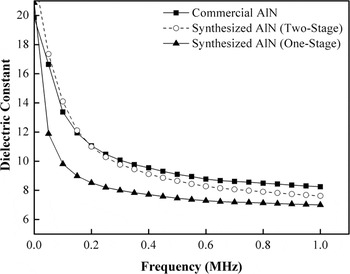
The transmission of high-frequency electrical signals without delays is required for AlN powders used as a ceramic substrate. The dielectric constants of the AlN powders synthesized using the two-stage plasma nitridation process (600 °C for 5 min followed by 700 °C for 5 min) and commercial AlN powders were measured within the range of 1 kHz to 1 MHz at room temperature. Figure 10 shows that the dielectric constant decreased with increasing frequency. The dielectric constant of the as-synthesized AlN powders was only slightly lower than that of the commercial powders. Specifically, the dielectric constants of the as-prepared and commercial AlN powders obtained at a frequency of 1 MHz were 7.6 and 8.2, respectively, both higher than that (7.0) of as-synthesized AlN powders prepared using one-stage MW plasma (NH4Cl = 50%, 700 °C for 15 min at 1200 W).
Dielectric constants of AlN powders synthesized using two-stage process and commercial AlN powders.

IV. CONCLUSIONS
In this study, well-dispersed AlN powders were synthesized via a two-stage plasma nitridation approach at a lower temperature and a shorter reaction time (600 °C for 5 min followed 700 °C for 5 min) than those required for conventional thermal methods (usually requiring over several hours at >900 °C) and a one-stage plasma nitridation process (at 800 °C for 15 min).
In the first stage, N2 plasma at 600 °C produces active or energetic N-containing species, resulting in the synthesis of AlN from Al powders and NH4Cl powders (50%) without the formation of molten Al metal and particle size increase. The AlN content is 13.0% for a reaction time of 5 min. The pre-synthesized AlN/Al powders were reacted with high concentration of energetic N-containing species in N2 plasma at 700–800 °C to rapidly synthesize AlN powders. For nitriding for 5 min in the second stage, the characteristic peak ratios of AlN (2θ = 33.2°)/Al (2θ = 44.8°) from XRD patterns reached 40.0 (for 700 °C) and 54.1 (for 800 °C), indicating that most of the Al metal had been converted to AlN. In addition, the particle size was usually smaller than that of the raw Al powders, and well-dispersed fine particles formed. Hence, using the two-stage plasma nitridation process, the synthesis of AlN powders requires less reaction time at a lower temperature to convert Al to AlN completely.
ACKNOWLEDGMENTS
The authors would like to thank the National Science Council of Taiwan for its financial support under grant NSC 102-2221-E-151-001-MY3.